

Air Duct Cleaning Reddit: What Homeowners Actually Say
You're looking at a duct-cleaning quote on your phone, wondering whether the dust in your vents is a genuine problem or a sales opportunity. A search for air duct cleaning Reddit discussions produces a familiar split: one commenter calls the service a scam, another says cleaning removed years of construction debris, and a third posts a warning about a low introductory price that became a much larger invoice.
Reddit is useful here, but not because every post is reliable. Anonymous users rarely provide enough information to verify their system, contamination, equipment, or contractor. The value is in the recurring patterns, especially when those patterns are compared with guidance from the U.S. Environmental Protection Agency, the National Air Duct Cleaners Association, and the National Institutes of Health.
What Reddit Gets Wrong About Duct Cleaning
A homeowner posts a photo of a $499 quote in an HVAC community and asks whether the price is fair. By the end of the day, the replies have formed a familiar chorus. Several people say the ducts never need cleaning. Others insist the company is exploiting anxiety about allergies. A smaller group asks the questions that matter more: Was there visible mold? Did a renovation fill the system with debris? Are pests getting into the ductwork?
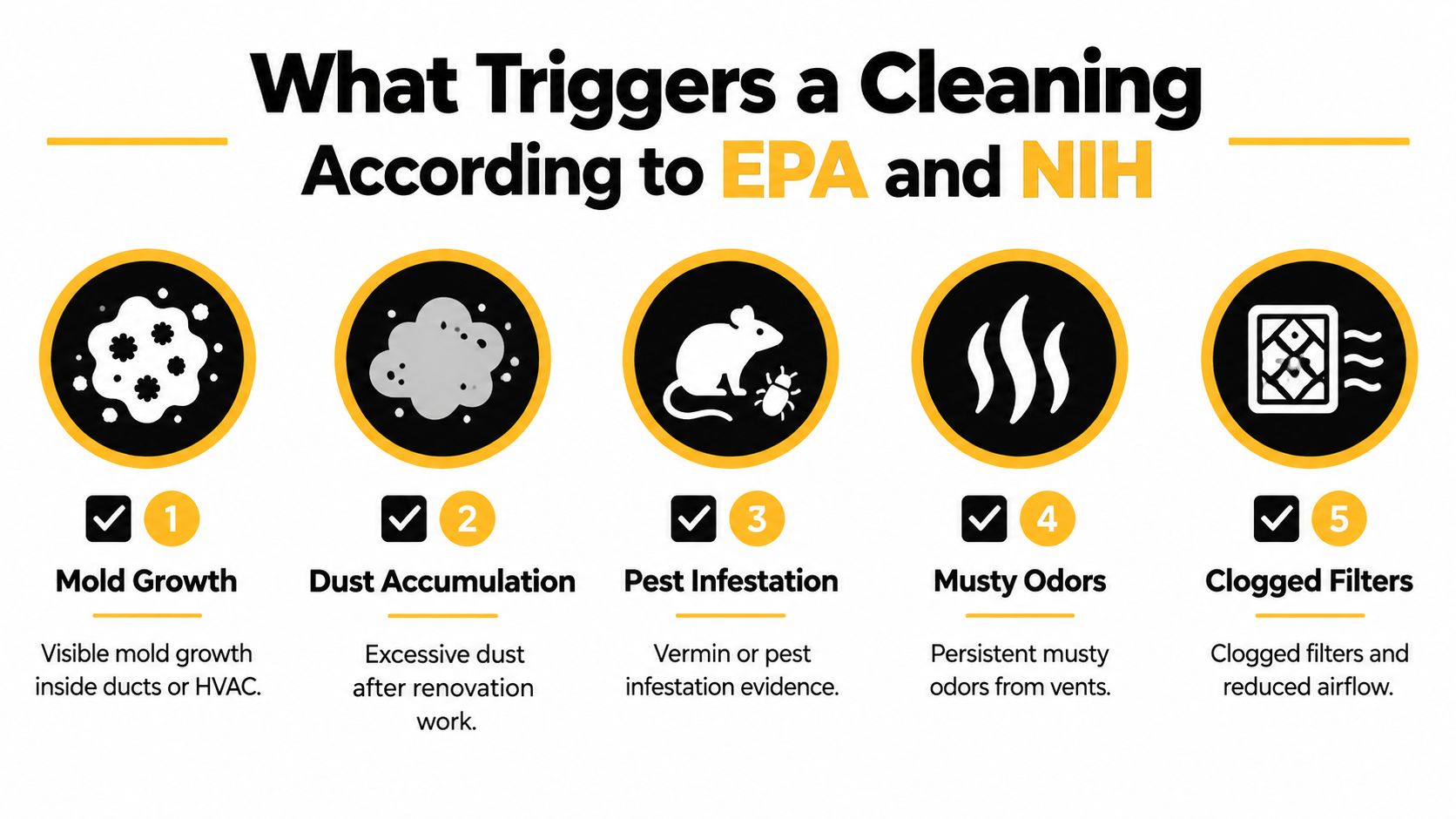
That distinction gets lost in the loudest comments. The U.S. EPA says routine duct cleaning isn't recommended because the benefits remain uncertain, but it also identifies specific circumstances that justify cleaning, including substantial visible mold inside hard-surface ducts or HVAC components, vermin infestation, and excessive dust or debris being released into the home. EPA's residential duct-cleaning guidance gives the debate a condition-based structure that many short Reddit replies lack.
Three assumptions that need context
The first misconception is that ducts never need cleaning. Clean, well-maintained systems generally don't need routine service, yet a system contaminated by pests, water damage, construction dust, or visible microbial growth presents a different problem. NIH guidance also lists persistent water damage, microbial growth, airflow-restricting debris, dust discharging from supply diffusers, and offensive odors from ductwork as reasons to consider cleaning or replacement. The NIH Office of Research Services fact sheet frames those signs as operational triggers rather than a fixed schedule.
The second assumption is that every quote is automatically a scam. A vague quote, aggressive upsell, or cheap teaser price deserves suspicion. A documented source-removal job with a defined scope, appropriate containment, and evidence of contamination is a different proposition.
The third is that visual cleanliness equals clean air. EPA field work found mechanical cleaning can remove adhered particulate and fibrous contamination from duct surfaces, while also finding no conclusive proof that routine cleaning prevents health problems or consistently lowers indoor particle levels. The EPA field-study material supports a narrower conclusion: cleaning can remove a visible source, but it isn't a universal indoor-air-quality treatment.
For homeowners weighing a quote, this explanation of air duct cleaning services can help clarify what the work is supposed to involve before the sales pitch begins.
The Scam Debate and Skeptical Voices
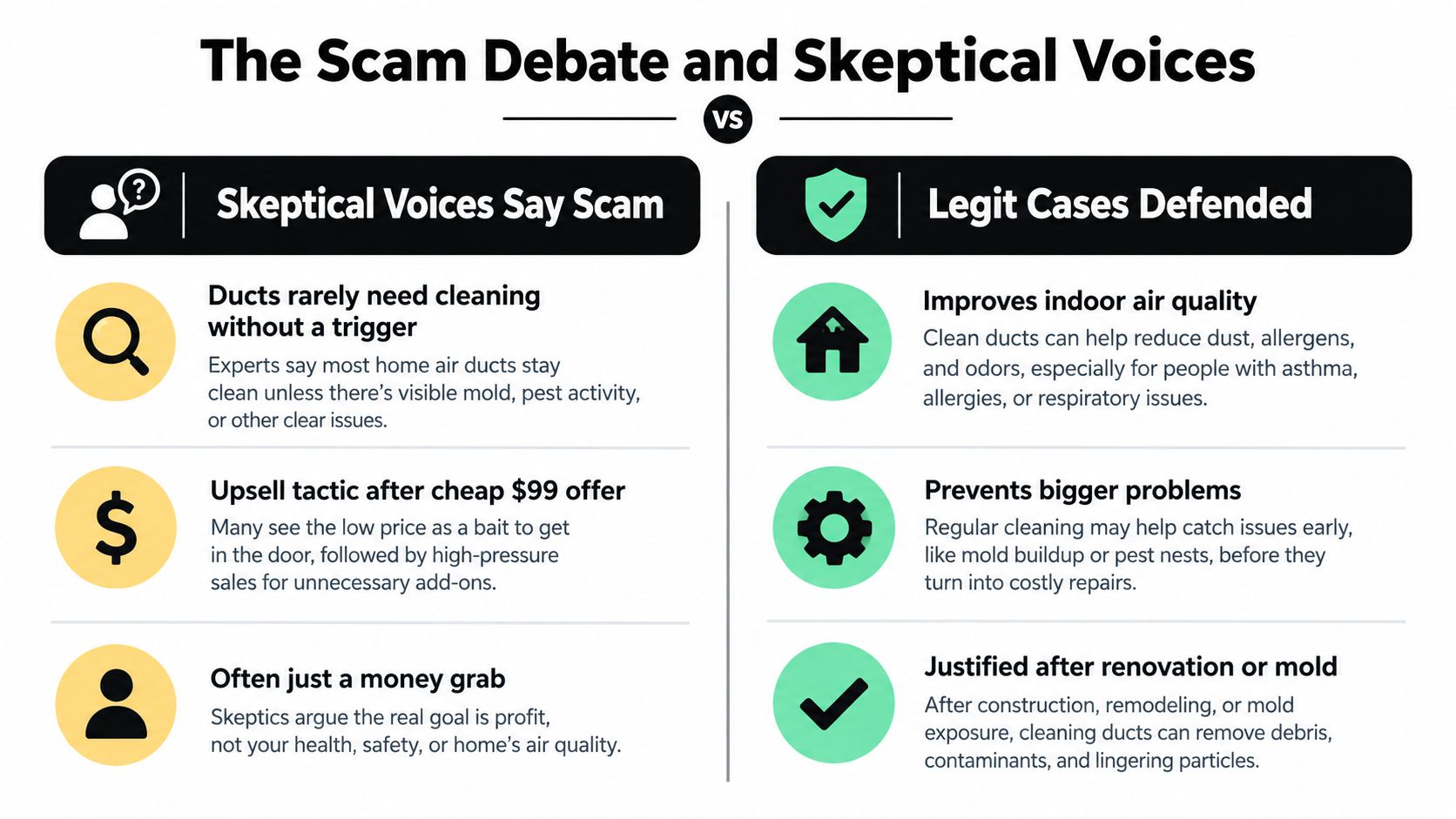
A homeowner sees an online offer for $99 whole-home cleaning. After the crew arrives, the quote expands to include mold treatment, antimicrobial fogging, or other work. That scenario appears repeatedly in HVAC and home-improvement discussions, where the central complaint is less about cleaning itself than about an unclear sales process. One HomeImprovement discussion illustrates why the starting price, included services, and possible add-ons matter before anyone schedules a visit.
Skeptics also challenge claims that dirty ducts automatically cause illness or that cleaning will transform household air. The EPA review of duct-cleaning evidence describes little to no sustained reduction in dust concentrations after cleaning. Any increase following disturbance tended to move back toward baseline within hours. Office field evidence reviewed there also found no measurable effect on supply-air quality.
Where the criticism carries weight
Three complaint patterns recur across high-engagement threads:
Bait-and-switch pricing: The initial offer does not clearly define the work, and the price changes after equipment reaches the home.
Chemical upselling: A technician presents sanitizer, biocide, or antimicrobial fogging as mandatory without first showing a contamination source.
Unverifiable evidence: Sales staff display dramatic before-and-after photographs without identifying the customer's system or showing what was removed from the current ductwork.
The chemical concern has a technical basis. Guidance attributed to the National Air Duct Cleaners Association favors source removal and addresses the HVAC system, including coils and blowers, when cleaning is warranted. It also notes that the EPA has not registered products for sanitizing or disinfecting ductwork, and that no fungicides are registered for use in ductwork. The EPA guidance on when to consider air-duct cleaning therefore supports caution when chemical treatment is presented as a replacement for physical removal.
Skepticism still has limits. Some tradespeople argue that broad claims about useless ducts obscure legitimate contamination work. Posters who began doubtful sometimes changed their view after opening return plenums and finding rodent residue, water damage, fire debris, or renovation dust.
A fair reading of Reddit: distrust the sales process first, not every possible cleaning job.
The strongest complaints involve checkable behavior: unexplained add-ons, refusal to show access points, and pressure to approve work immediately. Those signals provide a more useful decision framework than declaring duct cleaning always useless or always necessary.
When Redditors Report Cleaning Helped
Reddit success stories usually start with a specific problem. A homeowner moves in after construction and finds fine dust around the registers. Another discovers pest contamination in a return. A landlord reports smoke residue before a new tenant arrives. These accounts differ from routine-maintenance pitches because the owners can identify what they want removed.
The mechanical process matters. The explanation of mechanical HVAC cleaning describes agitation and extraction as the paired steps of mechanical cleaning. Tools loosen dust and debris, while an extraction system removes the material instead of shifting it elsewhere.
What a credible cleaning process looks like
A careful job generally follows this sequence:
Inspect the system. The contractor checks supply and return paths, coils, the blower area, plenums, access limits, and the likely contamination source.
Contain the work area. Openings are managed so loosened debris moves toward collection equipment rather than into occupied rooms.
Agitate adhered material. Brushes, air tools, or other mechanical devices disturb material attached to interior surfaces.
Extract the debris. A negative-air or HEPA-equipped vacuum collects the loosened material.
Inspect the result. The customer receives a clear account of what was cleaned and what remains inaccessible or damaged.
Redditors who describe meaningful results often mention a visibly dirty filter after service, less debris around registers, or an odor disappearing after contaminated ductwork was addressed. Some report that household congestion eased where a clear irritant had been present. Those are personal experiences, not evidence that cleaning treats allergies or respiratory disease. Federal evidence remains more cautious about routine health benefits.
The strongest positive accounts share one feature: source removal was the goal. That might mean construction dust, pest residue, smoke, or another identifiable contaminant. By contrast, neutral reports often come from homes with no visible contamination, unusual odors, or airflow problem.
For readers weighing allergy claims, this discussion of duct cleaning and allergies is most useful alongside federal evidence, not as a promise of symptom relief. The Reddit pattern is therefore practical: a documented contaminant gives cleaning a clearer rationale, while vague health promises deserve skepticism.
DIY Compared to Hiring a Pro
Reddit's DIY advice is practical but limited. Homeowners commonly describe removing vent covers, washing registers, vacuuming accessible sections with a shop vacuum, cleaning around the blower door, and replacing the HVAC filter. Some rent rotary brushes, use coil-cleaning wands, or run a camera scope through an accessible opening.
That work can improve visible housekeeping. It doesn't automatically reach the entire system, and aggressive brushing without simultaneous extraction can push debris farther into branch lines. Flexible ductwork creates another concern because forceful tools can disturb insulation or loosen connections. Sheet-metal plenums may also hide contamination beyond the first accessible opening.
Professional crews bring equipment homeowners usually don't have, including truck-mounted negative-air machines, containment materials, rotary agitation tools, and HEPA-filtered vacuums. NADCA's method requires both agitation and extraction, so a vacuum alone, or a brush used without controlled collection, doesn't represent the complete process.
DIY vs Professional Duct Cleaning on Reddit
Factor | DIY Approach | Professional Service |
|---|---|---|
Typical task | Remove covers, wash registers, and vacuum reachable surfaces | Inspect and clean connected HVAC components according to a written scope |
Equipment | Shop vac, flexible hose, brushes, flashlight, camera scope | Negative-air equipment, agitation tools, containment, and HEPA filtration |
Main advantage | Useful for cosmetic upkeep and accessible dust | Reaches more of the system and controls loosened debris |
Main risk | Debris can move deeper, or flexible ducts can be damaged | Poorly trained crews can still damage fragile systems or oversell chemicals |
Best fit | Visible buildup on covers or registers | Confirmed contamination beyond accessible sections |
The price figures sometimes repeated in Reddit DIY threads, such as $60 to $150 for rentals and $300 to $600 for professional service, aren't included in the verified evidence for this article, so they shouldn't be treated as established market rates. A better comparison is scope, equipment, access, and risk.
For homeowners comparing methods, this overview of air duct cleaning methods can help distinguish surface cleaning from full-system source removal. A sensible rule is simple: handle removable covers and accessible surfaces yourself, but seek professional assessment when contamination extends into trunks, plenums, coils, or blower compartments.
Real Costs and Bait-and-Switch Warnings
A low advertised price can look attractive until the technician explains what it excludes. In a recent HomeImprovement discussion, homeowners described full-home estimates ranging from about $350 to roughly $1,500, depending on the property and scope. The discussion of homeowner experiences and quotes does not establish a standard rate, but it shows why pricing quickly becomes a question of trust. This guide to what air duct cleaning costs offers another reference point for comparing estimates.
A useful quote identifies the areas to be cleaned, access requirements, whether coils and blowers are included, how loosened debris will be contained, and what happens if duct material is fragile or damaged. “Whole house” leaves too much unspecified.
The low-price script
Reddit users repeatedly describe promotions built around a very low entry price. The concern is not only that an inexpensive service must be poor. The advertised amount may cover a narrow task, followed by added charges for registers, vents, treatments, inspections, or alleged mold.
Watch for these warning signs:
Unclear scope: The company will not provide a written description of included components.
On-site escalation: The technician raises urgent concerns only after equipment is unloaded.
Mandatory chemicals: Sanitizing or fogging is presented as required without documented contamination.
Restricted warranties: The contract includes renewal terms, limits responsibility for damaged flexible duct, or ties future filter purchases to the company.
Payment pressure: The crew demands full payment before showing the work or discussing remaining debris.
A fair quote does not have to be the lowest. It should be explainable. Ask for per-system or per-component pricing, access requirements, exclusions, and a process for documenting contamination. If a contractor will not explain the scope, another written quote is more useful than an argument.
Reddit's more practical pricing advice is procedural: get written bids, compare equivalent scopes, and reject add-ons that were not part of the agreement. The final amount still depends on local conditions and the work included.
What Triggers a Cleaning According to EPA and NIH
Federal guidance does not support a universal cleaning calendar. As noted earlier, the EPA recommends cleaning ducts on an as-needed basis, because routine benefits remain uncertain in ordinary homes. Its concern is documented contamination or a system problem, not dust alone. The EPA's condition-based recommendation therefore offers a useful check against automatic recurring appointments.
NIH operational guidance points to the same decision framework. The specific warning signs are covered in the earlier section, but homeowners still need to establish whether a reported problem is real, localized, and connected to the ductwork or HVAC equipment.
Document the condition before approving work
A post-renovation concern should be tied to the affected vents, registers, or accessible duct sections. Photograph visible residue, note which rooms receive airborne debris, and record when odors or airflow changes occur. If there has been a leak, preserve information about the location, duration, drying work, and any replaced materials.
Ask the contractor to identify the source, show the affected component, and explain how the proposed work addresses it. A general statement that every system contains dust does not establish a cleaning need. A written inspection record can also separate contamination inside the ductwork from problems involving filters, coils, insulation, or the surrounding building.
Respiratory concerns require similar care. EPA material does not conclusively show that routine duct cleaning prevents health problems or reliably lowers household particle levels. That supports skeptical Reddit opinions about ordinary homes, while documented conditions help explain why some users report improvement after targeted work. Cleaning should not be presented as guaranteed relief for asthma, COPD, allergies, or immune compromise.
Decision rule: Treat symptoms as a reason to investigate indoor air quality, not as proof that duct cleaning is the answer.
The practical balance is straightforward. Do not authorize service solely because a salesperson invokes allergies. Do not dismiss visible contamination, pest evidence, water damage, or debris blowing from diffusers because an online commenter says ducts never need attention.
Red Flags and Scam Patterns to Watch For
Reddit threads often describe warning signs before discussing cleaning results. A door-to-door salesperson demanding a same-day decision, an unsolicited caller following an HVAC visit, or a technician refusing to show an access panel all limit a homeowner's ability to verify the work.
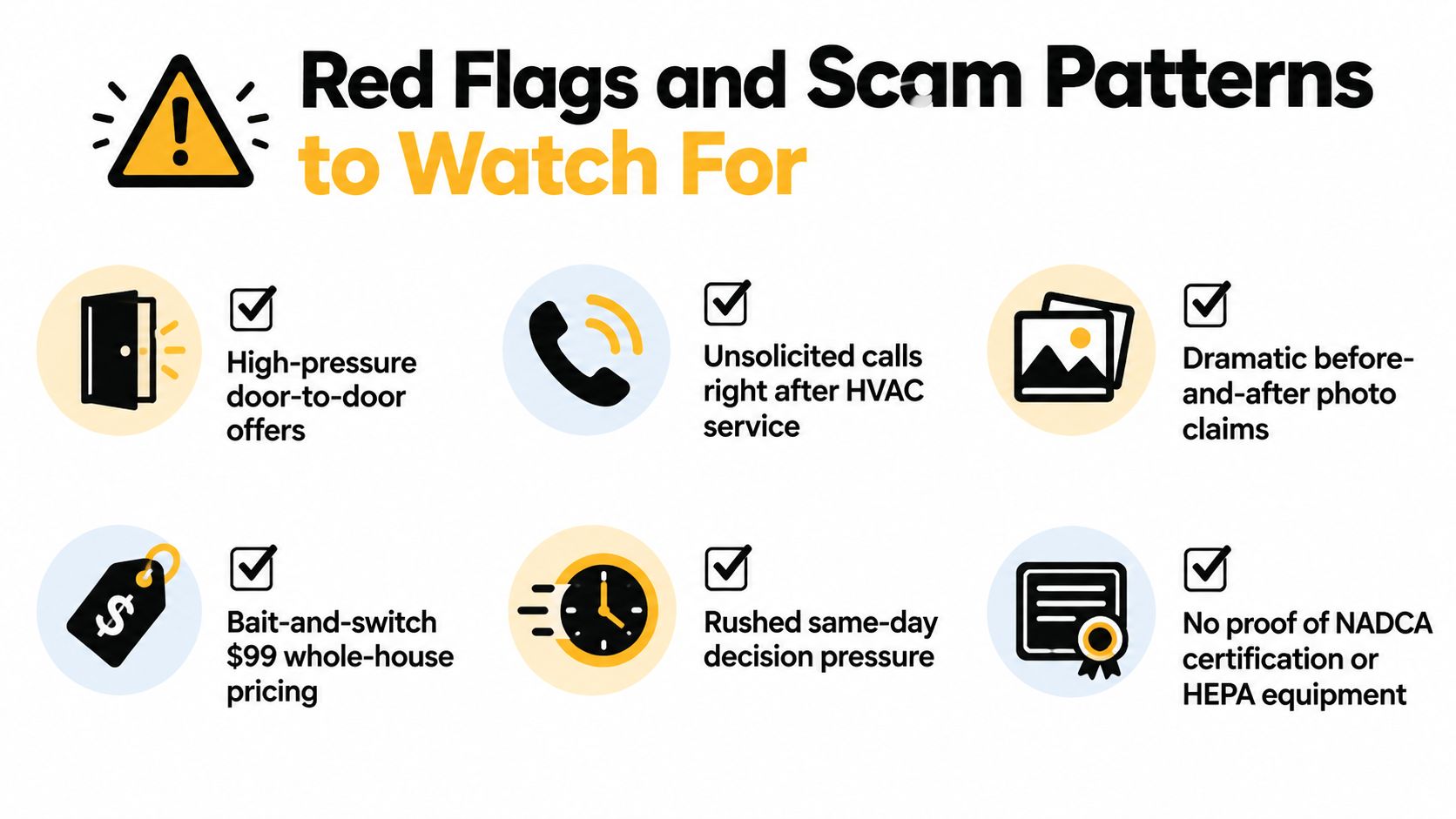
Before hiring, check the provider rather than relying on the advertised offer:
Credentials and insurance: Ask for relevant certification, current insurance, and the company's legal business details.
System-specific evidence: Require photographs or inspection notes showing your equipment, not stock images or another customer's system.
Equipment proof: Ask what extraction equipment, agitation tools, and containment methods the crew will use. A provider should explain how the method suits the duct material and system design.
Access and documentation: Confirm which panels will be opened, which components are included, and whether the company will document findings before and after cleaning.
Chemical claims: NADCA distinguishes mechanical cleaning from chemical sanitizing. Its guidance also notes that EPA registration does not support treating ductwork with fungicides.
Independent verification: Compare the contractor's explanation with guidance from EPA, NADCA, and NIH, then seek another inspection if the claimed problem cannot be shown.
The $99 advertised clean discussed in scam-focused Reddit threads became controversial because commenters expected the price to expand after crews identified supposed problems. That does not establish that every low offer is fraudulent. It does show why homeowners should verify the company, scope, equipment, and final price before work begins.
The embedded walkthrough can help you judge whether a provider's explanation resembles an inspection and source-removal process.
For a narrower service instead of a whole-system package, this information about affordable vent cleaning may help define the work before requesting a quote. Purified Air Duct Cleaning provides residential and commercial duct cleaning, dryer-vent cleaning, and HVAC coil cleaning in Avondale, Phoenix, Glendale, Mesa, and surrounding communities. Do not pay until the agreed scope and post-cleaning inspection are clear.
Practical Takeaways and Common Questions
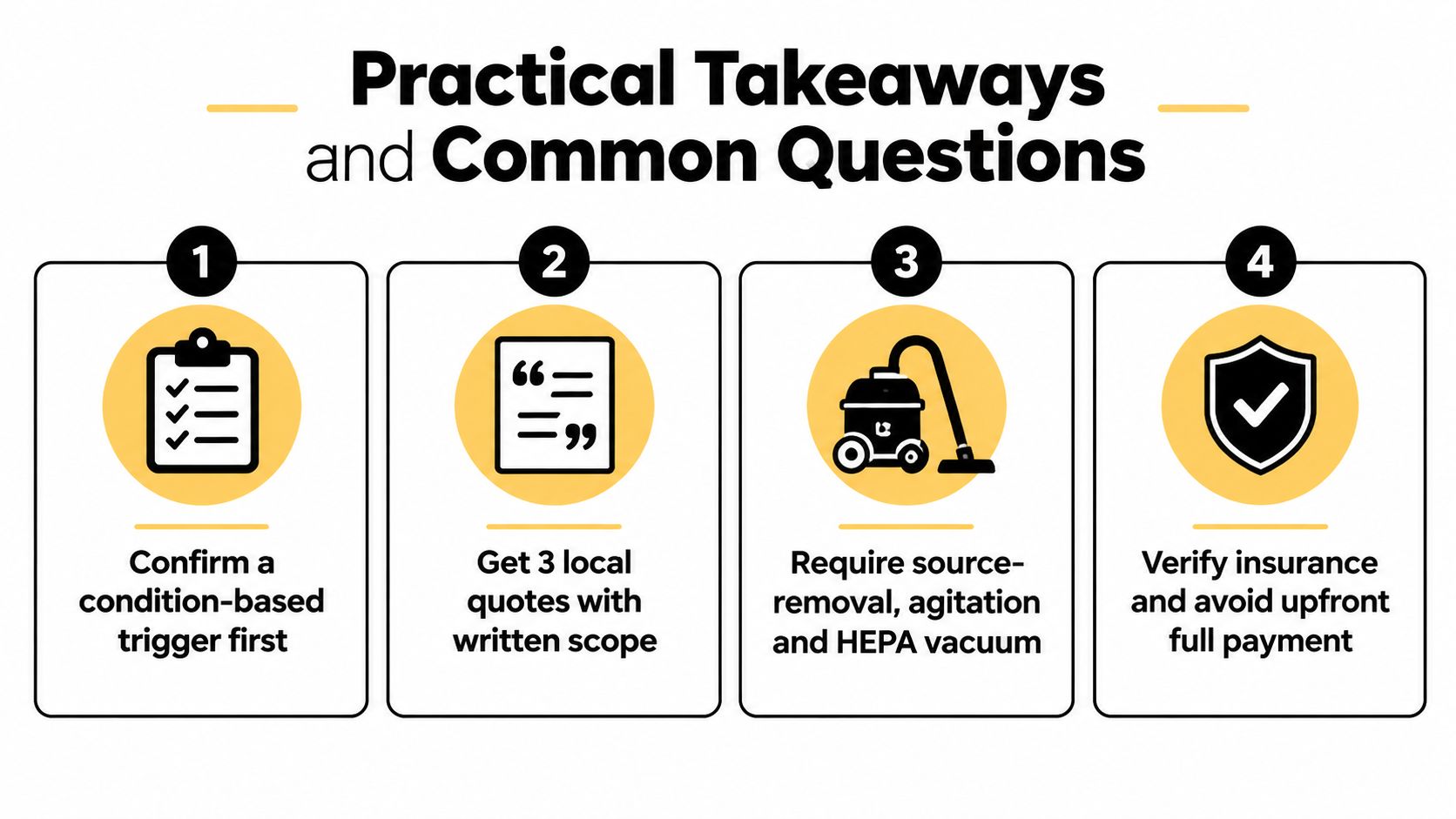
The most defensible Reddit conclusion is neither “duct cleaning is always a scam” nor “every home needs it.” The evidence supports a narrower decision process built around a real trigger, a transparent scope, and mechanical source removal.
A practical decision framework
Confirm the condition. Look for visible contamination, pest evidence, water damage, debris discharge, restricted airflow, or an odor tied to ductwork.
Compare written quotes. Ask multiple local providers to describe the same components, access points, equipment, exclusions, and total price.
Require source removal. The plan should include agitation and extraction, not just spraying or vacuuming a visible register.
Protect the system. Older or flexible ducts need a method suited to their condition. Ask how the crew will prevent damage and contain loosened material.
Purified Air Duct Cleaning offers residential and commercial duct cleaning, dryer-vent cleaning, and HVAC coil cleaning in Avondale, Phoenix, Glendale, Mesa, and surrounding communities, so homeowners can ask for a defined scope rather than accept a generic package.
Questions Reddit threads don't settle
How often should ducts be cleaned? There's no evidence-based fixed interval in the federal guidance cited here. Clean when a specific condition warrants investigation and service.
Do pets or smoking automatically require cleaning? They can change the inspection question, but they don't establish that cleaning is necessary. Look for contamination, odor sources, residue, or airflow problems.
Does new construction justify service? Renovation or construction debris can be a legitimate trigger when material entered the system or is being released indoors. A new home without those signs doesn't automatically need cleaning.
What if the company won't show the debris? Pause the job or withhold final approval until the contractor explains what was found, what was removed, and what areas couldn't be reached.
What if you suspect a scam charge? Save the advertisement, contract, photographs, invoices, and messages. Request an itemized explanation in writing, dispute unauthorized additions promptly, and consult a local consumer-protection agency or payment provider if the company won't resolve the issue.
Community consensus: Routine cleaning has weak support. Targeted cleaning can make sense when contamination is visible, documented, or affecting system operation.
The minority success stories matter because they show where the service can have a concrete purpose. The skeptical majority matters because it warns against health promises, chemical upsells, and vague pricing. Read both, then base the decision on the condition of your system rather than the most confident comment.
If your home or facility has visible debris, pest contamination, water damage, or airflow concerns, request a written evaluation from Purified Air Duct Cleaning. Ask the team to identify the source, explain the cleaning method, and separate necessary source removal from optional treatments before you approve the work.