

HVAC Coil Cleaning Cost Explained
On average, you can expect the HVAC coil cleaning cost to fall somewhere between $100 and $400 for a typical residential system. The final price tag really hinges on how easy it is to get to your unit and just how much gunk has built up on the coils. More complicated jobs will naturally creep toward the higher end of that range.
Understanding Your HVAC Coil Cleaning Cost

Pinning down the exact cost of cleaning your HVAC coils isn't a simple, one-size-fits-all number. A good way to think about it is like a car tune-up; a basic service for a well-maintained vehicle is a world apart from a major overhaul for one that's been neglected for years. The price for this essential HVAC maintenance works the same way.
This isn't just a niche service, either: it's part of a huge industry focused on making our homes healthier and more efficient. The HVAC cleaning services market was valued at around USD 15 billion in 2024 and is on track to hit nearly USD 27 billion by 2034. That growth is no surprise, with more and more people realizing that dirty coils can slash a system's efficiency by a whopping 30%.
A Quick Cost Breakdown
So, what can you actually expect to pay? To give you a clearer picture, a straightforward cleaning of an outdoor condenser coil that's easy to access will land on the lower end of the cost spectrum. On the flip side, if your indoor evaporator coil is buried deep inside the unit and caked with dirt, that deep clean is going to cost more.
A clean HVAC system is an efficient one. The money spent on professional coil cleaning is often an investment that pays for itself through lower energy bills and a longer system lifespan.
Figuring out your HVAC coil cleaning cost isn't just about the one-time service fee. It's really an investment in your home’s energy efficiency, which helps cut down on those painful utility bills over the long haul. If you're looking for more ways to trim your energy use, check out this a comprehensive guide to saving energy at home.
And remember, coil cleaning is just one piece of the puzzle. To keep your entire system running like a well-oiled machine, take a look at our other essential HVAC maintenance tips.
To help you get a better handle on budgeting for this service, we've put together a quick breakdown of what different levels of cleaning might cost.
Estimated HVAC Coil Cleaning Cost by Service Type
This table gives you a ballpark idea of what to expect based on how intensive the cleaning job is.
Service Level | Typical Residential Cost Range | Typical Commercial Cost Range | Services Included |
|---|---|---|---|
Standard Cleaning | $100 - $250 | $200 - $500 | A light cleaning of one accessible coil (either evaporator or condenser) using a basic chemical solution. |
Deep Cleaning | $250 - $400+ | $400 - $800+ | A thorough, heavy-duty cleaning of both coils, especially if they are heavily soiled or difficult to access. |
As you can see, the scope of the work directly impacts the price. A simple tune-up is budget-friendly, while a more involved deep clean requires more time and resources from the technician.
What Really Drives Your Final Bill
Ever wonder why your neighbor’s HVAC coil cleaning cost came in way under the quote you just got? The final price is rarely a simple flat rate. Instead, it’s a reflection of several key variables that can completely change the scope of the job.
Getting a handle on these factors will help you decipher any estimate that comes your way.
The biggest cost driver, hands down, is coil accessibility. Think about it like this: cleaning a window on the first floor is a breeze. Cleaning that same window on the third floor? Same task, but a whole lot harder to get to. It's the same story with your HVAC system. An outdoor condenser unit with plenty of elbow room is a straightforward job.
But an indoor evaporator coil buried deep in a cramped attic or a tight crawlspace is another beast entirely. Getting to it often means a technician has to disassemble parts of the air handler just to reach it. All that extra time and effort will absolutely show up on the final bill.
The Severity of Buildup
Another huge piece of the puzzle is the condition of the coils themselves. A system that gets its annual check-up might just have a light dusting. That’s a quick fix, usually manageable with a standard foaming cleaner.
On the other hand, a unit that's been ignored for years can be a real mess. We're talking about a thick, matted blanket of dirt, pet dander, grass clippings, and who knows what else. This gunk essentially acts like insulation, smothering your coils and forcing your system to work overtime.
Cleaning heavily soiled coils isn't just a simple spray-and-rinse job. It often demands multiple rounds of powerful cleaners, specialized tools, and a very careful touch to avoid bending the delicate aluminum fins. This all adds up to more labor time and higher material costs.
This kind of neglect calls for a much more intensive deep cleaning. The technician will need more time and stronger chemicals to get the coils back in working order, which naturally pushes the price up. It's a lot like a heavily soiled duct system; the worse the condition, the more resources it takes to clean properly. To see how much system condition matters, you can explore the real cost of air duct cleaning and see the parallels.
Location and Coil Type
Finally, a couple of other factors play into the final cost: where you live and the specific type of system you have.
Geographic Location: It’s no secret that labor rates can vary wildly from one place to another. A technician’s hourly rate in a big city is almost always going to be higher than in a small, rural town. That difference directly impacts your total service cost.
Coil Design: Not all coils are built the same. Some newer systems use micro-channel coils, which have much smaller, more complex passages. These can be trickier and more time-consuming to clean thoroughly compared to older, traditional fin-and-tube coils, which could add to the labor charge.
The True Cost of Skipping a Coil Cleaning
Thinking about the price of a professional coil cleaning is only looking at one side of the coin. The real financial gut-punch comes from the hidden expenses of neglect. It’s better to see the initial HVAC coil cleaning cost as an investment, one that shields you from the much bigger, long-term consequences of dirty coils.
Imagine wrapping a thick wool blanket around your car's engine on a hot day. That’s a perfect picture of what a layer of dust and grime does to your HVAC coils. This unwanted insulation forces the entire system to work much harder to cool your home, leading directly to some predictable and painful problems.
Skyrocketing Energy Bills
The most immediate and obvious hit you'll take from dirty coils is on your monthly energy bill. A system struggling to transfer heat has to run longer and more often just to hit the temperature on your thermostat. This constant struggle means it’s chugging down significantly more electricity.
And this isn't a small problem. According to the U.S. Department of Energy, regular maintenance that includes cleaning the coils can boost an HVAC system's efficiency by up to 20%. For most families, that adds up to some serious savings over a single cooling or heating season. For more ideas on boosting your system's performance, check out our guide on how to improve HVAC efficiency.
The industry is catching on, too. The commercial market for HVAC coil cleaning systems was valued at around USD 1.2 billion in 2024 and is projected to more than double to USD 2.5 billion by 2033. This explosion in growth shows just how seriously homeowners and businesses are now taking energy savings. You can dig into more insights about this expanding market and its drivers at Verified Market Reports.
Accelerated Wear and Catastrophic Failures
Beyond just higher bills, a system under constant strain is a system that's going to wear out faster. Period. Key components, especially the compressor, are put under immense pressure. The compressor is the heart of your air conditioner, and it also happens to be the most expensive part to replace.
An overworked compressor is a failing compressor. The cost of replacing one can often be so high that it makes more sense to replace the entire outdoor unit, a multi-thousand-dollar expense that could have been postponed with simple, regular maintenance.
Putting off a relatively small cleaning fee can easily snowball into a massive repair bill down the road. Here are the most common consequences we see from neglect:
Compressor Burnout: Continuous high pressure and temperatures can cause the compressor motor to fail completely.
Refrigerant Leaks: All that extra pressure strains refrigerant lines and joints, leading to frustrating and costly leaks.
Reduced Cooling Performance: Your home just won't feel as comfortable. You'll notice uneven temperatures and much longer cooldown times.
When it comes down to it, the true cost of skipping a cleaning isn't the money you save today. It's the slow burn of higher utility payments, reduced comfort, and the looming threat of a catastrophic system failure that will make any initial maintenance cost look like pocket change.
Comparing DIY vs Professional Service Costs
So, you're weighing your options: roll up your sleeves and clean those HVAC coils yourself, or call in a pro? The big question on everyone's mind is always about the money. Can you actually save a meaningful amount by going the DIY route?
The answer isn't as simple as comparing the cost of a can of cleaner to a service invoice. While tackling it yourself is definitely cheaper on the surface, the true hvac coil cleaning cost involves a lot more than just the initial cash outlay.
The Breakdown of DIY Costs and Risks
The appeal of DIY is pretty clear; you're in control, and it feels like you're saving a bundle. You can head to the hardware store and pick up the essentials, like a good foaming cleaner and maybe a fin comb for those delicate metal fins, for around $30 to $60. Seems like a no-brainer compared to a professional service fee, right?
But this is where you have to factor in the hidden costs: your time and the very real risks involved. Those aluminum fins on your coils are incredibly fragile. A little too much pressure from a brush or a clumsy move with a tool can crush them in an instant. Once they're bent, airflow is choked off, and you’ve just created a bigger problem than the one you were trying to solve.
Thinking about giving it a shot? Here’s a more realistic look at what you’re signing up for:
Supply Costs: You'll need to budget $30 to $60 for a quality no-rinse foaming cleaner, a soft-bristled brush, gloves, and a fin comb. Don't cheap out on the cleaner.
Time Commitment: If you've never done this before, block off a solid two to three hours. That includes figuring out how to access the coils, the actual cleaning, and the inevitable cleanup.
Potential for Damage: This is the big one. Bending fins or accidentally spraying water on sensitive electrical components can turn your money-saving project into an expensive emergency call to a technician. A repair for that kind of mistake will cost far more than a professional cleaning ever would.
If you're handy, patient, and comfortable with the risks, our detailed guide on how to clean AC coils can walk you through the process step-by-step.
The Value of a Professional Service
Hiring a professional might have a higher price tag, but you're getting a lot more than just a cleaning. You're paying for experience, safety, and the guarantee that the job will be done correctly. A trained technician knows exactly how to handle your specific HVAC system and comes equipped with commercial-grade cleaners and specialized tools that get the job done right.
Honestly, a huge part of what you're buying is peace of mind. A pro takes the risk of accidental damage completely off your shoulders and ensures the job is done right the first time, which is key to maximizing your system's efficiency and lifespan.
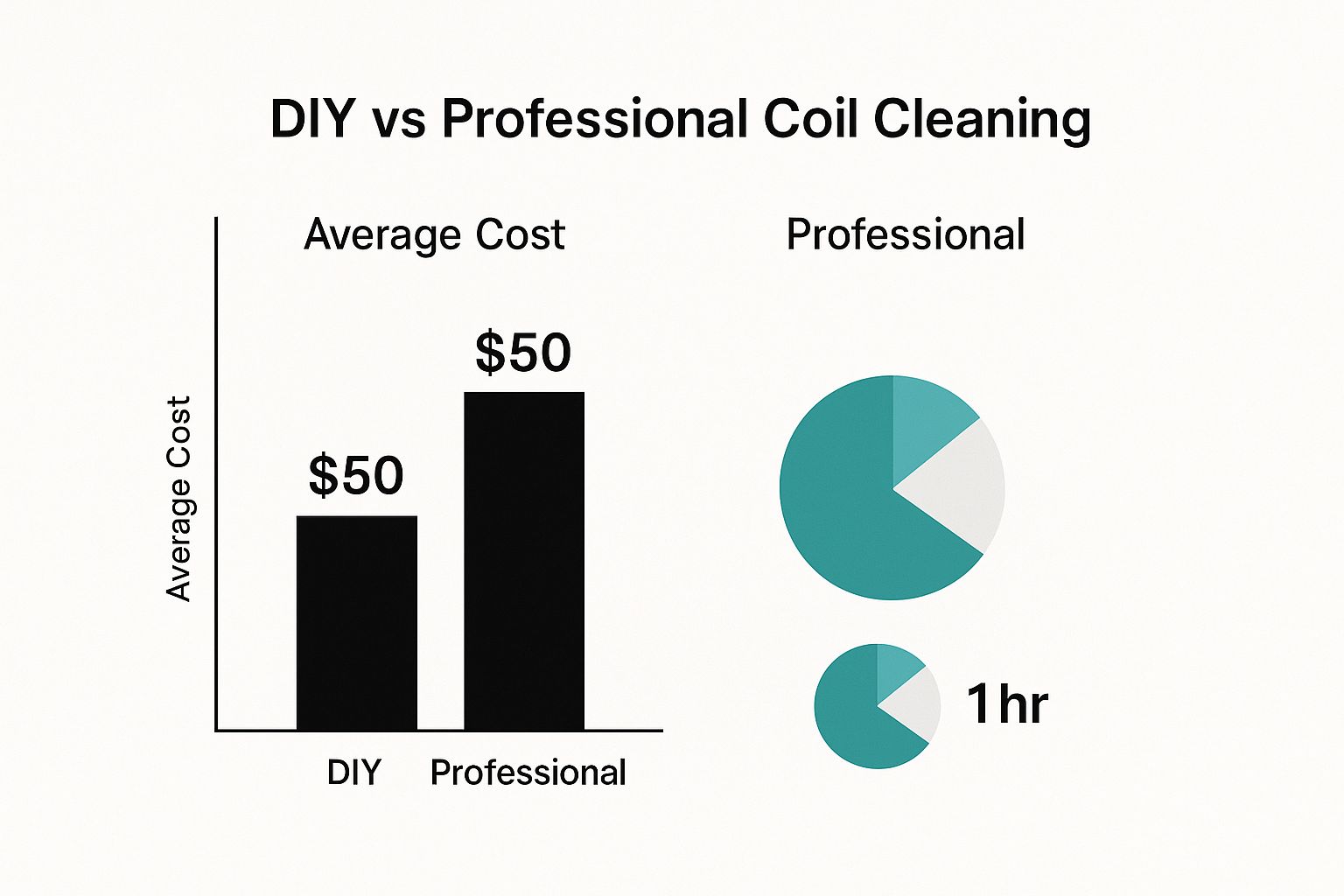
This infographic breaks down the average cost and time commitment, showing you a side-by-side view.
To make it even clearer, let's break down the pros and cons in a simple table.
DIY vs Professional Coil Cleaning Comparison
Factor | DIY Cleaning | Professional Service |
|---|---|---|
Upfront Cost | Low ($30 - $60 for supplies) | Higher ($100 - $400+ service fee) |
Time Investment | High (2-3 hours or more for beginners) | Low (Typically under 1 hour) |
Risk of Damage | High (Bent fins, electrical issues) | Very Low (Handled by an insured expert) |
Effectiveness | Moderate (Consumer-grade products) | High (Commercial-grade tools & cleaners) |
Convenience | Low (Requires research, effort, and cleanup) | High (Sit back and let them work) |
The numbers don't lie. While DIY is cheaper in terms of immediate out-of-pocket cost, a professional service is much faster and completely removes the risk of a costly mistake.
Ultimately, the best choice boils down to your budget, your confidence in your own skills, and how much you value your time, and the assurance of a job well done.
Actionable Ways to Save Money on Coil Cleaning
While the hvac coil cleaning cost is a worthwhile investment, that doesn't mean you can't be smart about it. With a few proactive moves, you can easily keep your maintenance budget in check without ever skimping on quality.
Let's think of this less as cutting costs and more as maximizing value. The real goal is to reduce the need for those intensive, expensive cleanings and to pay less when you do need to schedule service.
One of the best ways to save is to bundle your coil cleaning with a full annual HVAC tune-up. Most companies offer package deals that bring the total cost way down compared to booking each service on its own. It's a win-win: you save money and get your entire system checked out at once.
Proactive Habits Pay Dividends
A little bit of consistent upkeep can make a huge difference in your technician's workload, which often means a lower bill for you. These simple habits prevent the kind of heavy buildup that requires a deep, time-consuming cleaning.
Change Your Air Filter Regularly: This is your system's first line of defense. A clogged filter lets dust and debris sneak past and cake directly onto your indoor evaporator coil, making it dirty much faster.
Keep the Outdoor Unit Clear: Your outdoor condenser coil is constantly exposed to the elements. Make it a point to clear away leaves, grass clippings, and overgrown shrubs. Aim for at least two feet of clearance all around to ensure proper airflow.
Simple prevention is always cheaper than a cure. By taking a few minutes each month for basic upkeep, you're directly lowering your future maintenance costs and extending the life of your equipment.
These small actions stop your system from slowly suffocating, making the professional's job much easier, and faster, when they arrive. For more ideas on boosting your system's performance, check out these advanced HVAC energy-saving tips.
Smart Scheduling and Shopping Around
Good timing and a little diligence can also lead to big savings. The worst time to schedule a cleaning is when your AC dies in the middle of a July heatwave.
During the peak seasons of summer and winter, HVAC techs are in high demand, and their prices usually reflect that. If you can, schedule your coil cleaning during the milder "shoulder seasons" of spring or fall. You'll likely find more open appointments and maybe even some off-season discounts.
Finally, never take the first quote you get. It’s always a good idea to get estimates from at least three reputable local companies. This lets you compare not just the prices but the services included, ensuring you get the best possible value for your money. This principle of maintenance for efficiency isn't unique to HVAC; for example, proper solar panel cleaning for peak performance follows the same logic of upkeep boosting output.
A Look Inside a Professional Cleaning Service
When you pay the HVAC coil cleaning cost, you're getting more than just a quick spray-down. You're investing in a detailed, multi-step service performed by a trained technician to get your system back to peak health and efficiency. It pays to know what a thorough job looks like so you can be sure you're getting real value for your money.
Any reputable service starts with safety and preparation. The first thing a technician will do is a quick visual inspection of your unit and the area around it. Then, they'll shut off all power to the HVAC system, both at the breaker box and the disconnect switch near the unit itself, to make sure there's no risk of electrical accidents.
The Cleaning Process Unveiled
Once the system is safely powered down, the real work begins. A good technician follows a methodical process to make sure nothing gets missed. It usually goes something like this:
Removing Debris: First, they'll clear away any large debris like leaves, twigs, and grass that might be clogging up the outside of the condenser unit.
Applying a Professional Cleaner: Next comes a specialized, non-acidic foaming cleaner applied directly to the coils. This isn't something you can buy at a hardware store; it's designed to seep deep into the fins and chemically break down stubborn dirt, grime, and even biological growth without damaging the delicate aluminum.
Rinsing and Final Checks: After letting the cleaner work its magic, the tech will gently rinse the coils from the inside out using a low-pressure sprayer. Once clean, they’ll put the unit back together, turn the power back on, and run a final system test to ensure everything is running smoothly and efficiently.
A key indicator of a true professional is the toolkit they bring. They'll have equipment like fin combs to straighten bent fins, low-pressure sprayers that protect the delicate coil structure, and commercial-grade cleaners that are far more effective than anything available over the counter.
It's no surprise that the global demand for these professional services is growing, especially as more people focus on energy efficiency. In the commercial market alone, North America is projected to hit $191 million in revenue for 2025, with the U.S. making up over 82% of that market. This growth just shows how seriously property owners are taking maintenance to get the most out of their HVAC systems. You can dig deeper into the global market trends at Dataintelo. This thorough, expert process is exactly what you're paying for.
We Answer Your Coil Cleaning Questions
Even after you've got a handle on the costs and what the job involves, a few practical questions always seem to pop up. Let's tackle some of the most common things homeowners ask about keeping their HVAC coils in top shape.
How Often Should My HVAC Coils Be Cleaned?
For most homes, a professional cleaning once a year is the sweet spot. Tacking it onto your routine system tune-up is a great way to handle it, ensuring your unit is primed and ready before the summer or winter rush.
That said, some situations call for a bit more attention. You might want to bump that up to every six months if you've got pets that shed a lot, live somewhere with tons of dust or pollen, or have construction nearby kicking up all sorts of debris.
Can I Use a Pressure Washer on My Coils?
Please don't. Using a standard pressure washer on your AC unit is one of the fastest ways to destroy it. The intense, high-pressure spray will bend and flatten the delicate aluminum fins that make up your coils.
Once those fins are damaged, airflow is choked off. This absolutely tanks your system's efficiency and can even lead to a catastrophic compressor failure. Real pros use specialized, low-pressure tools designed to clean thoroughly without causing any harm.
Are the Cleaning Chemicals Safe?
Any reputable HVAC technician is going to put safety first. We use professional-grade cleaning solutions that are non-acidic and biodegradable.
When they're applied correctly and rinsed away completely, these cleaners don't leave any nasty residue behind. If you have specific concerns about pets or family sensitivities, just ask your technician. They can confirm they're using eco-friendly and pet-safe products to give you total peace of mind.
Ready to get your HVAC system running like new again? Contact Purified Air Duct Cleaning today for a free quote on professional coil cleaning and start improving your home's air quality. Find out more at purifiedairductcleaning.com.