

The Essential Guide to Dryer Vent Maintenance
Proper dryer vent maintenance is more than just a chore; it’s a critical safety measure. Neglecting it allows highly flammable lint to build up, creating a serious fire hazard while forcing your dryer to work harder and driving up your energy bills. This isn't just about cleaning; it's a vital investment in your home's safety.
Unpacking the Hidden Dangers in Your Laundry Room
Let's be honest, cleaning the dryer vent probably isn't high on your weekend to-do list. It's one of those out-of-sight, out-of-mind tasks that’s incredibly easy to put off.
But what if you knew that this simple act of maintenance was one of the most important fire prevention steps you could take? The seemingly harmless fluff that gets past your lint trap is more than just an annoyance; it’s a genuine hazard.
That soft, fuzzy lint is incredibly flammable. Every time you run your dryer, hot, moist air carries away tiny fibers and dust. While the lint screen catches a lot, a surprising amount still pushes through into the long, winding path of the vent duct. Over time, this buildup chokes off the airflow, causing heat to surge inside the vent and the dryer itself. This combination of intense heat and a large supply of tinder-dry fuel creates a perfect storm for a fire.
The Real-World Risks of Lint Buildup
The consequences of a clogged vent aren't just theoretical; they are backed by sobering statistics. According to the U.S. Fire Administration, about 2,900 clothes dryer fires are reported each year in the United States alone. These incidents result in an estimated 5 deaths, 100 injuries, and roughly $35 million in property loss.
The reality is that neglecting this simple maintenance can have devastating consequences, forcing homeowners to learn urgent steps like what to do after a house fire. It’s a stark reminder that prevention is always better than recovery.
Beyond the immediate fire danger, a blocked vent can cause other serious problems.
Carbon Monoxide Poisoning: For gas dryers, a clogged vent can prevent harmful exhaust, including carbon monoxide, from escaping your home. This colorless, odorless gas can build up to dangerous levels without you even knowing it.
Mold and Mildew Growth: The vent is designed to expel moisture. When that moisture gets trapped, it creates a damp, dark environment inside your walls, an ideal breeding ground for mold.
Appliance Damage: Restricted airflow forces your dryer to work much harder and for longer periods. This excessive strain leads to premature wear and tear, shortening the appliance's lifespan and leading to expensive repairs.
A clogged dryer vent doesn't just make your dryer work harder; it turns a common household appliance into a legitimate safety threat. Understanding the underlying causes of dryer fires is the first step toward effective prevention.
We've seen firsthand how these issues can escalate. Here’s a quick breakdown of what you're up against when a vent is neglected.
Key Risks of a Neglected Dryer Vent
Risk Area | Impact on Your Home | What to Look For |
|---|---|---|
Fire Hazard | Highly flammable lint combines with high heat, creating a major fire risk inside your walls. | A burning smell, clothes that are hot to the touch, or an overheating dryer exterior. |
Energy Waste | The dryer runs longer to dry clothes, significantly increasing your utility bills. | Drying cycles that take twice as long as they used to. |
Appliance Damage | Overheating and strain can cause premature failure of the heating element or motor. | Loud or unusual noises during operation, frequent stops and starts. |
Health Risks | Trapped moisture leads to mold growth; gas dryers can leak carbon monoxide. | A musty smell in the laundry room or unexplained headaches and dizziness. |
These risks are interconnected, turning a simple maintenance task into a crucial aspect of home safety and efficiency.
The Financial Drain of an Inefficient Dryer
While the safety risks are paramount, the financial impact is also significant. A dryer with a clear vent operates at peak efficiency, drying clothes faster and using less energy. When the vent is clogged, drying cycles can easily take twice as long.
This inefficiency translates directly to higher utility bills every single month. You're paying more for electricity or gas to do the same job, all because hot air can't escape effectively. The strain also means you’ll likely face a costly replacement for your dryer years before you should have to.
Thinking about dryer vent maintenance as a financial investment is a smart perspective. You can learn more about the specific causes of dryer fires and prevention tips in our detailed guide. It's a small task that protects both your family and your wallet.
A Practical Guide to DIY Dryer Vent Cleaning
Taking on your own dryer vent maintenance is one of those deeply satisfying projects. It's a direct way to boost your home's safety and efficiency, and with the right tools and a clear plan, you can confidently clear out that hazardous lint buildup. This guide gives you a straightforward, no-nonsense approach to get the job done right.
Before you even think about starting, you'll need to gather your tools. A good dryer vent cleaning kit is non-negotiable; it should include a flexible brush with several connecting rods. You'll also need a vacuum with a hose attachment, a screwdriver, and some sturdy work gloves. Trust me, you'll also want a dust mask; it's shocking how much fine, airborne lint gets kicked up.
Preparing Your Laundry Space
First things first: create a safe, accessible workspace. Safety is paramount, so your first move is to completely disconnect the dryer from its power source. For an electric model, just unplug it. If you have a gas dryer, you must shut off the gas supply valve, which is typically located behind the appliance.
With the power and gas off, you can now carefully pull the dryer away from the wall. This gives you the room you need to work without being cramped. You'll see the flexible transition duct, that's the tube connecting the back of your dryer to the main vent pipe in the wall. This is where the cleaning begins.
Cleaning the Dryer and Ductwork
Start by detaching that flexible duct from both the dryer and the wall pipe. Usually, a simple clamp holds it in place, which you can loosen with your screwdriver. Once the duct is off, you can reach into the dryer's exhaust port and pull out any big, obvious clumps of lint.
Next, grab your vacuum. Use its hose attachment to give the dryer's port and the inside of the flexible duct a thorough cleaning. Be gentle here, those flexible ducts, especially the foil or plastic types, can tear easily. And a quick but important note: if your duct is the white, vinyl kind, it's a known fire hazard. You should replace it with a semi-rigid metal one immediately.
Pro Tip: After you've vacuumed, run the brush from your cleaning kit through the flexible duct one last time. This is great for dislodging any stubborn, stuck-on lint that the vacuum might have missed.
Now for the main event. The next phase of proper dryer vent maintenance is cleaning out the main vent run inside your wall, which is where the most dangerous lint buildup happens.
Tackling the Main Vent Line
Attach the brush head to one of the flexible rods from your kit. Insert the brush into the wall duct and start scrubbing. I find a forward-and-back motion while rotating the brush works best to break up compacted lint.
As you push the brush deeper into the vent, just keep adding more rod sections. Most kits have enough to let you reach the entire length of the vent, even if it has some bends and turns. If you have an electric drill, you can attach the end of the rod assembly to it. Running the drill on a low speed will spin the brush, giving you a much more powerful clean. Just be patient and methodical, working your way through the entire system from the inside out.
This diagram really shows how a simple lint problem can escalate into a serious hazard.It's a clear visual: what starts as harmless lint quickly becomes a dangerous clog, directly raising the risk of a fire.
Final Steps and Reassembly
Once you've thoroughly brushed the interior duct, it's time to head outside and check the exterior vent cap. Clear away any lint, leaves, or other debris that could be blocking the flap. Make sure that flap opens and closes freely. If it's stuck shut, it traps hot air just like an internal clog would.
Back inside, vacuum out any lint that you dislodged from the wall pipe opening during the brushing process. Reconnect the flexible duct, making sure it's secure on both the wall pipe and the back of your dryer with the clamps tightened. Carefully push the dryer back into position, ensuring you don't crush or kink the ductwork. Finally, reconnect the power, and for gas dryers, turn the gas supply back on. Run a quick, empty cycle to confirm that air is flowing freely out of the exterior vent.
Sometimes, moving the dryer just isn't an option. For those tricky situations, our guide on how to clean a dryer vent without moving the dryer offers some great alternative methods.
As you get into the habit of DIY dryer vent cleaning, you might find it helpful to roll this task into a broader home upkeep schedule. For more ideas on organizing your home's care, you can consult a comprehensive rental property maintenance checklist; it has excellent tips that are useful for any homeowner.
Warning Signs That Demand Professional Attention
Doing your own dryer vent maintenance is a fantastic habit, but let's be real, sometimes, a simple DIY cleaning kit just won't cut it. Your home has a way of telling you when a minor clog has become a major problem, one that needs an expert's tools and experience. Learning to spot these red flags is absolutely critical for your safety and your dryer's lifespan.
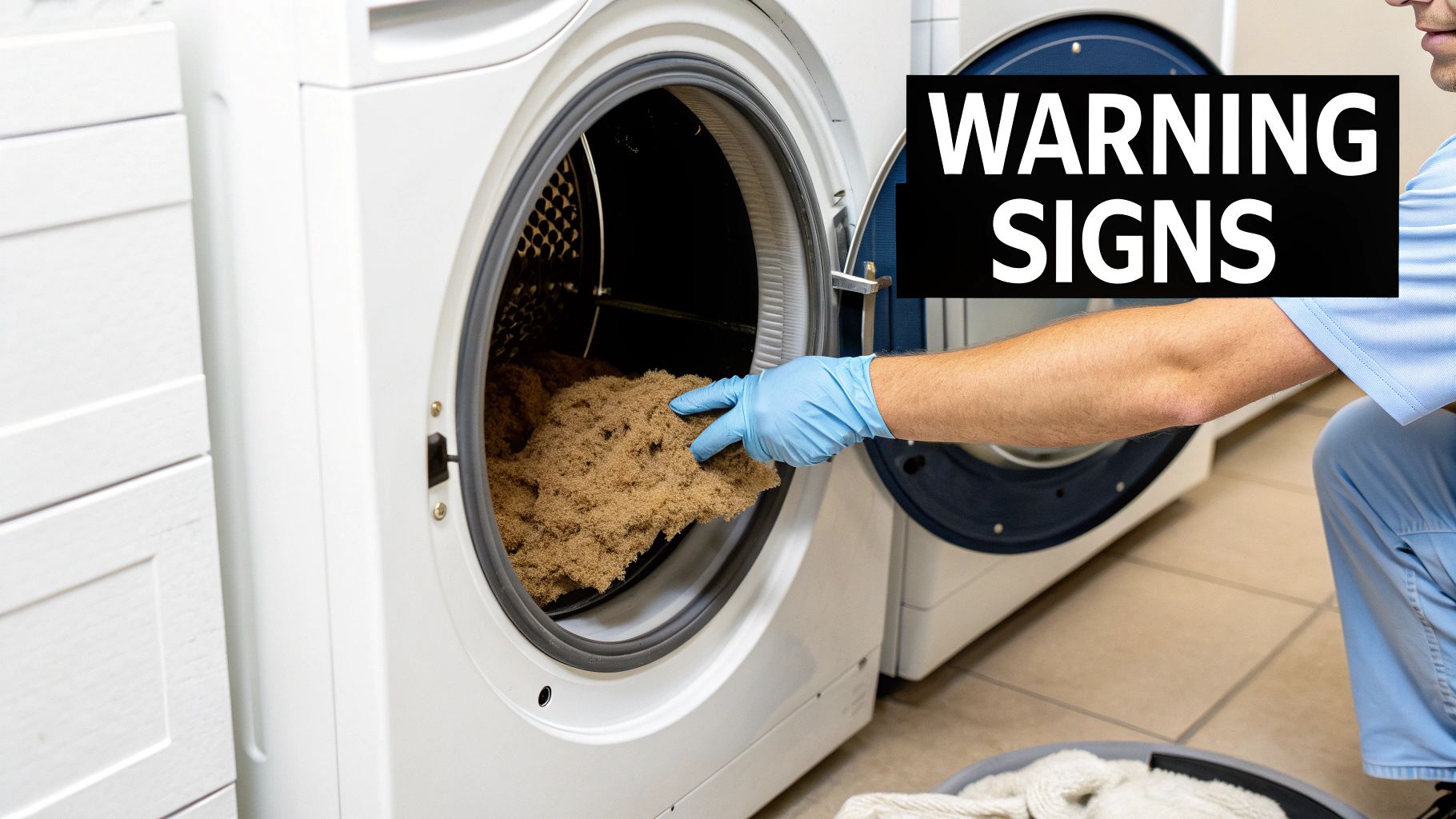
The most common tip-off? Poor performance. If your clothes are still damp after a full 60-minute cycle, forcing you to run it again (and maybe a third time), poor airflow is almost always the villain. This isn't just annoying; it means your dryer is fighting against a blockage, putting serious strain on its motor and heating element while wasting a ton of energy.
Obvious Performance and Sensory Clues
Your own senses are surprisingly effective diagnostic tools. Pay close attention to how your dryer runs, feels, and smells. These are often the first signs of a deep-seated blockage that a standard brush kit can't hope to reach.
A seriously alarming sign is an overheating appliance. If the top of your dryer is hot to the touch while it's running, that's a huge red flag. It means hot, moist air is trapped with nowhere to go. This trapped heat creates a dangerous fire hazard and can easily fry the dryer's internal electronics.
Another sign you can't ignore is a distinct burning smell. This odor usually means lint trapped deep inside the vent, or worse, inside the dryer's casing itself, is getting hot enough to scorch. If you smell something burning, stop the dryer immediately, unplug it, and call a professional. This is not something to mess around with.
A dryer that's hot to the touch or smells like it's burning is a safety emergency, not just an inefficient appliance. These symptoms point to a severe clog that your DIY tools cannot safely or effectively clear.
Visual Signs Inside and Outside
Beyond how your dryer is running, you can often see physical evidence of a severe clog. These visual cues are clear-as-day indicators that your entire vent system is compromised and needs professional attention right away.
Go outside and find your exterior vent cap. When the dryer is on, that little flap should be open, letting air escape freely. If you notice the flap stays shut or you can see lint and gunk packed around the opening, you've got a major obstruction somewhere in the line.
DIY vs Professional Cleaning: When to Make the Call
Trying to decide whether to tackle it yourself or bring in a pro? It can be tricky. This table breaks down common scenarios to help you make the safest and most effective choice.
Symptom or Scenario | Recommended Action | Reasoning |
|---|---|---|
Clothes take slightly longer to dry | DIY Cleaning | A minor, recent lint buildup is the likely cause and can often be handled with a standard kit. |
Dryer is hot to the touch | Call a Professional | This indicates a severe blockage causing the appliance to overheat, a serious fire risk. |
It's been over a year since the last cleaning | DIY or Professional | Routine annual cleaning can be a DIY job, but a professional ensures total thoroughness, especially for long or complex vents. |
You smell a burning odor | Call a Professional | This is a critical fire hazard. Lint may be scorching inside the vent or the dryer itself. Don't risk it. |
Visible lint around the outside vent | Call a Professional | This suggests a deep, compacted clog is preventing almost any air from escaping. A simple brush won't do the trick. |
These clues often point to issues far beyond a simple ball of lint. Sometimes, the ducting inside your walls is crushed, disconnected, or was improperly installed with too many sharp turns, creating spots where lint gets trapped and builds up over years. These are problems a DIY cleaning just can't fix.
If you're noticing several of these issues, it's crucial to understand the full range of clogged dryer vent symptoms. Knowing what to look for will tell you exactly when it's time to put the tools down and call for help.
The Financial Perks of a Clean Dryer Vent
Beyond the crucial safety benefits, keeping your dryer vent maintenance up-to-date is one of the smartest financial moves you can make for your home. It’s easy to dismiss this task as just another chore, but when you see it as a direct investment in your home's budget, its real value becomes clear. A clean vent isn’t a cost; it’s a savings strategy that pays off every single month.

The link between a clear vent and your wallet is simple: efficiency. Your dryer’s job is to push hot, moist air out of the drum and away from your house. But when the vent is clogged with lint, that airflow gets choked off, forcing the appliance to run much, much longer to get clothes dry. A cycle that should take 45 minutes might suddenly stretch to 90 minutes or more, basically doubling the energy you use for a single load.
Lowering Your Monthly Energy Bills
All that wasted energy adds up fast on your utility bills. It doesn't matter if you have an electric or gas dryer, you’re paying for every extra minute it runs. For a family doing several loads of laundry a week, a clogged vent can easily tack a noticeable amount onto your monthly expenses.
By simply clearing the path for hot air to escape, you bring your dryer back to its peak performance. The effect is immediate:
Drastically Shorter Drying Times: Your clothes actually get dry in a single cycle, just like the machine was designed to do.
Reduced Energy Consumption: Less runtime means less electricity or gas, which directly lowers your monthly bills.
Lower Household Heat: An efficient dryer sends heat outside where it belongs, instead of radiating it back into your laundry room and making your A/C work harder in the summer.
Extending the Lifespan of Your Dryer
The financial upside doesn't stop with your utility statements. An overworked dryer doesn't just cost more to run; it also wears out much faster. The constant strain of pushing hot air against a blockage puts a ton of stress on its most critical and expensive components.
Think of it like driving your car with the emergency brake halfway on. The engine has to fight that resistance, leading to premature failure. A dryer battling a lint clog is doing the same thing. The motor works harder, the heating element stays on longer, and internal thermostats can burn out from all the excess heat.
Regular dryer vent maintenance is proactive asset protection. It prevents the kind of cumulative strain that leads to a thousand-dollar appliance replacement years before it should have been necessary.
This kind of preventative care helps you sidestep hundreds of dollars in repair costs or, even worse, the much larger expense of buying a whole new machine. It’s a small investment that protects a major household appliance.
A Smart Economic and Regulatory Move
Keeping your vents clear is also just smart thinking in today's world. As utility prices keep climbing and efficiency codes get stricter, anything that cuts down on energy use is a win. Properly maintained vents mean shorter drying cycles, less appliance runtime, and lower electricity or gas consumption. For home service companies, bundling dryer vent cleaning with other maintenance tasks is a great way to help customers reduce their operating costs and make their appliances last longer.
Ultimately, the money you save from lower bills and not having to replace your dryer makes routine cleaning a no-brainer. The many benefits of dryer vent cleaning offer a powerful reason to add this task to your regular home maintenance schedule. It's an investment that truly pays for itself by boosting efficiency, preventing costly damage, and helping your home run as smoothly and economically as possible.
When to Call in the Pros for a Truly Safe Home
While DIY dryer vent maintenance is a fantastic habit for yearly upkeep, it definitely has its limits. That standard brush kit you can buy online is great for clearing out the easy-to-reach, loose lint, but it often stands no chance against the deeply compacted blockages, nests, or hidden ductwork problems that pose the most serious fire risks.
For genuine peace of mind and a guaranteed deep clean, nothing beats calling in a professional. This is where an expert makes all the difference. At Purified Air Duct Cleaning, we’re trained to see beyond the surface lint. Our certified technicians serve homeowners all across the Phoenix metro area, delivering a level of clean that DIY methods simply can't replicate.

What a Professional Cleaning Actually Involves
Forget about a simple brush on a flimsy rod. Our process uses specialized equipment built to obliterate any obstruction. We bring in high-powered vacuums and compressed air tools that safely dislodge and capture years of caked-on debris from every single inch of your ductwork.
Our comprehensive service isn't just a quick clean-out. It includes several key stages:
Initial Airflow Diagnostics: We start by measuring your vent's airflow before we even touch it. This gives us a clear baseline to see just how bad the blockage is.
Thorough Debris Removal: Our equipment doesn't just push lint around; it aggressively scrubs the interior walls of the vent, breaking up even the most stubborn, hardened lint.
Obstruction Clearing: We can find and remove things you'd never expect, like bird nests or even leftover construction debris, which are surprisingly common issues in Arizona homes.
Final Verification: After we’re done, we measure the airflow again. This is our proof that your vent is now performing at peak levels for both safety and efficiency.
Hiring a professional isn't just about cleaning; it's about diagnostics. An expert can spot and address issues you would never see, such as a disconnected duct inside a wall or an improperly installed vent line that creates a chronic fire hazard.
The Real Value of Hiring an Expert
The number one benefit of a professional service is the guaranteed removal of hidden hazards. A DIY attempt might get rid of 60% to 70% of the lint, but that last chunk is often the most compacted and dangerous. Our tools ensure a complete clean from end to end, which dramatically lowers your fire risk. To learn more about this crucial connection, you can explore our detailed article on professional dryer vent cleaning and fire prevention.
On top of that, a professional service immediately restores your dryer's efficiency, which you'll feel in your wallet. By clearing the way for maximum airflow, we help shorten drying times, lower your energy bills, and reduce the mechanical strain that causes expensive appliance breakdowns. It's a direct investment in your home's safety and operational health.
Serving the Greater Phoenix Community
At Purified Air Duct Cleaning, we are dedicated to making homes safer and healthier all across the Valley. Our team provides expert dryer vent maintenance to residents throughout our wide service area, giving families the assurance of a safe and efficient home.
We're proud to serve our neighbors in:
Avondale
Phoenix
Mesa
Glendale
Scottsdale
And surrounding communities
Our expertise goes beyond just dryer vents. We believe in a whole-home approach to air quality. More often than not, the same lint and dust clogging your vent are also circulating through your HVAC system. By bundling dryer vent cleaning with our premier air duct cleaning services, we can ensure every part of your home’s airflow is clean, safe, and running efficiently.
For homeowners in the Phoenix area, taking this next step is simple. A professional cleaning from Purified Air Duct Cleaning isn’t just a service; it’s the confidence that your home is protected from a preventable and all-too-common hazard.
Dryer Vent Maintenance: Your Questions Answered
Even after you get the basics down, it's normal to have a few questions about dryer vent maintenance. Getting the right answers is the key to feeling confident about keeping your home safe, whether you handle the small stuff yourself or call in a pro. We hear these questions all the time, so we’ve put together a quick guide to clear things up.
These are the nitty-gritty details that often trip people up, covering everything from cleaning schedules and tools to simply telling different parts of your dryer system apart.
How Often Should I Clean My Dryer Vent?
For the average household, the gold standard is a professional dryer vent maintenance cleaning once every year. An annual cleaning is the best way to get rid of all the lint that’s been slowly building up before it has a chance to hurt your dryer’s efficiency or become a fire hazard.
That said, your situation might demand a little more attention. You should probably bump that schedule up to every 6 to 9 months if any of these sound familiar:
You have a big family and the dryer is constantly running.
You’ve got pets that shed, that fur gets everywhere, including the vent.
Your dryer vent is extra long or has a lot of twists and turns. Every bend is another spot where lint loves to get stuck.
Even with a pro on the job, it’s smart to take a quick peek at your exterior vent cap every few months. Just make sure the little flap can still open and close freely.
Can I Use a Leaf Blower on My Dryer Vent?
Please don't. Using a leaf blower on a dryer vent is one of those popular DIY "hacks" that does way more harm than good. It might seem like a quick, powerful fix, but it usually just makes the problem worse.
That blast of air can take all the loose, fluffy lint and pack it down into a dense, solid clog deeper inside the duct. Even worse, the pressure can easily damage or completely disconnect the flexible ductwork hidden in your walls. If that happens, you’re now venting hot, lint-filled air directly into a concealed space, a huge fire risk and a perfect recipe for mold. Stick to the tools designed for the job.
What Is the Difference Between the Lint Trap and the Vent?
This is a big one, and the confusion is understandable. Knowing the difference between these two parts is absolutely essential for taking care of your dryer properly.
The lint trap is for daily maintenance; the dryer vent is for annual safety. The trap catches the big stuff from each load, while the vent is the long-term collection point for everything that gets past it.
The lint trap is that mesh screen you pull out from inside your dryer, usually right by the door. Its job is to grab the bulk of the lint from your clothes, and you must clean it after every single load. No exceptions.
The dryer vent is the entire duct system, the tube that runs from the back of your machine, through the wall, and out of your house. It’s the exit route for all the hot air, moisture, and tiny lint particles the trap didn't catch. This is the hidden part of the system where dangerous, flammable buildup happens over time.
Is a White Plastic Vent Hose Safe?
No, absolutely not. If you look behind your dryer and see a flexible, white vinyl hose, it needs to be replaced immediately. These ducts are a serious fire hazard.
Why? For starters, the plastic itself is flammable. They also crush very easily, which chokes off airflow, and their ribbed interior design is practically an invitation for lint to get trapped. In fact, most modern building codes have banned them completely. You should always replace a white plastic hose with a safer rigid or semi-rigid metal duct. The smooth interior lets lint and air flow through much more easily, and it won't catch fire.
If you're not sure about the state of your vent or just want the peace of mind that comes with a professional, deep clean, the team at Purified Air Duct Cleaning is ready to help. Contact us today to schedule your service. We'll make sure your home is safe and your dryer is running the way it should.