

A Practical Guide to Energy Efficiency in Commercial Buildings
Improving energy efficiency in commercial buildings goes way beyond just chipping away at the utility bill. Think of it as a core business strategy: one that protects your asset's value and polishes your brand's reputation. When you let energy performance slide, you're not just paying for wasted power; you're dealing with unhappy tenants and surprise maintenance bills that hit your bottom line from every direction.
Why Building Inefficiency Is Costing You More Than Money
When facility managers see "energy waste," the first thing that jumps to mind is the monthly power bill. And yes, those costs are a big deal. But that's just the tip of the iceberg. The real damage from poor energy performance runs much deeper, creating a ripple effect that touches every part of managing your property.
An inefficient building is often an uncomfortable one. You'll get complaints about inconsistent temperatures, random drafts, and stuffy air. Picture a multi-floor office building with an HVAC system that's been ignored for years. One floor is freezing, another is sweltering. This isn't just a minor annoyance; it's a huge reason tenants start looking for a new space.
The True Business Impact of Inefficiency
Beyond sending tenants packing, a struggling HVAC system is a magnet for expensive, last-minute maintenance calls. When a system has to fight against air leaks in the walls and roof, it's working overtime, leading to worn-out parts and sudden breakdowns. These emergency repairs shut down operations and drain maintenance budgets that should have been used for proactive upgrades.
There’s also the global push for sustainability to consider. Commercial buildings are a massive piece of the puzzle, holding a 45% share of the global energy-efficient building market in 2023. With buildings guzzling about 30% of the world's energy, and HVAC systems being the biggest culprits, keeping those systems in top shape is essential for staying in step with modern standards.
A proactive energy strategy is not just about saving money; it is a core business function for attracting and keeping high-value tenants, protecting asset value, and building a sustainable brand reputation.
The drivers for focusing on energy efficiency have evolved significantly. While saving money is always a plus, the business impacts now touch on everything from tenant retention to corporate responsibility.
Key Drivers for Commercial Energy Efficiency
Driver | Business Impact |
|---|---|
Tenant Comfort & Retention | Reduces complaints and turnover by creating a consistent, healthy environment. |
Asset Value Protection | Prevents premature equipment failure and maintains property marketability. |
Brand Reputation | Positions the building as modern, sustainable, and desirable to high-value tenants. |
Operational Resilience | Minimizes unexpected downtime and costly emergency maintenance calls. |
Regulatory Compliance | Helps meet or exceed emerging environmental performance standards and avoid penalties. |
These interconnected factors show that energy management is no longer a siloed technical task but a central pillar of successful property management.
Meeting Modern Tenant Expectations
Today's commercial tenants are savvy. They don't just want a functional space; they expect a healthy, comfortable, and eco-friendly one. A building known for high energy bills and comfort issues will have a tough time landing and keeping top-tier occupants, directly hitting your occupancy rates and rental income. To really get a handle on this, you need to view commercial building energy efficiency as the strategic advantage it is.
At the end of the day, putting money into energy efficiency is really an investment in your property's future. It turns a simple building into a high-performance environment that boosts productivity and wellness, giving you a powerful edge in a competitive market.
Conducting an Energy Audit to Find Your Starting Point
There's an old saying that holds true for just about every aspect of building management: you can't manage what you don't measure. This is the simple but powerful idea behind improving energy efficiency in any commercial building. Before you even think about upgrades, you first need a crystal-clear picture of how, when, and where your facility is using energy. This foundational step is the energy audit, and it's the data-driven roadmap you need to make smart, impactful decisions.
An energy audit isn't just a quick glance at your monthly utility bills. It’s a deep dive into your building’s performance, uncovering hidden waste and shining a light on your biggest energy hogs. A thorough audit establishes an accurate energy baseline, a clear starting point from which every future improvement is measured. Without it, you're essentially flying blind, unable to prove whether your investments are actually paying off.
Digging Deeper Than the Monthly Bill
Your utility bills are the first layer of the onion. They show your overall consumption, but the real story is in the patterns. Look for spikes in demand, compare your seasonal usage, and track year-over-year trends. Does your electricity usage plummet on weekends and holidays? If not, that’s a strong clue that equipment is running when it shouldn’t be.
The problem with a single monthly bill is that it lumps all your systems together. To get a truly granular view, submetering is essential. By installing meters on specific high-load systems, like your main HVAC units, lighting circuits, or even individual tenant spaces, you can isolate exactly where the power is going. This is how you move from knowing how much energy you use to understanding why you're using it.
An audit is your building's diagnostic tool. It reveals the symptoms of energy waste, such as an HVAC system running at full capacity in an empty building, and points directly to the underlying cause, like a simple programming error in your Building Automation System (BAS).
This process turns abstract numbers into a clear narrative about your building’s health. It’s the difference between guessing where you can save money and knowing with certainty.
Uncovering Operational Inefficiencies
It’s a common mistake to focus only on the equipment and completely forget about the people inside. How your building is actually used has a massive impact on its energy profile. That's why analyzing occupancy patterns is a crucial piece of the puzzle. Are you cooling and lighting conference rooms that sit empty most of the day? Is the entire office lit up long after the last employee has gone home?
Think about a mid-sized office in Phoenix. An energy audit might reveal that the HVAC system is running at full blast all night, every night. This isn't a sign of faulty equipment; it's a simple scheduling error in the BAS. Fixing that one programming issue could lead to thousands of dollars in annual savings with almost no upfront cost. These are the kinds of low-hanging fruit a proper audit uncovers.
The infographic below shows the direct line between poor system performance, like a neglected HVAC, and the real-world business consequences.
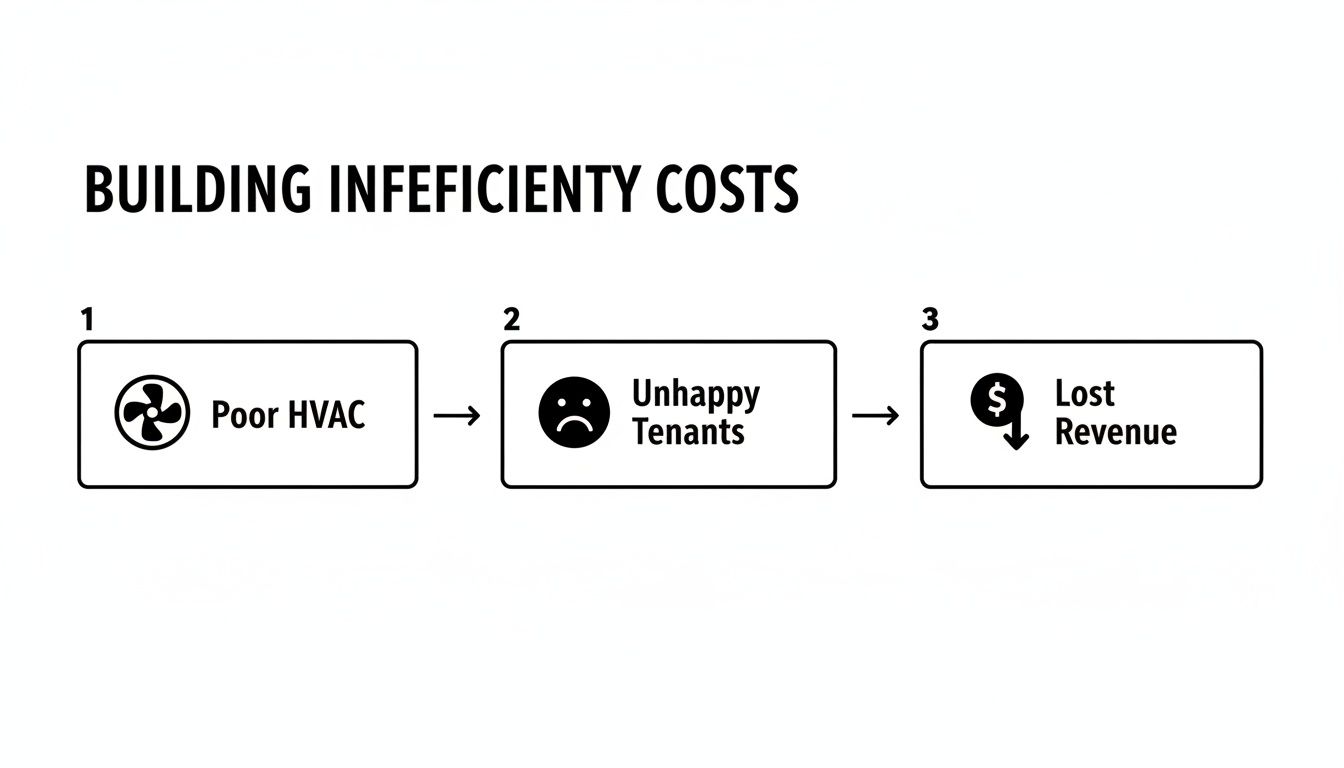
This simple flow makes it clear: operational issues aren't just about wasted energy. They directly impact tenant comfort and, ultimately, your bottom line.
Creating a Data-Driven Action Plan
Once you've gathered all the data from utility bills, submeters, and occupancy studies, the final step is to pull it all together into a clear action plan. This plan should prioritize your potential projects based on their savings potential and return on investment.
Your audit might reveal some eye-opening specifics:
25% of your total electricity consumption is from outdated fluorescent lighting.
Your primary air handling unit shows a 15% drop in efficiency compared to its specs, suggesting it's time to check for dirty coils or clogged filters.
Air pressure readings point to significant leakage in the ductwork serving the third floor. If you want to learn more about this, check out our guide on how to calculate air changes per hour for more insights into building ventilation.
By pinpointing these specific issues, you can build a targeted strategy. Instead of a vague goal to "save energy," you now have a concrete list of projects. This methodical approach ensures your resources are aimed where they will have the greatest impact on your building's performance and your budget.
Dialing in Your HVAC and Air Distribution Systems
Once you have a clear energy baseline, the next logical move is to go after the biggest energy hog in your building: the HVAC system. It’s almost always the primary driver of your utility costs, which also means it holds the most potential for serious savings. Getting its performance under control is a cornerstone of boosting energy efficiency in commercial buildings, and the best place to start is with something surprisingly simple, cleanliness and maintenance.
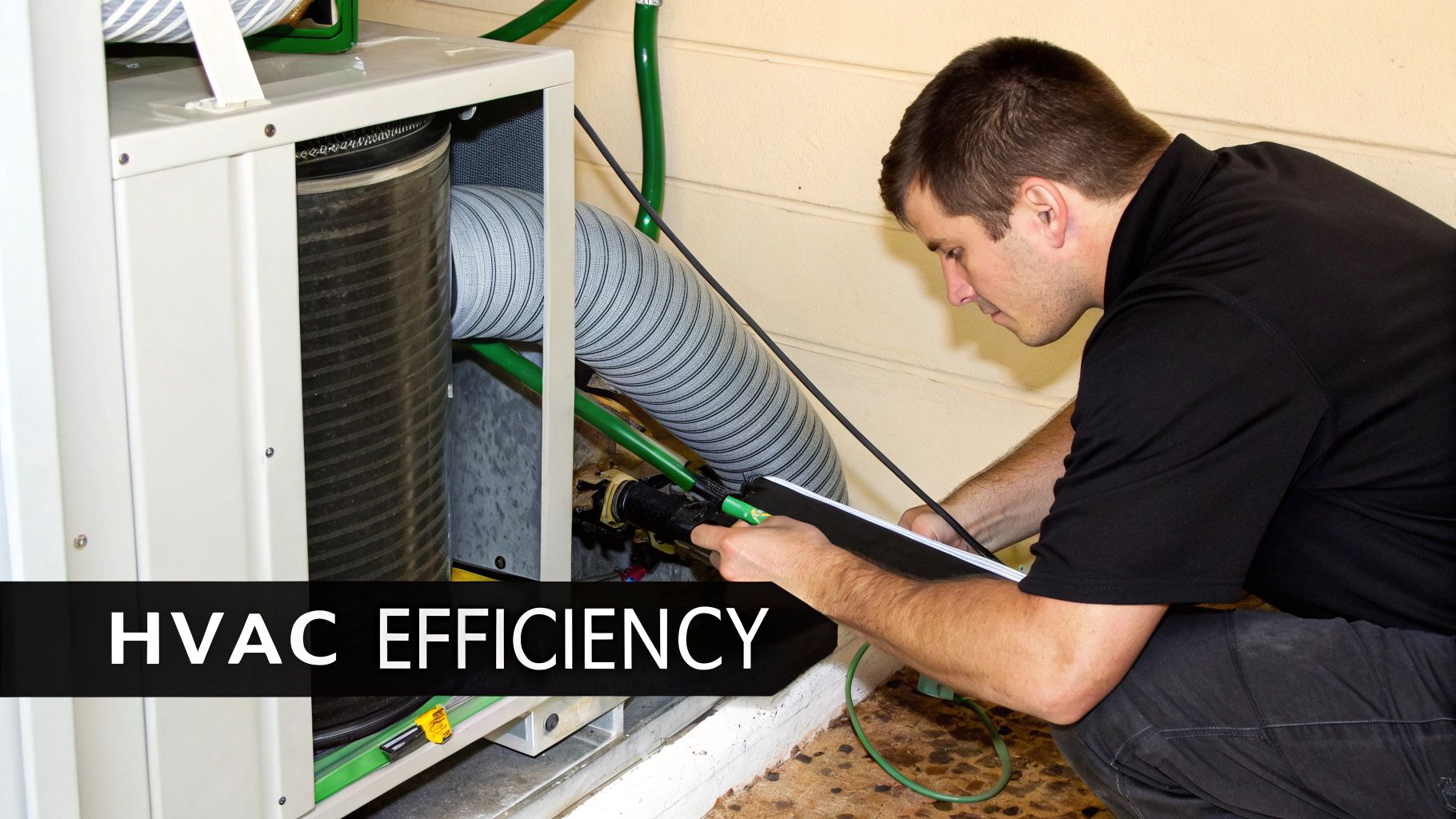
It’s easy to write off a little dust and dirt, but these contaminants are massive barriers to efficiency. Even a thin film of grime on HVAC coils or inside air ducts acts as an insulator. This forces your compressors and fans to work overtime, drawing more power just to hit the target temperature and directly inflating your energy bills.
The Real Cost of a Dirty System
Picture a car radiator caked in mud; it just can't shed heat effectively. A dirty HVAC coil is no different. The system is forced to run longer and more often, which not only wastes energy but also puts premature wear and tear on expensive components. Professional HVAC coil cleaning strips away that insulating layer, immediately restoring the system’s ability to transfer heat and cutting its energy draw.
The same logic applies to your ductwork. When debris piles up, it chokes off airflow, forcing the system's fans to struggle just to push conditioned air where it needs to go. A professional air duct cleaning clears these blockages, letting air move freely and taking a huge load off your equipment.
Here’s a real-world example I've seen play out: a retail chain couldn't figure out why one of its stores had consistently higher energy bills. An inspection found the rooftop HVAC units were choked with years of accumulated grime. After a thorough duct and coil cleaning, that store’s HVAC-related energy costs dropped by nearly 25% the very next quarter.
Neglecting basic system cleanliness is like trying to run a marathon with weights tied to your ankles. You’ll eventually finish, but you'll burn far more energy than necessary and risk a serious breakdown.
This just goes to show that massive savings don't always require a massive investment. Often, the smartest strategies are the foundational ones that get your system back to peak performance.
Get on a Preventive Maintenance Schedule
Waiting for things to break before you fix them is a recipe for high costs and headaches. A proactive, preventive maintenance schedule is absolutely essential for sustained energy efficiency in commercial buildings. It's all about catching small problems before they snowball into catastrophic (and expensive) failures.
A solid maintenance plan should include a few key actions performed on a regular basis:
Routine Filter Changes: Clogged filters are a top cause of poor airflow and bad indoor air quality. Check them monthly and replace them quarterly, or more frequently if you’re in a dusty environment.
Coil and Blower Motor Cleaning: This isn't a DIY job. Schedule a professional cleaning at least once a year to keep heat transfer and airflow at their best.
Component Inspection: Have a tech regularly check belts for wear, lubricate moving parts, and make sure electrical connections are tight and secure.
Condensate Drain Cleaning: A clogged condensate line can cause major water damage and shut your system down completely. Keep it clear.
Sticking to a schedule like this not only keeps your system running like a top but also drastically extends the life of your equipment. For a more granular look, check out our guide on creating a commercial HVAC maintenance checklist.
Plug the Leaks in Your Air Distribution Network
Think of your ductwork as the circulatory system for your building's conditioned air. Leaks are a huge energy drain. In fact, leaky ducts can lose up to 30% of the air passing through them. That means you're paying a premium to heat and cool your ceiling plenums, crawlspaces, and wall cavities.
Finding and sealing these leaks is one of the most cost-effective energy upgrades you can make. The process, called duct sealing, involves using professional-grade materials like mastic sealant or foil tape to close up every gap, hole, and sloppy connection in the system. The payback is immediate and comes in a few forms:
Lower Energy Bills: When conditioned air actually makes it to the rooms it's supposed to, the HVAC system doesn't have to run as long.
Happier Occupants: Sealing leaks gets rid of frustrating hot and cold spots, leading to a much more comfortable and consistent indoor environment.
Healthier Indoor Air: Leaky return ducts can pull dust, allergens, and other junk from unconditioned spaces right into the air you breathe. Sealing them cleans up your air quality.
As you look to take your system’s performance even further, Variable Frequency Drives (VFDs) can add another powerful layer of savings. A great practical guide to VFD energy savings can show you proven strategies for getting the most out of them. When you pair a clean, sealed, and well-maintained system with advanced controls like VFDs, you’ve created a powerhouse for long-term energy management.
Using Building Automation and Smart Controls for Efficiency
Today’s technology hands facility managers some incredible tools for automating and optimizing energy use, going far beyond old-school timers. A well-designed Building Automation System (BAS) acts as the central nervous system for your property. It gives you granular control and a constant stream of data, allowing you to fine-tune performance on the fly. This shifts energy management from a reactive chore to a proactive, intelligent strategy.
Instead of treating your building like one big box, a BAS lets you manage it zone by zone, system by system. This intelligent oversight ensures you’re only using energy precisely when and where it's actually needed. It’s the difference between using a sledgehammer and a scalpel to control costs and improve the indoor environment.
Leveraging Real-Time Occupancy Data
One of the most powerful features of a modern BAS is its ability to tie into occupancy sensors. Just think about all the spaces in a commercial building that are frequently empty: conference rooms, private offices, break areas. Without smart controls, your HVAC and lighting systems treat these spaces the same as a bustling lobby, burning through a tremendous amount of energy for no reason.
Occupancy sensors feed the BAS real-time data on which areas are in use, allowing it to make instant, automatic adjustments.
HVAC Setbacks: When a conference room sits empty for a set period, the system can automatically dial back the temperature to a more economical setpoint.
Lighting Control: Lights can be programmed to switch off the moment a room becomes vacant, taking care of one of the most common sources of energy waste.
Ventilation Adjustment: The system can also reduce fresh air intake to unoccupied zones, saving the significant energy required to heat or cool all that outside air.
For instance, a law firm with a dozen meeting rooms might find that half of them are empty on any given afternoon. A BAS using occupancy data can scale back the conditioning in those empty rooms, leading to huge savings without anyone ever feeling a change in comfort.
The Power of Smart, Adaptive Systems
Beyond just flipping switches, today’s smart controls can actually learn from building usage patterns and adapt over time. This creates a cycle of continuous improvement that sharpens energy efficiency in commercial buildings without needing constant manual tweaks. These systems don't just follow a schedule; they make intelligent, predictive decisions.
A smart BAS doesn't just follow a schedule; it anticipates needs. By analyzing historical data, it learns the building's rhythm, preparing spaces for occupancy just in time and powering down systems proactively, maximizing both comfort and savings.
Take the role of a smart thermostat in this ecosystem. It doesn’t just blindly stick to a pre-programmed schedule. It learns how long it takes to heat or cool a specific zone and uses weather forecast data to optimize start times. This ensures the space is comfortable right when people walk in, without running the system for an extra hour beforehand.
Another game-changing technology is daylight harvesting. Sensors placed near windows measure how much natural light is streaming into a space. The BAS then automatically dims the artificial lights in response, maintaining a perfect, consistent light level while slashing electricity consumption. This feature alone can cut lighting energy costs by 20% to 60% in perimeter zones.
Gaining Control Over Plug Loads
A final, often-overlooked energy hog is plug loads, the power consumed by everything plugged into your outlets. Computers, monitors, printers, and coffee makers can collectively draw a shocking amount of power, even when they’re sitting idle.
Smart plug load controls are a straightforward fix. These devices can be programmed to automatically cut power to non-essential equipment after hours. So, instead of relying on employees to remember to shut everything down, the BAS handles it for them. This simple step ensures that "vampire load" doesn't inflate your electricity bill overnight and on weekends.
These systems give you the power to manage consumption right down to the individual outlet. If you're looking for more ways to cut down on energy use, check out our article on 7 advanced HVAC energy saving tips. When you combine these strategies, you create a truly efficient and responsive building.
Upgrading Lighting and Fortifying the Building Envelope
Once you’ve tuned up your BAS and HVAC systems, it’s time to look at two other fundamental areas that heavily influence your building's energy use: your lighting and the physical structure itself. Tackling inefficiencies here offers some of the most reliable and fastest returns on investment I've seen.
These upgrades don't just work in isolation; they create a powerful synergistic effect with your mechanical systems, really driving down those operational costs.
It’s easy to overlook, but outdated lighting, especially old fluorescent tubes, can be responsible for up to 20% of a commercial building's total electricity bill. Making the jump to modern LED technology is one of the smartest upgrades a facility manager can make. It’s a genuine game-changer for your budget and your maintenance team's workload.
The Clear Business Case for an LED Retrofit
The benefits of an LED lighting upgrade are immediate and substantial. LEDs don't just use up to 90% less energy than old-school incandescent bulbs; their lifespan is also incredibly long, often lasting 50,000 to 100,000 hours.
This practically eliminates the need for replacements, freeing up your maintenance crew to focus on more critical issues instead of constantly swapping out dead bulbs.
Let's put some real numbers to it.
Scenario: A Tale of Two OfficesPicture a 10,000-square-foot office. With old T8 fluorescent lights, the annual electricity cost just for lighting could easily hit $7,000. After retrofitting the same space with modern LEDs, that yearly bill drops to around $2,500. That's a 64% savings, year in and year out, just from changing the lights.
But there’s a hidden benefit, too. Traditional bulbs waste a ton of energy as heat. This extra heat puts an additional load on your HVAC system, forcing it to work harder to cool the space. Since LEDs run cool, they lighten this burden, creating another layer of energy savings that often gets missed in the initial calculation.
Strengthening Your Building's First Line of Defense
While lighting is a major power draw, the building envelope is what dictates how much energy you need in the first place. Think of the envelope as the physical shell separating your conditioned interior from the outside world: your roof, walls, windows, and foundation.
A leaky, poorly insulated envelope means your HVAC system is in a constant, losing battle with the elements.
Fortifying this barrier is a crucial step toward achieving real energy efficiency in commercial buildings. It takes a huge load off your mechanical equipment, which extends its lifespan and cuts its energy use. A few key strategies work together to create a truly tight and efficient envelope.
Comprehensive Air Sealing: You’d be shocked at how much air escapes through tiny cracks around windows, doors, and where utilities enter the building. A professional air sealing job hunts down and plugs these gaps, keeping your conditioned air in and the outside air out.
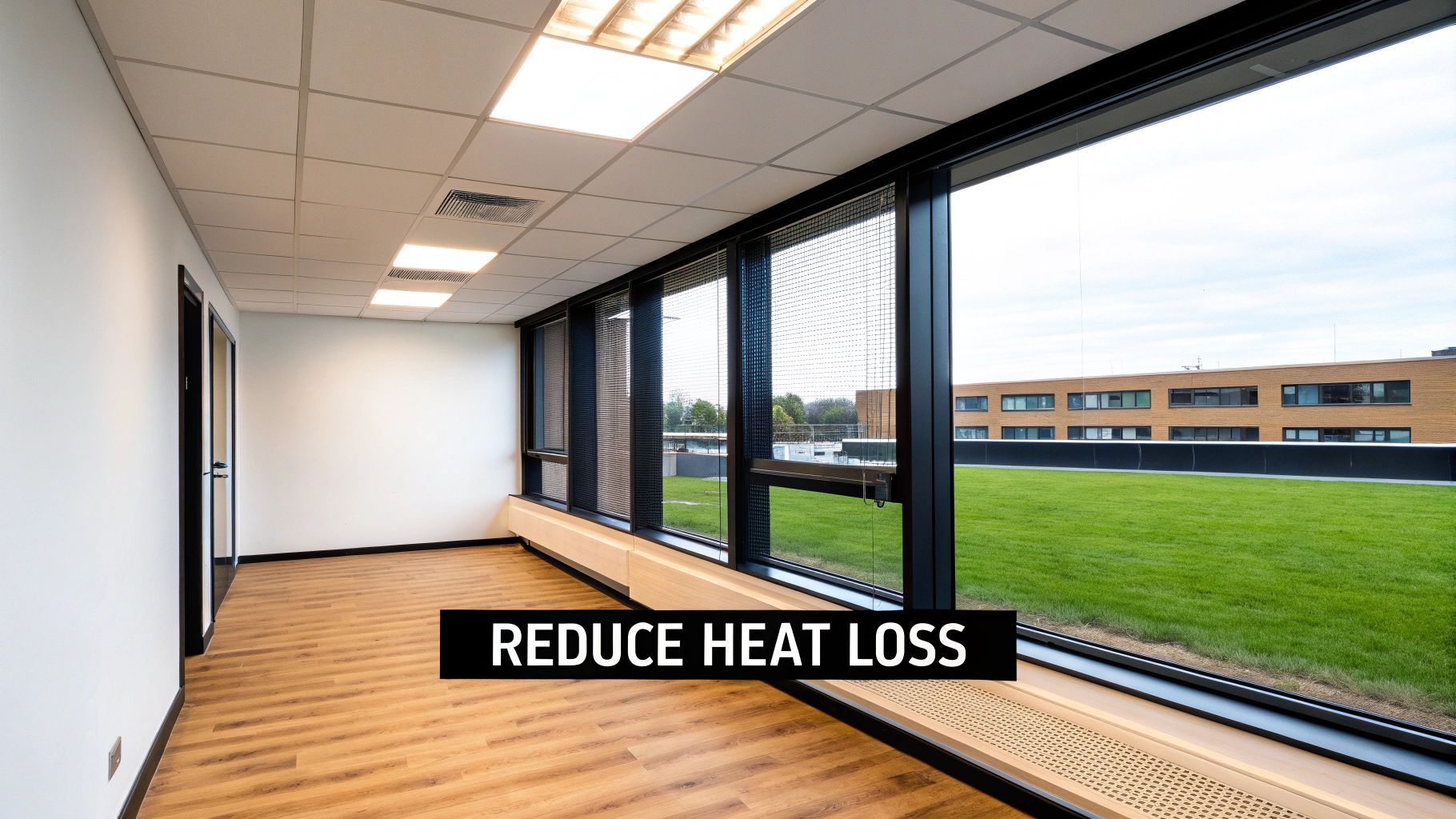
High-Performance Window Films: Windows are almost always the weakest link in the envelope. Applying advanced window films can block up to 80% of solar heat gain during the summer and help hold onto heat in the winter, all without blocking natural light.
Proper Insulation: This is a fundamental. Making sure your roof and walls have adequate insulation is like wrapping your building in a thermal blanket. It dramatically slows heat transfer, meaning you need far less energy to keep the temperature comfortable.
These structural upgrades are the perfect partner to the HVAC maintenance and optimization efforts we've discussed. When your building can naturally fight off heat gain and loss, your HVAC system simply doesn't have to run as hard or as often.
If you want to go deeper on how sealing leaks can impact your bottom line, check out our article on what duct sealing is and how it can save you money. It’s a powerful one-two punch that maximizes savings and keeps tenants happy.
Connecting Energy Savings with Indoor Air Quality
A truly high-performance building does more than just slash energy costs; it fosters a healthy, productive environment for the people inside. For years, the conversation around energy efficiency in commercial buildings was almost entirely about the bottom line. That's changed. Today, tenants and employees place a massive premium on indoor air quality (IAQ), making it impossible to separate the two.
This all starts with your HVAC system. As we've touched on, a clean, well-maintained system naturally runs more efficiently. But it's also the absolute foundation for good air quality. When your ducts and coils are free of dust, allergens, and microbial growth, the air being pushed through your building is simply cleaner and healthier.
Elevating the Indoor Environment
A clean HVAC system is the essential first step, but modern air purification technologies can take your building’s IAQ to the next level, often without a significant energy penalty. Solutions like ActivePure® technology, for example, work proactively within your existing ductwork to neutralize contaminants both in the air and on surfaces.
Unlike passive filters that just trap whatever happens to float by, this kind of technology actively seeks out and destroys pathogens like viruses, bacteria, and mold spores. It also goes after volatile organic compounds (VOCs) that off-gas from things like furniture, paint, and cleaning products.
This positions advanced air purification not just as a health benefit, but as a key differentiator in a competitive market. A building that can prove it delivers superior air quality is a building that can attract and retain premium tenants.
Offering a demonstrably healthier workspace has become a powerful marketing tool. It’s a clear signal that you’re invested in occupant well-being, a factor that has shot to the top of the priority list for businesses looking for a new home.
A Marketable Advantage
Investing in technologies that boost IAQ is really an investment in your property's value and appeal. It elevates your building from a simple commodity to a premium environment where businesses and their people can truly thrive. You can dive deeper by reading your guide to indoor air quality solutions to see exactly how these systems work.
By linking your energy strategy with a solid commitment to superior air quality, you create a powerful value proposition. This approach doesn't just cut your utility bills; it builds a reputation for excellence that pays dividends in tenant satisfaction and long-term profitability.
Your Top Commercial Energy Efficiency Questions, Answered
Taking on a major energy efficiency project can feel daunting. I get it. Facility managers and building owners often ask us where to even begin, what really moves the needle, and how to prove the investment was worth it. Let's tackle some of the most common questions we hear out in the field.
Where On Earth Do I Start?
Before you spend a dime on new equipment, get a professional energy audit. Full stop. This is your roadmap. An audit takes you from guesswork to a concrete, data-backed action plan. It will show you exactly where your energy dollars are going and highlight the low-hanging fruit, like identifying leaky ductwork or an ancient lighting system as your biggest energy hogs.
Do I Have to Make Huge, Expensive Upgrades to See Savings?
Absolutely not. While a full HVAC overhaul certainly has its place, some of the best returns come from simple, low-cost (or even no-cost) adjustments. Think about tightening up your preventive maintenance schedule for HVAC systems, getting coils and ducts professionally cleaned, or tweaking your Building Automation System schedules to better match when people are actually in the building. It all adds up.
We've seen countless property managers shocked to learn that a thorough professional cleaning of HVAC coils and sealing up ductwork can slash a system's energy use by 15-25%. It's foundational work that pays for itself in no time.
How Can I Tell if My Building Envelope Is the Real Problem?
There are a few classic tell-tale signs. Are there constant drafts? Do people complain about cold spots near windows? Are your HVAC bills through the roof in both the dead of winter and the peak of summer? If your heating and cooling systems seem to be running nonstop just to keep up, that’s a huge red flag. You're likely losing a massive amount of conditioned air through tiny leaks in your walls, roof, or window seals. A pro can use tools like a blower door test to show you exactly how bad the problem is.
Ready to transform your building's performance and slash operating costs? The journey to superior energy efficiency in commercial buildings begins with a clean, optimized HVAC system. At Purified Air Duct Cleaning, we provide expert commercial air duct and HVAC coil cleaning that restores your equipment to peak efficiency, improves indoor air quality, and delivers immediate energy savings. Learn more about our commercial services and get your free quote today.