

commercial hvac maintenance checklist: 8 essential steps
A commercial HVAC system is the unseen engine of business operations, quietly ensuring comfort, safety, and productivity. Yet, when it fails, the consequences are immediate: lost revenue, uncomfortable occupants, and costly emergency repairs. Proactive maintenance is the only strategy that transforms this critical asset from a potential liability into a reliable, efficient powerhouse.
Moving beyond simple reactive fixes requires a structured approach. This comprehensive commercial HVAC maintenance checklist provides that structure, breaking down complex tasks into manageable, scheduled actions. This guide is designed for property managers, facility operators, and business owners who understand that system uptime is directly linked to profitability and operational continuity.
Following this detailed roadmap will not only prevent catastrophic failures but also deliver significant, measurable benefits. You will learn how to:
Lower energy consumption through optimized system performance.
Improve indoor air quality for healthier, more productive occupants.
Extend the lifespan of your expensive equipment, maximizing your investment.
Consider this your definitive guide to operational excellence. It offers actionable steps for everything from daily inspections and thermostat calibration to annual compressor maintenance and safety device testing. By implementing this checklist, you can ensure your system performs optimally day in and day out, safeguarding your investment, your people, and your bottom line. Let's explore the essential checks that keep your commercial properties running smoothly and efficiently.
1. Air Filter Replacement and Inspection
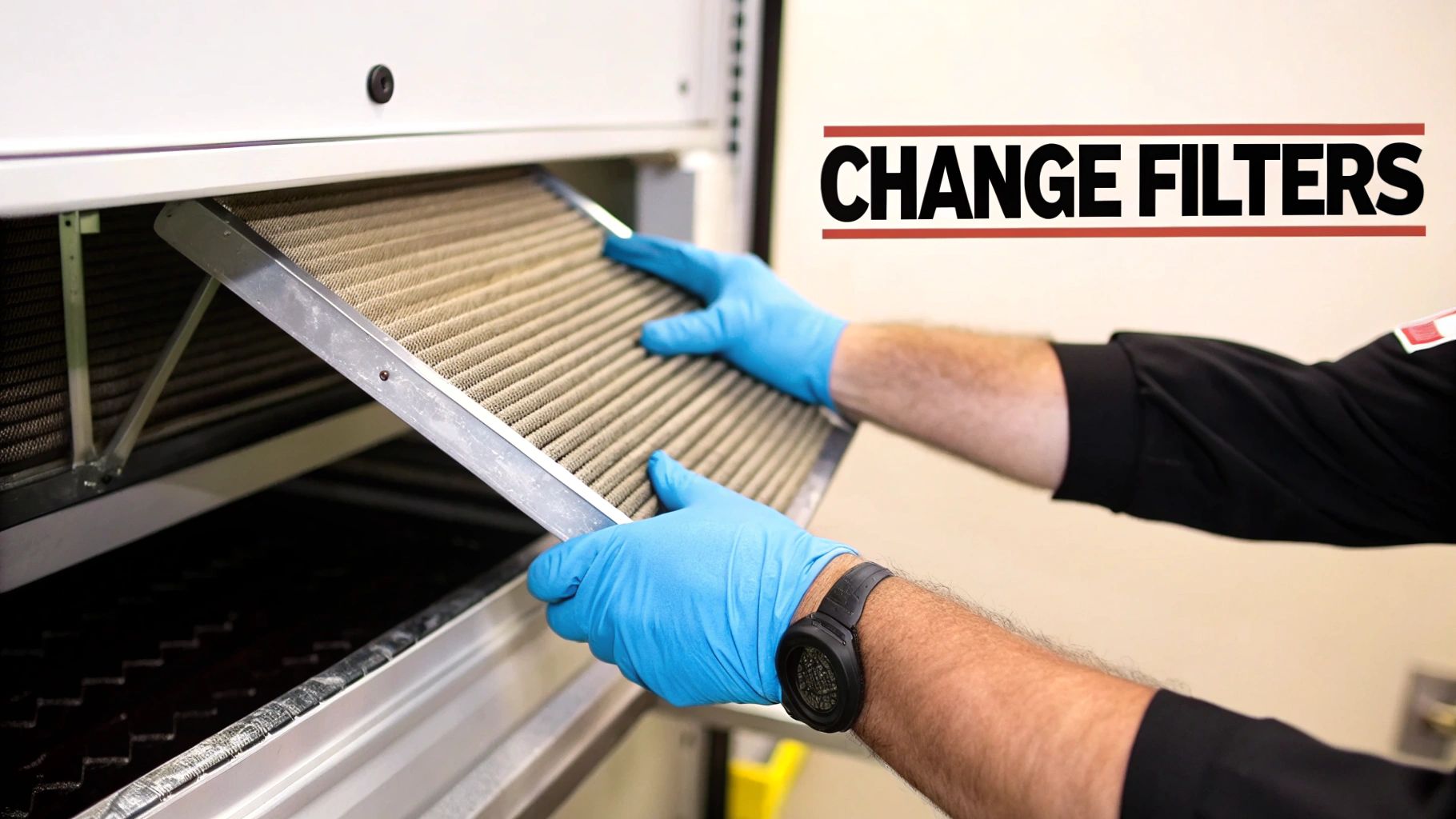
The single most critical task on any commercial HVAC maintenance checklist is the regular inspection and replacement of air filters. Think of filters as the lungs of your HVAC system; they capture dust, pollen, debris, and other airborne particulates, preventing them from circulating into your building's air and from clogging sensitive system components. Neglecting this fundamental step leads directly to reduced indoor air quality, increased energy consumption, and premature equipment failure.
In a commercial setting, the sheer volume of air being conditioned and the higher concentration of occupants mean filters get dirty much faster than in a residential home. A clogged filter forces the system's fan motor to work harder to pull air through, which not only wastes electricity but also puts significant strain on the motor, potentially leading to costly breakdowns.
Actionable Tips for Filter Management
To implement a successful filter maintenance strategy, consistency and documentation are key. Vague plans like "change them when they look dirty" are not effective. Instead, create a structured schedule based on your specific environment.
Establish a Schedule: Create a calendar reminder or use a facility management system to schedule changes. Office buildings may require monthly changes, while a hospital using high-efficiency HEPA filters might need a quarterly replacement schedule. A manufacturing facility with significant dust might need bi-weekly or even weekly inspections.
Use a Tracking Log: Maintain a log sheet on or near each air handler unit. Record the date of each filter change, the type of filter used (including its MERV rating), and the initials of the technician. This provides a clear maintenance history for compliance and troubleshooting.
Stock Adequate Inventory: Keep a supply of the correct filter sizes and MERV ratings on-site. This prevents delays and ensures that a dirty filter can be replaced immediately, rather than waiting for a new shipment to arrive.
Ensure Correct Installation: Always install filters with the airflow arrow pointing in the right direction, which is typically towards the main HVAC unit and away from the return duct. Installing a filter backward can reduce its effectiveness and may even cause it to collapse.
While filters are excellent at capturing particulates, understanding their role in the broader context of air quality is important. If you are comparing different air quality solutions, you can explore the differences between air filters and air purifiers to determine what is best for your facility's specific needs.
2. Condenser Coil Cleaning
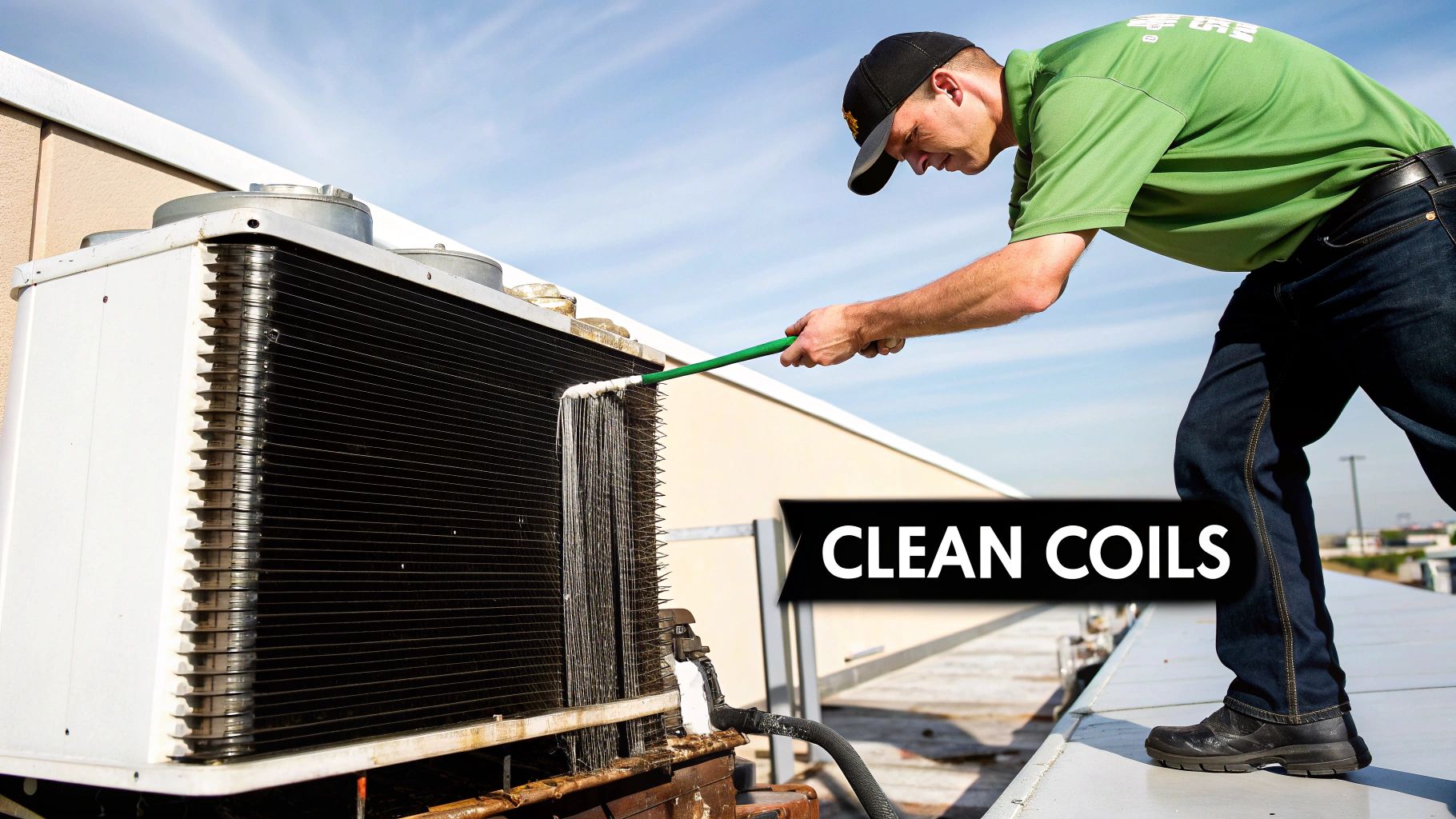
A crucial, yet often overlooked, component of any commercial HVAC maintenance checklist is the regular cleaning of the condenser coil. Located in the outdoor unit, this coil is responsible for releasing heat absorbed from inside your building into the outside air. Over time, it becomes caked with dirt, leaves, pollen, and other debris, which acts as an insulating blanket. This accumulation severely restricts the system's ability to transfer heat, forcing the compressor to work harder and run longer to cool your facility.
This added strain leads directly to higher energy bills, reduced cooling capacity, and an increased risk of compressor failure, one of the most expensive repairs in an HVAC system. For commercial properties, where cooling demands are high and consistent, a clean condenser coil is not just a maintenance task; it is a critical factor in managing operational costs and ensuring system reliability.
Actionable Tips for Coil Management
Effective condenser coil maintenance requires a proactive schedule tailored to your building's specific environment and operational demands. A reactive approach, waiting until performance degrades, is inefficient and costly.
Schedule Pre-Season Cleaning: The most strategic time to perform a thorough coil cleaning is in the spring, just before the peak cooling season begins. This ensures your system is operating at maximum efficiency when it is needed most.
Tailor Frequency to Your Environment: A restaurant with outdoor units exposed to grease-laden exhaust may need monthly cleaning. In contrast, a hotel in a coastal area might schedule bi-monthly cleanings to combat corrosive salt deposits, while a standard office building might only need it quarterly.
Maintain Clear Surroundings: Regularly trim vegetation, including bushes, trees, and weeds, to maintain at least two to three feet of clearance around all sides of the outdoor units. This simple step significantly reduces the amount of leaves and debris that can be pulled into the coils.
Use Proper Cleaning Techniques: Ensure technicians use only approved, non-acidic coil cleaning chemicals and soft-bristled brushes to avoid damaging the delicate aluminum fins. High-pressure washers can easily bend the fins, which restricts airflow just as much as dirt.
Document Every Service: Just like with filters, maintain a detailed log for each unit. Record the date of cleaning, the methods and chemicals used, and any observations about the coil's condition. This history is invaluable for warranty compliance and diagnosing future issues.
While a professional should handle the chemical cleaning process, understanding the fundamentals can help you oversee the work effectively. You can learn more about the steps involved in how to clean AC coils to ensure the job is done right.
3. Evaporator Coil Inspection and Cleaning
Just as critical as clean filters, the evaporator coil is the component responsible for absorbing heat from your indoor air, making it the heart of the cooling process. Located inside the air handler, this coil is constantly damp due to condensation, making it a prime breeding ground for dust, mold, and microbial growth. A dirty evaporator coil not only degrades indoor air quality by circulating contaminants but also insulates the coil, severely reducing its ability to cool efficiently and leading to blockages that can cause water damage.
In a commercial environment, ignoring evaporator coils can lead to significant problems, including foul odors, occupant health complaints, and increased operational costs. The layer of grime forces the refrigeration cycle to work harder and longer to achieve the desired temperature, driving up electricity bills and straining the compressor. This makes regular inspection and cleaning a non-negotiable part of any comprehensive commercial HVAC maintenance checklist.
Actionable Tips for Coil Maintenance
A proactive approach to coil maintenance prevents costly reactive repairs and ensures consistent system performance. Vague intentions are insufficient; a scheduled, documented plan is essential for managing this critical component effectively.
Establish a Schedule: The required frequency depends heavily on the environment. Healthcare facilities may need monthly inspections due to strict infection control standards, while buildings in humid climates like Florida or Louisiana often require quarterly cleaning to combat aggressive mold growth. An office with standard air quality might only need a biannual service.
Integrate with Filter Changes: Use filter replacement times as an opportunity for a quick visual inspection of the coils. This simple habit helps catch buildup before it becomes a major problem.
Maintain Condensate Systems: Keep drain lines clear by treating them with algaecide tablets or strips. Installing drain pan treatments can also inhibit the growth of slime and bacteria, preventing clogs and water overflow that can damage surrounding equipment.
Schedule Strategically: Plan professional coil cleanings during milder spring or fall weather. This allows the system to be shut down for service without significantly disrupting building operations or occupant comfort.
Properly cleaning HVAC coils involves specific techniques and chemicals to avoid damaging the delicate aluminum fins. For a detailed guide on the process, you can find out how to clean HVAC coils for peak system performance to ensure the job is done safely and effectively.
4. Refrigerant Level Check and Charge Balance
Refrigerant is the critical lifeblood of your commercial HVAC system, a specialized compound that absorbs and releases heat as it circulates through the evaporator and condenser coils. Maintaining the correct refrigerant charge is paramount for both cooling efficiency and equipment longevity. An undercharged system will struggle to cool the space, while an overcharged system can cause liquid refrigerant to flood and destroy the compressor, the most expensive component of the unit.
In a commercial environment, factors like long refrigerant lines, multiple system components, and continuous operation make precise charge balance essential. A certified technician uses specialized tools like manifold gauges, digital thermometers, and pressure charts to measure superheat and subcooling, ensuring the refrigerant level matches the manufacturer's exact specifications. This isn't just a top-off; it's a precise diagnostic procedure that guarantees optimal performance and prevents catastrophic failures.
Actionable Tips for Refrigerant Management
Effective refrigerant management requires precision, documentation, and adherence to environmental regulations. A proactive approach will extend equipment life and ensure your system runs efficiently, which is a key part of any comprehensive HVAC preventative maintenance checklist.
Document Baseline Levels: During system commissioning, record the initial, correct refrigerant charge levels. This baseline provides an invaluable reference point for future service, allowing technicians to quickly identify deviations.
Proactively Hunt for Leaks: Don't wait for cooling performance to drop. Instruct technicians to use electronic leak detectors or soap bubble tests around fittings, valves, and coil connections during routine inspections to catch small leaks before they become major problems.
Maintain EPA Certifications: The EPA's Section 608 regulations mandate that only certified technicians can handle refrigerants. Ensure all in-house staff or third-party contractors have current, valid certifications to maintain compliance and avoid significant fines.
Plan for Refrigerant Phase-Outs: Older systems may use refrigerants like R-22, which is being phased out. Develop a long-term plan to either retrofit these systems for use with modern, compliant refrigerants or budget for their eventual replacement.
Use Superheat and Subcooling: Insist that technicians use superheat (for fixed orifice systems) and subcooling (for TXV systems) calculations for charging. Simply checking pressure is not enough and can lead to an inaccurate and damaging charge.
5. Thermostat Calibration and Control System Testing
The thermostat acts as the brain of your commercial HVAC system, telling it when to turn on, when to turn off, and how hard to work. If this critical component is not accurately calibrated, the entire system operates on flawed information. This leads to uncomfortable temperatures, significant energy waste as the unit runs unnecessarily, and excessive wear and tear on major components like compressors and fans.
In a commercial environment, control systems are far more complex than a simple residential dial. They often involve programmable schedules, multiple zones, and integration with a larger Building Automation System (BAS). Regular testing and calibration ensure that these sophisticated controls function as intended, maintaining occupant comfort while optimizing energy efficiency. An inaccurate thermostat can easily cause a system to run 10-15% less efficiently, a substantial cost for any business.
Actionable Tips for Thermostat and Control Management
A proactive approach to thermostat management is crucial for any effective commercial HVAC maintenance checklist. Simply waiting for comfort complaints is a reactive strategy that costs money and frustrates occupants. Instead, integrate these structured practices into your routine.
Verify Accuracy with a Reference: Use a calibrated, certified reference thermometer placed next to the thermostat. Compare the readings after about 15 minutes. If there is a discrepancy of more than 2°F, the thermostat requires recalibration or replacement. Document this verification in your maintenance logs.
Check Physical Placement: Ensure thermostats are not located in areas that could produce false readings. They should be away from direct sunlight, drafts from windows or doors, and heat-generating equipment like office copiers or kitchen appliances.
Optimize Programmable Schedules: Don't "set it and forget it." Regularly review and update thermostat schedules to match current building occupancy. Program setbacks for nights, weekends, and holidays to avoid conditioning an empty space. For example, a school should have its schedule adjusted for summer break.
Document All Changes: Maintain a detailed log of all calibration adjustments, setpoint changes, and schedule modifications. This history is invaluable for troubleshooting future issues and tracking long-term system performance and energy consumption patterns.
Test System Communication: For smart thermostats or those linked to a BAS, periodically test their communication signals. Ensure the central control panel is receiving accurate data and that commands sent to the thermostat are being executed correctly. For wireless units, a quarterly signal strength check is recommended.
6. Ductwork Inspection, Sealing, and Pressure Testing
The ductwork in a commercial building is the circulatory system for conditioned air, delivering heating and cooling to every corner of the facility. However, leaks, disconnected joints, and poor insulation can lead to massive energy waste, poor indoor air quality, and significant comfort imbalances. An often-overlooked part of a commercial HVAC maintenance checklist, comprehensive ductwork inspection and sealing is essential for maintaining system efficiency and occupant comfort.
Over time, ducts can develop gaps and cracks, allowing conditioned air to escape into unconditioned spaces like ceiling plenums or crawlspaces. This forces the HVAC system to work harder and longer to meet thermostat setpoints, driving up utility bills. Furthermore, these leaks can pull in dust, contaminants, and moisture from unconditioned areas, distributing them throughout the building and compromising air quality.
Actionable Tips for Ductwork Integrity
A proactive approach to duct maintenance prevents minor issues from becoming major expenses. Professional assessment and sealing, often mandated by standards like ASHRAE 62.1, ensure your air distribution network performs as designed. For example, a retrofitted office building can achieve up to 15% energy savings through comprehensive duct sealing alone.
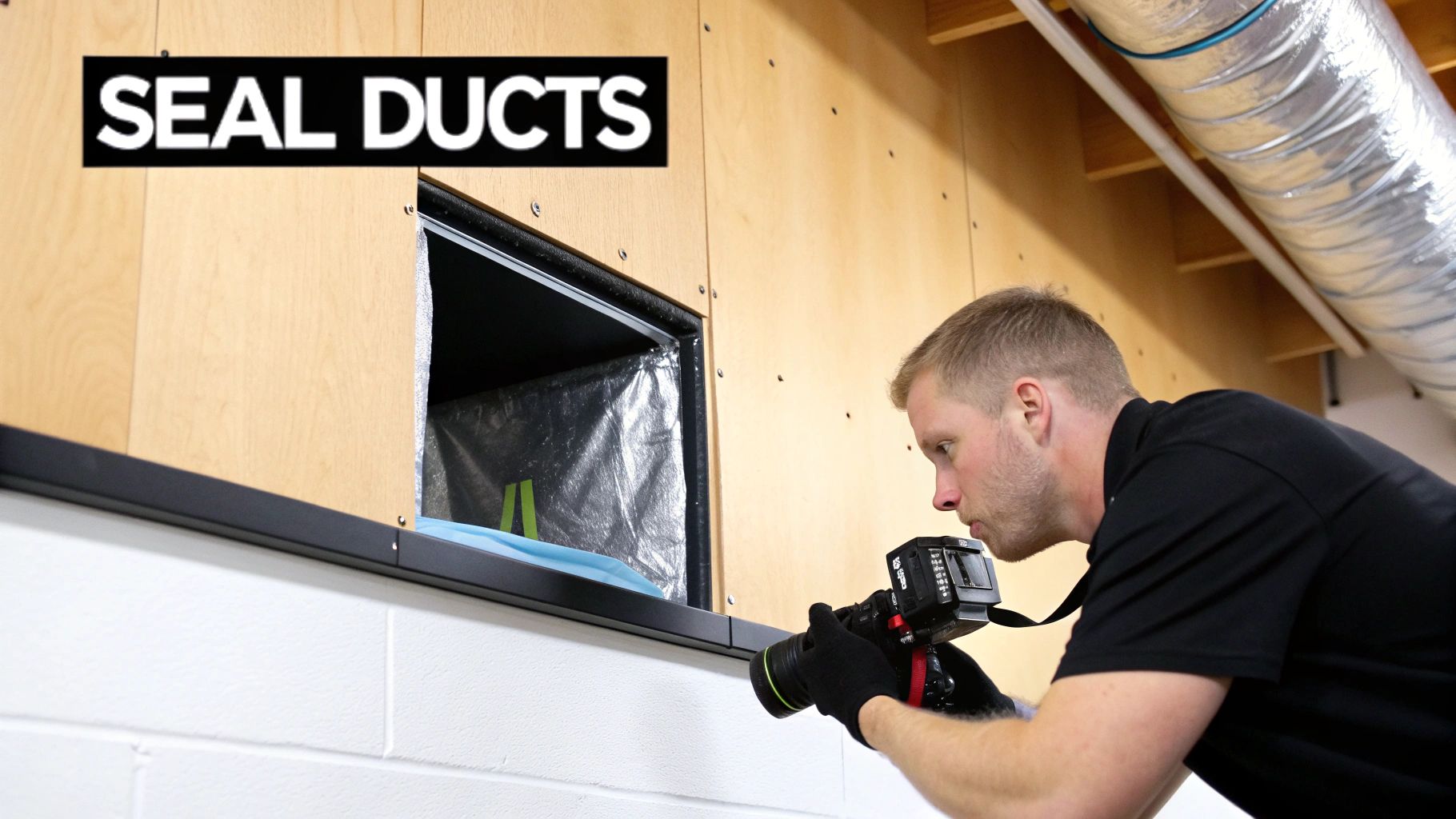
Schedule Professional Inspections: Arrange for periodic visual and camera-based inspections to identify hidden leaks, debris buildup, or damaged insulation inside the ductwork. This is especially critical in older buildings or after renovations.
Prioritize Proper Sealing: Use professional-grade, UL-listed mastic sealant or advanced methods like Aeroseal technology to fix all identified leaks. Avoid using standard "duct tape," which deteriorates quickly under temperature changes.
Perform Pressure Testing: For new construction or major retrofits, conduct a duct pressure test to quantify air leakage rates. This verifies that the system meets energy code requirements and provides a baseline for future performance assessments.
Insulate Adequately: Ensure all ductwork running through unconditioned spaces (attics, plenums) is insulated to at least an R-8 value to prevent thermal loss and condensation.
Install Access Panels: Add access panels at key junctions and near dampers. This simplifies future inspections, cleaning, and maintenance without requiring destructive entry.
Properly sealed and maintained ducts are fundamental to an efficient HVAC system. If you are questioning the condition of your facility's air distribution network, you can explore the benefits and reasons for cleaning commercial building ductwork to ensure optimal performance and air quality.
7. Compressor and Motor Maintenance
The compressor and motor are the heart and muscle of a commercial HVAC system. The compressor circulates refrigerant to transfer heat, while the motor drives the fans and pumps that move air and fluids. Given their central role and high replacement cost, typically ranging from $3,000 to over $8,000, proactive maintenance is not just recommended; it's an essential strategy for protecting your investment and ensuring operational reliability.
Neglecting these components leads to catastrophic and expensive failures. Issues like improper lubrication, electrical faults, or excessive vibration can escalate quickly, causing system-wide shutdowns that disrupt business operations, affect tenant comfort, and lead to emergency repair costs. A well-maintained compressor and motor, on the other hand, operate efficiently, consume less energy, and have a significantly longer operational lifespan, making them a cornerstone of any effective commercial HVAC maintenance checklist.
Actionable Tips for Compressor and Motor Care
A systematic and data-driven approach is crucial for managing these critical components. The goal is to identify early signs of wear and stress before they result in a complete breakdown.
Establish Performance Baselines: During commissioning or a major service, record baseline readings for vibration, temperature, and electrical amperage. This data becomes the benchmark against which all future readings are compared, making it easy to spot deviations that indicate a developing problem.
Monitor Key Vitals Regularly: Check the compressor's discharge temperature and the motor's amperage draw monthly. Compare these readings to the manufacturer's specifications. Consistently high temperatures can signal issues like low refrigerant charge or oil breakdown.
Conduct Annual Oil Analysis: Just as a blood test reveals human health, an oil analysis can reveal the internal condition of your compressor. This test detects acid, moisture, and metal particulates, providing early warnings of internal wear, contamination, or impending bearing failure.
Verify Refrigerant Superheat: Annually check and adjust the refrigerant superheat to the manufacturer's recommended levels. Proper superheat ensures that only vaporized refrigerant returns to the compressor, preventing a damaging condition known as "liquid slugging" which can destroy valves and pistons.
Install Protective Devices: Use crankcase heaters in cooler climates to prevent refrigerant from migrating into the compressor oil during off-cycles. This protects the compressor from a "flooded start," which causes severe lubrication loss and immediate wear upon startup.
Stock Critical Spares: Keep spare motor contactors, capacitors, and thermal overload protectors on-site. These are relatively inexpensive components that frequently fail and can be replaced quickly by a technician, minimizing system downtime.
8. Electrical Connections, Controls, and Safety Device Testing
A commercial HVAC system is a complex network of electrical components, and the integrity of these connections is paramount to both safety and performance. This crucial step in the commercial HVAC maintenance checklist involves inspecting everything from wiring and contactors to circuit breakers and sophisticated safety controls. These components manage the flow of high-voltage power, and neglecting them can lead to catastrophic failures, electrical fires, and significant operational downtime.
The electrical system acts as the central nervous system of your HVAC equipment. A single loose connection can cause voltage drops that strain motors, while a failing capacitor can prevent a compressor from starting. Regular testing ensures that all components are operating within their specified parameters, protecting expensive equipment from damage and ensuring the system responds correctly to control inputs and safety triggers.
Actionable Tips for Electrical Integrity
A systematic and documented approach is essential for managing the electrical health of your HVAC system. Proactive testing prevents reactive, emergency repairs.
Conduct Regular Voltage and Amperage Checks: Use a multimeter to test voltage at equipment terminals and a clamp meter to measure the amperage draw of motors and compressors. Compare these readings to the manufacturer's nameplate specifications to identify potential issues like an overworking motor or poor power quality.
Inspect Contactors and Relays: Visually inspect contactor points for signs of pitting, arcing, or corrosion. Worn contacts can create high resistance, generating heat and leading to component failure.
Test Safety Devices: Manually trigger all safety switches, such as high and low-pressure cutoffs and thermal overload relays, to ensure they function correctly. These devices are the last line of defense against severe equipment damage. Hospitals, for instance, often perform these tests monthly due to the critical nature of their systems.
Log All Findings: Maintain a detailed log of all electrical tests. Document voltage readings, amperage draws, capacitor ratings, and the results of safety switch tests. This creates an invaluable historical record for troubleshooting and trend analysis.
Utilize Thermal Imaging: In industrial or high-demand settings, using an infrared camera can quickly identify "hot spots" caused by loose or high-resistance connections before they fail. Beyond the HVAC unit itself, a comprehensive maintenance plan must include the critical electrical infrastructure like the Motor Control Center. To ensure this key area isn't overlooked, you can learn more about Mastering Motor Control Center Maintenance for a complete electrical safety strategy.
8-Point Commercial HVAC Maintenance Comparison
Maintenance Task | 🔄 Complexity | ⚡ Resources | ⭐ Expected Outcomes / 📊 Impact | Ideal Use Cases | 💡 Key Tips |
|---|---|---|---|---|---|
Air Filter Replacement and Inspection | Low: routine, repeatable; scheduling required | Low cost filters, basic tools, inventory management | ⭐ Improves IAQ; 📊 reduces energy use 5–15%; extends equipment life | Offices, retail, manufacturing, hospitals (HEPA) | Schedule changes; upgrade MERV gradually; install with correct airflow; keep spares |
Condenser Coil Cleaning | Medium: outdoor access, careful technique to avoid fin damage | Professional labor, coil cleaners, soft brushes, water/pressure rinse; possible downtime | ⭐ Restores heat transfer; 📊 improves cooling 5–10%; lowers energy bills | Rooftops, restaurants, coastal sites, malls | Clean before peak season; trim vegetation; use approved chemicals; allow drying |
Evaporator Coil Inspection and Cleaning | Medium–High: indoor access, possible disassembly, mold risk | Skilled techs, cleaning chemicals, potential refrigerant handling, condensate tools | ⭐ Improves IAQ by reducing mold; 📊 maintains refrigerant efficiency; prevents backups | Humid climates, healthcare, indoor pools, poorly distributed HVAC | Inspect during filter changes; use UV dye; maintain drain lines; schedule in mild weather |
Refrigerant Level Check and Charge Balance | High: requires certified technicians and precise measurement | EPA-certified tech, manifold gauges, leak detectors, recovery/recharge equipment | ⭐ Ensures optimal performance; 📊 improves efficiency 10–15%; protects compressor | Large offices, supermarkets, hotels, data centers | Record baseline charge; use superheat/subcooling; monitor leaks; keep certifications current |
Thermostat Calibration & Control System Testing | Low–Medium: simple cal checks to complex BAS integration | Reference thermometers, programming tools, wireless signal testers, IT coordination for BAS | ⭐ Prevents temperature swings; 📊 enables scheduling energy savings; improves comfort | Offices, schools, retail, hospitals with BMS | Place away from heat/sun; use certified thermometers; program setbacks; document changes |
Ductwork Inspection, Sealing & Pressure Testing | Medium–High: access challenges, pressure testing needs shutdown | Video cameras, blower/pressure test equipment, UL-listed mastic, insulation materials | ⭐ Reduces energy loss 10–20%; 📊 improves comfort uniformity; reduces infiltration | New construction, retrofit projects, schools, healthcare facilities | Use video inspection; test at design conditions; use UL mastic; document test results |
Compressor and Motor Maintenance | High: specialized diagnostics, vibration and oil analysis | Vibration analyzers, oil analysis labs, thermal probes, spare parts, skilled technicians | ⭐ Extends compressor life 10+ years; 📊 prevents catastrophic failures and downtime | 24/7 facilities (data centers), manufacturing, supermarkets, hotels | Establish baselines; monitor discharge temps; perform oil analysis; keep spare contactors |
Electrical Connections, Controls & Safety Device Testing | High: licensed electrician, code compliance, safety risk | Multimeter, megohmmeter, clamp meter, thermal imager, qualified electricians | ⭐ Prevents electrical fires; 📊 improves reliability and code compliance | Hospitals, industrial sites, schools, commercial buildings | Test voltages monthly; use thermal imaging; verify grounding; document all tests |
From Checklist to Action: Partnering for Long-Term HVAC Health
We have explored the intricate layers of a comprehensive commercial HVAC maintenance checklist, moving from daily visual checks to intensive annual inspections. This guide provides more than just a list of tasks; it offers a strategic framework for safeguarding one of your facility's most critical and costly assets. The true power of this checklist lies not in its completion, but in its consistent and correct application. It is the bridge between reactive repairs and proactive asset management, turning a potential liability into a reliable, efficient system that supports your business operations day in and day out.
The key takeaway is clear: proactive, detailed maintenance is non-negotiable for system longevity, operational efficiency, and occupant comfort. Ignoring tasks like regular coil cleaning, refrigerant level verification, or ductwork inspections leads to a cascade of problems. These issues include soaring energy bills, diminished indoor air quality, premature equipment failure, and costly, disruptive emergency repairs. This checklist serves as your roadmap to avoid these pitfalls.
The Power of Proactive Partnership
While your in-house team can manage certain aspects of this checklist, such as daily inspections or monthly filter changes, the technical complexity of modern HVAC systems demands professional expertise. Tasks involving refrigerant handling, electrical component testing, motor maintenance, and comprehensive system diagnostics require certified technicians with specialized tools and training. This is where a strategic partnership with a qualified HVAC service provider becomes invaluable.
A professional partner transforms your commercial HVAC maintenance checklist from a static document into a dynamic, living strategy. They bring the expertise to not only perform the checks correctly but also to interpret the findings. A certified technician can identify subtle signs of wear and tear that might otherwise go unnoticed, preventing a minor issue from escalating into a catastrophic failure.
Key Insight: The most effective maintenance plans blend in-house diligence with professional expertise. This hybrid approach ensures consistent oversight while leveraging specialized skills for complex technical tasks, maximizing both efficiency and safety.
Implementing Your Maintenance Strategy
Putting this plan into action requires organization and a commitment to consistency. For facility managers overseeing multiple properties or a large, complex facility, keeping track of these varied maintenance schedules can be a significant challenge. To effectively manage comprehensive HVAC maintenance schedules, exploring various property management software options can be highly beneficial for centralizing data and automating reminders.
Regardless of the tools you use, the goal is to create a seamless workflow that ensures no task is overlooked. This system should clearly define roles and responsibilities, track service history, and schedule future appointments. A well-documented maintenance history is not just a best practice; it is a valuable asset, providing crucial data for budgeting, capital planning, and troubleshooting.
Ultimately, this commercial HVAC maintenance checklist is your blueprint for achieving operational excellence. By embracing a proactive maintenance culture and partnering with trusted professionals, you are not just servicing a machine. You are investing in your facility’s financial health, ensuring the well-being of its occupants, and building a more resilient, sustainable business operation for years to come.
Ready to transform your maintenance plan from a checklist into a powerful asset protection strategy? The certified professionals at Purified Air Duct Cleaning specialize in comprehensive commercial HVAC services, from meticulous coil and duct cleaning to advanced ActivePure air purification solutions. Contact Purified Air Duct Cleaning today for a free quote and let us build a customized maintenance program that ensures the health, efficiency, and longevity of your system.