

Home Fire Safety Checklist: Essential Tips to Protect Your Family
Updated: Aug 8, 2025
In the United States, a home fire is reported approximately every 93 seconds, a sobering statistic that highlights the critical need for proactive safety measures. While most homeowners understand the importance of a basic smoke alarm, a truly effective fire safety strategy goes much deeper. It requires a multi-layered approach that integrates detection, prevention, escape planning, and the regular maintenance of your home's most critical systems. A fire can double in size every minute, leaving you with precious little time to react. This narrow window makes having a pre-established, well-practiced plan a non-negotiable lifeline, not just a suggestion.
This comprehensive home fire safety checklist is designed to move beyond generic advice, offering actionable and detailed steps to secure your household. We will explore the nuances of a complete safety protocol, covering essential topics such as:
The strategic placement and maintenance of smoke and carbon monoxide detectors.
Creating and rehearsing a realistic fire escape plan for all family members.
The proper upkeep of fire extinguishers and core home systems like heating and electrical.
Addressing often-overlooked fire risks lurking in kitchen appliances, dryer vents, and cluttered spaces.
Our goal is to provide you with a clear, systematic guide. Following this checklist will empower you with the knowledge to methodically identify and mitigate fire risks, transforming your home into a safer environment and ensuring you are prepared for any contingency.
1. Install and Maintain Smoke Alarms
A smoke alarm is your first line of defense against a house fire. According to the National Fire Protection Association (NFPA), the risk of dying in a reported home fire is more than twice as high in homes that do not have any working smoke alarms. These essential devices provide a critical early warning, giving you and your family precious seconds to escape before a fire grows out of control.
Modern smoke alarms detect fires using one of two primary sensor types: ionization or photoelectric. Ionization sensors are more responsive to flaming fires with smaller combustion particles, while photoelectric sensors are quicker to detect smoldering fires that produce larger particles. For the most comprehensive protection, experts recommend installing dual-sensor alarms that combine both technologies.
Key Insight: Having smoke alarms is not enough; they must be the right type, installed correctly, and maintained properly. A non-functional alarm provides a false sense of security, which can be more dangerous than having no alarm at all.
Implementation and Best Practices
To maximize their effectiveness, smoke alarms must be strategically placed throughout your home. This is a crucial step in any comprehensive home fire safety checklist.
Location is Everything: The NFPA recommends installing alarms on every level of your home, including the basement. They should be placed inside each bedroom and outside each separate sleeping area, such as a hallway. For sloped or peaked ceilings, install the alarm within three feet of the peak, but not directly at the apex where dead air can prevent smoke from reaching the sensor.
Choosing Your Alarm: Consider your needs. For instance, brands like Kidde offer models with 10-year sealed batteries, which are ideal for rental properties as they eliminate the need for annual battery changes. For tech-savvy homeowners, smart alarms like the Nest Protect offer mobile alerts, self-testing features, and detailed information about the location and type of threat. First Alert's dual-sensor alarms remain a popular, reliable choice for standard residential use.
Regular Maintenance: Proper upkeep is non-negotiable. Test every alarm monthly by pressing its test button. Replace the batteries at least once a year or immediately if the unit begins chirping, which is a low-battery warning. Gently vacuum the exterior of each alarm with a soft brush attachment every few months to remove dust and cobwebs that could interfere with its sensor.
The following infographic illustrates the essential lifecycle for maintaining your smoke alarms, a simple yet life-saving process.
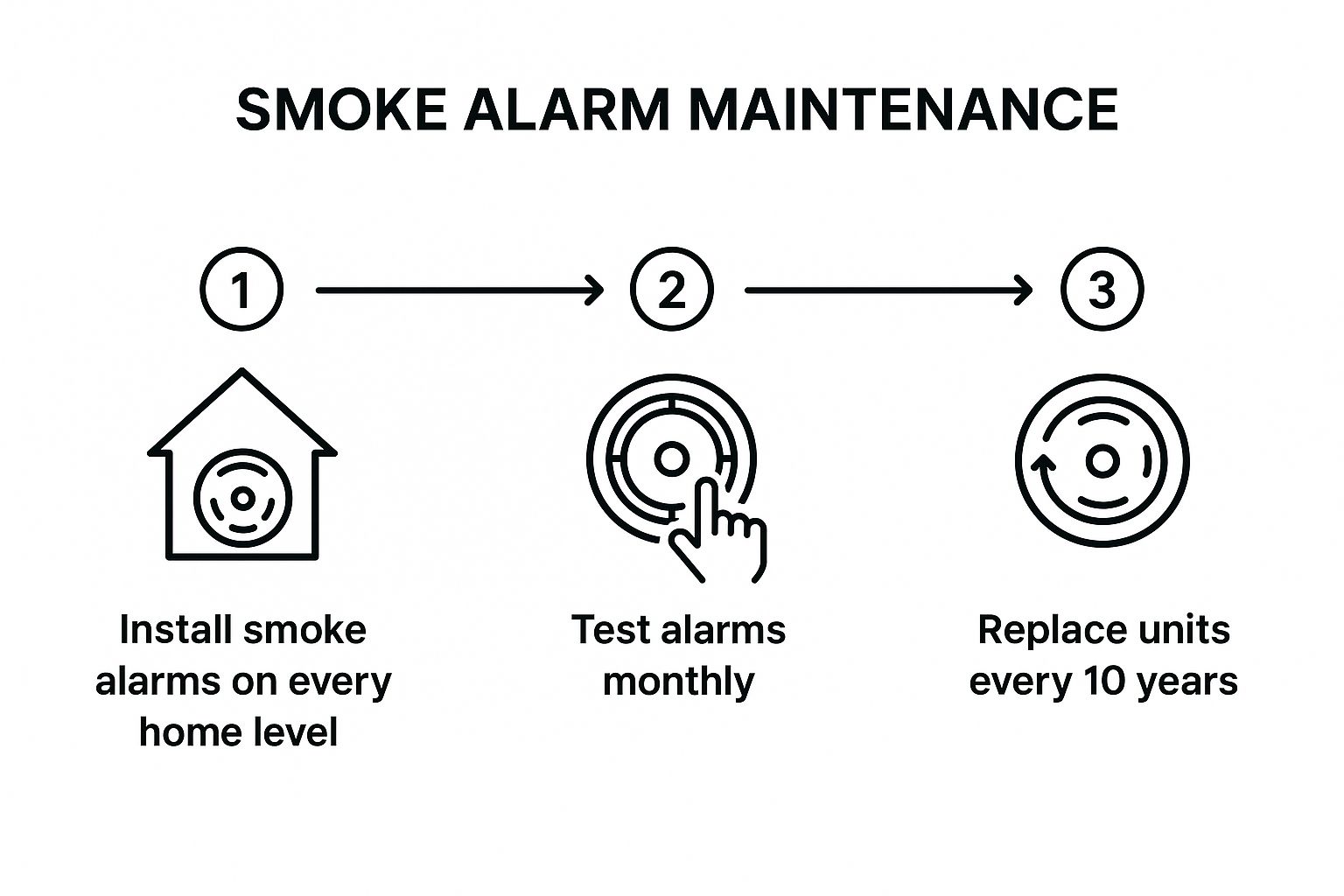
This simple three-step flow: install, test, and replace, forms the foundation of effective smoke alarm safety and is a process every homeowner should commit to memory. Regardless of how well you maintain it, the entire smoke alarm unit has a limited lifespan and must be replaced every 10 years to ensure its sensors remain reliable.
2. Create and Practice Fire Escape Plan
While smoke alarms provide the critical first alert, a well-rehearsed fire escape plan is what turns that warning into a life-saving action. A fire can spread with terrifying speed, leaving you with as little as two minutes to get to safety. An escape plan is a predetermined strategy that maps out primary and secondary escape routes from every room, designates a safe meeting place outside, and ensures everyone in the household knows exactly what to do when an alarm sounds.
This proactive measure, strongly advocated by organizations like the National Fire Protection Association (NFPA) and FEMA, transforms panic into purposeful movement. It accounts for different scenarios, the needs of family members with mobility limitations, and even the safety of pets. Without a plan, family members can become disoriented, separated, or may even attempt to go back inside for belongings, a decision that often proves fatal.

Key Insight: A fire escape plan is not just a map; it is muscle memory. The act of practicing the plan builds the instinct to act correctly under extreme pressure, which can make all the difference when seconds count.
Implementation and Best Practices
Developing and practicing your escape plan is a fundamental part of any comprehensive home fire safety checklist. It is an active, ongoing process, not a one-time task.
Map Your Routes: Draw a simple floor plan of your home, marking two ways out of every room, if possible. This includes windows as secondary exits. Ensure windows and doors open easily and are not blocked. Designate a specific meeting spot outside, a safe distance from the house, like a neighbor's mailbox or a large tree.
Practice Makes Perfect: Conduct a fire drill at home at least twice a year. Practice once during the day and once at night, as a fire can strike at any time. Time your drills; the goal is to get everyone out in under two minutes. This regular practice is essential for building confidence and readiness.
Address Specific Needs: Teach children to feel doors with the back of their hand to check for heat before opening them. If a door is hot, they must use their second way out. Designate a specific person to assist infants, older adults, or family members with disabilities. Plan for your pets by keeping leashes and carriers easily accessible near an exit. Once outside, stay outside and call for help.
A thorough understanding of fire prevention strategies complements your escape plan. To deepen your knowledge, you can explore a guide on how to prevent house fires and integrate its lessons into your safety routine. Taking these steps ensures you are prepared not just to react to a fire, but to proactively minimize its risk in the first place.
3. Maintain Fire Extinguishers
While smoke alarms provide a crucial early warning, a portable fire extinguisher is an essential tool that can empower you to suppress a small, contained fire before it grows into a life-threatening disaster. Having an accessible and functional extinguisher can mean the difference between a minor incident and a catastrophic loss. These first-line defense devices are designed to be used immediately, tackling fires at their source while they are still manageable.
For residential use, the most versatile option is a multipurpose ABC dry chemical extinguisher. This type is effective against Class A fires (ordinary combustibles like wood, paper, and cloth), Class B fires (flammable liquids like grease, gasoline, and oil), and Class C fires (electrically energized equipment). This broad capability makes them ideal for the diverse fire risks present in a typical home.
Key Insight: Owning a fire extinguisher is only the first step. Knowing how to use it, where to place it, and how to maintain it are equally critical components of any effective home fire safety checklist. An extinguisher that is inaccessible, discharged, or past its service date offers no protection.
Implementation and Best Practices
Properly integrating fire extinguishers into your safety plan involves strategic placement, regular checks, and user knowledge. It’s a proactive measure that gives you a fighting chance against a sudden blaze.
Strategic Placement: Fire extinguishers should be located in high-risk areas, most notably the kitchen, garage, and any workshop. The National Fire Protection Association (NFPA) recommends mounting them on a wall, 3 to 5 feet off the floor, in a conspicuous and easily accessible location. Ensure the path to the extinguisher is always clear and unobstructed.
Choosing Your Extinguisher: Select extinguishers based on their intended location. The Kidde Pro 210 is a popular rechargeable ABC model well-suited for kitchens. For vehicles, a more compact unit like the First Alert AUTO5 is designed for the specific fire risks in a car. Even commercial-grade units like the Amerex B402 are sometimes adapted for home use in areas with higher risks, such as a large home workshop.
Maintenance and Usage: Regular upkeep is simple but vital. First, check the pressure gauge monthly to ensure it's in the green "charged" zone. Second, have the extinguisher professionally serviced or replaced according to the manufacturer's recommendations, typically every few years for rechargeable models. Most importantly, everyone in the home should learn the P.A.S.S. technique: Pull the pin, Aim the nozzle at the base of the fire, Squeeze the lever, and Sweep from side to side. Remember to replace any extinguisher immediately after use, even if it was only partially discharged.
This video from the U.S. Fire Administration provides a clear demonstration of the P.A.S.S. technique, an essential skill for every member of your household.
By following these guidelines, you can ensure your fire extinguishers are reliable assets in your home's safety system. Always remember that extinguishers are for small, contained fires only. If a fire is spreading rapidly or you are unsure, your priority is to evacuate immediately and call 911.
4. Install Carbon Monoxide Detectors
While not a direct fire detector, a carbon monoxide (CO) alarm is a critical component of any comprehensive fire safety plan. Carbon monoxide is an invisible, odorless, and tasteless gas created when fuels like gasoline, wood, coal, or propane burn incompletely. Often called the "silent killer," it can incapacitate victims before they are even aware of its presence, which is especially dangerous during a fire when clear thinking is paramount.
Fuel-burning appliances, such as furnaces, water heaters, and fireplaces, are all potential sources of CO. A malfunction in these systems or a blocked vent can cause this lethal gas to accumulate to deadly levels. CO detectors are the only reliable way to be alerted to this threat, providing your family with the crucial warning needed to evacuate.
Key Insight: Carbon monoxide poisoning is a stealthy threat that can occur alongside or independently of a fire. A dedicated CO detector is not an optional extra; it is an essential life-saving device that addresses a distinct but related household danger.
Implementation and Best Practices
Effectively integrating CO detectors into your home fire safety checklist involves understanding their unique placement and maintenance requirements, which differ from smoke alarms.
Proper Placement: The Centers for Disease Control and Prevention (CDC) recommends installing a CO alarm on each level of your home and outside separate sleeping areas. Unlike smoke, which rises, CO mixes with the air. For this reason, detectors can be installed at knee height, though they are also effective on a wall or ceiling. Crucially, place them within 15 feet of any fuel-burning appliance and avoid putting them in kitchens or garages where false alarms can occur.
Choosing the Right Detector: Different homes have different needs. For a home with gas appliances, a model like the First Alert CO615 offers a digital display to show real-time CO levels. For apartments with shared ventilation, a Kidde Nighthawk unit provides reliable protection. For a connected home, a combination smart alarm like the Nest Protect detects both smoke and CO, sending alerts directly to your phone.
Maintenance and Response: Test your CO detectors monthly and replace their batteries annually. Never ignore a sounding alarm. If your CO detector goes off, immediately evacuate everyone from the house, get to fresh air, and call 911 from a safe location. Do not re-enter the home until emergency responders have declared it safe. Finally, have all your fuel-burning appliances professionally inspected each year.
5. Maintain Heating Systems and Chimneys
Heating equipment is a leading cause of home fires, second only to cooking. Regular maintenance of your home’s heating systems, including furnaces, boilers, fireplaces, and wood stoves, is not just about efficiency; it's a fundamental safety measure. Neglected systems can lead to malfunctions that cause fires, or the buildup of dangerous substances like creosote in chimneys, which is highly flammable.
The Chimney Safety Institute of America (CSIA) reports that creosote buildup is a primary cause of chimney fires, which can quickly spread to the rest of the home. Similarly, faulty furnaces or space heaters can ignite nearby combustible materials or leak deadly carbon monoxide. Professional annual inspections ensure these systems operate safely and efficiently, preventing catastrophic failures before they happen.
Key Insight: Proactive maintenance is far less costly and dangerous than reactive repairs. Scheduling professional service before the heating season begins is one of the most effective steps you can take to prevent a winter fire.
Implementation and Best Practices
A systematic approach to heating system care is an essential part of any home fire safety checklist. This involves a combination of professional servicing and routine homeowner tasks.
Schedule Annual Professional Inspections: Before each heating season, have a qualified technician inspect and service your furnace or boiler. For fireplaces and wood stoves, hire a CSIA-certified chimney sweep to clean the chimney and inspect for cracks, blockages, or creosote buildup.
Maintain Clear Space: Keep a minimum three-foot clearance around all heating equipment, including furnaces, water heaters, and portable space heaters. This "safe zone" should be completely free of flammable items like paper, clothing, furniture, and cleaning supplies.
Perform Routine Homeowner Checks: Throughout the heating season, a few simple tasks can make a significant difference. Replace furnace filters monthly, or as recommended by the manufacturer, to prevent dust buildup and improve airflow. Regularly inspect heating equipment for any signs of rust, cracks, or damage.
Use Equipment Properly: When using a fireplace or wood stove, burn only seasoned hardwood, as it produces less smoke and creosote than green or soft woods. Never use flammable liquids to start a fire. Consider installing a chimney cap to prevent debris, rain, and animals from entering and creating blockages.
6. Practice Electrical Safety
Faulty electrical systems are a leading cause of residential fires, with the U.S. Fire Administration reporting over 25,000 electrical fires in homes each year. Practicing electrical safety means proactively identifying and correcting potential hazards in your home's wiring, outlets, and appliances. This vigilance is crucial because electrical fires often start silently within walls or behind outlets, giving occupants little warning before escalating.
These fires typically result from issues like overloaded circuits, damaged wiring, or the misuse of extension cords and power strips. Modern safety devices like Arc-Fault Circuit Interrupters (AFCIs) are designed to detect dangerous electrical arcs, a common cause of such fires, and shut off power before a fire can start. Similarly, Ground-Fault Circuit Interrupters (GFCIs) protect against electrocution, especially in areas with water like kitchens and bathrooms.
Key Insight: Proper electrical safety is not just about preventing shocks; it's about actively managing one of the most significant hidden fire risks in your home. A well-maintained electrical system is a cornerstone of any comprehensive home fire safety checklist.
Implementation and Best Practices
A systematic approach to inspecting and using your home's electrical components can dramatically reduce your risk. This involves both routine checks and adherence to safe usage guidelines.
Inspect and Replace: Regularly examine all electrical cords, outlets, and switches. Any cord that is frayed, cracked, or damaged should be replaced immediately. If an outlet or switch feels warm to the touch, appears discolored, or sparks, it's a sign of a serious problem that requires a qualified electrician.
Avoid Overloads: Never plug more appliances into an outlet than it is designed to handle. Avoid "daisy-chaining" by plugging one power strip into another. High-power appliances like space heaters, refrigerators, and large appliances like dryers should be plugged directly into a wall outlet, not an extension cord. For more details on appliance safety, you can learn more about preventing a dryer lint fire hazard.
Professional Oversight: While simple tasks like testing GFCI outlets can be done yourself, major work should be left to the experts. Have a licensed electrician inspect your electrical panel every 10 years, especially in an older home. Installing modern safety devices like tamper-resistant outlets (if you have young children) or a whole-house surge protector is a worthwhile investment in safety.
The following tips provide a quick reference for daily electrical safety habits that every household member should know and practice.
Test GFCI and AFCI Devices: Press the "Test" and "Reset" buttons on GFCI outlets and AFCI breakers monthly to ensure they are functioning.
Unplug Small Appliances: Unplug items like toasters, coffee makers, and hair dryers when they are not in use to prevent them from becoming a fire hazard.
Use Cords Wisely: Never run extension cords under rugs or carpets, as this can cause them to overheat and present a fire risk. Use extension cords that are rated for the power of the device you are using.
7. Ensure Safe Cooking Practices
The kitchen is often called the heart of the home, but it is also the area with the highest risk for residential fires. According to the National Fire Protection Association (NFPA), cooking equipment is the leading cause of reported home fires and home fire injuries. Unattended cooking is the primary factor in these incidents, making active supervision and safe habits absolutely essential for preventing a devastating kitchen fire.
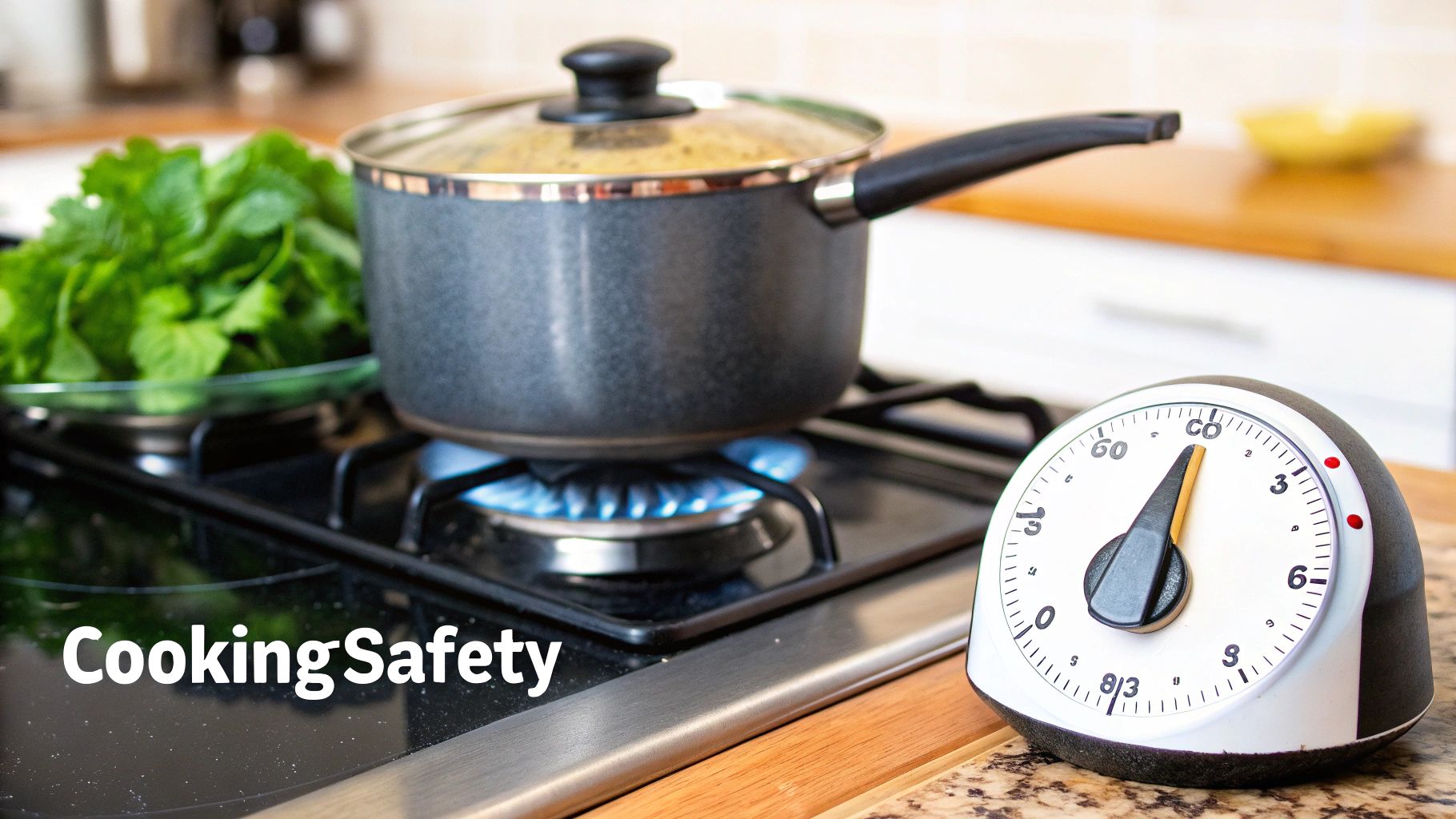
The principles of safe cooking revolve around attention, preparation, and cleanliness. A moment of distraction is all it takes for oil to overheat or food to ignite. By adopting practices common in professional kitchens, such as maintaining a clean cooking area and having suppression tools ready, you can significantly reduce your risk. This proactive approach is a cornerstone of any effective home fire safety checklist.
Key Insight: A clean kitchen is a safer kitchen. Grease and food particle buildup on stovetops, in ovens, and in exhaust vents provide fuel for a fire, allowing it to spread much more quickly. Regular cleaning is not just about hygiene; it is a critical fire prevention measure.
Implementation and Best Practices
Turning safe cooking from a concept into a habit requires conscious effort and a structured approach. Integrating these best practices into your daily routine will build a strong defense against common kitchen hazards.
Practice Active Cooking: The number one rule is to never leave cooking unattended. If you are frying, grilling, or broiling food, stay in the kitchen. If you must leave the room, even for a moment, turn off the stove. For slower cooking methods like simmering or baking, use a timer to remind you to check on the food regularly.
Create a Safe Zone: Keep the area around your stove and other heat-producing appliances clear of anything that can burn. This includes oven mitts, wooden utensils, food packaging, towels, and curtains. Enforce a "kid-free zone" of at least three feet around the stove and areas where hot food is prepared. Also, ensure pot handles are turned inward to prevent them from being knocked over.
Know How to Handle Fires: Never use water to extinguish a grease fire; it will cause the flaming oil to splash and spread the fire. For a small pan fire, slide a lid over the pan to smother the flames and turn off the burner. For an oven fire, keep the door closed and turn off the heat. Always have a Class B or multipurpose fire extinguisher nearby and know how to use it.
Dress for Safety and Cleanliness: Wear short sleeves or close-fitting clothing when cooking to prevent sleeves from dangling into a flame. Routinely clean cooking surfaces to prevent the buildup of grease. This includes the stovetop, the oven, and the microwave.
By making these practices second nature, you transform your kitchen from a high-risk area into a safe space for creating meals and memories. Vigilance is your most important ingredient.
7-Point Home Fire Safety Comparison
Item | Implementation Complexity 🔄 | Resource Requirements ⚡ | Expected Outcomes 📊 | Ideal Use Cases 💡 | Key Advantages ⭐ |
|---|---|---|---|---|---|
Install and Maintain Smoke Alarms | Low: easy installation and upkeep | Low: inexpensive devices and batteries | High: reduces fire death risk by 50% | Every home level, bedrooms, and sleeping areas | Early fire detection, interconnected alerts, smart notifications |
Create and Practice Fire Escape Plan | Medium: planning and regular drills | Low: time and minimal materials | High: reduces evacuation time and panic | Families, multi-room or multi-story homes | Builds preparedness, clear roles, improves safety awareness |
Maintain Fire Extinguishers | Medium: placement and annual checks | Medium: purchase and professional maintenance | Medium: stops small fires before spreading | Kitchens, garages, workshops | Versatile fire suppression, no special training needed |
Install Carbon Monoxide Detectors | Low: simple installation | Low to Medium: device cost plus battery | High: prevents fatal CO poisoning | Homes with fuel-burning appliances or attached garages | Detects invisible CO gas, early warning, legally required |
Maintain Heating Systems and Chimneys | High: requires professional service | High: annual inspection and cleaning costs | High: prevents heating-related fires and CO | Homes with heating equipment, fireplaces, chimneys | Fire prevention, energy efficiency, extended equipment life |
Practice Electrical Safety | Medium to High: inspections and upgrades | Medium to High: may require electrician services | High: prevents electrical fires and electrocution | All homes, especially older or renovated buildings | Advanced protection (GFCI, AFCI), hazard identification |
Ensure Safe Cooking Practices | Medium: behavior changes and vigilance | Low to Medium: some equipment costs | High: prevents most common cause of house fires | Every kitchen and cooking area | Reduces fire/injury risk, simple but effective precautions |
Integrating Safety into Your Daily Routine
Completing a comprehensive home fire safety checklist is more than a simple exercise in ticking boxes; it represents a fundamental shift in how you approach the well-being of your household. It is about transforming abstract safety concepts into tangible, repeatable actions. We have journeyed through the critical pillars of home fire preparedness, from the vigilant beeps of smoke and carbon monoxide detectors to the strategic foresight of a well-practiced escape plan. We have explored the hands-on responsibilities of maintaining fire extinguishers, the nuanced details of electrical safety, and the everyday mindfulness required in the kitchen. Each item on this checklist is a single, powerful layer of protection. When combined, they create a resilient, multi-faceted defense system that safeguards not just your property, but the lives within it.
The true value of this guide lies not in a one-time audit but in its integration into the rhythm of your life. Safety cannot be a "set it and forget it" task. It is a living, breathing commitment that evolves with your family and your home. By weaving these checks into your regular schedule, you cultivate a culture of awareness and preparedness that becomes second nature.
From Checklist to Lifestyle: Your Actionable Path Forward
Moving from knowledge to action is the most critical step. To ensure this checklist becomes a permanent part of your home management, consider these immediate and long-term strategies:
Create a Safety Calendar: Do not rely on memory. Use a digital or physical calendar to schedule recurring safety tasks. For example, set monthly reminders for testing smoke alarms, quarterly reminders to check fire extinguisher pressure, and semi-annual reminders for your family's fire escape drill.
Assign Responsibilities: Involve the whole family. Assign age-appropriate tasks to children, such as ensuring escape routes are clear of toys or helping you test smoke alarms. This fosters a shared sense of ownership and responsibility for everyone's safety.
Build a "Go-Bag" Today: One of the most proactive steps you can take is to assemble an emergency "go-bag" for your family. This should include copies of important documents, a first-aid kit, essential medications, a flashlight, and a portable phone charger. Place it near your primary exit so it is ready at a moment's notice.
The Overlooked Connection: Air Systems and Fire Safety
While many focus on active fire sources, the passive systems within your home play an equally vital role. Your HVAC and dryer vent systems, often out of sight and out of mind, are critical components of a complete home fire safety checklist. A clogged dryer vent, filled with highly flammable lint, is a leading cause of residential fires. Similarly, while HVAC ducts do not typically start fires, they can accelerate one with frightening speed by circulating smoke, toxic fumes, and superheated air throughout the entire home.
Key Insight: A clean air duct system not only reduces potential fuel for a fire but also helps maintain clear, breathable air during a crisis, buying you precious seconds to escape. It is an investment in both hazard reduction and a healthier living environment.
For homeowners, especially those in regions like Phoenix where air conditioning systems run nearly year-round, professional maintenance is not a luxury, it is a necessity. Addressing these specific risks through expert services like duct and vent cleaning closes a significant and often-ignored gap in home safety protocols. By adopting these practices and leveraging professional help where needed, you transform your home from a mere structure into a resilient sanctuary, meticulously prepared to handle the unexpected and secure the well-being of those you love most. Your commitment today builds a safer tomorrow.
Are you ready to address one of the most overlooked fire hazards in your home? The team at Purified Air Duct Cleaning specializes in comprehensive dryer vent and air duct cleaning services, helping Phoenix-area residents reduce fire risks and improve indoor air quality. Secure your peace of mind by ensuring your home’s air systems are clean and safe. Learn more and schedule your service today with Purified Air Duct Cleaning.