

What Is CFM in HVAC and Why It Is Critical for Your Home
When you hear HVAC pros talk about CFM, they're referring to Cubic Feet per Minute. It’s the single most important number for understanding how much air your HVAC system is actually moving. Think of it as the measurement of your system's lung capacity: how much air it can push through your home in a single minute.
This number isn't just technical jargon; it's directly tied to how comfortable you feel and how much you pay on your energy bills each month.
Understanding CFM: The Heartbeat of Your HVAC System
Let’s use an analogy. If your furnace and air conditioner are the heart of your home, then the air flowing through the ducts is the lifeblood. CFM is the metric that tells us how strongly and steadily that lifeblood is circulating.
This airflow is what delivers that refreshing cool air to every corner of your home, while also pushing out stale, dusty air to be filtered. In essence, it's the "breath" your home takes, minute by minute.
The Role of Airflow in Home Comfort
Getting the CFM right is all about ensuring that circulation is balanced and consistent. It's the secret to finally getting rid of those annoying hot and cold spots, giving you an even temperature from the living room all the way to the back bedroom.
Here in Arizona, you know how crucial that is. When the heat is relentless, steady airflow is what makes your home an oasis. If that airflow is weak or blocked, your system just can't keep up, no matter how hard it runs.
This imbalance quickly leads to problems you can feel and see on your utility bill:
Uneven Temperatures: The classic complaint: one room is an icebox while another feels stuffy and warm.
Poor Air Quality: When air doesn't move, dust, allergens, and pet dander have nowhere to go but down, settling on your surfaces instead of being pulled into the filter.
High Energy Bills: An HVAC system fighting against poor circulation has to work overtime, running longer and harder to try and cool your home, which means it's guzzling electricity.
The right CFM isn’t just about raw power; it's about achieving perfect balance. A system with airflow that’s correctly matched to your home's size and layout works smarter, not harder, and that has a direct impact on your family’s comfort and well-being.
Ultimately, the volume of air moving through your ductwork is the foundation of your system's performance. It works hand-in-hand with other forces, and if you want to dig deeper, you can learn more about how resistance impacts airflow by understanding what static pressure in ductwork is and why it matters. Getting a handle on this basic concept is the first real step toward a more comfortable and efficient home.
Why Proper Airflow Is a Pillar of Home Comfort and Health
Let's move past the technical jargon for a minute. The right amount of airflow, that perfect CFM, has a huge, real-world impact on how your home feels every single day. It's the secret ingredient that turns a house with frustratingly uneven temperatures into a consistently comfortable space.
Proper airflow is what actually delivers the cool air from your AC to every corner of your home. Get it right, and you can finally say goodbye to those stubborn hot and cold spots for good.
But it’s about more than just comfort. This constant circulation is a cornerstone of your family's health. Think about it: strong, steady airflow is what allows your HVAC system to actually do its job of filtering the air. It pulls dust, allergens, pet dander, and other junk out of the air you breathe and traps it in the filter, instead of letting it settle on your furniture or in your lungs.
The Connection Between Airflow and Energy Bills
Weak or blocked airflow has a direct, and often expensive, link to your monthly power bill. When your system has to fight against restrictions to move air, it has to work much harder and run much longer just to keep up. For anyone in Phoenix and Mesa, where our air conditioners are the biggest energy hogs, this inefficiency can cause a painful spike in electricity costs.
A finely tuned HVAC system with balanced airflow is an efficient one. It hits your target temperature faster and stays there with less effort. This not only puts less wear and tear on your equipment but also shows up as real savings on your energy bill each month.
Balanced CFM isn't just about moving air; it's about creating a living environment that is healthier, more comfortable, and easier on your wallet. To see how this fits into the bigger picture, you can check out our comprehensive guide to indoor air quality solutions for more ways to improve your home's atmosphere.
Air Quality and Your Family's Well-being
Good ventilation is non-negotiable for flushing stale, polluted indoor air out and pulling fresh air in. Here in the dry climate of the U.S. Southwest, keeping that air moving is critical for respiratory health.
Industry standards, like those from ASHRAE, recommend a minimum of 15 CFM per person just to maintain acceptable air quality. But here’s the kicker: dirty, clogged ducts can slash your system's airflow by up to 40%. This traps the very allergens and pollutants that affect millions of Americans right inside your home. You can find more details about how industry leaders view this topic by reading about the importance of CFM on Trane.com.
While optimizing your HVAC's airflow is a huge step, you can boost your home's air quality even further by using an air purifier with a True HEPA filter. At the end of the day, the amount of air your system moves determines whether it's truly protecting your family or just recirculating the same old contaminants.
How to Calculate the Right CFM for Your Home
Figuring out the perfect airflow for your home isn't some dark art reserved for HVAC engineers. While professionals use advanced tools for pinpoint accuracy, the basic idea behind it is surprisingly simple. It’s all about matching your system’s power to your home’s unique needs for balanced, consistent comfort.
At its core, the calculation starts with the volume of a room and how often all the air inside it needs to be completely swapped out. This refresh rate is what we in the industry call Air Changes per Hour (ACH). Different spaces have different demands; a kitchen filled with cooking smoke and smells needs way more fresh air than a rarely used guest bedroom.
Key Factors in CFM Calculation
Before crunching any numbers, we need to gather some basic intel on your space. Think of it like taking your home's vital signs. The main variables that will shape your CFM needs are:
Square Footage: This is the starting line. The bigger the home or room, the more air needs to be moved.
Ceiling Height: A room with vaulted 10-foot ceilings has a lot more air volume than the same room with standard 8-foot ceilings, and that extra air needs to go somewhere.
Insulation Quality: Let's face it, here in Arizona, the sun is relentless. A home with older, less effective insulation will leak cool air and absorb heat, meaning your AC has to work harder and push more air to keep up.
Sun Exposure: Those beautiful, big windows facing west? They act like mini-greenhouses in the afternoon, heating up the room and demanding a higher CFM to stay comfortable.
A Simple Formula for Estimating Room CFM
You don't need a degree in thermodynamics to get a solid baseline for your airflow needs. This simple calculation can help you understand what HVAC technicians are looking for when they size up a system for a home.
Here is the fundamental formula:
CFM = (Room Volume x Air Changes per Hour) / 60
Let's walk through a real-world example. Picture a typical living room that’s 15 feet by 20 feet with standard 8-foot ceilings.
Calculate the Room Volume: Just multiply the length, width, and height. *
Determine the Recommended ACH: For a common area like a living room, 6 to 8 air changes per hour is a good target. We’ll stick with 6 for this example.
Calculate the CFM: Now, we just plug those numbers into our formula. *
This quick math tells us that this specific living room needs about 240 CFM to feel properly ventilated and comfortable. While this is a great starting point, you can dive deeper into this topic by learning more about how to calculate air changes per hour with our easy indoor air tips.
Of course, this simple formula is just an estimate. It doesn’t factor in things like how leaky your windows are or the specific layout of your ductwork. That’s why having a professional assessment is always the gold standard for getting airflow that’s perfectly dialed in for your home.
Warning Signs of Incorrect HVAC Airflow
Your HVAC system usually gives you some pretty clear hints when its airflow, or CFM, is off-kilter. Catching these signals early is the best way to diagnose a problem before it spirals into something more serious and expensive. Most airflow problems boil down to one of two things: too little air moving, or way too much.
Either way, an imbalance throws your home's comfort, air quality, and even your energy bills out of whack. If you learn to spot these warning signs, you can figure out what your home is trying to tell you about its circulation.
Symptoms of Low Airflow
Low CFM is hands-down one of the most common issues we see. It often sneaks up on you, getting gradually worse until the problems are impossible to ignore. When your system can't move enough air, it's basically fighting an uphill battle, leading to a whole host of frustrating side effects.
If any of this sounds familiar, you might be dealing with weak airflow:
Uneven Temperatures: This is the classic symptom. Some rooms feel great, but others, usually the ones farthest from the furnace or air handler, stay stubbornly hot and stuffy.
Stuffy or Stale Air: Without good circulation, smells and indoor pollutants just hang in the air. If your home feels stuffy even when the system is running, that's a big red flag.
Persistent Dust: When air isn't moving right, it can’t pull dust and allergens back to the filter. Instead, all that gunk settles on your furniture, making it feel like your home is dusty minutes after you've cleaned.
Frozen Evaporator Coil: In really bad cases, low airflow can cause the indoor coil to freeze up completely. Not enough warm air is passing over the coil to keep the condensation from turning to ice, which can cause serious damage to your system.
When your HVAC system’s airflow is weak, it’s like trying to cool your home with a weak whisper instead of a steady breath. The system runs constantly but never quite achieves the comfort you’re paying for, placing unnecessary strain on vital components.
This diagram shows how things like a home's size, ceiling height, and insulation all play a role in figuring out the right CFM.
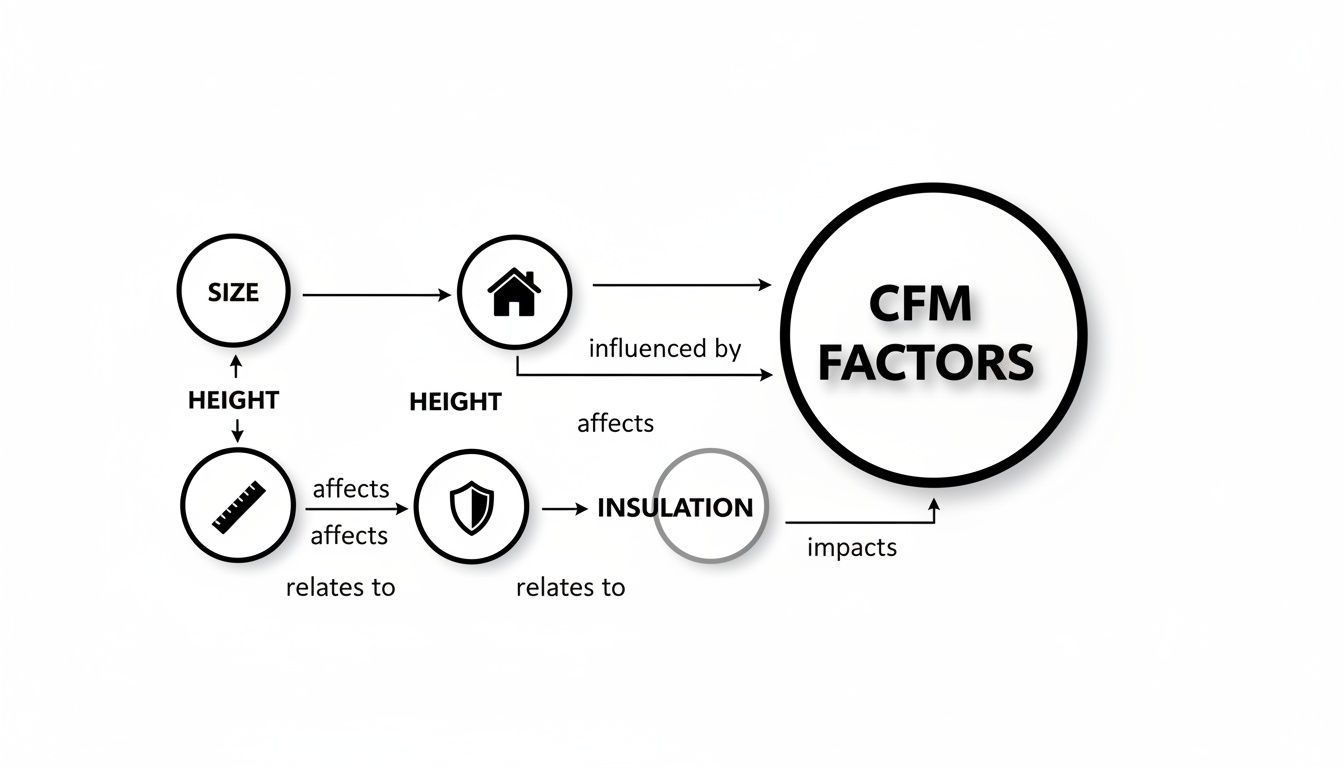
As you can see, getting the "what is cfm in hvac" calculation right isn't a one-size-fits-all deal; it has to be tailored to your home's specific layout. If these symptoms are hitting close to home, it’s time to investigate. A great place to start is learning about the 7 clear signs of dirty air ducts you shouldn't ignore, since clogged ductwork is a frequent cause of airflow restrictions.
Signs of Excessive Airflow
It's less common, but having too much CFM creates its own set of headaches. This usually happens when a system is oversized for the house or the fan speed is cranked up too high, pushing air around too aggressively.
You might have excessive airflow if you notice these things:
Noisy Vents: Air blasting through your ducts too fast can create annoying whistling or humming sounds from the registers.
Uncomfortable Drafts: Even on a blistering hot day, a constant gust of cold air isn't pleasant. Proper air conditioning should feel gentle, not like you're sitting in a wind tunnel.
Poor Humidity Control: When air rushes over the evaporator coil too quickly, it doesn't have enough contact time to pull moisture out of the air effectively. This can leave your home feeling cool but also unpleasantly damp and clammy, a tell-tale sign of a poorly balanced system.
How Clogged Air Ducts Sabotage Your System's Airflow

While things like an oversized HVAC unit can mess with airflow, a much more common culprit is lurking right inside your walls. It's the hidden enemy of your home's comfort and efficiency: dirty ductwork.
Over the years, your ducts collect an unbelievable amount of dust, pet dander, leftover construction debris, and who knows what else. This buildup isn't just gross; it actively sabotages your HVAC system's ability to do its job.
Think of your ductwork as your home's circulatory system. When it's clean, air flows freely, delivering comfort exactly where you need it. But when ducts get clogged, it's like a blockage in an artery. This obstruction forces your system's fan to work exponentially harder just to shove air through those narrowed passages.
The Impact of Restricted Airflow
This constant struggle has a direct, damaging effect on your system's cubic feet per minute (CFM). The fan is still spinning like crazy, but the actual volume of air reaching your rooms takes a nosedive. The U.S. Department of Energy points out that even a dirty filter can significantly reduce airflow; a clogged duct system creates an even bigger, more persistent bottleneck.
This restricted airflow sets off a chain reaction of problems that you can feel in your home and see on your utility bills.
Skyrocketing Energy Bills: Your HVAC unit has to guzzle more electricity to overcome all that resistance, often leading to a painful jump in your monthly costs.
Reduced Comfort: Rooms feel stuffy and you get annoying hot and cold spots. Even with the thermostat cranked, the conditioned air simply can't get where it needs to go.
Poor Indoor Air Quality: That nasty buildup of dust and allergens becomes a reservoir of airborne junk that gets circulated through your home every single time the system kicks on.
Increased System Strain: Forcing your system to fight against this blockage puts immense stress on critical parts like the blower motor and compressor, leading to premature breakdowns and expensive repairs.
Clogged ducts essentially suffocate your HVAC system. They starve it of the airflow it needs to operate efficiently, forcing it to run longer and harder while delivering less comfort, all at your expense.
Restoring Your System's Power
The good news is that this is a completely reversible problem. The most direct and effective fix is a professional air duct cleaning.
By thoroughly cleaning out the entire network of ducts, we remove the years of accumulated gunk that’s choking off your airflow. This one service can restore your system's CFM back to its original, factory-specified levels.
The result? You'll feel more powerful and consistent airflow, breathe cleaner air, and watch your energy consumption go down. It’s the single best thing you can do to bring your HVAC system back to peak performance.
Your Action Plan for Restoring Peak Airflow

Spotting the signs of weak airflow is the first step, but now it's time to roll up your sleeves and take action. The good news? Getting your system's CFM back on track doesn't always mean a massive, expensive project.
You can actually make a huge difference with a few simple checks, saving the professional help for the bigger, more stubborn issues. This plan will walk you from quick DIY wins to high-impact solutions, helping your HVAC system finally breathe freely again.
Start with Simple DIY Checks
Before you pick up the phone to call a technician, there are a handful of things you can do yourself. These quick inspections tackle the most common (and easily fixable) airflow blockers, and you'll often feel the results almost immediately. Think of it as first aid for your HVAC.
Here are the top tasks to knock out first:
Change Your Air Filter: A dirty, clogged filter is the undisputed champion of killing airflow. Seriously. Swap it out for a fresh one based on the manufacturer's timeline, usually every 1-3 months.
Clear All Vents and Registers: Take a quick tour of your house. Is a couch pushed up against a supply vent? Is a rug covering a return? Air needs a clear runway to circulate properly, so move anything that's in the way.
Clean Your Outdoor Unit: Your outside condenser unit has to breathe, too. Head outside and gently clear away any leaves, grass clippings, or other debris that's piled up around it. Aim for at least two feet of clear space on all sides.
Staying on top of these small tasks is key. For a deeper dive into routine care, check out our complete guide on how to maintain your HVAC system with tips for peak performance.
When to Call a Professional
If you've done the basics and your airflow problems are still hanging around, that's a pretty clear signal that the issue is deeper inside your system. This is the point where bringing in a trusted HVAC professional is the best move for your home's comfort and your system's long-term health.
Give a pro a call when you need:
Comprehensive Air Duct Cleaning: This is the single most effective way to get rid of years of caked-on dust, debris, and gunk that are literally choking your system's airflow from the inside out.
System Balancing: A technician has the tools to measure the CFM coming out of each vent. From there, they can adjust the hidden dampers inside your ductwork to make sure every single room gets the right amount of conditioned air, no more, no less.
Frequently Asked Questions About HVAC Airflow
Even after breaking down the details, a few questions always seem to pop up about HVAC airflow. We get it. Here are some quick, straightforward answers to the things homeowners ask us most often, helping you get a final, solid handle on what is CFM in HVAC.
Can My Home Have Too Much CFM?
You absolutely can, and it's a real problem. We often focus on not having enough airflow, but having too much creates a whole different set of headaches. Excessive CFM can make your vents noisy and create uncomfortable drafts. More importantly, it can wreck your humidity control because the air zips over the evaporator coils too fast to pull moisture out effectively.
Real home comfort isn't about raw power; it’s about balance. The goal is always the right amount of CFM for your home's unique layout and needs.
How Often Should Ducts Be Cleaned?
For most homes here in the dusty Arizona climate, a professional air duct cleaning every 3 to 5 years is a solid rule of thumb. Sticking to this schedule is one of the best ways to maintain healthy indoor air and keep that airflow moving efficiently.
Now, that's just a baseline. You'll want to think about more frequent cleanings if you have pets shedding dander, family members with allergies, or if you've just finished a big home renovation. Those situations can load up your ductwork with debris much faster.
Does a Bigger HVAC Unit Mean Better Airflow?
Not a chance. In fact, this is one of the most common and costly mistakes we see homeowners make. An oversized unit is an efficiency nightmare. It blasts your home with cold air so quickly that it shuts off before it has a chance to properly dehumidify the space, leaving you with that cold, clammy feeling.
This constant on-and-off process, known as "short-cycling," also puts a ton of unnecessary wear and tear on your system's components. Great CFM comes from a correctly sized system working in harmony with clean, well-designed ductwork, not from brute force.
Restoring your home's airflow is the key to unlocking better comfort, lower energy bills, and healthier air for your family. The experts at Purified Air Duct Cleaning have the professional tools and deep experience to get your system breathing freely again. Schedule your free quote online today!