

What Is Sick Building Syndrome and How Do You Fix It
Ever get a nagging headache that only seems to pop up at the office? Or a stuffy nose that magically clears up the moment you get home? If that sounds familiar, you might be dealing with Sick Building Syndrome (SBS).
It's a frustrating situation where people feel unwell for no obvious reason, and their symptoms are directly tied to the time they spend in a specific building.
Decoding Sick Building Syndrome
Think of Sick Building Syndrome as a building having its own invisible "pollen": a unique cocktail of irritants that causes a whole slew of vague but persistent symptoms. It's not a specific, diagnosable illness like the flu, but rather a collection of health issues that consistently flare up in one location.
At its core, SBS is an indoor air quality problem. Modern buildings are often sealed tight for energy efficiency, but this can be a double-edged sword. Without proper ventilation, contaminants like dust, chemicals from cleaning supplies, and even mold can get trapped and build up in the air. People breathing this contaminated air for hours on end can start to feel the effects.
The tricky part about SBS is its elusive nature. There's no single test a doctor can run to confirm it. Instead, it's all about the pattern: you feel sick inside the building and feel better once you leave.
The Foundation of an Unhealthy Building
So, what separates Sick Building Syndrome from just having a bad allergy day or catching a cold? It boils down to a few key characteristics. Recognizing these traits is the first step toward figuring out if your home or office is the real culprit behind your health complaints.
For a deeper dive, check out our guide on [how to tell if your home or business has poor indoor air quality](https://www.purifiedairductcleaning.com/post/how-to-tell-if-your-home-or-business-has-poor-indoor-air-quality).
To help you quickly identify the hallmarks of SBS, here’s a simple breakdown of its defining features.
Key Characteristics of Sick Building Syndrome
Characteristic | Explanation |
|---|---|
Location-Specific Symptoms | Health issues (like headaches or fatigue) consistently appear or worsen when you're in a particular building. |
Symptom Relief on Exit | You feel noticeably better shortly after leaving the building. Symptoms often disappear entirely. |
No Specific Diagnosis | Despite feeling sick, doctors can't pinpoint a specific illness or cause for your symptoms. |
Multiple Occupants Affected | It's common for several people in the same building to experience similar, unexplained symptoms. |
This table captures the essence of SBS; it’s not about a single germ, but a pattern of symptoms tied directly to an environment.
The World Health Organization first brought SBS into the spotlight back in 1984, identifying poor indoor air as a major global health risk. They defined it as a condition where people suffer from things like headaches, irritated eyes and throat, fatigue, and dizziness that are clearly linked to their time inside a building but have no specific, identifiable cause.
The defining feature of Sick Building Syndrome is the direct link between symptoms and a building. The collection of symptoms may differ from person to person, but the common thread is that relief is often found just by stepping outside.
This clear connection is what matters most. It tells you that the problem isn't necessarily with you: it’s with the environment you're in. Your building might literally be making you sick.
How to Recognize the Symptoms of SBS

Is it just a stubborn cold, seasonal allergies, or something more? The key to identifying sick building syndrome is connecting the dots between how you feel and where you spend your time. Symptoms often mimic everyday ailments, which makes them incredibly easy to dismiss.
The real clue is their consistent link to a specific building.
Think of it this way: if your headache reliably fades during your commute home or your stuffy nose only acts up at your desk, that’s a huge red flag that your environment is the problem. Moving from a general feeling of being unwell to spotting these distinct patterns is the critical first step.
The symptoms of SBS are frustratingly vague and can vary widely from person to person. However, they generally fall into a few key categories, each tied to how our bodies react to poor indoor air quality.
Neurological and General Symptoms
This is probably the most common bucket of complaints we hear about. These symptoms mess with your overall sense of well-being and ability to think clearly.
Persistent Headaches: A dull, nagging headache that creeps in after you've been in the building for a while and disappears after you leave.
Dizziness and Nausea: A feeling of lightheadedness or an upset stomach that you can’t trace back to food or a virus.
Difficulty Concentrating: People often describe this as "brain fog." It's that frustrating feeling of not being able to focus on tasks you can normally handle with ease.
Unexplained Fatigue: A bone-deep weariness that feels completely out of proportion to your workload or how much you slept the night before.
The most telling sign of sick building syndrome is the timing. If multiple people report feeling better on weekends or during vacation, only for symptoms to return Monday morning, the building itself is the likely culprit.
Respiratory and Mucous Membrane Irritation
Poor indoor air is often loaded with microscopic irritants that directly attack your respiratory system and sensitive membranes in your eyes, nose, and throat. The feeling is almost identical to a bad allergy attack.
These issues can be particularly troublesome, as they are often caused by airborne contaminants getting cycled through the building’s ventilation system over and over. Pollutants like dust, pollen, and even hidden mold spores can trigger these reactions. To learn more about that specific risk, you can explore the connection between mold in air ducts and the symptoms you shouldn’t ignore.
Common Respiratory Signs
Symptom | Common Description |
|---|---|
Throat Irritation | A scratchy, sore, or dry throat that develops during the day. |
Nasal Issues | A constantly stuffy or runny nose that only seems to happen indoors. |
Eye Irritation | Dry, itchy, or watery eyes that make looking at a screen miserable. |
Dry Cough | A persistent cough without other signs of a cold, like a fever. |
On top of all this, some people also experience skin irritation, like unexplained dryness, itchiness, or even rashes. These varied symptoms create a confusing picture, but when you look at them through the lens of location and timing, they point directly toward an unhealthy indoor environment.
The Hidden Culprits Behind a Sick Building
So, what flips the switch on a perfectly normal-looking building, turning it into a place that makes people feel unwell? It’s almost never one single thing. Instead, Sick Building Syndrome is usually the result of a complex cocktail of factors that quietly sabotage your indoor air quality. Pinpointing these culprits is the first real step to figuring out if your own space has a problem.
Think about a room that’s been sealed shut, no open windows, no fresh air. What happens? Every little contaminant, from dust and chemicals to the carbon dioxide we exhale, just builds up and stagnates. That’s a pretty good picture of what happens inside many modern buildings, where poor ventilation traps pollutants and creates a genuinely unhealthy environment.
These trapped pollutants typically fall into three buckets: chemical, biological, and physical. Each plays its part, working together to turn a place of comfort or productivity into a source of chronic illness.
Chemical Contaminants
One of the biggest offenders in sick buildings is the presence of chemical contaminants. These are often brought into our spaces by the very materials we use to build, furnish, and clean them.
Volatile Organic Compounds (VOCs): These are gases that get released from solids or liquids. You know that "new car" or "new paint" smell? That’s often the smell of VOCs off-gassing into your air from things like fresh carpet, new office furniture, and paint.
Cleaning Products: The very products we use to keep things tidy, common cleaners, air fresheners, and pesticides, can release chemicals that linger long after you’ve used them, irritating airways.
Office Equipment: Even things we see every day, like printers and copiers, can emit ozone and fine particles that chip away at the air quality.
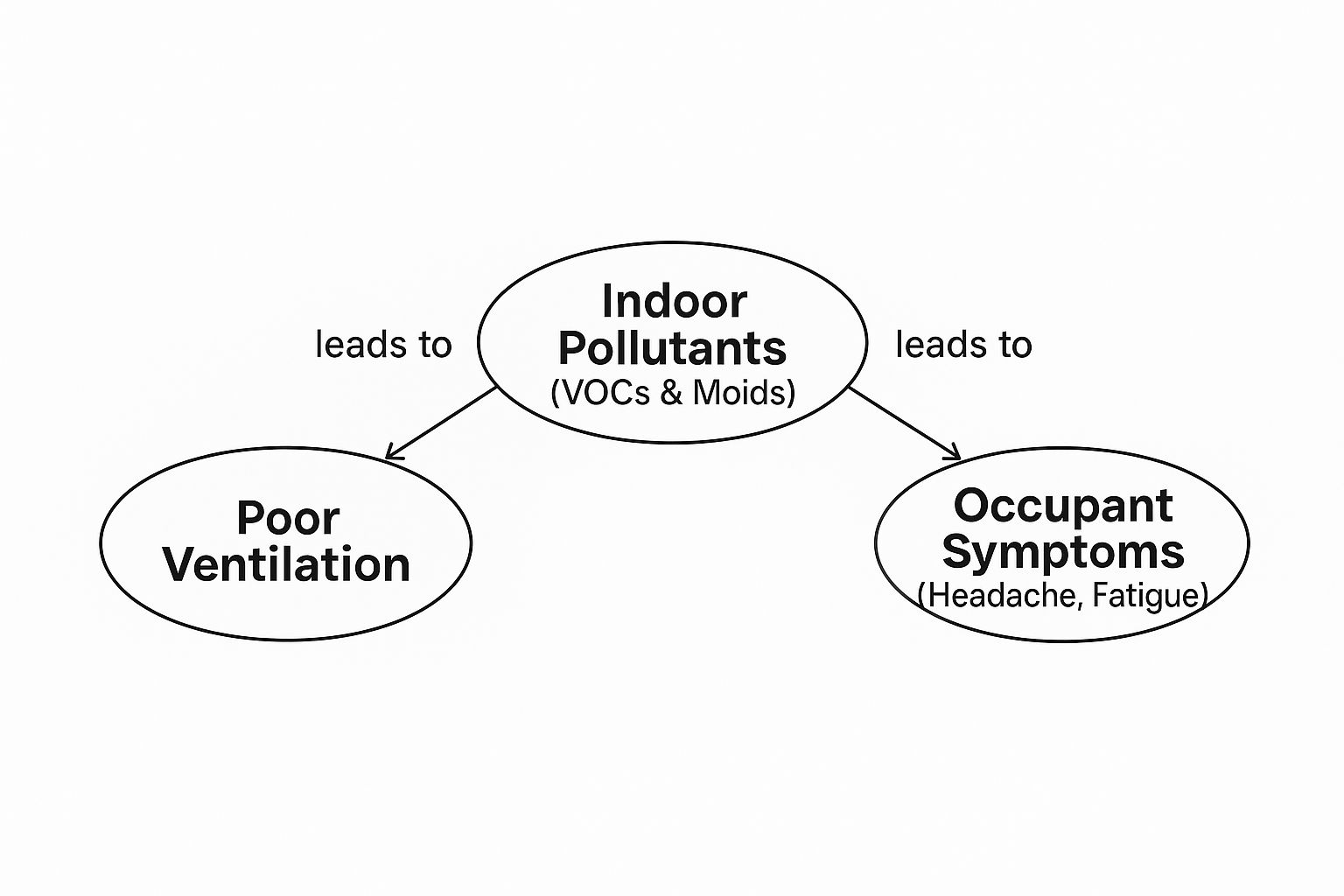
As this image shows, poor ventilation is the foundation of the problem. It creates the perfect conditions for these indoor pollutants to accumulate, which directly leads to the symptoms people start to experience.
To better understand where these invisible threats come from, let's break them down.
Common Sources of Indoor Pollutants in Buildings
Pollutant Type | Common Sources | Potential Health Effects |
|---|---|---|
Volatile Organic Compounds (VOCs) | Paint, new carpet, furniture, adhesives, cleaning products, air fresheners | Headaches, nausea, dizziness, eye/nose/throat irritation, long-term organ damage |
Biological Contaminants | Mold, mildew, bacteria, viruses, dust mites, pollen | Allergic reactions, asthma attacks, respiratory infections, sinus congestion |
Combustion Pollutants | Tobacco smoke, unvented heaters, gas stoves | Respiratory irritation, carbon monoxide poisoning, increased risk of cancer |
Physical Particulates | Dust, fibers (from insulation/textiles), dirt | Lung irritation, coughing, aggravation of existing respiratory conditions |
This table highlights just how many everyday items can contribute to an unhealthy indoor environment. Without proper ventilation and air purification, these pollutants have nowhere to go but into our lungs.
Biological Contaminants
Next up are the biological contaminants. We’re talking about living or once-living organisms that absolutely love indoor environments, especially when there’s a little moisture to help them along. These are the sneakiest culprits because they often grow completely out of sight.
A sick building is often just a sign of an imbalanced indoor ecosystem. When ventilation is poor and humidity is high, the building can become a breeding ground for contaminants that would otherwise be harmless.
Some of the most common biological troublemakers include:
Mold and Mildew: These fungi set up shop in damp, dark places like bathrooms, basements, and inside HVAC systems where condensation collects. They release tiny spores into the air that can trigger serious allergic reactions and respiratory problems.
Bacteria and Viruses: Crowded indoor spaces with poor airflow are the perfect place for airborne bacteria and viruses to spread from person to person.
Pollen and Dust Mites: These classic allergens get trapped in carpets, furniture, and especially inside your air ducts, where they get blown around the building on a constant loop.
The health problems from dirty air ducts can be especially significant, as your HVAC system can act like a superhighway, delivering these biological particles to every single room.
Physical and Environmental Factors
Finally, we have physical factors baked into the building's design and day-to-day operation. These elements are all about how air moves (or doesn't move), how comfortable the space feels, and how concentrated pollutants are allowed to get. Poor ventilation, inconsistent humidity control, and fluctuating temperatures are all major players here.
This isn’t just speculation; research from the National Center for Biotechnology Information has confirmed it. Their data clearly shows that indoor pollutants like VOCs and bioaerosols are key drivers of Sick Building Syndrome worldwide, making it a serious public health issue.
Identifying the Key Risk Factors
Ever wonder why some buildings feel "off" while others feel fine? Or why certain people in the office are always complaining of headaches while others feel perfectly healthy? It all comes down to a mix of the building's own weaknesses and our individual sensitivities.
When these factors overlap, an otherwise normal space can become a breeding ground for health issues. Not every building is built the same, and some are just more prone to trapping pollutants because of how they're designed or maintained. Let's break down what to look for.
Building-Specific Vulnerabilities
Some buildings are practically set up for failure when it comes to air quality. Think about modern, super-efficient buildings; they often have sealed windows to save on energy. That’s great for the power bill, but terrible for airflow, as it traps every little contaminant inside.
Here are a few common culprits:
Outdated HVAC Systems: An old, creaky heating and air conditioning system is more than just noisy. It's often terrible at filtering air and can't control humidity properly, rolling out the welcome mat for mold and bacteria.
Poor Ventilation: This is a big one. If you're not bringing in enough fresh air, you're just recirculating the same stale, polluted indoor air over and over. Contaminant levels can skyrocket.
Recent Renovations: That new carpet smell? It's not a good thing. New paint, furniture, and flooring can release a cocktail of volatile organic compounds (VOCs) into the air in a process called off-gassing. Without good ventilation, those chemicals are stuck in there with you.
These elements are all part of what experts call Indoor Environmental Quality (IEQ), and they're the main suspects behind Sick Building Syndrome. In fact, scientific reviews found that a whopping 49.09% of studies on SBS looked only at IEQ factors. Another 40% looked at both the building and the people in it. You can read more about these findings on the National Center for Biotechnology Information website.
Occupant-Related Factors
Of course, the building is only half the story. The people inside it matter just as much. Not everyone who steps into a "sick" building will have the same reaction, or any reaction at all.
Some of us are just more vulnerable. Our bodies are more sensitive to what's in the air, making us the "canaries in the coal mine" who feel the effects first.
An individual's pre-existing health condition can act like an amplifier for the effects of poor indoor air. A person with asthma might experience a severe reaction to airborne dust that someone else wouldn't even notice.
This is where your personal health and even your job description become major risk factors.
Pre-existing Conditions: If you have allergies, asthma, or other respiratory issues, you're going to be more sensitive to airborne irritants like dust, mold spores, and chemical fumes.
Compromised Immune Systems: People with weakened immune systems can have a much harder time dealing with biological contaminants like bacteria and viruses that get circulated through the air.
Job-Specific Exposure: Where you sit in the office can make a difference. Employees working near the copy room get blasted with ozone and fine particles from the machines, while someone stuck in a stuffy, windowless corner is breathing in more concentrated, stale air.
By understanding both a building's weak spots and your own personal sensitivities, you can get a much clearer picture of your risk. Getting IEQ right is the foundation of a healthy indoor space. You can learn more by checking out our [guide to indoor environmental quality standards](https://www.purifiedairductcleaning.com/post/a-guide-to-indoor-environmental-quality-standards).
Proven Solutions for a Healthier Building
Once you start connecting the dots and suspect your environment is making you sick, it's time to take decisive action. Reclaiming your indoor space from the invisible troublemakers behind sick building syndrome isn't a one-and-done fix. It demands a proactive, two-pronged approach: first, you have to get rid of the pollutants already there, and second, you need systems in place to keep the air and surfaces clean continuously.
The best place to start is with the building's own circulatory system: its HVAC network. You'd be shocked to see what builds up in air ducts over time. We're talking about a nasty collection of dust, mold spores, bacteria, and allergens that turns your ventilation system into a superhighway for contaminants, blasting them into every single room.
Start with Professional Air Duct Cleaning
Think of your building's HVAC system as its lungs. If they're clogged and dirty, the whole building is going to feel it. Just changing the filter is like putting a band-aid on a deep wound; it won’t solve a deep-seated problem.
That’s why professional air duct cleaning is the critical first step. Certified technicians use specialized, powerful tools to dislodge and safely vacuum out years of accumulated grime from deep inside your ductwork. This is far more than a surface clean. It's a foundational reset for your building's air quality, clearing out the main reservoir where pollutants have been hiding.
By physically removing these hidden contaminants, you immediately lighten the load on anyone struggling with allergies or respiratory issues. To get a better handle on the entire process, this comprehensive [air duct cleaning and sanitizing guide for homeowners](https://www.purifiedairductcleaning.com/post/air-duct-cleaning-sanitizing-guide-for-homeowners) breaks down exactly what's involved.
Since mold is one of the biggest culprits behind poor indoor air, getting smart about [preventing carpet mold](https://3n1services.com/how-to-prevent-carpet-mold/) is another key piece of the puzzle for creating a healthier space.
A clean HVAC system is the baseline for a healthy building. Without addressing the source of contaminant distribution, any other solution is merely a temporary fix.
Go Beyond Filters with Active Air Purification
After getting your ducts professionally cleaned, the next move is to keep the air pure going forward. Standard HEPA filters do a great job of trapping airborne particles that happen to pass through them, but they’re completely passive. They can’t touch the germs on your desk, your kitchen countertop, or that doorknob everyone touches. And they certainly can't neutralize chemical gases like VOCs.
This is where active air purification technologies really change the game. Systems like ActivePure don't just sit back and wait for pollutants to come to them. Instead, they go on the offense, actively seeking out and destroying contaminants everywhere in your space.
Originally developed in partnership with NASA, this technology works by creating and sending out safe, oxidizing molecules into the air. These molecules neutralize nasty pathogens like viruses, bacteria, and mold spores the moment they make contact, both in the air and on surfaces. It’s like having a silent, invisible cleaning crew working 24/7.
Here’s why it’s a more complete solution:
Reduces Surface Contaminants: It cleans high-touch surfaces like doorknobs and keyboards without you having to lift a chemical spray bottle.
Neutralizes Airborne Pathogens: It zaps viruses and bacteria right out of the air before they even have a chance to spread.
Eliminates VOCs and Odors: It actually breaks down harmful chemical gases and funky smells, rather than just covering them up.
When you combine a deep HVAC cleaning with an advanced, active purification system, you create a powerful one-two punch. This strategy doesn't just put a bandage on the symptoms of a sick building; it tackles the root causes head-on, ensuring a consistently cleaner, healthier, and safer indoor environment for everyone inside.
Frequently Asked Questions About SBS
When you start digging into sick building syndrome, a lot of practical questions come up about how it all works in the real world. Let's tackle some of the most common ones to help you figure out what's going on and what to do next.
How Is Sick Building Syndrome Different From a Specific Allergy or Cold?
The biggest giveaway is the pattern. Think about it: a cold virus or a seasonal allergy to something like pollen doesn't care where you are. It's going to follow you from home to the office to the grocery store.
Sick building syndrome is different because the symptoms are tied to a specific building. You might feel fine all morning at home, but then an hour into your workday, your head starts to ache and your eyes get itchy. The real clue? You feel better not long after you leave the building for the day.
Ultimately, SBS isn't a single illness that sticks with you; it's a collection of symptoms triggered by a place.
Can Sick Building Syndrome Affect Me at Home?
Yes, absolutely. We often hear about SBS in big office buildings, but the same problems can pop up right in your own house.
Anything from poor ventilation and fumes from new furniture or carpet to hidden mold and even the chemicals in everyday cleaning products can tank your indoor air quality.
Here's the classic sign: if you consistently feel worse inside your house than you do outside or anywhere else, it's a huge red flag. That pattern strongly suggests your home environment is the root of the problem, and it's time to investigate your indoor air quality.
What Should I Do if I Suspect My Workplace Is Causing SBS?
If you're pretty sure your office is making you sick, your first step is to become a detective. Your best tool is a clear record of what's happening.
Start a simple log. Note what your symptoms are, when they show up, how bad they feel, and, this is key, when they start to fade. This helps draw a clear line connecting your symptoms to the building.
Then, discreetly ask a few coworkers if they've been feeling off. A group of people experiencing the same thing is much harder to ignore. Armed with your notes and some backup, you can then approach your manager, HR, or the building's facility manager. Remember, employers have a responsibility to provide a safe work environment.
Are Standard HEPA Air Purifiers Enough to Solve SBS?
While HEPA (high-efficiency particulate air) filters are fantastic at trapping things floating in the air, like dust, pollen, and pet dander, they're only part of the puzzle. They are a passive technology, meaning they can only clean the air that gets pulled directly through them.
That's their main drawback. A HEPA purifier won't do anything about the germs and contaminants that have already landed on your desk, keyboard, or doorknobs. Plus, they can't touch chemical gases, known as volatile organic compounds (VOCs), which are a major contributor to SBS.
To really tackle sick building syndrome, you need a more comprehensive, active approach. An active system goes beyond just filtering the air and works to neutralize contaminants on surfaces throughout the entire space, giving you a much more complete solution.
Ready to take control of your indoor air quality and create a healthier environment for your family or employees? Purified Air Duct Cleaning offers expert solutions, from professional air duct cleaning to the installation of advanced ActivePure technology. Contact us today for a free quote and breathe easier knowing your air is in the hands of certified professionals. Visit us at https://www.purifiedairductcleaning.com to learn more.