

AC Coil Cleaning Pressure Washer: A Safe Step-by-Step Guide
The popular advice is simple: never use a pressure washer on an AC coil. That warning protects many homeowners, but it leaves out an important distinction. A controlled, low-impact rinse is not the same as aiming a close, angled blast at delicate aluminum fins, and the right choice depends on the coil, its condition, the equipment limits, and your ability to protect electrical parts.
Coil cleaning can recover lost heat-transfer performance when dirt, grease, or biological deposits restrict the system. An EPA pilot field study published in 1996 estimated that heat removed by the cooling coil increased by approximately 14% to 23% after cleaning. The researchers also cautioned that the sample was small and the observation period was short, so those results don't justify promising a fixed whole-system energy saving.
The practical rule is straightforward: treat ac coil cleaning with a pressure washer as controlled maintenance, not a brute-force washing job. The sections below show where pressure helps, where it causes damage, and how to verify whether the cleaning improved operation.
Why Pressure Washing an AC Coil Is Riskier Than It Looks
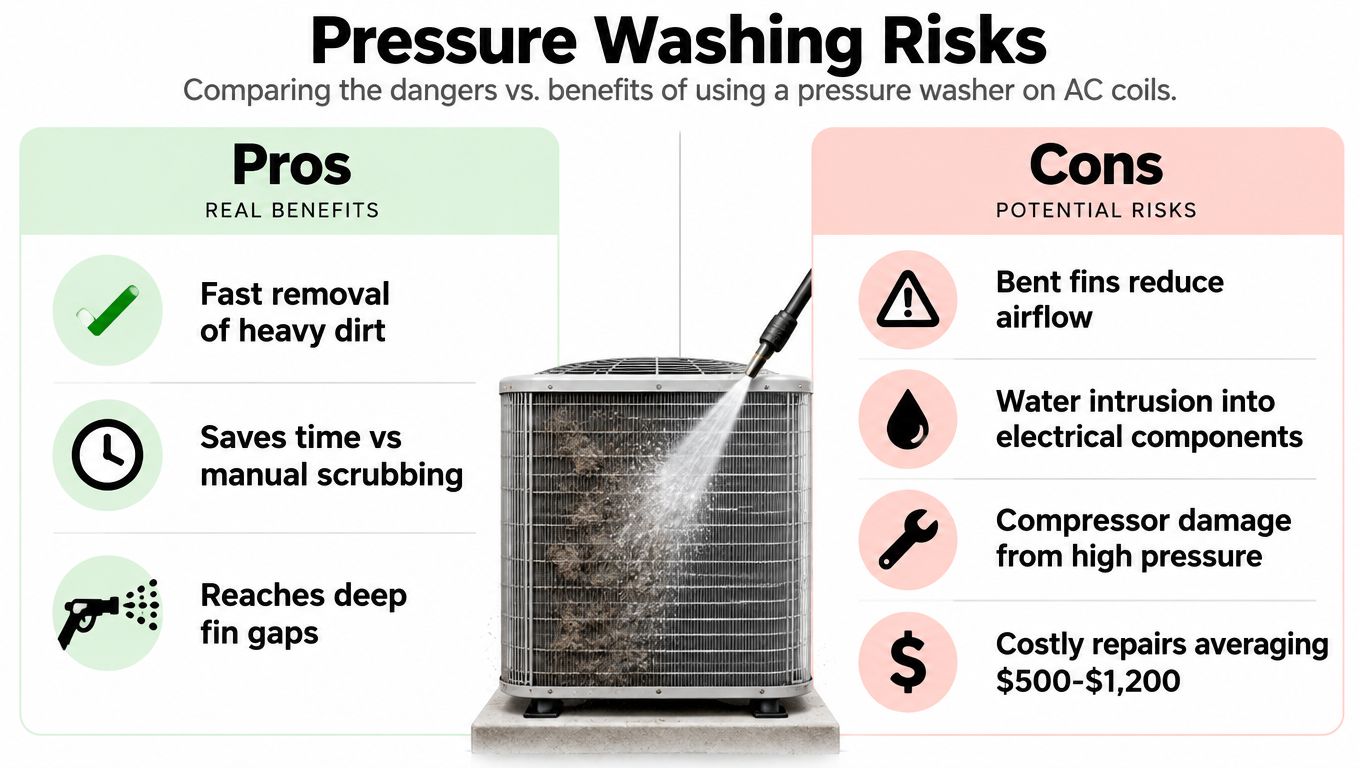
A pressure washer can clean an AC coil quickly, then leave it performing worse. The machine may produce 1,500 to 3,000 PSI, while aluminum coil fins are thin, closely spaced, and easy to deform. The right question is not whether pressure can remove dirt. It is whether the coil, fin condition, nozzle distance, spray pattern, and electrical protection make that pressure controllable.
Many residential coils use roughly 8 to 20 fins per inch. Flatten only part of that fin pack and you reduce the open path for air. Static pressure rises, the fan moves less air, and the condenser may run at a higher temperature. A surface can look bright after washing while the compressed section still restricts airflow.
A narrow nozzle held close to the coil creates the greatest risk. An angled jet can fold fins over instead of passing between them, cut into soft aluminum, bend the tubing behind the fins, or drive dirt farther into the coil. Water can also reach electrical components. The damage is not limited to appearance, and a pressure washer does not straighten fins or repair corrosion.
Cleaning still has a legitimate purpose. The EPA field study cited earlier found better cooling-coil heat removal after cleaning, with the benefit depending on how dirty the equipment was at the start. A lightly dusty coil has little fouling to remove. Grease, cottonwood, pet hair, and biological deposits can block airflow and reduce heat transfer, so cleaning may recover lost performance.
Field rule: A clean-looking coil is not proof of a successful service. Check the fin pack and operating measurements, because a damaged coil can look spotless while restricting the system.
The performance benefit has limits
Carrier guidance cites DOE-related information that raising condensing temperature from 95°F to 105°F can reduce cooling capacity by 7% and increase power consumption by 10%. Its discussion also references an EPA-linked evaluation reporting an approximately 12% average efficiency improvement after treating existing air-cooled HVAC coils. These figures describe particular conditions, not a guaranteed result for every home. Coil fouling, refrigerant charge, airflow, climate, and operating schedule all affect the outcome, as Carrier guidance explains.
Outdoor condenser coils usually offer more control because runoff stays outside and access is available from multiple sides. Indoor evaporator coils demand greater caution. Water can reach the air handler, circuit board, blower motor, insulation, or ceiling cavity, creating electrical and property-damage risks.
Pressure is only one setting. Fan width, nozzle distance, spray angle, water volume, detergent, and operator control matter just as much. If fins are broadly flattened, the coil sits inside an air handler, or the equipment instructions do not permit rinsing, use a soft brush, an approved no-rinse cleaner, or a qualified HVAC technician instead.
Pre-Cleaning Inspection and Safety Checklist
Before water touches the coil, identify which coil you're cleaning. The outdoor condenser coil sits inside the exterior unit and releases heat from the refrigerant. The indoor evaporator coil is commonly installed inside a furnace, air handler, attic cabinet, closet, or crawlspace, where runoff can damage surrounding equipment and building materials.
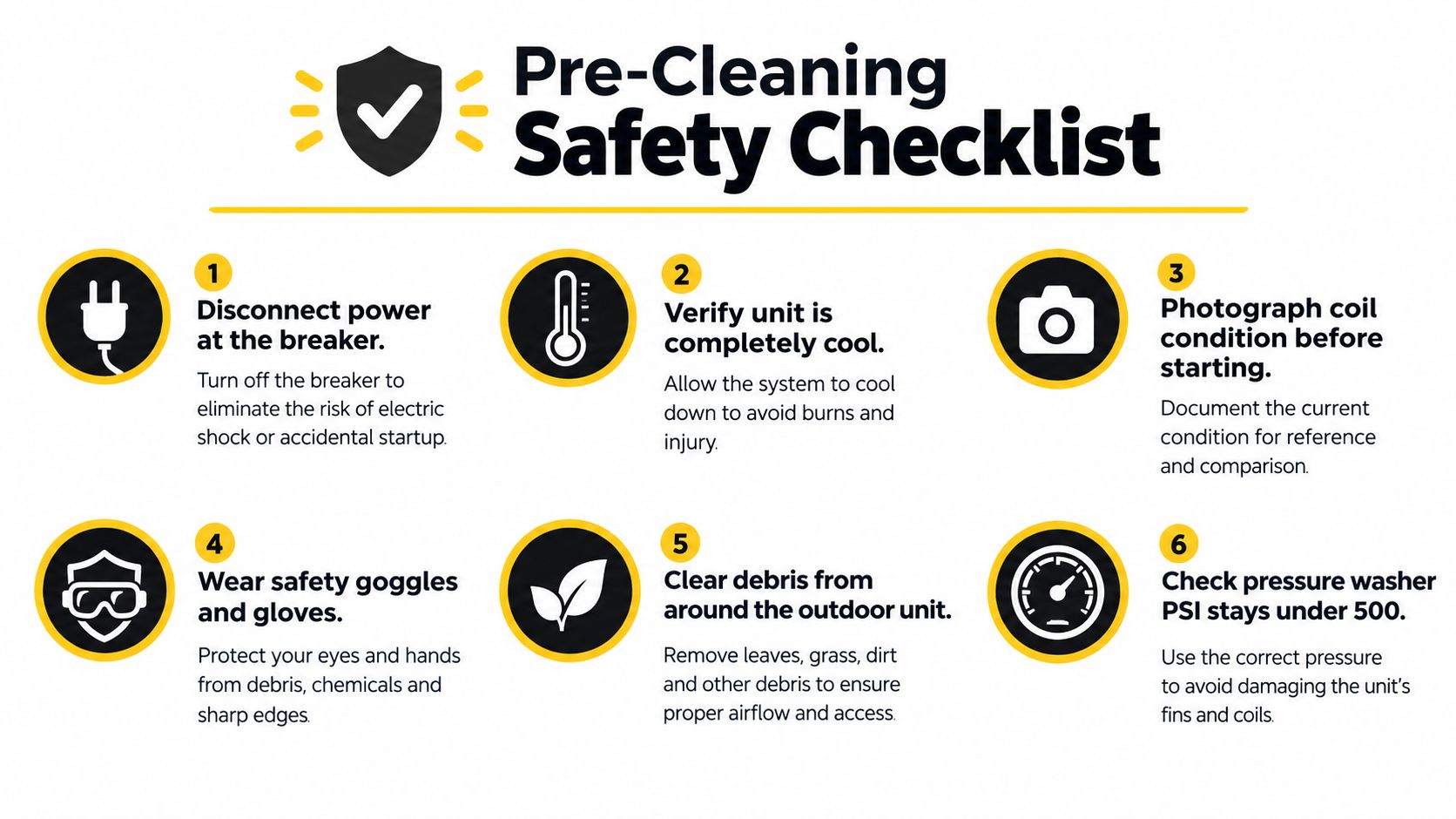
Start at the electrical panel. Switch off the breakers serving the air conditioner and indoor blower, then verify that the equipment is de-energized before removing panels. Don't rely only on the thermostat. A technician uses lockout and tagout practices because another person can restore power while the cabinet is open.
Inspect the coil before choosing a method
Use a flashlight and photograph the fin pack before cleaning. Look for broad sections of flattened fins, oily residue, biological deposits, heavy pet hair, blocked passages, corrosion, and signs that the condensate pan or drain is already full. If the coil is fragile or badly damaged, pressure won't restore it.
Cover or shield motors, control boards, capacitors, sensors, electrical junctions, and exposed wiring from spray and runoff. For indoor work, also plan containment before applying any liquid. A wet vacuum, containment mat, towels, and a controlled drain path are more important than having a powerful washer.
Remove loose debris with a soft brush or low-pressure air. Work gently in the direction of the fins. This first pass reduces the amount of material that water must carry through the coil and helps you see whether the remaining fouling is oily, biological, or dry dust.
Confirm drainage and equipment conditions
Check that the condensate pan is intact and that the drain can carry water away. A partially blocked drain can overflow as soon as cleaning water enters the pan. On an outdoor unit, clear leaves, weeds, and loose debris around the cabinet so runoff doesn't carry contamination back toward the coil.
Wear eye protection and gloves, especially when using coil detergent. Use only a manufacturer-approved, noncorrosive product compatible with aluminum. Acidic or aggressive cleaners can corrode the coil, and more chemical strength doesn't compensate for poor rinse control.
Gasoline-powered pressure washers must not operate inside buildings or partially enclosed spaces. Their engines produce carbon monoxide, which can accumulate rapidly. NIOSH pressure-washer safety guidance recommends placing the pump and power unit outdoors, away from air intakes, and routing only the high-pressure hose indoors.
For questions about indoor air equipment, system access, and related service decisions, review the HVAC maintenance FAQs before opening a cabinet.
Step-by-Step Pressure Washer Procedure for AC Coils
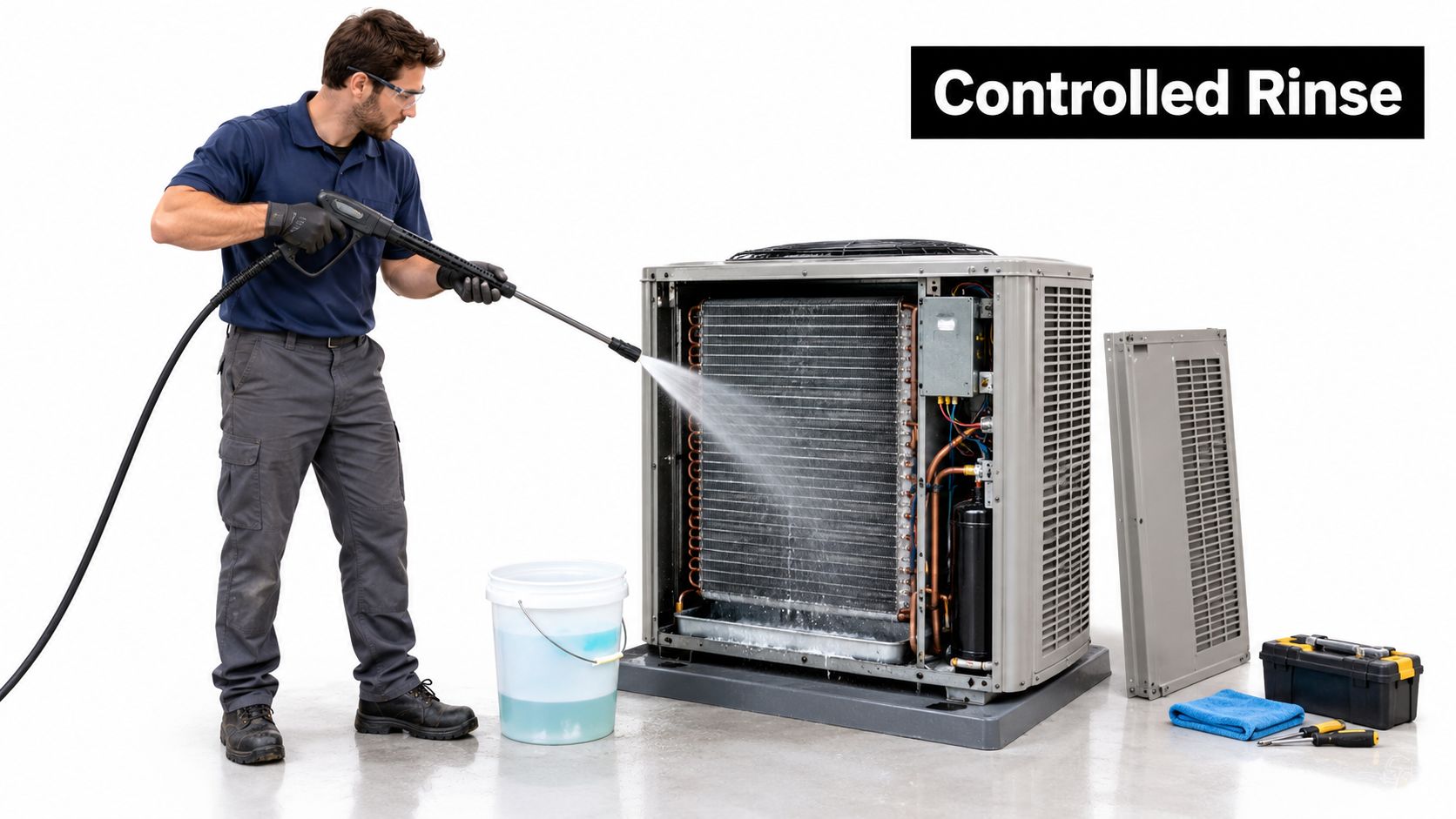
A pressure washer should behave like a controlled rinse, not a blasting tool. If you can't keep the wand moving, maintain distance, protect the equipment, and control the runoff, stop and use a lower-impact method or hand the job to a technician.
Set the washer within a conservative working envelope
EVAPCO's equipment-maintenance guidance specifies a maximum spray pressure of 1,500 psig, a wand distance of at least 12 inches, and a nozzle of 25 degrees or wider to reduce the risk of fin deformation, tube damage, and accelerated corrosion. Follow the equipment manufacturer's lower limit if it provides one.
Start farther away and use the widest practical fan pattern. Keep the nozzle perpendicular to the fin surface and move continuously. Never park the spray on one spot, sweep along the fins at a sharp angle, or use a concentrated tip to chase a stubborn patch.
Practical rule: If the spray bends the fins, the setup is too aggressive. Increase distance, widen the pattern, reduce pressure, or stop.
First rinse loose dirt from the clean side toward the dirty side when access permits. On an outdoor condenser, that generally means directing water from the inside outward so debris exits rather than becoming more tightly packed. Avoid spraying directly at electrical components, fan motors, control compartments, and seals.
Use detergent only when the deposit calls for it
Dry dust and loose debris may need only a gentle rinse. Oils, biological deposits, and compacted grime may require a manufacturer-approved, noncorrosive coil detergent. Apply enough to wet the surface, allow the specified dwell time, and don't let the product dry on the aluminum.
Rinse thoroughly with the same controlled pattern. Keep the wand moving and watch the runoff. If water starts traveling toward controls, the blower compartment, wall cavities, or an uncontrolled drain, stop immediately.
This professional coil-cleaning workflow should include more than a visible rinse. After cleaning, inspect the entire fin pack, check the drain path, and use a fin comb only for minor, isolated fin damage. A fin comb won't repair crushed sections or tube damage.
A short visual demonstration can help you understand the motion and distance, but a video can't replace the equipment manual or a technician's inspection.
Record the system's baseline readings before service and repeat them after the unit has returned to stable operation. If airflow, static pressure, temperature behavior, or electrical operation is abnormal afterward, don't keep washing. The next step is diagnosis.
Pressure Washer vs Other Coil Cleaning Methods
The strongest tool is rarely the best first tool. A conventional washer can move heavy dirt quickly, but it also has the widest damage potential. A garden hose, pump sprayer, or professional coil-cleaning pump may provide enough water and control without exposing delicate fins to a concentrated blast.
Method | Best For | Fin Safety Risk | Indoor Use |
|---|---|---|---|
Pressure washer | Accessible outdoor coils with severe fouling, only within manufacturer limits | High if distance, angle, or nozzle control is poor | Rarely appropriate, requires strict containment and electrical protection |
Garden hose with wide fan nozzle | Routine outdoor dust and loose debris | Low when used gently and perpendicular to fins | Usually unsuitable without containment |
Pump-up sprayer | Applying approved detergent to localized deposits | Low, because pressure and volume are limited | Possible for no-rinse products, but cabinet access and runoff remain concerns |
Foaming coil cleaner | Oily or biological deposits on accessible surfaces | Depends on chemical compatibility and brushing technique | Often more practical than rinsing, but follow the product and equipment instructions |
Dedicated professional coil-cleaning pump | Indoor or commercial work requiring controlled flow and recovery | Lower when operated by trained personnel | Appropriate when technicians can isolate equipment and manage wastewater |
Consumer and commercial pressure washers commonly operate around 1,500 to 3,000 PSI, while concentrated high-pressure spray can flatten thin aluminum fins and restrict airflow even after dirt removal. That makes pressure washers a poor default for indoor evaporator coils, where water management is as important as fin protection.
Match the method to the fouling
A garden hose with a broad pattern is often enough for loose outdoor dust. It gives up speed and reach, but the lower impact makes operator error less costly. A pump-up sprayer works well for applying a compatible cleaner to a small contaminated area, especially when rinsing would threaten nearby electrical equipment.
Foaming cleaner isn't a substitute for diagnosis. It can loosen deposits, but an incompatible chemical can corrode aluminum, and residue left in the fin pack can create a new problem. Read the product label and equipment instructions rather than assuming household detergent is harmless.
Indoor evaporator coils frequently need access panels, containment, wet-vac recovery, and careful protection of the furnace or air handler. If the coil has severe buildup, a technician may need to open more of the cabinet or use specialized equipment. An in-duct air-scrubber resource can address a different air-quality concern, but it doesn't replace coil cleaning or repair.
Measuring Whether the Cleaning Actually Worked
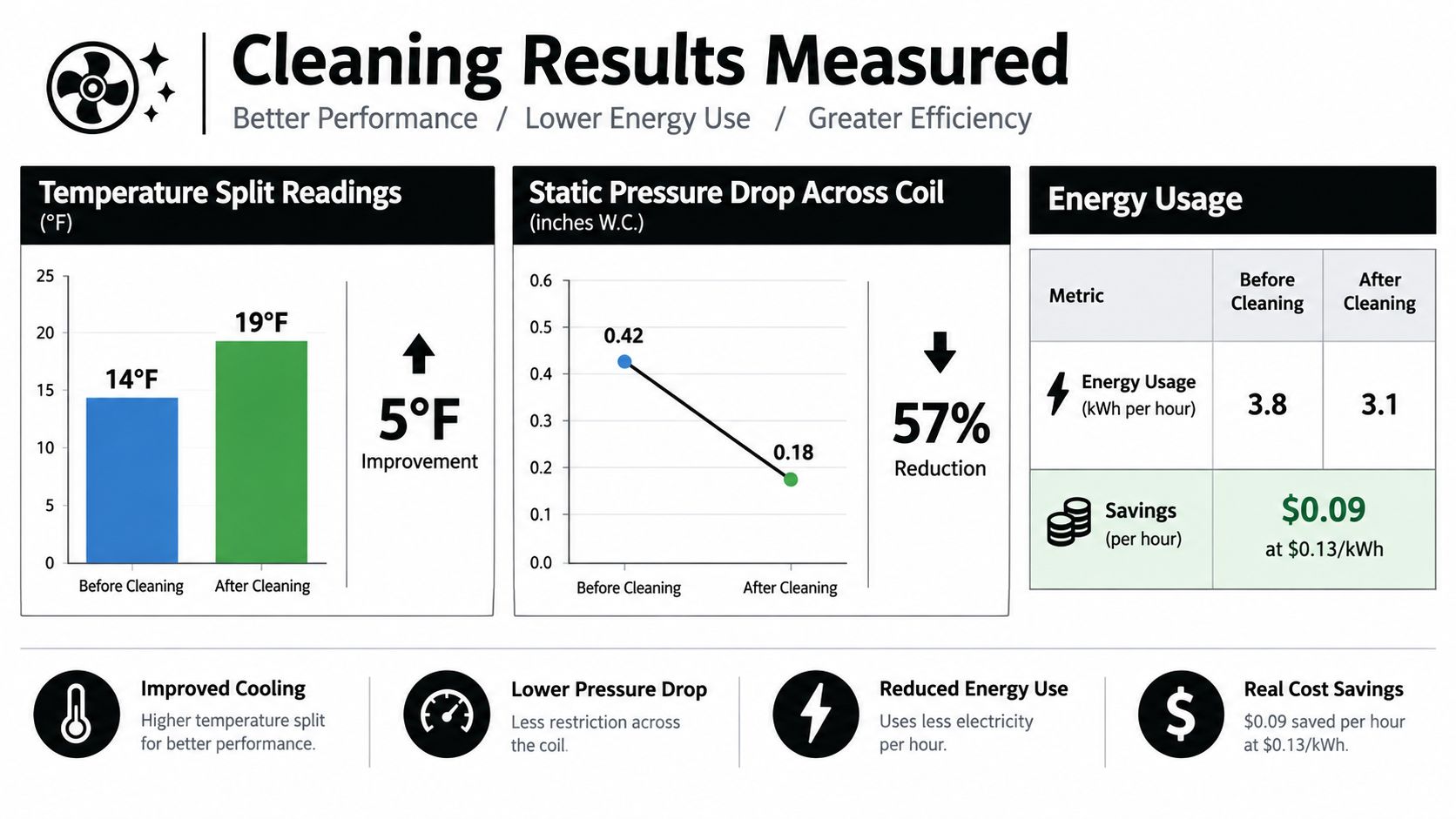
A shiny coil can still have restricted airflow, and a coil that looks imperfect can perform adequately. Measure before and after service whenever possible. At minimum, record supply-air temperature, return-air temperature, and the resulting temperature split under comparable operating conditions.
A technician can also measure external static pressure, airflow, coil pressure drop, and electrical operating data where the equipment and instruments allow safe testing. Let the system stabilize before repeating the readings. Comparing a startup condition with a fully operating condition produces misleading results.
Research on fouled residential evaporator coils found that fouling can reduce airflow by roughly 5% to 7%, increase coil pressure drop by about 6% to 16%, and raise fan power demand by approximately 1% to 10%. The same research on fouled evaporator coils reported efficiency and capacity degradation commonly below 5%, although severely fouled or marginal systems can perform worse.
Read the results as a technician would
A useful post-cleaning pattern is restored airflow, reduced static pressure, stable temperature behavior, and no new electrical or refrigerant symptoms. Visual cleanliness supports the result, but it doesn't prove it.
If the readings don't improve, investigate the rest of the system. A loaded filter, blocked return, weak blower motor, refrigerant problem, dirty ductwork, or duct leakage can produce poor cooling that coil cleaning won't solve.
Measurement beats marketing: Don't accept a promised savings percentage when nobody recorded the starting condition.
The purpose of testing isn't to manufacture a dramatic result. It's to determine whether the service addressed the actual restriction. If the system was lightly fouled, the measurable change may be small. If the coil was obstructed, restored airflow and lower resistance may be more meaningful than a single electricity reading.
For a broader explanation of evidence-based cleaning decisions, see this scientific proof resource. Keep the comparison honest by testing under similar indoor and outdoor conditions, with the same filter and operating mode.
When a Professional HVAC Service Is the Right Call
Consider a common Avondale situation. A homeowner sees monsoon debris and desert dust around an outdoor condenser, then notices allergy concerns inside the house. A YouTube video recommends a pressure washer, so the homeowner opens the indoor air handler and tries to rinse the evaporator coil. Water reaches the cabinet, the fins flatten across part of the coil, and the original cooling complaint remains.
That isn't a failure of cleaning effort. It's a mismatch between the tool, the coil, and the environment. The indoor coil needed controlled access, containment, electrical protection, and a method appropriate for the air handler.
A professional visit should begin with diagnosis, not detergent. The technician can inspect the fin pack, protect controls and motors, manage rinse water with containment and recovery equipment, use a compatible cleaner, and check airflow and temperature behavior afterward. If the coil is concealed or severely impacted, the technician can explain what access is required before water enters the cabinet.
Red flags that change the decision
Leave the work to an HVAC professional when you find:
Broadly bent fins: A fin comb can address minor isolated damage, not a widespread crushed fin pack.
Indoor access problems: Attics, crawlspaces, tight closets, and air handlers need controlled water management.
Biological or oily buildup: The right cleaner, dwell time, and disposal method matter.
Refrigerant or electrical symptoms: Cleaning won't repair leaks, failed capacitors, damaged wiring, or blower problems.
Uncertain system diagnosis: Poor cooling may originate in the filter, blower, ductwork, or refrigerant circuit.
A 2025 report on HVAC cleaning cited average fan-and-blower energy savings of 41% to 60% across examined buildings, while one Boulder case saw a 110% increase in conditioned supply airflow after coil cleaning. The Facilities Dive coverage also makes clear that results depended on the building and component. Those findings support measurement, not a guarantee for a Phoenix home.
If you need help evaluating whether the work belongs with a specialist, this resource on how to find pressure washing experts can help you identify an experienced service provider. For HVAC-specific inspection and cleaning, review the available professional HVAC services before choosing a method.
A Pressure-Washer Coil Cleaning Checklist You Can Actually Use
Use this list at the equipment, not from memory:
Identify the coil: Outdoor condenser and indoor evaporator coils need different access and runoff plans.
Isolate power: Turn off the relevant breakers and verify the equipment is de-energized.
Inspect first: Photograph fins, wiring, controls, drain paths, and existing damage.
Remove loose debris: Use a soft brush or low-pressure air before applying water.
Protect the equipment: Shield motors, boards, sensors, capacitors, and electrical junctions.
Choose the least aggressive method: A hose or pump sprayer may be enough.
If using a washer: Stay within the equipment instructions and EVAPCO's 1,500 psig maximum, 12-inch minimum distance, and 25-degree-or-wider nozzle guidance, as described in the EVAPCO maintenance document.
Verify performance: Compare airflow, static pressure, temperature split, and safe electrical readings before and after service.
Coil cleaning is corrective maintenance intended to recover performance lost to fouling, not a guaranteed energy upgrade. DOE-related guidance cited by Carrier reports that raising condensing temperature from 95°F to 105°F can reduce cooling capacity by 7% and increase power use by 10%, which shows why coil condition matters without proving that every rinse delivers the same result.
In hot, dusty climates, recurring accumulation is normal. A yearly technician inspection paired with a gentle homeowner-level outdoor rinse between visits is often safer than an annual pressure-washer attempt.
Purified Air Duct Cleaning provides residential and commercial HVAC coil cleaning, along with air duct and dryer vent services, for homes and facilities across the Phoenix metro area. If you want the coil inspected, cleaned with appropriate containment, and checked for performance afterward, visit Purified Air Duct Cleaning to request a quote.