

Indoor Air Quality Standards: A Complete Reference Guide
The World Health Organization's 2021 guideline for PM2.5 recommends no more than 5 micrograms per cubic metre as an annual average and 15 micrograms per cubic metre over 24 hours. Those values apply to indoor environments as well as outdoor air, but they aren't automatically enforceable indoor limits. They are health-based benchmarks that help building owners decide whether ventilation, filtration, source control, or further investigation is needed. (WHO Global Air Quality Guidelines)
That distinction defines the practical meaning of indoor air quality standards. Some requirements enter through local building codes and become legally binding. Others, including ASHRAE standards, guide design and operation without automatically carrying the force of law. Health organizations such as WHO provide evidence-informed targets, while the U.S. Environmental Protection Agency connects ventilation guidance with real-world facility management.
For Phoenix-area homes, offices, schools, and retail properties, the right question isn't just, “Are we compliant?” It's whether the building controls pollutants under normal conditions, during occupancy changes, and when wildfire smoke enters the region. The reference points below help separate legal duties from voluntary benchmarks, then turn those benchmarks into a measurement and maintenance plan.
Why Indoor Air Quality Standards Matter Now
Fine particles enter Phoenix-area buildings through several routes, including outdoor infiltration, combustion, cooking, cleaning, and resuspended dust. Monsoon dust can raise particle levels, while wildfire smoke can penetrate through open doors, leakage, and outdoor-air systems. A building may meet its ventilation design requirements and still need temporary filtration or source-control measures during those events. The WHO Global Air Quality Guidelines provide a health-based reference for judging that exposure.
WHO guidance is not a universal legal indoor-air limit. Legal duties come from adopted building, mechanical, or residential codes, while health benchmarks support decisions where no enforceable indoor pollutant limit exists. Fine particles also have no reliably harmless appearance threshold, so a clean-smelling room or dust-free surface does not establish acceptable air. (WHO pollutant health impacts)
Use standards as a decision map
Start with the reference that matches the decision:
Legal requirements govern permitted construction and any ventilation or equipment provisions adopted by the local jurisdiction.
Design standards, including ASHRAE 62.1 and 62.2, guide ventilation, exhaust, source control, filtration, and operation. They become enforceable only when adopted into law.
Health-based benchmarks help assess exposure and set investigation priorities when no indoor pollutant limit applies.
Operational indicators, such as carbon dioxide trends, show whether ventilation performs as intended in occupied rooms.
The practical result is a documented record of the building's design intent, legal obligations, relevant contaminants, measurements, and response actions. Duct cleanliness, outdoor-air delivery, filtration, and wildfire response should be assessed separately, because acceptable compliance paperwork does not prove that indoor conditions are healthy.
The Three Categories of Indoor Air Quality Rules
Indoor air quality rules fall into three practical categories: enforceable code requirements, voluntary design standards, and health-based targets. Keeping them separate prevents a common error: a property can meet a local ventilation requirement while still showing high levels of particles, carbon monoxide, formaldehyde, humidity, or wildfire smoke.
Enforceable requirements apply when a jurisdiction adopts them through a building code or regulation. The adopted wording, edition, occupancy classification, and inspection process determine what an owner or project team must provide. A contractor's reference to ASHRAE does not establish that the latest edition governs an existing Phoenix property. Adoption by a local code is what turns a voluntary standard into law; the ASHRAE sections below show what that means in practice.
Voluntary design standards provide a technical framework for ventilation, exhaust, source control, filtration, and operation. ASHRAE 62.1 primarily covers commercial and institutional buildings, while ASHRAE 62.2 addresses residential buildings. A building may satisfy a local legal minimum without following the newest ASHRAE edition, especially when an older code governs the project. (ASHRAE Standards 62.1 and 62.2)
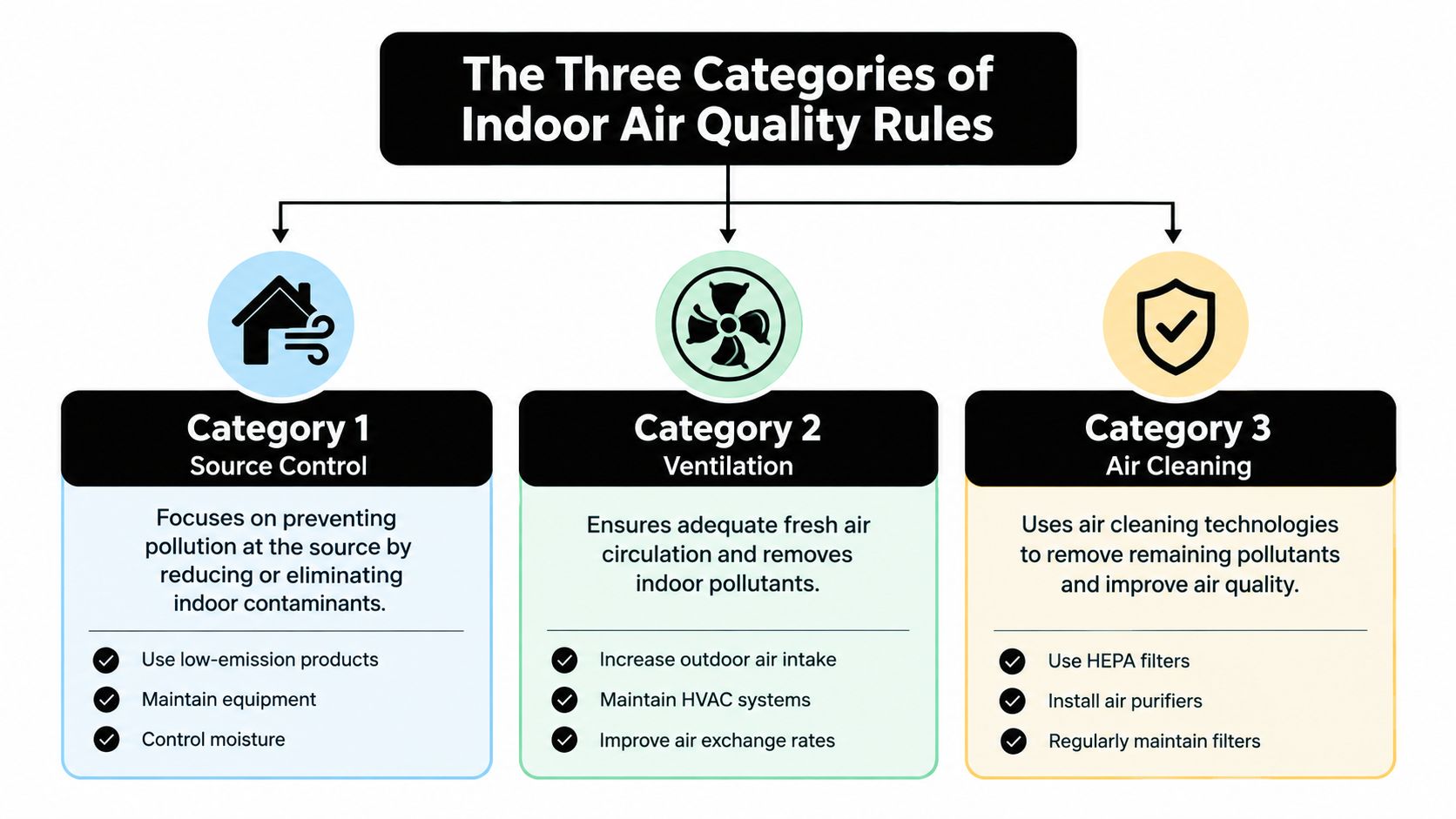
Health-based targets address the concentration operators should aim for to reduce health risk. WHO's PM2.5 guidance fits this category. It does not replace local law, but it can support risk communication, monitoring programs, tenant complaint investigations, and improvement plans.
Practical rule: Treat “compliant,” “designed to,” and “measured below a health benchmark” as three separate statements.
Ventilation rates are not pollutant limits. Outdoor air can dilute contaminants generated by occupants, yet it can also bring wildfire smoke or other outdoor pollution indoors. ASHRAE's Indoor Air Quality Procedure provides a performance path by requiring designers to identify indoor and outdoor contaminant sources and demonstrate that indoor concentrations remain below specified limits. That approach is useful for unusual occupancy patterns, special processes, or buildings where an outdoor-air table does not represent the actual risk.
Product certifications require the same care. A green label on a furnishing or material may address a defined product scope, not the building's complete IAQ. Review its testing basis and current certification details, using guidance on how to verify GREENGUARD claims. For workplace questions, compare applicable codes and technical guidance with OSHA indoor air quality standards. Duct contamination, outdoor-air delivery, filtration, and wildfire response still require separate measurement and action.
ASHRAE 62.1 for Commercial and Institutional Buildings
ASHRAE 62.1 has served as a U.S. benchmark for ventilation and acceptable indoor air quality in commercial and institutional buildings since 1973, when it was titled “Standards for Natural and Mechanical Ventilation.” Its early requirements specified minimum and recommended outdoor-air quantities intended to support occupant health, safety, and well-being. (ASHRAE Standards 62.1 and 62.2)
The standard changed through major revisions in 1981, 1989, 1999, 2001, 2004, 2007, 2010, and later years. The 1981 edition added the Indoor Air Quality Procedure, a performance-based option for projects where a fixed outdoor-air rate does not describe the risk well.
Choosing the right compliance path
The Ventilation Rate Procedure calculates outdoor-air delivery from occupancy and space-use assumptions. A facility manager should confirm that the selected category reflects actual operations. A conference room, open office, healthcare area, classroom, and retail floor can have very different occupancy patterns and contaminant sources.
The Indoor Air Quality Procedure calls for a more specific analysis. The design team identifies indoor and outdoor contaminant sources, selects control measures, and demonstrates that indoor concentrations remain below specified limits. It can suit unusual processes, changing occupancy, or pollutant sources that a generic ventilation rate does not address adequately.
Modern 62.1 also addresses mechanical and natural ventilation, filtration, air-cleaning systems, controls, and operation and maintenance. Those requirements make field performance part of the facilities manager's job. Stuck outdoor-air dampers, loaded filters, overridden controls, and deferred maintenance can reduce delivered ventilation after construction.
A design that specifies outdoor air per person means little if stuck dampers, loaded filters, or overridden controls cut delivered outdoor air substantially.
ASHRAE 62.1 is generally a voluntary technical standard until a jurisdiction, code, contract, or authority having jurisdiction adopts applicable provisions. Confirm the locally enforceable requirements before treating compliance with the standard as a legal obligation.
Phoenix facilities face a seasonal trade-off. Outdoor air can dilute indoor sources during clean conditions, while wildfire smoke can turn untreated intake air into a pollutant pathway. Set a documented operating sequence for normal ventilation, filtration, recirculation, and temporary smoke response. For practical guidance, review commercial building ventilation alongside adopted local requirements. Calibration, commissioning, and field measurements determine whether the installed system performs as intended.
ASHRAE 62.2 for Homes and Low-Rise Residential
ASHRAE 62.2 is the residential counterpart to 62.1. It addresses whole-building ventilation, local exhaust, and source control in single-family homes, apartments, and low-rise multifamily buildings. The standard recognizes that a home needs both general dilution and targeted removal, such as kitchen and bathroom exhaust.
The distinction matters because whole-building ventilation can't replace source control. A bathroom fan should remove moisture where it is generated, while a kitchen exhaust system should capture cooking emissions close to the appliance. A central ventilation system may dilute contaminants throughout the home, but it won't perform the same job as properly located local exhaust.
ASHRAE 62.2-2025 generally becomes mandatory only when a jurisdiction adopts it through its residential building code. Many pollutant limits within the standard remain guidance rather than enforceable standards. (ASHRAE policy brief on IAQ)
What homeowners should verify
Ask the builder, contractor, property manager, or local code office:
Code adoption: Does the applicable residential code adopt ASHRAE 62.2, and which edition applies?
Ventilation design: What whole-building ventilation approach was installed?
Local exhaust: Do kitchens and bathrooms exhaust effectively to the exterior?
Source control: Are combustion appliances, moisture sources, and high-emission products managed at their origin?
Air distribution: Will filter upgrades or duct changes reduce airflow or create excessive pressure drop?
Duct sealing can reduce uncontrolled infiltration and help the system deliver air where intended, but sealing isn't a substitute for designed ventilation. A tighter home may need deliberate outdoor-air delivery, especially if ordinary exhaust fans pull replacement air through dusty or contaminated pathways.
Homeowners comparing HVAC equipment can use a practical overview of AC features from Edinhart Realty and Property Management to understand equipment options, but equipment marketing shouldn't be mistaken for a code determination. For filtration and purification decisions, residential air purification systems should be evaluated against the specific contaminant, airflow capacity, maintenance needs, and smoke conditions.
WHO Global Air Quality Guidelines Applied Indoors
The WHO 2021 Global Air Quality Guidelines provide a useful PM2.5 benchmark for buildings. PM2.5 consists of fine particles with aerodynamic diameters of 2.5 micrometres or less. These particles can reach deep into the lungs, and WHO guidance applies to indoor environments. It remains a health-based recommendation, not a single legally binding indoor-air standard. (WHO pollutant health impacts)
PM2.5 benchmark | Recommended value |
|---|---|
Annual average | 5 micrograms per cubic metre |
24-hour average | 15 micrograms per cubic metre |
Interim annual targets | 10, 15, 25, and 35 micrograms per cubic metre |
Interim 24-hour targets | 25, 37.5, 50, and 75 micrograms per cubic metre |
The annual benchmark supports assessment of sustained exposure. The 24-hour benchmark is more useful for short pollution episodes, including wildfire smoke entering a building. Interim targets provide staged performance levels for operators and jurisdictions that cannot reach the strictest recommendation immediately. (WHO Global Air Quality Guidelines)
Applying the benchmark without overclaiming
Use these values to trigger investigation, not to certify a building as safe. For example, a monitor averaging 12 micrograms per cubic metre over a month sits above the annual guideline but below the first interim annual target. That result supports checking filtration, outdoor-air intake settings, pressure relationships, and particle sources before reassessing performance.
Short readings need context. Cooking can produce a brief spike, while wildfire smoke can raise both outdoor and indoor concentrations for longer periods. Duct contamination may contribute particles, but a monitor cannot determine whether the cause is ductwork, filter bypass, infiltration, or an indoor activity.
WHO bases the recommendations on evidence reviews of adverse health effects and presents them as health-protection guidance. (WHO pollutant health impacts) Legal compliance remains a separate question. In Phoenix-area homes and commercial buildings, identify the adopted building code, occupational requirements, or public-health rule first, then use the WHO values as a voluntary benchmark for investigation and improvement.
EPA Reference Figures and School Guidance
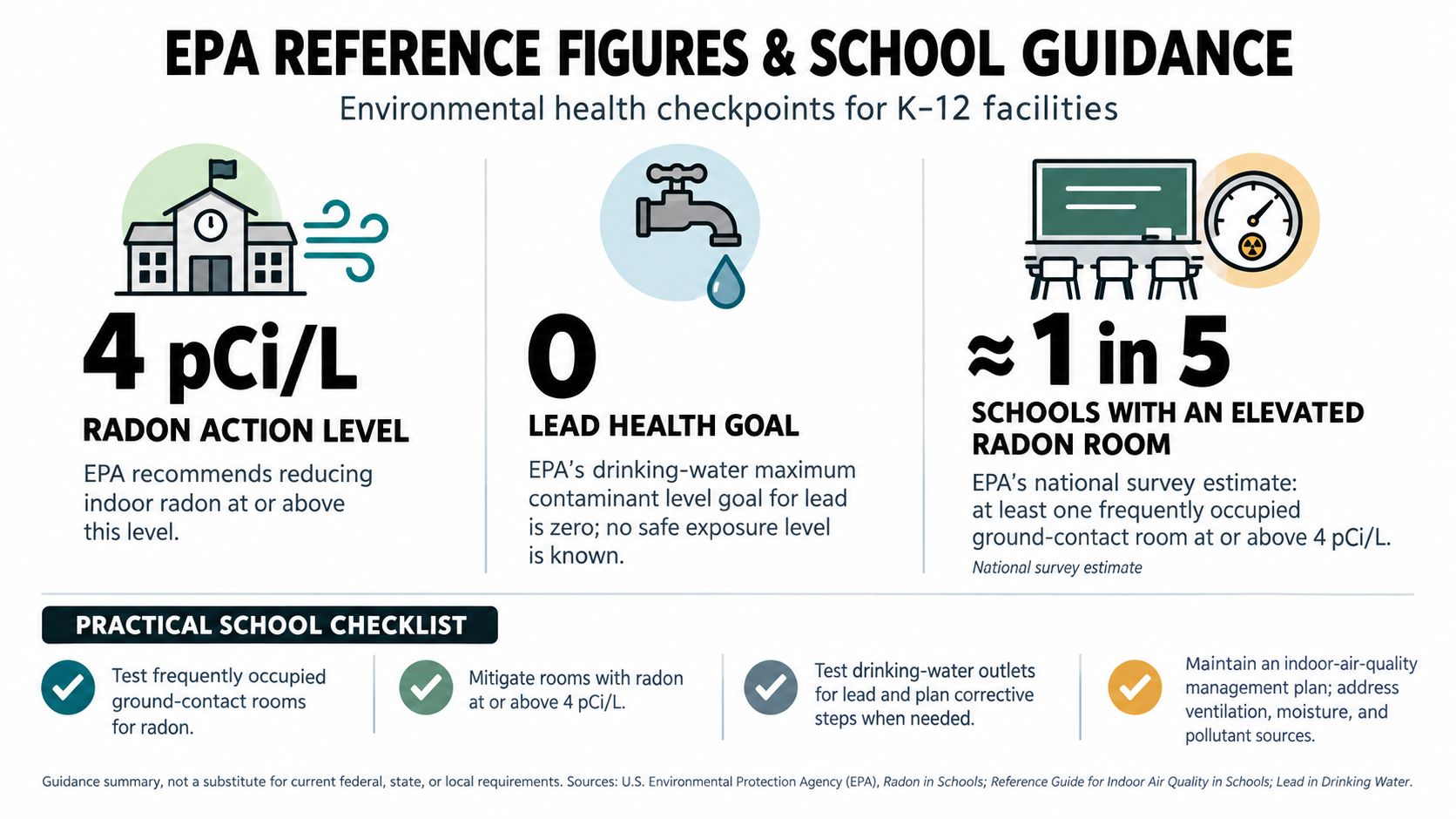
The U.S. Environmental Protection Agency identifies approximately 15 cubic feet per minute of outdoor air per person as the classroom ventilation rate associated with current ASHRAE guidance. This figure is a voluntary design and operating reference, not automatically a legal requirement. Outdoor air can dilute indoor pollutants, odors, and occupant-generated carbon dioxide, provided the HVAC system delivers the intended airflow consistently. (EPA school IAQ reference guide)
EPA also describes carbon dioxide as a practical indicator of ventilation performance. Occupants exhale CO2, so concentrations generally rise when outdoor-air delivery falls behind occupancy. The ASHRAE guidance cited by EPA uses approximately 700 parts per million above outdoor CO2 as a classroom reference, often corresponding to an indoor concentration near 1,000 ppm, depending on outdoor conditions. Treat this as a ventilation signal, not a universal toxic-exposure limit for ordinary occupied buildings.
Read trends, not isolated readings
Place CO2 monitors in representative occupied zones and review patterns across the day. A repeated rise during occupancy can point to insufficient outdoor air, a scheduling problem, or a controls fault. A stable CO2 result does not establish control of PM2.5, formaldehyde, carbon monoxide, or humidity, so it belongs within a broader assessment.
EPA links ventilation performance with HVAC inspection, maintenance, and regular filter replacement. In Phoenix offices, schools, and retail spaces, confirm that outdoor-air dampers open as intended, supply and exhaust fans run, filters fit correctly, and controls match actual occupancy. Pair every CO2 trend with a damper, filter, and control check before drawing conclusions about ventilation.
Wildfire Smoke and Event-Based Indoor Air Decisions
The assumption that more outdoor air is always healthier fails during wildfire smoke events. Outdoor air can carry fine particles and gaseous pollutants indoors, so opening windows or increasing untreated outdoor-air intake may worsen indoor conditions.
EPA's 2025 commercial-building guidance recommends preparing MERV 13 or higher filtration, confirming that HVAC equipment can handle the filter's pressure drop, maintaining airflow, weatherizing the building, and accounting for indoor PM2.5 sources such as cooking and vacuuming. (EPA wildfire smoke guidance)
Use an event-based operating rule
During clean outdoor conditions, prioritize designed outdoor-air ventilation and source-specific exhaust. Outdoor air can dilute occupant-generated contaminants, odors, and moisture when the incoming air is acceptably clean and the system can condition it.
During smoke events, prioritize filtration, recirculation, reduced infiltration, and verified airflow. Schools and commercial facilities should close doors and windows when smoke affects the building, use HVAC recirculation where appropriate, and monitor indoor PM2.5 rather than judging conditions by smell.
Smoke response rule: Don't install a higher-efficiency filter without confirming blower capacity, pressure drop, fit, and delivered airflow.
Phoenix-area properties need this distinction because smoke exposure can change rapidly, while HVAC systems continue operating under their normal control sequence. A MERV 13 filter that loads quickly or restricts airflow can create a different operational problem. Filter compatibility, replacement planning, and pressure verification belong in the smoke preparedness plan, not in a crisis-only checklist.
Cooking and vacuuming can also raise indoor PM2.5 while windows remain closed. Use local exhaust during cooking, avoid adding indoor particle sources during smoke episodes, and verify results with calibrated monitoring. A practical resource on wildfire smoke and indoor air quality can help property teams build a response procedure around filtration, recirculation, and source control.
Comparing ASHRAE, WHO, and EPA at a Glance
The three frameworks answer different questions. ASHRAE focuses on building ventilation and system design, WHO provides health-based particulate benchmarks, and EPA translates selected ventilation concepts into operational guidance for schools and commercial buildings.
Framework | Scope | Primary deliverable | Enforceability | Typical use |
|---|---|---|---|---|
ASHRAE 62.1 | Commercial and institutional buildings | Ventilation rates and performance-based IAQ procedures | Enforceable only when adopted by a jurisdiction | Design review, HVAC operation, maintenance planning |
ASHRAE 62.2 | Homes and low-rise residential buildings | Whole-building ventilation, local exhaust, and source control | Generally mandatory only when adopted in residential code | New homes, renovations, residential HVAC planning |
WHO guidelines | Indoor and outdoor air evaluation | Health-based PM2.5 recommendations | Not a single legally binding indoor standard | Monitoring, risk communication, improvement targets |
EPA guidance | Schools and commercial facilities | Ventilation indicators and wildfire response practices | Guidance unless incorporated into another requirement | Facility operations, inspections, smoke preparedness |
Match the framework to the question
For new construction or renovation, begin with the adopted local code, then use the relevant ASHRAE standard to interpret design and documentation. For ongoing operations, inspect equipment, controls, filters, outdoor-air delivery, exhaust, and maintenance records.
For an occupant complaint about particles or smoke, WHO's PM2.5 values provide a useful health-based comparison, while EPA guidance helps identify practical controls. For a lease clause or contractor scope, specify the applicable code edition, performance expectation, measurement method, and response process. Avoid writing “meets ASHRAE” without naming the standard, edition, pathway, and adopted code context.
The overlap is valuable: ASHRAE helps control how air moves, EPA helps operators verify and adjust systems, and WHO helps interpret particle exposure. The gap is equally important. None of these frameworks alone proves that every contaminant is controlled in every room under every operating condition.
Measuring and Verifying Indoor Air Quality
A useful IAQ program follows the same sequence whether the property is a home, office, school, or retail site:
Assess the space. Record occupancy, HVAC type, operating schedules, complaints, recent renovations, combustion equipment, moisture, and smoke exposure.
Identify sources. Look at cooking, cleaning, construction materials, outdoor infiltration, duct contamination, combustion, and activities that resuspend dust.
Choose the benchmark. Use the adopted code for legal requirements, ASHRAE for system design and operation, WHO for PM2.5 evaluation, and EPA indicators for school or commercial ventilation.
Measure conditions. Monitor PM2.5, CO2, temperature, humidity, carbon monoxide, and formaldehyde where the building history or risk warrants it.
Correct the source. Improve local exhaust, repair leaks, control moisture, adjust outdoor-air delivery, clean contaminated components when justified, and select filtration the HVAC system can support.
Verify the result. Repeat measurements under comparable occupancy and operating conditions, then retain the readings, equipment details, calibration information, and corrective actions.
Consumer monitors can reveal patterns, but they don't replace professional investigation when readings are persistent, inconsistent, or connected to health complaints. CO2 can indicate ventilation performance, while PM2.5 can reveal smoke or cooking events. Carbon monoxide and formaldehyde require particular care because a general-purpose monitor may not provide reliable evidence for a high-consequence decision.
Duct cleaning and filtration address different problems. Cleaning can remove accumulated dust and debris from ductwork, vents, or coils when inspection supports that action. Filtration removes particles from moving air, but only when the filter fits, airflow remains adequate, and the system receives appropriate maintenance. How to measure indoor air quality provides a practical starting point for turning readings into a documented plan.
Indoor Air Quality Standards Frequently Asked
Is there one U.S. indoor air quality standard?
No. Indoor air requirements depend on the jurisdiction, building type, adopted codes, and contaminant. A facility manager must identify which rules apply, then use voluntary benchmarks where regulations leave gaps.
Is there a U.S. indoor PM2.5 standard?
There is no single federal indoor PM2.5 limit for every occupied building. Teams often compare readings with applicable outdoor criteria or voluntary health guidance. The WHO pollutant health impacts guidance helps explain why particle exposure matters, but it does not create a U.S. indoor legal requirement.
Does code compliance prove healthy air?
No. Code compliance confirms that adopted project and jurisdictional requirements were met. It does not prove that ducts are clean, filters fit correctly, wildfire smoke is excluded, or indoor sources are controlled. In Phoenix-area buildings, duct contamination and smoke intrusion require separate inspection and measurement.
Why isn't ventilation enough?
Ventilation can dilute pollutants generated indoors, but outdoor air can also bring wildfire smoke and other contaminants inside. Effective control combines source reduction, outdoor-air management, filtration, maintenance, and measurements taken during representative conditions.
Why are schools difficult to evaluate?
Schools have changing occupancy, dense classrooms, varied schedules, portable buildings, aging HVAC equipment, and limited maintenance budgets. A single reading may miss problems that appear during arrival, lunch, or crowded instruction. Evaluation therefore requires location-specific measurements, operating records, contaminant testing where warranted, and corrective actions that staff can maintain.
Purified Air Duct Cleaning serves Phoenix-area homes and commercial properties with duct, coil, and dryer vent cleaning, plus ActivePure installation. Visit Purified Air Duct Cleaning to request an assessment and quote.