

Air Duct Cleaning UV Light: Real Performance vs Myths
Professional in-duct UV systems can inactivate more than 99.5% of certain airborne bacteria under suitable conditions, but that result doesn't represent every organism or every home. Actual performance depends on UV dose, airflow, exposure time, placement, cleanliness, and maintenance, not the lamp alone.
The most popular advice about air duct cleaning UV light is also the least reliable: install a bright blue lamp and expect the whole building to become purified. A lamp can be useful, especially near a damp evaporator coil, but it can't remove dust, repair wet insulation, replace filtration, or compensate for air moving too quickly through an undersized treatment zone.
I've seen well-designed systems support cleaner coils and biological control, and I've also seen expensive lamps installed where the airflow, geometry, and maintenance plan made the advertised result unrealistic. The difference comes from engineering, not appearance. The following benchmarks and practical checks will help you separate a useful HVAC component from a glowing marketing accessory.
Why UV Light Claims Need Reality Checks
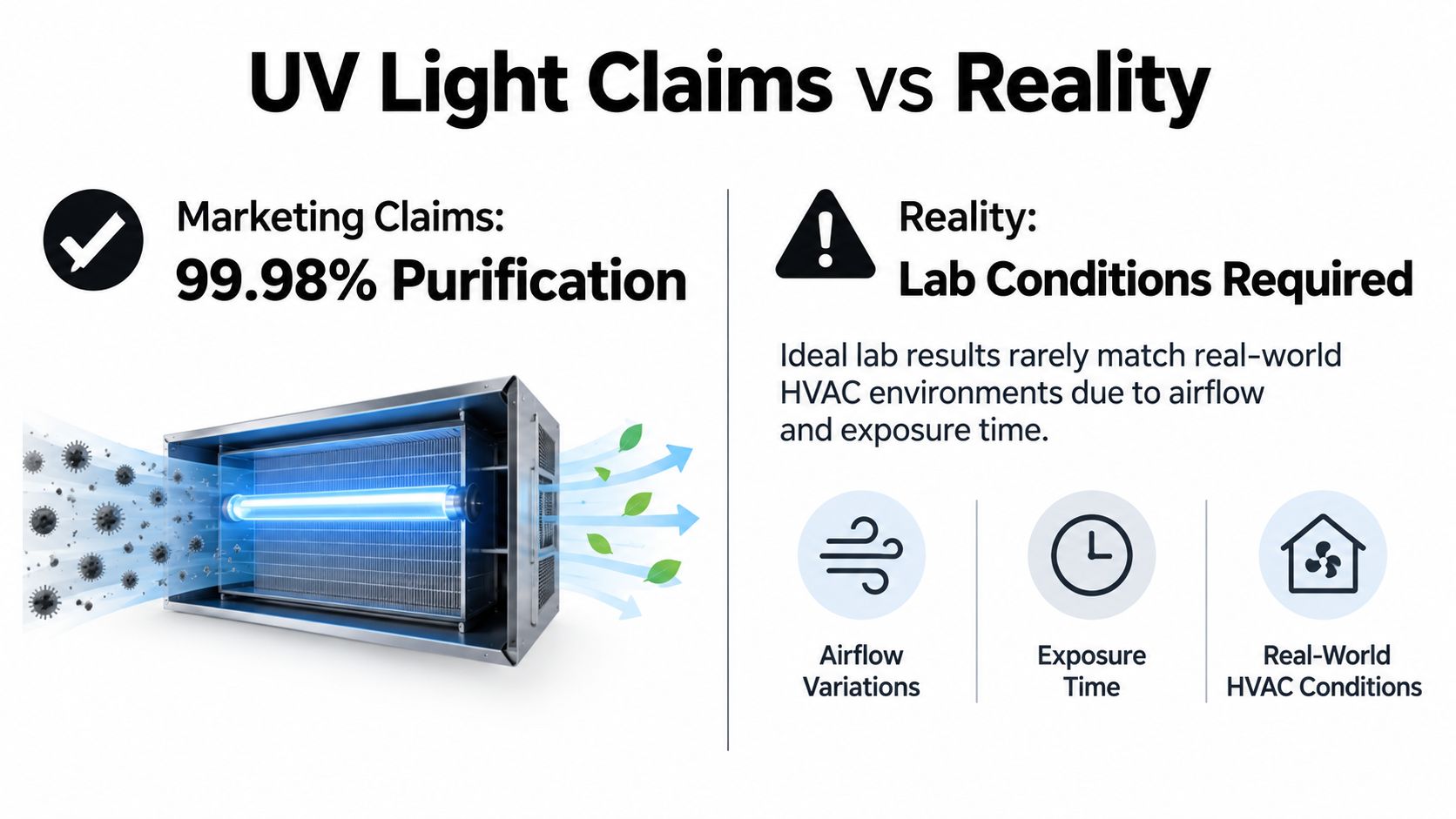
A single UV lamp does not purify an entire building just because the box shows a high kill rate. Those headline numbers usually come from a narrow test setup with a specific organism, a fixed exposure time, controlled humidity, and an air path that looks nothing like a real return duct or air handler. In the field, results rise or fall on system design.
Ultraviolet germicidal irradiation, or UVGI, is a supplemental air and surface treatment. The CDC's explanation of GUV and UVGI systems describes UV-C as shorter-wavelength ultraviolet energy used in HVAC equipment and upper-room fixtures to inactivate viruses, bacteria, and fungi. The same CDC guidance also points to the variables that decide whether a system performs well: dose, exposure time, lamp intensity, airflow, air changes, humidity, and fixture location.
That is the part marketing glosses over. I pay far more attention to the path of the air, the size of the irradiated zone, and maintenance access than to the wattage printed on the lamp carton. A lamp can be functioning perfectly and still miss the headline result once it is installed in a fast-moving, cramped, dusty system.
What the research shows
A 2024 peer-reviewed study found that an in-duct UVGI system inactivated more than 99.5% of airborne Escherichia coli at residence times below 0.36 seconds, but under those same operating conditions it delivered a 53% reduction for Paenibacillus aragonensis and a 73% reduction for Cladosporium spores (study details in PubMed). That is a useful result because it shows both where UVGI can perform well and where broad claims start to fall apart.
Different organisms respond differently to the same dose. A strong result against one bacterium does not mean the same lamp will produce the same reduction for spores, fungi, or every contaminant moving through a duct.
Claim Type | Typical Marketing Figure | Research-Backed Range |
|---|---|---|
Airborne bacterial inactivation | 99.98% purification | More than 99.5% for tested E. coli under defined conditions |
Airborne fungal reduction | Broad whole-building purification | 53% for Paenibacillus aragonensis and 73% for Cladosporium spores under identical tested conditions |
HVAC surface treatment | Up to 99% | Up to 99% for microorganisms living on HVAC surfaces, depending on intensity and exposure |
Whole-home result | One universal percentage | Depends on dose, airflow, organism, placement, humidity, and maintenance |
Use those numbers the right way. They are not proof that UV is hype, and they are not proof that one lamp solves indoor air quality on its own. They show why air duct cleaning UV light has to be treated as an engineered treatment zone with defined targets, verified conditions, and a maintenance plan that keeps dose available over time.
How UV-C Actually Disinfects HVAC Systems
UV-C doesn't clean air by making particles disappear. It damages the genetic material of susceptible microorganisms so they can no longer reproduce effectively. That process requires enough energy at the target surface or in the moving air stream, and the delivered energy depends on intensity multiplied by exposure time.
The wavelength matters. For occupied HVAC applications, designers commonly specify ozone-free 254-nanometer UV-C, while avoiding ozone-producing 185-nanometer emissions in occupied spaces. ASHRAE advises keeping indoor ozone as low as reasonably achievable because ozone harms respiratory health (ASHRAE filtration and disinfection guidance).
A bright lamp isn't necessarily a powerful treatment system. Light output falls with distance, a dirty sleeve blocks energy, and fast-moving air may pass the lamp before receiving the required dose. A contractor who only discusses wattage is leaving out the variables that determine performance.
Airborne treatment versus coil treatment
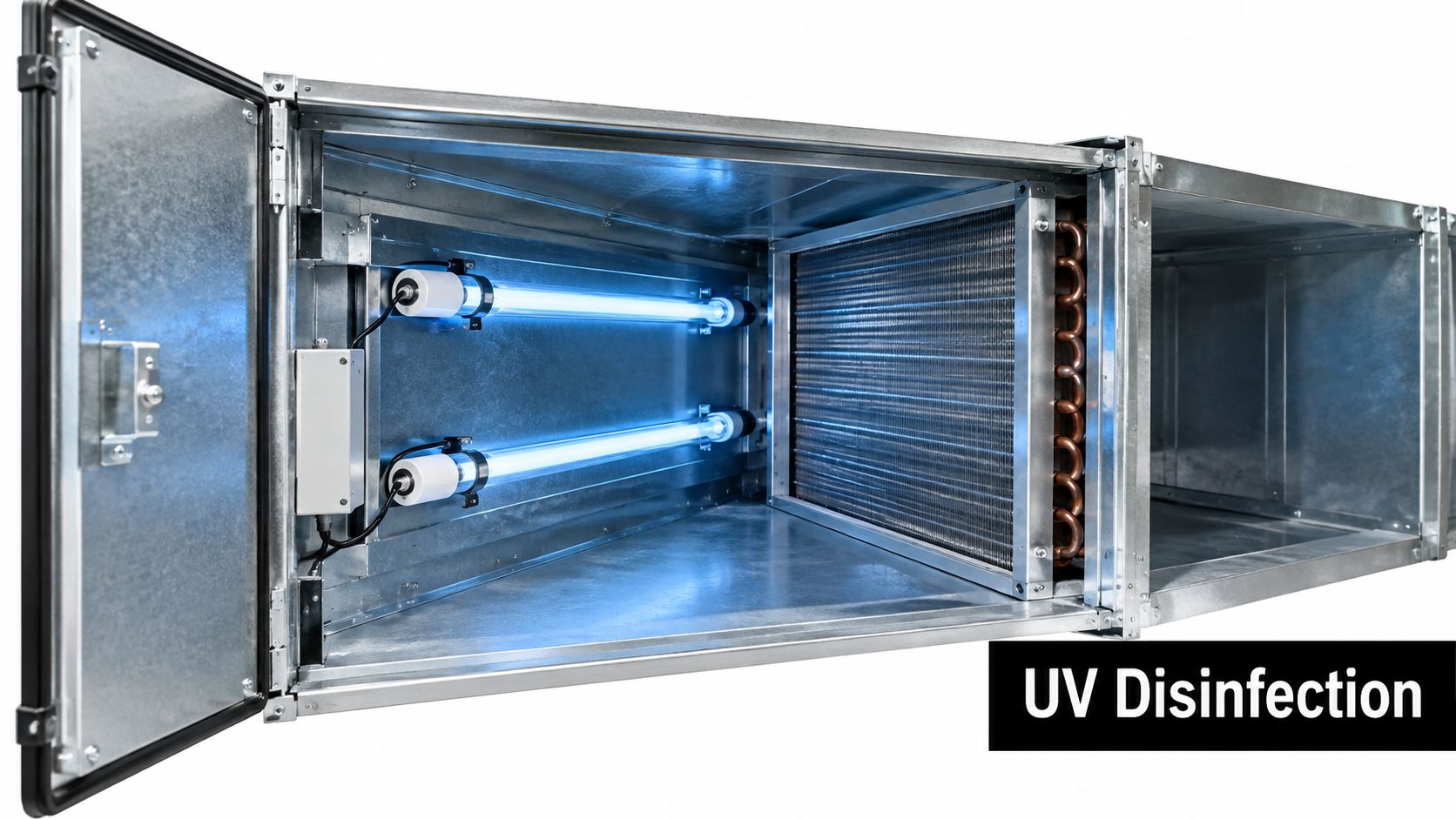
Airborne disinfection treats microorganisms during a brief pass through the duct or air handler. Coil treatment works differently. A lamp positioned to irradiate an evaporator coil can expose the coil surface continuously, helping control biological growth on a damp component. The two applications require different placement, exposure assumptions, and verification.
ASHRAE guidance specifies a minimum target dose of 1,500 µJ/cm², recommends designing for air speeds of 500 feet per minute or less, and calls for an irradiated zone at least 2 feet long with at least 0.25 seconds of exposure (ASHRAE UV-C guidance). If the air moves faster, the system needs greater irradiance, more lamps, or a longer treatment section to preserve the target dose.
Practical rule: Judge a system by measured irradiance, duct velocity, exposure geometry, and calculated dose. Lamp wattage alone isn't a performance specification.
Surface treatment has its own limits. The Air Movement and Control Association reports that UV-C can inactivate up to 99% of microorganisms living on HVAC surfaces, but the result varies with intensity, exposure duration, placement, and installation conditions (AMCA UV-C guidance). That doesn't mean the same system delivers that reduction to every organism in a moving air stream.
For broader building hygiene, UV-C can sit alongside commercial hygiene solutions, especially where facility operators also need physical cleaning and source control. A useful technical overview of residential configurations is available in this guide to an in-duct UV air purifier.
Use the following media as a visual explanation of how lamp position and airflow affect the treatment zone:
The central distinction is simple. UV-C inactivates microorganisms; filters capture particles. A UV lamp can't take the place of a properly selected filter, and a filter doesn't provide the same continuous irradiation of a wet coil. Good HVAC design uses each component for the job it can perform.
UV Light Compared to ActivePure and Other Technologies
UV-C is only one tool in the indoor air quality toolbox. Homeowners and facility managers often compare it with ActivePure systems, HEPA filtration, and ionizers as if they were interchangeable products. They aren't. Each technology acts on a different part of the contamination problem.
HEPA filtration physically captures airborne particles. It is the most direct option when the priority is removing particulate matter such as dust, pollen, and other suspended particles, provided the system can handle the pressure drop and the filter is maintained. HEPA filtration doesn't irradiate a coil or inactivate organisms on a surface.
UV-C targets biological contaminants through radiation. It can support coil hygiene and airborne treatment, but it needs a calculated dose, safe enclosure, and a clean optical path. It also doesn't remove accumulated dust or debris.
ActivePure systems are marketed as air and surface purification equipment that works in the air handler or as a portable unit. Performance depends on the specific device, installation, and test evidence. I wouldn't accept a broad product claim without asking what organism was tested, whether the result applied to air or surfaces, and whether the configuration resembles the building's actual airflow.
Ionizers charge airborne particles so they may collect on surfaces or move more readily into a collector. Their usefulness depends on the device design, airflow, collection method, and maintenance. Some ionization systems can also raise concerns about byproducts, so safety documentation matters.
Technology | Primary Action | Maintenance Level | Safety Profile | Best Use Case |
|---|---|---|---|---|
UV-C | Inactivates susceptible microorganisms in air or on HVAC surfaces | Lamp cleaning, output checks, replacement, shielding inspections | Safe when fully enclosed and correctly designed; hazardous UV leakage is unacceptable | Coil hygiene and supplemental biological control |
ActivePure | Device-specific air and surface purification process | Follow the equipment's service and replacement requirements | Evaluate product documentation and installation controls | Supplemental purification where the selected system has appropriate testing |
HEPA filtration | Captures airborne particles | Filter replacement and pressure monitoring | Generally straightforward when the HVAC system supports the pressure load | Dust, pollen, and particulate reduction |
Ionizer | Charges airborne particles for collection or deposition | Emitter and collector maintenance, performance checks | Review byproduct and safety documentation | Particle management when properly engineered |
Mechanical cleaning | Removes accumulated dust, debris, and contamination | As needed based on conditions | Requires containment and trained technicians | Visible contamination, debris, moisture damage, and restricted airflow |
A common installation mistake is choosing one technology to solve every IAQ complaint. A family concerned about pollen needs particle capture. A facility with wet coils may benefit from surface-directed UV-C. A building with visible contamination needs source control and physical cleaning before anyone discusses purification.
The engineering trade-off matters as much as the technology label. A high-efficiency filter can increase resistance and reduce airflow if the fan and cabinet weren't designed for it. UV-C needs sufficient space for exposure and access for maintenance. Ionization requires attention to collection and byproducts. ActivePure requires device-specific verification rather than assumptions based on a different product.
For a closer look at system configurations, review this guide to an in-duct UV air purifier. The useful comparison isn't “Which product has the highest percentage?” It's “Which contaminant am I trying to control, and does this technology address it directly?”
When UV Light Makes Sense for Your Property
A UV-C lamp makes sense when the problem is biological growth inside the HVAC system and the installation is engineered for that target. It is a practical add-on for homes with persistently wet coils, recurring growth on air-handler surfaces, or occupants who want another layer alongside filtration and ventilation. A lamp by itself is not the strategy.
In the field, the clearest residential win is usually coil and air-handler hygiene. Keeping UV-C focused on a damp evaporator coil can help limit growth on that surface and keep the coil cleaner between service visits. That does not fix a bad condensate slope, a clogged drain, damaged liner, or humidity that stays too high. Installation quality matters more than marketing claims about lamp strength, because dose depends on where the lamp sits, what it is aimed at, and how consistently that surface is exposed.
Commercial properties can justify UVGI more often because the equipment usually gives you more room to design around real operating conditions. Larger air handlers may allow a longer treatment zone, multiple lamps, and access for proper setup and follow-up service. In healthcare, education, hospitality, and office buildings, UV-C can fit into a broader ventilation and filtration program. It still needs clear design intent and a maintenance owner.
I slow the conversation down when the building has an obvious source problem.
Start with the basics:
Visible contamination: Mold-like growth, vermin contamination, or heavy debris calls for inspection and, where needed, physical removal.
Moisture failure: Wet insulation, standing water, poor drainage, and uncontrolled humidity will keep feeding growth after a lamp is installed.
Airflow problems: A blocked filter, crushed duct, or poor balancing can reduce filtration performance and limit useful UV exposure.
Occupant expectations: UV-C does not guarantee protection from infection, allergies, odors, or every airborne irritant.
The EPA's duct-cleaning guidance points to specific conditions that can justify cleaning, including substantial visible mold growth inside hard-surface ducts or HVAC components, vermin contamination, and excessive dust or debris released into occupied spaces. That same guidance also supports the right order of operations. UV light doesn't remove accumulated dust, debris, or damaged insulation, so inspection and correction come first.
That is where a lot of disappointing UV jobs start. A contractor sells the lamp before fixing the drain issue, before checking for matted coils, or before confirming whether the complaint is really particulate, odor, or microbial growth. One advertised kill rate from a single lamp rarely predicts whole-building results. Air speed, exposure time, lamp placement, and maintenance determine whether UV-C adds real value in an occupied building.
A better process is straightforward. Identify the contaminant, inspect the equipment, correct moisture and airflow defects, improve filtration if needed, and then decide whether UV belongs in the system. Property owners comparing options should also review whether in-duct air purifiers are worth it for their actual conditions instead of assuming every glowing device solves the same problem.
Installation and Maintenance Requirements
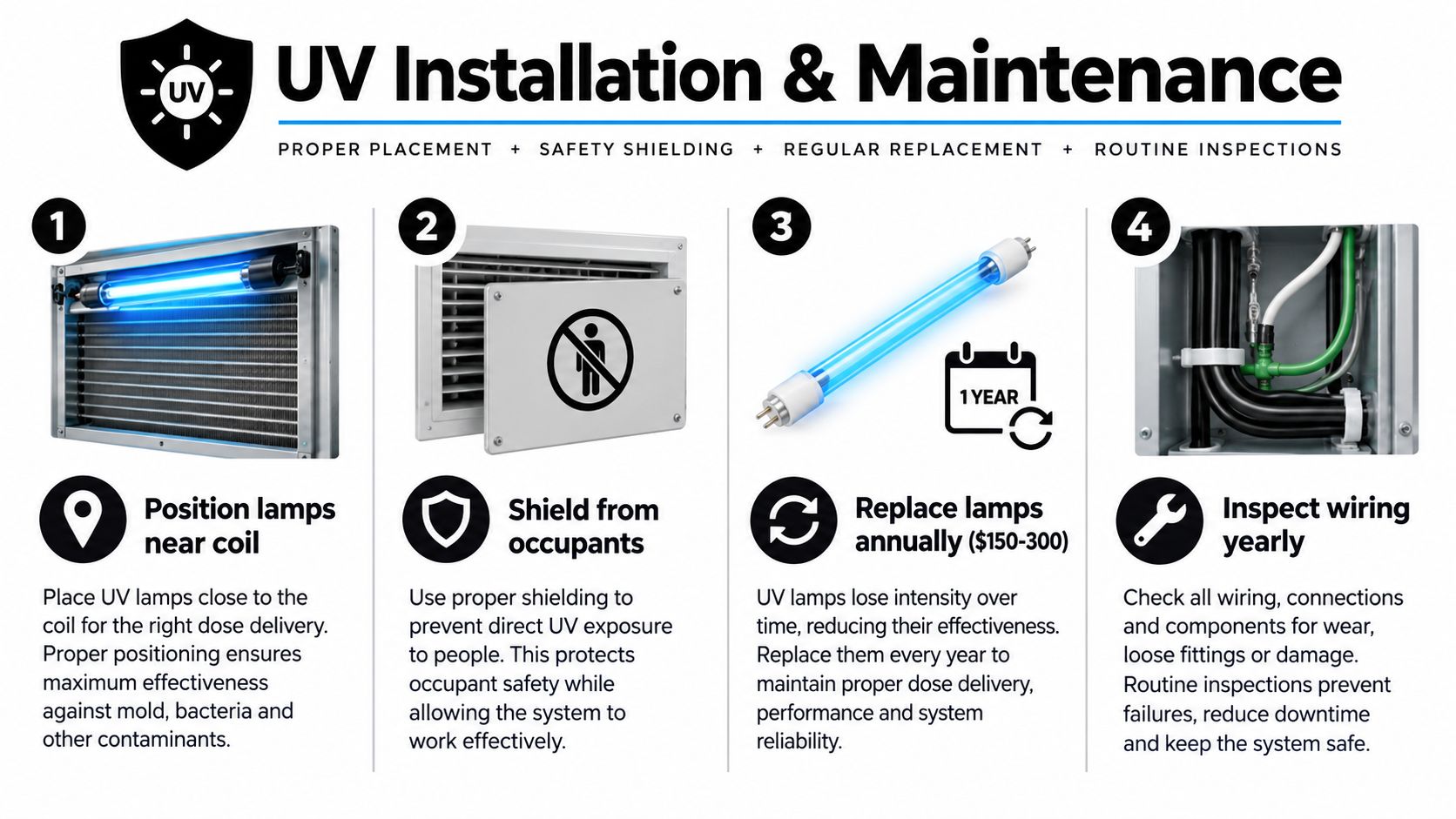
Installation quality decides whether UV-C does useful work or just adds a glowing tube inside the cabinet. I have seen expensive lamps mounted in poor locations, with no clear treatment target and no way to service them safely. The right starting point is the equipment itself: coil condition, drain pan, filter cabinet, cabinet depth, wiring route, access panels, and any chance of UV exposure outside the air handler.
Placement follows the job. A coil-treatment lamp usually belongs where it can keep the wet side of the evaporator assembly illuminated without blocking routine service. Air-stream treatment is less forgiving. Duct size, air velocity, lamp distance, and the length of the irradiated section all affect delivered dose, so a lamp installed in fast-moving air can underperform even when the fixture itself looks impressive.
What a qualified proposal should show
Treatment target: The proposal should identify whether the lamp is meant for coil surfaces, moving air, or both. Those are different design problems, and they should not be sold as if one mounting location handles them equally well.
Safety controls: UV-C should stay inside a sealed, shielded HVAC enclosure. Proper housings, warning labels, interlocks or door switches, and protection against direct eye or skin exposure are part of a safe installation. Open fixtures in occupied areas or in cabinets that leak light are poor practice.
Electrical workmanship: The installer should use appropriate wiring methods, mount the ballast or power supply securely, protect penetrations, and preserve service access. A sloppy install creates avoidable shock, vibration, and air-leak problems.
Maintenance ownership: The agreement should state who cleans the lamp and sleeve, checks lamp condition, inspects wiring, and replaces the lamp after output drops. Visible glow is not proof of useful germicidal output.
Maintenance is where many UV systems lose value. Dust on the lamp, fouled coils, high humidity, temperature shifts, airflow changes, and a neglected filter all reduce the energy reaching the target. That is why advertised lamp performance rarely matches real building performance unless the system is installed around actual operating conditions and checked on a schedule.
UV-C is only one part of the assembly. If the proposal also includes filtration or other IAQ equipment, compare the scope against this overview of whole-house air purifier installation. Then ask a simple question: which component handles particles, which one addresses microbial growth on surfaces, and what maintenance keeps each part working as intended?
Building a Layered IAQ Strategy
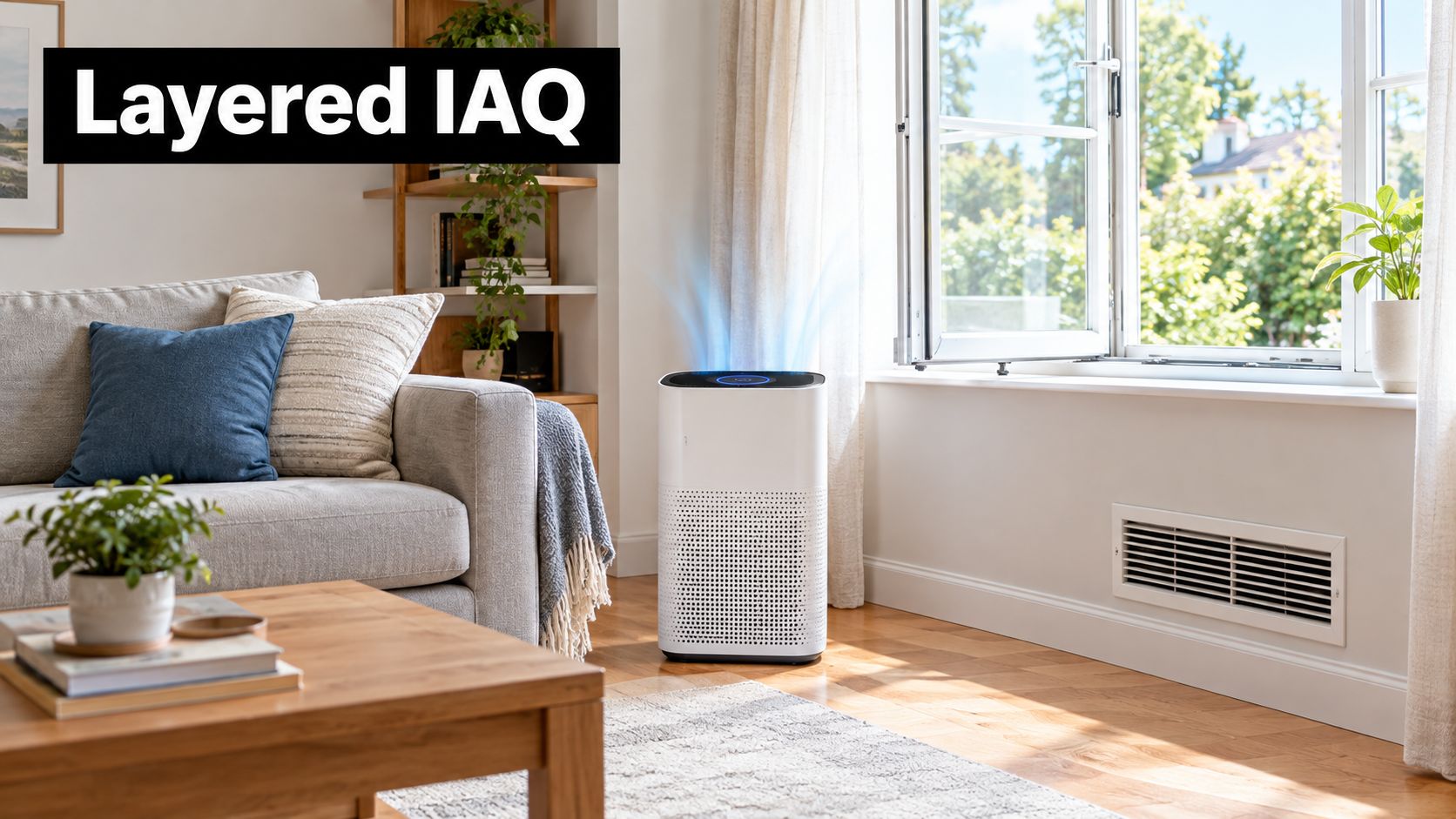
A layered IAQ strategy works better than chasing one advertised UV lamp result. In the field, the homes and buildings that perform best are the ones where source control, ventilation, filtration, cleaning, moisture management, and UV-C each handle a specific job. A single fixture cannot clean dust, correct wet insulation, dilute stale indoor air, and control microbial growth at the same time.
Start with the problem, not the product. If water is getting into the system, fix the leak. If the return side is pulling in attic dust or crawlspace air, seal it. If combustion appliances, cleaning chemicals, or occupant activities are driving complaints, address those sources directly. Then support the space with outdoor-air ventilation where appropriate and filtration that matches the blower's actual capacity, because UV-C does not remove particles from the airstream.
That order matters. I have seen systems with expensive UV upgrades still struggle because the coil was matted, the drain was fouled, the cabinet leaked, or the filter rack bypassed air. Installation quality and system condition decide whether UV-C adds value or just looks reassuring through a service panel.
A practical order of operations
Inspect before selling. Check the coil, drain pan, duct interiors, filter, insulation, and airflow path. Document visible contamination, moisture, and pressure problems. Odors do not automatically mean the ducts need cleaning, and they do not automatically mean UV-C is the answer.
Remove what should not be there. UV-C does not lift debris off a blower wheel, remove settled dust, or repair damaged liner. If inspection shows buildup or wet contamination, physical cleaning and repair come first.
Capture particles. Choose filtration the equipment can support. A high-resistance filter in a weak cabinet can reduce airflow, increase bypass, and make the rest of the IAQ package perform worse instead of better.
Add UV where it has a defined job. Coil treatment can help control growth on wet surfaces. Air-treatment sections can help with moving air, but only when placement, exposure time, and airflow are engineered around the actual system. That is why a single lamp's stated kill rate rarely predicts whole-building results.
Maintain the whole assembly. Replace filters on schedule, keep coils and drains clean, verify airflow, clean lamp surfaces, and inspect shielding and wiring. If one part is neglected, the entire setup loses effectiveness.
Documentation should be simple and specific. Facility managers should keep the design assumptions, lamp model, service access requirements, and maintenance responsibilities on record. Homeowners should ask three direct questions. What problem is this solving? What does it not solve? How will we confirm it is still working next season?
A layered plan also helps prevent unnecessary duct cleaning. The NIH HVAC duct-cleaning fact sheet says ductwork can hold dust and support microbial growth, while the indoor-air benefits of cleaning are inconsistent. It advises identifying and controlling the contamination source first, using containment and high-efficiency negative-air equipment, and treating duct cleaning as a last resort after other measures are considered.
For homeowners, real estate professionals, and property operators, the right mix may include duct inspection, coil cleaning, better filtration, moisture correction, and UV-C. The right combination depends on the building, the occupants, and the documented issue. For a broader prevention framework, review these preventive health measures.
Purified Air Duct Cleaning provides residential and commercial duct cleaning, HVAC coil cleaning, and in-duct air-purification installations, including UV-C options, across the Phoenix metropolitan area. Visit Purified Air Duct Cleaning to request a quote and discuss an IAQ plan that addresses cleaning, filtration, coil hygiene, and UV-C as complementary services.