

Wildfire Smoke Indoor Air Quality: How to Stay Safe
You check the outdoor air-quality reading, see wildfire smoke settling over the neighborhood, and close every window. The air conditioner is running, so it feels reasonable to assume the family is protected indoors. That assumption can fail without warning. Wildfire smoke indoor air quality depends on the building envelope, HVAC settings, filter performance, and what the air is doing inside your rooms.
A closed building can reduce smoke entry without eliminating it. The practical question isn't whether your home looks sealed from the outside. It's whether your indoor PM2.5 monitor shows that your controls are working.
Understanding Wildfire Smoke Indoor Air Quality Risks
A large California study published in 2021 analyzed more than 2.4 million sensor-hours from over 1,400 buildings using indoor and outdoor PurpleAir measurements. The researchers found that the geometric-mean infiltration ratio fell from 0.4 on non-fire days to 0.2 during wildfire days, which means buildings and occupants reduced the proportion of outdoor-origin particles entering indoors, but didn't stop entry. Even with that lower ratio, average indoor PM2.5 concentrations nearly tripled during wildfire events because outdoor smoke levels were much higher (PNAS study on wildfire smoke infiltration).
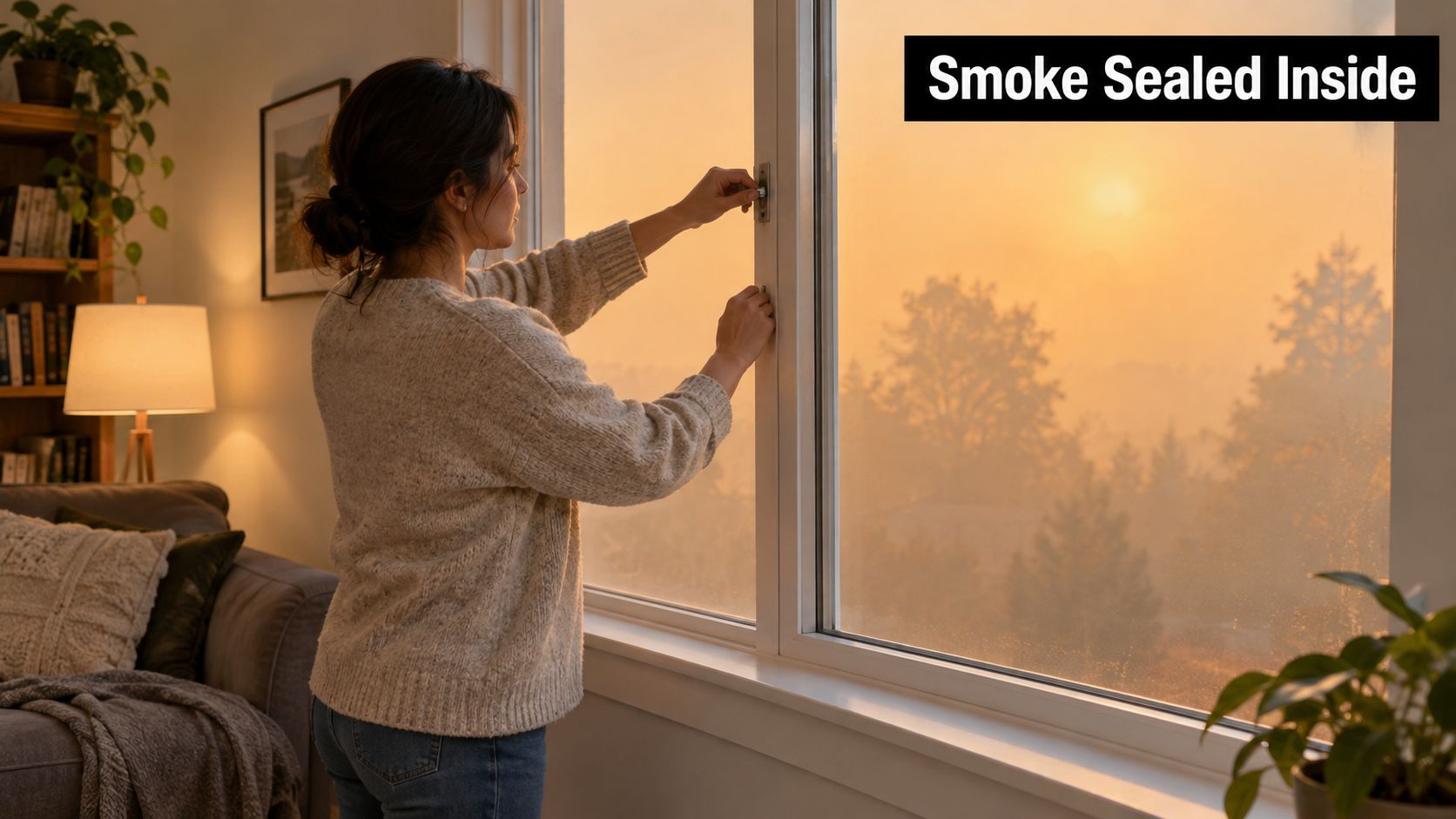
That result matters because outdoor and indoor readings don't move in perfect lockstep. Two homes on the same street can experience different indoor PM2.5 levels because one has a tighter envelope, better filter fit, a different HVAC operating schedule, or a portable purifier in the occupied room.
Why a closed window isn't a clean-air strategy
Smoke enters through more than open windows. Pressure differences pull particles through door gaps, construction joints, duct penetrations, bathroom and kitchen exhaust pathways, and outdoor-air intakes. Every time a door opens, contaminated air can also enter directly, then remain suspended or settle on indoor surfaces.
Building age helps, but it doesn't settle the question. The California research found that newer structures, air conditioning, and filtration generally corresponded with lower infiltration. They still experienced smoke entry, and indoor concentrations still rose sharply during fire events.
Practical rule: Treat a closed window as one control, not as proof that the room is safe.
Indoor air quality is a moving balance. Outdoor smoke intensity can rise faster than your building can dilute or filter it. Your HVAC system may reduce exposure when it recirculates air through an effective filter, but it can also introduce smoke if it draws outdoor air through an economizer or intake. A monitor gives you the missing information: the particle concentration where people breathe.
How Smoke Infiltrates Buildings and Homes
Wildfire smoke particles are small enough to exploit weak points in a building envelope. They can move through loose window seals, gaps around doors, poorly sealed ductwork, and ventilation openings. Mechanical systems add another pathway when they pull smoky outdoor air indoors.
The U.S. Environmental Protection Agency reports that, with doors and windows closed and portable air cleaners off, indoor PM2.5 during wildfire events is generally about 55% to 60% of outdoor concentration, but individual homes can range from roughly 30% to 100% of outdoor levels (EPA guidance on reducing indoor wildfire-smoke exposure). That range is why an outdoor AQI reading can't tell you precisely what your family is inhaling inside.
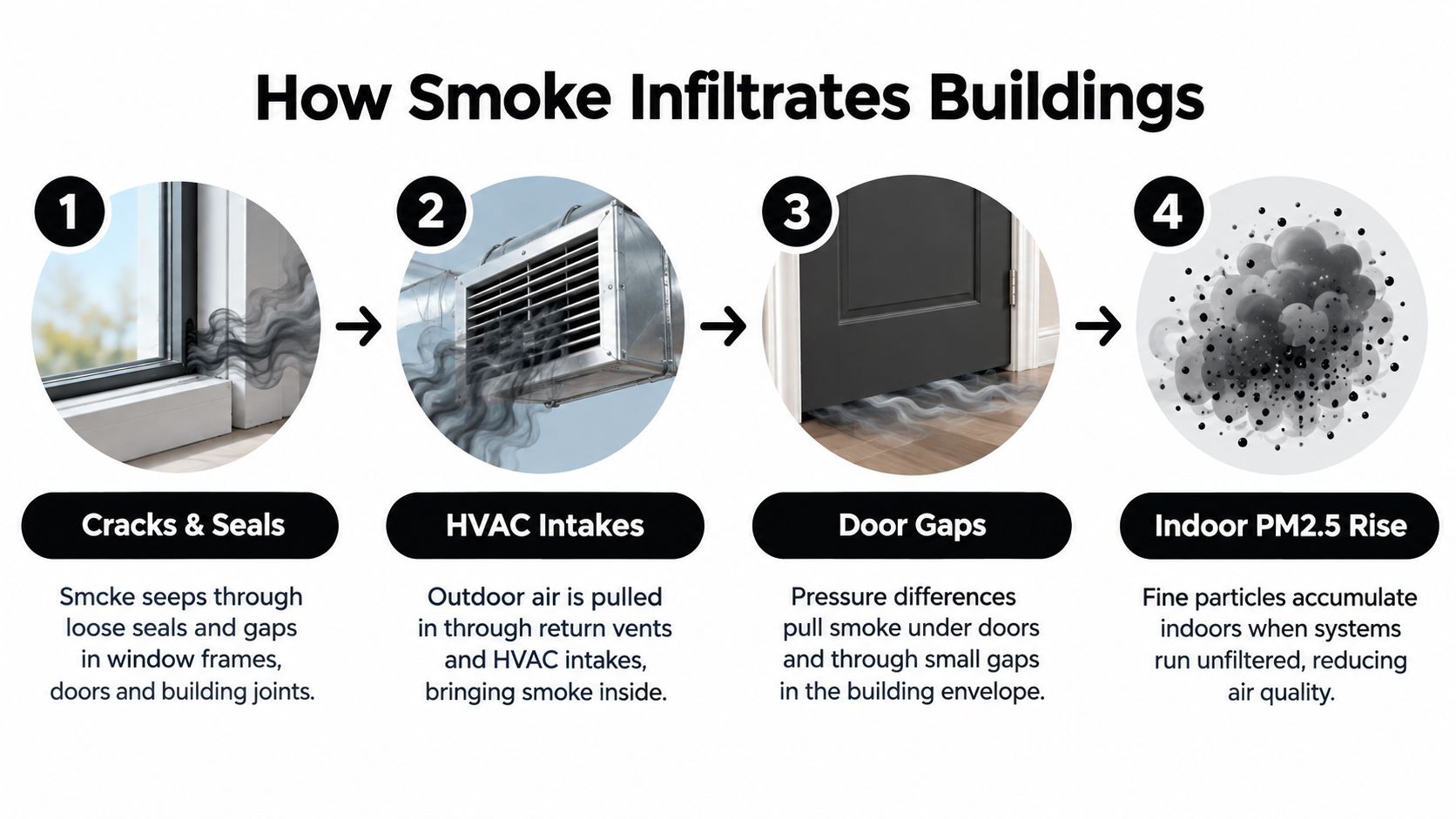
The pathways worth checking
A Western Montana residential study recorded a mean indoor PM2.5 concentration of 15.9 micrograms per cubic meter during a wildfire period, compared with a mean outdoor concentration of 36.8 micrograms per cubic meter, producing an overall infiltration factor of 0.32 during wildfire conditions, as reported in the EPA guidance above. Smoke could enter within minutes to several hours and remain indoors for as long as 8 to 10 hours, so a short exposure at the door can become a prolonged indoor problem.
Start with the locations people overlook:
Window assemblies: Inspect worn weatherstripping, frame joints, and sliding-window seals. Ash and debris on screens can also affect airflow and cleaning, so a practical window screen cleaning Simi Valley guide can help with maintenance after a smoky event.
Exterior doors: Check the sweep and perimeter gasket. A visible light gap is a straightforward sign that smoke can find a route inside.
HVAC intakes: Identify whether the system is drawing outdoor air continuously or through an economizer. Outdoor-air settings need different treatment during an active smoke episode.
Exhaust and pressure balance: Kitchen and bathroom exhaust can depressurize a home, encouraging smoky air to enter through unsealed openings.
Duct connections: Leaks near returns or equipment can pull contaminated air from attics, garages, crawl spaces, or wall cavities.
The building envelope isn't the only variable. Filter efficiency, fan runtime, room arrangement, and occupant behavior determine how much smoke remains suspended. For a broader explanation of how outdoor pollution moves indoors, see this guide to outdoor air pollution and indoor exposure.
Choosing the Right Filtration and MERV Ratings
A filter upgrade should begin with particle performance and HVAC compatibility, not with the highest number printed on the package. MERV ratings are tested under ASHRAE Standard 52.2 across particle ranges of 0.3 to 1, 1 to 3, and 3 to 10 micrometers.
A CDC technical report states that MERV 11 filters must achieve at least 20% average efficiency for 0.3 to 1 micrometer particles, while MERV 13 and higher filters must achieve at least 50% efficiency for that same range (CDC wildfire air filtration technical report). Because wildfire smoke contains substantial submicron material, MERV 13 is a practical minimum target for many smoke episodes.
Use this filter decision sequence
First, identify the system constraint. Check the current filter size, the air handler's documentation, and the available rack depth. A one-inch filter and a deeper media cabinet don't behave the same way, even when their MERV labels match.
Next, verify pressure drop at design airflow. A higher-efficiency filter can create more resistance. That may reduce airflow, impair heating or cooling, increase fan energy use, or contribute to coil-freezing and equipment stress. ASHRAE says a typical one-inch filter can generally be replaced with a filter rated up to MERV 13, while higher ratings require closer attention to system capability (ASHRAE residential filtration guidance).
Then, stop bypass. Air that slips around the filter isn't cleaned by the filter media. A loose rack, damaged gasket, or incorrectly sized filter can undermine an otherwise appropriate MERV selection.
Finally, operate and inspect it. During smoky conditions, run the central fan continuously when feasible, using recirculation rather than outdoor-air intake where the system allows. Inspect the filter frequently and replace it when visibly loaded or according to the system's maintenance requirements.
Why the highest rating can be the wrong choice
MERV 13 and higher filters have stronger minimum efficiency requirements in the smallest tested range, but the rating alone doesn't tell you how much clean air reaches the room. If resistance causes a weak blower to move less air, the system may filter fewer total cubic feet, cool poorly, or shut down under stress.
The sound decision is the highest filter efficiency the equipment can safely handle, confirmed against airflow and pressure limits. A qualified HVAC technician can measure performance rather than guessing from the label.
Portable Purifiers vs Whole Home Systems
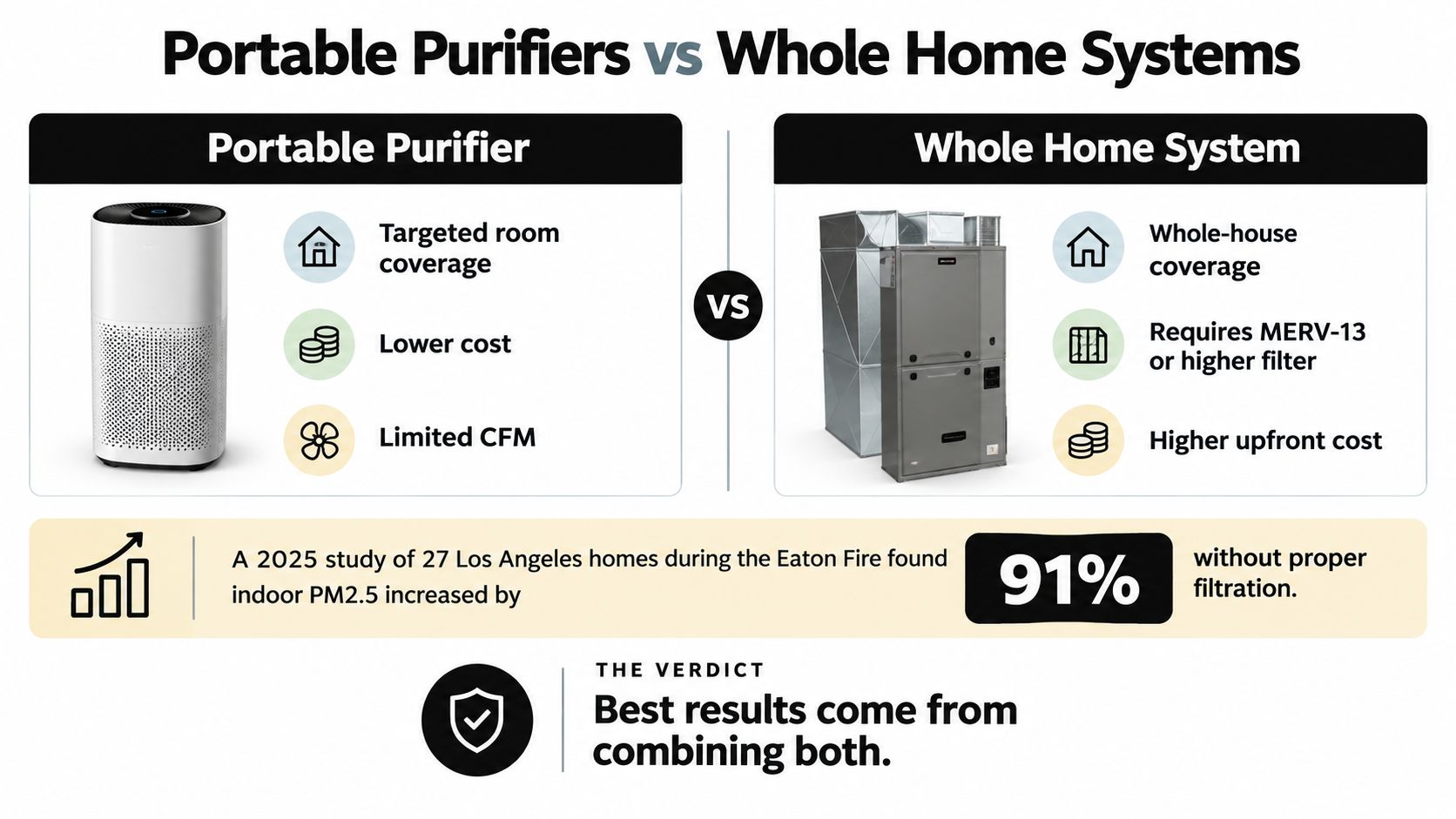
A portable purifier and a central HVAC filter solve different coverage problems. The portable unit treats air in a defined room, while the central system treats air that passes through the return and supply network. Neither one automatically protects every occupied space.
During the January 2025 Eaton Fire, a study of 27 Los Angeles homes found that indoor PM2.5 increased by 91%. Homes using HEPA purifiers had significantly, but only modestly, lower indoor concentrations than homes using sham units (PNAS report on the Eaton Fire study). The result challenges a common assumption: seeing “HEPA” on a box doesn't guarantee a clean home.
Portable units fit targeted protection
A portable cleaner makes sense when you need a clean-air room, have limited HVAC control, or want to protect bedrooms and living areas where people spend the most time. Place it with clear airflow around the intake and outlet, keep doors and windows closed, and size it for the room rather than the entire house.
Coverage is the limitation. A unit in a bedroom won't clean a distant office, closed hallway, or separate floor effectively. Placement also matters. A purifier hidden behind furniture or operated on a very low setting may move too little air to make a meaningful difference.
For people comparing models, a resource such as shop smoke removal air cleaners can help organize options, but evaluate the unit's room coverage, airflow, noise, filter replacement needs, and whether it generates ozone. Avoid ozone-generating devices because they can worsen indoor air.
Whole-home filtration reaches more spaces
A central HVAC system with a compatible MERV 13 or higher filter can treat air throughout the home, but only while air moves through the filter. That usually means the blower needs to run continuously or on an extended schedule during the smoke episode. A filter also won't remove particles from rooms the system doesn't serve well, nor will it correct outdoor-air intake settings.
Option | Main strength | Main limitation |
|---|---|---|
Portable purifier | Concentrates cleaning in an occupied room | Doesn't provide equal coverage throughout the building |
Whole-home HVAC filtration | Uses existing duct distribution for broader coverage | Depends on blower operation, filter fit, and compatible pressure drop |
Combined approach | Adds room-level control to central filtration | Requires coordinated placement, operation, and maintenance |
Reviewing whether in-duct air purifiers are worth it can help you separate particle filtration from other air-treatment technologies. For wildfire smoke, particle removal, airflow, and measured indoor results should lead the decision. The strongest practical strategy is often central filtration for background control plus a portable purifier in the cleanest occupied room.
Operational Strategies for Smoke Events
Equipment only works when the building operator uses it at the right time. During normal conditions, increasing outdoor ventilation can support indoor air freshness. During an active wildfire smoke episode, that priority reverses because more outdoor air can mean more smoke entering the building.
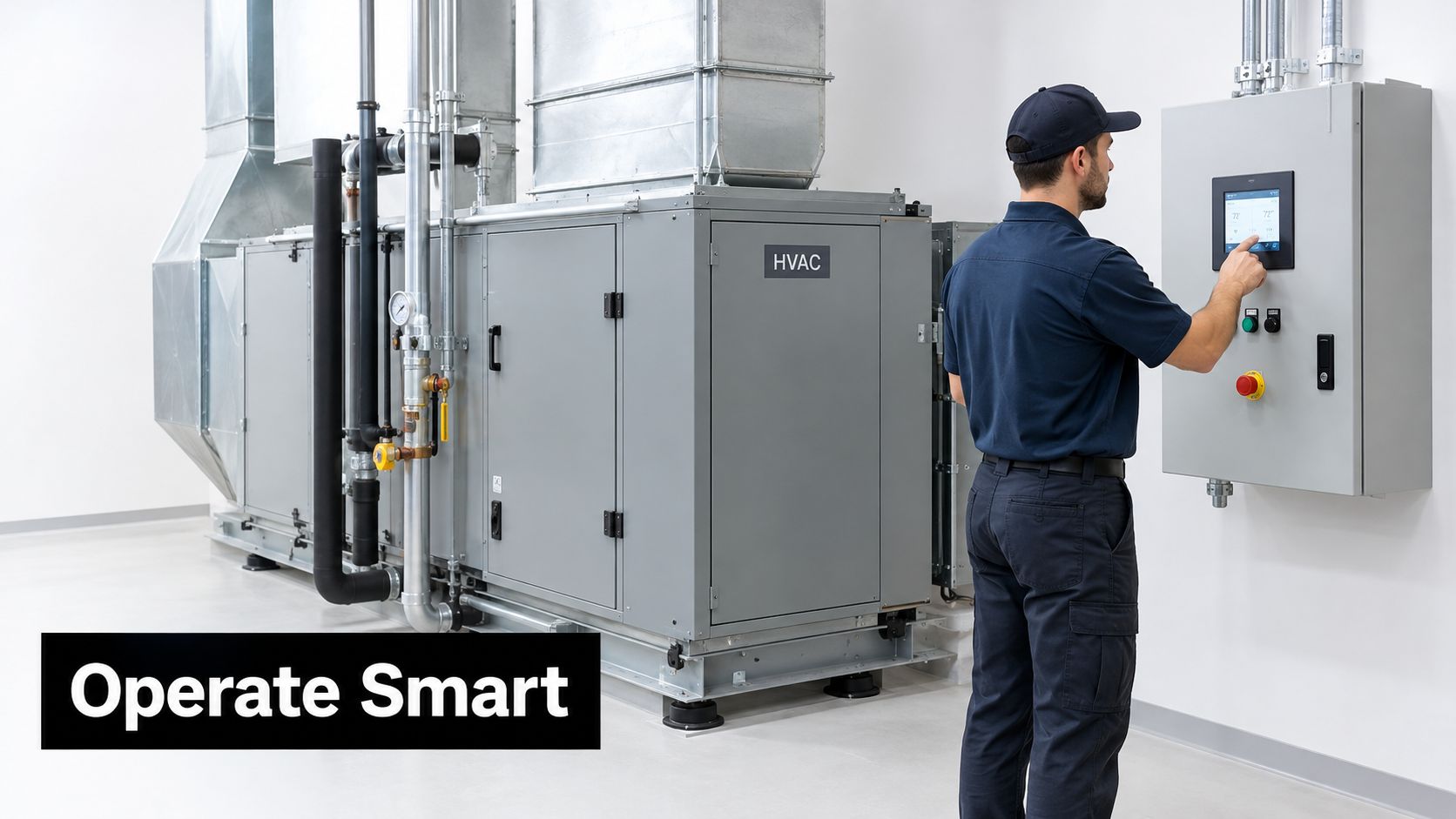
A 2025 study of 24 university buildings in Alberta found that 71% exceeded the Canadian daily PM2.5 limit of 27 micrograms per cubic meter during smoke events. The same study found substantially lower indoor-to-outdoor PM2.5 ratios with MERV 13 filtration than with MERV 8, 0.12 versus 0.28, while higher air-change rates generally increased smoke infiltration (Alberta university-building study).
Use a timed operating protocol
Before smoke arrives: Confirm that the filter is correctly installed, the rack is sealed, and the blower can operate at the intended setting. Identify outdoor-air intakes, economizer controls, and the room you can use as a clean-air space.
While outdoor PM2.5 is high: Close windows and exterior doors. Set the HVAC system to recirculation if available, and close or minimize outdoor-air intake according to the equipment's design and safety requirements. Run central filtration continuously when feasible, and keep portable cleaners operating in occupied rooms.
Monitor the result: Don't rely on the fan indicator alone. Compare the indoor PM2.5 trend with outdoor conditions, watch for a rise after doors open, and check whether the reading falls after filtration runs. A rising indoor reading tells you to investigate infiltration or add clean-air capacity.
After conditions improve: Reopen outdoor-air ventilation to flush accumulated pollutants, but do it after outdoor air quality has recovered. Increasing ventilation during the smoke peak can undermine the very filtration strategy intended to protect occupants.
Turning the HVAC system off can stop air from passing through the filter. In many buildings, controlled recirculation and filtration are more protective than leaving the system idle.
For commercial properties, managers should document the switch points, confirm occupied-room coverage, and keep filtration running during low-occupancy periods if smoke has already entered. Schools, offices, multifamily buildings, and retail facilities need a written sequence because different operators may otherwise make conflicting adjustments.
The operating plan should also remove indoor particle sources. Avoid candles, wood-burning appliances, smoking, and cooking methods that add fine particles while the building is closed up. Those sources can raise indoor readings even when the outdoor smoke level is falling.
Verification and Professional Mitigation Services
Wildfire smoke protection isn't complete until you verify the indoor result. Outdoor readings describe the incoming hazard, but they can't account for your home's leakage, filter bypass, HVAC schedule, room layout, or purifier placement. Put an indoor PM2.5 monitor in the room where people spend the most time, then use it to compare conditions before and after each intervention.
A practical audit
Check that the filter fits tightly, the rack has no visible bypass, outdoor-air settings match the smoke protocol, and the blower runs when filtration is supposed to operate. If indoor readings remain high, test one change at a time, such as sealing a door gap, changing recirculation settings, or moving a portable purifier into the occupied room.
Ducts and coils also deserve attention when dust and debris have accumulated. Cleaning won't replace filtration, but restricted coils, contaminated components, or leaky duct connections can reduce system performance and create additional pathways for unwanted particles. A qualified professional can inspect the equipment, assess airflow, and determine whether cleaning, sealing, filter changes, or an air-treatment upgrade addresses the actual failure point. Guidance on choosing an indoor air quality expert can help homeowners prepare the right questions.
Purified Air Duct Cleaning provides residential and commercial air duct cleaning, dryer vent cleaning, HVAC coil cleaning, and installation of NASA-certified ActivePure air purification systems across the Phoenix metropolitan area. Those services can support a broader maintenance plan, but indoor PM2.5 monitoring should remain the test of whether wildfire-smoke controls are working in your specific building.
If smoke is affecting your Phoenix-area home or facility, Purified Air Duct Cleaning can inspect ductwork, vents, coils, and filtration equipment, then discuss practical indoor air quality improvements. Request a quote and pair professional system maintenance with an indoor PM2.5 monitor so you can verify the results during the next smoke event.