

Air Purification System Cost: Prices and What Drives Them
A whole-home HVAC air purifier typically installs for about $500 to $2,500, with a typical project landing near $1,200, while portable units run from $50 to $1,500 depending on the room and the features. The first figure buys equipment plus labor and integration with your ductwork. The second buys a box you plug into a wall.
That difference in what the numbers measure is why so many cost comparisons mislead. The U.S. EPA's summary of residential air cleaner information splits the cost of an air cleaner into purchase, maintenance (including filter and part replacement), and electricity, and notes that the most effective units generally cost more because they combine high airflow with efficient particle capture. Most quotes cover the first bucket and stay quiet on the other two.
Rank systems on a five-year total and the order changes. A machine that costs more at the register but runs on a fraction of the electricity and takes a modestly priced filter can pass a cheaper unit before the warranty expires. Each category below comes with a range and the reason behind it, so you can map your own building onto the numbers instead of guessing.
Air Purification System Costs by Type
Air purification pricing splits on one question first. Does the equipment go into the ductwork, or does it sit in the room with you?
Whole-home equipment carries an installed price because a technician mounts it in the return or plenum, seals the cabinet, and verifies that airflow still meets design. The PickHVAC guide to installed air purifier prices puts a whole-home HVAC air purifier at approximately $500 to $2,500 installed, with a typical project averaging near $1,200. Basic media-filter cabinets generally fall around $300 to $1,300, and electronic air cleaners commonly range from $600 to $2,200. Portables stay lower at the register: small-room models about $50 to $350, medium or large-room devices approximately $150 to $900, and premium connected units up to $1,500.
Then comes the line most buyers forget. Replacement filters commonly run $15 to $180 per filter depending on size and design, and that charge repeats for the life of the system rather than landing once.
System type | Typical price range | Price basis | Best fit |
|---|---|---|---|
Whole-home HVAC air purifier | $500 to $2,500 (typical about $1,200) | Installed, including labor | Whole-house coverage on forced-air systems |
Basic media-filter cabinet | $300 to $1,300 | Installed | Budget whole-house filtration |
Electronic air cleaner | $600 to $2,200 | Installed | Fine particles in forced-air systems |
Portable, small room | $50 to $350 | Purchase price | Bedroom or home office |
Portable, medium or large room | $150 to $900 | Purchase price | Living areas and open plans |
Premium connected portable | Up to $1,500 | Purchase price | Smart controls and air quality monitoring |
Replacement filter | $15 to $180 per filter | Recurring | Every system that uses filters |
A portable price and an in-duct price aren't the same measurement, and treating them as one is the most common budgeting error in this category. The installed figure includes professional labor and integration with the building's HVAC infrastructure. The portable figure is the box alone. Capacity, filtration technology, furnace or air handler compatibility, duct access, electrical work, and local labor rates are what move an installed quote.
Match your property to a row before you shop. A renter treating one bedroom wants the small-room portable. A homeowner with forced-air heat and dust through the whole house is pricing a media cabinet or a whole-home unit. A property manager with several zones is buying multiples, not one oversized box. If the vocabulary is still blurry, this explanation of what air purification actually does separates filtration from UV and ionization before you start comparing prices.
What Pushes the Price Up or Down
Quotes for the same purifier can land hundreds of dollars apart, and the box is rarely the reason. Six variables decide whether a project sits at the bottom of the range or above it.
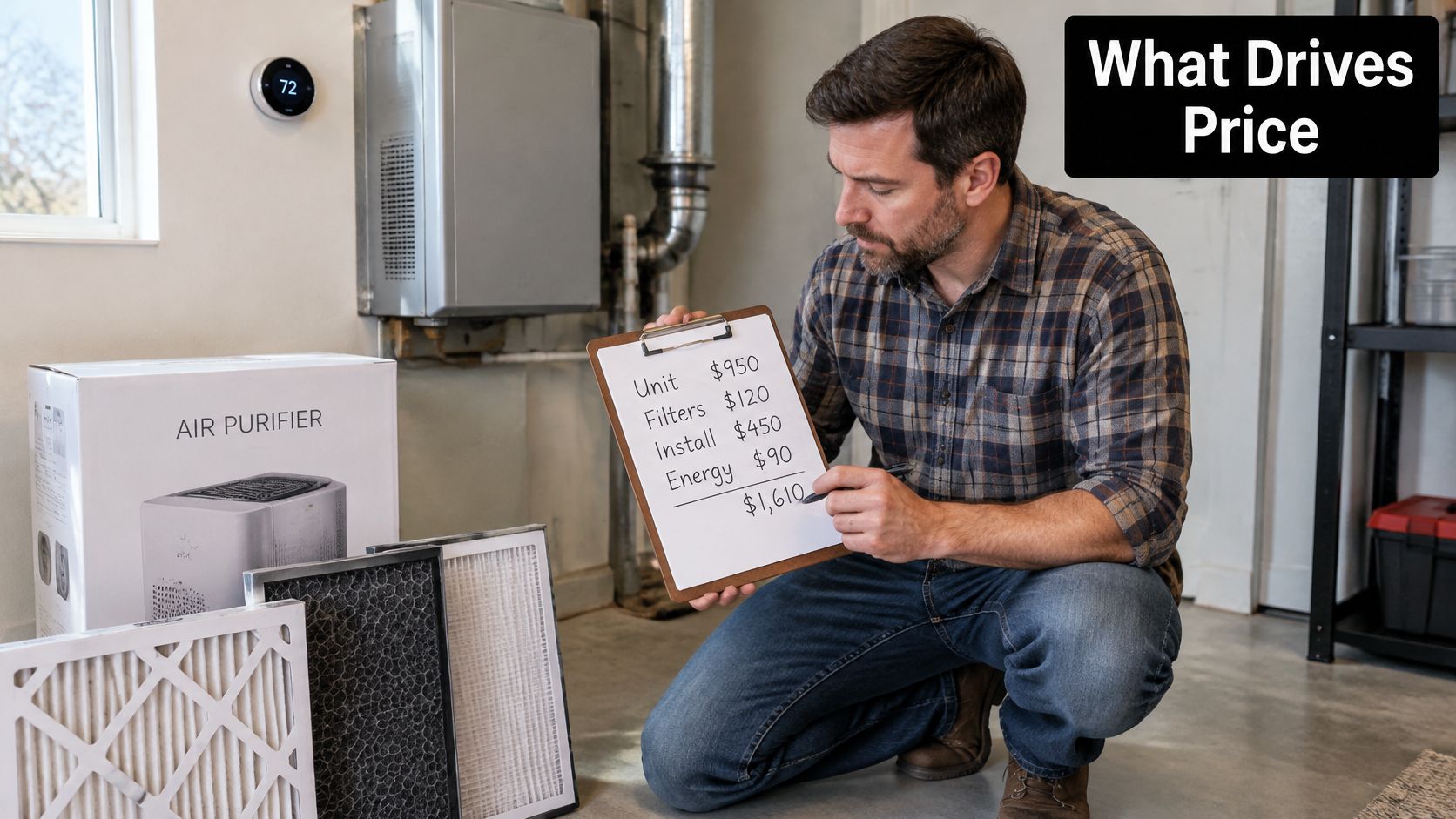
Capacity comes first. A unit sized for one bedroom carries a fraction of the equipment cost of a system matched to a large multi-level house with several zones, and a big house may need more than one device before the coverage is even. Filtration technology comes second. A basic media filter cabinet is the cheapest way into whole-house filtration, while a dedicated HEPA or electronic design costs more to buy and more to install because it needs a different housing, more static pressure headroom, and often its own power.
Cost factor | Lower-cost case | Higher-cost case |
|---|---|---|
Equipment capacity | Unit sized for one room or a small apartment | Unit sized for a large whole house |
Filtration technology | Basic media filter | Dedicated HEPA or electronic air cleaner |
Furnace or air handler fit | Standard accessible forced-air system | Custom mounting or new controls |
Duct access | Accessible return and plenum | Cramped, sealed or unlined ducts |
Electrical work | Existing outlet or circuit | New circuit or panel upgrade |
Labor rates | Local market average | Premium metro or after-hours rates |
Where the labor hours go
Duct access is the factor that surprises homeowners. An accessible return and plenum lets a technician cut in a cabinet and seal it in an afternoon. A cramped attic run, flex duct that's been crushed under insulation, or a plenum with no straight section wide enough for the cabinet can double the time on site, and time is what you're buying.
Electrical work gets billed separately when the unit needs a circuit it doesn't have. A small electronic cleaner that plugs into an existing outlet is inexpensive to power. A larger system that needs a dedicated circuit or a spare panel slot adds an electrician to the job. Labor rates then vary by market, so a Phoenix quote and a rural quote for identical equipment won't match, and neither one is wrong.
You control two of these before you call anyone. Size the equipment to the space you want treated rather than to the whole house by default, and find out early whether your ducts are accessible enough for an in-duct cabinet. Those two answers set most of the price. The rest is shopping labor.
Five-Year Ownership Cost, Not Just the Sticker Price
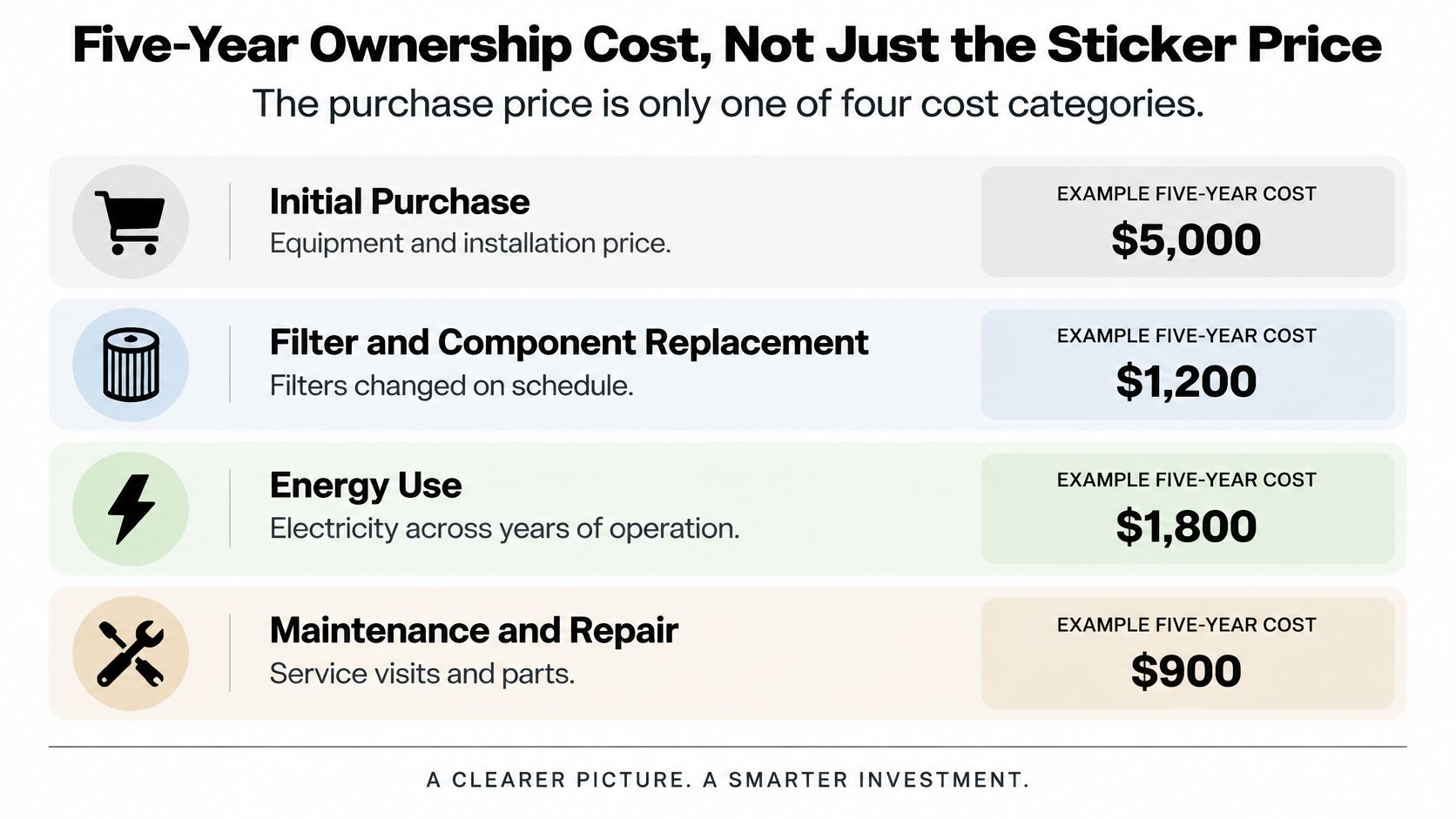
The sticker price answers a question you'll stop caring about in year three. ASHRAE's handbook chapter on air cleaners identifies four major cost drivers for air purification: initial purchase, replacement or cleaning of filters and components, electricity, and disposal. Most residential quotes cover the first and stay silent on the other three.
Pressure drop is the technical reason the other three matter. As a filter loads with particles, its resistance rises, so the blower either pushes harder and draws more power or delivers less air to the rooms. A low-cost, high-resistance filter can therefore produce higher operating costs and poorer contaminant removal than a more expensive, low-resistance design, which is the opposite of what the price tag suggests. Keeping the equipment serviced on schedule protects both airflow and the bill, which is why preventive maintenance scheduling belongs in the same conversation as the purchase.
Ask for this in writing: the device's pressure-drop data at your intended airflow, and one sentence confirming your blower or variable-frequency drive can hold design airflow with the filter loaded.
The installed price is often the smaller part of the bill. Over a system's working life, electricity and filter replacement typically outweigh what you paid to put the unit in, and disposal adds a small cost at the end. How those categories split shifts with climate, run hours, and equipment, but the pattern holds widely enough that an installation quote on its own tells you very little about what the system will cost you.
Build the model yourself with conservative inputs and the pattern still shows. Say a $1,200 installed unit plus five years of filters at an assumed $120 a year comes to about $1,800 before any extra fan energy, and that assumes nothing fails. Add a second unit for a bedroom, price a high-static filter that makes the blower work harder, or shorten the filter interval in a dusty climate, and the gap between the cheap quote and the good one narrows or disappears.
If the mechanics of filter loading are new to you, this short walkthrough makes the airflow side concrete.
Three things to request from any installer
Pressure-drop data at design airflow. Not a MERV rating on its own. The resistance curve at the airflow your system moves.
A blower confirmation. A yes or no on whether the existing fan or variable-frequency drive holds that airflow once the filter is loaded.
A scheduled media replacement line. Filter interval and part number written into the quote, so the recurring cost is visible on day one instead of appearing in year two.
Portable Units and What They Cost to Run
A portable unit's price tag says nothing about how well it cleans or what it costs to run. The measure that connects both is CADR, the clean air delivery rate, which the EPA defines as the product of removal efficiency and airflow, expressed as the equivalent cubic feet per minute of cleaned air. Higher CADR clears a given room faster. The ENERGY STAR air cleaner specification sets the efficiency benchmark for qualifying room air cleaners at at least 2.0 dust CADR per watt, with a minimum dust CADR of 50, and estimated roughly 215 kWh of annual savings per qualifying model against the comparison baseline, about $16 a year under the analysis's electricity assumptions.
Electricity is where the cheap unit gives the money back. ENERGY STAR's air cleaner program page reports that a standard room air cleaner running continuously uses approximately 394 kilowatt-hours per year, while certified models use more than 50% less energy, saving about 211 kWh and roughly $18 to $40 a year depending on unit size and local electricity prices.
The formula you can run on any model
Unit | Annual energy use | Cost at $0.12 per kWh | Cost at $0.18 per kWh |
|---|---|---|---|
Standard room air cleaner, running continuously | 394 kWh | About $47 | About $71 |
ENERGY STAR certified model | About 183 kWh | About $22 | About $33 |
Annual savings from certified model | 211 kWh | About $25 | About $38 |
Annual electricity cost equals operating watts multiplied by hours per year, divided by 1,000, multiplied by your local rate. A 60-watt unit running around the clock uses about 526 kWh, which is roughly $79 a year at $0.15 per kWh. Two of those in two bedrooms and the line doubles, which is the point where a certified model's higher purchase price usually pays itself back first.
Check ozone before you chase a bargain. ENERGY STAR's cited requirement limits ozone-emitting models to 50 ppb under the applicable safety standard, and the EPA warns that improperly installed electronic or ion-generating cleaners may produce ozone, a lung irritant. An ionizer that saves a few dollars a month isn't saving anything if it adds an irritant to a bedroom. When you're narrowing a shortlist for one room, this roundup of portable air purifiers covers the specs worth comparing side by side.
Installation and Maintenance Costs Beyond the Unit
The installed quote covers more than the equipment, and the difference between two bids is often what each one leaves out without saying so. Ask directly whether the price includes mounting in the return or plenum, sealing around the cabinet, startup, and a test that airflow still meets design.
Mounting and sealing: Cutting into a plenum and sealing a cabinet is skilled work. If the line isn't listed, it isn't included.
Startup and airflow verification: A static pressure reading before and after tells you whether the system still delivers the air it's rated for.
Year-one filters: Confirm whether filters come with the install or start billing immediately.
Electrical scope: A plug-in unit and a hardwired one carry very different bills, so ask which one you're getting.
A higher-efficiency filter is only an upgrade if the blower can carry it. ASHRAE's filtration and disinfection resources explain that higher filter efficiency generally creates greater pressure drop, which can reduce airflow, require more fan energy, or produce both effects. In an ASHRAE residential and light-commercial study, high-MERV filters produced approximately 45% greater pressure drop than low-MERV filters, while median airflow decreased by about 4% during fan-only operation and 10% during cooling operation. An inexpensive filtration upgrade that starves the coil isn't inexpensive.
A filter price that ignores fan capacity isn't a maintenance cost. It's a deposit on a blower upgrade.
Calendar the parts as carefully as the purchase. Ducts are generally recommended to be cleaned every 3 to 5 years, depending on ductwork age and condition, the type of heating and cooling system, and any allergies or respiratory problems in the home. We build that maintenance into the air purification systems we install, so the filter changes and airflow checks happen on a schedule rather than when someone remembers.
If the upgrade needs fan or duct work, add that line before you compare filter brands. This walkthrough of whole-house air purifier installation shows where the duct and electrical scope usually sits in a project.
Home and Business Requirements That Change the Budget
Residential buyers usually price one of three situations. A single room for allergy relief, a whole house on forced-air heating and cooling, or a household with pets or an allergy sufferer that wants continuous filtration through the day. Each one points at different equipment and a different recurring cost.
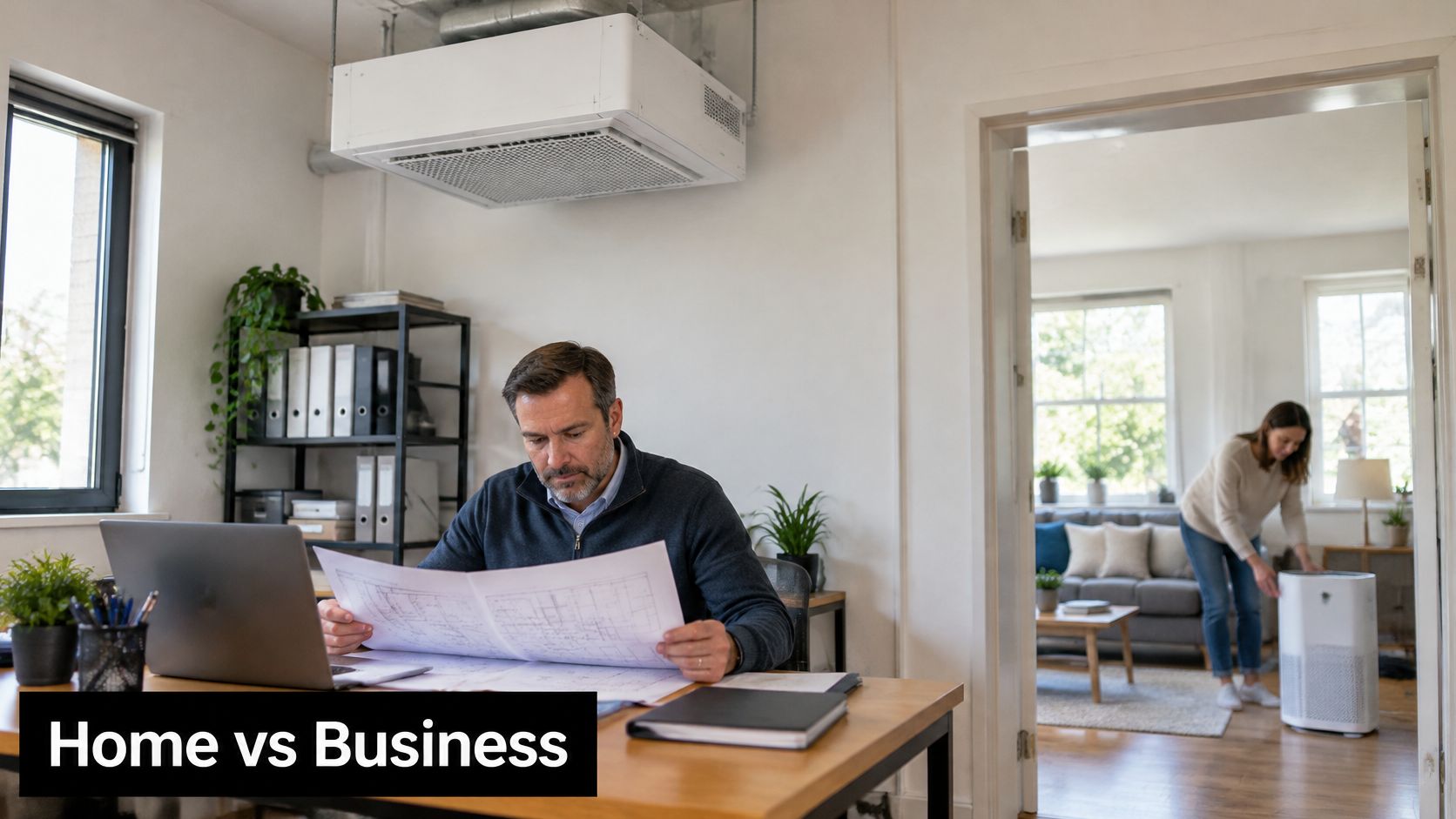
Commercial buyers price on floor area, occupancy, and zones. A 6,000 square foot office with four zones needs several in-duct units or a mix of in-duct and portable equipment, scheduled filter changes, and a maintenance log the building can show. The equipment list is longer, but service and scheduling are where the budget moves.
Local climate shifts the math again. Dust and heat mean the HVAC system runs long hours and the filters load faster than they would in a mild climate, so the maintenance line grows in a way a national average won't capture. Before spending on equipment, it helps to know what's in the air. Restore Heroes' indoor air quality testing guide covers the tests that separate particulates from moisture and gases, which changes the equipment you need and the cost of getting it right.
More units don't automatically mean a higher cost per room. One oversized unit serving a divided floor plan can cost more to buy and run than two correctly sized ones, because it moves air it doesn't need to and still misses the rooms behind closed doors. For businesses working through that math, this guide to commercial air purifiers explains how zoning changes the equipment count. In a home, the filter line grows fastest. In a commercial space, it's service and the filter schedule.
Budget and Compare Quotes Before You Buy
Turn the ranges into three numbers before you call anyone: the installed or purchase price for the equipment that fits your space, five years of filters, and five years of electricity. Add them, and you have a total that survives a sales pitch.
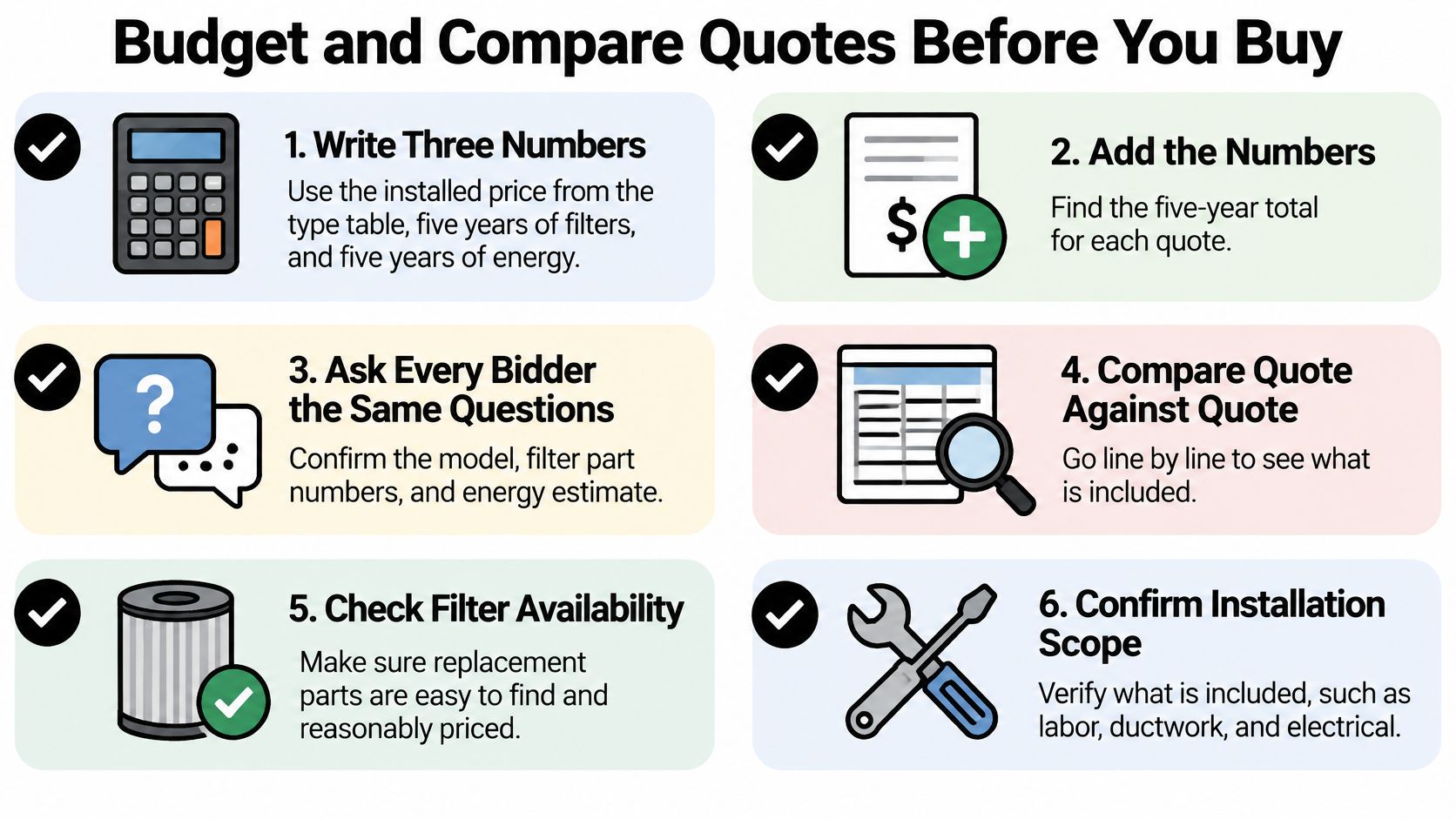
Six steps that keep quotes comparable
Write three numbers. Installed or purchase price, five years of filters, five years of energy.
Add them up. The five-year total is what you compare, not the invoice.
Ask every bidder the same questions. Model, filter part numbers, energy estimate at your rate, and what's excluded.
Compare line against line. A quote missing the electrical line isn't cheaper, it's incomplete.
Check filter availability. Confirm the part number and that it will still be stocked in three years.
Confirm installation scope. Labor, ductwork, electrical, and the post-install airflow test.
Every installer should attach pressure-drop data at the design airflow and answer yes or no on whether the existing blower holds that airflow. Use the answer to accept or reject the quote. It isn't a negotiating point, and a vendor who can't supply it hasn't done the calculation.
In the Phoenix area, we assess each customer's specific needs and recommend the most suitable system for the home rather than quoting a box, and both residential and commercial jobs come with free quotes, given over the phone or through a walk-through at a commercial space. Score a quote from Purified Air Duct Cleaning on those same six lines as any other bid, then rank the five-year totals.
Buy when the system type fits the space, every cost line is itemized, and the first filter change date is written on the quote. If one of those is missing, the price you're comparing isn't the price you'll pay.
Purified Air Duct Cleaning installs and maintains air purification systems across Avondale and the wider Phoenix metro, and every project starts with an assessment of your home or building and a recommendation that fits it. Both residential and commercial work comes with free quotes, over the phone or through a walk-through at your commercial space. Visit Purified Air Duct Cleaning to book one and get a five-year total instead of a single price.