

What Is Air Purification? How It Works and Which Type Fits
A true HEPA filter removes at least 99.97% of particles measuring 0.3 microns, a size chosen for testing because it's among the hardest for a mechanical filter to catch, and a MERV 13 HVAC filter captures at least 50% of particles between 0.3 and 1 micron. Air purification is the controlled removal or reduction of airborne contaminants such as dust, pollen, mold spores, bacteria and fine particles, using filters, ventilation or air-cleaning devices.
So why does a bedroom with a purifier humming all night still smell of last night's salmon?
Because a purifier is a tool, not an outcome. Many shoppers buy a machine, plug it in, and assume the air is handled. What they bought is one layer of a job that also depends on where the pollution comes from, how much outdoor air reaches the room, and whether the equipment matches the particles present.
The better question: not "which purifier wins the roundup" but "which pollutant am I trying to remove, and what will it take to remove it?"
That reframing changes what you buy, where you put it, and whether you need a purifier at all.
What Air Purification Means and Why It Matters
A window screen is a filter, just a crude one. It stops mosquitoes and lets the breeze through, and it does nothing whatsoever about smoke drifting past the porch. That's purification compressed into a single object: you pick a barrier matched to the size of what you want to stop, and you accept the rest passing through.
Contaminants sort by size, and that sorting drives every decision that follows. Visible dust, pollen and lint sit at the large end, which is why cheap fiberglass media catches a decent share of them. Pet dander and mold spores fall in the middle. Fine particulate matter, diesel soot and wildfire smoke sit at the small end, and those are the particles that travel deep into the lungs. A filter that handles the first group can be close to useless against the third.
Size isn't a footnote. It's the design brief.
Most homeowners underestimate the risk. The World Health Organization estimated that household air pollution caused approximately 2.9 million premature deaths in 2021, including more than 309,000 deaths among children younger than five, with most of that burden traced to smoke from solid fuels and kerosene burned indoors. Few of us cook over open coal, but the underlying lesson holds: the source matters more than the device.
A Walk Through Your Own Home
Name two or three sources before you shop. It takes four minutes and saves several hundred dollars.
Cooking: frying and roasting throw off fine particles and moisture. A range hood vented outdoors, running on high, beats any countertop appliance.
Pets and carpet: dander and tracked-in dust settle into fabric and get stirred back up by foot traffic. Vacuuming with a sealed HEPA unit and washing bedding does more than a purifier running in the same room at low speed.
Outdoor air: wildfire smoke and street dust slip through gaps around doors and windows. Sealing those gaps and running filtration during smoke events is a different job from routine dust control.
Paint belongs on that list too, and it's an unusual one because it's temporary and chemical rather than particulate. Alex Trend Painters' advice on indoor air and painting covers how coating choice, ventilation during application and curing time shape what you breathe for the following week. A purifier with a carbon stage can help with the odor, but opening windows and choosing a low-emission product handle the cause.
Sort your shortlist into what a filter can capture and what only ventilation, exhaust or source removal can fix. What is air purification, really? It's the first column of that list, done deliberately.
How Filters Capture Particles and How to Read Their Ratings
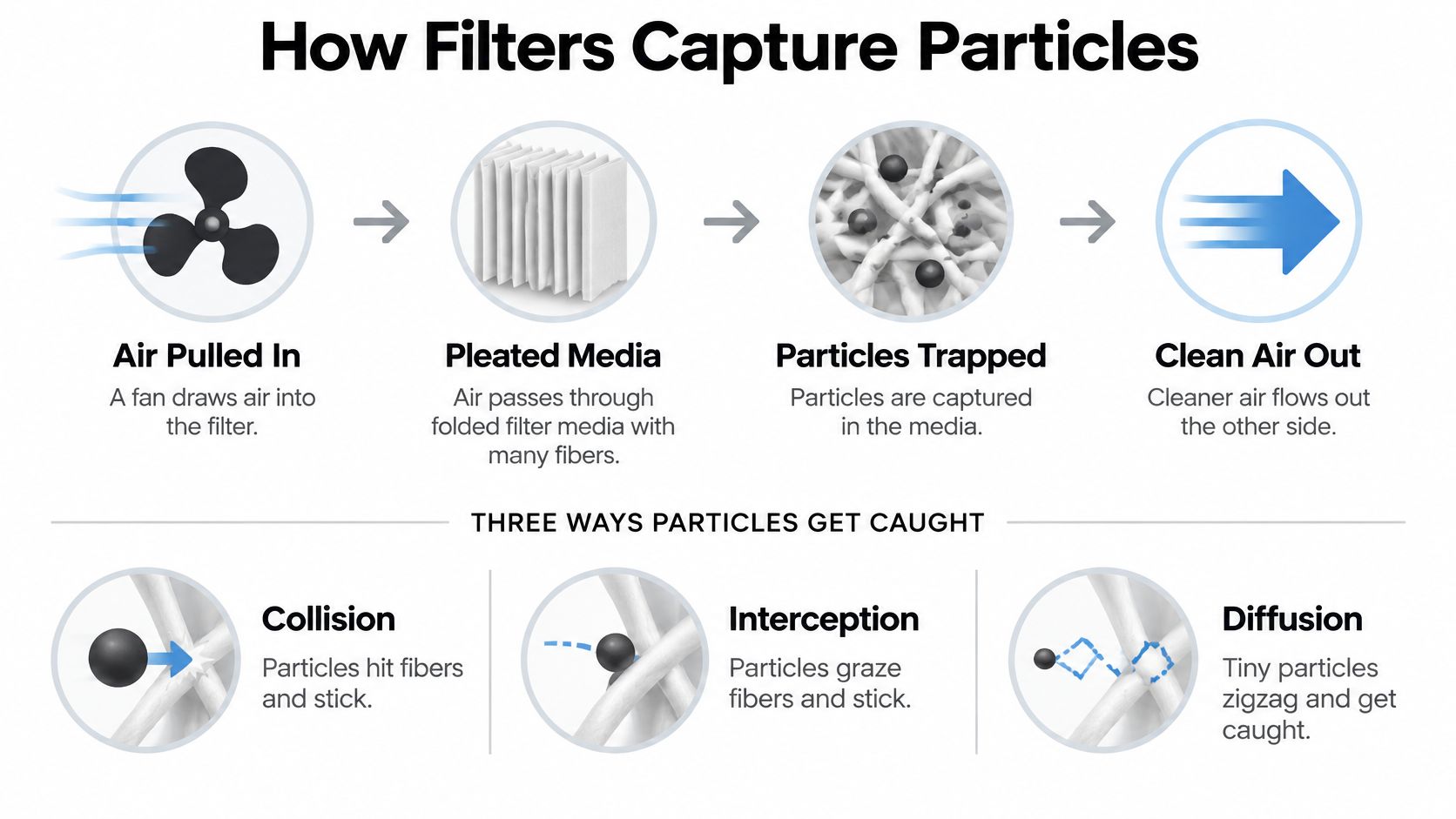
A mechanical filter is a dense mat of fibers, and air doesn't so much flow through it as thread between the strands. Particles that touch a strand stay there. That simple fact explains why two filters of identical thickness can perform nothing alike.
The Three Ways a Fiber Catches a Particle
Collision. Larger particles carried on the airstream have enough momentum to keep going straight when the air bends around a fiber. They hit it and stick.
Interception. Smaller particles follow the airflow but graze a fiber closely enough that molecular attraction holds them.
Diffusion. The tiniest particles get knocked around by air molecules, zigzagging until they wander into a fiber. The smaller they are, the more they zigzag.
This is why 0.3 microns is the testing benchmark. It's the awkward middle ground where particles are too small for momentum to fling them into a fiber and too large to wander much. The contaminant that slips through most easily is the one at that size.
Two Rating Systems, One Question
Every label answers a single question: how much of a given particle size does this stop? HEPA and MERV answer it in different ways, for different equipment.
HEPA applies to a filter, or a whole appliance, tested to a fixed standard. The U.S. Environmental Protection Agency states that a true HEPA filter can theoretically remove at least 99.97% of particles measuring 0.3 microns. Anything sold as "HEPA-like" or "HEPA-style" hasn't been tested to that number.
MERV is the HVAC scale, covering particles from 0.3 to 10 microns. EPA data show MERV 8 filters capture at least 20% of 1 to 3 micron particles and at least 70% of 3 to 10 micron particles, while MERV 13 filters capture at least 50% of 0.3 to 1 micron particles, at least 85% of 1 to 3 micron particles, and at least 90% of 3 to 10 micron particles. EPA guidance generally recommends MERV 13 or higher when a building's equipment can handle the added airflow resistance.
Rating or filter | Particle size | Minimum capture | Typical use |
|---|---|---|---|
HEPA | 0.3 micron | at least 99.97% | Portable room cleaners |
MERV 8 | 1 to 3 micron | at least 20% | Basic residential HVAC filters |
MERV 8 | 3 to 10 micron | at least 70% | Basic residential HVAC filters |
MERV 13 | 0.3 to 1 micron | at least 50% | Recommended HVAC upgrade where equipment allows |
MERV 13 | 1 to 3 micron | at least 85% | Recommended HVAC upgrade where equipment allows |
MERV 13 | 3 to 10 micron | at least 90% | Recommended HVAC upgrade where equipment allows |
Reading One Row at a Time
Start with the particle size that worries you, then look across. If smoke and viruses are the concern, you want the 0.3 to 1 micron row, and the difference between 50% capture and 99.97% capture is the difference between a filter and a HEPA appliance. If dust and pollen are the concern, the 3 to 10 micron rows tell you a MERV 8 already catches most of it.
The CDC's ventilation guidance recommends MERV 13 filters, or the highest-efficiency filter an HVAC system can handle without harming system performance, because most respiratory droplets and particles released during breathing, talking, singing and coughing are smaller than 5 micrometers. The same guidance states that portable HEPA cleaners are preferred whenever possible, and that HEPA filtration is more efficient for human-generated infectious particles than even MERV 16 media.
The rule that settles most arguments: efficiency only counts if the system can still move air through the filter. A MERV 16 that starves your blower performs worse than a MERV 13 that doesn't.
Here's the exercise. Pull your current filter, find the MERV number printed on the frame, and locate its row above. For the mechanics of sealed housings and bypass leakage, this explanation of a HEPA air filtration system covers the hardware that decides whether the rating holds in your actual ductwork.
Types of Air Purification Systems Compared
Every option below is a specialist. Several of them handle exactly one job, so read the table as a map of which tool removes which pollutant rather than a ranking from best to worst.
System type | Where it works | Removes well | Watch for |
|---|---|---|---|
Portable HEPA air cleaner | Single room or bedroom | Dust, pollen, pet dander and fine particles | Must be sized to the room; no gas removal |
In-duct air scrubber | Whole home through ductwork | Particles and some microbes across the house | Needs HVAC compatibility and professional installation |
HVAC filter upgrade (MERV 11 to 13) | Central air system | Dust, pollen and larger particles, with some fine particles | Can raise airflow resistance if the blower isn't designed for it |
Ionizer or electrostatic precipitator | Single room | Particles | May emit ozone |
UV germicidal lamp | Ducts or a room | Microbial inactivation | Catches no particles; lamp output fades with age |
Activated carbon module | Portable or HVAC | Odors and some gases | Doesn't capture particles on its own |
Photocatalytic oxidation device | Single room | Limited; not designed for smoke | May generate ozone or other byproducts |
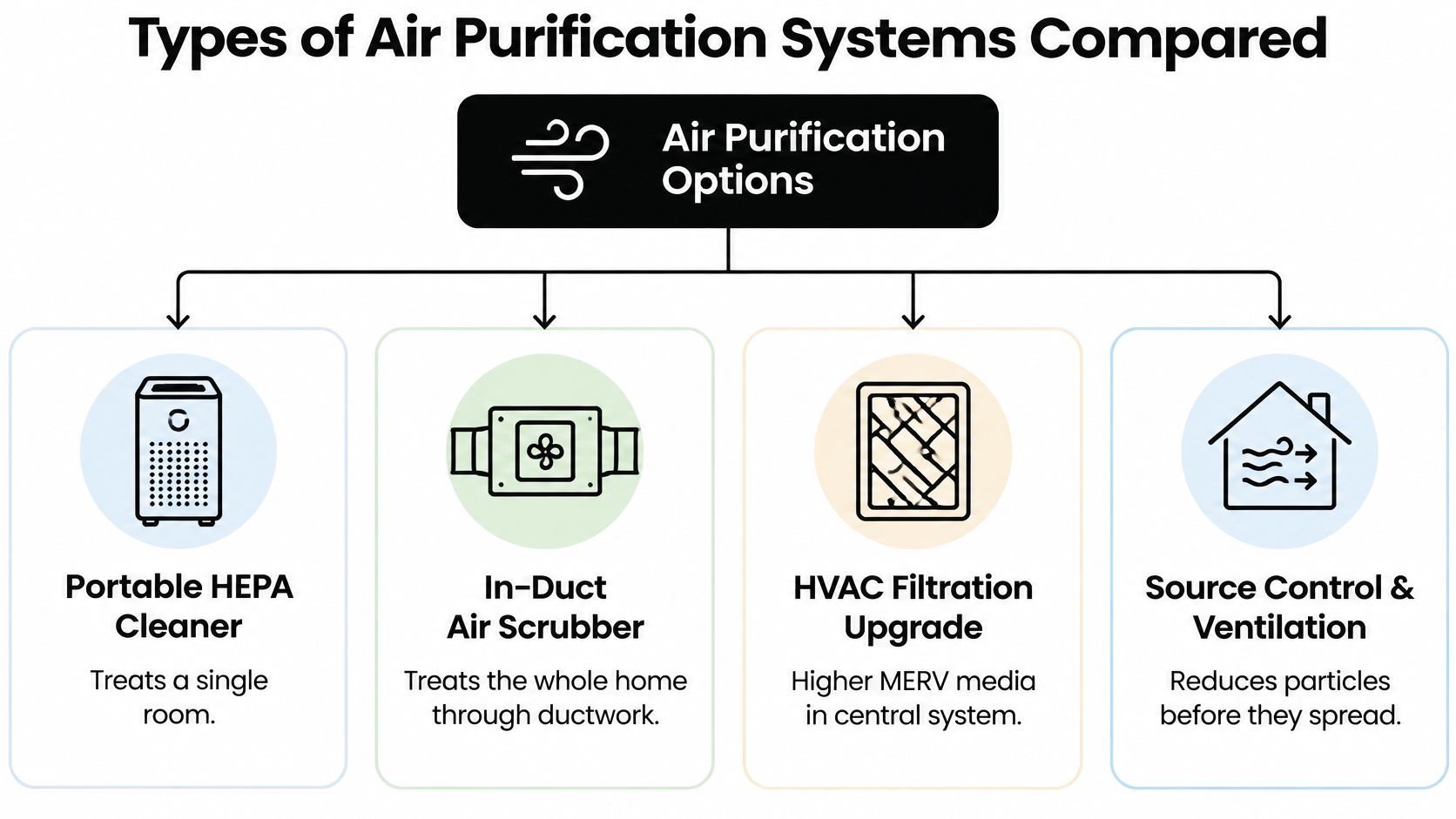
Portable HEPA cleaners pull room air through pleated media and physically trap particles. They treat one room, which is fine if that room is your bedroom. Efficiency alone doesn't tell you how much clean air you're getting, though. ASHRAE's filtration resources describe clean air delivery rate as roughly airflow multiplied by removal efficiency, which is why a superb filter on a weak fan cleans very little air. Sizing follows from that: a unit rated for a small bedroom will barely keep up in an open living space, and the smoke CADR matters most when fine particles are the concern.
In-duct air scrubbers install in the ductwork and treat air for the whole house, which suits open floor plans and multi-room allergy problems. They only work while the system fan runs, so a closed bedroom with the system off sits untreated. Installation belongs with a technician who can confirm the equipment can handle the added resistance.
HVAC filter upgrades are the cheapest whole-house improvement available. The catch is blower capacity, coil cleanliness and filter fit. Air that slips around the frame instead of through the media takes the rating with it.
Ionizers and electrostatic precipitators charge particles so they cling to collector plates or nearby surfaces. They can emit small amounts of ozone, and dirty collection plates make it worse. Gases pass through untouched.
UV germicidal lamps inactivate microbes that pass close enough to the lamp. They catch no particles at all, and their output drops with age. A UV lamp inside a dirty coil assembly is a maintenance problem, not a purification strategy.
Activated carbon adsorbs odors and some gases, and its capacity depends on how much carbon is in the cartridge. Carbon handles gases while media filters handle particles, which is why combination units pair the two: they are doing two separate jobs inside one box.
Photocatalytic oxidation devices carry the most advanced-sounding name on the list, and the marketing often matches. Their real-world particle removal is limited, they are not designed for smoke, and some designs produce ozone or other byproducts of their own.
EPA notes that portable cleaners fitted with high-efficiency filters can substantially reduce indoor particle concentrations, with results depending on room size, operating speed, filter condition and air leakage. Virus-related particles can fall in the 0.1 to 1 micrometer range, so equipment should be HEPA-rated, smoke-CADR rated or specifically tested below 1 micron (EPA guidance on air cleaners and HVAC filters).
If you're weighing a charged-plate device against a media filter, this comparison of an air ionizer versus an air purifier walks through the trade-offs. Match the device to the pollutant you have, and treat whichever you choose as one layer working alongside ventilation and source control.
Why Filtration Alone Does Not Clean Indoor Air
A purifier can only clean what passes through its intake. Anything produced faster than the unit can capture it, dissolved in the room's air as a gas, or settled onto surfaces slips past untouched. That gap is why the box in the corner so often disappoints.
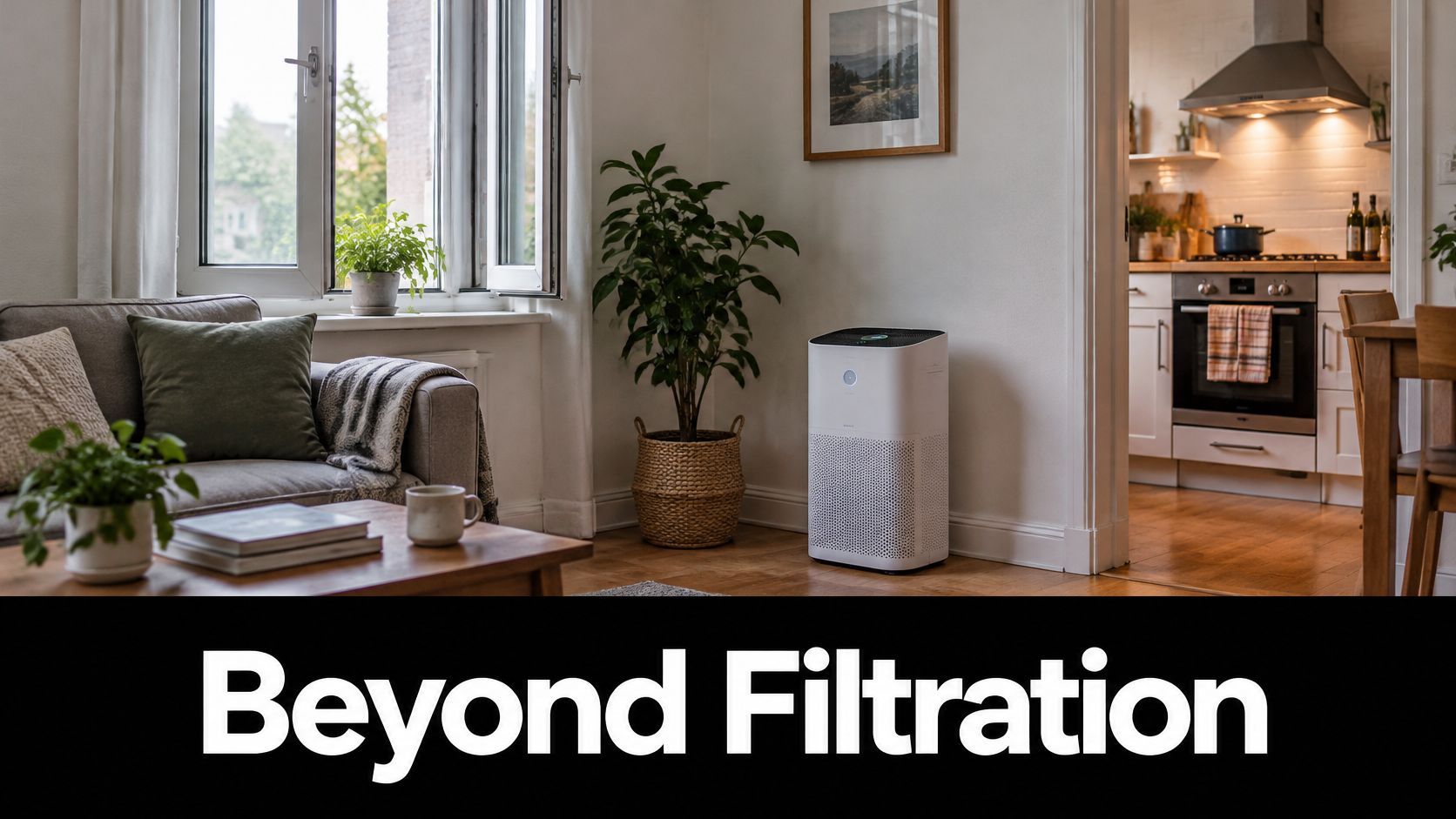
A filter works like a strainer in a stream: it catches whatever flows through it and ignores everything that never enters the current. Clean indoor air needs the whole system working together, and ASHRAE's residential ventilation standard reflects that by treating acceptable indoor air quality as a combination of ventilation, local exhaust, source control and filtration. The 2025 revision raised the prescriptive filtration level from MERV 6 to MERV 11 (ASHRAE Standards 62.1 and 62.2), a sign that the industry now treats filtration as one layer of an integrated design.
The list of what escapes a purifier is long. Carbon dioxide builds up in a sealed room and no filter touches it. Humidity stays whatever the weather and the building make it. Combustion gases from a gas stove or fireplace, radon rising from the soil, and chemicals off-gassing from new furniture, paint and cleaning products all pass through a particle filter unchanged. Moisture is its own category: windows that sweat through the winter water the mold growing around frames and sills, and this window moisture advice for East Texas shows how to trace condensation back to its source.
Local exhaust is the layer homeowners most often forget. A bathroom fan and a range hood remove pollutants at the point where they are created, before they ever reach the room's air. A dryer vent packed with lint is the extreme case: National Fire Protection Association data for 2010 through 2014 show U.S. fire departments responded to an average of 15,970 home structure fires involving clothes dryers or washing machines each year, and failure to clean was the leading contributing factor (NFPA dryer and washing machine fire report). No air cleaner substitutes for clearing that vent.
Work the problem in this order:
Identify the pollutant. Odor, visible dust, dampness, headache in a closed room and smoke haze each point somewhere different.
Control or remove the source. Vent the range, seal the gap, fix the leak, stop storing solvents indoors.
Confirm outdoor-air ventilation is adequate. A tight house needs a deliberate path for fresh air, not just a filter.
Then choose filtration or air cleaning that matches the pollutant and the equipment you own.
Skipping to step four is the most common mistake, and the expensive one. Stronger filtration also adds airflow resistance, so an oversized upgrade can cut delivered airflow, hurt comfort and shorten equipment life. For most homes, the purifier earns its place last, after the sources are controlled and fresh air has a path in.
Byproducts and Claims to Check Before You Buy
The question in the showroom is usually "does it kill germs?" The question that protects your lungs is narrower: what does it remove, what does it emit, and how was that measured in a room like yours?
Start with emissions. The EPA's guide to air cleaners advises avoiding portable or HVAC cleaners that intentionally produce ozone, because ozone irritates the lungs. Electrostatic precipitators, ionizers, some UV systems and plasma cleaners may also emit ozone depending on their design. EPA's wildfire guidance draws a sharp line: mechanical filters, including HEPA and other pleated media, trap smoke particles without producing ozone, while photocatalytic oxidation, hydroxyl generators and UV-component devices aren't recommended for smoke removal because they aren't designed for particles and may generate ozone or other pollutants.
Then look at the evidence base. A 2025 analysis by researchers from academic and government institutions identified 672 studies of air-cleaning technologies published through 2023, and only about 8% tested effectiveness in people, while more than 90% tested devices in unoccupied spaces (WSAV coverage of the analysis). Occupied-space testing does exist. A 2025 classroom study reported that HEPA-purifier use was associated with a 32.8% reduction in viral diversity, equivalent to about one virus per classroom (classroom HEPA study). Modest, measurable and honest.
A claim without airflow, byproduct data and test conditions is marketing. The specification sheet is where the argument gets settled.
A Five-Question Checklist
Is a clean air delivery rate stated for the room size? Without CADR, you can't compare two units or predict coverage.
Is ozone emission measured and listed? A number beats a "no harmful byproducts" badge every time.
Was performance tested in an occupied room or an HVAC system? Bench tests in empty chambers don't reflect furniture, doors and human activity.
Does it capture particles, inactivate microbes, or both? These are different claims and only one of them lowers the particle count you inhale.
What upkeep does it need? Filter changes, lamp replacement and plate cleaning all decide whether month twelve performs like week one.
Photocatalytic oxidation deserves particular scrutiny, since the technology name sounds reassuring and the byproducts don't always get disclosed. This breakdown of the photocatalytic oxidation air purifier covers how the reaction works and what to ask before installing one in an occupied space.
What Studies and Real Homes Show About Results
Measured results are smaller and more specific than advertising implies. Controlled HEPA filtration studies have measured lower indoor PM2.5 than a sham unit running the same room air, so the particle count drops where the purifier runs. The effect is real. It is also narrower than the word "purified" suggests, since gases, settled dust and anything the airflow never reaches stay behind.
A 2024 systematic review found HEPA filtration removed 43.3% to 73.4% of allergens or particulate matter across the indoor environments it examined (Wiley systematic review). A range that wide is not a flaw in the research. Room volume, run time, filter condition and how leaky the space is all move the number, the same way a dehumidifier's rating assumes the windows stay closed.
Three illustrations of how that plays out (scenarios, not reported case studies):
A Phoenix family with dust and summer smoke. A HEPA cleaner sized for the main living space runs continuously at a tolerable speed, filters get changed on schedule, and windows stay shut during smoke events. The purifier did its job. What still needed attention sat outside its reach: gaps around the back door and a return duct pulling attic dust into the hallway, both of which are source problems rather than filtration problems.
A child with asthma in a small bedroom. A correctly sized portable unit runs with the door closed overnight, holding a clean-air pocket through the worst hours. What still needed attention: the stuffed animals on the bed and the carpet holding dander, neither of which a filter touches. If asthma is the reason you're shopping, this guide to whether an air purifier helps asthma is a sensible next read.
A small office with stale air. The filter was upgraded and the outdoor-air damper settings were checked, giving the space cleaner recirculated air plus actual fresh air. What still needed attention: a conference room with no local exhaust and a lunchroom range hood venting into the ceiling.
Notice what repeats across all three. The purifier performs roughly as the studies predict, and each leftover complaint is a source or ventilation problem that filtration was never going to solve. That is the honest picture: purification lowers measurable particle exposure in proportion to room size, run time and maintenance, and it earns its keep as one layer alongside source control and fresh air.
Choose the Right Air Purification Setup for Your Space
Find your situation, then read across to what to verify before you spend anything.
Home or facility situation | Starting point | Why it fits | Verify before buying |
|---|---|---|---|
Single bedroom with allergies or asthma | Portable HEPA cleaner rated for the room | Captures dust, pollen, pet dander and fine particles | Smoke CADR of at least two-thirds of the room's floor area in square feet |
Whole house on central HVAC | MERV 13 filter if the blower allows it | Captures most respiratory-size particles across the house | Blower capacity and airflow after the upgrade |
Smoke or odors from outdoors or cooking | Portable HEPA cleaner with activated carbon | Fine smoke particles and some odorous gases | Mechanical filtration only; skip units that produce ozone |
Dusty or mold-prone ducts | Duct and coil assessment before any purifier | Removes contamination at its source | Moisture and mold sources identified first |
Commercial facility with many occupants | In-duct air scrubber with a maintenance plan | Treats the full air system | Maintenance schedule and filter log |
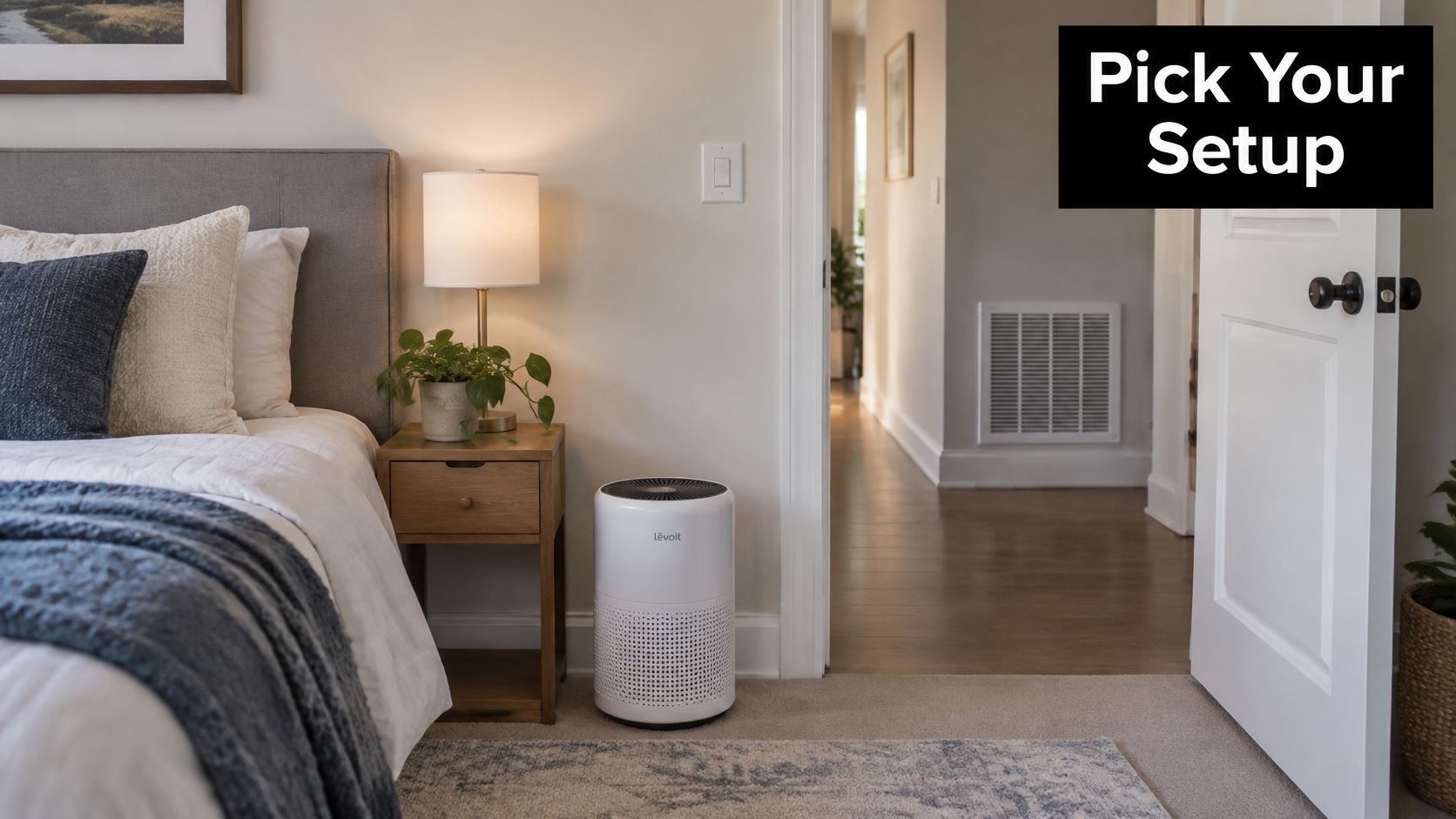
Sizing catches more buyers than any other detail. A unit that's right for a 150-square-foot bedroom won't hold a 500-square-foot open living area, no matter what the box claims, and matching purifier capacity to room size explains how coverage ratings are calculated. If you want to go a level deeper on how quickly a room's air gets replaced, this explanation of air changes per hour connects airflow, room volume and real exposure.
Here's the three-step next move. Measure the floor area of the room that bothers you most. Write down the two or three pollutants that matter there, whether that's pollen, pet dander, cooking smoke or dampness. Then get the system looked at before you buy hardware, because the right answer might be a filter that fits the blower, a duct that needs cleaning, or a portable unit and nothing else.
We assess each property's specific needs and recommend the most suitable system for the home rather than a fixed package, then provide regular maintenance for the systems we install. ActivePure technology, developed with NASA for the International Space Station, is available either as a unit installed in a residential or commercial air duct or as a plug-and-play unit you can place anywhere in a home or office.
If you'd rather not guess which layer your home is missing, Purified Air Duct Cleaning installs and maintains air purification systems across Avondale and the wider Phoenix metro, from in-duct ActivePure units to portable cleaners, alongside the duct and coil cleaning that keeps them working. We look at the pollutants you have, check whether your HVAC system can carry a higher-MERV filter, and recommend equipment sized to the rooms you use most. Visit Purified Air Duct Cleaning to request a free quote and get an honest read on your indoor air before you buy anything.