

Duct Cleaning Truck Equipment and How It Works
Your appointment window was two hours wide, and now there's a box truck at the curb with a hose as thick as your arm snaking across the porch and through the front door. A technician is taping plastic over a floor register and asking whether the furnace sits in the garage or the hall closet. You booked a duct cleaning, but nobody mentioned that a truck would be part of it.
That hose is the reason the truck exists. A duct cleaning truck is a mobile service platform, a vehicle built around a high-capacity vacuum and the tools that travel with it, and its job is to move air in one direction while a crew works inside your house. Knowing what's on board, and what the equipment can and can't do, turns a confusing visit into a decision you can evaluate.
What a Duct Cleaning Truck Carries on Board
A crew arrives with a vacuum, long hoses, brushes and protective coverings. Each item has a distinct job: the vacuum draws air and debris from the duct system, hoses carry suction to the work area, and brushes loosen material from duct surfaces so it can be removed.
Core equipment on a duct cleaning truck
Component | What It Does | Typical Specification |
|---|---|---|
High-capacity vacuum unit | Draws air and debris from the duct system | Performance depends on airflow delivered through the connected setup |
Flexible hoses and extension lines | Carry suction to the duct openings | Length is selected to reach the work area from the truck |
Snake rotor brush | Loosens contaminants from the duct interior | Flexible rotary brush suited to the ductwork |
Access tools and hardware | Open registers, grilles and access panels | Tools suited to the openings being serviced |
Collection bag or chamber with HEPA filter | Captures debris carried out of the ductwork | HEPA-filtered collection |
Portable negative air machine | Provides filtered negative pressure during the work | Portable, HEPA-filtered equipment |
Containment supplies | Protect floors and catch debris near the work area | Plastic tarp and floor coverings |
Grille and vent cleaning tools | Clean supply and return vents | Vacuum and wiping tools |
Hose length is not a fixed truck specification. The crew needs enough hose to reach the duct openings while setting up the vacuum for the particular building. The hose's diameter and routing also affect how air moves through the system. For a closer look at how duct-cleaning hoses affect the setup, consider how the connection from truck to ductwork shapes the entire cleaning run.
Purified Air Duct Cleaning provides air duct and HVAC cleaning for residential and commercial customers. Its cleaning process uses a snake rotor brush to extract contaminants from duct interiors, followed by vacuuming the ductwork from end to end. The equipment on the truck supports that process, from reaching the ducts to collecting debris and protecting the work area.
Suction, Airflow and Containment That Protect Your Rooms
Think about a garden hose. Open the tap all the way and the water leaves the nozzle hard, but add twenty extra feet of hose, two sharp bends and a kink under a wheelbarrow, and the same tap feels weak in your hand. Air behaves the same way at a much larger scale. Every foot of hose, every elbow, every half-sealed register bleeds pressure before suction ever reaches the last branch line of your ductwork.
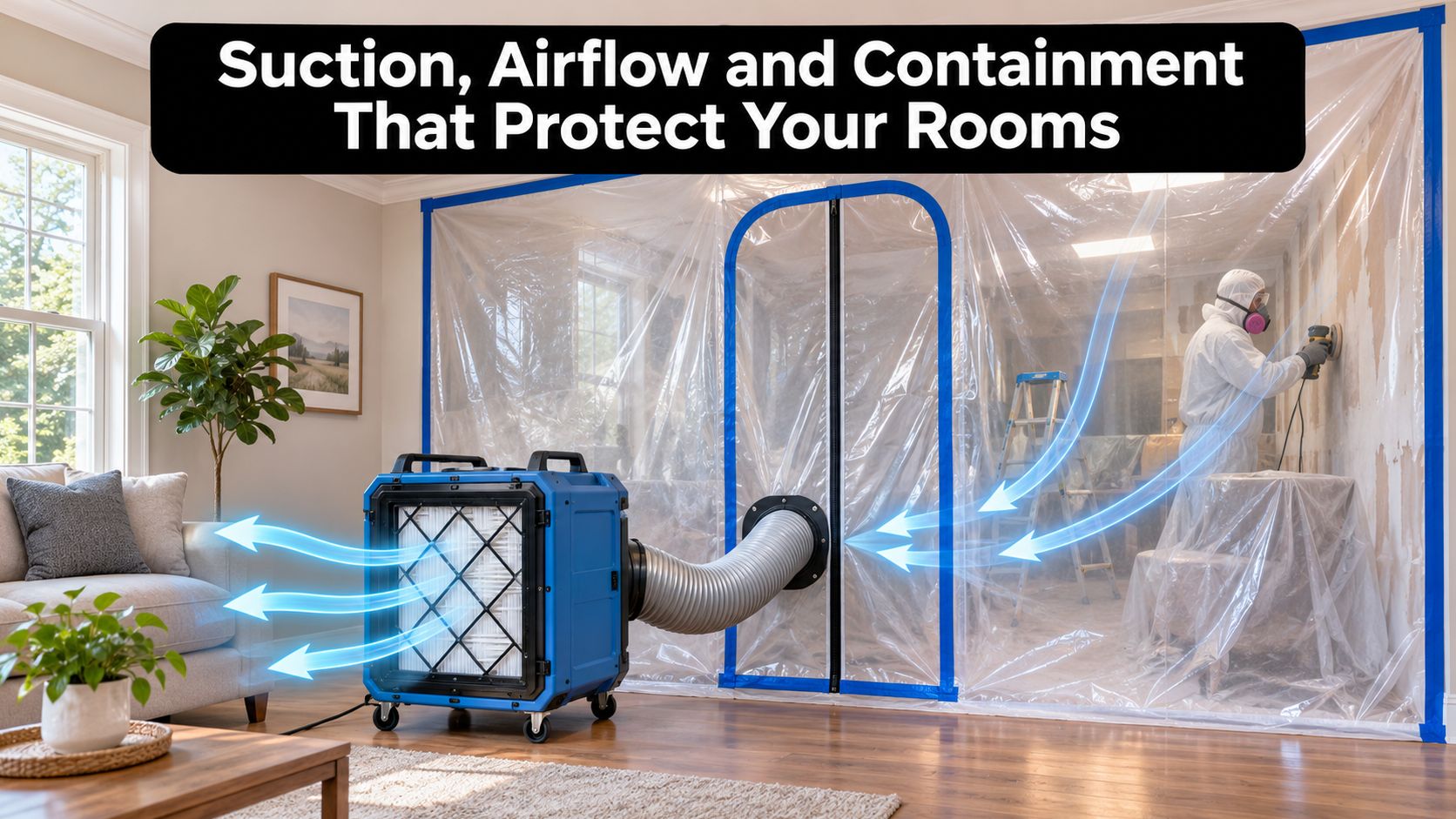
The number that predicts a good job is delivered airflow and maintained negative pressure at the duct system, not the inlet rating printed on the machine. A crew can quote an impressive figure measured right at the vacuum's intake and still deliver a fraction of it where the brush is working. As NADCA's guidance on vacuum performance and negative pressure.pdf) explains, pressure losses accumulate through long hoses, bends, restricted access openings and poorly designed ductwork, and the entire HVAC system has to stay under negative pressure relative to occupied areas while cleaning happens.
What weak airflow does inside the duct
If airflow falls short, agitation makes the mess worse before it makes it better. The brush loosens dust that the airstream can't carry, so material settles deeper in the system or drifts out through a register into the room. That's the reason the sequence is strict: seal the registers, connect the vacuum to the trunk or the return section, hold continuous negative pressure, and verify the equipment sustains the airflow your duct geometry and contaminant type require.
The containment side you can see
Containment is the part of the job a homeowner can watch. We lay a plastic tarp around the service area as a precaution, and debris gets vacuumed and caught in a HEPA bag rather than blown through a shop vac. On the negative pressure method, grilles and dirty filters come out and a portable HEPA filtered negative pressure machine holds the work zone at a lower pressure than the rooms next to it, so any dust that goes airborne travels toward the filter. That setup, explained in how negative air duct cleaning works, is what keeps dust out of the rooms you're still living in.
Mechanical brushing and air washing temporarily resuspend fine dust, including respirable-size particles that would otherwise escape through the vacuum exhaust and settle on your furniture. The NADCA ACR standard addresses that with HEPA filtration at 99.97% collection efficiency for particles 0.3 micrometers and larger, as set out in the HVAC air distribution system cleaning standard. A compliant operation keeps the cleaned section at a lower pressure than nearby rooms, runs the vacuum continuously while agitation is happening, and either exhausts outdoors or filters the exhaust to that standard when indoor discharge is unavoidable.
The question that separates quotes: do you measure delivered airflow at the duct system, or do you only quote the inlet rating on the vacuum?
Three checks you can make on the day
Filter rating: ask what the exhaust filter is rated for, and confirm it's HEPA-class rather than a standard cartridge filter.
Collection assembly: look at the seals where the hose meets the machine and where the collection bag or chamber closes. Loose clamps and torn gaskets leak dust back into the room.
Containment from start to finish: registers stay sealed and the vacuum runs while the brush is moving, not only during a final pass at the end.
If any of those three is missing, the truck is parked outside but the containment isn't doing its job.
How a Cleaning Run Works, Step by Step
The order of work matters more than the size of the machine. A skilled crew follows a sequence where each step exists for a reason, and each one has a common slip that undermines the result. Here's the run in order.
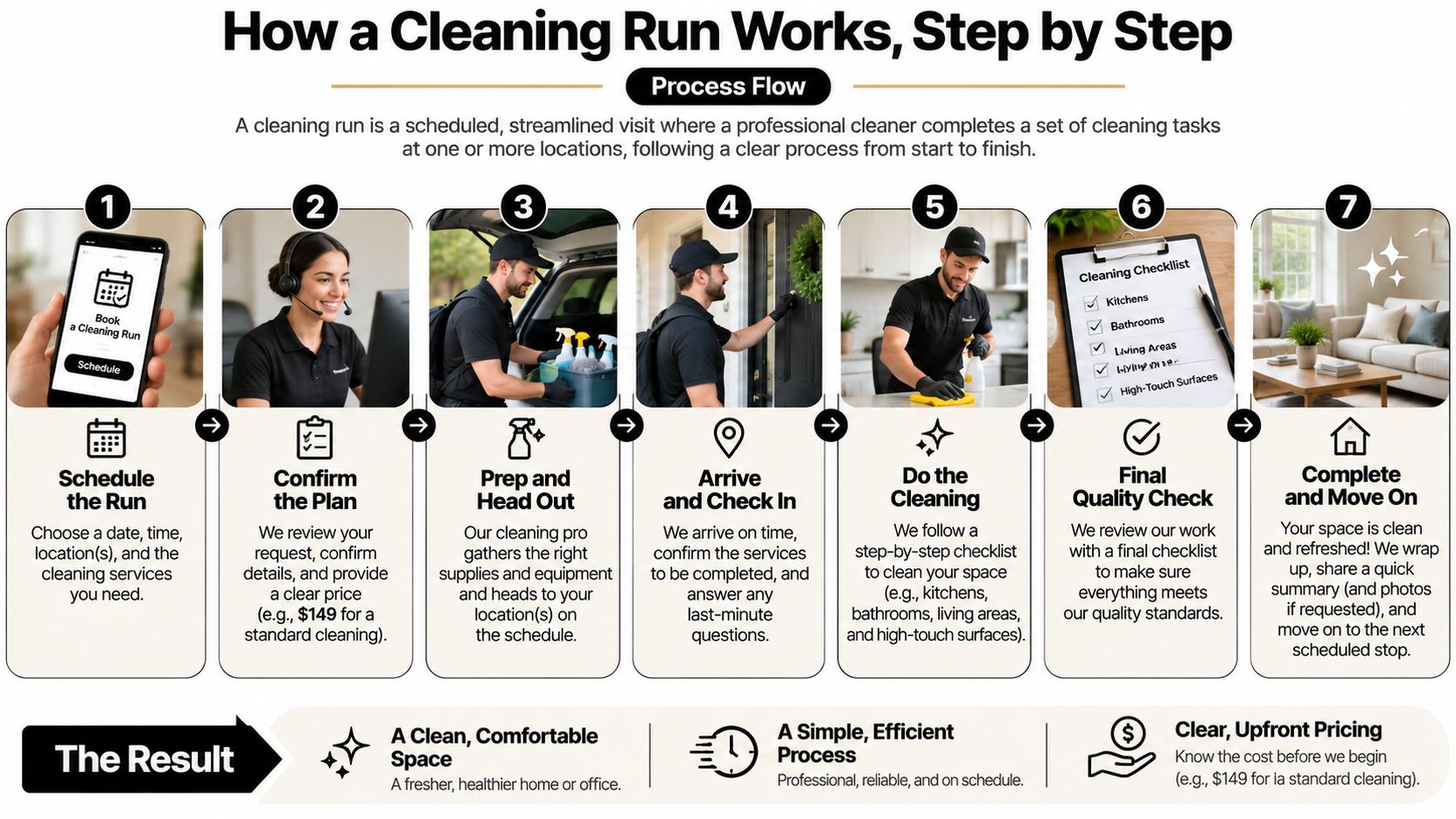
Lay the tarp first. Plastic goes down around the service area before a single tool comes off the truck. Anything that drops out of a vent lands on sheeting instead of carpet, and it gets vacuumed up before the crew leaves.
Open the system. Grilles and dirty filters come out, and access points are opened so the brush and hose have a clear path instead of a detour.
Seal and connect. Supply registers are sealed and the vacuum connects to the trunk or the return section. The slip to watch for is an unsealed register: it bleeds suction and turns a strong vacuum into an average one.
Brush with extraction running. A snake rotor brush scrubs the interior surface of the ductwork end to end while the vacuum pulls. Brushing without suction doesn't clean, it just relocates dust deeper into the system.
Vacuum and wipe the vents. Any debris that fell out of a vent gets vacuumed, then each supply and return grille is opened, vacuumed and wiped down.
Keep the collection in line. The collection bag or HEPA chamber stays connected during agitation, not bolted on at the end, so exhaust stays filtered for the whole run.
Walk it back. Plastic comes up, tools return to the van, and the space is left as clean as or cleaner than before the crew arrived.
Choose the agitation to match the duct material
Tool selection isn't a formality. A rotary brush gives direct mechanical contact and works well on rigid sheet metal with dense, adhered buildup, while an air whip follows bends and branch runs and is gentler on flexible duct. Put an aggressive brush into flex duct and you can tear the inner liner off its helix, which then leaks conditioned air into an attic for years. That's why matching the cleaning method to the duct material is part of the job, not a preference.
What a clean run looks like
When the system restarts, you shouldn't see a dust cloud puff out of the registers. Grilles should be visibly clean on the supply and return side, vents should show no loose debris when you shine a light into them, and the floor should look the way it did before the crew arrived. If the provider can show you before-and-after images from inside the trunk line, ask for them. The inside of the duct is the only place where the work happened.
Jobs That Send a Crew Out and What Triggers Them
Duct cleaning isn't a subscription, and it isn't a yearly box to tick. A truck gets dispatched because a specific condition exists in a building. The trick is matching your situation to the trigger, because that match determines which equipment the crew brings in and how much containment the job needs.
Common truck jobs and what triggers them
Job | Typical Trigger | Equipment Emphasis |
|---|---|---|
Post-construction debris removal | Dust and debris left after building or renovation | Full containment and HEPA exhaust |
Mold on hard-surface ducts or HVAC parts | Substantial visible mold | Sealed containment and HEPA exhaust |
Vermin infestation cleanup | Droppings or nesting material in the ducts | HEPA vacuum under containment |
Visible dust release from vents | Substantial dust and debris blowing into the home | Continuous suction and negative pressure |
Dryer vent lint removal | Lint buildup that restricts airflow and is highly combustible | Dryer vent tools, rear area and lint filter cleaning |
HVAC coil or component cleaning | Visibly fouled components | Access tools for coils and components |
Post-construction is the classic dispatch. Drywall dust and framing debris get pulled into return ducts during a remodel, and the volume is high enough that partial containment fails. If you've just finished a kitchen or a basement, cleaning ducts after a renovation is a different job from a routine maintenance visit, and it should be quoted that way.
Dryer vents are a fire-safety job that often rides along with a duct visit, and the numbers justify treating it seriously. The U.S. Fire Administration estimates that residential buildings experience about 2,900 clothes-dryer fires reported to fire departments each year, and failure to clean was the leading contributing factor in 34 percent of them, per its report on dryer fire hazards. The mechanism is simple: lint rides the vent with moist exhaust air, collects in the dryer and the vent, restricts airflow, and stays highly combustible.
Vent routing is the part most homeowners never check. A dryer vent that exhausts into an attic, crawl space, chimney or interior wall instead of outdoors pushes moist, lint-laden air into the building, which feeds mold and hurts indoor air quality at the same time. If your vent ends anywhere other than outside, that's a repair question before it's a cleaning question.
When Truck Cleaning Is Not Needed and Common Myths
The most useful thing you can hear about duct cleaning is also the least profitable thing for a contractor to say: not every house needs it. The U.S. Environmental Protection Agency states that duct cleaning has never been shown to prevent health problems, and that studies have not conclusively demonstrated that dirty ducts raise household particle levels, because much of the dust stays attached to duct surfaces rather than entering occupied rooms. The same EPA guidance on whether you should have air ducts in your home cleaned notes that routine cleaning isn't recommended, and that cleaning may be appropriate when there's substantial visible mold on hard-surface ducts or HVAC components, vermin infestation, or substantial dust and debris being released into the home.
A peer-reviewed evidence review reached a similar place. Cleaning does remove contaminants from duct interiors, but the changes in indoor pollutant concentrations afterward varied widely, and the evidence was inadequate to establish consistent improvements in indoor air quality, energy consumption, airflow or occupant symptoms.
A truck represents specialized access and removal capability. Your benefit depends on the condition the crew diagnoses and the quality of the work.
Three claims worth testing
Myth one: ducts need cleaning every year. No public health authority sets a calendar. Timing follows the ductwork's age and condition, the type of heating and cooling system, and whether anyone in the home has allergies or respiratory problems. On that basis we generally talk about three to five years for a typical house, and much sooner after a renovation, a pest event or a water intrusion.
Myth two: cleaning cures allergies. A truck visit addresses a contamination source. It doesn't treat a person, and no credible evidence shows that duct cleaning resolves allergy symptoms on its own. If allergies are the reason you're booking, the honest conversation is about source removal plus filtration and humidity control, not about a single visit.
Myth three: clean ducts always cut energy bills. The evidence review didn't establish consistent energy gains from cleaning. A restricted coil or a crushed flex run does waste energy, but that's a component problem solved by coil cleaning and duct repair, not by brushing the trunk line.
Cleaning carries some risks too, including dust and debris released into the air, allergic reactions and mold growth when moisture is present, and those risks are rare when a qualified company does the work properly. That's the whole case for hiring trained crews with containment rather than the cheapest truck in the search results.
Air Treatment Options Compared
Cleaning, filtering and treating are three different jobs, and a quote that blurs them is impossible to compare. Duct cleaning removes what has settled on the inside of the duct: dust, debris, and whatever came in with a pest or water event. An air cleaner or treatment device works on air that's already moving through the system.
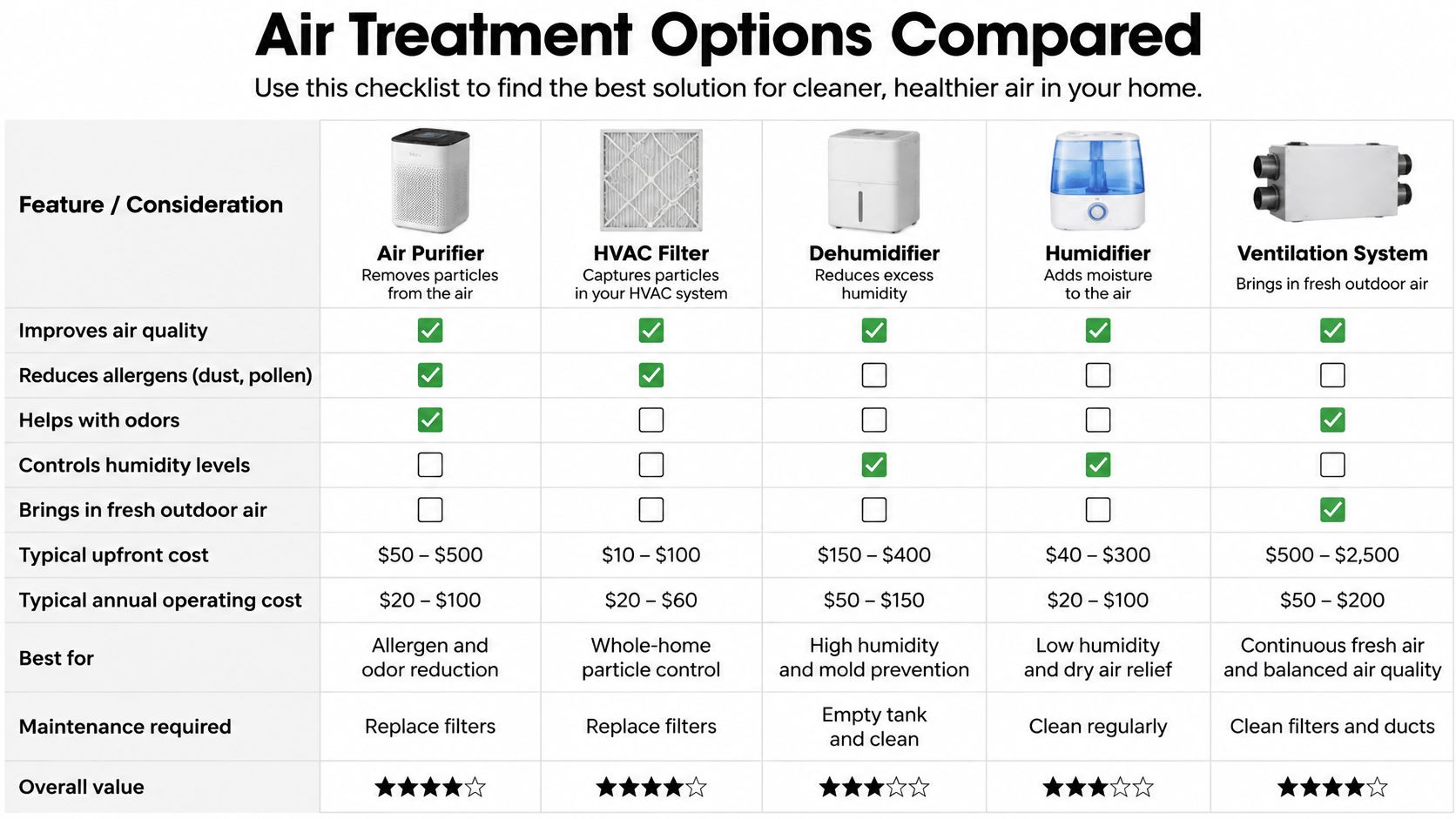
The EPA's guidance on air cleaners in the home separates residential equipment into two configurations: in-duct devices installed within a central heating, ventilation and air-conditioning system, and portable air cleaners used in individual rooms. Either may help control airborne allergens, particles and, in some cases, gaseous pollutants, though it may not reduce adverse health effects from indoor pollutants.
Option | Where It Operates | What It Addresses |
|---|---|---|
Duct cleaning truck | Inside the duct system, through access points | Settled dust, debris and contaminants on the duct interior |
In-duct filter rated by MERV | Inside the central HVAC airflow path | Particles captured as air passes through the filter |
In-duct air treatment device | Within the HVAC airflow path | Airborne contaminants, depending on the device and its testing |
Portable room air cleaner | Individual rooms | Airborne allergens and particles, and in some cases gaseous pollutants |
For a filter, the number to check is MERV, the Minimum Efficiency Reporting Value, which the same EPA guide uses to measure filter efficiency. A filter catches particles as air passes through the media. An in-duct treatment device sits in the same airflow path and works by a different mechanism, so the two shouldn't be treated as interchangeable when you're comparing costs.
Treatment devices deserve specificity rather than slogans. NASA's technology transfer publication describes how ActivePure generates reactive molecules that disperse through a space using the building's HVAC circulation, and reports that a Kansas State University study measured a 99.8 percent reduction in indoor MRSA and a 98.1 percent reduction in E. coli, with a separate University of Cincinnati study validating particulate matter extraction, as detailed in the NASA Spinoff feature on the technology. Those are controlled-study results for named organisms under stated conditions, not a guarantee for your particular building.
Plan your day around the visit itself. Our air duct cleaning service takes on average 2 to 3 hours from start to finish, depending on the size of the home, and a commercial building with multiple rooftop units runs longer. EPA's residential guide doesn't cover large-building HVAC systems, so a commercial scope needs a building-specific evaluation instead of extrapolation from household advice.
Booking Checklist for a Truck Visit
Before booking, match the service to the problem. If dust is blowing from vents, renovation debris is visible, or you have another specific concern, ask the provider what the crew will inspect and remove. If there is no clear reason for cleaning, ask what evidence would justify the work.
Use these questions to compare providers:
How will you check airflow and negative pressure? The vacuum's inlet rating describes suction at the machine, not how well negative pressure is maintained through the duct run. Ask whether the crew checks conditions at the duct system while cleaning.
How will you contain dust and debris? Ask how the crew protects the service area and collects loosened material. A clear explanation should cover what happens if debris drops from a vent.
What will you inspect and document? Ask what the technician checks before and after the work, and what information you'll receive.
What does dryer vent cleaning include? Confirm that the service addresses lint, debris, and blockages in the vent so air can flow properly and the dryer is less likely to overheat.
How will the job change for a commercial building? Request an evaluation based on the building and its HVAC system rather than assuming a home service plan will fit.
For more help preparing for a provider conversation, see these questions to ask before air duct cleaning.
Purified Air Duct Cleaning serves residential and commercial customers across the Phoenix metropolitan area, with services including air duct cleaning, dryer vent cleaning, and HVAC coil cleaning. Based in Avondale, the business offers free quotes. Compare answers and estimates, then contact Purified Air Duct Cleaning to discuss your property and request a quote.
For duct cleaning businesses handling calls while crews are on site, Mercateer for one-to-ten truck shops offers an option to consider for scheduling.