

Air Ionizer vs Air Purifier: Which Cleans Air Better?
The most repeated shopping tip treats a falling particle count as proof the room is clean. That tip fails the air ionizer vs air purifier test. A lower reading can mean the dust left the air and landed on walls, fabric, and people, not that it left the building.
Quiet operation and a missing filter cartridge get sold as upgrades. Quiet is not containment. If you live with allergies, asthma, pets, or shared office air, the useful question is where the particles go after the device runs, and whether the unit adds ozone while it works.
Air Ionizer vs Air Purifier at a Glance
A HEPA air purifier pulls room air through fibrous filter media and holds particles in a replaceable cartridge. An air ionizer charges particles so they settle on walls, floors, furniture, or HVAC surfaces. One device stores the dust. The other relocates it.
Air purifier vs ionizer on the criteria that matter
Factor | HEPA air purifier | Air ionizer |
|---|---|---|
How it removes particles | Pulls air through fibrous filter media and traps particles | Charges particles so they settle or attach to surfaces |
Particles kept inside the device | Yes, in a replaceable filter | Mostly no, particles land on walls, floors, furniture and HVAC surfaces |
Ozone risk | None intended, filtration does not generate ozone | Can emit ozone depending on model, design and maintenance |
Gases and odors | Limited unless paired with an activated carbon stage | Little or no removal, according to EPA |
Upkeep | Replace filter on the manufacturer schedule | Clean surfaces and plates, and verify ozone specifications |
Evidence base | Established filtration benchmark with a measurable efficiency rating | Results vary by room size and ventilation, and evidence outside the lab is limited |
Read the rows in the order your household fails. For allergy or asthma homes, particle retention and ozone risk decide the purchase. Odor coverage and upkeep decide whether the unit is still running in six months. A device you stop using because the plates are filthy, or because the carbon stage was never there, does not clean anything.
Ionizer is an umbrella word. It covers plain ionizers, bipolar ionization units, electrostatic precipitators, and ozone generators. Those four do not share one safety file or one test method. The table compares the common ionizer design, a charger without a capture filter, with a filter-based purifier.
Practical rule: If the goal is measurable particle removal in occupied rooms, start with mechanical filtration. Treat ionization as an add-on only after that model's ozone data checks out.
Duct hardware is a separate choice from either row. Our note on air duct cleaning and UV light stays on the duct, not on swapping out a room filter.
How Each Device Removes Particles and Where They End Up
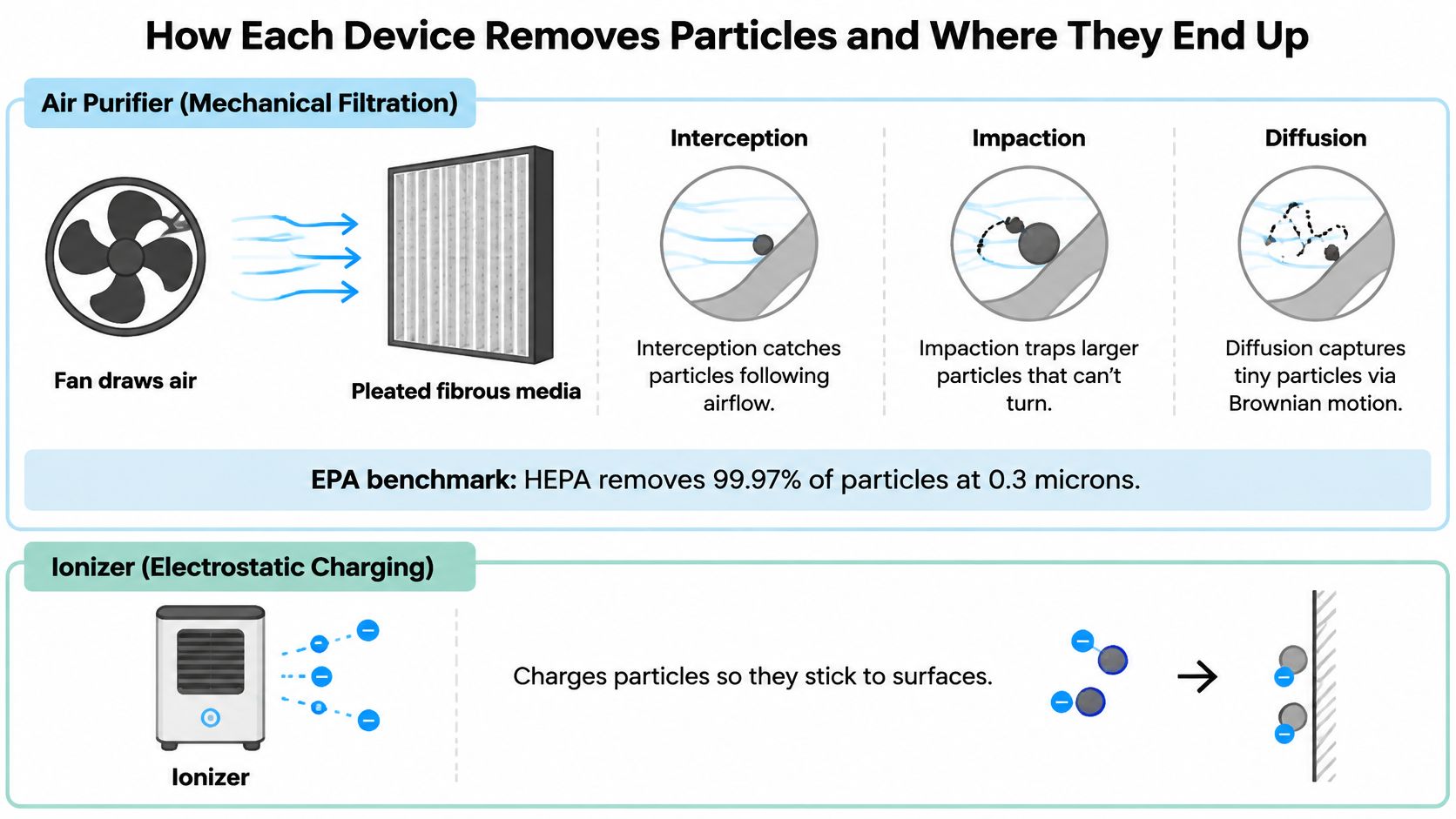
Follow the air, then follow the dust. The diagram below splits the two paths before any marketing label gets in the way.
What the filter actually catches
A purifier fan draws room air into pleated fibrous media. Particles do not all stick the same way.
Interception: Mid-size particles following the airstream brush a fiber and stay there.
Impaction: Larger particles cannot turn with the air and strike the fiber.
Diffusion: The smallest particles wander by Brownian motion and hit fibers they were not aimed at.
The EPA residential air cleaner summary describes HEPA filters with MERV ratings from 17 through 19 as having a minimum efficiency of 99.97% to 99.999% for particles measuring 0.3 micrometers. That size is a hard test point, not a claim that only 0.3-micrometer dust matters. Larger and smaller particles are caught by the mechanisms above. Room results still depend on airflow, a tight filter fit, run time, and a clean-air delivery rate matched to the room.
Where the charge sends them
An ionizer emitter charges airborne particles. They can then settle on walls, floors, furniture, curtains, HVAC surfaces, or occupants instead of passing into a cartridge. The EPA wildfire filtration guidance treats mechanical filtration as a reliable particle-removal method that does not produce ozone, and it notes that ionizers may be relatively ineffective against larger particles such as pollen and household dust allergens. The same guidance says ionizers do not remove gases or odors, and it points higher-efficiency mechanical filtration at smoke and fine particles because capture comes without intentional ozone.
Pollen and pet dander are coarse and drop quickly once charged. Cooking smoke and wildfire haze are finer and keep drifting until something collects them. A lower airborne count, by itself, does not mean those particles were eliminated.
The University of Massachusetts Environmental Health and Safety guidance warns that deposited pollutants can remain in the room and that electronic cleaners can be less effective than filtration. Fans, HVAC cycling, walking, and cleaning lift that film back into the air. That rebound hits allergy and asthma households hardest. Evidence for bipolar ionization outside laboratory conditions remains limited, while filtration is the more established path: adequate HVAC or HEPA media, enough airflow, and filters changed when loaded.
Does an ionizer reduce your exposure, or does it move particles from the air onto surfaces you touch?
Wipe one windowsill or shelf once a week for three weeks and note how fast the film returns. Fast return means a lot of dust is leaving the air by settling, not by staying in a cartridge. Candle soot adds to that film. If you burn candles, the guide to cleaner candles for Canadians from Shivora Candles is a useful check on what the flame itself puts into the room. An ionizer-only setup also means more surface cleaning. A short look at how an electronic air cleaner differs from a boxed filter helps before you treat every "ionic" label as the same machine.
A walk-through of both paths, including where settled dust can be stirred up again, is easier to follow on video than in a spec sheet.
Ozone Limits That Decide Ionizer Safety
A unit can pass an emissions ceiling and still be a weak cleaner. These are the benchmarks that belong on a purchase sheet, not a slogan about "fresh" air.
Ozone benchmarks and certifications for ionizers
Reference point | Value or requirement | What it means for buyers |
|---|---|---|
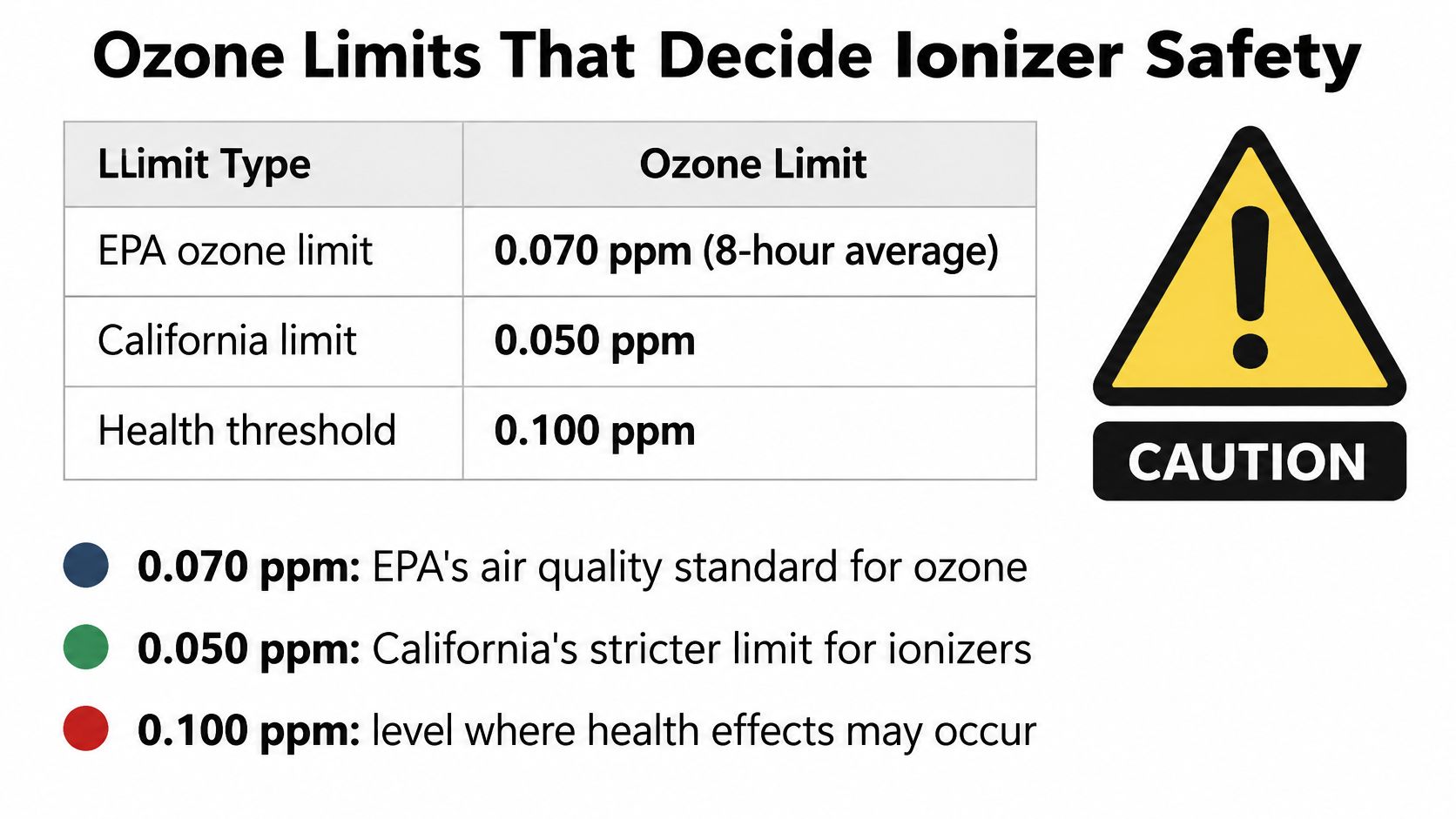
California covered air cleaner limit | 0.050 ppm (50 ppb) ozone emission | Required ceiling for covered units sold or supplied in California |
FDA limit for medical devices | 0.05 ppm ozone | Benchmark cited by EPA, not a home appliance standard |
Ozone generators | Not for use in occupied spaces | EPA advises against running them around people |
Bipolar ionization equipment | UL 2998 certification | Look for it when a unit makes bipolar ionization claims |
Ozone at public-health levels | Little removal of particles or microbes | An ozone reading that passes a limit does not prove cleaning |
How to read the ceilings
Ozone is a lung irritant. The California Air Resources Board consumer page reports that the EPA warns ion generators and some electronic air cleaners can produce ozone indirectly, and that under some operating conditions indoor concentrations may rise significantly above levels considered harmful to human health. California requires covered indoor air-cleaning devices sold or supplied in the state to be certified at an ozone-emission concentration no higher than 0.050 parts per million (50 parts per billion). The same page notes that the U.S. Food and Drug Administration has set a 0.05 ppm ozone limit for medical devices. That figure is an emissions or concentration limit. It is not proof the device improves indoor air quality, and it is not a home-appliance performance grade.
What a passing number does not do
The EPA page on ozone generators sold as air cleaners states that, at concentrations that do not exceed public-health standards, ozone has little potential to remove indoor contaminants. It does not remove particles such as dust and pollen, and it is not effective against viruses, bacteria, mold, or other biological pollutants at those concentrations. Ozone generators produce large amounts of ozone and should never be used in homes or other occupied spaces.
A bipolar unit is not the same product as a purposeful ozone generator, but it is not automatically clean either. When a seller makes bipolar ionization claims, look for UL 2998 and for maintenance steps that keep by-products in check. Our notes on bipolar ionization in HVAC spell out why the model name matters more than the category label.
A device can sit under an emissions ceiling and still leave allergens, smoke, and odors for a filter to do.
Before any electronic cleaner runs in a bedroom, nursery, or classroom, ask for independent ozone documentation on that exact model. A particle-charging function is not the same thing as safe contaminant removal.
How Room Size, Ventilation and CADR Change Results
A single removal percentage is not a room rating. An academic chamber study reported approximately 70% particle removal by both an ionizer and a high-flow HEPA filter in 15 minutes. Geometry changed the winner. The filter outperformed the ionizer in two small rooms. The ionizer performed better in three larger rooms. Both technologies became less effective as room size increased, and both worked better in unventilated spaces.
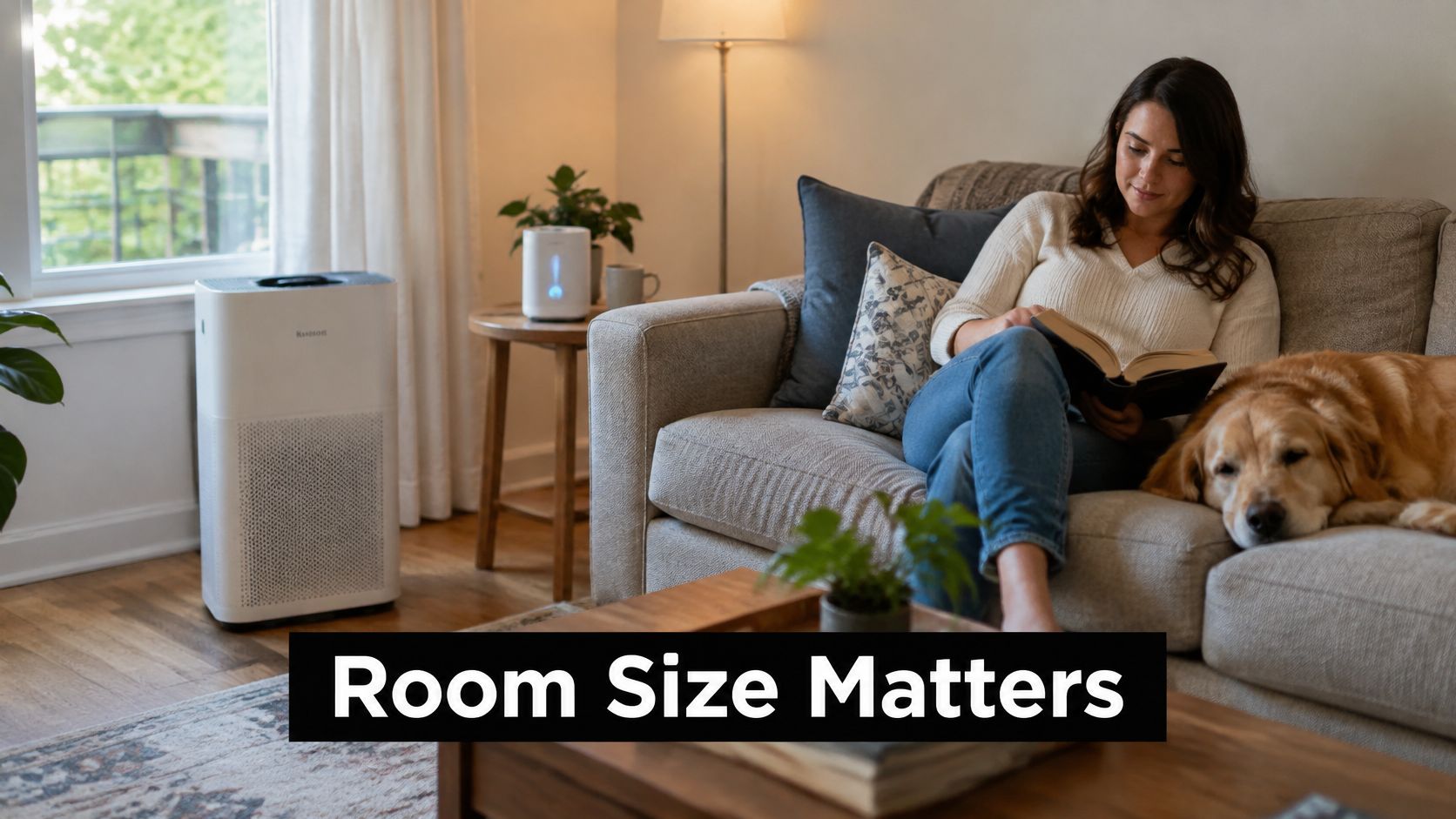
Open windows, a kitchen exhaust, or an HVAC fresh-air intake dilute the plume the device is treating. That is good for stale air and bad for anyone reading the lab percentage as a promise. Charged particles that settle on walls, furnishings, or HVAC surfaces also create a cleaning job. Disturb those surfaces and the dust moves again.
Three rooms, three questions
Clean-air delivery rate (CADR) is the volume of cleaned air a purifier delivers per minute. Match that rating to the room. Do not match it to the percentage printed on the box.
Say you are choosing for these spaces:
A 15 square meter bedroom: Doors usually stay shut at night. A compact purifier with a CADR meant for that footprint can cycle the air while you sleep. A unit marketed for a whole floor will be louder than you need, but an undersized one will not finish a pass before morning.
A 40 square meter open living room: Volume jumps, and a hallway may steal air. The bedroom unit, run for the same hours, will lag. Check the smoke or dust CADR against that larger footprint before you trust the 15-minute headline.
A 60 square meter home office suite: Two connected rooms behave like the larger chambers in the study, where both technologies lost ground as size grew. One portable unit in the corner will not treat the far desk unless the CADR and the placement say so.
A machine sized for the small bedroom underperforms in the larger room even if you leave it on all day. Placement matters too. A purifier blocked by a sofa moves less air than the lab setup assumed.
Close the doors, run the device for a set period, then compare dust on one dark surface before and after. If the film looks the same, the CADR is not keeping up with that room.
Broader habits still change the load the device sees. The steps to improve indoor air quality from Gmaids cover cleaning and source habits that sit beside any machine. If you are comparing portable units room by room, our home air purifier reviews keep the focus on fit and upkeep rather than on a single lab percentage.
Matching the Device to Your Air Quality Problem
Pick the row that matches the pollutant you can name. A device aimed at the wrong target looks busy and changes little.
Which approach fits each air quality situation
Situation | Better fit | Why it works |
|---|---|---|
Pollen, dust mites or pet dander allergies | HEPA-rated air purifier sized to the room | Particles are held in the filter rather than settling into the room |
Wildfire smoke or fine haze | Mechanical filtration with fine-particle capture | EPA recommends filtration for smoke with no intentional ozone |
Cooking, smoking or chemical odors | Purifier with an activated carbon stage | Ionizers do not remove gases or odors |
Whole-home supply air | In-duct HEPA-rated or independently verified system | Treats air as it moves through the HVAC system |
Occupied space with many people and an ozone concern | Filtration plus ventilation, with verified low-ozone equipment only | Avoids ozone exposure while capturing particles |
Allergies, smoke, and smells
For dogs, cats, or pollen, put a HEPA-rated room unit in the bedroom and keep the door closed while it runs. Coarse allergen particles belong in the cartridge, not on the bedding you remake every morning.
Wildfire haze and heavy cooking smoke call for mechanical filtration aimed at fine particles, with windows shut during the event. Filtration is the path that captures smoke without intentional ozone generation. A carbon stage does not replace that particle filter. It sits beside it.
Odors and gases from cooking, smoking, or household chemicals need activated carbon, because charging particles does not strip gases. Paint is a clear case. Fumes keep off-gassing after the roller is clean, which is why paint fume removal starts with ventilation and a carbon stage, not with an ion setting. Houseplants are pleasant and some people like them as a side habit. The roundup of natural air purifiers from Leaves & Soul is a fair read on greenery, and it is not a substitute for a filter when the problem is smoke or dander.
Whole home and crowded rooms
Supply air that serves every room needs treatment in the duct, not a single box in the den. We offer an in-duct air scrubber and portable air purifiers for that split. ActivePure Technology is available as a unit installed in a residential or commercial air duct, or as a plug-and-play unit placed anywhere in a home or office. Check ozone documentation on any electronic add-on against the ceilings that apply to occupied rooms, and keep a real particle filter in the system.
In a clinic waiting room, a classroom, or an open office, pair filtration with outdoor air. Use only equipment with verified low-ozone performance. A crowded room amplifies a bad emissions choice because nobody can leave the plume.
Neither machine helps much while the source stays. Stop indoor smoking, fix a leaking combustion appliance, and vent the hobby space before you shop. A purifier downstream of a continuous source is a mop under a running tap.
Confirm Ozone and Filter Specs Before You Buy
Finish this list before you pay. Each step answers a different failure mode, so skipping one leaves a hole the brochure will not mention.
Name the technology on the spec sheet. Write down mechanical HEPA, plain ionizer, bipolar ionization, electrostatic precipitator, or ozone generator. Ozone evidence is not shared across those labels, so a review of "ionic purifiers" as one group will mislead you.
Pull ozone paperwork for that model number. Match it to the ceilings that govern occupied rooms, and do not accept a category brochure in place of a test on the unit you will plug in.
Match CADR to the room you measured. Use the closed-door dust check on the bedroom, the living room, or the office suite you occupy. A rating for a different floor plan is a different product.
Price the upkeep, not just the box. For a purifier, get the filter cost and the replacement interval in months. For an ionizer, budget time to wipe surfaces and plates and to HEPA-vacuum settled dust so it does not return to the air.
Ask where the performance number was measured. Laboratory chamber data and occupied-room data answer different questions. Treat the words ion, plasma, and NASA as marketing until a test report sits behind them.
Get maintenance, ozone specs, and warranty terms in writing before you sign. Verbal assurances disappear when the first plate needs service.
The EPA guidance on air cleaners, HVAC filters, and respiratory viruses advises against air cleaners that intentionally generate ozone in occupied spaces, notes that bipolar ionization can produce ozone and other by-products unless design and maintenance precautions are used, and points to UL 2998 for that equipment. California's framework requires covered indoor air cleaners to meet an ozone-emission limit, and CARB cautions that certification does not evaluate pollutant-removal effectiveness. A unit can satisfy an emissions rule and still fail to remove allergens, viruses, or odors better than ordinary filtration. That question matters for families with asthma, children, older adults, and anyone responsible for a full occupant load.
For air purification systems, we assess each customer's specific needs and recommend the most suitable system for the home. Residential and commercial services come with free quotes, given over the phone or through a free walk-through at a commercial space.
Choose a filter-based purifier when measurable particle removal is the priority. Add an ionizer only after ozone data for that model is verified, and only as a companion to filtration, ventilation, and source control.
Purified Air Duct Cleaning assesses the pollutant you have, then installs portable air purifiers or in-duct systems, including ActivePure units, for homes and commercial spaces across the Phoenix area. If you want particle capture without guessing at ozone paperwork, start with a free phone quote or a commercial walk-through. Visit Purified Air Duct Cleaning to schedule that conversation.