

Home Air Purifier Reviews: How to Choose the Right System
The most popular advice in home air purifier reviews is often the least useful: choose a model based on the room size printed on the box. That number can make an undersized purifier look suitable, while hiding the performance measure that tells you how much cleaned air the machine delivers.
A better approach starts with effective coverage. You need enough airflow to move the air in the room repeatedly, a filter that captures the pollutants you care about, and a fan speed you can tolerate for long periods. You also need to account for replacement filters, electricity, maintenance, and installation rather than judging value by the purchase price alone.
The Truth About Manufacturer Room Size Claims
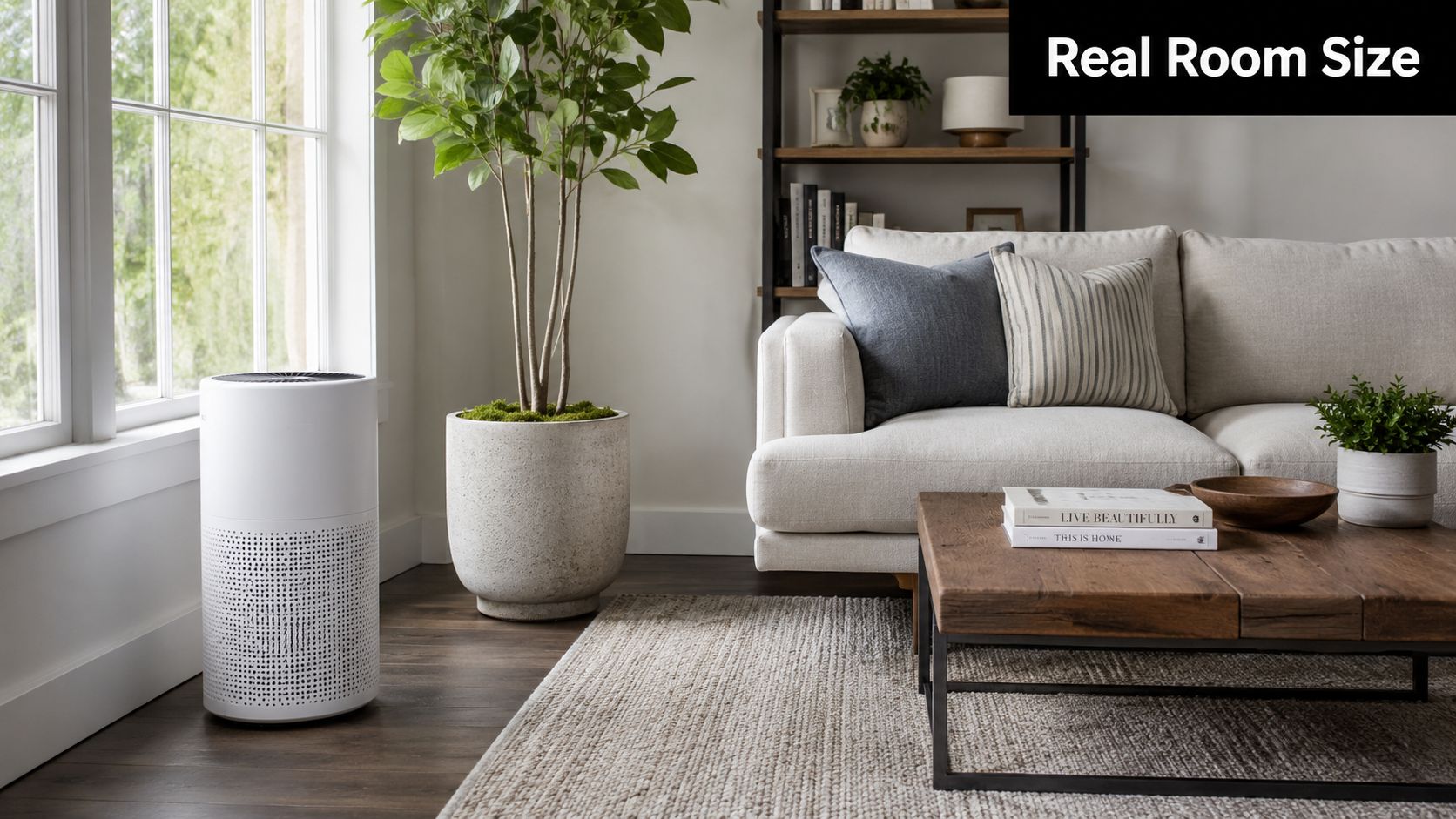
A room-size claim sounds precise, but it often describes an idealized maximum rather than the cleaning performance you'll experience at home. The problem is simple: a purifier can be marketed for a large room while moving too little filtered air to clean that room thoroughly at a livable fan speed.
Independent analysis of 252 air purifier devices found a substantial gap between declared coverage and calculated effective area. For HEPA plus UV devices, the median effective area based on declared CADR was 12 square meters, compared with a recommended room area of 40 square meters. HEPA-only devices had a median effective area of 15.83 square meters, while their stated recommended area was 52.5 square meters. The same comparison reported 4.5 square meters versus 40 square meters for UV-only devices and 7.5 square meters versus 54 square meters for other technologies. The analysis concluded that declared room recommendations significantly overestimate what devices can sanitize, as documented in the European Journal of Public Health analysis of purifier sizing.
Why square footage can mislead
Square footage describes floor area, not the volume of air that must be cleaned. Ceiling height, open doorways, furniture placement, outdoor infiltration, and the pollution source all affect the workload. A purifier in a closed bedroom has a very different job from one in a large, open living area connected to a kitchen and hallway.
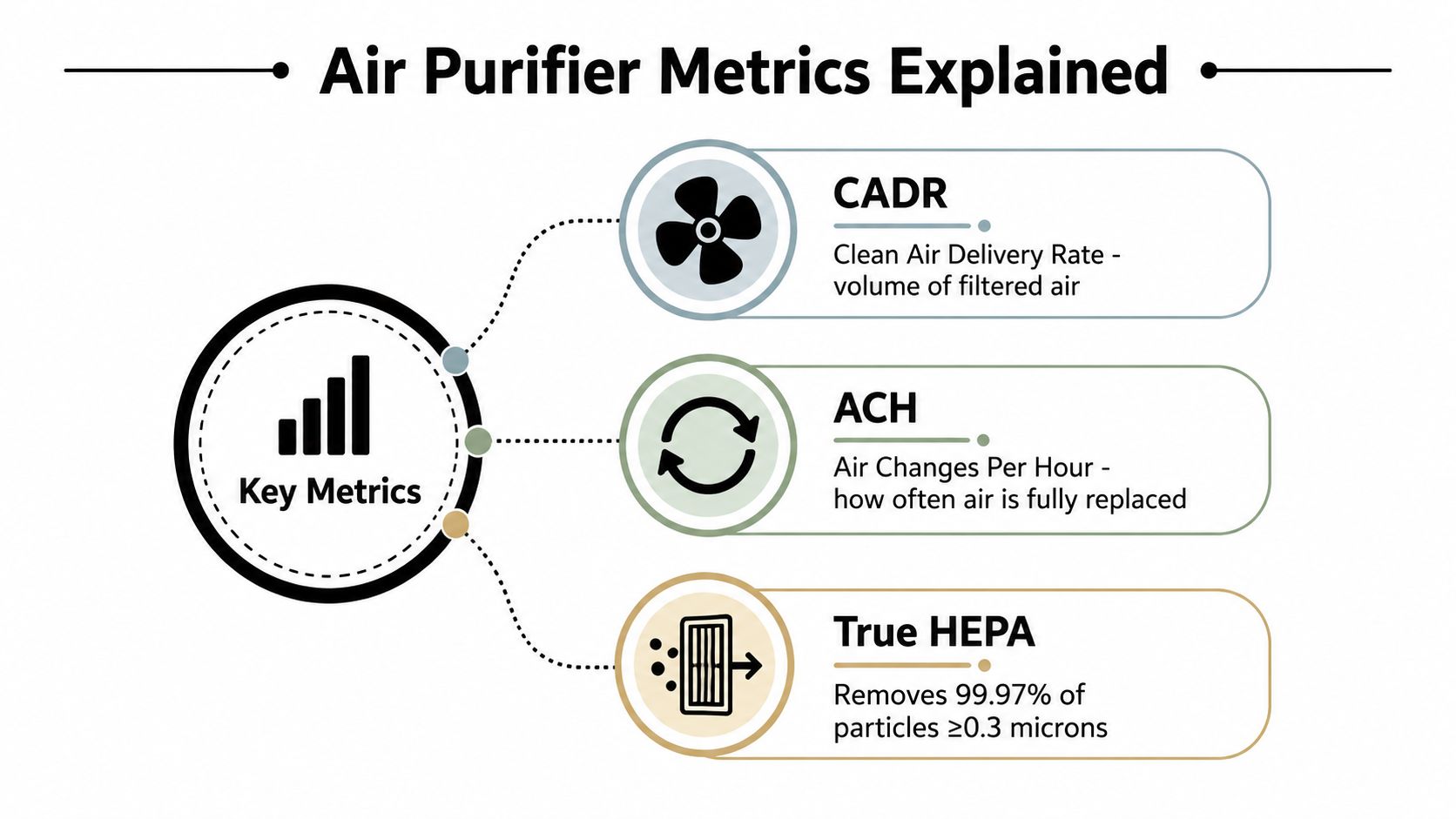
This is why CADR, or Clean Air Delivery Rate, is the most decision-useful metric. CADR describes the rate at which a purifier delivers pollutant-free air. A high-efficiency filter attached to a weak fan may capture particles effectively when air reaches the filter, but it won't clean the room quickly if the fan moves insufficient air.
Practical rule: Treat the printed room size as a rough screening claim. Use CADR to compare machines and size the purifier for the room's actual air volume.
Homeowners who want a deeper explanation of ventilation and air exchange rates should also consider how often the room's air is replaced or recirculated. That perspective prevents a common buying mistake: choosing a compact, quiet unit that technically covers the room but can't deliver enough clean air during smoke, dust, or allergy events.
Oversizing is usually safer than undersizing
A larger purifier doesn't need to run at maximum speed all day. It can often deliver useful airflow on a quieter setting, while a small unit may need to run loudly and still fail to keep pace with the room's pollution load. Independent sizing guidance therefore favors measured airflow over a generous marketing label.
The EPA illustrates this approach with CADR recommendations matched to room area. Its example table lists a minimum CADR of 65 cfm for a 100-square-foot room, 130 cfm for 200 square feet, 195 cfm for 300 square feet, 260 cfm for 400 square feet, 325 cfm for 500 square feet, and 390 cfm for 600 square feet in its Guide to Air Cleaners in the Home. Use those values as a practical reference, then check whether the purifier maintains that airflow at a noise level you'll accept.
Decoding the Metrics That Actually Matter
A purifier is like a lung for one room. The fan draws dirty air in, the filter removes or captures selected pollutants, and the machine sends cleaner air back into the space. Filtration efficiency tells you how well the filter works on particles that reach it. Airflow tells you how much room air reaches the filter. You need both.
Start with CADR
CADR means Clean Air Delivery Rate, usually expressed in cubic feet per minute. It combines airflow with particle-removal performance, so it's more informative than looking at fan power or filter branding by itself.
A useful sizing benchmark is about 4.8 to 5 air changes per hour, the performance level associated with AHAM-style sizing rules and many technical reviews. One commonly derived rule puts recommended room area at about 1.55 times the smoke CADR. Under the stated ceiling-height and airflow assumptions, a purifier with a 233 CFM smoke CADR supports roughly 361 square feet, while a 333 CFM unit supports about 448 square feet, according to HouseFresh testing and sizing guidance.
Those examples aren't universal guarantees. A room with high ceilings contains more air than a room with the same floor area and standard ceilings. Open doors and central HVAC operation can also change how quickly contaminants enter or move through the space.
Translate CADR into ACH
ACH, or Air Changes Per Hour, estimates how many times the purifier can deliver an amount of clean air equal to the room's volume in one hour. It doesn't mean every molecule is removed after one cycle. It's an airflow model that helps you compare cleaning intensity.
To estimate ACH, use this sequence:
Calculate room volume by multiplying length, width, and ceiling height.
Convert the purifier's airflow into the same volume units.
Multiply airflow by 60 to estimate hourly delivery.
Divide hourly clean-air delivery by room volume.
For example, a purifier may appear powerful on a product page, but its ACH falls if you move it into a taller room or an open-plan area. Reviews that report CADR without explaining room volume provide only part of the answer.
Separate HEPA efficiency from airflow
True HEPA filtration is a filter standard, not a room-coverage rating. The commonly cited North American benchmark is 99.97 percent efficiency at 0.3 micrometers, while European H13 and H14 classifications are defined at 99.95 percent and 99.995 percent, respectively, as summarized in air purifier certification guidance from TTSQC.
That distinction matters because a highly efficient filter can create resistance. If the fan can't push enough air through the filter, the purifier may perform well in a single-pass filter test but deliver weak room cleaning. Compare the stated or independently measured CADR, the filter claim, and noise at each usable fan speed.
Sensors can help a purifier respond to changing particle levels, but they don't replace airflow. A practical indoor air quality sensor guide can help you understand what a monitor measures and what it can't prove about whole-room cleaning.
Portable Units Versus Whole-Home In-Duct Systems
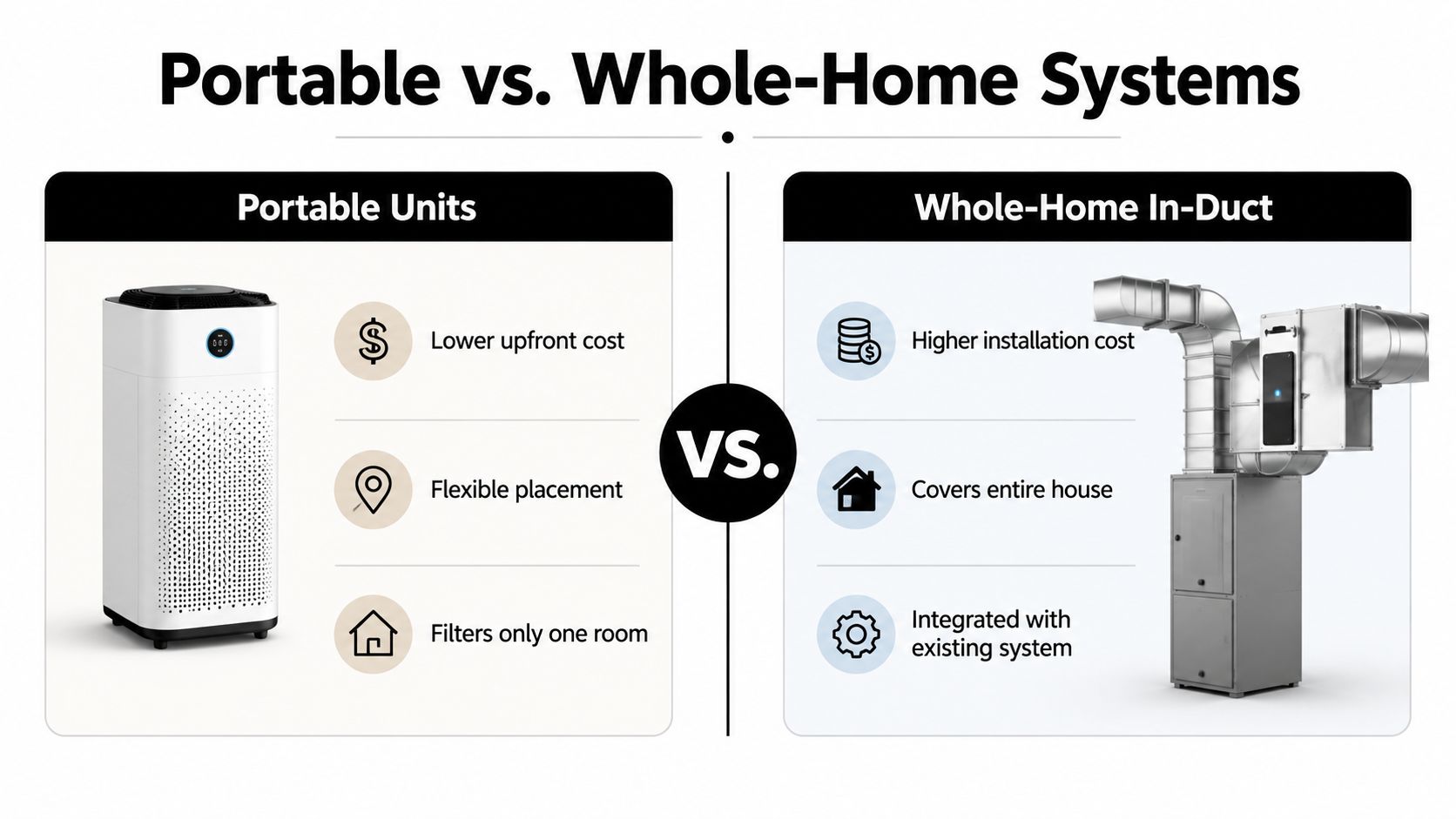
Portable and in-duct systems solve different problems. A portable purifier is a room appliance. It sits where people sleep, work, or spend time, and its performance depends on the air volume and conditions in that room. A whole-home system works through the HVAC network, so its reach depends on which rooms the ductwork serves and how the equipment is integrated.
When a portable purifier fits better
Portable units make sense when your priority is specific and local. You might want cleaner air in a bedroom during pollen season, in a nursery, or near a desk where you spend much of the day. You can reposition the unit, compare its noise with your tolerance, and replace it without modifying the HVAC system.
That flexibility comes with limits. One portable purifier generally works best in one contiguous room. A unit in the living room won't clean a closed bedroom with the same effectiveness, and a purifier placed behind furniture may struggle to draw and distribute air properly.
Look for:
Verified CADR: Match the airflow to the room rather than relying only on the box claim.
Quiet usable settings: Check whether the unit still moves meaningful air when set low.
Accessible filters: A difficult filter change increases the chance that maintenance gets skipped.
No unwanted byproducts: Be cautious with ionization or ozone-based claims and inspect the test documentation.
When in-duct purification has an advantage
An in-duct system is more integrated. It can treat air as the HVAC system circulates it, reducing the need for separate appliances in several rooms. Installation quality matters, because added filter resistance or poorly placed equipment can affect airflow, static pressure, and comfort.
This approach is particularly relevant for homeowners who want a consistent whole-home strategy rather than room-by-room coverage. It can also suit property managers and families who don't want to move, monitor, and maintain multiple portable devices.
Some systems add active technologies rather than relying only on passive particle filtration. ActivePure technology, described by the publisher as NASA-certified, is installed in residential and commercial settings as an air purification option designed to address contaminants in air and on surfaces. Claims about pathogen reduction should be evaluated through the manufacturer's documentation and independent testing, not accepted solely because a technology uses terms such as “active” or “NASA-certified.”
A professional overview of whole-home air purifiers integrated with HVAC systems can help you identify the practical questions to ask about duct layout, service access, airflow, and replacement components.
The decision comes down to coverage
Choose portable equipment when you need targeted treatment, flexible placement, or a lower-complexity installation. Choose in-duct equipment when you need a coordinated system for rooms served by the HVAC network and are prepared to budget for professional integration.
Neither option automatically cleans every part of a home. Portable systems can be underpowered for open spaces, while in-duct systems can't compensate for rooms that the ductwork doesn't serve effectively. The right choice follows the airflow path, not the product category label.
Calculating the Real Cost of Clean Air
The purchase price is only the first line on the invoice. A useful ownership estimate includes the purifier or installation, replacement filters, electricity, service, and the likelihood that the unit will remain practical to operate over time.
Reviews that compare long-term value should disclose these assumptions. A budget portable unit may require frequent filter purchases or run inefficiently at the speed needed for effective cleaning. A premium whole-home system may cost more at installation but offer centralized maintenance and broader coverage. Without the operating context, “budget” and “premium” are incomplete labels.
Build the estimate before you buy
Use this framework:
Record the purchase or installation price.
Find the manufacturer's filter replacement interval and current replacement price.
Estimate electricity from the unit's wattage, expected daily runtime, and local utility rate.
Add professional service, inspections, or HVAC-related maintenance where applicable.
Compare the total against the coverage and usable ACH, not against price alone.
The table below is deliberately qualitative because exact ownership costs depend on the model, household runtime, filter pricing, utility rate, and installation requirements.
Cost Factor | Budget Portable Unit | Premium Whole-Home System |
|---|---|---|
Initial expense | Usually lower purchase cost | Higher equipment and installation cost |
Filter replacement | Purchased per unit, with cost affected by replacement interval | Centralized replacement, with system-specific parts |
Energy use | Depends on fan setting and daily runtime | Depends on HVAC runtime and purification technology |
Maintenance access | Homeowner usually handles portable filter changes | Professional service may be useful for in-duct components |
Coverage | Typically targeted to one room | Designed to serve rooms connected to the HVAC system |
Reliability value | Depends on construction, motor, controls, and filter availability | Depends on installation quality, equipment compatibility, and service support |
Five-year comparison | Add all filters and electricity over the ownership period | Add installation, replacement parts, electricity, and service over the ownership period |
Judge cost against behavior
The cheapest purifier isn't a bargain if you keep it on a low setting that doesn't deliver enough clean air. The most expensive system isn't automatically good value if it treats spaces you don't use or requires maintenance you won't schedule.
A sound five-year projection asks one practical question: What will this system cost to deliver the cleaning level my household can maintain? That calculation keeps the discussion focused on effective coverage, not an attractive sticker price.
How to Spot Reliable Independent Reviews
A trustworthy review should let you reconstruct the buying decision. You should be able to see what the reviewer measured, how the purifier was operated, which room conditions applied, and whether the comparison used the same method across products.
Consumer Reports has tested nearly 170 air purifier models and combines product ratings with owner satisfaction and reliability surveys drawn from tens of thousands of members, according to its air purifier buying guide. Its broader testing framework covers more than 8,500 products and services, which helps explain why its air purifier coverage carries more weight than a short product impression.
Look for repeatable measurements
Strong home air purifier reviews usually answer these questions:
What was measured: Look for CADR, particle reduction, energy use, filter life, and noise rather than a general statement that the air “felt fresher.”
At which settings: A maximum-speed result tells you what the machine can do when noise is not the priority. A useful review also reports performance at quieter, sustainable settings.
In what room: Room dimensions, ceiling height, doors, and test conditions affect ACH and should be disclosed.
With what method: The reviewer should explain the particle source, measurement tools, run time, and comparison process.
After continued use: Filter loading, reliability, controls, and maintenance can change the ownership experience.
Reviewer's test: If you can't find the CADR, fan setting, room assumptions, and maintenance method, you're reading a recommendation, not a complete performance review.
Separate certification from marketing language
Terms such as “medical grade,” “whole-home,” “natural,” and “advanced purification” don't tell you how much clean air reaches the room. A certification can establish a test standard, but it doesn't guarantee that a purifier is correctly sized for your home.
Be especially careful with very large coverage claims that aren't supported by CADR. The independent analysis cited earlier found that recommended room areas can significantly exceed calculated effective areas, so a review should show the airflow math rather than repeat the box.
Check whether the review reflects real life
Noise determines whether a purifier runs. Controls determine whether residents can use it correctly. Filter access determines whether maintenance happens. Placement determines whether the machine can draw and distribute air without obstruction.
An objective review connects those details to the result. It doesn't treat a smart app, decorative design, or sensor display as a substitute for measured airflow. For another layer of household monitoring, compare review methodology with guidance on selecting an indoor air quality meter, while remembering that a sensor reading is not the same as a CADR test.
The Case for Professional ActivePure Installation
Passive filtration and active purification serve different roles. A portable HEPA purifier captures particles that pass through its filter. An in-duct active system is designed to work within the HVAC air path, and ActivePure technology is positioned as a way to address contaminants in both air and on surfaces.
That broader objective can matter in homes where residents want more than room-specific particle reduction. Families dealing with recurring odors, allergy concerns, frequent occupancy, or whole-home distribution may prefer a system integrated into the existing ductwork instead of placing separate appliances throughout the house.
Installation determines practical performance
A qualified technician should assess the air handler, duct configuration, available access, electrical requirements, airflow direction, and maintenance needs before installing an in-duct device. The technician should also explain what the system is designed to address and what it cannot replace, such as cleaning settled dust from floors, furniture, or other surfaces.
Active technologies deserve the same scrutiny as HEPA systems. Ask for product documentation, safety information, installation requirements, and evidence supporting any pathogen or surface-treatment claim. A professional guide to air purification for viruses can help frame those questions without confusing air treatment with general cleaning or ventilation.
For homeowners in the Phoenix metropolitan area, Purified Air Duct Cleaning offers duct and HVAC cleaning services along with installation of NASA-certified ActivePure air purification systems. Its certified technicians serve communities including Avondale, Phoenix, Glendale, and Mesa, and the company provides free quotes for residential and commercial indoor air quality work.
If your home air purifier reviews have left you unsure about CADR, room coverage, filter upkeep, or whole-home installation, ask Purified Air Duct Cleaning to evaluate your ductwork and indoor air quality needs. Visit Purified Air Duct Cleaning to request a free quote and discuss a practical purification plan for your home.