

Residential Dryer Vent Cleaners: What They Do
You open the dryer, pull out a towel, and find the middle still damp. The cycle finished, the drum turned, and the machine produced heat. Before you assume the dryer needs replacing, there's another possibility worth checking: the warm, moisture-filled air may not be getting out.
Residential dryer vent cleaners work on that exit path. The useful question isn't whether your vent is due for cleaning. It's whether the problem comes from removable lint, damaged ductwork, an awkward vent route, or the appliance itself.
What a Residential Dryer Vent Cleaner Actually Does
A residential dryer vent cleaner's job is to restore and check the exhaust path from the appliance to outdoors. That involves more than vacuuming the opening beneath the lint screen. A useful service combines mechanical cleaning, inspection, and enough diagnosis to explain what was restricting the system.
The familiar laundry-day frustration is a good starting point.

Your dryer has to do more than warm the laundry. It also needs to carry the released moisture away. The Consumer Product Safety Commission's dryer safety guidance identifies unusually long drying times and clothing that remains damp as reasons to investigate a blocked exhaust path.
Cleaning starts with locating the problem
A technician should establish where the exhaust travels before choosing how to clean it. The connection behind the dryer is only the beginning; the remaining duct may pass through concealed spaces before reaching an exterior wall or roof termination.
The work should answer several practical questions:
Where is the restriction? It might be near the appliance, deeper inside the duct, or at the outlet.
What is causing it? Removable lint and a crushed connector require different remedies.
Can cleaning solve it? A poorly arranged duct may need repair rather than another brushing.
What changed afterward? The technician should explain how the completed work was checked.
Think of the service as clearing a blocked drain, then making sure the pipe itself isn't damaged. Removing debris matters, but it doesn't prove the entire route works properly.
Practical rule: Hire someone to investigate the airflow problem, not merely collect a bag of lint.
That distinction helps prevent unnecessary appliance replacement. It also keeps you from paying repeatedly for cleaning when the underlying restriction needs a different repair.
The Hidden Pathway from Drum to Outside Air
Follow the exhaust in the direction it travels, and the system becomes easier to understand. The diagram provides a map of the parts a technician should account for.
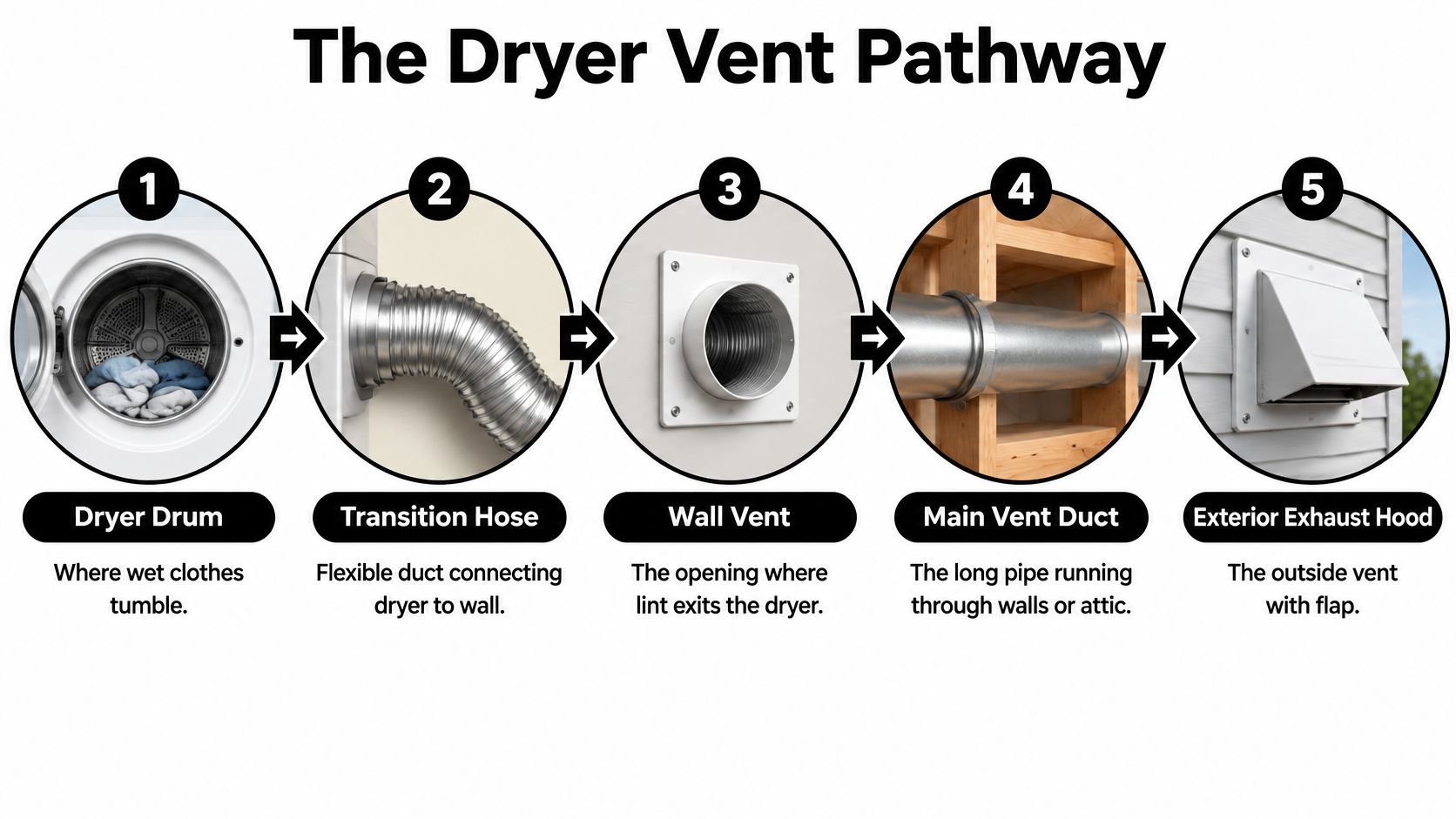
The dryer drum is where wet clothing tumbles. Exhaust passes through the appliance's filtering and outlet arrangement, then enters the transition connector, the accessible connection between the dryer and the building's duct.
The wall opening is a connection point, not necessarily the end of the vent. Beyond it, the main duct carries exhaust through the building to the exterior hood or cap, where a movable flap allows discharge. Understanding the purpose of a dryer vent helps distinguish this dedicated exhaust system from the home's heating and cooling ducts.
Why the route and materials matter
A drinking straw provides a useful comparison. Exhaling through a short, straight straw takes less effort than exhaling through one that's pinched or bent repeatedly. Your dryer's blower faces a similar resistance problem.
The U.S. Department of Energy advises keeping dryer ducts short and straight, because long runs and excessive bends encourage lint backup, increase drying time, and create a fire hazard. The same guidance favors rigid or semi-rigid metal over plastic or foil accordion-style material.
Behind the dryer: Look for a connector compressed between the appliance and wall.
Inside concealed spaces: Ask how the technician established the route and identified inaccessible areas.
At the termination: The hood and flap deserve inspection, not just the pipe leading toward them.
The video below offers another way to visualize the system.
You don't need to open walls to be an informed customer. You need a clear explanation of where the exhaust goes, which parts were inspected, and whether any portion remains uncertain. An honest limitation is more useful than an unsupported assurance that everything looks fine.
Why Lint Buildup Becomes a Fire and Health Problem
A little lint on the screen looks harmless. The concern changes when combustible fibers accumulate where the dryer must discharge hot air. The problem is the combination of fuel, heat, and restricted exhaust, not an untidy appliance.
National records show that dryer fires have been a persistent household safety issue. The Consumer Product Safety Commission estimated approximately 15,500 dryer-associated fires in 1996, with 20 deaths, 320 injuries, and about $84.4 million in property damage.
The risk isn't limited to that historical snapshot.
What the fire record tells homeowners
In its analysis of home dryer and washing-machine fires, the National Fire Protection Association identified failure to clean as the leading cause, accounting for 31% of incidents in its 2010–2014 dataset. That finding supports treating vent maintenance as fire prevention rather than an optional convenience service.
This visual summarizes the concerns homeowners commonly associate with a neglected exhaust system.
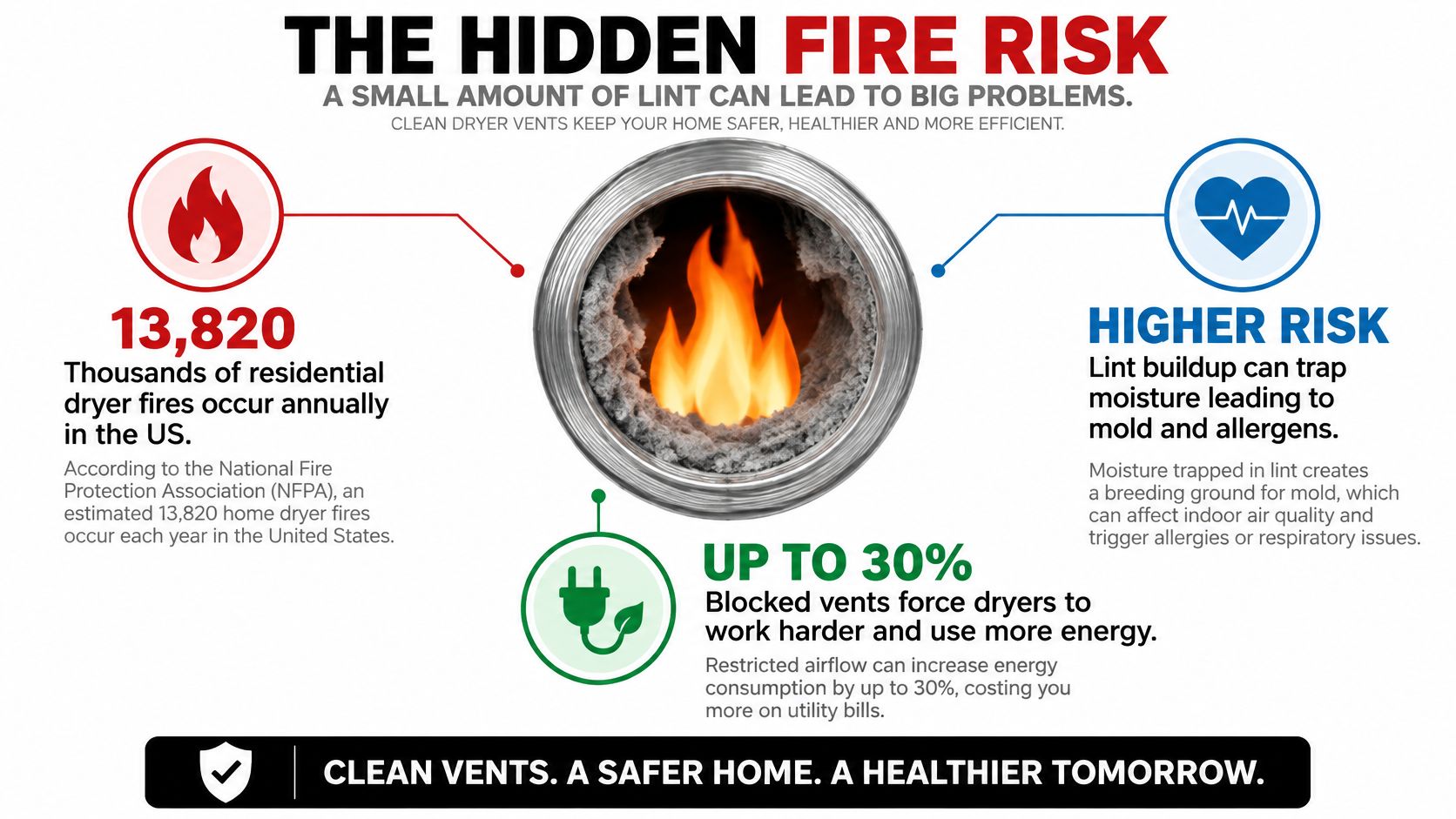
The indoor-air side deserves careful wording. If moist exhaust leaks from a disconnected or damaged connection, the laundry room may receive air intended for outdoors. That warrants inspection, but damp laundry or a musty odor alone doesn't establish that mold is present, and vent cleaning isn't a treatment for allergies.
A clean vent reduces a documented hazard. It doesn't make a dryer fireproof or diagnose an indoor-air health problem.
For context on the incident categories, see this explanation of dryer vent fire statistics. Avoid comparing estimates from different reporting periods as though they measured identical events.
The practical response is proportionate: maintain the exhaust system, investigate changes, and correct damaged connections. Promises of guaranteed fire prevention, longer appliance life, or specific health improvements go beyond what a cleaning visit can establish.
Warning Signs That Your Vent Needs Attention
The most useful clue is a change from your dryer's normal behavior. A machine that has always struggled needs investigation, but a familiar load suddenly taking much longer gives you a particularly useful observation to share.
Damp clothes are a reason to check the exhaust, not proof that lint is the cause.
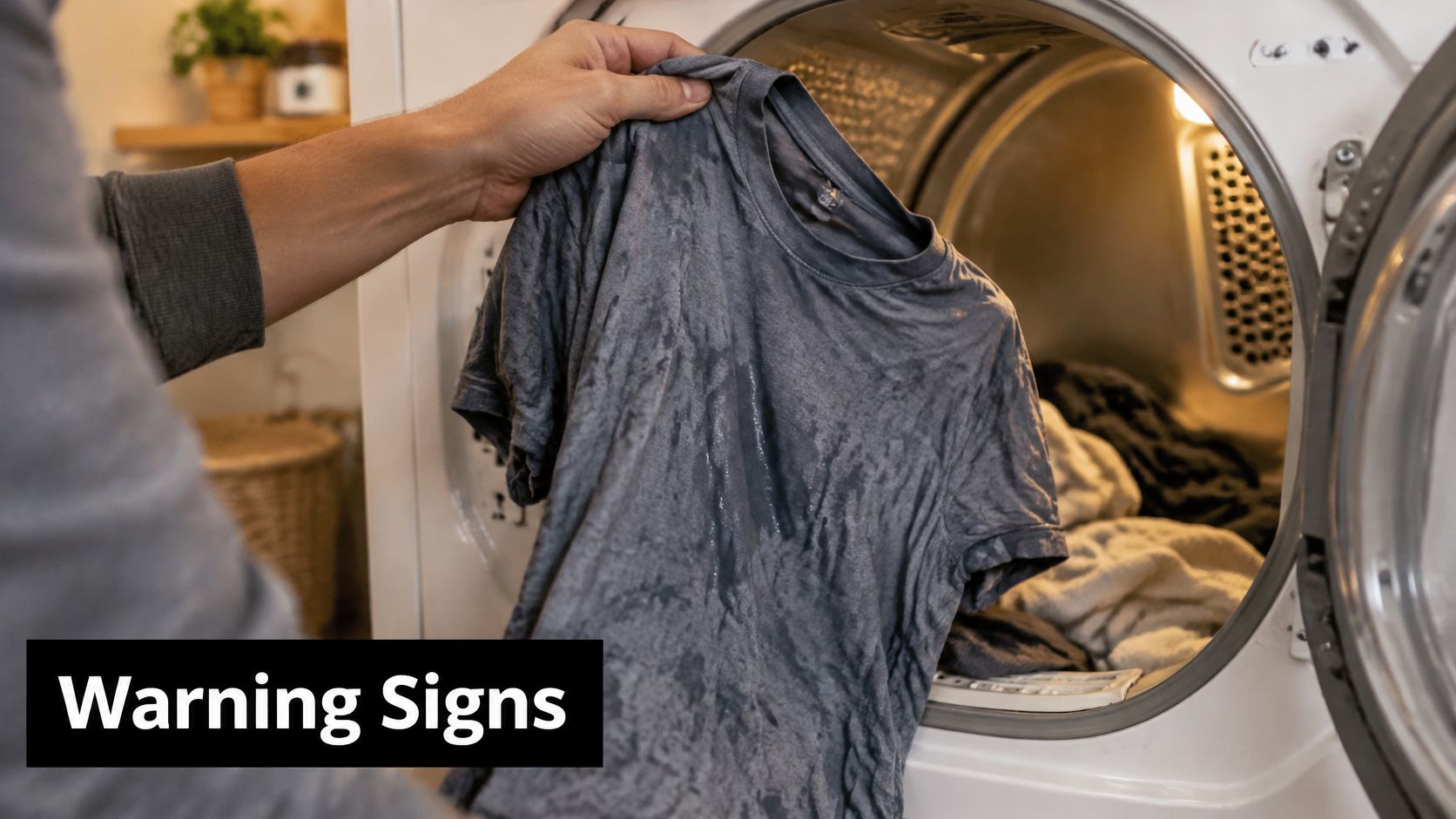
The National Park Service's dryer-fire guidance connects longer drying times, damp clothing, excessive heat, and weak exhaust-flap movement with the need for attention. Those signs help you decide what to inspect, but they don't identify the exact blockage location.
A safe homeowner self-check
Start with the lint screen. Check that it's clear before drawing conclusions about the concealed duct.
Look behind the appliance without forcing it forward. Note an obviously flattened or kinked connector. Don't stretch a gas connection or disconnect equipment just to investigate.
Observe an accessible exterior flap during ordinary operation. Weak movement is useful information, but it isn't a calibrated airflow test. Don't climb onto a roof to check it.
Record the change. Tell the technician whether the problem appeared suddenly, developed gradually, or followed moving the appliance.
A musty smell deserves investigation without assuming its source. A burning smell calls for stopping the dryer, not running another test load; if there's smoke or an active fire, leave the area and contact emergency services.
Safety first: Don't keep operating an overheating dryer to gather better evidence.
Use this practical guide to recognizing a clogged dryer vent to organize your observations. If the accessible components look normal, the next step is inspection, not guessing whether to buy a new machine.
A cleaner can investigate the exhaust route. If that route checks out and the symptoms remain, an appliance technician may be the appropriate next call.
What Happens During a Professional Cleaning Visit
A thorough visit should begin with questions, not a brush disappearing into the wall. Tell the technician what changed, whether anyone recently moved the dryer, and whether a previous cleaning helped.
Ask for a walkthrough that records the dryer model, fuel type, visible vent material, estimated route, and termination location. Unknown details should remain identified as unknown rather than filled in by assumption.
Establish the starting condition
Before cleaning, request an assessment of the connector, outlet flap, and exhaust performance. A technician may use an airflow instrument or another clearly explained assessment method. Ask where the reading is taken and how the same conditions will be reproduced afterward.
The U.S. Fire Administration identifies accumulated lint as combustible material that reduces airflow and recommends cleaning the vent pipe at least annually, or sooner when drying time increases. That safety guidance is a reason to inspect the whole route, not just the easiest opening.
Mechanical cleaning: Depending on access and duct condition, the technician may use rotary brushes, vacuum collection, or air-whip equipment. Ask how the chosen method reaches the full run without damaging it.
Termination work: Request inspection and cleaning of the outlet, including anything obstructing flap movement.
Reassembly: The connector should be securely restored without being crushed when the dryer returns to position.
Verification: Ask for a repeat assessment and an explanation of any remaining restriction.
Access from both ends can help, but don't treat a particular tool or approach as proof of quality. The important question is whether the technician can account for the complete route.
Leave with findings, not just reassurance
Ask the technician to separate debris removed, defects found, and recommended repairs. Those are different outcomes.
A bag of lint demonstrates that material was collected. Comparable before-and-after observations provide better evidence that the work improved the exhaust path. If airflow remains poor, the report should say so and identify the next diagnostic step rather than presenting cleaning as a complete solution.
How to Choose a Qualified Dryer Vent Cleaner
Compare providers by the questions they're prepared to answer. A low quote isn't automatically a warning sign, and expensive equipment doesn't guarantee careful work. Look for a clear scope, relevant training, and a willingness to document limitations.
Ask what any advertised certification covers. You're looking for experience with dryer exhaust systems, not a credential associated with an unrelated cleaning service.
Green Flags vs Red Flags When Hiring a Dryer Vent Cleaner
Signal | Green Flag | Red Flag |
|---|---|---|
Scope | Explains which components and access points are included | Describes only cleaning near the lint trap |
Training | Identifies relevant training and practical experience | Uses certification language without explanation |
Evidence | Offers comparable airflow observations or measurements | Treats collected lint as the only proof |
Findings | Provides written notes about damage and restrictions | Says every problem needs another cleaning |
Pricing | Explains flat or itemized charges and possible extras | Won't clarify what the advertised price covers |
Insurance | Can provide appropriate proof for in-home work | Avoids questions about coverage |
Read this guide to recognizing dryer vent cleaning scams before accepting an offer that changes substantially after the technician arrives. Ask for approval before extra work begins, and keep the agreed scope in writing.
Questions worth asking before booking
How will you inspect my vent route? Mention a roof outlet, concealed run, or difficult access in advance.
How will you verify the result? Request a concrete explanation rather than a promise of improved performance.
What happens if cleaning doesn't resolve the restriction? Look for a repair recommendation, not an automatic repeat appointment.
What's excluded? Clarify whether connector replacement, termination repairs, and appliance work require separate authorization.
A company that also handles HVAC work may offer convenient coordination, but that doesn't automatically make it more qualified for dryer exhaust service. Ask the same dryer-specific questions.
Likewise, recommendations for coil cleaning or duct sealing should have their own findings and justification. A clogged dryer vent doesn't establish that the home's heating and cooling ducts need work. Keep related services separate enough that you can make an informed decision about each.
Cleaning Schedule and the Limits of an Annual Rule
Annual maintenance is a useful baseline, but it's not a diagnosis. A calendar reminder can tell you when to arrange service; it can't tell you why a dryer is struggling or whether a damaged component needs replacement.
NFPA guidance, summarized through the U.S. Fire Administration's fire-prevention resources, recommends removing vent-pipe lint at least once a year and increasing frequency when drying takes longer than normal, along with suitable metal venting. Treat that as a maintenance floor, not permission to ignore symptoms until the next anniversary.
Use the baseline, then adjust to the home
Consider the circumstances with your technician:
Route and bends: Discuss whether the layout makes inspection or cleaning more difficult.
Laundry use: Describe how heavily the dryer is used rather than assuming every household has the same maintenance needs.
Materials and condition: Ask whether the existing connector and duct are suitable.
Service history: Bring previous findings, especially when the same complaint returns after cleaning.
Pet bedding, frequent laundry, or an awkward route are useful details to mention, but they don't establish a universal replacement schedule for the annual baseline. Similarly, an older appliance isn't automatically proof of a blocked vent. Its performance still needs diagnosis.
Maintenance perspective: Don't wait for the calendar when performance changes, and don't use repeated cleaning to avoid a needed repair.
A crushed connector requires correction. An unsuitable termination or poorly arranged route may require redesign. Removing lint can't change the shape or material of the duct.
Use these dryer vent cleaning frequency considerations to prepare questions about your own installation. The most useful maintenance plan combines the recommended baseline with inspection findings and a clear trigger for earlier attention.
Putting It All Together for a Safer Laundry Room
You don't need to become a vent-cleaning specialist to make a sound decision. You need to notice changes, describe them clearly, and ask a provider to distinguish between something that can be cleaned and something that must be repaired.
Keep this homeowner checklist with your maintenance records:
Maintain the lint screen. Clean it before or after every load; professional duct service doesn't replace that routine step.
Watch familiar loads. Note meaningful changes in drying time rather than relying on memory when trouble develops.
Book the right scope. Request inspection of the route, connector, and termination, not just brushing near the appliance.
Ask for evidence. Keep the before-and-after findings and any explanation of unresolved restrictions.
Follow through on repairs. Don't treat a temporarily better drying cycle as confirmation that a documented defect has disappeared.
Keep indoor-air services in perspective
Dryer exhaust maintenance, HVAC duct cleaning, coil cleaning, and ActivePure air purification are different services with different purposes. If you're considering them together, ask the provider to explain the need for each separately and what outcome it can reasonably verify.
The immediate next step is simple: check your maintenance history and write down any current symptoms. If you arrange a visit, ask beforehand how the technician will document the condition and confirm the result. That conversation is more useful than choosing a service solely because an advertisement says your annual cleaning is due.
Purified Air Duct Cleaning offers residential dryer vent cleaning, vent-path inspection, mechanical cleaning, and post-service airflow verification in the Phoenix metropolitan area. Visit Purified Air Duct Cleaning to request a quote and discuss your dryer's symptoms, vent access, and any recurring restrictions before scheduling.