

Benefits of Duct Cleaning for Healthier Indoor Air
Your air conditioner is running, but the back bedroom still feels stuffy. You've wiped dust streaks off the registers, noticed a musty smell at startup, and started wondering whether the air moving through your home is part of the problem. The benefits of duct cleaning depend on what an inspection finds, not how persuasive the advertisement sounds.
Why Homeowners Start Thinking About Duct Cleaning
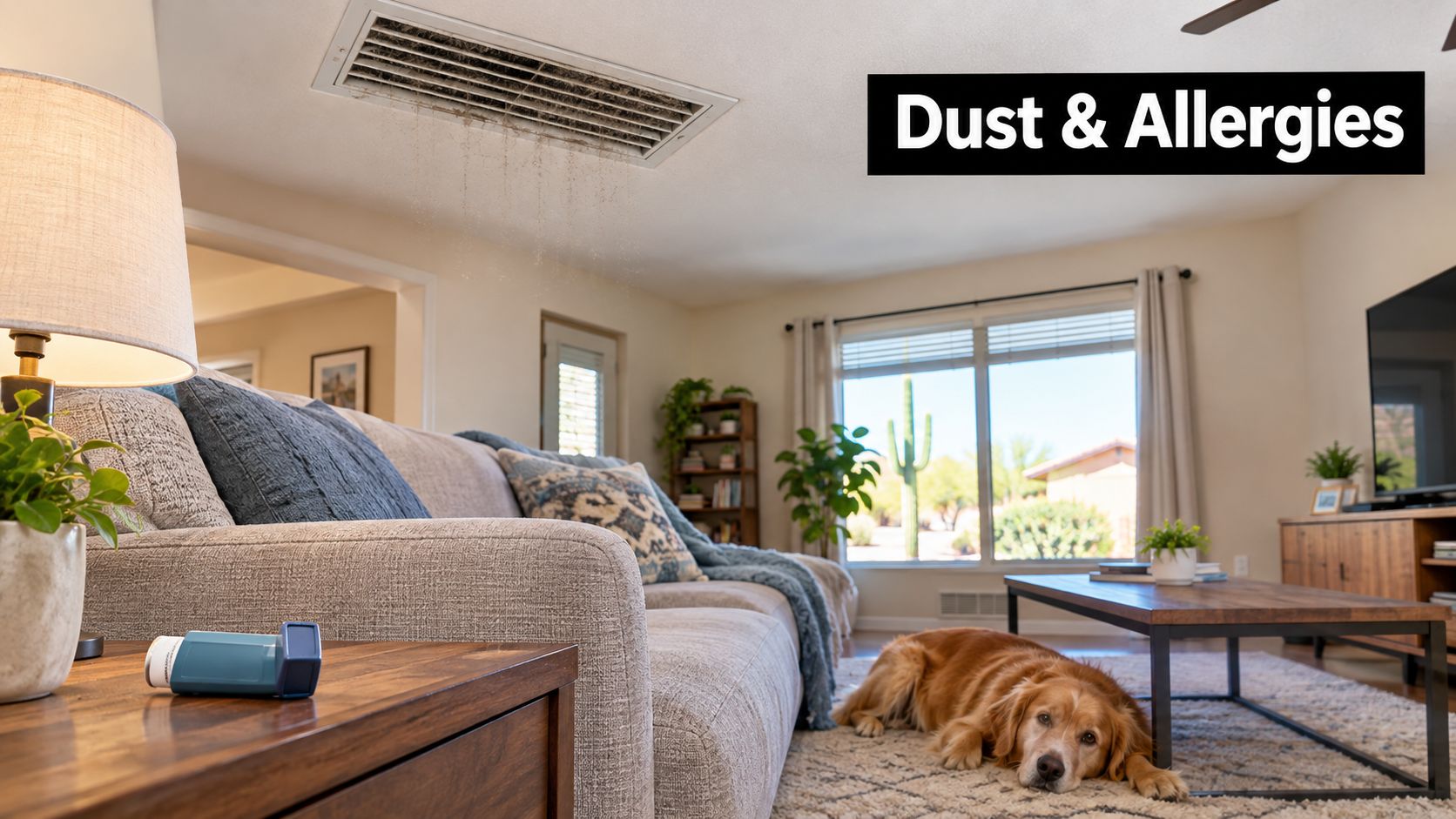
Consider a Phoenix family running the AC through summer. Their golden retriever sheds on the living room rug, pet odors linger, and their child's asthma seems worse indoors. When they notice weak airflow and dark streaks around a register, duct cleaning feels like a logical next step.
That's a hypothetical situation, not proof that dirty ducts caused the symptoms. These observations belong on an inspection checklist, but they don't establish what's happening inside the system.
The familiar combination of pets, dusty vents, and respiratory concerns can make homeowners understandably uneasy.
Separate the observation from the diagnosis
A dirty register tells you that the register needs attention. It doesn't show whether the hidden duct contains substantial debris, whether a coil needs cleaning, or whether an airflow problem requires repair.
Before buying a service, organize your concerns:
What you see: Note dust discharged during startup, visible debris, or staining near an opening.
What you smell: Record whether an odor appears only when the system operates or remains throughout the room.
What you feel: Identify rooms with weak airflow instead of describing the whole house as uncomfortable.
What changed: Include renovation work, a moisture event, new pets, or a lapse in HVAC maintenance.
Those details help a technician investigate instead of guessing. They also help you evaluate whether a proposed cleaning addresses your actual complaint.
Treat cleaning as a maintenance decision
Marketing often combines several promises into one package: cleaner air, fewer allergy symptoms, lower bills, and fresher rooms. Online advice can swing toward the opposite extreme, treating every cleaning service as unnecessary.
Neither approach helps you assess your own ductwork. A useful recommendation identifies the material present, the affected components, and the outcome the service can reasonably deliver.
Practical rule: Ask what the technician found before asking what cleaning will accomplish.
If asthma symptoms have changed, involve the child's healthcare professional rather than using a cleaning appointment as a substitute for medical guidance. For the building itself, start with inspection and keep the broader indoor environment in view.
How Your HVAC System Actually Moves Air Through the Home
On a warm afternoon, one room may feel stuffy while another stays comfortable. The reason is not always dirty ductwork. To understand what cleaning can address, first follow the air through the system and identify where a deposit sits.
A forced-air HVAC system moves air in a loop: room air returns to the equipment, passes through system components, then travels through supply ducts back to rooms. Ducts carry air; the blower moves it; the filter captures particles along its designed path. These parts have different jobs, so dust in a duct and buildup on a cooling coil are separate issues.
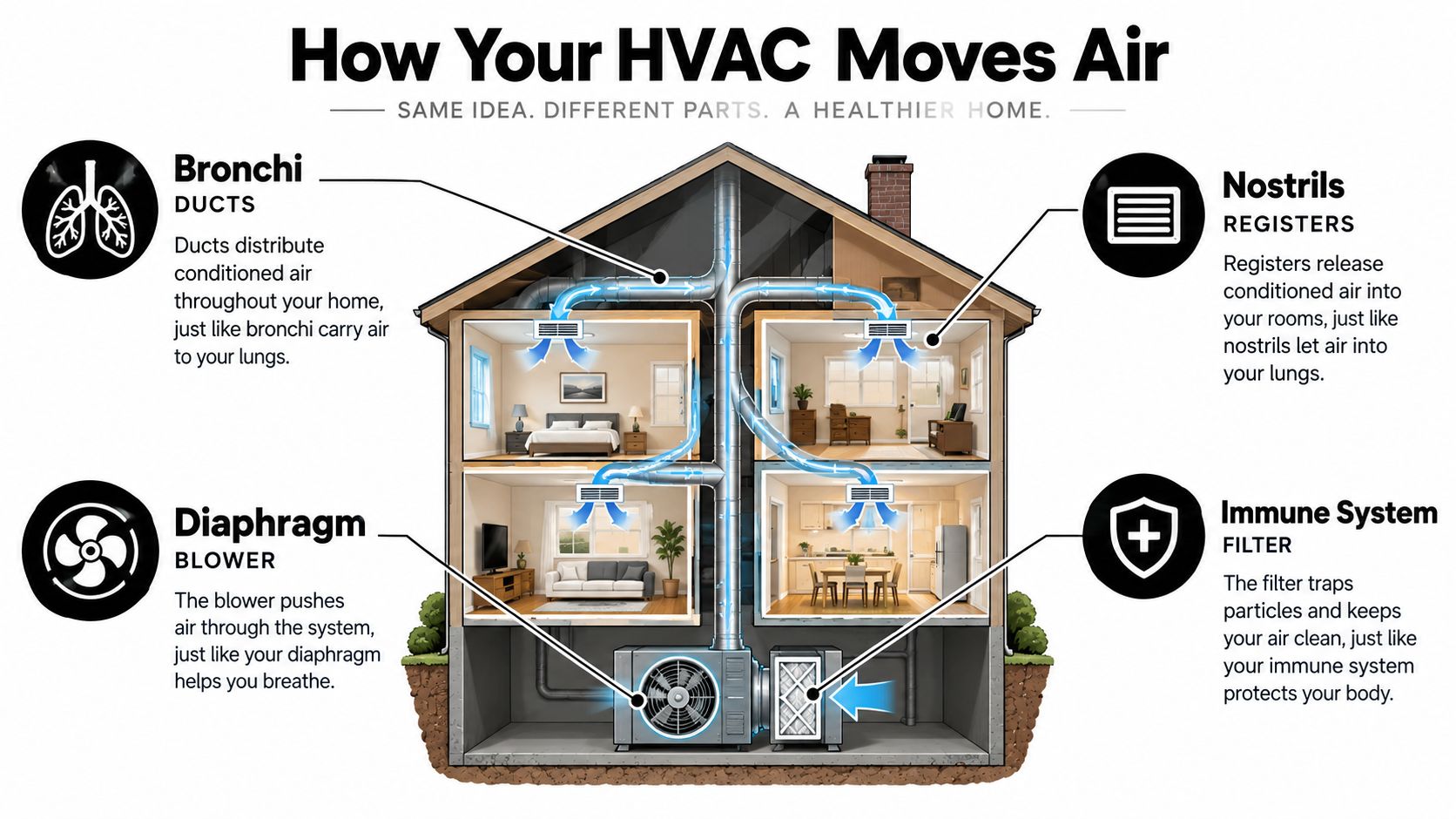
The analogy to lungs can help. The blower works like a diaphragm, pushing air through the system, while ducts resemble branching bronchi that carry it to different rooms. Supply registers act like openings for air to enter a room. The filter works like a barrier, trapping particles; it does not make the entire system sterile.
During normal operation, air enters return grilles and moves toward the air handler. It passes through the filter and, during cooling, across the cooling coil. The blower then sends it through a main supply duct and smaller branches to room registers. Equipment layouts differ, so ask a technician to point out these parts in your home.
Where material is found matters. Dust on a register is accessible; deposits deeper in a branch duct need inspection. Buildup on a blower or coil concerns a working component, not just an air passage. Cleaning one area does not automatically address the others.
EPA's 1997 field study of nine single-family homes found that mechanical cleaning removed adhered dust and dirt from non-porous, bare sheet-metal ducts, as reported in EPA's air-duct-cleaning field research. That finding applies to the ducts studied. It does not establish that every material or home will respond the same way. Ask whether your ducts are bare metal, lined, or flexible, and whether the proposed tools suit their construction.
Room comfort also depends on more than cleanliness. For a separate starting point, see this guide to improving air circulation in your house. Consider cleaning when inspection identifies removable material, rather than assuming that a warmer room proves the ducts need attention.
The Real Benefits You Can Expect From Professional Cleaning
The most defensible benefit is straightforward: professional cleaning removes documented contamination from the surfaces it reaches. If inspection reveals construction debris or substantial accumulated material, removal addresses a known maintenance problem rather than an assumed one.
Other outcomes need closer qualification. An odor may improve if cleaning removes its confirmed source, but cleaning the wrong component won't solve it. Likewise, removing a physical obstruction is different from expecting ordinary light dust removal to correct poor airflow.
Understand what the energy evidence measures
A multi-climate evaluation reported 41%–60% lower fan and blower energy consumption and 10%–46% higher supply airflow after cleaning the complete air path, not merely accessible duct surfaces, as described in NADCA's HVAC-cleaning energy study summary.
The distinction matters. Those results concern a combined HVAC intervention involving components where accumulated particulate matter increases resistance and impairs heat transfer. They aren't a guaranteed reduction in your household electricity bill.
Think of cleaning a duct as clearing a passage and cleaning a fouled coil as restoring a working surface. Both may belong in a service plan, but they address different problems.
Duct Cleaning Benefits, Evidence Strength, and Required Conditions
Benefit | Evidence Strength | System Condition Required |
|---|---|---|
Removal of adhered dust and debris | Direct evidence for the tested bare-metal ducts | Documented deposits on cleanable surfaces |
Removal of construction material | Defensible source-control application | Construction debris confirmed inside the system |
Odor improvement | Conditional, not a universal outcome | The odor source is identified and removable |
Restored airflow | Depends on restriction and cleaning scope | Removable buildup is contributing to resistance |
Reduced fan energy use | Documented for complete-air-path cleaning | Contaminated HVAC components comparable to those evaluated |
Allergy or asthma improvement | Not established as a predictable cleaning outcome | Requires evaluation beyond settled duct debris |
Set a measurable expectation
For facility operators, ask for baseline and post-service airflow, static pressure, temperature split, and fan electrical demand when performance improvement is the reason for cleaning. Without comparable measurements, “the system runs better” remains an impression rather than verification.
For homeowners, a written scope and photographs of the contaminated areas can provide a more useful record than a promised savings percentage. Agree on what will be cleaned and how the technician will show the work is complete.
For another service-oriented explanation to compare against that scope, consult Covenant Aire Solutions on duct cleaning. Use it to develop questions, not as a substitute for inspecting your equipment.
Sensitive occupants deserve careful expectations. The discussion of whether cleaning air ducts helps with allergies can help you frame that conversation without confusing a cleaner duct surface with a guaranteed change in symptoms.
What a Professional Duct Cleaning Visit Actually Looks Like
A technician opens an access point and finds a layer of dust inside the duct. The next steps should be easy to follow: inspect the system, explain the work, contain loosened material, and show what was cleaned. A professional visit is less like wiping a visible surface and more like cleaning a hidden passage without pushing debris into the rooms it serves.
The process illustration shows the stages, including sanitizing. Treat that step as a separate treatment decision, not a routine part of every cleaning.
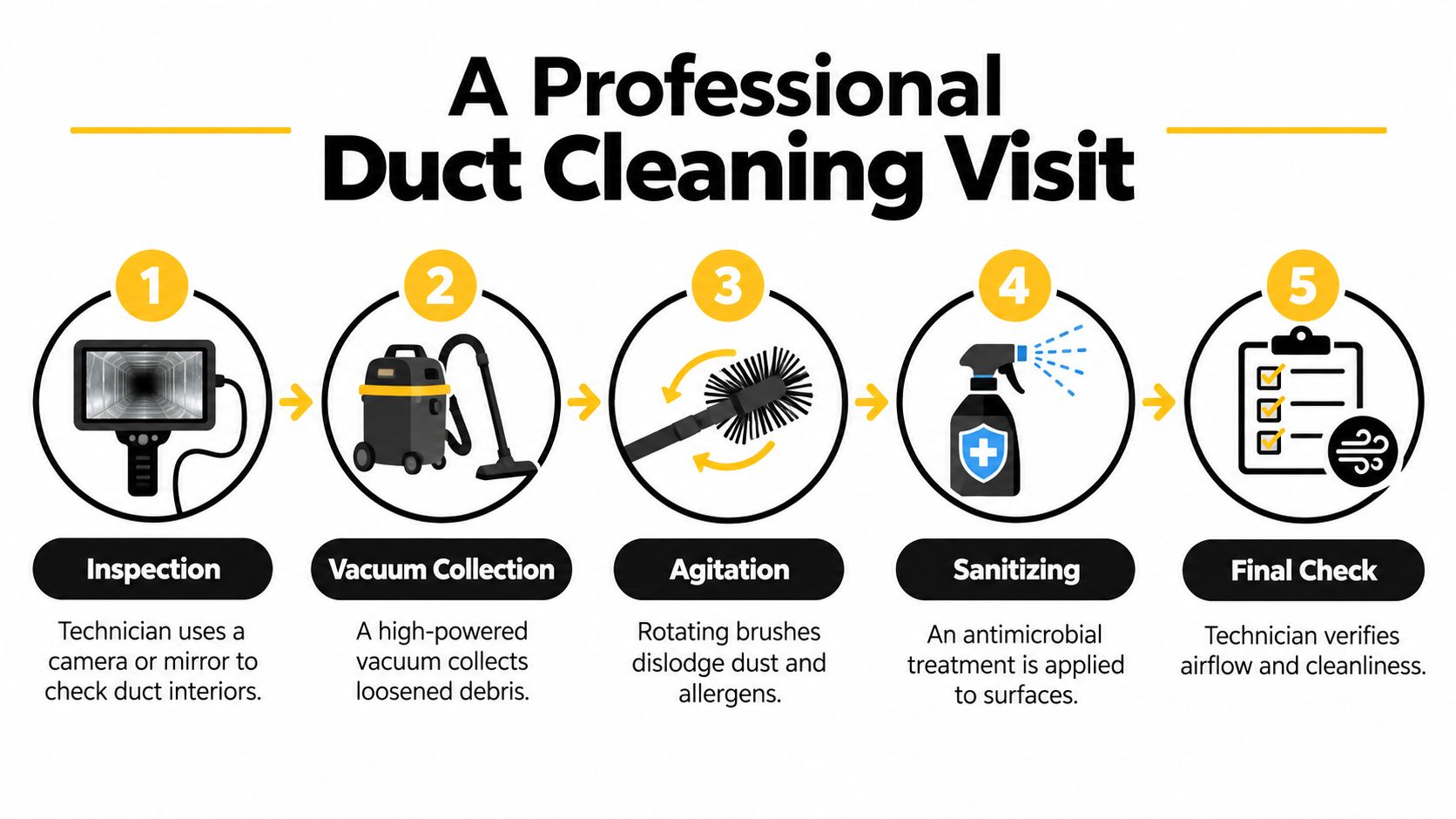
Before work begins, ask the technician to inspect accessible duct interiors with a camera or mirror, identify the duct material, and describe which components the estimate covers. The tool and method should suit the material, much as a brush chosen for metal may be unsuitable for a flexible liner.
Follow the debris
Once the scope is clear, ask how the contractor will loosen and capture the buildup. Mechanical agitation may use brushes or compressed-air whips, while a truck-mounted or portable vacuum collects debris. Clarify how exhaust is handled and whether the system includes a HEPA-filtered collection unit.
The work plan should make these steps clear:
Containment: How registers and work openings will be managed to limit debris spreading.
Agitation and collection: How material will be loosened and captured together.
Component cleaning: Whether blower assemblies, coils, and the drain pan are included or priced separately.
Reassembly: How access openings, grilles, and equipment panels will be secured.
EPA research reports that cleaning may temporarily increase airborne particle and microbial concentrations, followed by reductions in some contaminants. That finding makes containment an important part of the method, as described in EPA's review of duct-cleaning research. A brief increase alone does not prove the job worked or failed. If visible dust escapes into occupied rooms, ask how collection and containment are being managed.
Check the work, not just the grille
Request before-and-after photographs of comparable locations and a list of the components serviced. If improved airflow was part of the proposal, ask for the agreed measurements. A clean register cover cannot show whether the hidden areas in the contract were addressed.
Before approving an antimicrobial treatment, ask for the product name, purpose, surface compatibility, and application instructions. Spraying does not replace debris removal or investigation of moisture.
A clean grille is easy to show. Documentation should also address the hidden areas included in the contract.
HomeProBadge's guide to spotting air duct cleaning scams offers questions to consider when reviewing a proposed scope or responding to sales pressure.
For a visual supplement, watch the following video.
When Cleaning Pays Off Most in Phoenix Area Homes and Businesses
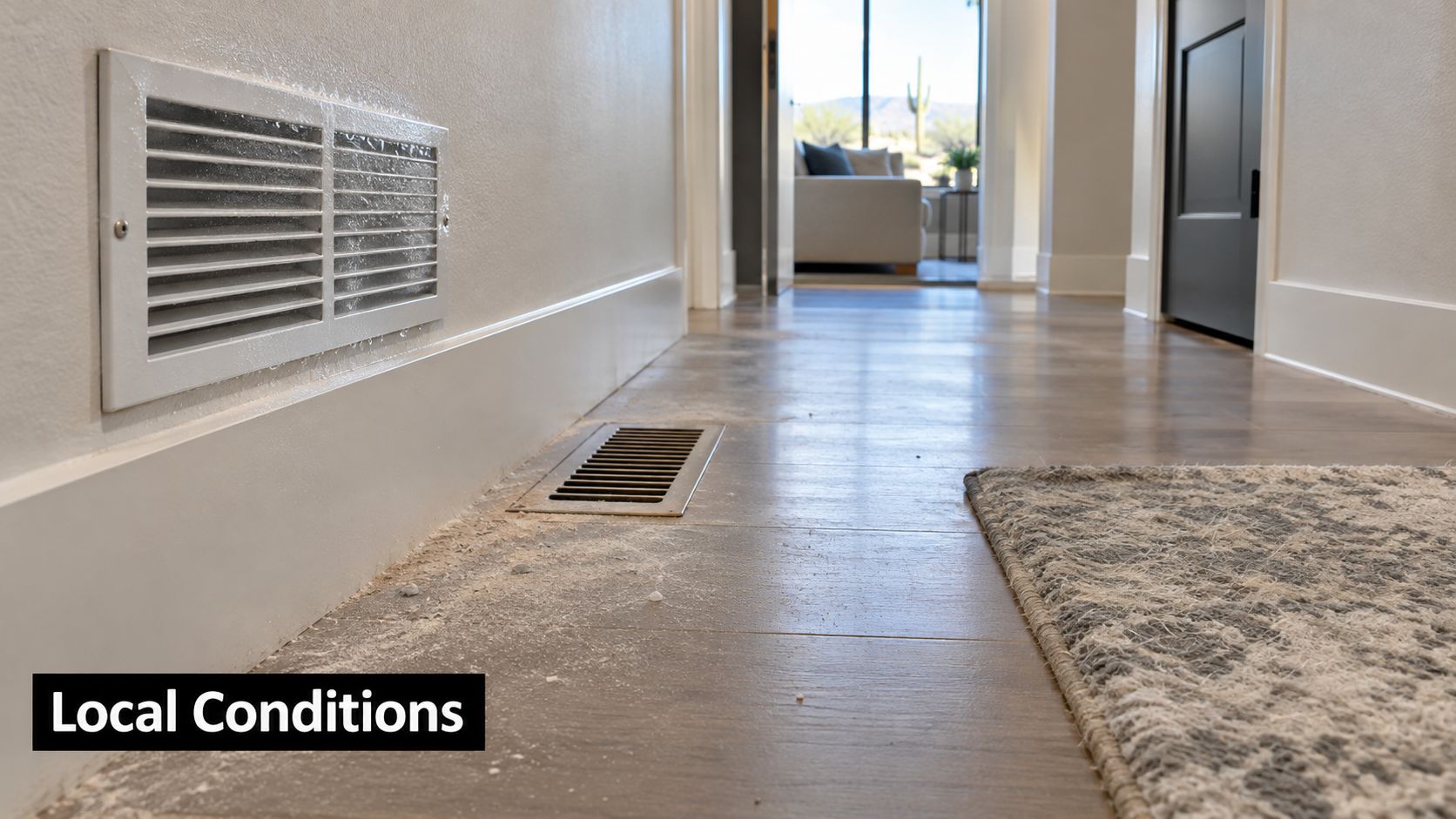
A remodel is finished, the rooms are tidy, and dust still collects near a supply register. For a Phoenix homeowner, that is a reason to inspect, not proof that the ducts need cleaning. The same applies after a commercial tenant buildout: the decision should follow evidence inside the system, not the event alone.
If a technician finds drywall dust or other construction debris in the ductwork, cleaning has a clear target. If the ducts are free of that material, the project itself does not establish a need. A vent's appearance can prompt an inspection, but it cannot show the condition of every hidden branch.
The right question depends on what happened and where contamination may have entered:
After construction: Did dust enter the return or supply ducts, and can the technician identify where it settled?
After monsoon-season moisture concerns: Was there a leak, condensation, or a confirmed damp area? A musty odor alone does not establish growth inside ducts. Find and address the moisture source first.
In homes with multiple pets: Is hair or debris accumulating inside the system, or is the concern mainly on furnishings and filters?
After regional wildfire smoke: Is there evidence that smoke entered the home or left residue in the system? Duct cleaning alone does not resolve an airborne smoke concern.
After commercial buildouts: Which zones ran during dusty work, and can the contractor document affected duct branches?
These are reasons to investigate, not evidence that every Phoenix property has the same exposure. A well-maintained system with no documented contamination may not need immediate cleaning.
For concerns beyond duct interiors, this guide to improving air quality in your Phoenix home can help organize other possible causes and next steps.
Dryer exhaust is a separate system
Dryer vent cleaning addresses lint in the exhaust pathway, a different issue from dust inside HVAC ducts. Coordinating visits may be convenient when both systems need attention, but an HVAC duct recommendation does not confirm a dryer exhaust problem.
For 2010 through 2014, NFPA estimated an annual average of 15,970 U.S. home fires involving dryers or washing machines. Failure to clean contributed to 33% of dryer fires, and dust, fiber, or lint was the first material ignited in 26%, according to NFPA's dryer and washing-machine fire report.
Those findings support inspecting or cleaning dryer exhausts and removing lint. They do not make general air duct cleaning the same fire-prevention service.
Why Duct Cleaning Alone Will Not Fix Most Air Quality Problems
A homeowner may notice lingering odors after a duct cleaning and wonder why the air still feels stale. The answer often lies elsewhere in the HVAC system or the home. Clean ducts don't guarantee healthy indoor air, because cleaning addresses material inside the ducts, not every source of particles, odors, or moisture.
The EPA says duct cleaning has not been shown to prevent health problems, and household particle levels have not been conclusively linked to dirty ducts. The agency notes that cleaning contaminated coils, fans, and heat exchangers may improve efficiency, while duct-only cleaning has less supporting evidence in its homeowner guidance on air duct cleaning. These distinctions help separate a documented benefit from a broader promise.
Start with the complaint, then look for its likely source. Particles may come from indoor activities or inadequate filtration. A persistent odor can have a source outside the ductwork, while dampness calls for investigating moisture. Uncomfortable rooms or high energy use may point to airflow or equipment problems. Duct cleaning is useful when contamination is present, but it cannot correct every cause.
A practical evaluation follows the path of the air. Check whether the filter fits properly and whether the HVAC system can handle its rating. Have a technician look for leaking or disconnected ducts and damaged insulation, which cleaning cannot repair. For ventilation concerns, review how outdoor air enters the building and whether the system is operating as intended. Identify and reduce the source of a pollutant where possible.
Choosing a filter by rating alone can create problems if it restricts airflow or does not fit the equipment. Discuss compatibility with an HVAC professional, and use this guide to indoor air quality filtration to prepare questions.
Moisture needs its own diagnosis. A musty smell alone does not establish that humidity equipment is needed. First identify whether there is a moisture-control problem; if whole-home equipment fits the situation, use this resource to pick a whole house dehumidifier.
Match each proposed service to a known condition and a way to check whether it was addressed. Cleaning may belong in the solution, but the goal is to correct the cause of the complaint, not schedule more services.
Your Decision Checklist for Scheduling the Next Cleaning
Before scheduling, gather enough information to choose yes, no, or not yet. You don't need to diagnose the system yourself, but you should be able to explain why you're asking for an inspection.
Bring these observations to the appointment
Recent renovations: Note the work performed and whether the HVAC operated during dusty activities.
Visible dust puffs: Record which register releases material and when it happens.
Startup odors: Describe the smell and whether it disappears after operation begins.
Pets and shedding: Explain household changes without assuming pets automatically require duct cleaning.
Filter history: Check the filter's condition and record when it was last replaced.
Moisture events: Include leaks, water damage, or known condensation concerns.
Indoor symptom changes: Document patterns for your healthcare professional as well as the building assessment.
Inspection history: Locate prior service records and note unresolved findings.
For routine equipment care, ENERGY STAR recommends monthly filter checks, particularly during heavy use, replacement when dirty or at least every three months, and cleaning indoor and outdoor coils before warm weather because dirty coils impair cooling and can increase operating costs, according to its heating and cooling maintenance guide.
Make a condition-based choice
Yes makes sense when inspection documents significant removable contamination and the proposed scope addresses it. Not yet fits when the cause remains uncertain or another repair needs attention first. No immediate cleaning is reasonable when inspection finds no significant contamination.
For scheduling context, consult this guide to duct cleaning frequency, but let findings outweigh elapsed time.
The genuine benefits are cleaner contaminated surfaces and, where the right components need attention, potential performance improvement. Don't budget around guaranteed symptom relief or automatic bill reductions.
Purified Air Duct Cleaning offers residential and commercial air duct cleaning, dryer vent cleaning, and HVAC coil cleaning across the Phoenix metropolitan area. Visit Purified Air Duct Cleaning to request a quote and discuss which service fits your inspection findings, airflow concerns, or recent renovation.