

Cleaning Air Ducts Benefits: What You Actually Gain
You dusted yesterday, and there's already a fine film on the coffee table. A bedroom feels stale, someone sneezes more at home than outside, and the air conditioner seems to run longer than it used to. Understanding cleaning air ducts benefits starts with separating what cleaning can physically remove from what only sealing, filtration, or equipment service can fix.
Why the Ducts Behind Your Walls Deserve a Second Look
You walk from the kitchen to the living room and catch a musty note when the system starts. Sunlight through a window shows dust drifting near a supply register, and one bedroom never feels quite as cool as the rest of the house. None of that proves your ducts are the problem, but each clue tells you to look at the system that moves air all day.
Small Signs Worth Noticing
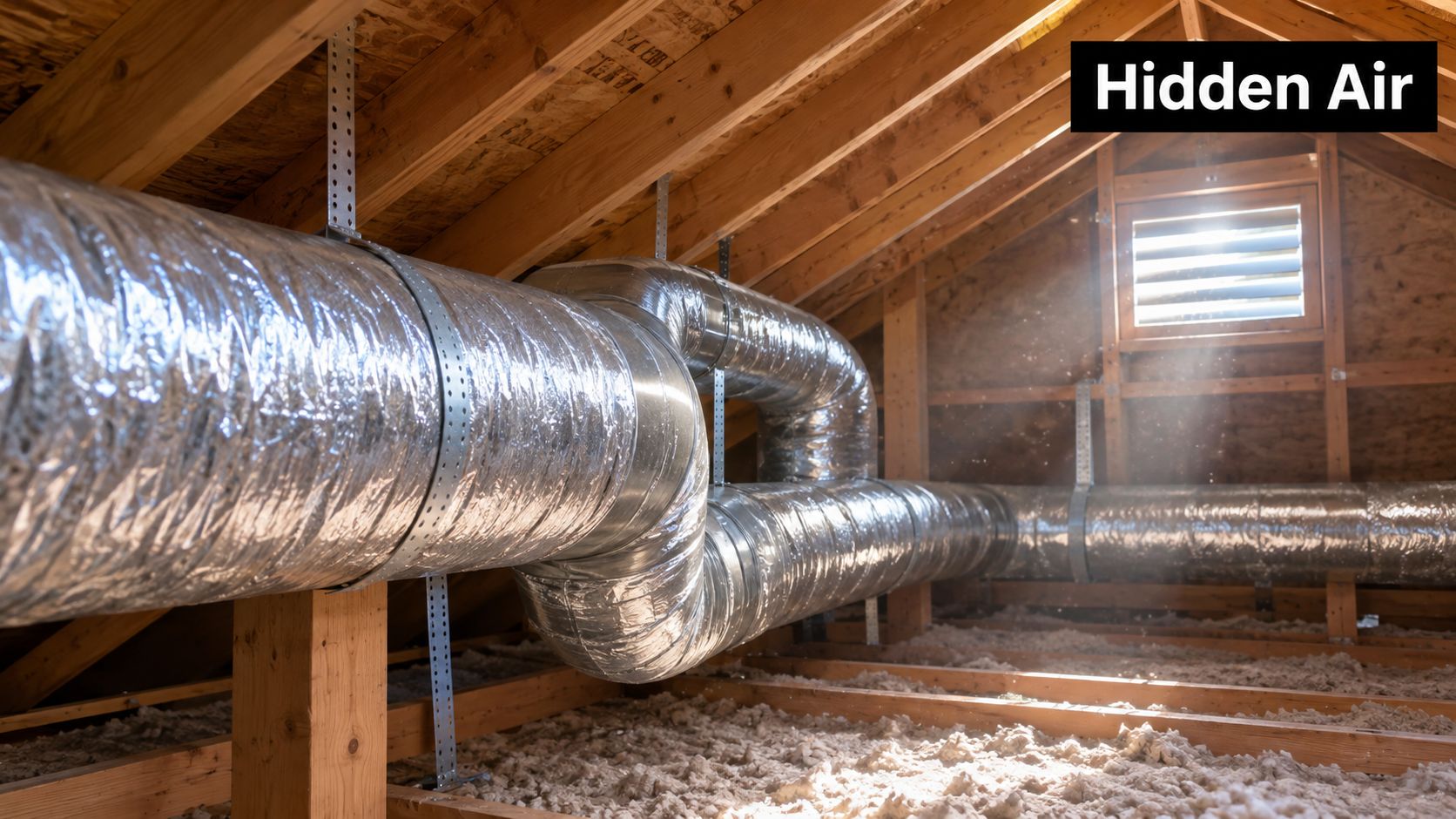
Ducts run through attics, walls, and crawlspaces, so you rarely see them working. You notice the results instead: dust returning quickly, lingering odors at startup, uneven rooms, or allergy symptoms that feel worse indoors. Those signs can also point to a dirty filter, a leaking return, or a coil that needs service, which is why guessing wastes money.
Think of ductwork as a household asset rather than a hidden tube. It carries every bit of heated and cooled air you pay for, and it shapes whether rooms feel balanced or stuffy. A careful inspection of accessible registers, filters, and the air handler gives you a starting point before you pay for any cleaning.
Look first, clean second: Visible debris, odor, or growth inside accessible duct openings is a stronger reason to act than a calendar reminder.
When a family treats those early clues as information, the next step gets clearer. You're not chasing a promise of perfect air. You're checking whether material has built up where air travels, and whether another part of the system is creating the symptom you noticed.
How Air Ducts Work and What Builds Up Inside Them
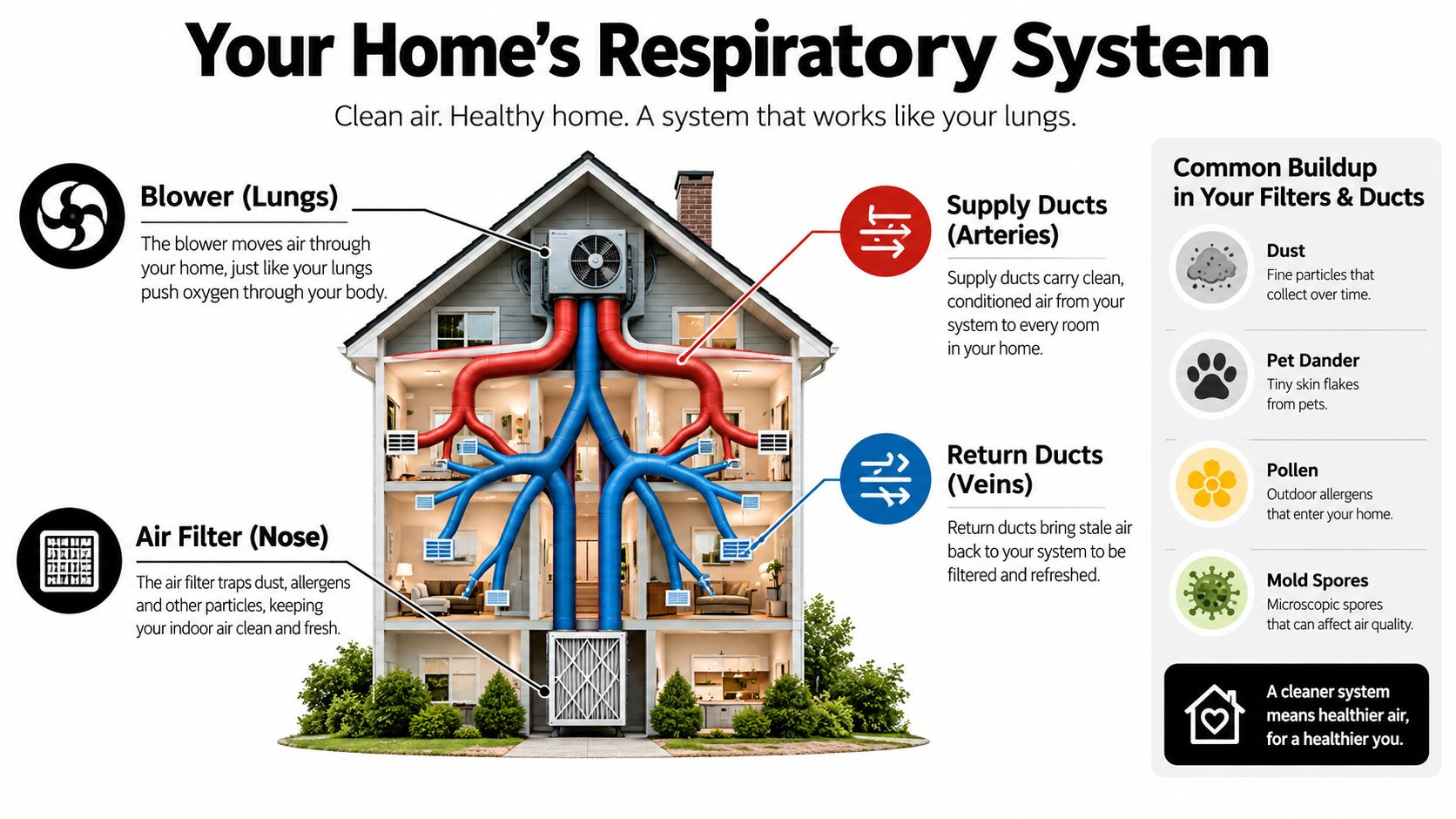
Your home breathes through machinery. The blower works like lungs, pushing and pulling air. Supply ducts carry conditioned air out to rooms, return ducts bring room air back, and the filter acts like a nose, catching larger particles before air reaches the equipment. Registers are the openings you see on walls, ceilings, and floors.
That loop runs again and again. Air leaves the air handler, travels through supply runs, enters a room, drifts toward a return, and passes through the filter before the blower moves it once more. If a return is undersized or a filter is clogged, the blower works against resistance even when the ducts themselves look fairly clean.
What Collects Over Time
Material enters from everyday life and from the building itself. A guide to signs and buildup in dirty air ducts is useful when you're trying to tell normal dust from a heavier problem.
Dust and lint: Skin flakes, fabric fibers, and household dust settle on interior surfaces, especially at bends and rough joints.
Pet dander and pollen: Fine particles hitchhike indoors on clothing, pets, and open doors, then deposit where airflow slows.
Construction debris: Drywall dust, sawdust, and scraps left after building or remodeling can sit in runs for years.
Microbial growth: Condensation on cold surfaces or in a wet drain pan can support growth if moisture stays.
Pest remnants: Insects or rodents that enter damaged ductwork can leave nesting material and droppings.
Much of this material clings to duct walls instead of floating into rooms, which surprises many homeowners. Loose debris near a damaged or disconnected section behaves differently from a thin, adhered layer. That's why the location and type of buildup matter as much as the fact that you found dust.
The Measured Benefits of Cleaning Air Ducts
The best-documented benefit is simple: source removal. Mechanical cleaning physically lifts adhered dust and debris off nonporous duct surfaces, the way a damp cloth removes grime that a feather duster only stirs into the air. In a study of nine single-family homes, mechanical duct cleaning effectively removed adhered dust from duct surfaces, with supply-air rates rising by 4 to 32 percent in eight of the homes, though indoor particle levels did not consistently drop. Cleaner surfaces and freer supply delivery are genuine gains. They stop short of a proven whole-house health improvement, because ducts are only one pathway in a system that also includes the filter, the coil, and the rooms themselves.
Where the Evidence Is Strong and Where It Isn't
Measured Outcome | What the Research Found | Why It Matters |
|---|---|---|
Duct surface deposits | Mechanical cleaning removed adhered dust and dirt | Confirms cleaning works as source removal |
Supply airflow | Rates rose in most homes in the nine home study | Rooms may receive air more freely |
Indoor particles | No consistent reduction was clearly shown | Outdoor air and indoor sources also matter |
Bioaerosols | No significant reduction in that field study | Cleaning alone doesn't prove a health gain |
The table captures a pattern worth understanding: removing a reservoir of material is measurable, while improvements in the air you breathe depend on everything else feeding that air. Filtration, moisture, and outdoor intake all keep working after the cleaning crew leaves.
For allergy concerns, the honest answer is conditional. Pulling out a heavy reservoir of dust, dander, or debris can reduce what the system can disturb, yet filtration, moisture control, and source control elsewhere in the home still carry weight. If you're weighing whether duct cleaning helps with allergies, ask what specific contaminant was found and how the provider will contain it during agitation.
Containment matters because brushing and air sweeping can resuspend particles if the work isn't controlled. Ask for sealed registers, negative pressure collection, and HEPA filtered exhaust, plus a visual check afterward. Those steps protect the rooms you're trying to improve.
Airflow, Equipment Strain, and a Separate Fire Issue
Better balanced airflow is plausible when debris, a fouled blower, or a clogged coil was restricting the system, and less restriction can ease strain on motors. A light dust layer in otherwise healthy ductwork doesn't justify the same expectation. The same careful thinking applies to other maintenance: homeowners reviewing window cleaning advantages for homes will recognize the pattern, where a service helps most when it targets a visible, specific problem.
Dryer vent cleaning is different, and providers often offer it alongside duct work. The National Fire Protection Association estimated an annual average of 15,970 U.S. home structure fires involving clothes dryers or washing machines during 2010 to 2014, with clothes dryers accounting for 92% of the incidents. That supports lint removal as fire prevention for dryer vents. Ordinary HVAC duct dust carries no equivalent documented fire risk.
In practice, the defensible list is narrower than many ads suggest: removal of documented buildup, possible airflow improvement, easier inspection of components, and support for broader maintenance. That shorter list still earns its place when duct cleaning sits inside a complete indoor-air plan rather than standing alone as a cure-all. Universal air quality gains and dramatic bill savings from duct cleaning by itself remain unproven.
Why Full HVAC System Cleaning Outperforms Duct Cleaning Alone
A thin layer of dust inside a wide duct rarely chokes airflow by itself. A matted evaporator coil, a blower wheel coated with grime, or a slimy condensate pan can restrict the system far more, because air must pass through tight coil fins and curved blower blades. Clean the tube but leave those parts fouled, and you've polished the hallway while the doorway stayed blocked.
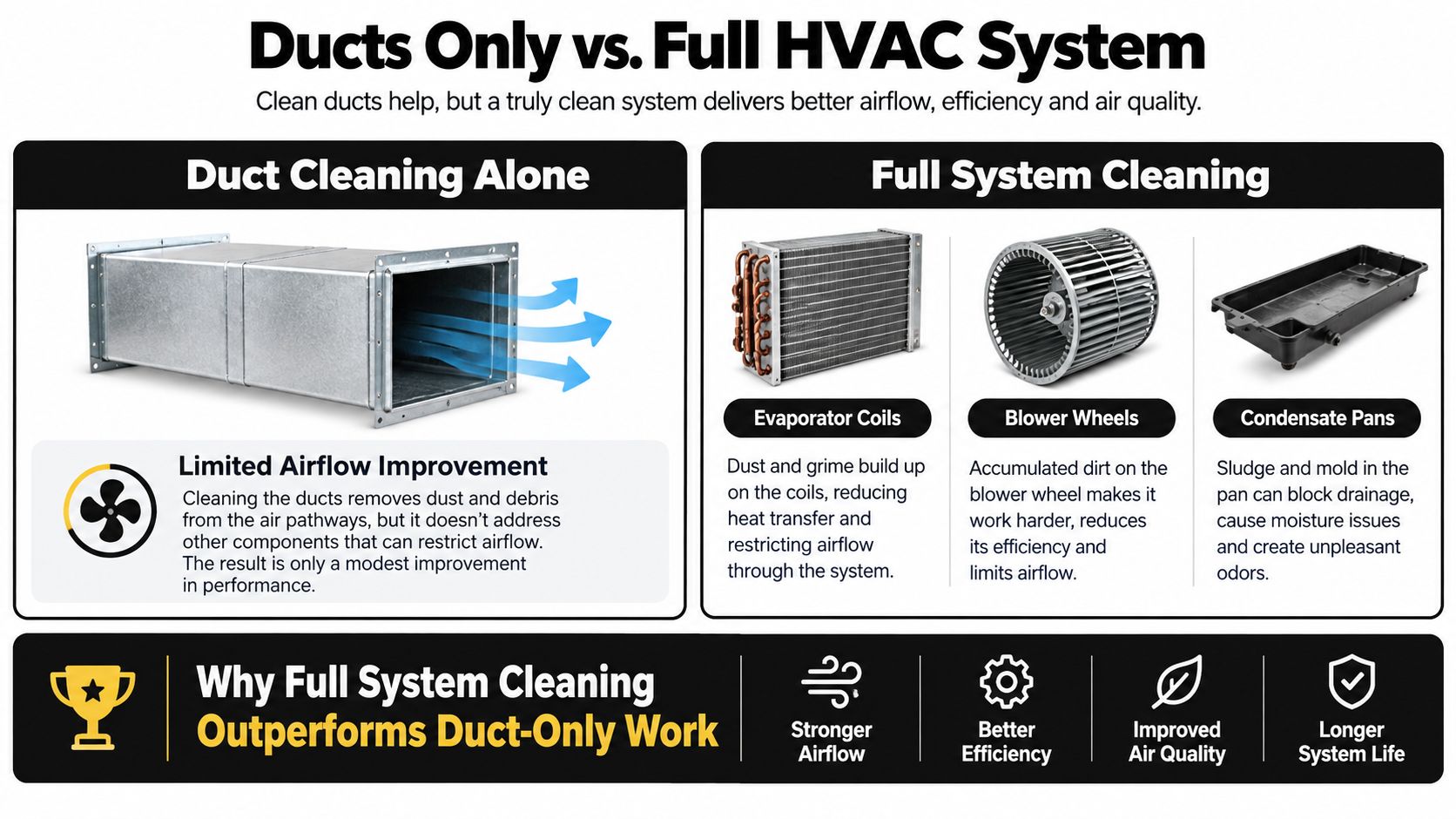
That distinction changes how you read performance claims. Newer multi-building research reported that cleaning the broader HVAC system, including ducts, coils, blowers, and related components, reduced fan and blower energy consumption by 41 to 60 percent and increased supply airflow by 10 to 46 percent across several climate zones. Those results describe full system cleaning, not ducts in isolation.
What a Properly Scoped Job Includes
Before you approve a quote, ask the technician to name each component in the scope. A description of residential HVAC cleaning services and included components can help you compare one proposal with another.
Coils and drain pan: Ask whether the evaporator coil will be inspected and how condensate drainage will be checked.
Blower assembly: Ask if the wheel and housing are included, since buildup there directly affects delivered air.
Ducts and registers: Confirm both supply and return runs are covered, not only the easy openings.
Filter and access panels: Ask what filter will be installed afterward and whether panels will be resealed.
The better question isn't whether duct cleaning works in the abstract. It's which component is causing your symptom, and what will be measured before and after service.
A quote that only mentions ducts may still be right for a home with documented debris and clean equipment. It just shouldn't borrow the stronger results that belong to a full cleaning. Match the scope to the inspection, and you avoid paying twice.
Cleaning vs Sealing vs Better Filtration
Three different jobs often get sold under one promise of cleaner, cheaper air. Cleaning removes material that's already inside. Sealing stops conditioned air from escaping and dirty attic or crawlspace air from being pulled in. Filtration captures particles as air circulates, day after day. Each solves a different problem.
Leakage is the documented energy issue. The U.S. Department of Energy has reported that typical residential duct systems lose approximately 25% to 40% of the heating or cooling energy produced by a furnace, heat pump, or air conditioner, generally through leakage and poor insulation rather than dust alone. Ducts in a hot attic suffer most, because cooled air leaks into a space nobody occupies.
Sealing targets that loss directly. ENERGY STAR estimates that sealing and insulating ducts can improve heating and cooling efficiency by as much as 20 percent, particularly for ducts located in attics, crawlspaces, garages, and other unconditioned areas, using mastic or metal backed foil tape at seams and connections. If you're pricing that work, an explanation of duct sealing and potential savings helps you separate sealing costs from cleaning costs.
A Simple Decision Lens
Choose cleaning first: You see substantial debris, visible mold, pest evidence, or dust blowing from registers.
Choose sealing first: Rooms are uneven, bills feel high, and ducts run through unconditioned spaces with loose joints.
Choose filtration first: Allergies persist, the filter loads quickly, or fine dust returns despite a clean system.
Filtration upgrades need care. A higher MERV filter captures smaller particles, but it can add resistance if the return area is too small for it. Ask a technician to confirm the blower can handle the filter you want, and check filters monthly during heavy use. A dirty filter restricts airflow, wastes energy, and lets dust accumulate inside equipment.
Many homes need a combination, sequenced sensibly. Remove documented contamination, seal the leaks that pull in new dirt, then filter the air that remains. That order gives each dollar a distinct job instead of asking cleaning to do all three.
Two Quick Snapshots of Duct Cleaning in Real Homes
Stories make the tradeoffs easier to picture, as long as you read them as examples rather than guarantees. The first household combines several services at once, which is exactly why its result can't be credited to duct cleaning alone.

A Suburban Avondale Family
A couple in Avondale with two shedding dogs, a newborn, and a parent with asthma kept finding heavy dust near returns. Inspection showed debris in the ductwork, a fouled coil, and a loose return connection pulling in dusty air. They chose combined duct and coil cleaning, plus sealing that return run and fitting a fresh filter.
Afterward, they noticed they were dusting less often and the parent described breathing more easily at home. That's a believable household outcome, but it followed three interventions, not one. Cleaning didn't fix outdoor pollen coming through open doors, and they still needed regular filter changes.
A short walkthrough can help you picture how technicians access and contain the work before you schedule anything similar.
A Small Dental Office Near Phoenix
A dental office near Phoenix with a rooftop unit fielded complaints that some operatories felt warm while the waiting room felt cold. A technician found restricted supply airflow and dirty components in the air handler. After a full HVAC cleaning and a new filter rack, airflow felt more even and the summer utility bill was noticeably lower.
The cleaning didn't fix the building's afternoon sun load on west facing glass. Staff still used shades during peak heat. The lesson in both snapshots is the same: targeted cleaning helped because someone first identified a specific restriction or contamination source.
How to Prepare Your Home and Verify the Results
Good results start before the vacuum truck or portable collector arrives. Ask the provider how they'll inspect the system, which components are included, and how they'll protect your rooms. Vague answers about sanitizing everything should prompt more questions, especially if nobody has looked inside your ducts yet.
Questions to Ask Before Booking
Containment method: Will registers be sealed and the system kept under negative pressure during agitation?
Exhaust filtration: Does the collection equipment exhaust through HEPA filtration if it discharges indoors?
Scope in writing: Are coils, blower, drain pan, and both supply and return ducts listed, or only some of them?
Evidence: Will you receive before and after photos from inside representative runs?
Prepare the house the day before. Clear access to registers, the air handler, and attic or crawlspace entries, and cover nearby furniture if the provider advises it. Plan for pets and sensitive household members to stay in a closed room or leave during the noisiest work, since agitation can temporarily stir particles even with containment.
Verification habit: Photograph your thermostat runtime and filter condition before service, then compare the same details afterward instead of relying on memory.
Checking the Work Afterward
Walk the home with the technician. Look inside accessible supply and return openings with a flashlight, confirm registers were reinstalled tightly, and ask whether any damaged or disconnected sections were found. If the technician can measure static pressure or airflow, ask for the readings and keep them with your service records.
Then watch the new filter over the following weeks and months. A filter that loads extremely fast may point to a return leak or another dust source that cleaning didn't address. Note odors at startup, room balance, and runtime as well. Those simple observations turn a one off appointment into evidence you can use at the next service visit.
A Steady Plan for Cleaner Air Year Round
Cleaner air at home rarely comes from one dramatic appointment. It comes from a steady routine: filters checked during heavy use, moisture kept under control, dust sources reduced, ventilation working as intended, and duct cleaning used when inspection shows a reason. That framing protects you from both neglect and overselling.
Routine cleaning for every home on a fixed schedule isn't the evidence based default. Targeted cleaning makes sense after water damage, when you find substantial visible mold or vermin, or when heavy debris is entering living spaces. If you're deciding on timing, guidance on duct cleaning frequency can help you weigh your home's conditions rather than follow a generic interval.
Keep the rest of the strategy boring and consistent. Replace a visibly dirty filter instead of waiting, fix condensate and plumbing leaks quickly, vacuum with attention to return areas, and seal duct joints that pull air from dusty spaces. Each habit supports the others, and none requires you to believe an exaggerated promise.
The value of cleaning air ducts benefits is quieter than the advertising. Documented buildup gets removed, restricted components get attention, and the system can move air with less resistance. With realistic expectations and a few measurements, you'll know what improved, what didn't, and what deserves your next maintenance dollar.
If an inspection has shown debris, odor, or restricted airflow in your system, Purified Air Duct Cleaning provides air duct cleaning, HVAC coil cleaning, and dryer vent cleaning for homes and businesses across the Phoenix metropolitan area. Visit Purified Air Duct Cleaning to request a quote and ask what a properly scoped, full system visit would include for your home.