

Indoor Air Quality Filtration: A Practical Guide
A family in the Phoenix Valley might seal the windows during a dust storm or wildfire-smoke event, then wonder why the air inside still feels irritating. Their HVAC filter may be catching some particles, but the result depends on what those particles are, how much air moves through the filter, and whether pollution sources inside the home remain.
Indoor air quality filtration works best as part of a broader plan. The U.S. EPA notes that levels of many indoor air pollutants are two to five times higher than typical outdoor levels, and sometimes more than 100 times higher. The EPA's explanation of indoor air cleaners and HVAC filters also makes an important distinction: filtration supports cleaner air, but it can't replace source control or adequate ventilation.

Why Indoor Air Quality Filtration Matters
A useful way to understand filtration is to follow three questions: What size are the particles? How much clean air reaches the room? What's creating the pollution? A filter can capture some airborne particles, but its label alone doesn't tell you how much clean air it delivers or whether the main indoor problem is something a filter can address.
When a family sees dust collecting on surfaces, for example, a filter may reduce some airborne dust but won't prevent new dust from entering or being stirred up. During smoke events, particle filtration can help, but odors and gases may call for different measures. If allergies are the concern, reducing sources such as dust, pet dander, or mold moisture matters alongside choosing a filter. Readers looking for practical household cleaning measures can also review this guide to reduce allergens at home.
Four decisions shape a filtration plan
Start with filter type. A mechanical filter catches particles as air passes through it; other technologies may target gases or pollutants in different ways. Next, choose an efficiency rating that suits the particle sizes you want to capture and the equipment you have.
Then decide where filtration should happen. An HVAC filter serves air moving through the central system, while a portable air cleaner is designed for a particular room. Finally, plan for maintenance. A loaded filter, a poor seal, or a neglected system can undermine the performance you expected from a new product.
These choices depend on the building and the problem. A homeowner with seasonal allergies may prioritize pollen and pet-related particles. A commercial operator may need to account for occupied rooms, system capacity, and how the building is ventilated.
Start with the source, then size the solution. A filter rating matters, but so do particle size and the amount of clean air delivered to the occupied space.
Treat indoor air quality as a system problem, not a shopping problem. Filtration is one tool alongside removing pollutant sources, managing moisture, and supplying clean outdoor air where appropriate.
How MERV Ratings Actually Work
MERV, or Minimum Efficiency Reporting Value, gives you a standardized way to compare how well HVAC filters capture particles across size ranges. The rating comes from test methods for particles between 0.3 and 10 micrometers. That range matters because small particles can remain airborne longer and may be harder for basic HVAC filters to capture. The EPA's MERV rating guide reports the minimum efficiencies shown below.
MERV Rating | 0.3–1 Micrometers | 1–3 Micrometers | 3–10 Micrometers |
|---|---|---|---|
MERV 8 | Not specified here | At least 20% | At least 70% |
MERV 11 | At least 20% | At least 65% | At least 85% |
MERV 13 | At least 50% | At least 85% | At least 90% |
MERV 14 | Not specified here | Not specified here | Not specified here |
MERV 8 captures some larger particles, but its minimum capture is lower for the 1–3 micrometer range. MERV 11 improves capture in that range and also captures a portion of the smallest category shown. MERV 13 reaches higher minimum efficiencies across the listed categories, including fine particles. The table doesn't supply specific efficiencies for MERV 14, so don't infer exact percentages from its rating alone.
The rating isn't the whole result
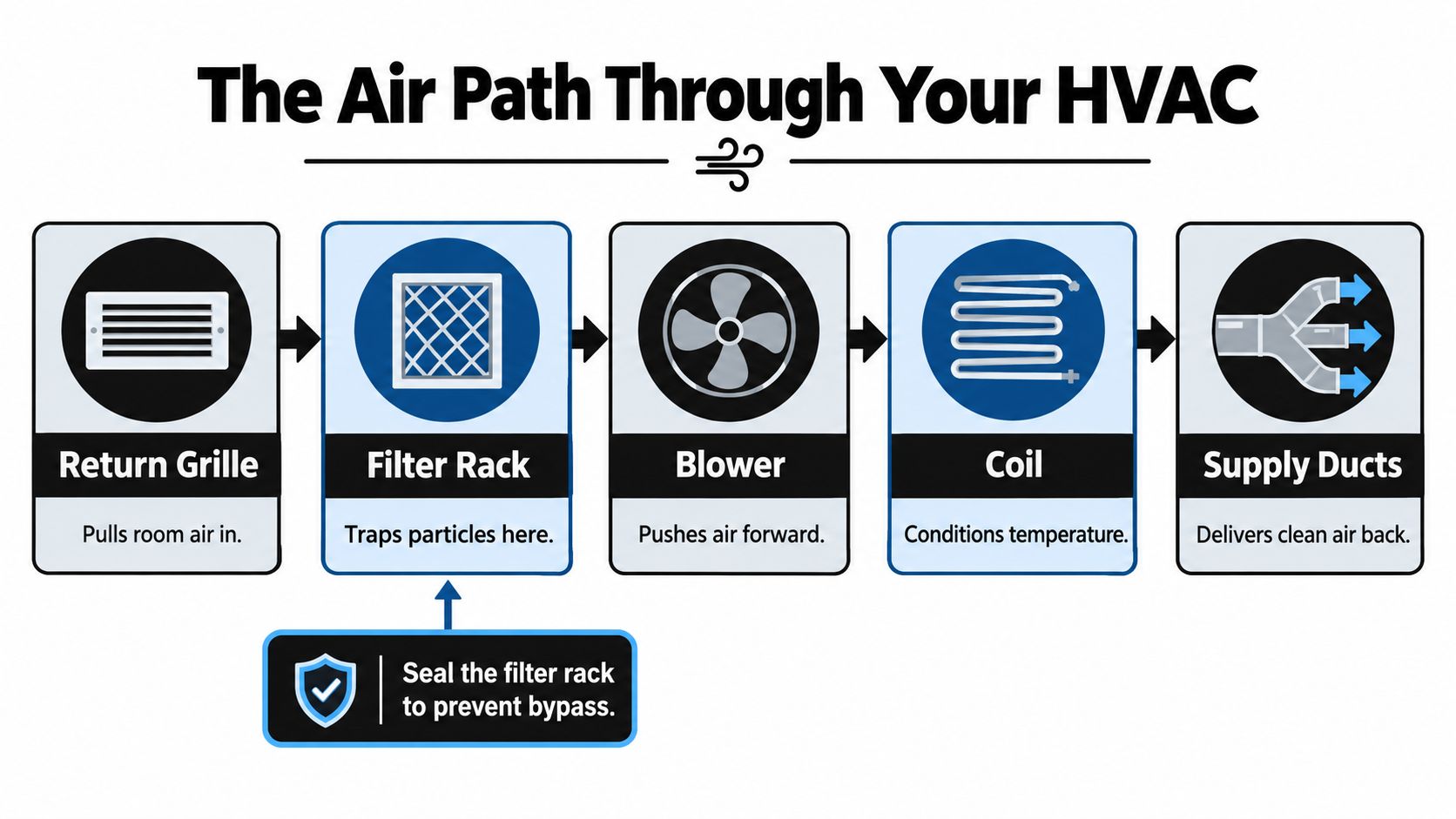
A filter has to let enough air pass through it for the HVAC system to deliver conditioned air. Higher-efficiency media can increase resistance, or pressure drop. If the equipment can't handle that resistance, airflow may fall, potentially affecting heating or cooling performance. Filter fit matters too: air that leaks around the edge bypasses the media instead of being filtered.
ASHRAE recommends MERV 13 as a practical minimum for many HVAC systems, with MERV 14 or higher preferred when the equipment can accommodate it. During the COVID-19 pandemic, ASHRAE advised using properly sized MERV 13 filters, or the highest rating an HVAC system could support. ASHRAE's filtration guidance emphasizes the need to account for equipment capacity and bypass leakage.
Choose the highest rating your system can support, not the highest rating on the shelf. Have a qualified technician check static pressure and airflow rather than guessing from the filter label.
A well-fitted, compatible filter can perform more usefully in practice than a higher-rated filter that restricts airflow or leaves gaps. For a plain-language overview of how to interpret labels and choose a filter, see this guide to MERV ratings and home filter selection.
Comparing HEPA, Activated Carbon, and ActivePure
Product pages often put different filtration technologies side by side, even though they don't all target the same problem. HEPA is a particle filter. Activated carbon is used to adsorb certain gases and odors. Active technologies are marketed for treatment within the airstream or on surfaces. Those differences matter more than a broad promise to “clean the air.”
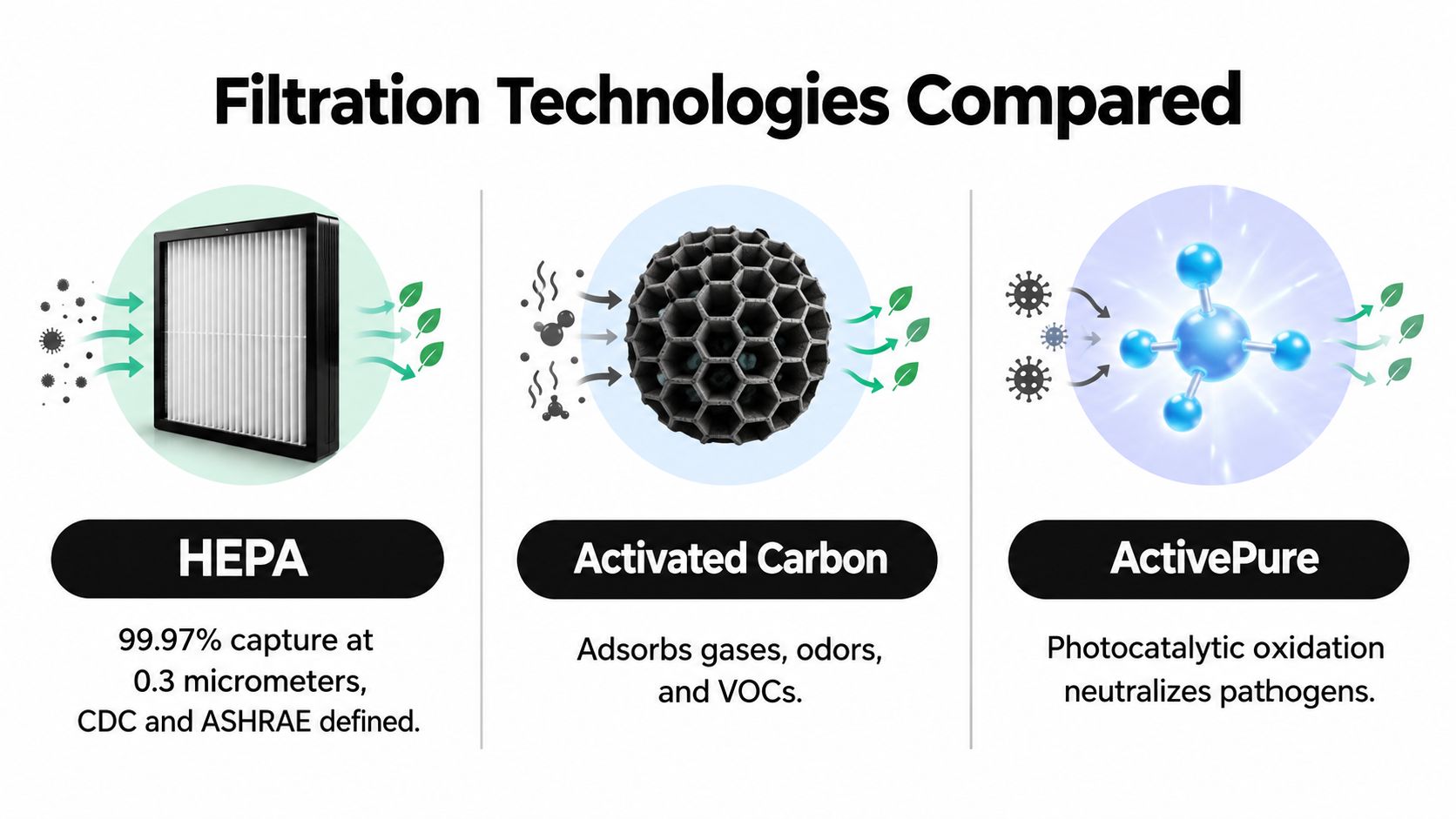
A HEPA filter is defined by its capture performance at a particular test particle size. CDC guidance specifies at least 99.97% capture of particles measuring 0.3 micrometers, and the CDC discusses this standard in healthcare environmental controls. The 0.3-micrometer size is a testing reference, not proof that larger or smaller particles pass through more easily. Filtration involves mechanisms such as interception, impaction, and diffusion, and real-world results still depend on airflow and a good seal. CDC ventilation guidance distinguishes HEPA from MERV filters and notes that HEPA filters are more efficient at filtering human-generated infectious particles than MERV 16 filters.
Activated carbon addresses a different category. It can adsorb certain gases, odors, and volatile organic compounds, while ordinary particle filters don't automatically remove gases. Performance depends on the material and amount of carbon and on how air moves through the unit, so check product specifications rather than assuming all carbon filters do the same job.
ActivePure is an active air-treatment technology used in some in-duct and portable products. The publisher, Purified Air Duct Cleaning, installs ActivePure systems; if you're evaluating any active technology, look for clear information about its mechanism, testing, and what it has been shown to address. Don't treat marketing language as a substitute for understanding which contaminants a device targets. For an overview of whole-home options, this resource on air purification systems offers another point of comparison.
A layered approach may make sense when a building has multiple concerns: mechanical filtration for particles, carbon media for certain gases or odors, and an additional technology only when its purpose and supporting evidence are clear. Each layer adds equipment, maintenance, and potential cost, so match the combination to the problem rather than buying every feature.
How Filtration Integrates With Your HVAC System
In a central HVAC system, room air returns through a grille, passes through a filter rack, moves across the blower and conditioning coil, then travels through supply ducts back to the rooms. The filter's position and fit determine whether the air passes through the media. A gap around the filter can let untreated air bypass it.
Static pressure is the resistance the blower works against as it moves air through the system. A filter that's too restrictive, clogged, or incorrectly sized can raise that resistance and reduce airflow. Homeowners may notice weak heating or cooling; restricted airflow can also contribute to equipment problems. Don't assume a higher MERV caused a symptom without checking the system, because other maintenance or equipment issues can produce similar signs.
Check the system before upgrading
Confirm that the replacement filter matches the rack dimensions and sits securely. Ask a qualified HVAC professional to evaluate available static-pressure capacity, blower operation, and airflow before moving to a more restrictive filter. After installation, monitor the system for changes in comfort and operation.
Ductwork and coils also affect the overall picture. Dust and debris in the system can become reservoirs that need attention, while dirty coils can interfere with heat transfer. Cleaning isn't a substitute for filtration or source control, but inspection can reveal maintenance issues that a filter upgrade won't fix. If you're weighing an in-duct option, this overview of whole-house air purifier installation can help frame the system-level discussion.
A portable air cleaner works differently: it cleans air in the room where it operates rather than relying on central ductwork to circulate air through a filter. For a single bedroom or office, that may be a practical complement to HVAC filtration. For whole-home coverage, the central system can distribute cleaner air through its ducts, provided the filter and equipment are properly matched.
Performance Metrics That Actually Matter
A filter's efficiency describes how well it captures particles under test conditions. It doesn't, by itself, tell you how much clean air reaches the room. For portable air cleaners, Clean Air Delivery Rate (CADR) combines particle-removal efficiency with airflow, making it a useful way to compare room units.
The EPA's sizing table lists minimum CADRs of 65, 130, 195, 260, 325, and 390 cubic feet per minute for rooms of 100, 200, 300, 400, 500, and 600 square feet, respectively. That works out to roughly 0.65 CFM per square foot under the table's assumptions. See the EPA guide to choosing an air cleaner for your home for the sizing approach.
Room area | EPA table minimum CADR |
|---|---|
100 sq ft | 65 CFM |
200 sq ft | 130 CFM |
300 sq ft | 195 CFM |
400 sq ft | 260 CFM |
500 sq ft | 325 CFM |
600 sq ft | 390 CFM |
For example, a 300-square-foot bedroom corresponds to a minimum CADR of 195 CFM in that table. A separate smoke-sizing rule recommends a smoke CADR of at least two-thirds of the room's floor area. That means a 300-square-foot room calls for a smoke CADR of at least 200. The smoke CADR guidance is especially useful when comparing performance for small particles.
Account for airflow and the room itself
A high-efficiency filter in a low-airflow unit may deliver less clean air than a less restrictive filter paired with stronger airflow. CADR makes that trade-off easier to see because it accounts for both particle removal and the volume of air processed. A unit's setting matters too: if noise leads you to run it at a low setting, consider the CADR at that setting rather than relying only on the maximum rating.
Room dimensions are a starting point, not the full story. Higher ceilings mean more air in the space, so a room with a tall ceiling may need more capacity than its floor area suggests. Operate the cleaner continuously when practical, or at a higher setting during a pollution event. If you want to observe changes in particles, an indoor air quality monitor can provide context, though it doesn't replace sizing and source control. This guide to an indoor air quality meter can help you understand what such a device may tell you.
Choosing Filtration for Homes vs Commercial Spaces
The same principles apply in a home and a commercial building, but the operating conditions differ. At home, people often focus on pollen, pet dander, dust, or wildfire smoke, and may need a quiet unit for a bedroom. A portable cleaner can target one occupied room; central HVAC filtration can serve multiple rooms when the equipment supports the filter and air circulates through the system.
A practical home decision starts with the affected space. If one bedroom is the main concern, size a portable unit to that room and consider how often it will run. If the concern is more widespread, assess central filtration and the HVAC system's ability to move air. For smoke, use the CADR sizing guidance rather than choosing by filter label alone.
Commercial operators have additional constraints. Occupancy patterns, ventilation requirements, equipment capacity, tenant comfort, and after-hours schedules all affect whether a proposed filtration change will work in practice. A large unit that's switched off because it's noisy, or a filter that restricts system airflow, won't meet the intended need. Facility managers should coordinate filter selection with HVAC professionals and applicable building requirements. This overview of commercial indoor air quality may help operators frame those considerations.
Match the equipment to the duty
Real estate agents preparing a property for sale may value visible maintenance, including clean vents and well-kept HVAC equipment, but filtration shouldn't be presented as proof that every indoor air concern has been solved. A portable cleaner, an HVAC filter upgrade, and an in-duct treatment each serve different purposes. Choose based on the room, operating schedule, source of the problem, and what the system can support, not on what another property uses.
Maintenance and Honest Limits of Filtration
A new filter is only the start of a maintenance plan. Follow the equipment manufacturer's replacement guidance and inspect the filter regularly. A clogged filter can restrict airflow, while a poorly seated one can let air bypass the media.
Use this checklist to keep the system on track:
Replace or clean filters: Follow the filter and HVAC manufacturer's instructions, and check sooner if the filter appears loaded.
Clean return grilles: Remove visible dust so buildup doesn't obstruct airflow.
Inspect coils and ducts: Address accumulated debris or maintenance problems when an inspection shows they warrant attention.
Maintain the dryer vent: Remove lint and keep the exhaust path clear. Underwriters Laboratories reports approximately 15,600 structure fires, 400 injuries, and 15 deaths annually from clothes-dryer fires, and identifies failure to clean as a factor in 33% of those fires. The EPA's air-cleaner and filter guidance is a useful reference for the fire-prevention rationale and dryer-vent maintenance context.
Plan recurring service: A documented preventive maintenance schedule can help households and facility teams keep inspections from slipping.
Filtration also has honest limits. Portable and HVAC particle filters don't automatically control carbon monoxide, radon, excess humidity, or every volatile organic compound. HEPA and other particle filters can reduce particles, but they don't remove every gas or resolve a moisture source such as a leak. Odors may also remain if the source continues.
The EPA cautions that air cleaners alone can't ensure adequate indoor air quality when pollutant sources remain or ventilation is insufficient. Reduce or remove the source where possible, address moisture and combustion issues, and provide clean-air ventilation as appropriate. For businesses coordinating this work with other facility tasks, a commercial cleaning routine for local businesses can help make recurring care easier to organize.
A filter works best when the source is controlled, the air can move through the system, and maintenance keeps the equipment operating as intended.
Purified Air Duct Cleaning provides residential and commercial air duct, dryer vent, and HVAC coil cleaning, along with installation of in-duct and portable ActivePure systems across the Phoenix metropolitan area. If you're weighing filtration options or planning system maintenance, visit Purified Air Duct Cleaning to discuss a practical next step for your home or facility.