

Indoor Air Quality System: A Guide for Phoenix Homes
On a dusty Phoenix afternoon, the windows may show a fine film of desert grit while the air conditioner cycles hard and the return grille pulls in whatever has entered through doors, leaks, and daily activity. The home can feel cool while the air remains loaded with particles, odors, pollen, or combustion by-products.
An indoor air quality system isn't one magic appliance. It's a coordinated approach that combines filtration, ventilation, air cleaning, source control, monitoring, and maintenance. The right combination depends on the property, the ductwork, the equipment, occupancy, and the pollutants you're trying to control.
What an Indoor Air Quality System Actually Does
A homeowner often starts with a simple complaint: dust returns soon after cleaning, bedrooms feel stuffy, or allergies worsen when the monsoon brings pollen and outdoor debris. In Phoenix, the source may be a loaded filter, a leaky return duct, open doors during a dust event, or an air conditioner that recirculates indoor air without enough outdoor-air exchange.
The U.S. Department of Energy notes that indoor pollutant concentrations can be two to five times higher than outdoor concentrations, which makes controlled ventilation and pollutant removal central to building performance, as described in this ASHRAE position document on indoor air quality. That doesn't mean every home needs the same equipment. It means the system should address the actual pathway by which contaminants enter, accumulate, or spread.
Four jobs, not one device
A useful indoor air quality system performs four distinct jobs:
Particle removal: Filters capture dust, pollen, fibers, and other particles moving through the HVAC system.
Dilution: Ventilation brings in cleaner outdoor air and exhausts stale indoor air, provided outdoor conditions and equipment design support that strategy.
Biological control: Certain air-cleaning technologies target airborne biological contaminants or contaminants on equipment surfaces, but performance depends on installation, airflow, contact, and verification.
Moisture and by-product management: The system must avoid creating excess moisture, ozone, or other unwanted compounds while keeping coils, drain pans, filters, and ducts serviceable.
Source control comes before equipment. Fixing a return-air leak, stopping smoke at its source, correcting a moisture problem, or sealing a dusty attic pathway can outperform adding another device to a compromised system.
A practical indoor air quality service overview should therefore begin with inspection. Check the filter rack, duct connections, blower condition, coil, outdoor-air intake, exhaust pathways, and the rooms where occupants spend time. A purifier can't compensate for a filter slot that bypasses air or a return duct that pulls contaminated air from an attic.
The Four Main Types of Indoor Air Quality Systems
Phoenix homeowners usually encounter four categories. They can work separately, but they solve different problems and shouldn't be treated as interchangeable.
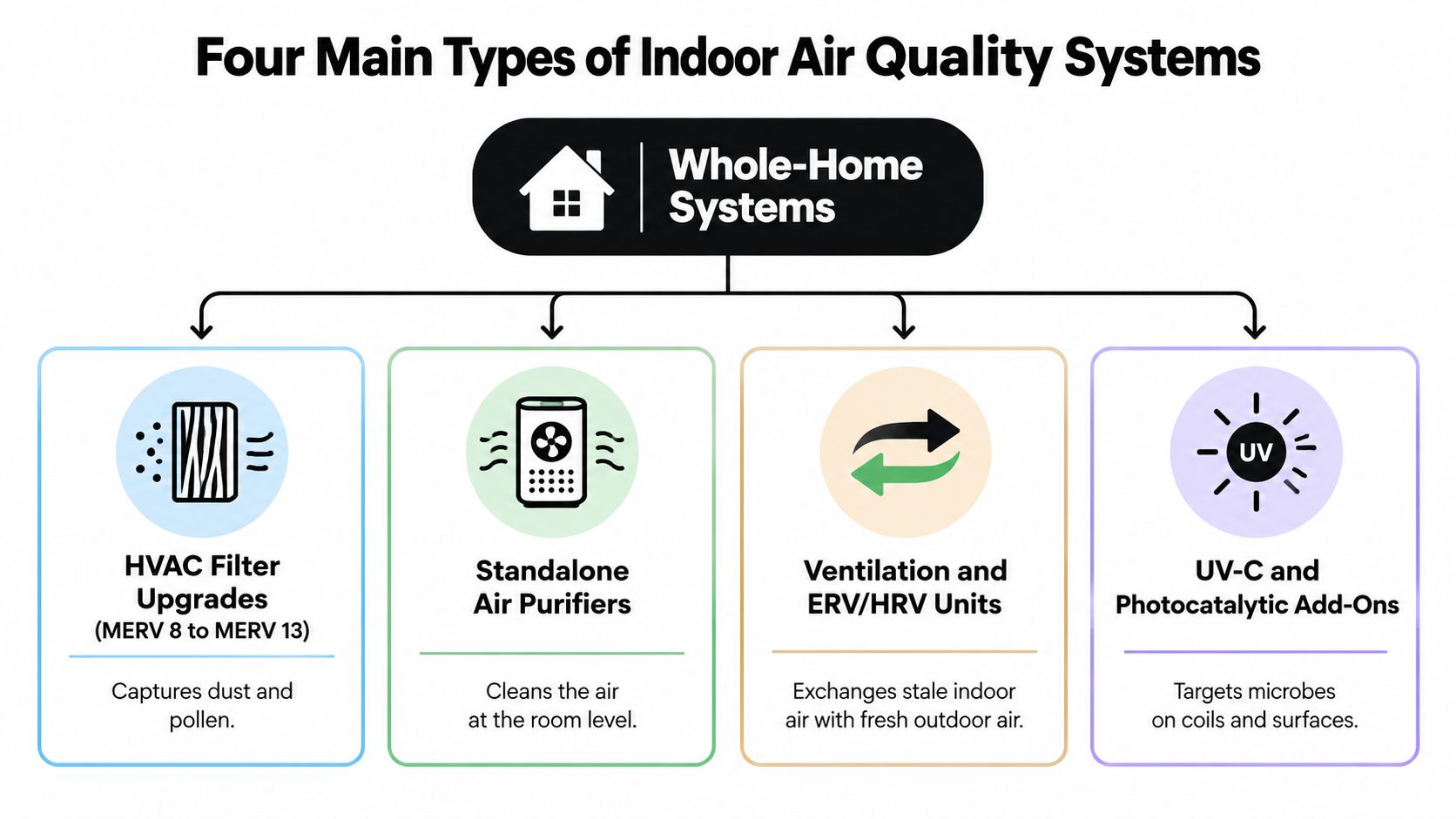
HVAC filter upgrades
A filter is the first mechanical barrier in a forced-air system. Many homes use a basic filter that protects the equipment but offers limited particle capture. Moving from MERV 8 toward MERV 13 can improve capture, but only if the blower, filter rack, and duct system can handle the added resistance.
ASHRAE states that MERV 13 filters remove at least 85% of particles in the 1 to 3 micrometer range, a key performance category for general HVAC filtration, according to its filtration and disinfection guidance. That rating describes tested particle capture, not total contaminant removal from a home. A poorly sealed filter slot can let air bypass the media, and an undersized filter can restrict airflow.
In-duct purifiers
An in-duct purifier installs in the return or supply side of the central HVAC system. The location matters because it determines which air passes through the device and how consistently the equipment operates. Some systems use additional filtration, some use light-based technologies, and others use active-air processes.
They're suited to whole-home circulation, but they depend on the HVAC fan schedule. If the fan runs only during heating or cooling calls, the purifier won't treat air in rooms that aren't being circulated.
Portable air cleaners
A portable unit cleans air in one occupied room. It can be useful in a bedroom, nursery, home office, or other space where a central system doesn't provide enough circulation. Look for a published clean-air delivery rate, place the unit where airflow isn't blocked, and size it for the room rather than choosing by appearance.
Portable equipment often wins when the problem is concentrated in one room or when a rental property doesn't permit HVAC modifications. It won't correct dirty ducts, an unsealed return, or contaminants generated elsewhere in the house.
ActivePure® active-air technology
ActivePure® systems are installed in or near the HVAC airflow and are designed to work through active-air treatment rather than relying only on a passive filter. The practical question isn't whether a technology sounds advanced. Ask where it will be installed, how it operates with the blower, what by-products are measured, and what maintenance the equipment requires.
For homeowners comparing room-based and whole-home approaches, this residential air purification systems guide can help frame the choice. A related issue is visible dust on glass and screens. If exterior grime is affecting your view, professional spotless windows for Colorado Springs homes is a separate maintenance service, not a substitute for indoor filtration.
The layering principle is simple: filtration captures particles, ventilation dilutes contaminants, room units add targeted capacity, and active technologies address additional treatment goals. No single label proves that the occupied rooms receive the required clean airflow.
Comparing Filters, In-Duct Purifiers, Portable Units, and ActivePure
Product selection gets easier when you compare systems by operating reality rather than by the most dramatic marketing phrase. A filter may offer strong particle capture but no ventilation. A portable cleaner may perform well in a bedroom but do nothing for a dusty return duct. An in-duct purifier may cover more rooms but only when the HVAC fan moves air.
System Type | Best For | Maintenance | Coverage | Approx. Cost |
|---|---|---|---|---|
HVAC filter upgrade | Dust, pollen, and particles moving through central HVAC | Inspect loading, replace as needed, verify airflow and sealing | Whole home when the HVAC system operates | Varies by filter size, equipment, and installation |
In-duct purifier | Whole-home treatment integrated with central airflow | Device inspection, filter or lamp service where applicable, airflow checks | Whole home or served HVAC zones | Varies by technology, access, and installation |
Portable air cleaner | A bedroom, office, or other occupied room | Filter replacement and intake cleaning | One room or nearby area | Varies by CADR, controls, and filter design |
ActivePure® system | Active-air treatment paired with HVAC circulation | Device inspection, operating verification, and scheduled service | Whole home or selected HVAC zones | Varies by system type and installation |
The best first purchase for a dusty home is often not the most complex device. Start by checking the filter fit, return leaks, duct cleanliness, blower wheel, and coil. A premium purifier installed downstream of a leaking return can leave the actual problem untouched.
A portable cleaner wins when one room needs more capacity than the central system provides. An in-duct device wins when the HVAC layout is sound and the occupants want treatment across connected zones. Layering can outperform choosing one category in isolation, but every added component introduces maintenance, pressure-drop, noise, energy, or by-product questions.
Practical rule: Choose the system that delivers verified clean airflow where people sit and sleep, not the system with the longest feature list.
Phoenix homes also face seasonal swings. Dust loading can rise after wind events, while monsoon conditions can carry pollen and biological material indoors. If the return side is dusty or the filter loads quickly, are in-duct air purifiers worth it depends on correcting those fundamentals first.
Equivalent Clean Airflow and the 5 ACH Target
The useful performance question is not “What percentage does this device remove?” It's “How much clean air reaches the occupied room?”
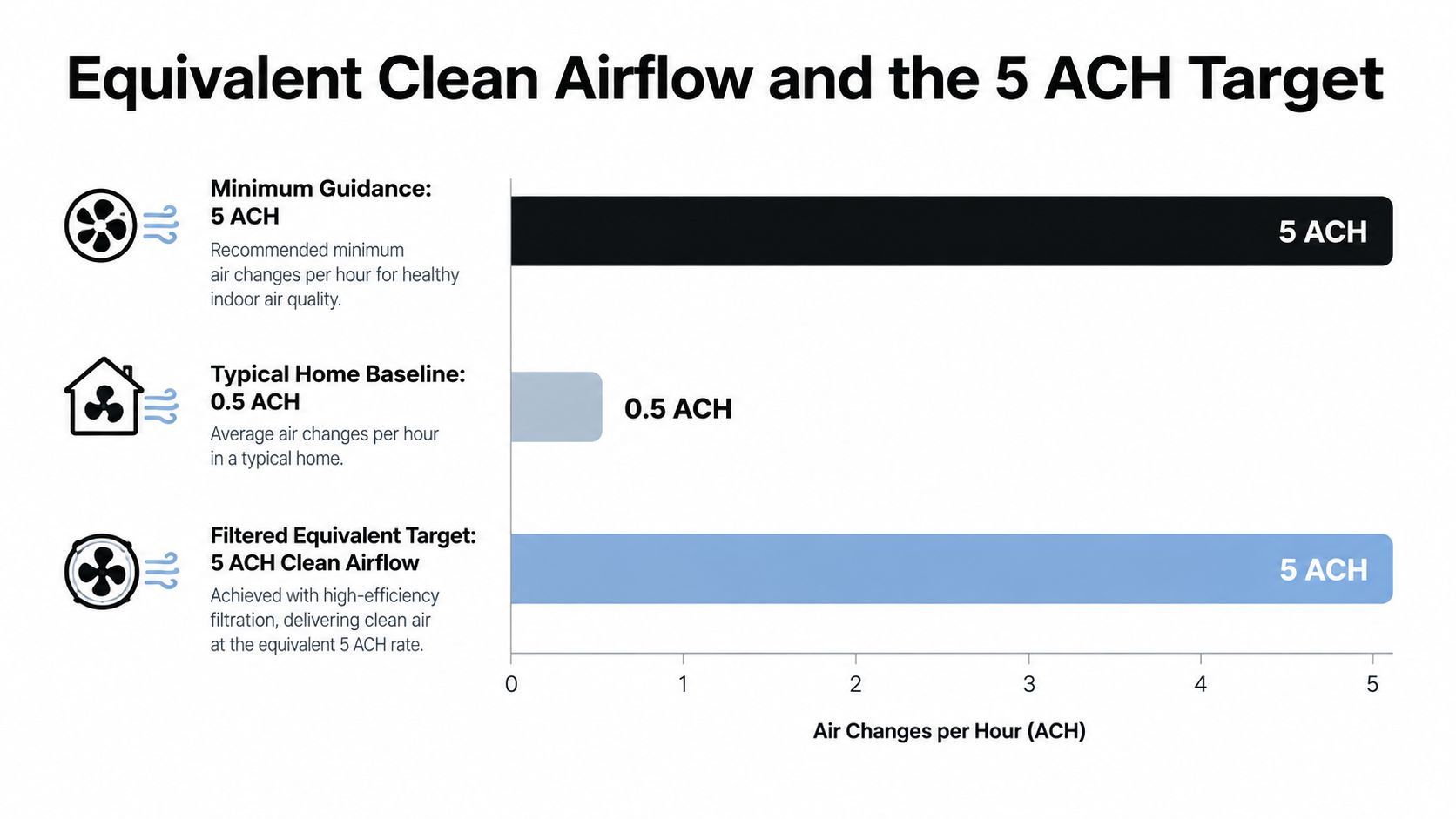
Equivalent clean airflow combines outdoor-air ventilation, HVAC filtration, and portable air-cleaner capacity. Current public-health guidance recommends at least 5 clean-air changes per hour, or 30 CFM per occupant, whichever is greater, using those combined sources, according to California Department of Public Health ventilation guidance.
Do the room calculation
ACH is calculated as:
Clean airflow × 60 ÷ room volume = ACH
For a 1,000-square-foot room with an 8-foot ceiling, the volume is 8,000 cubic feet. Reaching 5 ACH requires approximately 667 CFM of equivalent clean airflow, using the same public-health guidance.
That 667 CFM doesn't have to come from one appliance. A designer may combine outdoor-air delivery, filtered HVAC recirculation, and portable air-cleaner capacity. The calculation only works if the airflow figures reflect actual operation and the filtration efficiency is accounted for. A fan's advertised airflow isn't automatically equivalent clean airflow.
Why occupancy changes the answer
The alternative benchmark is 30 CFM per occupant. A large open-concept room may meet a room-volume target while falling short of the per-person target during a gathering. Holiday visitors, a crowded family room, or a busy home office can increase contaminant generation without increasing fan operation or outdoor-air exchange.
Check the equipment's CADR, confirm the HVAC fan schedule, measure or verify ventilation airflow, and consider whether doors, furniture, and closed bedroom doors interrupt distribution. A guide to air exchange rates is useful for understanding why the number on a product carton isn't the same as delivery throughout a home.
Phoenix adds an energy trade-off. Bringing in more outdoor air during extreme heat can increase cooling demand, while relying only on recirculation leaves dilution limited. The practical design balances clean airflow, equipment capacity, filtration resistance, comfort, and operating cost.
The Honest Truth About Germ-Killing Claims and By-Products
A high pathogen-removal percentage doesn't automatically identify the safest or most effective indoor air quality system. Laboratory chambers can produce controlled contact conditions that don't exist in a furnished home with uneven airflow, open doors, variable fan schedules, and changing occupancy.
EPA states that ozone concentrations within public-health standards have little potential to remove indoor contaminants and don't effectively remove viruses, bacteria, or mold. Ozone can also react with chemicals to create harmful by-products, as explained in the EPA guidance on ozone generators sold as air cleaners.
Ask for operating evidence
Before approving a system, ask the installer to document:
Clean-air delivery: What airflow reaches the room, and how was it measured?
Filter pressure drop: Will the filter restrict the blower or reduce delivered airflow?
Ventilation rate: How much outdoor air enters during occupied operation?
Sensor placement: Is the monitor near a return, supply grille, window, or pollution source that could distort readings?
Independent testing: Were results measured in a chamber, on a surface, or in an occupied building?
Maintenance records: Who checks loading, seals, lamps, cells, sensors, and operating schedules?
A device can work in a controlled test and still underperform in a Phoenix home if the fan rarely runs or the supply air doesn't reach the occupied zone. Conversely, a modest filtration upgrade can provide dependable value when it remains sealed, compatible, and continuously used.
If someone proposes an ozone treatment, ask what is being treated, whether people and pets must leave, how residual ozone is verified, and how by-products are addressed. The phrase ozone shock treatment shouldn't replace a clear exposure-control plan.
Choosing the Right System for Phoenix-Area Properties
Start with the building, not the product brochure. A technician should inspect the return path, filter rack, supply and return ducts, blower, coil, drain pan, outdoor-air intake, and room distribution before recommending equipment. Dusty or leaky ductwork can undermine an otherwise well-rated system.
Phoenix conditions create several distinct loads:
Desert dust: Wind events and construction can load filters quickly and expose leaks that remain unnoticed during calmer weather.
Monsoon pollen: Outdoor particles can enter through doors, windows, return leaks, and ventilation paths.
Wildfire smoke: Fine particles require filtration and monitoring, while outdoor-air decisions may need to change during smoke events.
Hard-water minerals: Mineral deposits can affect coils, drain components, and maintenance access where water systems or evaporative equipment are present.
Dryer-vent restriction: Lint and restricted airflow create a household fire concern, separate from general HVAC cleanliness.
WHO reports that poorly ventilated dwellings can reach indoor fine-particle levels 100 times higher than acceptable levels. WHO guideline values for PM2.5 are 5 micrograms per cubic meter as an annual mean and 15 micrograms per cubic meter as a 24-hour mean, according to its air-pollution guidance. A general “air quality score” can't replace pollutant-specific monitoring.
Match the approach to the property
For a single-family Avondale home, correct return leaks, verify filter compatibility, inspect the coil and blower, then consider an in-duct or portable system based on room coverage and occupancy. Put a portable cleaner in a bedroom if that room needs additional clean-air capacity.
For a small Phoenix business, map occupied zones, check outdoor-air delivery, review filter pressure drop, and place monitors where people work. A central solution may be appropriate, but meeting-room occupancy and intermittent fan schedules can create local exposure differences.
For a multi-unit commercial facility, use zone-by-zone evaluation. One whole-building reading can hide a poorly served room, a loaded filter, or uneven airflow. Document maintenance, operating schedules, sensor locations, and post-installation results so the system can be verified rather than assumed.
Maintenance Habits That Keep Your System Working
EPA commonly describes filter replacement at 60 to 90 days, but dusty conditions, wildfire smoke, construction, pets, and high occupancy can shorten that interval, as explained in its guide to air cleaners in the home. Inspect the filter's actual loading instead of following the calendar blindly, and confirm that a denser filter hasn't reduced airflow.
Dryer maintenance belongs on the same safety list. NFPA estimated an average of 15,970 home structure fires involving clothes dryers or washing machines each year during 2010 through 2014, with clothes dryers accounting for 92% of those fires, according to its research on home fires involving dryers and washing machines. Lint accumulation and restricted vent airflow aren't merely housekeeping concerns.
Within 30 days: Inspect the HVAC filter, return grilles, dryer vent, and visible duct connections.
Within 60 days: Verify airflow, clean accessible components, and review monitor placement and readings.
Within 90 days: Reassess filter loading, schedule professional service if needed, and document any purifier maintenance.
Moisture control matters in every climate. For broader household prevention ideas, this resource on how to prevent mould in Dublin bathrooms illustrates the same practical principle: control moisture at its source instead of relying on cleaning after growth appears. Pairing professional duct cleaning with an ActivePure® installation can provide a layered approach when the equipment, airflow, and maintenance plan are properly verified.
Purified Air Duct Cleaning provides duct cleaning, dryer-vent cleaning, HVAC coil cleaning, and in-duct or portable ActivePure® installation for Phoenix-area homes and commercial properties. Visit Purified Air Duct Cleaning to request a quote and schedule an inspection focused on duct condition, clean airflow, filtration, and equipment compatibility.