

Indoor Air Quality Explained: A Practical Guide for 2026
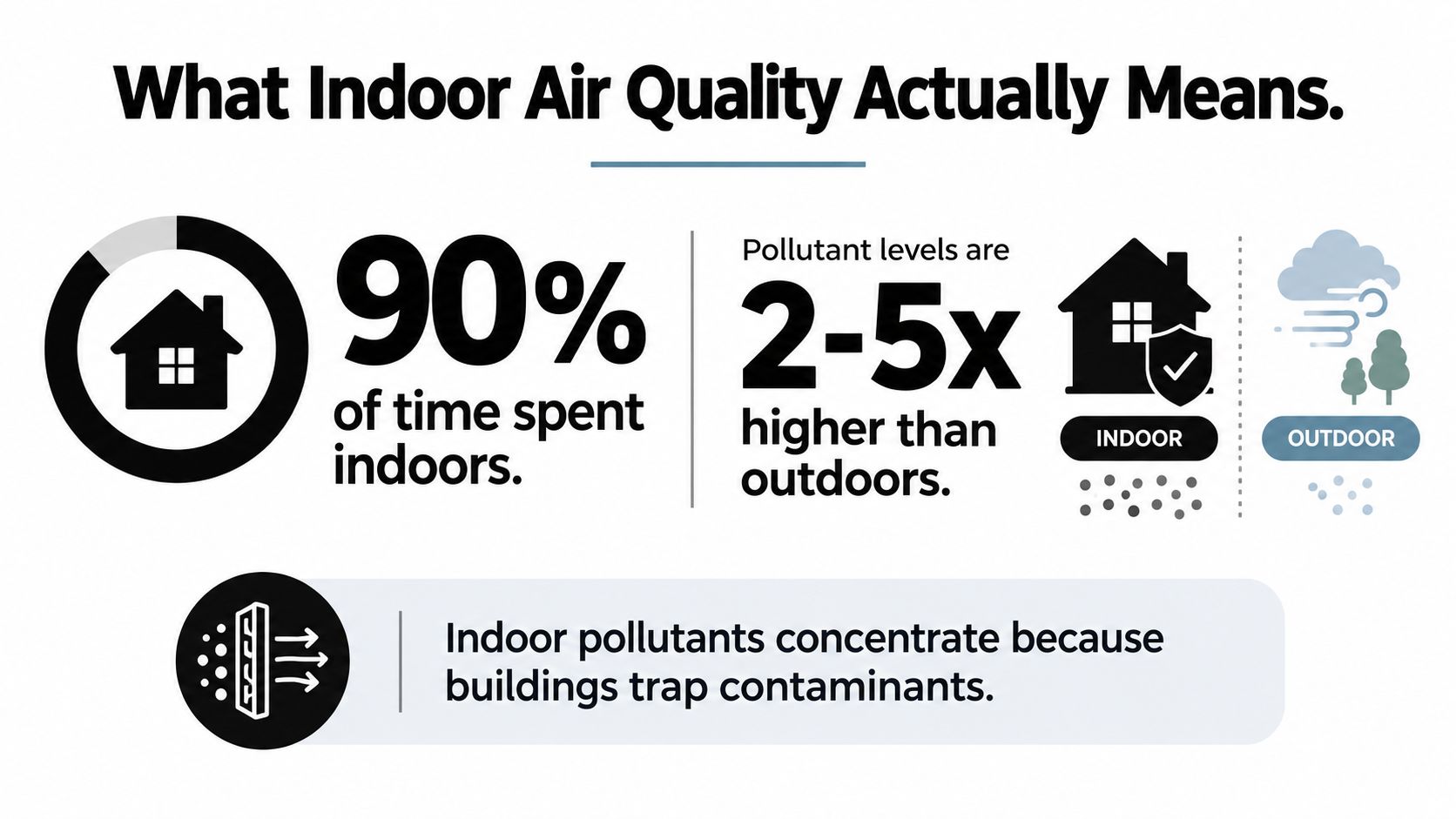
Americans spend about 90% of their time indoors, and indoor pollutant concentrations are often 2 to 5 times higher than outdoor levels. In some situations, indoor concentrations have reached 10 times outdoor levels, according to U.S. Environmental Protection Agency information on indoor air quality. The air inside a home, office, school, or shop isn't automatically safer because it feels comfortable.
Indoor air quality is a public-health gap because many people recognize that polluted air can be harmful, yet still don't know which problems they can control, which measurements matter, or when a filter, cleaning service, or air-cleaning device is appropriate. This guide translates the technical ideas into practical decisions for homeowners and facility managers, from source control and ventilation to MERV-rated filtration, duct and coil hygiene, humidity management, and the possible by-products of some purification technologies.
What Indoor Air Quality Actually Means
Indoor air quality, or IAQ, describes the condition of the air people breathe inside a building. A comfortable temperature or fresh smell does not establish that the air is clean. IAQ asks what is suspended, dissolved, or circulating while people live and work in the space.
The main categories are particles, including dust and combustion aerosols; biological material, including pollen, pet dander, mold spores, and microorganisms; gases and volatile organic compounds, released by products and building materials; and moisture, which affects whether biological growth can develop. Outdoor pollution can enter through doors, windows, ventilation intakes, and leaks in the building envelope.
Comfort isn't the same as clean air
A room may feel cool and odor-free while containing fine particles, high carbon dioxide levels from limited outdoor-air exchange, or gases released by furnishings and cleaning products. A strong smell also cannot measure a contaminant's risk. Odor is a clue, not a complete IAQ test.
A building works like a container with inputs, processes, and outputs. People, pets, cooking, materials, and combustion appliances add pollutants. Ventilation and exhaust remove or dilute them. Filters capture some particles, while moisture control limits conditions that support mold and other biological growth.
EPA guidance on mold and moisture supports keeping indoor relative humidity between 30% and 50%. This range limits conditions that favor mold, dust mites, and cockroaches, which can worsen respiratory symptoms. Bathrooms, kitchens, and other moisture-producing areas should exhaust outdoors instead of sending humid air into adjacent rooms.
The public-health gap often comes from unused control options. Source control removes or reduces pollutants at their origin. Measured ventilation helps bring in outdoor air without assuming that more airflow is always better. MERV-rated filtration captures particles when the HVAC system can support the filter's resistance, while clean ducts, coils, and registers help the equipment move treated air as intended. Air-cleaning devices also require scrutiny because some technologies can create unwanted by-products. Removing one pollutant does not justify introducing another.
The practical questions matter most
Good IAQ management begins with four questions:
What is entering the air? Identify cooking emissions, smoke, cleaning chemicals, building materials, outdoor pollution, pets, and moisture.
What is moving through the HVAC system? Check filter condition, airflow, return pathways, coils, supply registers, and exhaust operation.
What can be measured? Particle readings, carbon dioxide trends, humidity, temperature, and professional testing can reveal patterns that smell and comfort do not show.
What is under your control? Start with source removal, then choose measured outdoor-air exchange, filtration, and targeted maintenance.
For a plain-language resource on indoor air quality, readers can connect these concepts with everyday building decisions. This explanation of indoor air quality versus outdoor air adds context before selecting an intervention.
The Pollutants Hiding in Your Indoor Air
Your lungs are a first filter, but they're a biological filter, not a replaceable HVAC cartridge. Every breath brings air across sensitive tissue, so the source, size, and chemical nature of indoor pollutants all matter. A yellow or gray filter can show that particles are moving through a system, but clean-looking equipment doesn't prove that gases, biological material, or fine aerosols are absent.
The EPA identifies indoor pollutant sources that include tobacco smoke, outdoor air, people who shed viruses and bacteria, animals that shed allergens, and damp surfaces or water reservoirs where fungi and bacteria can grow. The following categories make those sources easier to recognize.
Category | Examples | Typical Sources |
|---|---|---|
Particulates | Dust, fine particles, PM2.5, construction debris | Cooking, combustion, outdoor pollution, sanding, renovation, tracked-in soil |
Biological material | Pollen, pet dander, dust mite debris, mold spores | Bedding, carpets, pets, damp areas, soft furnishings, poorly maintained equipment |
Gases and VOCs | Paint vapors, cleaning-product emissions, formaldehyde-containing emissions, odors | Paint, furnishings, new carpet, adhesives, fragrances, solvents, air fresheners |
Combustion products | Carbon monoxide, nitrogen dioxide, smoke, fine combustion particles | Gas stoves, fireplaces, tobacco, candles, attached garages, fuel-burning equipment |
Particles behave like suspended dust
Particles vary in size and composition. Larger dust settles on surfaces, while smaller particles can remain airborne longer and travel through return grilles and supply ducts. Cooking, smoking, fireplaces, renovation work, and outdoor smoke can all add particle loads to a room.
A practical clue is location. If particle readings rise during cooking, source control and local exhaust deserve attention. If readings stay high after the activity ends, filtration, air mixing, or ventilation may be inadequate.
Biological material follows moisture and surfaces
Pollen and pet dander are familiar allergens, but dust mite debris and mold spores often hide in places people don't inspect frequently. Bedding, carpet, curtains, upholstered furniture, crawl spaces, drain pans, and damp mechanical rooms can all contribute to the indoor allergen load.
Moisture changes the problem. The EPA's professional introduction to indoor air pollution lists humidifiers and other water reservoirs as places where fungi and bacteria may grow. A musty odor, condensation, visible water damage, or recurring dampness should prompt investigation of the moisture source, not just the installation of a stronger filter.
Gases don't behave like dust
A particle filter may capture some solid or liquid particles, but it won't automatically remove every gas or VOC. Paint, new carpet, furnishings, adhesives, cleaning products, fragrances, and pesticides can release gases into occupied areas. Opening a window may help when outdoor air is clean, but ventilation needs to be considered carefully during wildfire smoke, heavy traffic pollution, or other outdoor contamination events.
For renovation projects, practical advice on reducing paint-related odors and emissions is available through this guide to paint fume removal. Choosing lower-emission materials and avoiding unnecessary fragrances can reduce the pollutant load before a machine has to deal with it. Households seeking less aggressive cleaning routines may also find a useful example in this non-toxic Dallas maid service.
How Poor Air Quality Affects Your Health
Indoor air problems often appear first as small, repeatable patterns. A child coughs after going to bed. Several office workers develop headaches in the same room. A family notices irritation whenever someone cooks. These clues don't prove a single diagnosis, but they show why the building and the occupant's symptoms need to be considered together.
A child with asthma may react after spending hours around dust mite debris in bedding, carpet, or upholstered furniture. The useful response isn't to blame the child or buy a random purifier. It is to inspect the bedroom, control moisture, clean soft surfaces appropriately, improve particle removal, and discuss persistent symptoms with a healthcare professional.
An office worker who develops afternoon headaches or feels mentally foggy near new workstations may be reacting to poor ventilation, VOC emissions, heat, glare, dehydration, or another cause. New furniture and finishes can release gases, while insufficient outdoor-air exchange allows pollutants and occupant-generated carbon dioxide to accumulate. A building investigation should measure conditions and review recent changes rather than treating every complaint as a temperature problem.
Combustion deserves immediate attention
Gas stoves, fireplaces, attached garages, and other fuel-burning sources can release combustion pollutants. The EPA identifies environmental tobacco smoke and outdoor air among major indoor sources, while household activities and fuel-burning equipment can add further contaminants.
A kitchen exhaust fan that only recirculates air isn't equivalent to an exhaust hood that vents outdoors. Source control means using outdoor-vented exhaust where available, maintaining combustion equipment, keeping vehicles and fuel-powered equipment out of occupied areas, and installing appropriate carbon monoxide alarms according to local safety guidance.
Vulnerable occupants may have less margin
People with asthma, cardiovascular disease, or respiratory illness can be more affected by indoor exposure, particularly when they spend substantial time in enclosed spaces. The EPA identifies radon as a key indoor contaminant and the second leading cause of lung cancer in the United States, which shows why invisible exposure deserves attention even when a home has no odor or visible dust.
Globally, the burden is much larger than many people realize. The World Health Organization's household air pollution fact sheet states that about 2.1 billion people still cooked with open fires or inefficient stoves in 2025-era reporting. It estimates that household air pollution caused 2.9 million deaths in 2021, including more than 309,000 deaths in children under age five, and that about 95 million DALYs were lost that year. The combined effects of ambient and household air pollution are linked to 6.7 million premature deaths annually.
These figures also explain why indoor air quality should be treated as a health issue, not merely a comfort upgrade. Persistent symptoms require medical advice, while building owners and operators should investigate recurring patterns rather than dismissing them as normal occupancy.
Measuring and Filtering the Air You Breathe
Three control levers organize most IAQ decisions: source control, ventilation, and filtration or air cleaning. Source control removes the pollutant before it spreads. Ventilation dilutes and removes contaminants with outdoor air. Filtration captures particles in the air stream, but it can't replace source control or solve every gas and moisture problem.
Start with ventilation
The WHO defines ventilation as intentionally bringing clean air into a space while removing stale air. Buildings use natural, mechanical, or hybrid, also called mixed-mode, ventilation. The important word is clean. Bringing in outdoor air during heavy smoke or high outdoor particle pollution may require treatment before that air enters the occupied space.
For homes, EPA guidance on ventilation describes ASHRAE Standard 62.2-2016 as recommending 0.35 air changes per hour, with no less than 15 cubic feet per minute per person. These figures are design guidance, not a guarantee that every room has acceptable air. Duct leakage, closed doors, blocked grilles, occupancy changes, and poor exhaust design can still create local problems.
A carbon dioxide monitor can help reveal ventilation patterns, especially when readings rise during sleep, meetings, or crowded periods. A PM2.5 monitor can show particle spikes during cooking, cleaning, renovation, or outdoor smoke events. Neither instrument measures every pollutant, so treat readings as clues that guide investigation.
Match the filter to the system
MERV, or Minimum Efficiency Reporting Value, provides a benchmark for particle filtration from 0.3 to 10 microns. According to ASHRAE's explanation of MERV filtration, MERV 13 is at least 85% efficient for particles in the 1 to 3 micron range, while MERV 14 is at least 90% efficient in that range. ASHRAE recommends at least MERV 13 where possible, with MERV 14 preferred in many applications.
MERV Rating | Particles Trapped | What It Catches | Best For |
|---|---|---|---|
MERV 8 | Rated particle range from 0.3 to 10 microns | Common household dust and larger airborne particles | Systems designed for a lower pressure drop |
MERV 11 | Performance depends on the product and test conditions | More fine particles than basic filters, when the system supports the load | A possible middle-ground residential choice |
MERV 13 | At least 85% efficient for 1 to 3 micron particles | Fine particles, many aerosols, and respirable dust in the tested range | Systems verified to handle the pressure drop |
MERV 14 | At least 90% efficient for 1 to 3 micron particles | Greater capture in that tested range | Applications where equipment compatibility is confirmed |
MERV 16 | Must be evaluated from the product specification and HVAC design | High-efficiency particle capture when the system is engineered for it | Specialist or commercial applications, not an automatic upgrade |
Higher filtration can increase pressure drop. Before installing a restrictive filter, verify fan capacity, airflow, coil performance, and filter fit. As a practical starting point, many homeowners can consider a MERV 11 to MERV 13 filter if the equipment manufacturer permits it, while a move to MERV 16 should wait for an HVAC professional to confirm that the blower and system can handle it.
A guide to selecting an indoor air quality meter can help you choose measurements that match the question you're trying to answer.
Choosing the Right Air Cleaning Strategy
No single IAQ product solves every indoor pollutant problem. A source-control fix may outperform a powerful purifier, while a filter upgrade may accomplish little if the filter rack leaks or the blower can't maintain airflow. The right strategy depends on the pollutant, the building, the occupants, and the maintenance capacity.
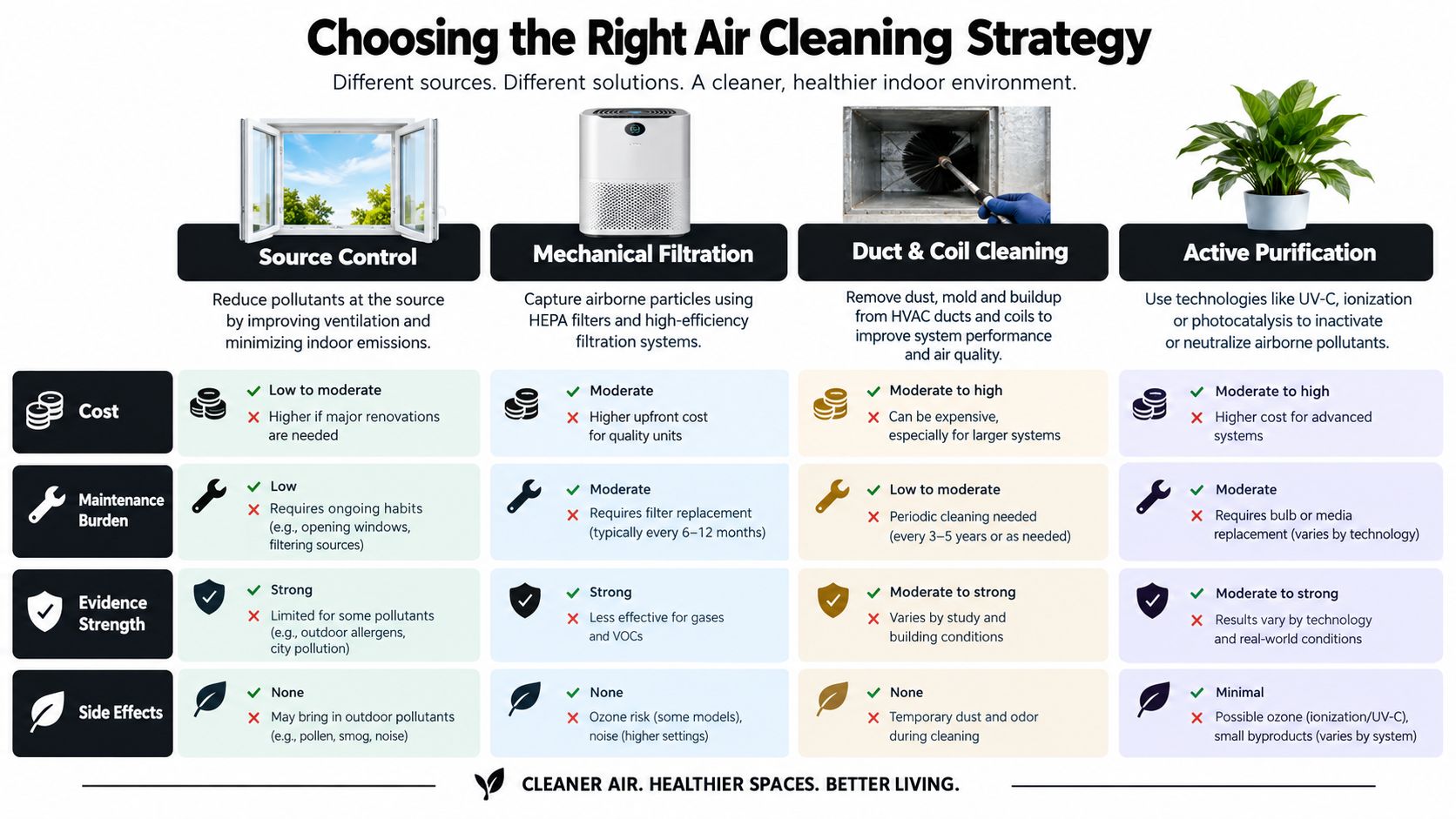
Strategy | Primary job | Maintenance burden | Evidence and limitations | Main tradeoff |
|---|---|---|---|---|
Source control | Remove or reduce pollution where it begins | Usually low to moderate | Often the most direct response to smoke, moisture, or chemical emissions | May require changing habits, materials, or equipment |
Mechanical filtration | Capture particles that pass through the HVAC system | Filter replacement and airflow checks | Performance depends on rating, fit, airflow, and particle size | Higher efficiency can increase pressure drop |
Duct and coil cleaning | Remove accumulated debris from HVAC components | Condition-based professional service | Useful when contamination or restricted components are documented | Cleaning doesn't remove every airborne gas or source |
Active purification | Treat air or surfaces through a device or system | Product-specific inspection and replacement | Requires independent, whole-system performance information | Some technologies may create unintended by-products |
Ask what the device creates
NIST reported in September 2025 that many air cleaners can generate small amounts of air pollution and that, until recently, there wasn't a standard way to measure these negative by-products. That finding changes the buying question. Consumers shouldn't ask only whether a device removes particles. They should also ask whether it has been tested for ozone, formaldehyde, ultrafine particles, or other emissions relevant to its technology.
Ionizers and ozone-generating products deserve particular caution because a device intended to clean air can alter indoor chemistry. Request documentation for by-product testing, follow the manufacturer's operating limits, and avoid assuming that “active” means harmless or universally effective.
Buying question: What does the system remove, what can it produce, and how was whole-system performance measured under realistic indoor conditions?
Place purification alongside the basics
ActivePure is presented by its providers as a continuously operating technology that oxidizes contaminants rather than waiting for particles to pass through a conventional filter. That positioning may make it relevant for people considering in-duct or portable purification, but it doesn't eliminate the need for clean outdoor air, source control, compatible filtration, and moisture management.
Purified Air Duct Cleaning offers residential and commercial duct cleaning, dryer vent cleaning, HVAC coil cleaning, and installation of ActivePure-based purification systems. Those services represent one possible package of interventions, but the decision should still begin with the pollutant source and the equipment's documented performance.
For a practical overview of household device options, review this guide to a home air purifier. Advice on reducing air-quality problems during painting is also available through these air quality tips by Alex Trend Painters.
Watch the following video for a visual explanation of air-cleaning approaches:
Duct, Coil, and Vent Services That Move the Needle
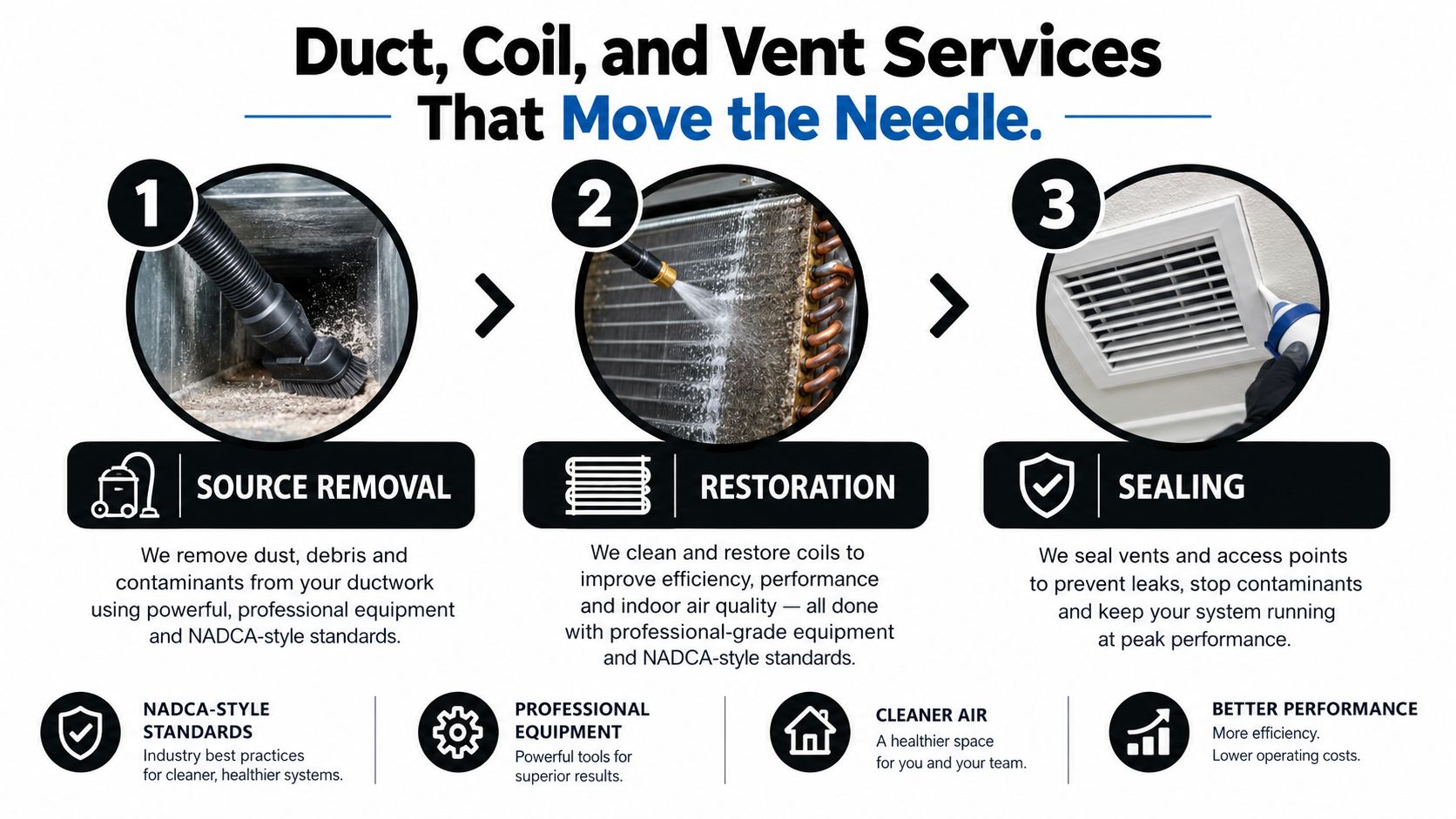
Professional HVAC cleaning is most useful when it addresses a defined mechanical or contamination problem. A technician shouldn't treat every dusty register as proof that the entire duct system needs aggressive cleaning. The inspection should establish where debris is located, whether it can enter occupied air, whether airflow is restricted, and whether moisture or equipment failure is contributing to the condition.
Duct source removal
A qualified technician may use negative-pressure collection equipment, agitation tools, access panels, and controlled vacuuming to remove dust and debris from supply and return pathways. A NADCA-style source-removal approach focuses on collecting loosened material rather than redistributing it through the building.
The technician should protect occupied areas, isolate the work zone, inspect internal surfaces, and document damaged insulation, disconnected sections, or excessive debris. Cleaning won't fix a moisture leak, a poorly fitted filter, or a return-side opening that continues to draw dust from an attic, crawl space, or mechanical room.
Read about professional duct cleaning equipment to understand why equipment selection and containment matter. A basic household vacuum isn't designed to manage the pressure, access, or filtration requirements of a full HVAC system.
Coil restoration and airflow
Evaporator and condenser coils transfer heat. When dust, lint, biological residue, or other buildup coats coil surfaces, the system may struggle to move heat even when the thermostat and refrigerant charge are correct. Cleaning can restore contact between the moving air and the coil surface, but a technician should also check condensate drainage, fin condition, access panels, and airflow.
The outcome to look for isn't a vague promise of “cleaner air.” Ask whether the work addresses restricted airflow, coil contamination, drain-pan moisture, or visible debris. Those are observable conditions that can be documented before and after service.
Dryer vents are a separate safety system
Dryer vent cleaning doesn't clean the home's HVAC ducts. It addresses lint accumulation and airflow in the dryer exhaust pathway. Warning signs include lint around the termination, a musty or overheated laundry area, unusually long drying cycles, or clothing that needs repeated cycles.
Commercial kitchens and laundries need a more structured inspection program because grease, lint, heat, and heavy use can increase the consequences of restricted exhaust. The exact service interval should follow the equipment, operating conditions, building requirements, and technician findings rather than an arbitrary calendar.
For homes, schedule duct, coil, and dryer vent inspections when symptoms or evidence justify them, after renovation or water damage, during property transfer, or as part of a documented preventive-maintenance program. A facility manager should record pressure, airflow, coil condition, filter fit, exhaust performance, and corrective work so the next service starts with evidence.
Your Indoor Air Quality Action Plan
A practical IAQ plan starts with the pollutant most likely to affect the building and the control that reduces it with the fewest unintended effects. The goal is coordinated action, not automatically buying the most expensive machine.
Maintain indoor relative humidity between 30% and 50%, a range supported by EPA guidance for caring for indoor air. Use bathroom and kitchen exhaust fans that discharge outdoors, repair leaks promptly, and inspect places where condensation collects. Moisture control protects occupants and HVAC equipment because damp surfaces can support biological growth.
A homeowner's checklist
Use this sequence during the coming week:
Measure the pattern. Place PM2.5, carbon dioxide, and humidity monitors where people spend time. Record readings during cooking, sleeping, cleaning, and periods when windows or exhaust fans are used.
Remove obvious sources. Stop indoor smoking, control cooking emissions, reduce unnecessary fragrances, store chemicals properly, and address visible water damage.
Inspect the HVAC path. Check that the filter fits tightly, supply registers are open, return grilles are clear, and dust does not appear immediately after cleaning.
Choose compatible filtration. Consider a MERV-rated filter allowed by the HVAC manufacturer. Confirm that added resistance will not reduce blower performance or suitable airflow.
Test for radon where appropriate. Radon has no reliable smell or visual warning. A proper test is more useful than judging air quality by comfort or cleanliness.
Document professional findings. Keep inspection results, photographs, airflow observations, and equipment recommendations when ducts, coils, or dryer vents are serviced.
Replace filters according to the manufacturer's instructions, system loading, household conditions, and equipment manual. A calendar reminder helps, but a heavily loaded filter needs attention sooner. Repeated loading or airflow complaints warrant professional investigation.
A facility manager's checklist
Commercial buildings need a written responsibility chain. Assign someone to review outdoor-air operation, exhaust performance, filter condition, humidity, drain pans, coils, occupant complaints, and renovation activities. Keep ventilation balanced with outdoor conditions. The WHO warns that incoming air may need treatment when outdoor particulate matter is high.
Schedule duct and coil work according to inspection findings, equipment design, contamination risk, and operating intensity. Dryer exhaust, kitchen exhaust, and process ventilation need separate records because their maintenance requirements differ from comfort HVAC.
Priority order: Remove the source, introduce clean outdoor air, capture particles with compatible filtration, then add specialized cleaning or purification when measurements and equipment conditions justify it.
Indoor air quality improves when several modest controls work together. Start with measurement, correct the clearest source, verify airflow, and request documented evidence before approving a service or device.
Purified Air Duct Cleaning can inspect and clean residential or commercial ductwork, dryer vents, and HVAC coils, and discuss ActivePure-based purification within a broader IAQ plan. Visit Purified Air Duct Cleaning to request an evaluation linked to the air-quality conditions in your property.