

Air Duct Cleaning Asthma: Evidence and Smart Decisions
Routine air duct cleaning alone isn't proven to prevent asthma problems or reduce indoor dust levels, while high-efficiency filtration can lower some airborne triggers by 50% or more. Cleaning becomes more defensible when the system has visible mold, pest debris, heavy contamination, or another clear source of exposure.
Could a spotless vent cover make you feel safer without changing the particles that trigger symptoms? That question exposes the central problem with the phrase “air duct cleaning asthma.” Homeowners often ask whether cleaning the ducts will improve asthma, but the more useful question is whether the HVAC system is actively transporting a contaminant, or whether the home needs better filtration and source control.
Asthma triggers can include dust, mold, pet dander, pollen, smoke, and other indoor pollutants. Ductwork can matter, but it isn't automatically the main source. A sound plan starts with inspection, identifies the contaminant, and then matches the remedy to the problem rather than treating every dusty duct as a health emergency.
What Air Duct Cleaning Actually Does for Asthma
Routine air duct cleaning isn't a proven asthma treatment. The U.S. Environmental Protection Agency says duct cleaning has never been shown to prevent health problems, and studies haven't conclusively shown that indoor dust levels rise only because ducts are dirty. The EPA also explains that much of the debris inside ducts adheres to duct surfaces instead of entering occupied rooms, which limits what cleaning alone can reliably accomplish. EPA guidance on whether to clean home air ducts provides the most important baseline for evaluating health claims.
That doesn't mean ductwork is irrelevant. A system with visible mold, pest remnants, substantial construction debris, or contamination caused by a moisture event deserves attention. In those situations, cleaning can be part of a broader remediation plan. The distinction is important: remediation addresses a documented source, while routine cleaning assumes that ordinary settled dust is causing asthma symptoms.
Why clean vents sound more persuasive than they are
The assumption is understandable. HVAC equipment moves air through supply ducts, return ducts, grilles, registers, coils, and blower components. If a technician removes material from those parts, a homeowner may reasonably expect cleaner air and easier breathing. The problem is that visible dust in a duct isn't necessarily airborne, and removing it doesn't automatically remove dust mites, pet dander, moisture, smoke, or other sources elsewhere in the home.
A professional service can remove accumulated material, but its value depends on what was removed, where it came from, and whether the source remains. For example, cleaning a return duct won't solve a leak that draws dusty attic air into the system. Cleaning a vent won't correct mold growing around a plumbing leak. Cleaning supply ducts won't replace an inadequate filter or stop a pet, fireplace, renovation, or damp carpet from generating new particles.
Practical rule: Don't approve cleaning because a salesperson says “dust causes asthma.” Approve it when an inspection shows a plausible contaminant pathway and the provider explains how the work will interrupt it.
For a plain-language explanation of the service itself, see this overview of what air duct cleaning services include. Ask whether the proposed work includes the accessible supply and return paths, registers, air handler components, and post-service verification. A limited vent vacuum may look productive while leaving the actual contamination untouched.
The sensible expectation is modest. Targeted cleaning may remove a contamination source, reduce visible debris, or support HVAC maintenance. It shouldn't be sold as a guaranteed way to reduce asthma symptoms, replace medical care, or improve every home's indoor air.
Why Indoor Air Quality Matters More Than Outdoor Pollution for Asthma
People with asthma spend much of their day inside the home, workplace, school, or vehicle. The EPA reports that people spend about 90% of their time indoors, a figure that helps explain why indoor allergens and irritants can play a significant role in asthma episodes. EPA information about improving the indoor environment puts the exposure question in practical terms: the air inside familiar spaces deserves direct attention.
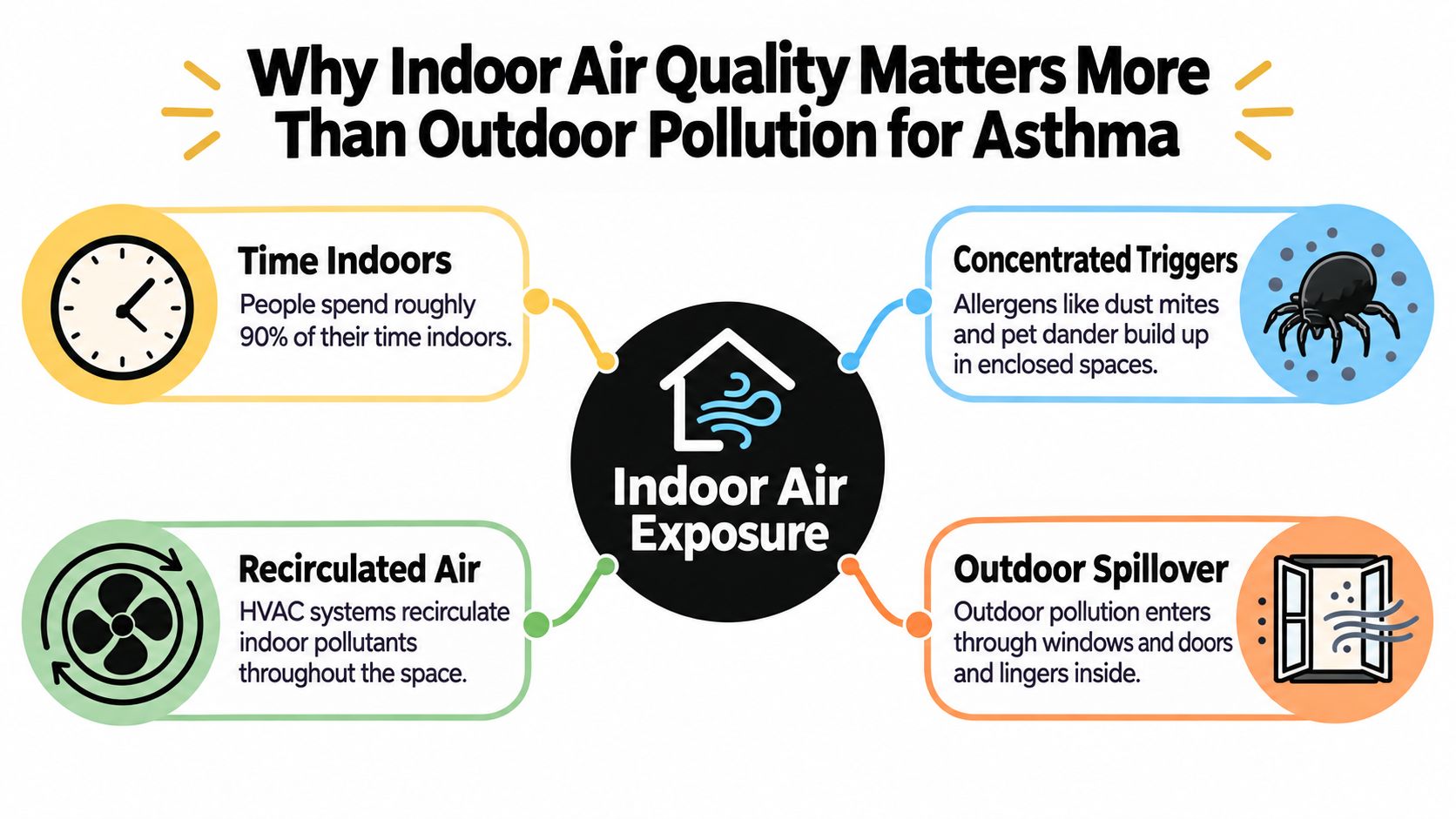
Indoor air tends to collect contributions from many sources at once. Bedding can hold allergens, pets add dander, cooking creates particles, leaks support mold, and smoking introduces irritants. Outdoor pollution still matters, but opening a door or window, tracking particles indoors, and operating a recirculating HVAC system can bring outdoor contaminants into the same enclosed environment where indoor sources are already present.
The HVAC system as a pathway
An HVAC system doesn't create every pollutant it moves. It can, however, redistribute particles when airflow or vibration disturbs material, especially if filters fit poorly, return grilles are loaded with dust, or duct surfaces contain loose contamination. That makes the system one part of an exposure pathway, not proof that the ducts are the original cause.
The distinction helps prioritize work. If a moisture problem is feeding mold, fix the moisture first. If a filter is bypassing air around its frame, correct the fit. If outdoor air enters through a damaged return, seal the leakage. A duct cleaning that leaves those conditions in place may provide only temporary housekeeping benefits.
Moisture deserves particular scrutiny because damp materials can support biological growth. Homeowners investigating crawl spaces, walls, or other moisture barriers may find a useful explanation in this field guide to moisture barriers from Home Pro's Remodeling & Repairs. The goal isn't to treat every moisture concern as a duct problem, but to prevent water and humidity from creating the kind of contamination that makes duct remediation reasonable.
For a broader comparison between the two exposure environments, this guide to indoor air quality versus outdoor air offers useful context. In practice, asthma-focused indoor air work should begin with the rooms where people sleep and spend time, then trace contaminants back to their sources. Ducts belong in that investigation when evidence connects them to distribution.
What Clinical Guidance Says About Duct Cleaning and Asthma Control
Clinical guidance doesn't support routine HVAC duct cleaning as a standard asthma-control measure. The NHLBI and NAEPP expert panel classified duct cleaning as Evidence D, while a Canadian scientific review concluded that available evidence is insufficient to show that cleaning improves asthma symptoms, indoor air quality, or HVAC performance. The clinical guidance is summarized in this NCBI review of environmental control measures for asthma.
Evidence D doesn't mean that every contaminated duct system is harmless. It means the available research doesn't justify a general recommendation that people with asthma should routinely clean ducts to control the disease. That is a very different conclusion from saying that cleaning is never appropriate.
Maintenance is not the same as asthma treatment
HVAC maintenance protects equipment, supports airflow, and can address visible contamination. Asthma management is a medical and environmental process involving trigger identification, prescribed treatment, and reduction of exposure. Those activities can overlap, but one shouldn't be marketed as a substitute for the other.
A homeowner should be cautious when a provider promises symptom relief before inspecting the system. A credible assessment should identify the material, location, likely pathway, and corrective method. If the provider can't show contamination or explain how it reaches occupied space, the case for cleaning is weak.
When targeted cleaning makes sense
Cleaning becomes more reasonable when one or more of these conditions are present:
Visible mold: Mold-like growth inside accessible duct components or on adjacent HVAC surfaces needs professional evaluation, along with investigation of the moisture source.
Pest contamination: Droppings, nesting material, or insect debris indicate a specific sanitation problem rather than ordinary settled dust.
Heavy debris: Construction material, soot, or substantial loose buildup can justify source removal, especially when the system has distributed material into rooms.
A contamination event: Renovation dust, smoke, water intrusion, or a similar event can place unusual loads on the HVAC system.
Damaged components: Deteriorated insulation, disconnected ducts, or return-side leaks may require repair before or alongside cleaning.
The order matters. Find and correct the source before cleaning whenever possible. Otherwise, new contamination can enter the system immediately after service. If mold is present, cleaning without moisture correction is incomplete. If pests remain active, removing old debris won't solve the underlying problem.
The same standard applies after service. Don't judge success by fragrance, a polished vent cover, or a technician's claim that the system is “sanitized.” Look for documented source removal, repaired defects, cleanable components returned to service, and a plan for filtration and follow-up.
Signs Your Duct System May Be Worsening Asthma Symptoms
Most homes have some dust. The practical question is whether the HVAC system contains unusual, visible, or active contamination that can be disturbed and redistributed. Start with the evidence you can see, smell, or document, then request an inspection before committing to cleaning.
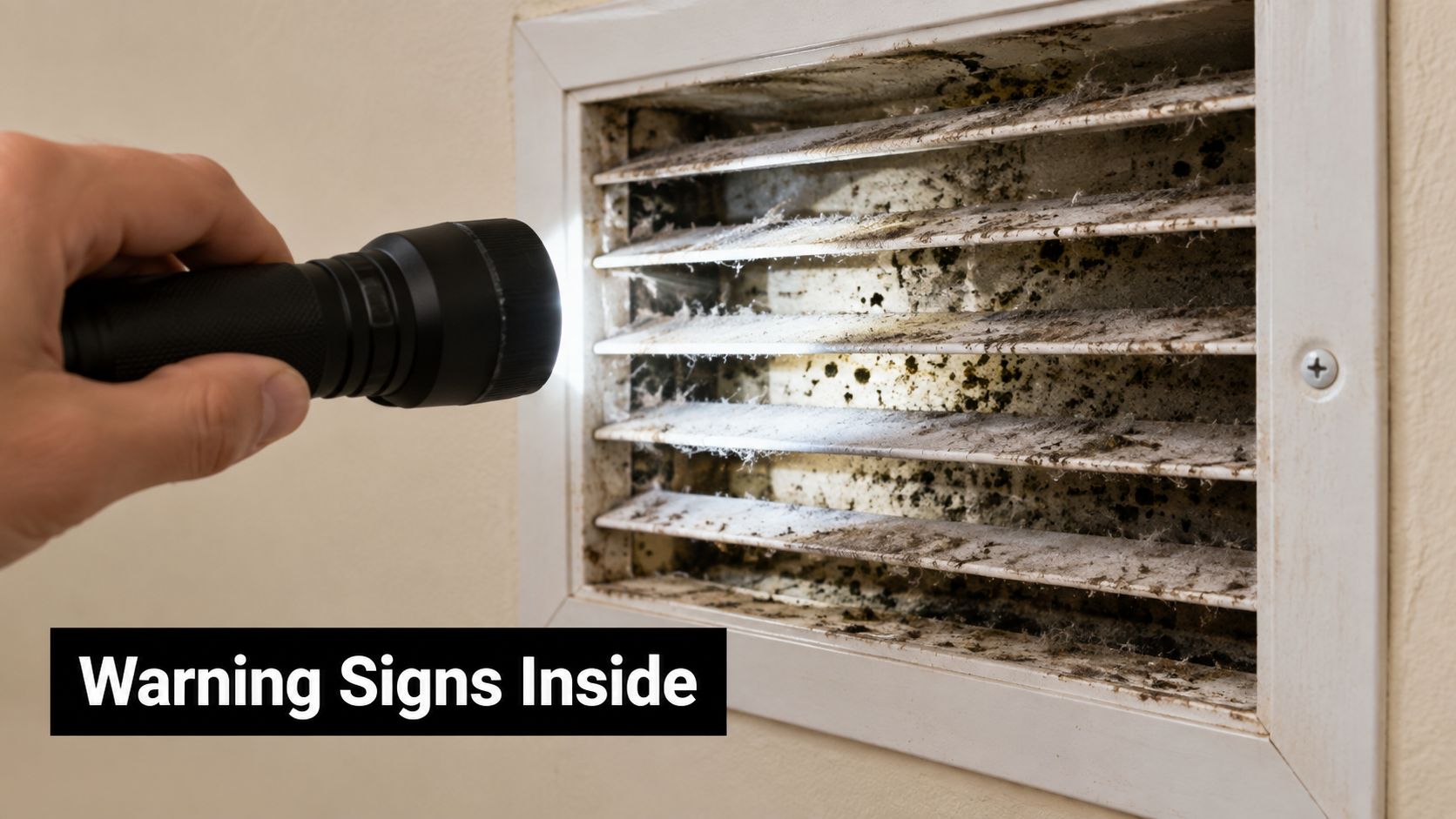
Use a simple screening process
First, inspect accessible areas. Remove a register cover safely and look for loose debris, unusual staining, pest material, or suspected microbial growth. A dark mark isn't automatically mold, and a professional should avoid identifying contamination from appearance alone when testing or material evaluation is needed.
Next, look for a plausible distribution pattern. Debris repeatedly appearing at supply registers, dust discharged when the blower starts, or a musty odor tied specifically to HVAC operation deserves more attention than dust sitting undisturbed inside one grille. Also inspect the return side, filter slot, blower compartment, coil area, and nearby insulation when access is safe.
Then, review recent events. A renovation, smoke incident, water leak, pest problem, or HVAC repair can explain a sudden change. Symptoms that worsen after the system runs may justify an evaluation, but they don't prove that the ducts caused the symptoms. Asthma symptoms can have several triggers, so keep medical guidance in the decision.
Air movement can resuspend particles when a system starts, particularly if loose material is present. A scientific review associated dirty ductwork with higher respiratory symptom risk, and it found that never-cleaned supply-air ductwork was associated with higher risks for multiple lower respiratory and atopic symptoms. Those associations support careful investigation of poor HVAC hygiene, but they don't establish that routine cleaning will predictably improve asthma. The review of HVAC contamination and respiratory symptoms is useful because it shows why inspection matters without turning association into a promise.
Before scheduling work, ask for photographs or video of the claimed contamination, a description of the affected components, and the proposed containment method. This guide to dirty ducts and air duct cleaning can help homeowners distinguish visible evidence from generic sales language.
A qualified provider should also explain risks. Aggressive brushing can damage fragile duct liner or flexible ductwork. Poor containment can disturb settled material and release it into rooms. If symptoms are severe or rapidly worsening, contact a healthcare professional rather than waiting for HVAC service.
After an inspection, you should be able to answer three questions: What is contaminated? How could it reach occupied space? What correction prevents recurrence? If the provider can't answer them, postpone cleaning and obtain another opinion.
How Filtration and Source Control Compare to Duct Cleaning Alone
Duct cleaning removes material already inside the system. Filtration and source control reduce what enters the system and what remains airborne over time. That difference explains why they often deserve priority for asthma-focused indoor air work.
A peer-reviewed modeling study found that forced-air systems using high-efficiency filtration produced 30% to 55% lower cat allergen levels and 50% to 75% lower fungal spore levels than other ventilation and filtration arrangements. The same study modeled 90% to 98% lower environmental tobacco smoke levels and 90% to 99% lower inhalation risk from respiratory infection in the high-efficiency filtration setup. These are modeled results, not guarantees for a particular home. The peer-reviewed filtration and forced-air systems study explains why filtration deserves separate attention from duct cleaning.
A separate review found that filters around MERV 12 or higher can reduce airborne asthma triggers by at least 50%, while filters removing more than 70% of cat dander, PM2.5, and respiratory virus particles can lower indoor concentrations of those triggers by more than half. Filter performance depends on fit, airflow, maintenance, and system compatibility, so a higher rating isn't automatically better if the equipment can't handle it.
What to prioritize first
Action | What it addresses | Main limitation |
|---|---|---|
Correct filter selection | Particles moving through the forced-air system | A clogged or poorly fitted filter can bypass the intended benefit |
Source control | Mold moisture, smoke, pet dander, dust, and other generators | The source must be identified and addressed consistently |
Duct sealing and repair | Return-side leakage and pathways that draw in contamination | Sealing doesn't remove contamination already present |
Targeted cleaning | Visible mold, pest debris, heavy loading, or event-related contamination | It doesn't prevent new particles from entering |
In-duct air treatment | Certain airborne contaminants moving through the HVAC system | It isn't a replacement for filtration, cleaning, moisture control, or medical care |
The EPA recommends MERV 13 filters in ducted systems for improved filtration, provided the HVAC equipment can accommodate them. The agency also emphasizes source control, ventilation, and filtration as the main indoor-air strategies, alongside practical measures such as regular dusting, cleaning, fixing leaks, and washing bedding. Its indoor air quality guidance identifies mold, dust mites, pet dander, environmental tobacco smoke, cockroach allergens, particulate matter, and other pollutants as relevant indoor asthma triggers.
Where ActivePure fits
ActivePure can be considered as an in-duct or portable air-treatment option, not as a reason to skip basic controls. Purified Air Duct Cleaning installs ActivePure systems alongside services such as duct, dryer vent, and HVAC coil cleaning. A homeowner considering the technology should ask what the specific device treats, how it integrates with the HVAC equipment, what maintenance it requires, and what evidence applies to the intended use.
Air cleaners have limits. EPA guidance notes that some HVAC-installed devices are designed to treat whole-house air, but they may not fully reduce adverse health effects for sensitive groups, including people with asthma and allergies. The agency also says evidence is weak that air-cleaning devices reduce asthma symptoms associated with some small particles that remain airborne, while larger particles can settle before filtration captures them. EPA guidance on air cleaners and indoor air supports using air treatment as a complement, not a standalone promise.
For homeowners weighing an in-duct purifier against other options, this discussion of whether in-duct air purifiers are worth it provides a useful checklist. The practical hierarchy is straightforward: control moisture and combustion sources, use a properly fitted compatible filter, keep surfaces and returns clean, repair leaks, then consider targeted cleaning or supplemental air treatment based on the home's documented conditions.
How to Prepare for Duct Cleaning and What to Expect Afterward
If inspection supports cleaning, preparation helps protect the household and gives the provider room to work without creating avoidable disruption. Ask for a written scope that identifies the affected components, access points, containment method, and any proposed chemical treatment.
Before the appointment
Move fragile objects away from registers and access panels. Tell the provider about asthma, pets, recent renovations, suspected mold, smoke exposure, and any materials that may be sensitive to agitation. Confirm whether occupants should leave during the work, especially if anyone reacts strongly to dust or cleaning products.
The HVAC system may need to be switched off while technicians connect negative-pressure equipment and agitate surfaces. Keep windows and doors managed according to the provider's containment plan, and don't run the system until the technician confirms that access panels are sealed and the equipment is ready.
Use this practical guide to preparing for duct cleaning as a checklist, then adapt it to the equipment and contamination in your home.
After the work
Request before-and-after documentation where appropriate. Check that registers, grilles, access openings, and nearby work areas are clean. Replace or service the HVAC filter according to the provider's recommendation and equipment requirements, particularly if the old filter held substantial debris.
Don't expect immediate asthma relief as proof of success or continued symptoms as proof of failure. Cleaning may remove a documented source, but ongoing exposure can come from bedding, flooring, pets, moisture, smoke, or outdoor infiltration. If symptoms persist, contact the healthcare professional managing the asthma and reassess the broader indoor environment rather than automatically booking another duct cleaning.
A Practical Decision Framework for Asthma-Focused Homeowners
Start with source control and a compatible, properly fitted filter. Inspect the HVAC system when you see mold, pest debris, heavy contamination, event-related dust, or symptoms that clearly track system operation. Choose targeted cleaning when inspection confirms a plausible contamination pathway, then repair moisture, leakage, or damaged components so the problem doesn't return.
Routine cleaning alone isn't an asthma-control plan. Combine ongoing housekeeping, moisture management, filtration, and professional evaluation with medical advice. Use air treatment such as ActivePure only as a complementary option with clearly understood limits.
Purified Air Duct Cleaning can inspect and clean residential or commercial duct systems, HVAC coils, and dryer vents, and it also installs ActivePure air purification systems for homeowners evaluating broader indoor-air controls. Visit Purified Air Duct Cleaning to request a quote and discuss whether your home needs targeted remediation, filtration support, or a wider IAQ assessment.