

Smoke Smell Coming from Vents: Causes and Safe Fixes
The air outside has smelled like a campfire for two days. You've kept the windows shut, checked the news, maybe dug out a mask. Then the furnace or the air conditioner cycles on, and within a minute the same acrid smell is drifting out of the supply vents in the hallway. Nothing in the house is burning. No alarm, no visible smoke, just that flat, smoky odor arriving every time the blower runs.
Most of the time the equipment isn't making the smoke. It's moving it. An HVAC system pulls air from somewhere and pushes it somewhere else, and when the outdoor air is dirty, the system becomes a delivery route. The less common case matters more: something inside the equipment, the ductwork, or the wiring is overheating or decomposing, and the smell is a warning rather than a nuisance.
The order of work is the same in both cases. Identify what you're smelling, correct the air path with settings and filtration, then decide whether the ductwork itself needs cleaning. Your nose is a decent detector and a poor measuring instrument, so use it to sort the cause and not to judge whether the air is safe.
Match Your Smell to Its Most Likely Cause
A smoke smell coming from vents comes from one of two places, and the distinction decides how fast you need to move. In the first bucket, the system is bringing smoke in from outside: an outdoor-air intake, a leaky return, an economizer, a neighbor's chimney drifting into the intake on a calm evening. The equipment is fine. In the second bucket, the smoke originates inside the equipment or the ducts: dust burning off a heat exchanger at the first heat of the season, an overheating blower motor, failing wiring, mold in a wet drain pan, or residue left on duct surfaces from a past fire.
Getting the bucket wrong is expensive in both directions. Treat an electrical fault as outdoor smoke and you keep running a system that shouldn't run. Treat outdoor smoke as an equipment failure and you pay for a service call you didn't need.
Smell or Symptom | Most Likely Cause | First Check |
|---|---|---|
Smoky smell only when the fan runs, after a wildfire or dust storm | Outdoor smoke drawn in through the fresh-air intake | Thermostat fan setting and whether outdoor air is entering |
Burnt dust smell at the first heat of the season | Dust settling on the heat exchanger or burner and burning off | Whether the smell fades within a few hours of running |
Hot electrical or burnt plastic smell | Overheating wiring, motor or control board | Shut the system off and call a technician |
Musty or sour smell that comes and goes | Mold or moisture in the ducts, drain pan or coil | Look for condensation, staining or standing water |
Smell in one room only | Vent or duct serving that room, or a nearby source | Compare the smell at each register and the return grille |
Constant stale smoke odor after a fire or smoking indoors | Residue in filters, insulation or duct surfaces | Filter condition and whether odor is stronger at return air |
Outdoor smoke is not a small effect. In five Boston-area households, median indoor PM2.5 increased from 3.5 micrograms per cubic meter on non-smoke days to 9.9 during wildfire-smoke days in 2023, according to a 2024 study published in Environmental Health. A 2025 study in Water, Air, & Soil Pollution tracking the 2023 wildfire season in Chicago found the likelihood that indoor PM2.5 exceeded the World Health Organization guideline rose from 0.5% on smoke-free days to nearly 24% during heavy-smoke events.
Close the loop with two questions. Does the smell start only when the fan runs? Did smoke or dust show up outside before it appeared inside? Two yeses point to outdoor air and a filtration problem, not a duct cleaning problem. That matters, because the wildfire smoke and indoor air quality basics start with the air path, not the vacuum truck.
Check the Air Path and Set the System for Smoke
Smoke at a register does not prove the ductwork is dirty. In a central system, contaminated outdoor air can enter through an outside-air intake, travel the return side, and be redistributed through every supply register in the building. EPA wildfire smoke tools and resources single out economizers and other outdoor-air controls as a route that can bring in large amounts of outside air during a smoke event, which is why the ventilation strategy counts as much as the filter.
The first two moves cost nothing and answer most of the question.
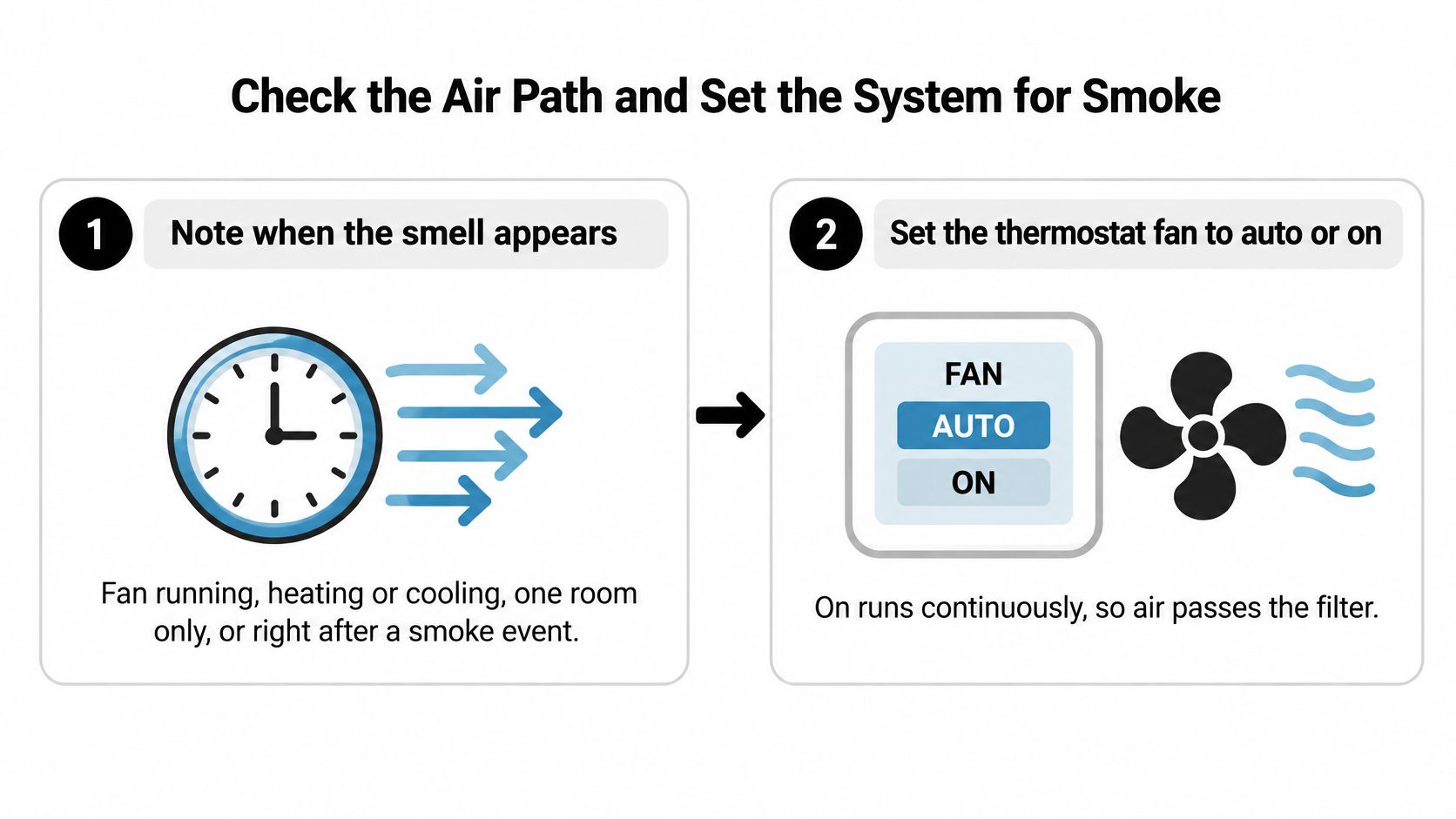
Run These Checks in Order
Time the smell. Note whether it appears only when the fan runs, only during a heat or cool call, in one room, or right after an outdoor smoke event. The pattern narrows the source before you touch anything.
Set the thermostat fan to on rather than auto. On runs the blower continuously, so indoor air keeps passing through the filter instead of sitting still between cycles. Auto means filtration stops the moment the compressor or burner does.
Find the air mode. Look for a fresh-air or outdoor-air damper, an economizer, or a heat or energy recovery ventilator tied into the ductwork. If it's open or running during a smoke event, close it or switch the system to recirculation. Tight modern houses often have an HRV or ERV pulling outdoor air in continuously, and it will pull smoke in with it.
Pull the return filter. A filter that's dark, matted, or smells smoky when you hold it up is finished. Replace it before you judge anything else, because a loaded filter both restricts airflow and keeps releasing odor.
Compare the smell at three points with the system off. A supply register, a return grille, and the air handler cabinet. Stronger at the return or the cabinet means the source is inside the system. Stronger at one supply register alone points to that branch or to something in the room.
Look at accessible ductwork in the attic or crawl space. Dark deposits, staining, or dust trails on the outside of a run tell you more than odor does.
Settings While Smoke Is Outside
Close the windows and doors, keep the fresh-air intake shut, run the fan on, and put a portable air cleaner in the room you use most. Closing up helps, but it doesn't seal the building. During wildfire-smoke events, indoor PM2.5 generally reaches 55% to 60% of outdoor levels when windows and doors are closed and no portable air cleaner is operating, according to the EPA's 2025 guidance on reducing exposure indoors. A cleaner in the main room changes that arithmetic in a way that closing windows alone can't.
Practical rule: If the fan sits on auto, the filter only works during a heating or cooling cycle. Switch to on for the duration of a smoke event and let the blower do the filtering work.
Pick a Filter the Blower Can Carry
Filtration is the lever, but the rating has to match the equipment. EPA wildfire and indoor air quality guidance recommends a filter rated MERV 13 or higher, or the highest efficiency the system can safely accommodate, and cites research showing that continuous fan operation can reduce indoor particle concentrations by as much as 24%. A filter that's too restrictive for the blower is worse than a modest one that fits, because excess airflow resistance drops delivery, strains the motor, and can ice a coil.
Filter Rating | What It Captures | Smoke Event Suitability |
|---|---|---|
MERV 8 | Coarse dust and pollen, little fine smoke | Weak for smoke; use only if the system cannot handle more |
MERV 11 | Finer dust, pollen and some larger smoke particles | Reasonable middle option if airflow stays strong |
MERV 13 | Fine smoke particles and most combustion particles | Commonly recommended target when the blower and filter rack can handle it |
Check the rack depth and the filter's actual thickness before you upgrade. A 1 inch MERV 13 and a 4 inch MERV 13 are very different loads on the same blower, and the deeper media usually wins on both airflow and service life. Filtration also has limits worth naming: a 2025 study in Environmental Science & Technology found that 71% of studied public buildings exceeded the Canadian Ambient Air Quality Standards limit for PM2.5 under wildfire-affected conditions, regardless of ventilation type or filter grade. Filter well, then verify with a monitor instead of assuming.
When the outdoor air clears, open the windows, restore the fresh-air intake, and put the fan back to auto. Between smoke events, the settings you run decide how much of the next one gets inside, which is why HVAC settings and indoor air quality belong on the same maintenance list as filter changes.
Clearing an Odor That Lingers After the Smoke
Residue is what you're chasing now, and it's rarely in one place.
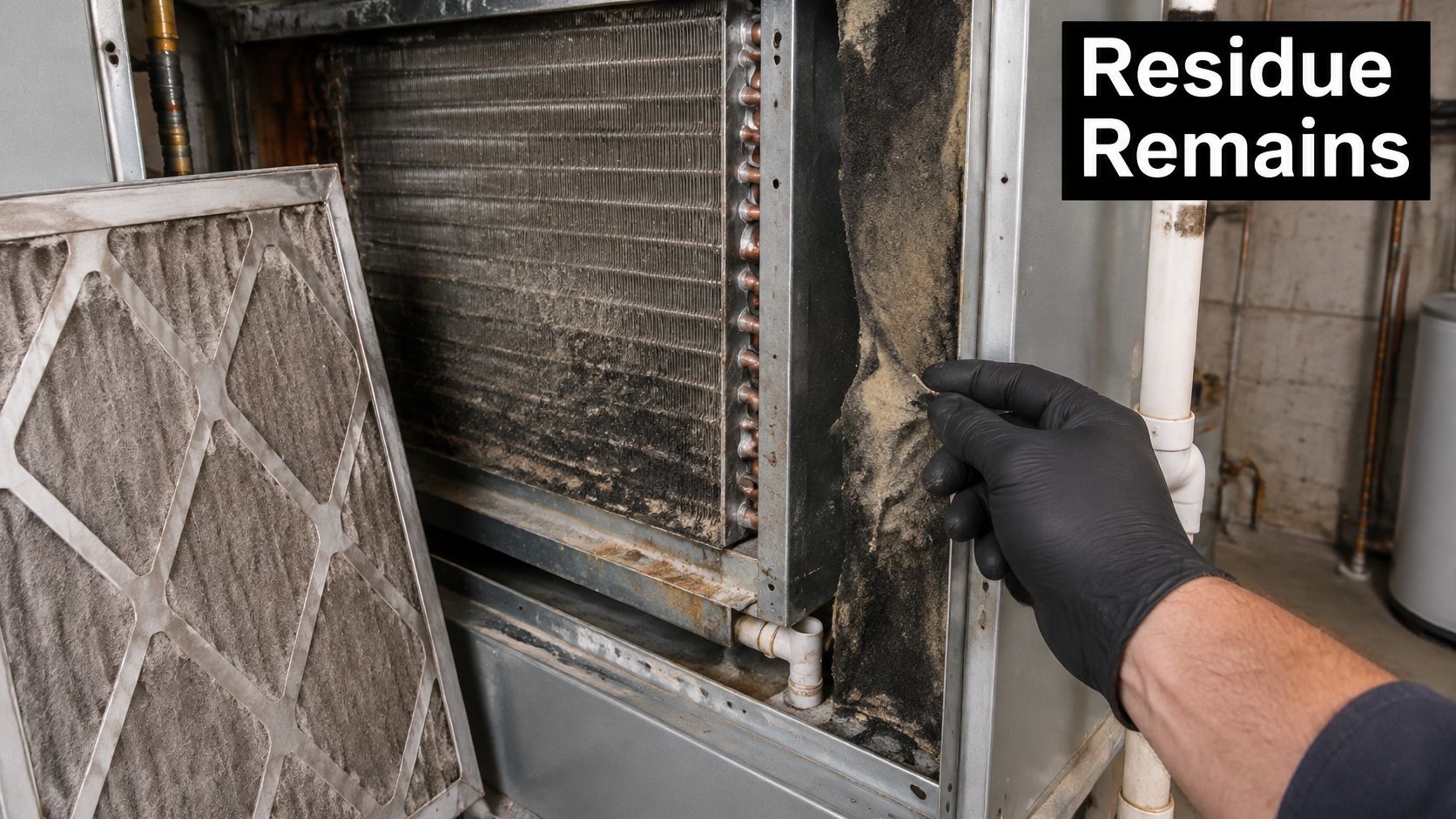
What Actually Holds the Smell
Once the outdoor air clears and the smell stays, smoke has stopped arriving and started sticking. Odor compounds settle into the filter media, the evaporator coil fins, the fiberglass or foil insulation inside the air handler, the cabinet seams, and the porous surfaces in the rooms: upholstery, carpet, drywall, cardboard boxes, the coats in the front closet. Duct surfaces hold it too, especially where runs pass through a humid attic or crawl space.
A wet coil is the usual suspect in a house that smells sour rather than smoky. Dust collects on the fins, condensation keeps it damp, and the mix supports mold growth that releases spores into the airstream every time the blower runs.
Verify Before You Treat
Record a baseline. Write down indoor PM2.5 and a plain description of the odor before you change anything. Without a before number you can't tell improvement from adaptation.
Seal obvious outdoor-air leaks. Gaps around the return plenum, the intake hood, and any duct penetration into an unconditioned space are the ones that matter most.
Install the filter you selected and run recirculation. Fan on, fresh-air intake closed, windows shut.
Reassess after several air changes. Read the monitor again, then open the house only once outdoor air is clean and check whether the smell returns when you close it back up.
If particle counts fall and the smell doesn't, a portable unit with a carbon or VOC stage is the next cheapest test, and choosing a portable air filter for smoke comes down to matching filter stages to what's in the air rather than buying the biggest box on the shelf.
If you're handling the surface cleaning yourself, wiping grilles, cabinet interiors and hard furnishings with a damp cloth, price the supplies before you start. Estimatty's guide to cleaning chemical costs breaks down what professional-grade products cost, so the job doesn't stall halfway through.
Duct cleaning alone often misses the source, because the residue sits in filters, coils, and insulation that a duct vacuum never reaches. That's why inspection of the coil and the insulation comes after steps one through four, not before.
That's what that side of the inspection looks like in the field.
Skip ozone generators in occupied space. The EPA's wildfire guide for public health officials states that ozone can create additional problems and that any professional ozone treatment requires an unoccupied area and a controlled re-entry period. Hydroxyl and photocatalytic units have their own constraints, and none of them substitute for removing the residue in the first place.
When to Shut Down the System and Call a Pro
One rule overrides every check above. If the smell suggests fire or gas, stop diagnosing and act.
Burning plastic, a hot electrical odor, or visible scorching at a vent or the air handler means shut the power off at the unit and at the thermostat, then call an HVAC technician now. A rotten-egg or gas odor means get everyone out and call the gas utility from outside the house. Visible smoke or sparks mean shut the system down, leave the area if smoke continues, and call emergency services if there's a fire.
Safety first: A service call you didn't need costs money. A furnace left running with a wiring fault costs considerably more.
Some people shouldn't wait for the diagnosis. Anyone with asthma, heart or lung disease, infants, older adults, and pregnant people should move to cleaner indoor air at the first sign of trouble and contact a doctor for wheezing, chest tightness, a persistent headache or dizziness.
Situation | Action | Timing |
|---|---|---|
Burning plastic or hot electrical smell | Shut power to the unit and thermostat, then call an HVAC technician | Now |
Visible smoke, sparks or scorching at a vent or air handler | Shut the system off, leave the area if smoke continues, call emergency services if there is fire | Immediately |
Rotten-egg or gas odor | Leave the home, call the gas utility from outside | Immediately |
Smoke smell after an outdoor event, no heat or electrical signs | Replace the filter, run recirculation, air out the house and monitor | Reassess within a few days |
Smell that remains after filter change and airing out | Schedule an inspection of coils, ducts and insulation | Within one week |
Smell is not a measurement. The EPA's wildfire smoke one-pager notes that odor alone can't determine whether hazardous concentrations remain, and that a darkened or rapidly loaded filter is a practical indicator of substantial exposure. If a smoke smell persists through a filter change and a few days of recirculation, or stays after the house has been aired out, book an assessment of the coil, ducts, and insulation within a week. A technician can measure the system rather than guess at it.
When an inspection does find residue, cleaning is a scheduled step after the fixes, not an emergency response. Duct cleaning isn't risk-free: dust and debris released into the air, allergic reactions, and mold growth are the ones to watch, and they're rare when the work is done properly by a qualified company. Know what an air duct inspection camera should show you so the findings are pictures, not adjectives.
Confirm the Source Before Booking Duct Cleaning
A duct cleaning quote should follow a diagnosis, not replace one. The checklist that matters fits on one card.
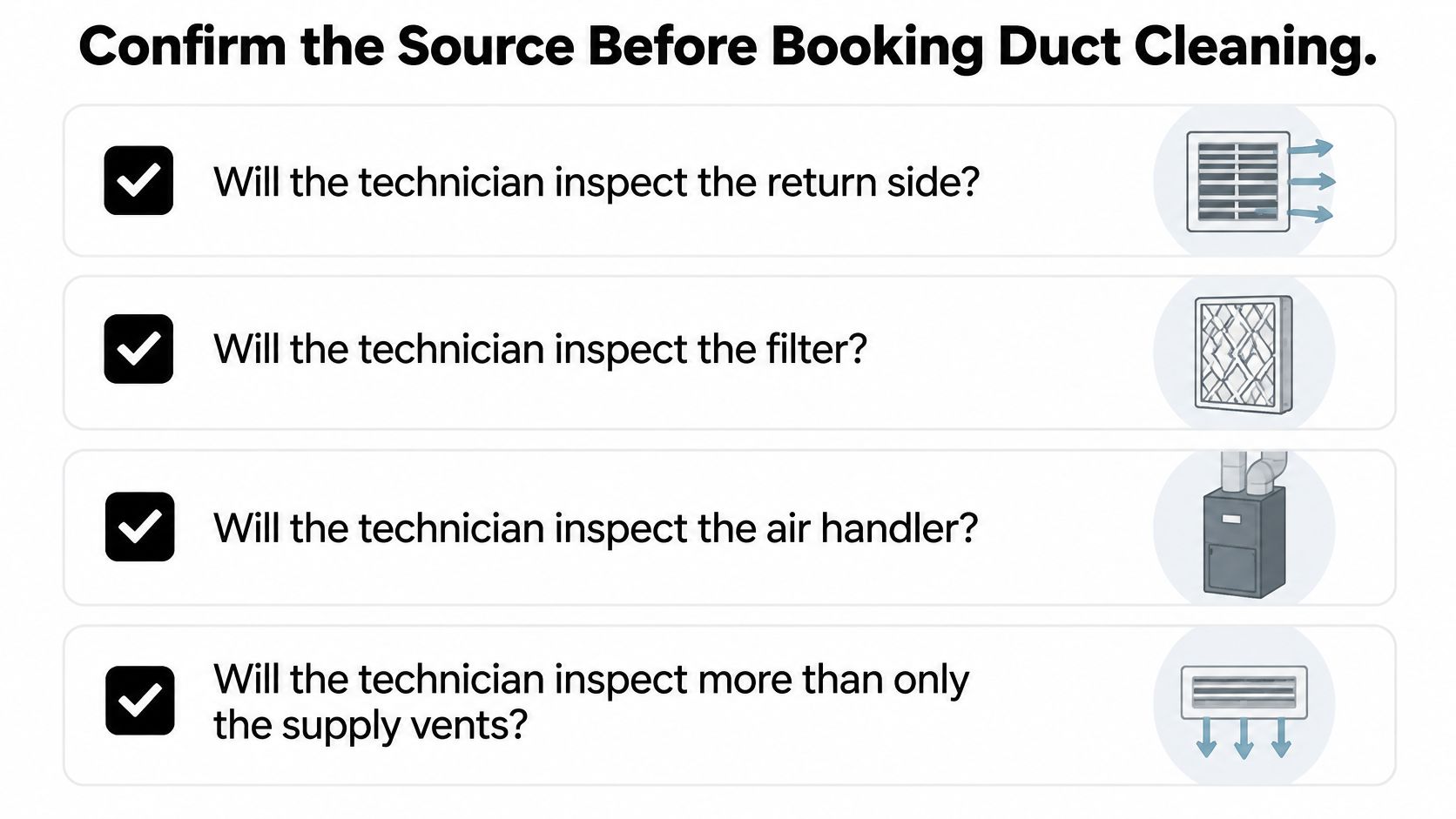
Will the technician inspect the return side, not just the supply vents? Residue and debris collect on the return run and at the air handler, and a job that touches only the registers misses both.
Will they check the fresh-air or outdoor-air damper? If that damper is how smoke is getting in, cleaning changes nothing.
How does the vacuum method work? Our vacuum method opens, vacuums and wipes down the supply and return vents, rather than blowing dust around the room.
How is dust controlled during the visit? If debris drops out of a vent, our tarp catches it and the techs vacuum it up. Ask any company what happens to the dust that doesn't stay in the duct.
How long does the visit take? Our air duct cleaning service takes on average 2 to 3 hours from start to finish, depending on the size of the home. A quote for 45 minutes is telling you something.
Is odor treatment included or separate? Deodorizing is a different step from removing debris, and it should be explained and priced as one.
A reputable provider should describe the source they expect to find before cleaning, and should never promise that cleaning alone removes an outdoor-smoke odor. Cleaning addresses what's inside the system; it can't fix what's coming in through the intake. The benefits of cleaning air ducts are mostly about airflow, debris and coil performance, which is a narrower and more honest claim than odor elimination.
If the source is outdoor smoke or a dirty filter, fix that first. Book cleaning when your own inspection, or a technician's, shows debris or residue inside the system.
Purified Air Duct Cleaning handles air duct cleaning, HVAC coil cleaning, dryer vent cleaning, and air purification installation for homes and commercial buildings across Avondale and the Phoenix metro. If the checks above point to residue inside the system rather than smoke from outside, our technicians open, vacuum and wipe the supply and return vents and can add an in-duct or portable purification system for lingering smoke and odors. Visit Purified Air Duct Cleaning to request a free quote.