

Portable Air Filter for Smoke: How to Size and Choose One
The sky has that dull orange cast, and the house still smells faintly of a campfire even though every window is latched. You're standing in a bedroom or a living room with a portable air filter for smoke in the cart, or already on the floor, and the box promises it "covers" a big square footage. That sticker is a starting point, not a guarantee.
Smoke isn't the dust you wipe off a shelf. It stays floating, it leaks back in through small gaps, and a quiet low-speed setting can leave it in the air you breathe. A low-cost build can match a branded machine when the airflow is right. An expensive one can disappoint if the room is open, the doors keep swinging, or the fan never leaves whisper mode.
What follows is the sizing math, why fine smoke beats a pollen filter, which technologies help and which ones you should skip, what lab tests showed for box-fan builds, and when one room unit stops being the whole answer.
Room Size Math for Smoke CADR Targets
A portable air filter for smoke should have a smoke CADR of at least two-thirds of the room's floor area in square feet. CADR means Clean Air Delivery Rate: how many cubic feet of cleaned air the machine delivers each minute. You get the floor area by multiplying length by width, then you compare that area with the unit's coverage claim and its CADR.
The EPA residential air-cleaner guidance sets general minimums at 65 cubic feet per minute for 100 square feet, 130 for 200 square feet, 195 for 300 square feet, 260 for 400 square feet, 325 for 500 square feet, and 390 for 600 square feet. Those figures are a floor, not a smoke target. Put the two-thirds smoke targets beside them.
Room floor area | General residential CADR minimum | Smoke CADR target (two-thirds of area) |
|---|---|---|
100 sq ft | 65 cfm | 67 cfm |
200 sq ft | 130 cfm | 133 cfm |
300 sq ft | 195 cfm | 200 cfm |
400 sq ft | 260 cfm | 267 cfm |
500 sq ft | 325 cfm | 333 cfm |
600 sq ft | 390 cfm | 400 cfm |
Measure the zone people actually use
Say the bedroom is 12 feet by 10 feet. That's 120 square feet, and two-thirds of 120 is 80, so you want a smoke CADR of at least 80 cfm. A nursery, a home office, or the corner where someone sleeps on a sofa gets the same treatment: length times width, then the two-thirds check.
Open plans are where buyers get fooled. A kitchen that opens into a living room is one air volume. Either add the connected floor area and size for that total, or pick the largest zone you need to protect and close it off. A "500 square foot" badge often comes from a dust test, not from smoke.
Read the smoke line, then leave it on high
The label prints separate CADR figures. You want the line for tobacco smoke or wildfire smoke. A high dust or pollen CADR doesn't promise the same result on fine smoke. If the carton only gives a room-size slogan, you don't have the number that matters.
The EPA page on cleaner-air rooms says to run an appropriately sized portable cleaner continuously on its highest fan setting while you are making that room. The rating assumes steady airflow with windows and doors closed. Drop to low and you deliver less cleaned air every hour, even if the filter media is excellent. A side-by-side look at how machines are rated sits in these home air cleaner reviews.
Practical rule: If the smoke CADR is under two-thirds of the floor area, that unit is too small for the room, no matter what the box art says.
Why Smoke Is Harder to Filter Than Dust
Household dust behaves like gravel. A coarse screen stops most of it. Smoke behaves like fine flour. It drifts through gaps, hangs in a sunbeam, and films every surface long after the fire is miles away.
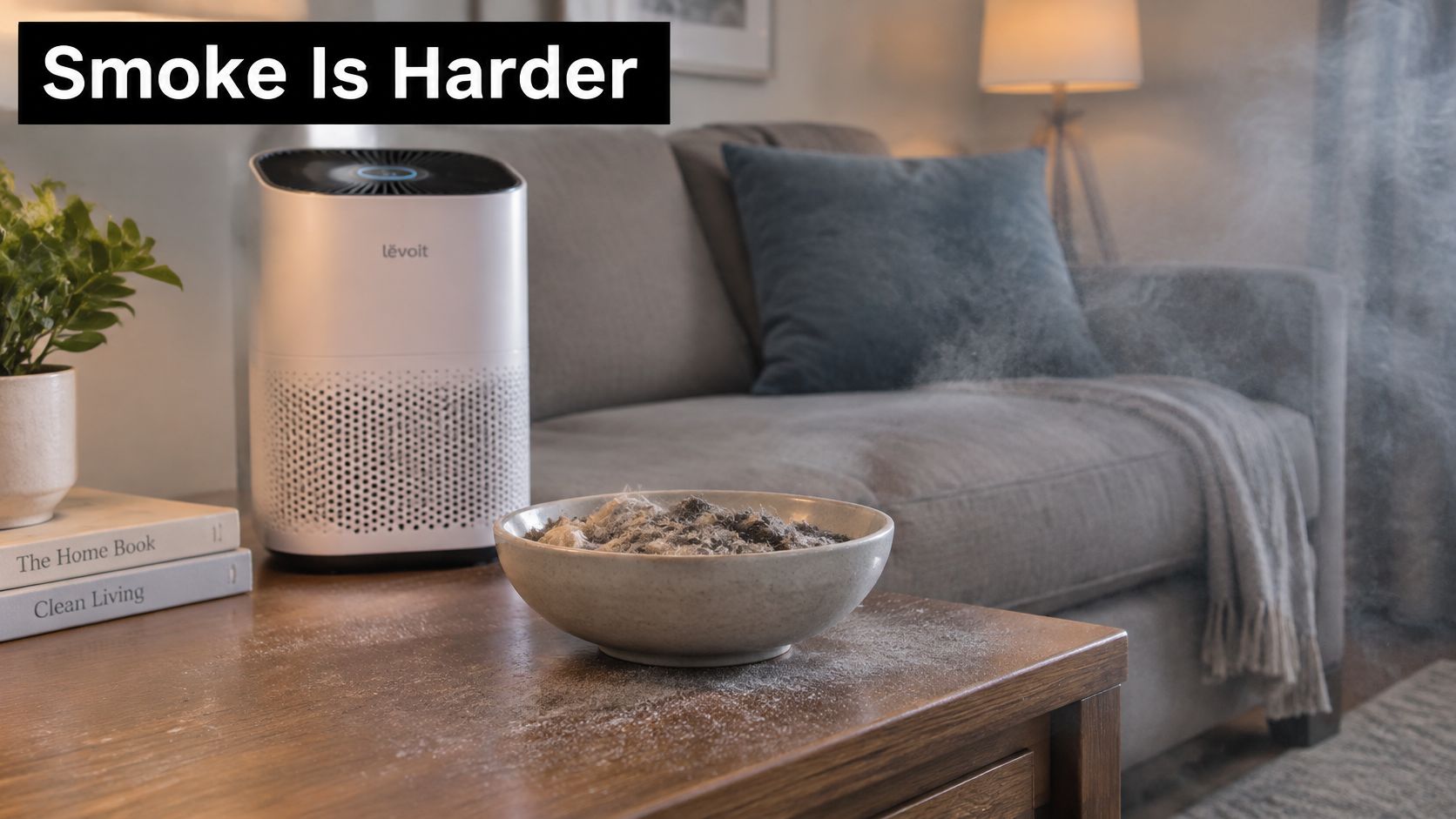
Most wildfire smoke is PM2.5, particles about 2.5 micrometers across or smaller, on the order of 30 times thinner than a human hair. They stay aloft for hours, reach deep into the lungs, and pass filters that were built to catch pollen and lint. A window screen that stops leaves barely notices them.
Two problems inside one haze
Smoke isn't a single pollutant.
Particles: Specks a mechanical filter can trap, if the media is fine and air is forced through it instead of around it.
Gases and odor molecules: These aren't specks. They need a material that adsorbs them. A particle filter leaves the smell behind.
A portable unit doesn't scrub the room in one gulp. It pulls room air in, pushes cleaned air out, and repeats. Each pass lowers the particle load a bit. That's why hours of runtime beat a short blast on turbo.
During wildfire-smoke events, the EPA wildfire guide for public health officials reports that portable air cleaners can cut indoor PM2.5 by approximately 50% to 80%, with an average reduction of about 65%, when windows and doors stay closed and the unit is sized for the room. Leave a slider cracked for "a little fresh air" and outdoor smoke refills the space while the fan works. The same guide notes that portable units are built for individual rooms, not for every space tied to a central system.
The particle side of that story, and why the smaller fraction matters for lungs, is laid out in this piece on indoor air quality and PM2.5.
Seeing the particle path helps the sizing math stick:
Closed doors and real airflow decide whether you land near that average or well below it.
Which Portable Technologies Remove Smoke Well
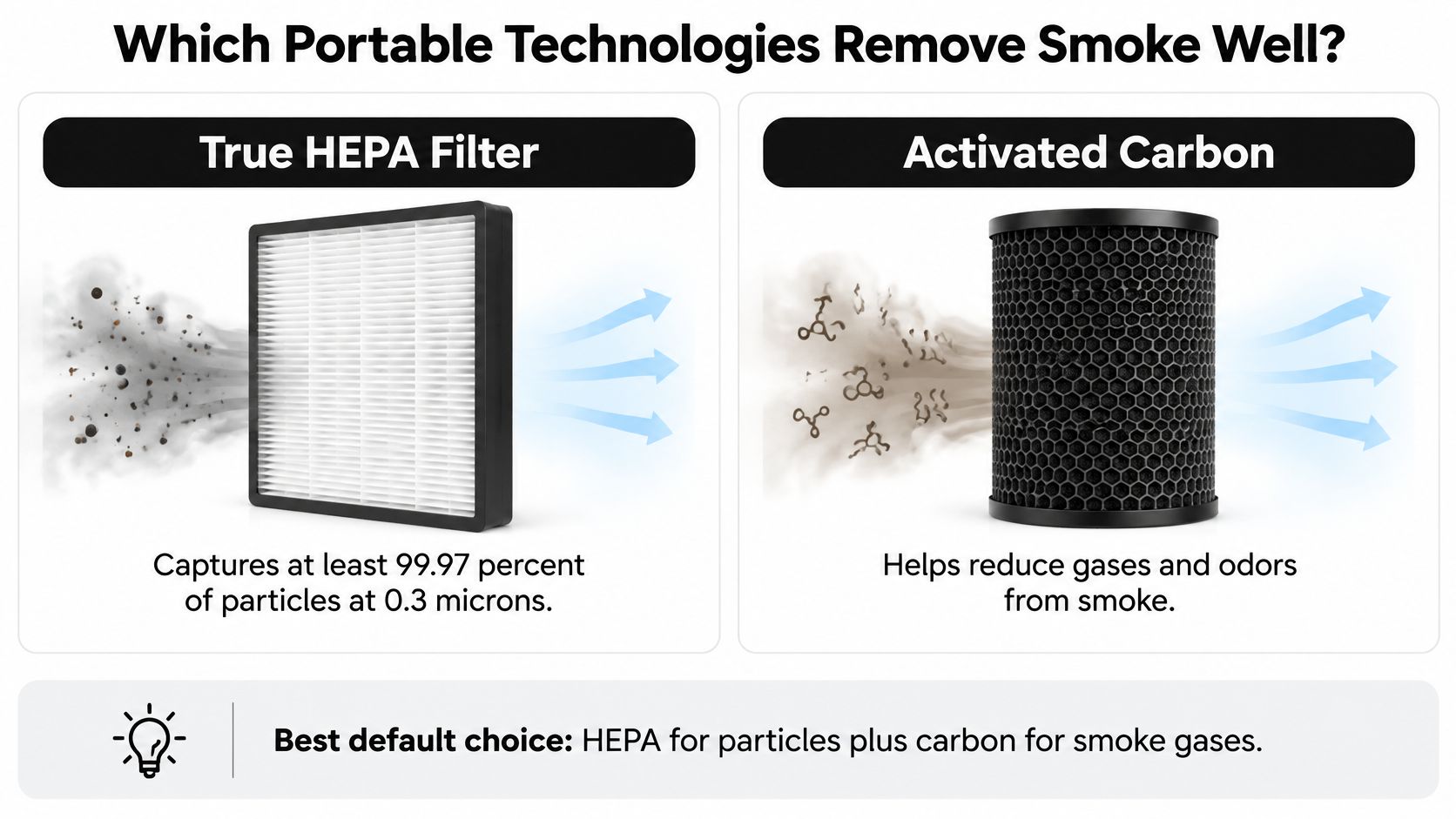
The default that holds up is a true HEPA filter for particles plus activated carbon for gases and odors. HEPA media is built to capture at least 99.97 percent of particles at 0.3 micrometers, which covers the fine fraction in smoke. Carbon adsorbs some odor molecules and gases. It doesn't replace particle filtration, and a thin carbon sheet won't do the work of a heavy carbon bed.
What else is on the shelf
Prefilters around MERV 8 to 11 catch ash, hair, and coarse debris so the HEPA lasts longer. Alone, they're weak on the fine smoke you can smell but barely see.
A box fan with a MERV 13 filter can move a lot of air if the filter is sealed to the fan so air can't sneak around the edges. Done carelessly, it's loud, leaky, or both.
Ozone generators are a different category, and not a safe one for a room people occupy. The EPA page on ozone generators sold as air cleaners states that inhaled ozone can damage the lungs, and even relatively low amounts may cause chest pain, coughing, shortness of breath, and throat irritation. Ozone can also worsen chronic respiratory disease, including asthma. The same page notes that bipolar ionization devices may generate ozone or other byproducts unless safeguards are used, and it points buyers toward UL 2998 certification when that technology is on the table.
Technology | Fine smoke particles | Gases and odors | Ozone risk | Verdict |
|---|---|---|---|---|
True HEPA plus activated carbon | Strong on fine particles | Carbon reduces some odors and gases | None | Best default for smoke |
Prefilter only (MERV 8 to 11) | Catches larger ash and debris, weak on fine smoke | Little effect | None | Supplement, not a standalone solution |
Box fan with MERV 13 filter (DIY) | Strong when sealed and sized correctly | None unless carbon is added | None | Effective if built carefully |
Ozone generator | Not recommended for occupied rooms | No reliable effect | High, can harm lungs | Avoid |
Bipolar ionization without UL 2998 | Uncertain | Uncertain | Possible ozone or byproducts | Verify certification first |
Shops that already maintain heating equipment sometimes publish plain-language notes on smoke season. The write-up from Bear Valley Plumbing & Heating smoke filtration is one place to see how a service company frames filters when outdoor smoke shows up.
A short buyer check
Smoke CADR on the label: Confirm a tobacco-smoke or wildfire-smoke figure, not only a room-size claim.
HEPA designation: Look for true HEPA, not "HEPA-type" wording.
Carbon for odor: Ask how much carbon is in the filter, not just whether a black layer exists.
Sealed frame and filter price: Air that bypasses the media wastes the rating, and replacement filters are part of the actual cost.
Noise at the speed you'll run: If high speed is too loud to sleep with, you won't leave it there.
How those filters relate to the air handler in the closet is covered in this guide to indoor air quality filtration.
How DIY Box Fan Filters Compare in Tests
Government lab work ranks do-it-yourself smoke filters by the same CADR used on retail boxes. In U.S. EPA testing published in 2022, a box fan with one 1-inch MERV 13 filter produced a wildfire-smoke CADR of 111 ± 1. A cardboard shroud, which blocks the corners where air slips past the filter, lifted that to 156 ± 4. A 4-inch MERV 13 filter with a shroud reached 248 ± 15. A two-filter design hit 263 ± 22. A four-filter Corsi-Rosenthal box reached 401 ± 31.
Configuration | Wildfire-smoke CADR | Approximate room size |
|---|---|---|
Box fan with one 1-inch MERV 13 filter | 111 ± 1 | About 165 sq ft |
Box fan with one 1-inch MERV 13 filter and cardboard shroud | 156 ± 4 | About 235 sq ft |
Box fan with 4-inch MERV 13 filter and shroud | 248 ± 15 | About 370 sq ft |
Two-filter design | 263 ± 22 | About 390 sq ft |
Four-filter Corsi-Rosenthal box | 401 ± 31 | About 600 sq ft |
What the ladder actually teaches
The filter grade barely changed between the first two rows. The shroud did. Smoke removal depends on how much air moves through the media and on stopping bypass, not on the brand printed on the cardboard. EPA reported that low-cost DIY units can reduce indoor smoke at least as effectively as commercial portable air cleaners with similar CADR values. CADR is the comparison. A marketing line about "medical grade" isn't.
Match the build to the room, not to a photo online. The 111 setup suits about 165 square feet. The shrouded 1-inch build suits about 235. The 4-inch shrouded fan suits about 370. The two-filter design suits about 390. The four-filter box suits about 600. A Corsi-Rosenthal box in a small bedroom is more machine than the room needs, and it will be loud. A single 1-inch filter in a great room won't keep up.
The costs people skip
During severe smoke, filters load fast and need frequent replacement. A quiet commercial unit is more likely to stay on overnight. A box fan at full speed in a bedroom often gets switched off by midnight, which erases the CADR you just built. A poorly wired fan, a filter sucked tight against the blades, or a unit left running unattended on carpet is a fire risk. Tape the filter on the intake side, keep the cord clear, and don't leave it as the only appliance in an empty room for days.
A DIY build is worth it when the CADR matches the room and someone will change the filters. It isn't a bargain if it sits off because it's too loud to live with.
Set Up a Clean-Air Room and Its Limits
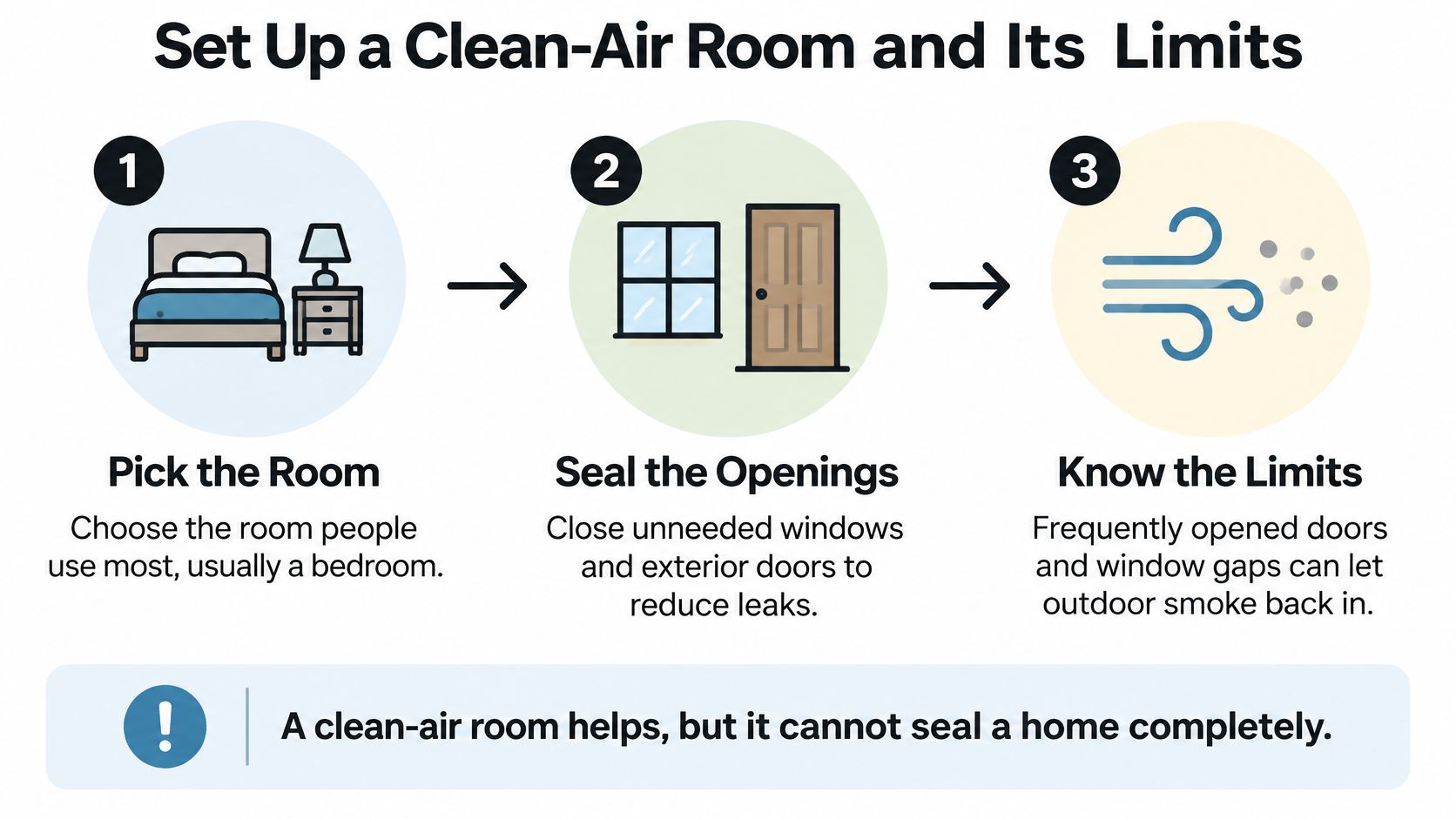
Pick one room and treat it as the cleaner-air space. The bedroom usually wins, because that's where people spend the most uninterrupted hours.
Pick the room and find the leaks. Walk the bedroom or the office you can close. Note the door that gets opened for the dog, the window that never quite latches, and the return grille that whistles. Those paths bring outdoor smoke back in.
Close what you don't need. Shut unneeded windows and exterior doors. Keep the interior door shut while the cleaner runs. If the house is too hot to close up, deal with temperature first. A sealed room that overheats isn't a plan.
Place the unit near where people breathe. Set it beside the bed or the desk, intake clear of walls, curtains, and laundry. A machine jammed in a corner recycles the same pocket of air.
Leave it on the highest speed you can tolerate. Continuous running beats cycling. The noise is part of the trade. Earplugs or a lower shelf placement often beat dropping two fan speeds.
Watch the filters, not the calendar. In heavy smoke, check the prefilter every few days. Replace the main filter when airflow falls off or the smoke smell returns sooner than it used to. A loaded filter can look only slightly gray and still be choked.
Check a monitor if you have one. Compare indoor and outdoor PM2.5. If the indoor number barely moves, the room is leaking, the unit is undersized, or both.
What a sealed test house still couldn't hold
Recent building-science work, published in Environmental Science & Technology Letters, found that a portable air cleaner removed 90% of pulse-introduced particles within two hours in a sealed test house. When outdoor PM2.5 kept infiltrating, steady-state effectiveness in different locations was only 70%, 45%, and 55%. Layout, open doors, leakage, outdoor-air exchange, and recirculation changed the result. One device doesn't cover a multi-room house.
That gap shows up fast in Phoenix-area houses: large open plans, a central air handler that runs for cooling, and doors opened all evening. Smoke follows those paths. Portable cleaners belong in individual rooms. Broader coverage means HVAC filtration, more than one unit, or both. A practical way to think about smoke that has already entered the house is this guide to wildfire smoke and indoor air quality.
Costs and limits no setup step removes
The EPA course on preparing for smoke and heat is blunt about the trade-offs. A HEPA label isn't enough by itself. Protection depends on correct sizing, sustained airflow, and replacing filters as they load. Ozone-producing cleaners can cause coughing, breathing difficulty, and lung damage, so they stay out of occupied rooms. Low-cost DIY cleaners with box fans and MERV 13 filters can match commercial units of similar CADR, but only when design, materials, assembly, and filter changes are done carefully. The most expensive branded purifier isn't automatically the better buy, and a sloppy DIY build can be unsafe, noisy, or ineffective.
Compare total cost, not the checkout price. Count replacement filters, electricity at the fan speed you'll use, and noise at that speed. Ask whether the machine still moves air after a heavy smoke week. Activated carbon may help with some odors. It doesn't stand in for high-CADR particle filtration.
A clean-air room lowers exposure where you sleep. It doesn't seal the rest of the house, and it doesn't fix a central system that's pulling smoke through the ducts.
Choose a Portable Unit or Upgrade Your Whole Home
A portable unit is usually enough for one bedroom or a single living area during a short smoke event, if the smoke CADR matches the floor area and you can keep that room closed. That's the common case: a few bad days, one room you can dedicate, someone willing to run the fan.
Move toward whole-home filtration when smoke hits several rooms at once, when smoke season repeats every year, when someone in the household has asthma or allergies, or when you can't seal a single room because the plan is wide open. In those houses, a portable air filter for smoke is still useful at the bedside. It isn't the only layer.
Two whole-home paths
A higher-MERV filter in the central system treats air the blower already moves. The catch is compatibility. A thick, high-MERV filter can starve an older blower or collapse in a rack that wasn't built for it. Someone has to check the filter slot and the fan's capacity before you jump several MERV numbers.
In-duct purification treats air as it passes through the system, which helps when doors between rooms stay open and a single portable can't see the whole volume. Whether that add-on earns its keep depends on the duct layout and how often the blower runs. A clear walk-through of the trade-offs is in this article on whether in-duct air purifiers are worth it.
Households that want a broader checklist for daily air, beyond smoke week, can create a healthier indoor environment by combining filtration with source control and sensible ventilation. Filtration doesn't replace those other steps.
Purified Air Duct Cleaning, based in Avondale, AZ, serves the Phoenix area with duct cleaning, HVAC coil cleaning, and in-duct and portable ActivePure air purification systems. A technician can look at the ductwork and the blower before anyone recommends a system, which matters more than a catalog photo when the question is smoke across several rooms.
Measure each room you need to protect, calculate the smoke CADR target, and read that figure on the label. If one closed room covers the hours that matter, buy or build for that room. If smoke season is a yearly event and the plan won't close, look at the central filter and the ducts next.
Purified Air Duct Cleaning helps Phoenix-area homes cut the dust and debris in ducts and coils, and it installs in-duct and portable ActivePure systems aimed at smoke, odors, and fine particles. If a single room unit isn't covering the way your family lives, start with a look at the air handler and the ducts. Visit Purified Air Duct Cleaning to request a quote and talk through portable versus whole-home options for your floor plan.