

Dirty Duct Cleaning: Signs, Steps and Real Results
Your air ducts don't need cleaning just because another year has passed. The useful question is whether there's contamination worth removing, where it came from, and whether the contractor can show that it's gone. Dirty duct cleaning should solve a documented problem, not turn ordinary household dust into a reason to buy recurring service.
A worthwhile visit starts with inspection and ends with evidence. Between those points, the technician needs to remove deposits without spreading them through your home, protect the duct material, and identify problems that cleaning won't fix.
Signs Your Ducts Are Dirty Enough to Matter
Start with a ten-minute flashlight check, not a booking form. Look through accessible supply registers and return grilles, inspect the filter, and note what happens when the fan starts. Don't remove equipment panels, reach into the blower compartment, or enter an attic without safe access.
Every home has some dust. What deserves attention is a recurring layer, visible material leaving a register, or contamination connected to a likely source. A dusty grille alone doesn't tell you what the rest of the system looks like.
Use these observations to guide an inspection, not to diagnose mold or identify an infestation yourself.
Dirty duct symptoms, likely causes and quick checks
Symptom | What it may mean | Quick check |
|---|---|---|
Grey or fuzzy layer inside a supply register | Dust and lint buildup on duct walls | Shine a flashlight 30 cm into the register and look for a layer on the metal |
Dust puffs out when the fan starts | Loose deposits in branch ducts or the blower | Run the fan on low, if available, and watch registers from across the room |
Musty smell only when the system runs | Possible mold on the coil, drain pan or duct interior | Ask for a check of the drain pan and coil for black or green staining |
Droppings, nests or dead insects near returns | Possible vermin access to ductwork | Inspect return grilles and visible attic duct runs without disturbing deposits |
Dust returns within a day of wiping surfaces | Air leaks or a dirty return path rather than duct dust alone | Check whether the return grille meets the wall securely and the filter fits tightly |
Uneven room temperatures and high utility bills | Possible duct leakage or poor insulation | Compare register temperatures and have accessible attic or crawl-space ducts inspected |
Staining isn't a confirmed mold diagnosis. Photograph it rather than scrubbing it away before inspection. This guide to mold-in-air-duct symptoms can help you describe what you've noticed.
The Department of Energy's duct-system guidance reports typical losses of 25% to 40% of heating or cooling energy before conditioned air reaches rooms, associated with leakage, poor insulation and unconditioned locations; improved design, sealing and insulation can reduce losses to a maximum of 20% of underlying loads in typical cases. Treat uneven rooms and high bills as reasons to investigate ductwork, not proof that cleaning will save energy.
Before calling, collect:
Register photos: Include the grille and visible interior.
Return-grille photos: Capture edges and nearby deposits.
Air-handler-door photos: Show the equipment and access conditions.
Filter photos: Include its condition, size and fit.
When Dirty Ducts Call for Cleaning and When They Do Not
The advice that every home needs annual duct cleaning goes beyond the evidence. The EPA's residential duct-cleaning guidance says knowledge remains limited, a blanket recommendation isn't justified, and cleaning has never been shown to prevent health problems.
The same guidance notes that cooking, cleaning, smoking, outdoor infiltration and ordinary movement can contribute more indoor exposure than contaminants resting inside ducts. Studies haven't conclusively demonstrated that dirty ducts increase household particle levels. That distinction matters when someone presents a photograph of dusty metal as proof that your family is breathing unhealthy air.
Cleaning is an as-needed response, not a substitute for finding the source.
Use the condition to choose the response
Condition | Response | Note |
|---|---|---|
Substantial visible mold growth | Clean and correct the moisture source | Cleaning without fixing moisture allows the problem to return |
Vermin infestation | Remove pests and seal entry points, then clean | Arrange removal of droppings and nests before ordinary cleaning proceeds |
Excessive dust or debris released into occupied rooms | Clean the affected system | Confirm the source with filter and register checks first |
Routine dust with no visible buildup | Change filters as needed and vacuum accessible registers | No scheduled duct cleaning is needed on this evidence alone |
Construction or renovation debris | Plan cleaning before occupancy when inspection confirms deposits | Check branch ducts for drywall dust and sawdust rather than assuming they're clean |
Leaky or uninsulated ducts in a hot attic | Seal and insulate first | Cleaning doesn't correct leakage or insulation failures |
Construction history is a reason to look, not automatic proof that every branch needs treatment. Likewise, a musty odor should prompt investigation of moisture and equipment, not an immediate offer to fog the entire system.
Practical rule: When contamination is visible and the source is identified, cleaning is a reasonable step. When neither is established, start with basic maintenance and a better inspection.
Check the filter fit, address return-path gaps, and vacuum accessible registers where appropriate. If the complaint persists, ask the technician to show where the material originates before authorizing a larger job.
How to Prepare Your Home Before the Crew Arrives
Preparation gives the crew access to the places you've paid them to inspect and clean. A blocked return or crowded equipment closet shouldn't become an excuse for incomplete work.
Keep your notes, photographs and written scope together.
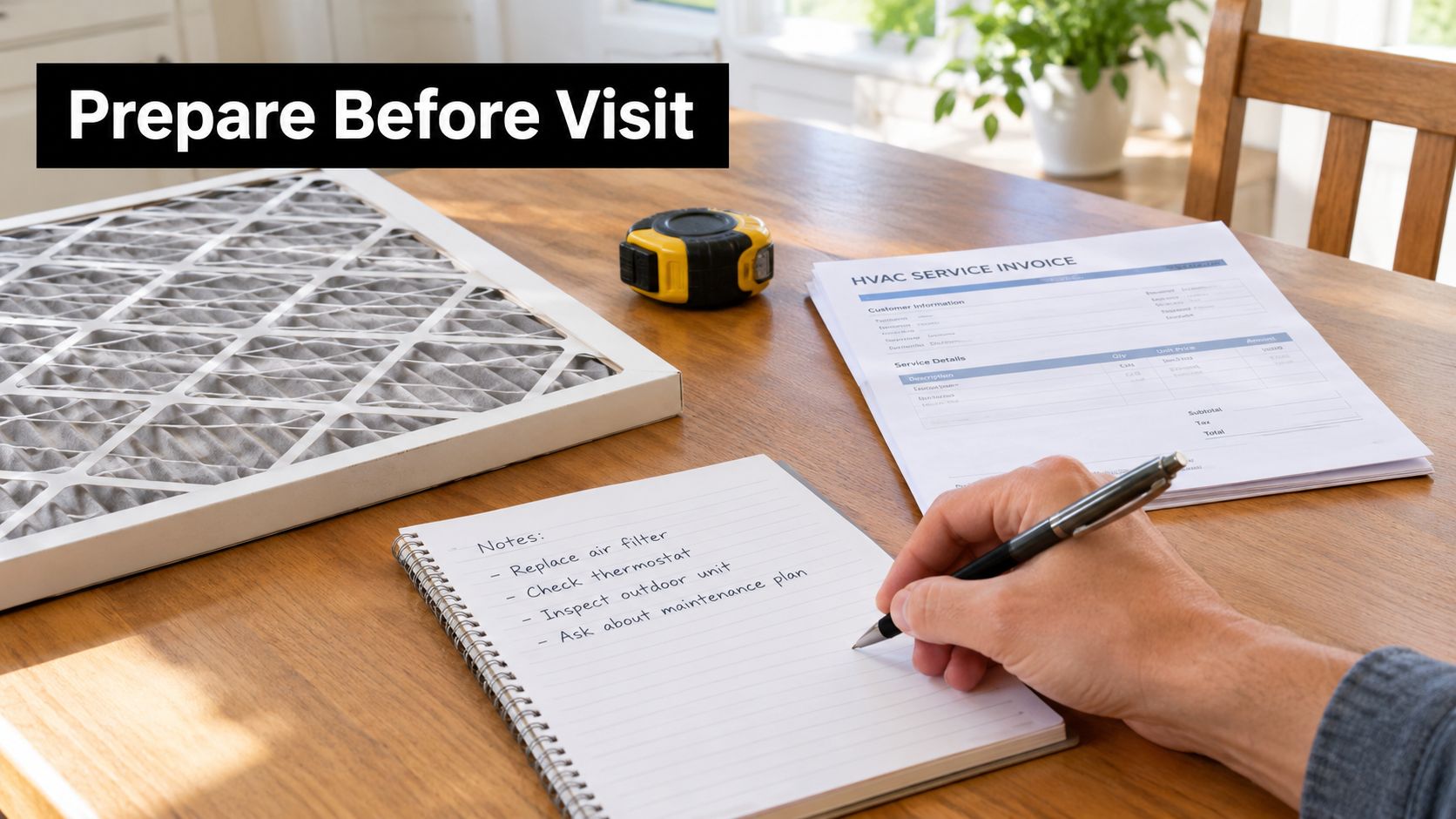
Get the house and paperwork ready
Write down the equipment details. Note the system age if known, last service date, filter size and air-handler location so the technician can plan access and bring the appropriate replacement filter.
Clear at least an arm's length around the air-handler closet and every return grille, then ask whether the crew needs more room for hoses and tools. Good access lets technicians work without moving your belongings or overlooking a cramped component.
Move vulnerable belongings. Shift furniture, bedding, electronics and wall decor away from registers that will be covered or disturbed, keeping the work route clear as well.
Put pets in a closed room away from the work and tell the crew about allergies, asthma or infants in the home. That gives everyone a chance to agree on containment and occupancy arrangements before equipment starts.
Leave thermostat decisions to the technician. Ask whether to turn the system off beforehand or leave fan control to the crew, rather than changing settings during the work.
Photograph each register and return grille, then wipe a dark cloth across an accessible supply grille. This creates a simple surface baseline, although it doesn't measure airborne particles or conditions deeper inside the ducts.
Plan for noise and disruption. Keep the afternoon flexible, ask for a realistic duration, and discuss whether ventilation afterward is appropriate given outdoor conditions and the work performed.
Get the scope in writing, with coils, drain pan, blower compartment and plenum explicitly included or excluded. This prevents a register-cleaning visit from being mistaken for whole-system service.
For additional access and household planning, use this practical duct-cleaning preparation guide.
Don't open electrical compartments or move heavy equipment to help. Leave technical access to the crew, and ask them to identify anything they can't safely reach before they begin.
How Professional Duct Cleaning Works Step by Step
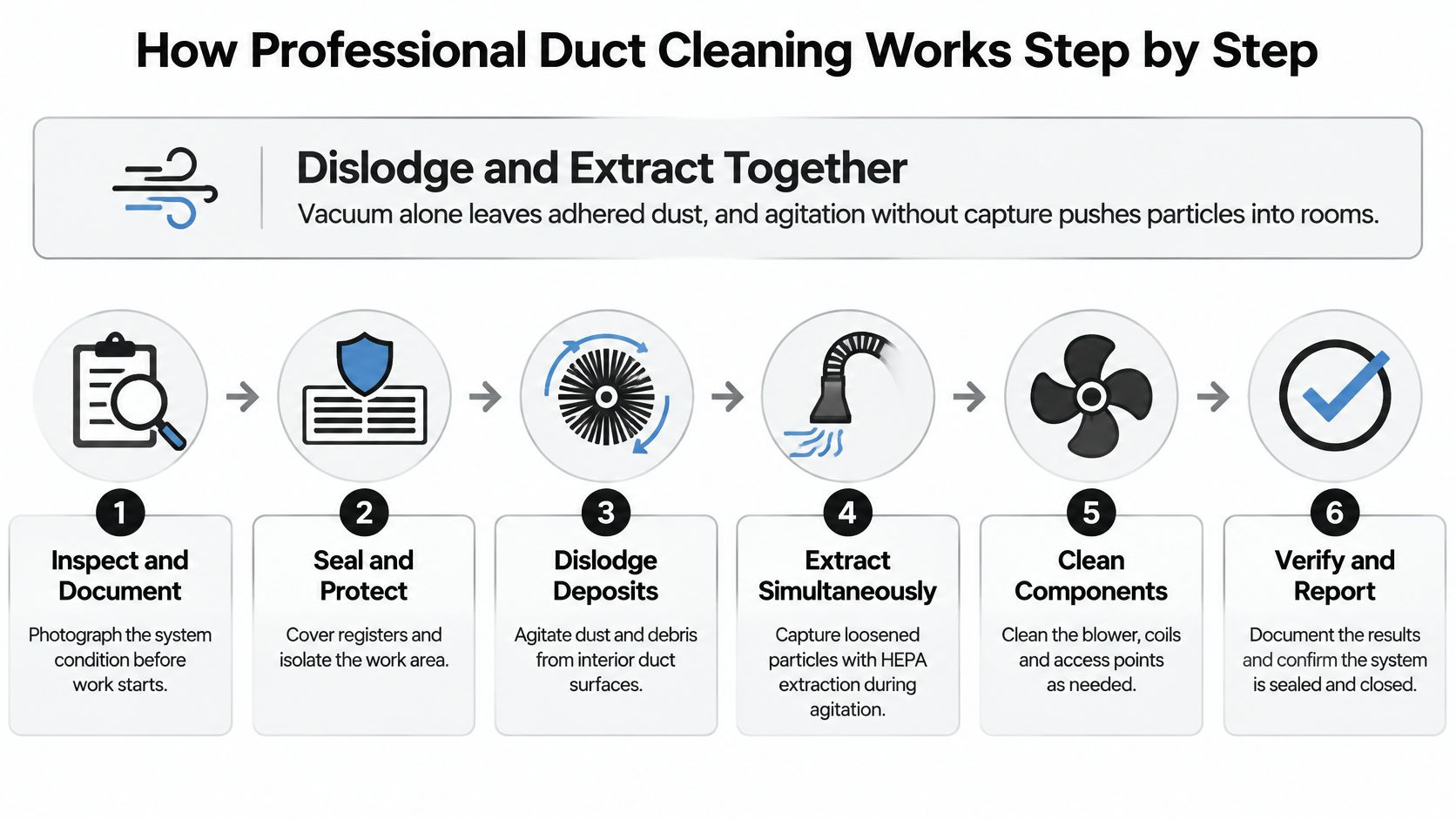
Dislodging deposits and extracting them must happen together. Vacuum alone can leave adhered dust behind, while agitation without adequate capture can redistribute particles into occupied rooms. The NADCA explanation of proper cleaning methods describes mechanical source removal as the foundation of the process.
The process illustration shows how those tasks fit together.
Follow the dirt from inspection to collection
Inspect and photograph before disturbing anything. The technician should document the air handler, supply and return ducts, plenums, coils, filters and insulation. This establishes the condition and identifies material that requires a gentler method or a different response.
Isolate the HVAC system and connect a high-volume vacuum at the collection point. Continuous negative pressure needs to be established and verified, not assumed because a vacuum motor is running.
Protect occupied rooms. Seal supply and return registers that aren't being worked on, and use HEPA-filtered or properly exhausted collection equipment. Containment needs to remain effective as the crew moves through the system.
Work deposits toward the collection point using contact vacuuming, rotary brushes, air whips or compressed-air nozzles. The technician should select tools for the substrate rather than apply an aggressive brush everywhere, especially where fiberglass lining is present.
Clean the system components, not just grilles. Address the coil, drain pan, blower compartment and plenum within the agreed scope. If access or condition prevents completion, the technician should explain that limitation rather than omit the component without saying so.
Close and reseal service openings as sections are completed, keeping negative pressure in place while contaminant-removal work continues. Replace the filter and complete final closure before returning the HVAC system to normal operation.
Walk through the results together. Compare matching photographs, identify inaccessible areas and record unfinished work or repairs separately. A collection of clean grille pictures isn't documentation of the blower or return plenum.
Match the method to the material
NADCA's industry history describes its foundational emphasis on removing contaminants rather than sealing them inside ductwork. Chemical fogging and encapsulation aren't substitutes for physical removal; any proposed chemical treatment needs a specific, documented rationale.
A technician should be able to explain where loosened debris goes and how the chosen tool avoids damaging your duct material.
For a closer comparison of tools, review these air duct cleaning methods. Ask for a job-specific time estimate because system size, layout and access differ.
Use the video as a process reference, then compare the proposed work with your written scope.
What Clean Ducts Look Like and What Results to Expect
An EPA field study of nine single-family homes found that mechanical cleaning removed adhered dust and dirt, particularly from nonporous bare sheet metal, but didn't clearly demonstrate lower indoor airborne particle levels; outdoor particles influenced the results, and bioaerosol or microbial density showed no significant reduction.
That's the distinction to keep in mind: successful debris removal isn't proof of a universal indoor-air benefit. The EPA review discussed earlier also describes dust briefly increasing after cleaning before returning to baseline within hours. A fresh smell on the first afternoon tells you little about the quality of removal.
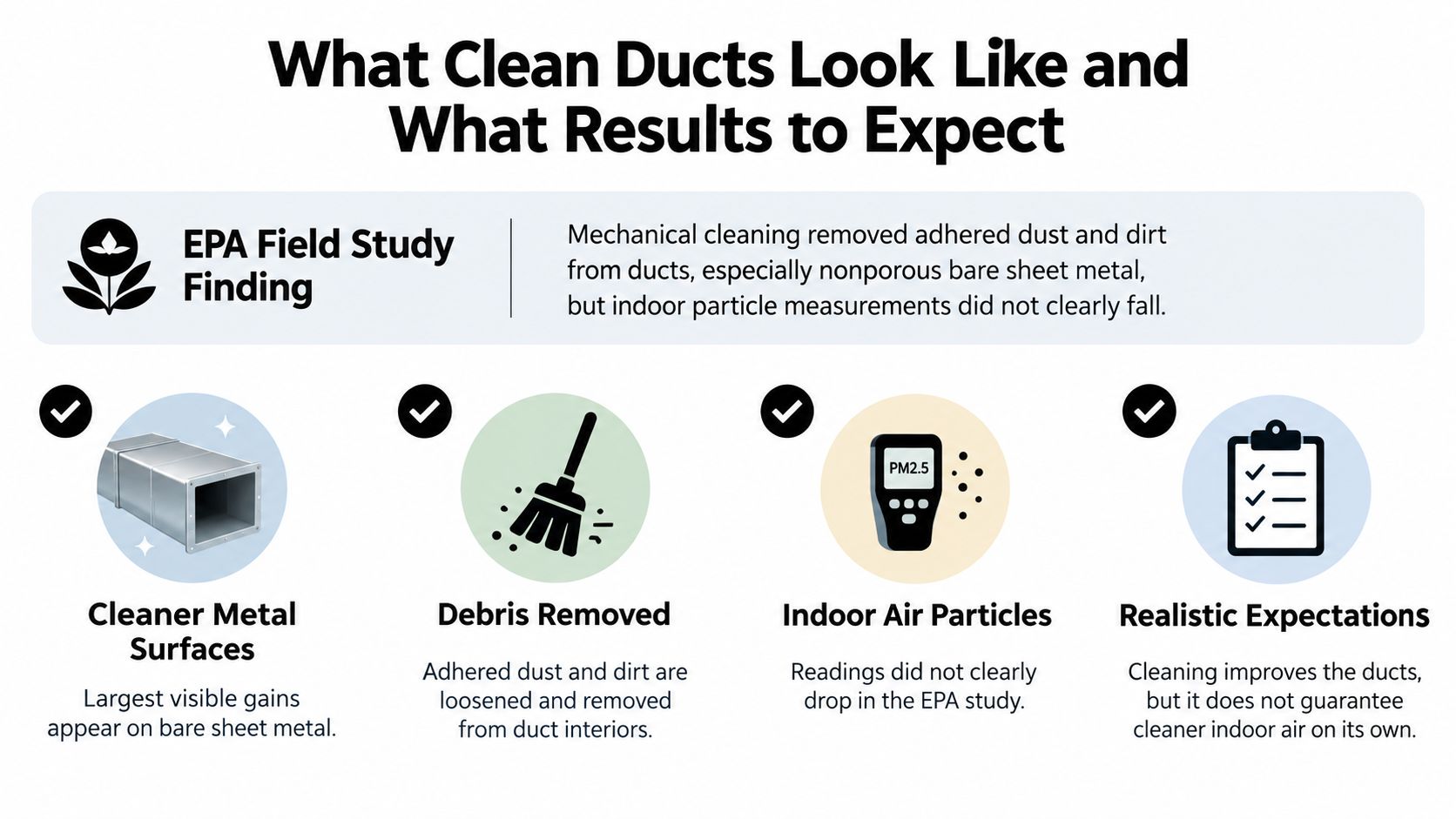
Judge the components you paid to have cleaned
Use this checklist for visible, accessible areas. Bare-metal expectations don't apply to every lined or flexible duct surface, and permanent discoloration isn't necessarily removable debris.
Component | Clean looks like | Red flag |
|---|---|---|
Branch ducts | Bare metal without a grey deposit in the visible section | Fuzzy or greasy film left on walls |
Return plenum | Loose debris removed and return cavity visibly clear | Debris pushed into a corner |
Blower wheel and housing | Blades free of dust mats and pet hair | Blades untouched because access was skipped |
Evaporator coil | Fins clear, with a reasonably even surface appearance | Dust cake bridging the fins |
Drain pan | Sludge removed and staining reduced where removable | Standing water or sludge left unexplained |
Registers and access panels | Clean grilles and properly resealed service openings | Loose panels or unexplained encapsulating treatment |
Compare photographs taken from the same opening and angle, with similar lighting. These air duct cleaning pictures can help you understand the difference between surface dust and a meaningful deposit.
Check the filter and registers after one week, and note whether visible dust returns within days. Treat rapid recurrence as a reason to investigate a remaining source, not automatically authorize another cleaning.
Acceptance standard: Ask for visible cleanliness and documented component coverage, not promises of allergy relief, pathogen elimination or guaranteed energy savings.
If a contractor uses particle measurements, ask for consistent instruments, locations and conditions. Otherwise, before-and-after readings may not provide a fair comparison.
Confirm the Provider and Scope Before You Book
Choose a provider by what they'll inspect, remove and document. A friendly booking call is useful, but it doesn't tell you whether the quoted service includes the dirty blower you really need addressed.
Keep the inspection paperwork available when comparing proposals.

Get these answers in writing
Will you inspect and document before finalizing the quote? Ask whether inspection is included in the price and how findings change the proposed work. An unexplained package price makes it difficult to know what problem you're paying to solve.
Which method will you use? Request a description consistent with the source-removal process above, including the tools appropriate for your duct material and the collection arrangement.
Does the scope match the other quotes? Compare coils, drain pan, blower, plenum and registers by name. A lower price isn't a useful comparison when important components are excluded.
Will you provide before-and-after photographs of every scoped component? Ask how inaccessible sections will be reported, rather than accepting representative pictures from whichever opening is easiest to reach.
What results are you promising? Reject guarantees that go beyond the evidence discussed above. A provider should distinguish cleaning results from medical outcomes and repair-related performance improvements.
Are filter replacement and access-panel sealing included? Confirm whether discovered repairs require separate authorization and charges before the crew performs them.
A useful starting point for discussing scope is this explanation of NADCA duct-cleaning standards. Ask the contractor how its proposed work follows those principles rather than accepting a standards reference as proof of completion.
Ask every provider, including Purified Air Duct Cleaning, to answer these questions in writing. If a contractor uses SkipCalls' contractor answering service, ask the booking representative to pass your inspection concerns and scope questions to the technician; scheduling support doesn't replace technical answers.
Request the written inspection and scope first. Then decide whether the findings match a genuine cleaning trigger, whether repairs should come first, and whether the proposal provides a way to verify completion.
Purified Air Duct Cleaning offers residential and commercial duct cleaning and HVAC coil cleaning across the Phoenix metropolitan area. Visit Purified Air Duct Cleaning to request a quote, describe the deposits or symptoms you've observed, and ask for a written inspection and component-by-component scope before booking.