

Duct Cleaning Quotes: How to Compare and Save
You've got two estimates on your phone, and they don't look like they're pricing the same house. One company quoted you over the phone in two minutes. The other wants photos, vent counts, and access to your attic before it'll commit to a number. You're not looking for the cheapest crew in Phoenix. You're trying to figure out which duct cleaning quotes describe real work, and which ones leave the expensive parts for later.
Why Two Duct Cleaning Quotes Can Vary by Hundreds of Dollars
That gap usually isn't about greed or generosity. It's about scope. One bid may cover only the supply registers you can see from the hallway. Another may include return trunks, the blower compartment, the coil, and the drain pan. Both companies call it duct cleaning, but they're not selling the same job.
Treat the quote itself as the deliverable. A useful estimate tells you what problem was found, which components will be cleaned, what method will be used, and how the crew will prove the work was done. A weak estimate gives you a total and a few reassuring words about fresher air.
Read the Assumptions Behind the Price
Start by looking for what's missing. Does the bid state how many supply and return runs are included? Does it say who cuts and reseals access panels, or whether that work costs extra on the day? If those answers aren't written down, the low number is built on assumptions you haven't agreed to.
Practical rule: If two bids differ sharply, assume the scopes differ until each company proves otherwise in writing.
Diagnosis should come before price. A technician who hasn't seen heavy accumulation, renovation debris, vermin evidence, water damage, or a fouled coil is guessing. Sometimes the honest answer is targeted component cleaning, filtration work, or no duct cleaning at all. That's not a lost sale. That's a contractor refusing to price a fix for a problem you may not have.
Ask each bidder one direct question: what did you find that justifies this work? The company that can show you inspection photos and name the affected components has earned the right to talk price. The company that leads with a discount hasn't.
The Real Factors That Drive a Duct Cleaning Quote
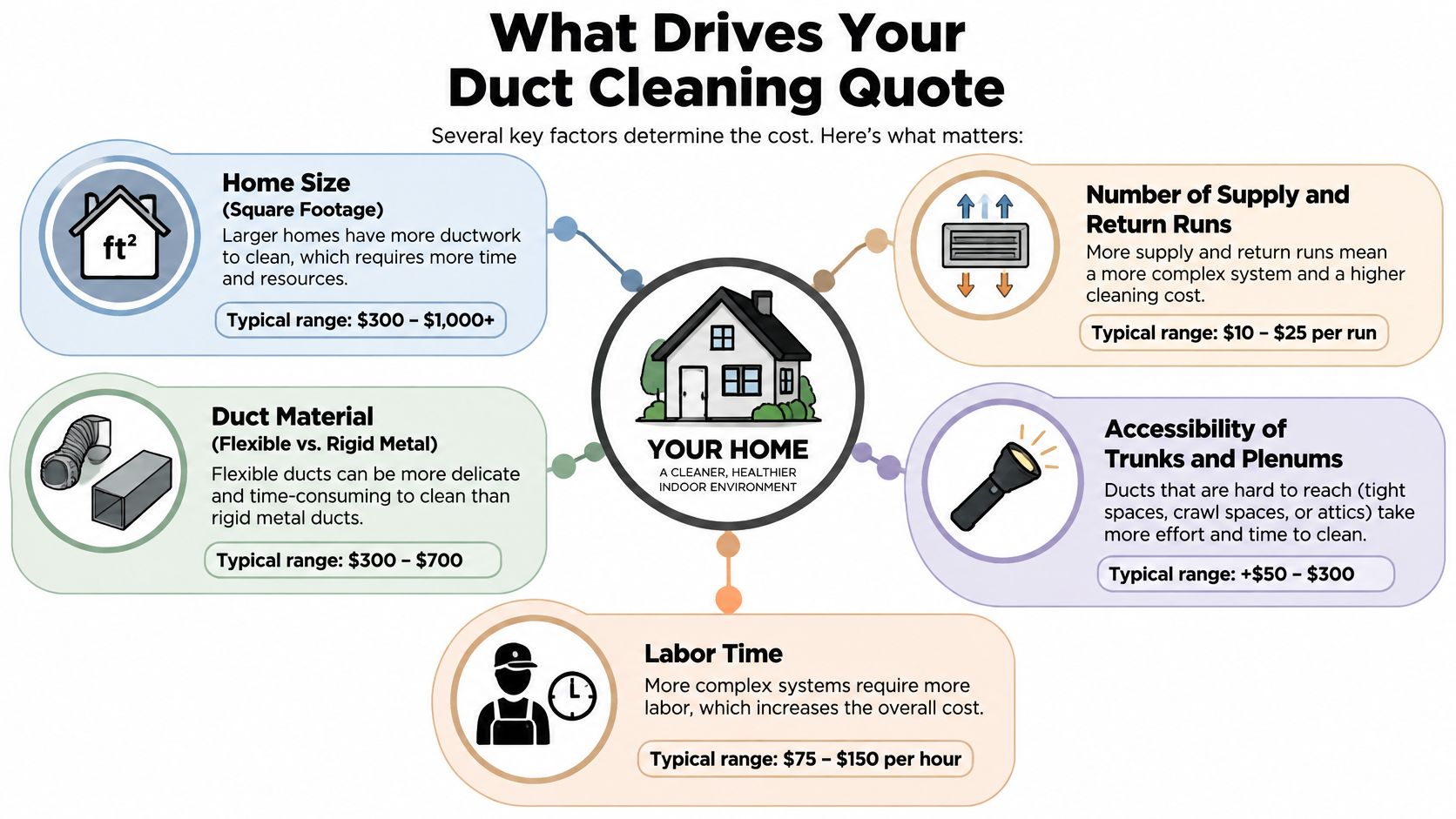
Think of your duct system like plumbing for air. Length, layout, access, and what's built up inside determine the labor. Square footage alone tells a contractor very little, which is why two homes of identical size can produce very different duct cleaning quotes.
System Layout and Access
Number of runs: Every supply register and return grille is an access point the crew must open, agitate, and vacuum. More runs mean more time.
Number of systems: A home with separate air handlers for different floors or zones has separate trunks, plenums, and blowers to set up and clean.
Duct material: Rigid metal in an open space tolerates brushing well. Flexible duct in a tight attic needs gentler agitation and slower handling to avoid damage.
Accessibility: Trunks and plenums buried behind finished ceilings or cramped attic framing take longer to reach, and access panels may need to be cut and resealed.
None of that is upselling. It's the physical reality of getting tools through your system without tearing it up. When you're weighing the real cost of air duct cleaning, match each line to a physical feature of your home, not to a sales tier.
Contamination Level
A light film of household dust is a different job from construction debris, pet hair matted into return trunks, or material left by pests. A U.S. Environmental Protection Agency field study published in 1997 to 1998 found supply-duct dust deposits before cleaning averaged 1.5 to 26.0 grams per square meter, while return-duct deposits ranged from 5.3 to 35.1 grams per square meter. That spread is the point. Contamination varies enough between homes, and between supply and return sides of the same home, to legitimately change labor time and price.
Components beyond the ducts move the number too. A quote that includes the evaporator coil, blower assembly, or a humidifier is pricing additional disassembly, cleaning, and reassembly. If one bid includes those parts and another doesn't, you don't have a price difference. You have two different jobs wearing the same label.
What a Complete Residential Quote Should Itemize
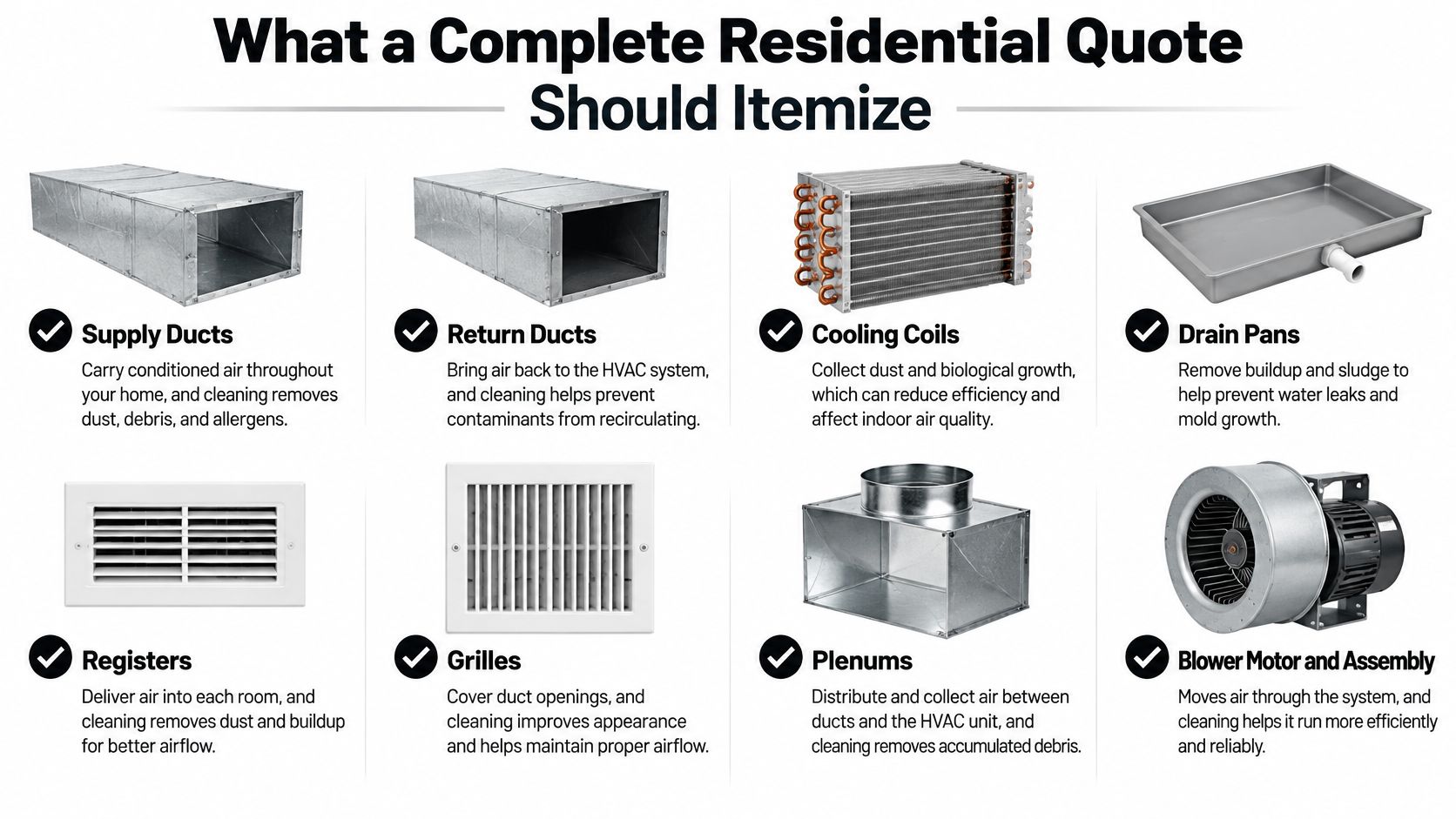
A complete quote reads like a parts list for your HVAC system. If you can't point to a component on the page, assume it isn't included. Vague language like whole house or full service means whatever the company decides it means on the day of the job.
The Component Checklist
NADCA lists supply and return ducts, coils, drain pans, registers, grilles, plenums, blower motors and assemblies, heat exchangers, filters, and air cleaners as system components a thorough quote should address, with agitation performed under continuous negative pressure. Use that list as your audit tool. Go line by line and mark each item as included, excluded, or not applicable to your system.
Supply and return ducts: Both sides matter, and returns often carry the heavier load.
Coils and drain pans: A fouled coil restricts airflow no matter how clean the ducts are.
Registers and grilles: Removal allows proper access and cleaning, not just a wipe at the opening.
Plenums and blower assembly: These move all the air in the system, so skipping them undermines the rest of the work.
Filters and air cleaners: The quote should state whether they're cleaned, replaced, or left to you.
Reading up on NADCA duct cleaning standards before you collect bids makes this audit much faster.
The Method Matters as Much as the Parts
The quote should name the cleaning mechanics: brushes, air whips, compressed-air nozzles, hand brushing, or contact vacuuming. Agitation loosens material from duct walls. Negative pressure captures it before it drifts into your rooms. A bid that describes agitation without containment is describing how debris gets redistributed through your house.
Access work belongs in writing too. If the crew needs to cut into a trunk or plenum, the quote should say so, and it should say how that opening gets sealed afterward. Print this checklist, lay your estimates beside it, and the partial bids identify themselves.
Basic Service vs Full System Cleaning Compared
Most pricing fights happen because a basic bid and a full-system bid get compared as equals. They aren't. The table below shows where the scopes typically split, so you can reclassify each estimate you've received before you judge its price.
Service Element | Basic Quote | Full System Quote |
|---|---|---|
Supply registers | Included | Included |
Return ducts and grilles | Often excluded or limited | Included |
Main trunks and plenums | Sometimes excluded | Included |
Blower motor and housing | Excluded | Included |
Evaporator coil and drain pan | Excluded | Included |
Register removal and washing | Surface wipe at best | Removed and cleaned |
Verification photos | Rarely offered | Before and after images |
Sanitizer or antimicrobial | Sold as an add-on | Quoted separately, if at all |
Where Add-Ons Fit
Add-ons aren't automatically scams, but they should never be bundled invisibly. Sanitizer application, for example, is a chemical treatment, not cleaning. It should appear as its own line with the product named, so you can decide whether you want it in your system at all. If a technician raises mold treatment, that's a different scope again. Mold remediation, insulation replacement, and duct repair are separate trades of work with separate pricing, and a duct cleaning quote shouldn't absorb or promise them.
Comparing air duct cleaning methods helps here, because the method often reveals the tier. A crew blowing compressed air through registers without negative pressure containment isn't delivering the full-system column, whatever the invoice calls it.
A low headline price with a partial scope isn't a deal. It's a down payment on a second visit.
Choose the tier based on the diagnosed problem. If inspection shows debris concentrated in return trunks and a dirty blower, a register-only cleaning won't touch your actual issue. If your system is lightly dusty and components are clean, paying for full disassembly may buy you nothing. Match scope to evidence, then compare prices within that scope.
The Health and Efficiency Claims to Question
Some quotes arrive wrapped in promises: fewer allergies, lower bills, cleaner breathing for your kids. Be blunt with yourself here. Those claims are exactly where this industry overpromises, and they're the claims you should challenge first.
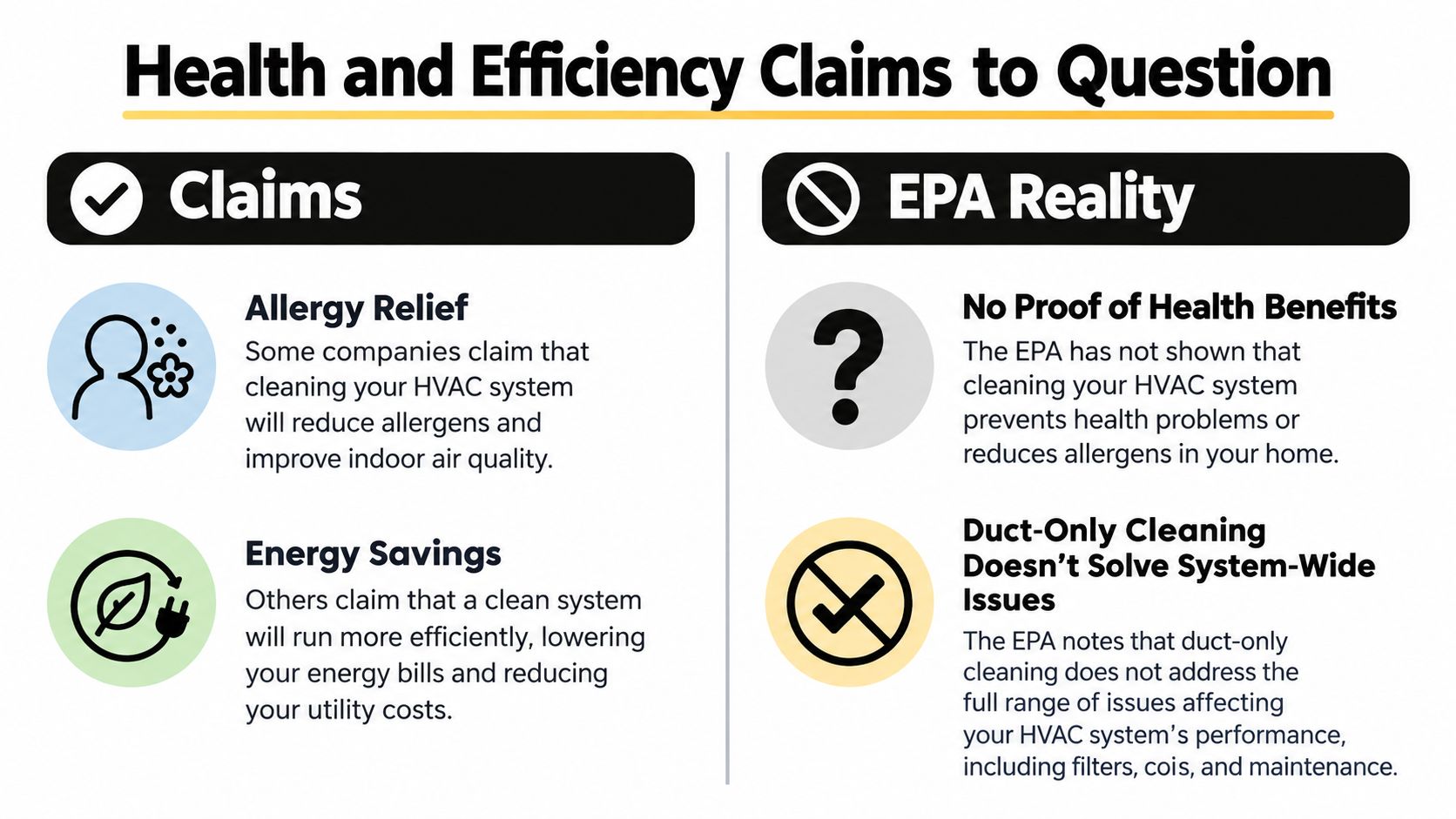
EPA guidance states that duct cleaning has not been shown to prevent health problems and that cleaning only ducts has not been shown to improve HVAC efficiency, while ENERGY STAR identifies duct sealing and insulation as the interventions that can improve heating and cooling efficiency by as much as 20 percent in some cases. Read that twice before you sign anything. The efficiency intervention with support behind it is sealing and insulating leaky ducts, not vacuuming them.
Questions That Expose Weak Claims
What will you measure? Ask for pre- and post-service airflow or static pressure readings if efficiency is part of the pitch.
Where's the contamination? A health claim without inspection photos of actual buildup is marketing, not diagnosis.
Is the problem leakage? If conditioned air escapes through bad seams in a hot Arizona attic, cleaning won't fix your bills. Sealing might.
What's excluded? Make the bidder separate debris removal, component maintenance, and leakage or insulation work into distinct lines.
A credible contractor will welcome these questions and narrow the claim to what cleaning does: remove accumulated material from the components listed. A contractor who guarantees symptom relief or a specific drop in your utility bill without measured baseline data is selling certainty nobody can deliver. Decline that bid, even if it's cheap. Especially if it's cheap.
Why a Dryer Vent Line Deserves Its Own Quote
Your dryer vent is not part of your HVAC duct system. It's a separate exhaust path carrying hot, lint-laden air, and it carries a fire risk your supply ducts don't. When a company tosses dryer vent cleaning in as a free extra, ask what that includes. A quick blast from the laundry room wall isn't verification.
National Fire Protection Association analysis of 2014 to 2018 U.S. home fires found an estimated 13,820 home structure fires per year involving dryers, with 32 percent attributed to failure to clean and 27 percent specifically to dust, fiber, or lint ignition, causing seven civilian deaths, 344 civilian injuries, and 233 million dollars in direct property damage on average each year. Failure to clean is a maintenance problem. That's precisely what a proper line item addresses.
What a Separate Dryer Vent Line Should Specify
Inspection: The full run checked, including the exterior termination and any screens or covers that trap lint.
Lint removal: Mechanical cleaning along the entire length, not just the first section behind the dryer.
Airflow verification: A measurable check after cleaning that the vent moves air freely.
Access work: Long runs, roof terminations, and vents with multiple elbows take more labor and should be priced openly.
Consider how these fires start. Lint accumulates where nobody looks, exhaust slows, heat builds, and material that's kindling sits inches from a heating element. The homeowner often had a warning sign, clothes taking longer and longer to dry, and treated it as an aging appliance instead of a blocked vent. A quote that itemizes inspection and airflow verification forces that check to happen. A bundled freebie lets everyone skip it.
If you're in the Phoenix area and your dryer runs hot or slow, get the vent quoted on its own terms. Details on dryer vent cleaning in Phoenix, AZ show what a standalone scope looks like. Don't let a safety item ride along as an afterthought in duct cleaning quotes built for a different system.
Smart Steps for Comparing Competing Quotes
Don't hire from a single estimate, and don't hire from a phone quote with no inspection behind it. Get competing bids in writing, then score them on scope and verification rather than price alone.

The Federal Trade Commission recommends obtaining multiple written estimates for home-improvement work and advises that each estimate should describe the work, materials, completion date, and price, and that the written contract should identify the contractor's name, address, phone number, and license number. Apply that standard. If a bid lacks a completion date or license number, it isn't finished yet. Send it back.
Watch a walkthrough of how a proper service unfolds before you finalize your choice, so you know what the crew should be doing in your home.
A Simple Scoring Pass
Rate each bid on four things: itemized scope, stated exclusions, verification method, and warranty or revisit terms. Ask every bidder to explain any major price gap against the others. Honest companies can do that in plain language. Also read up on spotting air duct cleaning scams before they cost you, because pressure tactics and doorstep price changes follow predictable patterns.
Reject any quote that arrives without inspection findings or photos. You're being asked to pay for removing contamination nobody has shown you. For commercial properties, add containment method, work scheduling around occupants, and waste handling to your scoring, since those controls protect people in the building while work proceeds.
Your Quote Comparison Checklist Before You Sign
Keep this beside your printed estimates and check each bid against it.
Diagnosis documented: Photos or written findings name the affected components.
Scope itemized: Ducts, coil, blower, registers, and access work listed separately.
Exclusions stated: Repairs, remediation, insulation, and treatments spelled out.
Method named: Agitation tools and negative pressure containment described.
Dryer vent separate: Inspection, lint removal, and airflow verification on their own line.
Contract complete: Price, completion date, and contractor license details in writing.
The cheapest bid missing these items is usually the most expensive one you'll buy.
If you're holding duct cleaning quotes you can't compare, send them back for itemization, then get a diagnosis-first estimate from Purified Air Duct Cleaning, which offers free quotes for Phoenix-area homes and businesses with the scope spelled out before work begins. Ask for the component list, the exclusions, and a separate dryer vent line in writing, and you'll know exactly what you're paying for before anyone opens a register.