

Benefits of Air Duct Cleaning for Healthier Homes
You wipe the coffee table, put the cleaning cloth away, and notice another dusty film the next afternoon. When the air conditioner starts, the room feels a little stale, too. It's reasonable to wonder whether something inside the vents is undoing your housekeeping.
The benefits of air duct cleaning depend on what's inside the system. Removing substantial contamination is a defensible goal. Promising that cleaning will cure allergies, eliminate household dust, or automatically lower utility bills isn't. A useful decision starts with understanding the difference.
What Lives Inside Your Air Ducts
Your ductwork is the network of passages that moves air between your heating and cooling equipment and your rooms. Supply ducts deliver conditioned air, while return ducts carry air back toward the equipment. Depending on the home, those passages may run through ceilings, walls, an attic, or other concealed spaces.
Think of them as your home's air-delivery routes, rather than its lungs. The distinction matters: ducts transport air, but they don't independently purify it. What you see on a register also doesn't necessarily tell you what's happening farther inside.
This illustration provides a useful mental map of the materials a duct inspection might encounter.
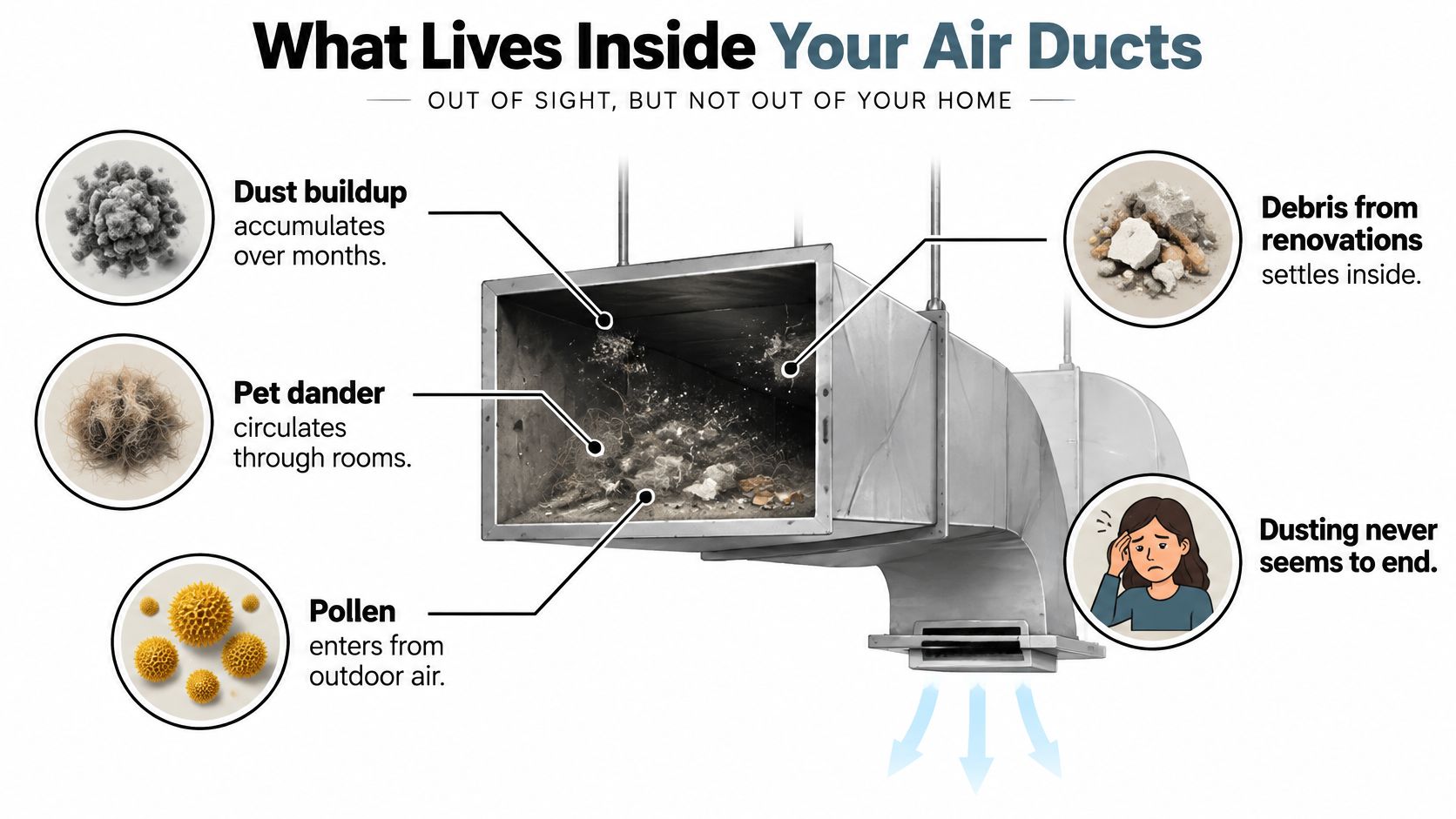
Separate clues from conclusions
Dust, hair, and renovation debris are reasons to look more closely, not proof that your entire duct system needs cleaning. Likewise, stale air or sneezing shouldn't become an automatic duct-cleaning diagnosis.
Dust around a grille: Ask whether you're seeing surface dirt or material being discharged from inside.
A suspicious patch: Request an assessment rather than assuming every dark mark is mold.
An unusual smell: Describe when it occurs and whether it follows cooling, rainfall, or another event.
For a closer look at suspicious growth, this guide to mold in air vents and a healthier home can help you prepare questions for an inspection.
Your goal isn't to make every hidden surface spotless. It's to identify contamination that warrants attention and understand whether it's connected to the problem you're experiencing.
How Contamination Builds Up Over Time
A Phoenix homeowner spends a weekend sanding drywall. By Monday, fine white powder has drifted toward the return grille, and the question is where it went after that.
A return vent pulls room air toward the equipment, and everything floating in that air travels with it. Along the way, each particle meets one of three fates: the filter catches it, it settles onto a duct surface, or it stays suspended and cycles back into the room. Only the material that stays inside becomes duct contamination. Dust you're breathing in a bedroom is a separate problem entirely.
A close-up makes substantial accumulation easier to recognize.
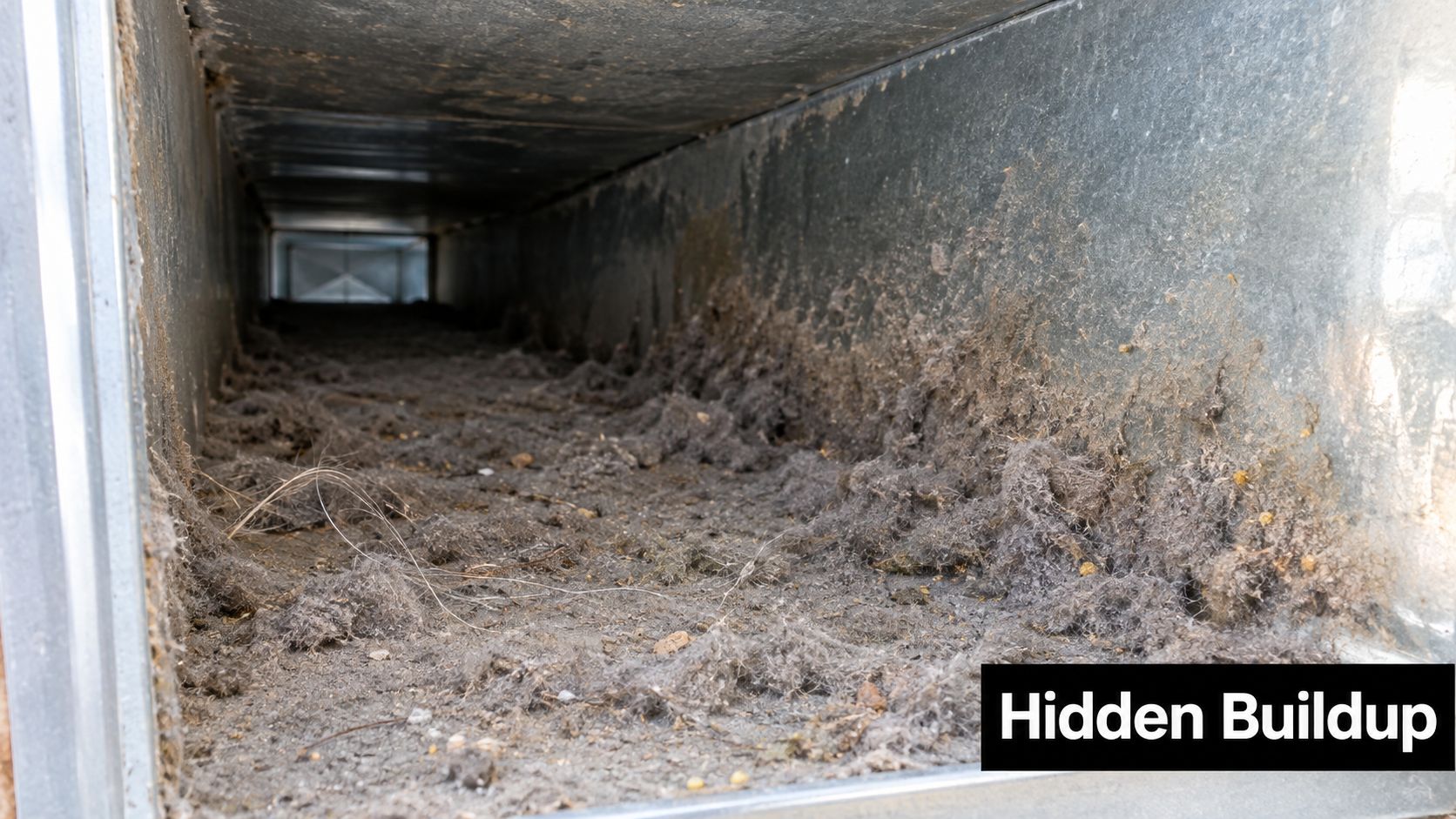
Buildup inside a duct works like plaque narrowing an artery: the comparison holds when debris restricts the passage, and it falls apart when someone applies it to a light film of dust. A photo of a dirty surface proves material exists. It cannot prove how much usable airflow space is gone.
That gap between visible dirt and functional impact is why the technician's wording matters more than the image:
What the inspection finds | What it actually indicates |
|---|---|
Settled surface dust | Material is present, but presence alone doesn't establish a performance problem |
Substantial accumulation | Enough debris is present to justify discussing targeted removal |
An actual obstruction | Material blocks a passage or component and calls for an airflow assessment |
Back to the drywall example: renovation debris sitting in an accessible return supports a targeted cleaning recommendation. A thin, undisturbed coating in the same spot supports monitoring instead.
EPA guidance draws the same line. Substantial deposits deserve attention, while ordinary surface contamination doesn't automatically justify service. The decision rests on the amount, location, and condition of the material, and the homeowner who asks "what is this affecting?" walks away with a better answer than the one who asks whether the camera found dust.
Health and Comfort Benefits: What Cleaning Can and Cannot Deliver
A homeowner pays for a full duct cleaning expecting the sneezing and stale smell to disappear. Three weeks later the house feels about the same, and the invoice feels wasted. That outcome is common, and it usually traces back to expectations rather than workmanship.
The one result cleaning reliably delivers is source removal: mechanical tools pull accumulated debris out of accessible duct surfaces, leaving measurably cleaner components. Whether that cleaner hardware translates into cleaner breathing air is a separate question.
In a 1997 EPA field study involving nine single-family homes, mechanical cleaning effectively removed adhered dust and dirt, but researchers didn't establish consistent reductions in airborne particles or significant reductions in bioaerosol or microbial density; outdoor particle levels complicated the measurements (EPA residential duct-cleaning field study).
Emptying a vacuum canister works as a comparison here. The canister is objectively cleaner afterward, but emptying it changes the air in the room only if the machine was leaking dust back out while it ran. Ducts follow the same logic: removal is documented, exposure reduction is conditional.
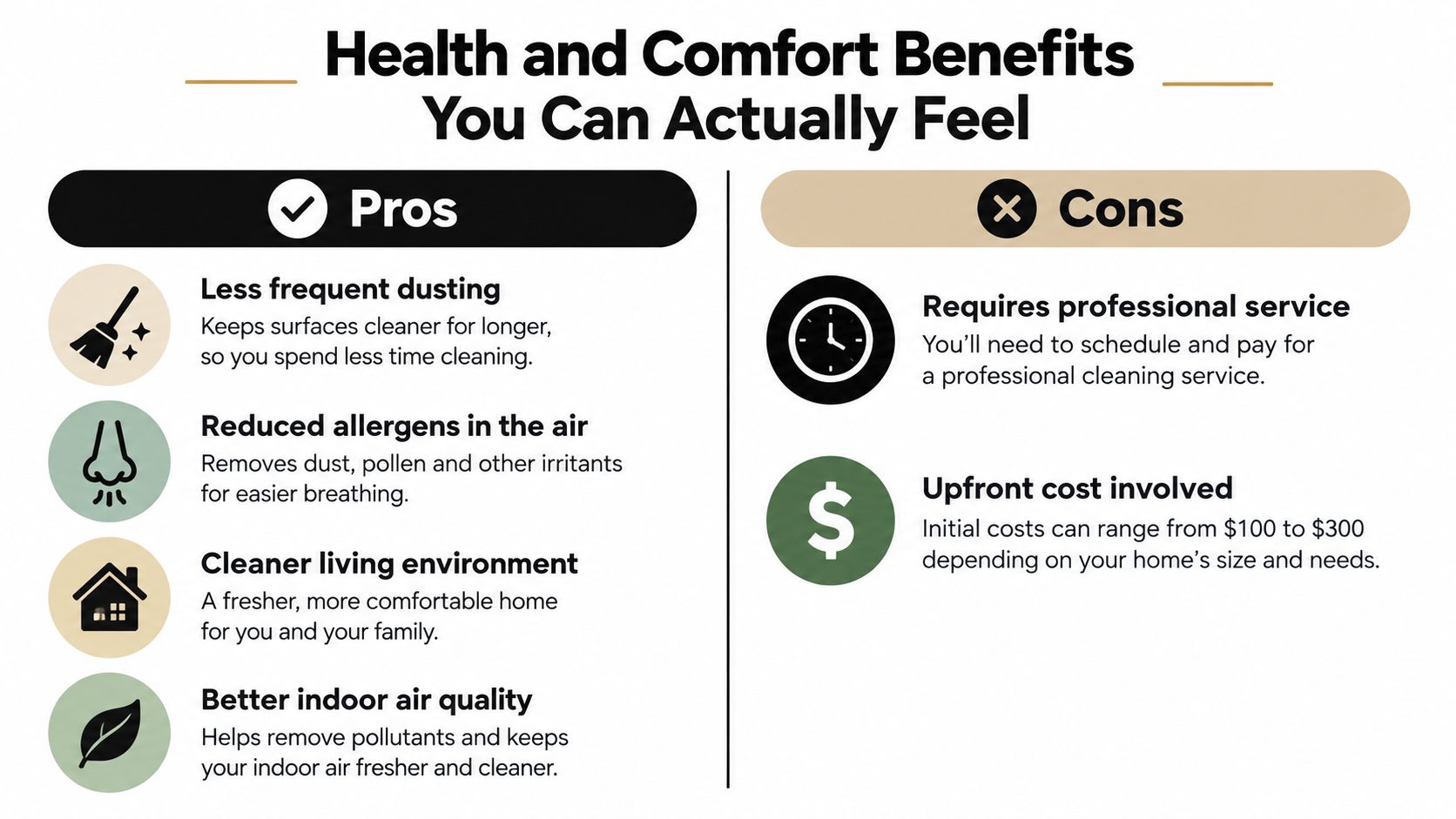
Match the benefit to the actual problem
Benefit lists like the one above describe possible outcomes, not established results for every home. Removing material that contains allergens isn't the same as demonstrating lower airborne allergen exposure. Less frequent dusting is plausible only if the system was contributing meaningfully to the dust settling on furniture.
Odor works the same way. Cleaning resolves a smell when the contaminated surface was the source. Debris inside the ducts won't explain a problem that starts in carpet padding or a drain line.
A solid expectation looks like this: documented removal of identified contamination. A conditional one looks like improved comfort, provided that contamination was feeding a household complaint. Guaranteed allergy relief and disease prevention sit outside what the evidence supports.
Persistent symptoms can also point somewhere other than the ductwork. If you're investigating musty air after monsoon dust, Restore Heroes' indoor-air-quality testing resource offers another avenue to explore before assuming the ducts are responsible.
Household members with asthma or allergies deserve accurate expectations rather than strong sales claims. This overview of indoor air quality effects on health can help frame a broader conversation about their environment, while medical questions belong with a qualified clinician and maintenance decisions stay tied to observable building conditions.
How Clean Ducts Help Your HVAC System Breathe
A furnace blower pushing air through a trunk line packed with drywall dust works like a runner breathing through a scarf: the body still moves, but every breath costs more effort. That picture fits only when debris is narrowing the path or coating the parts that move air. A thin film of ordinary dust on a duct wall can look unpleasant and still leave plenty of room for airflow.
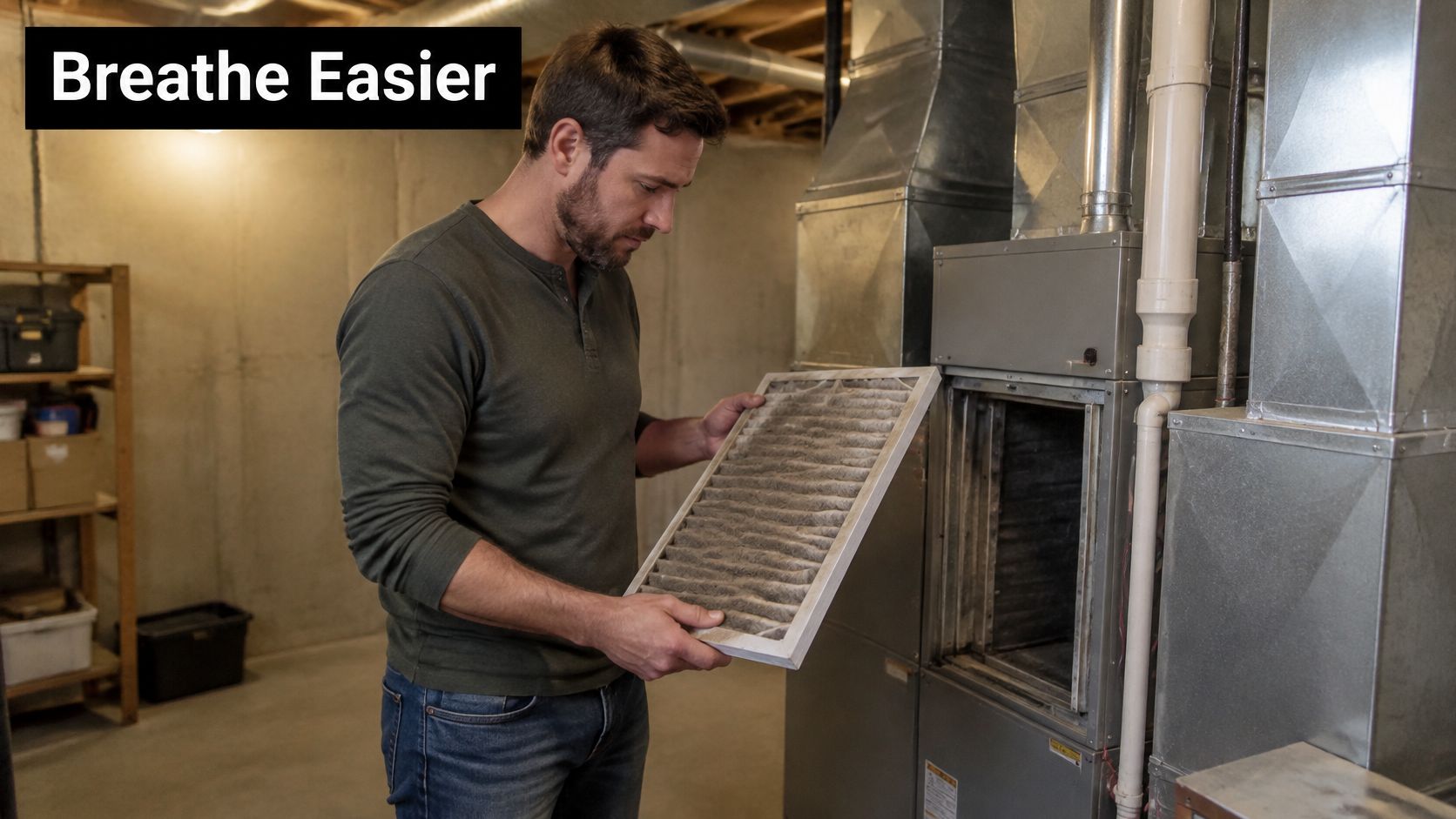
The EPA draws the useful boundary: cleaning cooling coils, fans, and heat exchangers may improve efficiency, extend operating life, and reduce energy or maintenance costs, while evidence for efficiency gains from cleaning ducts alone remains limited (EPA guidance on residential air-duct cleaning). That guidance also says cleaning has not been shown to prevent health problems and is not recommended as routine service without a specific indication.
Finding a technician can point to | Cleaning task that matches it | Claim to treat cautiously |
|---|---|---|
Debris visibly narrowing a duct passage | Source removal of that debris | “Cleaning always lowers bills” |
Accumulation on blower or coil surfaces | Component cleaning for the affected part | “Duct washing alone restores efficiency” |
A clogged or mismatched filter | Replacement under the equipment instructions | “A new filter fixes duct contamination” |
If airflow is the complaint, review whether cleaning air ducts helps with airflow to see where ductwork fits and where filters, dampers, blower speed, and duct design take over.
Use this video as a visual walkthrough, then ask what the technician found in your own system.
A strong recommendation sounds specific: “the return drop is partly blocked, here is the photo, and removing that material clears the restriction.” A weaker one bundles quieter operation, fewer repairs, and lower bills into one promise. Ask how any suspected performance problem will be checked before the work and verified afterward.
Fire Safety: What Duct Cleaning Does and Does Not Address
The laundry room is where duct-related fire risk concentrates. In a U.S. Fire Administration analysis covering 2008 to 2010, failure to clean was the leading contributing factor in 34% of residential clothes-dryer fires (USFA clothes-dryer fire report). That statistic describes dryer maintenance. It says nothing about the supply and return ducts attached to your furnace.
The confusion is understandable, since both systems move air through enclosed channels. A dryer exhaust duct works like a chimney for lint: it carries hot, moist air and combustible fibers outdoors, and residue accumulates along the route over time. Supply and return ducts move room-temperature air, and the dust inside them is not packed against a heat source. Booking a duct cleaning and assuming it covers the dryer vent is like scheduling a chimney sweep and expecting the gutters to come out clean too. The appointment only covers what the scope names.
UL's guidance gives the dryer its own maintenance schedule: clean the lint filter after every use, inspect the exhaust vent annually, and clean it when needed, following the manufacturer's operating instructions (UL guidance on mitigating clothes-dryer fires). That is a concrete, evidence-backed action, which is why it belongs in a different conversation from the softer claim that cleaning HVAC ducts prevents house fires.
Three questions keep a service call honest. First, does the estimate list the dryer exhaust route as its own line item rather than folding it into a general duct quote? Second, does the inspection cover the full route to the exterior termination, or only the section behind the appliance? Third, will the technician document what was found and removed? Clear answers separate a documented lint-removal job from a vague safety promise.
If you are organizing a wider home safety review, the Wisenet Security fire safety guide offers a broader reference, while your appliance manual and local requirements stay central to the actual decisions. When you compare vent and chimney cleaning services, ask each provider which systems they inspect and what they document. Fire-risk reduction in the laundry room comes from dryer maintenance, and that outcome is real, well supported, and worth scheduling on its own terms.
When Professional Cleaning Is Worth Scheduling
An inspection should answer a decision question: What condition would this service correct? If nobody can identify the condition, you don't yet have a clear reason to authorize the work.
The EPA guidance discussed earlier supports an inspection-based approach. Visible suspected mold, pest contamination, and substantial debris warrant a different response from an otherwise functioning system with ordinary dust. Recent renovation or persistent odor can justify investigation, but neither proves cleaning is the right remedy.
Triggers That Justify Professional Duct Cleaning
Trigger | Primary Benefit | Service Needed |
|---|---|---|
Confirmed mold growth inside ducts or on relevant components | Address identified contamination | Qualified assessment, moisture correction, and appropriate cleaning or material replacement |
Evidence of vermin infestation | Remove contaminated material | Pest control and entry-point correction, followed by suitable cleanup |
Substantial debris released from supply registers | Remove a documented debris source | Inspection and targeted duct cleaning |
Renovation material found inside ductwork | Remove construction residue | Post-project assessment and cleaning where deposits are confirmed |
Persistent unexplained odor | Identify and address the actual source | Diagnostic inspection before selecting treatment |
Heavy accumulation associated with restricted airflow | Remove the identified restriction | HVAC assessment and cleaning of affected passages or components |
Not every row calls for cleaning as the first action. For suspected mold, identification and the underlying moisture condition matter. For pest contamination, removing debris without addressing access leaves the original problem unresolved.
Before approving work: Ask for photographs of your system, an explanation of the finding, and a written description of the proposed remedy.
Property managers can apply the same decision logic to larger buildings. Renue Systems Four Points' commercial HVAC cleaning services provide a relevant service reference when exploring commercial options, but a provider's offering shouldn't replace a building-specific assessment.
For homeowners deciding when to revisit the question, this guide to duct-cleaning frequency can support a conversation about conditions and maintenance history. Use findings to determine timing, rather than treating the calendar alone as evidence that contamination needs removal.
Common Misconceptions About Duct Cleaning
A homeowner can reasonably support professional duct cleaning and still reject exaggerated claims. The useful question isn't whether the service is always good or always unnecessary. It's whether the proposed work fits the condition of the system.
Consider a sales pitch that promises allergy relief, lower bills, and a dust-free home before anyone has inspected the equipment. Those are separate outcomes with different causes. Combining them into a package doesn't make the evidence stronger.
Claims worth questioning
Common claim | A more defensible interpretation |
|---|---|
Cleaning eliminates allergies | Removing deposited material doesn't establish symptom relief |
Every home needs cleaning on a fixed schedule | Timing should reflect system conditions and findings |
A dusty vent proves the whole system is contaminated | The visible surface is a starting point for inspection |
A quick vacuum at the register equals complete cleaning | The contractor must explain which surfaces and passages the work reaches |
A cleaner duct guarantees cleaner room air | Surface cleanliness and airborne exposure are different outcomes |
The earlier EPA field study illustrates the last distinction. Researchers documented physical removal without establishing a consistent whole-home particle benefit. That's not an argument against removing substantial contamination; it's an argument against promising more than the work demonstrates.
Evaluate the process, not the slogan
Ask the contractor to describe how they'll dislodge, capture, and remove the material they found. Request an explanation of how they'll protect occupied rooms and avoid leaving loosened debris behind. These questions help distinguish a defined source-removal job from superficial attention to visible grilles.
Ask for boundaries: Which supply ducts, return ducts, and equipment components are included?
Request evidence: What will show that the identified material was removed?
Challenge add-ons: What specific finding justifies each additional treatment?
You don't need a dramatic health promise to justify a useful maintenance task. A documented contamination problem, a suitable removal method, and a clear scope make a stronger case than a list of benefits that nobody can verify in your home.
Your Practical Next Steps for Cleaner Air
Start with observations you can describe. Note which room feels stale, when an odor appears, and whether material seems to leave a register when the system operates. Avoid turning those observations into a diagnosis before someone examines the equipment.
Then organize a maintenance conversation around the systems involved, rather than requesting every available cleaning service.
Bring this checklist to your next appointment
Inspect accessible vent surfaces: Record what you can see without reaching into concealed ductwork or disturbing suspected contamination.
Review dryer maintenance separately: Check the lint-care instructions and arrange an exhaust assessment when needed.
Request an HVAC inspection first: Ask the technician to examine relevant ducts, filters, coils, and fans before recommending cleaning.
Ask about the cause: If there's moisture, pest activity, or an obstruction, find out what corrective work belongs alongside removal.
Confirm filter compatibility: Discuss an appropriate replacement or upgrade with the equipment's requirements in mind.
Get a defined scope: Keep duct cleaning, coil cleaning, repairs, and dryer vent work identifiable on the estimate.
Choose a result you can verify
Decide what success means before authorizing service. That might be removal of visible renovation debris, correction of an identified restriction, or a properly maintained dryer exhaust route. Don't accept a promise of symptom relief as a substitute for documented work.
The most useful plan combines targeted cleaning, appropriate filtration, and equipment maintenance. It addresses your home's actual conditions while preserving realistic expectations about air quality, performance, and safety.
For homeowners comparing service options, Purified Air Duct Cleaning offers air duct cleaning, dryer vent cleaning, and HVAC coil cleaning across the Phoenix metropolitan area. Visit to request a quote and discuss which service fits the debris, airflow concern, or dryer-maintenance need identified in your home.