

Benefits of Cleaning Air Ducts, and Their Limits
You wipe the dust from a bedroom vent, but the room still feels warmer than the hallway. Meanwhile, the dryer needs another cycle, and someone in the house seems to sneeze more indoors. It's reasonable to wonder whether cleaning the air ducts could help, but those observations don't necessarily point to the same problem.
Why Duct Cleaning Gets So Much Attention
A dusty register is easy to notice. The condition of the duct behind it, the cooling coil, or a connection above the ceiling is much harder to judge. That gap between what you can see and what you can't is why duct cleaning attracts so much attention.
For homeowners, the questions usually involve comfort, housekeeping, and utility bills. Facility managers may also hear complaints about stuffy offices or uneven temperatures. Families concerned about allergies want to know whether the air circulating through the building is making symptoms worse.
Dirty-looking vents are a clue, not a diagnosis.
The concern about indoor air is understandable. The EPA's indoor-air-quality overview reports that Americans spend approximately 90% of their time indoors, where concentrations of some pollutants are often 2 to 5 times higher than typical outdoor concentrations.
That same overview identifies dust mites, mold, pet dander, tobacco smoke, cockroach allergens, and particulate matter as potential asthma triggers. It doesn't identify dirty ducts as the sole cause of increased indoor pollution.
Start With the Problem You Want to Solve
Your reason for considering service should shape the inspection. A dusty grille calls for a different investigation than a room with weak airflow or a dryer that isn't exhausting properly.
Before booking, separate your concerns:
Comfort: Which rooms feel warmer, colder, or less ventilated?
Cleanliness: Is dust limited to register surfaces, or is substantial material visible inside?
Health: Do symptoms follow particular rooms, activities, pets, or moisture conditions?
Safety: Is the concern about the HVAC system, or about lint in the dryer exhaust?
These distinctions matter in the Phoenix area, where long cooling seasons make dependable air delivery especially important. They don't establish a local savings figure or prove that cleaning is the right repair.
The most useful way to judge the benefits of cleaning air ducts is to keep separate outcomes separate. Restored airflow, reduced dryer-vent hazards, symptom relief, and lower energy use require different evidence. A responsible service recommendation should identify which outcome is realistic for your building.
What Cleaning Air Ducts Actually Changes
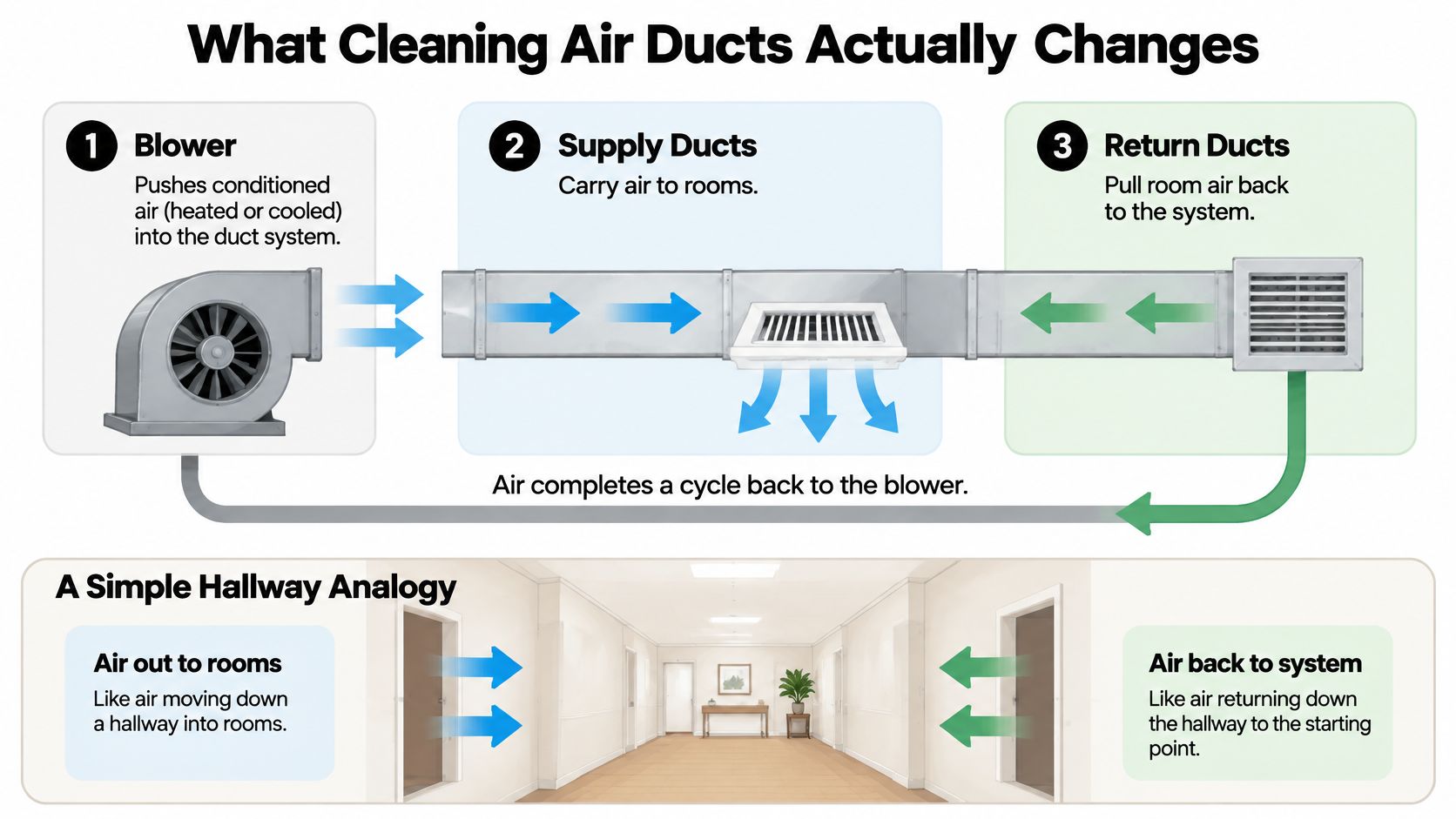
Think of your ductwork as a network of hallways. The blower moves air through the system, supply ducts carry conditioned air toward rooms, and return ducts provide the route back.
Dust, pet hair, and renovation debris can accumulate along that route. Cleaning addresses material deposited on accessible surfaces. It doesn't automatically change everything carried in the air.
The diagram shows the basic circulation path.
Cleaning the Pathway
A written cleaning scope should identify the accessible duct interiors, registers, grilles, and related components the technician intends to address. Don't assume that a quote for ducts includes the blower housing, cooling coil, or every concealed branch.
Ask how technicians will loosen deposits and collect the material without spreading it through occupied rooms. The explanation should connect the equipment and technique to your duct material and access conditions. A comparison of air-duct cleaning methods can help you prepare those questions.
The distinction between cleaning and repair is straightforward:
Task | What it addresses |
|---|---|
Removing deposited debris | Material inside the accessible air pathway |
Sealing a disconnected joint | Air escaping through a connection |
Correcting duct sizing | A pathway that can't deliver the intended airflow |
Repairing insulation | Unwanted heat transfer through duct surfaces |
A cleaner hallway is still the same size. Likewise, removing dust doesn't enlarge an undersized duct or reconnect a separated section.
The Sources Still Need Attention
Cooking, smoking, pets, outdoor air, and moisture can continue introducing pollutants after a cleaning visit. These sources need their own controls.
Filtration: Ask whether the installed filter fits correctly and suits the equipment.
Ventilation: Have appropriate outdoor-air and exhaust arrangements evaluated.
Source control: Address smoke, recurring moisture, and other identifiable contributors rather than relying on downstream cleaning.
For example, removing pet hair from a return doesn't stop a pet from shedding. Removing deposited renovation debris doesn't capture dust still being generated by unfinished work.
Cleaning changes the condition of the pathway when unwanted material is present. Keeping the pathway cleaner afterward requires attention to what enters it.
Airflow Gains You Can Measure
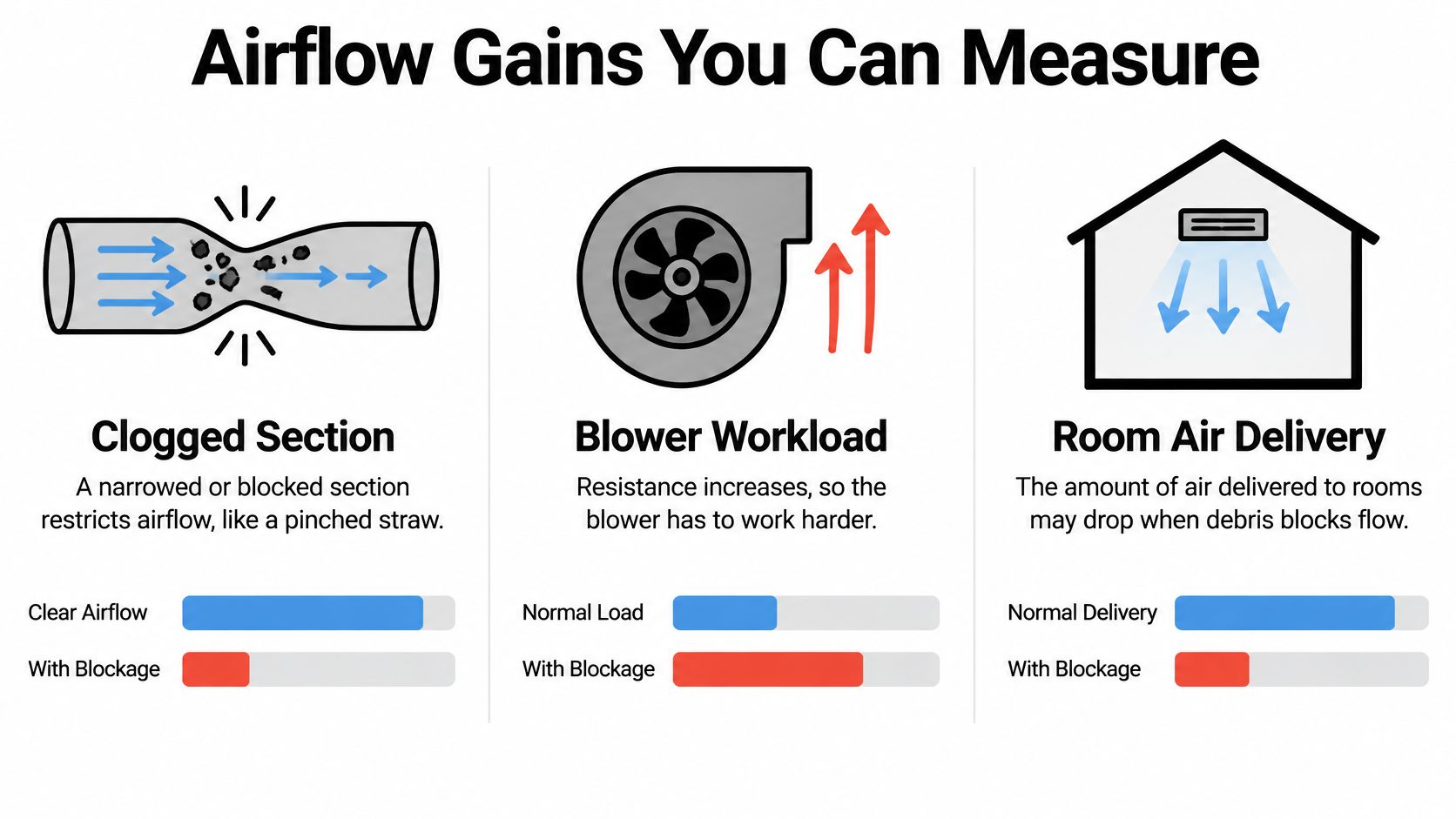
A heavily obstructed duct section can behave like a pinched straw. The passage offers more resistance, and less air may reach the intended room. Removing the obstruction can improve delivery, but only if that obstruction was limiting airflow.
The visual below illustrates that relationship without assuming every dusty duct is restricted.
What the Field Measurements Found
In an EPA field study of nine single-family homes, cleaning removed accumulated duct-surface material, and measured supply-air rates increased by 4–32% in eight homes, while return-airflow rates increased by 14–38% in two homes. The same study found no clear reduction in indoor particle concentrations and no significant decline in microbial or bioaerosol density.
Outdoor particles strongly influenced the indoor measurements. That helps explain why a physical change inside the ducts didn't translate into a clear improvement in the broader indoor-air measurements.
The study supports a limited, useful conclusion: airflow can improve after cleaning contaminated ductwork. Its measured ranges aren't a forecast for your home, and they shouldn't become a promised result in a sales estimate.
Practical rule: Ask the technician to identify the restriction before promising to restore airflow.
Build a Before-and-After Record
A photograph can establish that debris was present. It can't, by itself, establish how much the debris affected air delivery. For that, ask for observations and measurements tied to the complaint.
A useful record includes:
Visible conditions: Photographs identifying the affected duct or register.
Filter condition: Notes about loading, fit, and any obvious bypass around the filter.
Coil cleanliness: A check for deposits on nearby HVAC components.
Airflow or pressure readings: Measurements at relevant locations, with the test conditions recorded.
Comparisons are more meaningful when the technician checks the same locations under comparable operating conditions. Otherwise, a changed fan setting or filter could complicate the interpretation.
For a deeper explanation of the distinction between dust removal and restored delivery, review whether cleaning air ducts helps with airflow.
If a room remains uncomfortable after deposits are removed, the next step is diagnosis, not another promise about cleaning. The defensible performance target is improved air delivery where a restriction existed, not guaranteed relief from allergies or asthma.
Energy and Health Claims That Need Limits
Cleaner ducts and a more efficient HVAC system aren't interchangeable claims. A technician may discover conditions that waste energy during a cleaning inspection, but discovering those conditions doesn't mean dust caused them.
Department of Energy guidance places typical residential duct energy losses at approximately 25% to 40% before conditioned air reaches occupied spaces. That estimate concerns total duct-system losses, not savings recoverable through cleaning; NIST's heat-pump installation-fault analysis separately identifies duct leakage and inadequate airflow from poorly configured or undersized ducts as important performance problems.
Protected duct locations can have lower losses, while exposed routes such as hot attics can lose more. Leakage, poor connections, inadequate insulation, and installation conditions can matter even when the duct interiors look clean.
Match the Correction to the Cause
NIST also describes how leakage in hot climates can increase indoor humidity, potentially prompting occupants to lower thermostat settings. Removing deposits doesn't resolve that chain of problems unless deposits are part of the actual restriction.
Similarly, EPA research has not established realized energy and ventilation-efficiency gains from duct cleaning alone. A savings estimate should therefore name the correction behind it, such as sealing leakage or resolving a measured airflow problem.
Duct Cleaning Claims and What They Can Prove
Claim | Supported when | Not proven by cleaning alone |
|---|---|---|
Better comfort | Debris was restricting delivery to occupied rooms | Balanced temperatures throughout the building |
Lower energy use | A diagnosed system fault is corrected and results are measured | A predictable utility-bill reduction |
Better health | Identified contamination is addressed within a broader indoor-air plan | Prevention of illness or reliable symptom relief |
Greater safety | An obstructed dryer exhaust is cleared | That residential air-duct cleaning prevents dryer fires |
Keep Health Decisions Separate
The EPA's position is that duct cleaning hasn't been shown to prevent health problems. Its condition-based approach focuses on substantial debris, pest infestation, and significant visible mold concerns rather than treating cleaning as a medical intervention.
Readers managing respiratory symptoms can use this explanation of air-duct cleaning and asthma to frame questions without replacing medical advice. Engle Services' resource on reducing allergen buildup in air ducts offers another maintenance topic to discuss alongside filtration and source control.
The buying decision should follow the diagnosed condition, not the size of the promised health or energy benefit.
Real Situations Where Cleaning Earns Its Place
The following are illustrative situations, not customer case studies. Each starts with an observable condition and leads to a different decision.
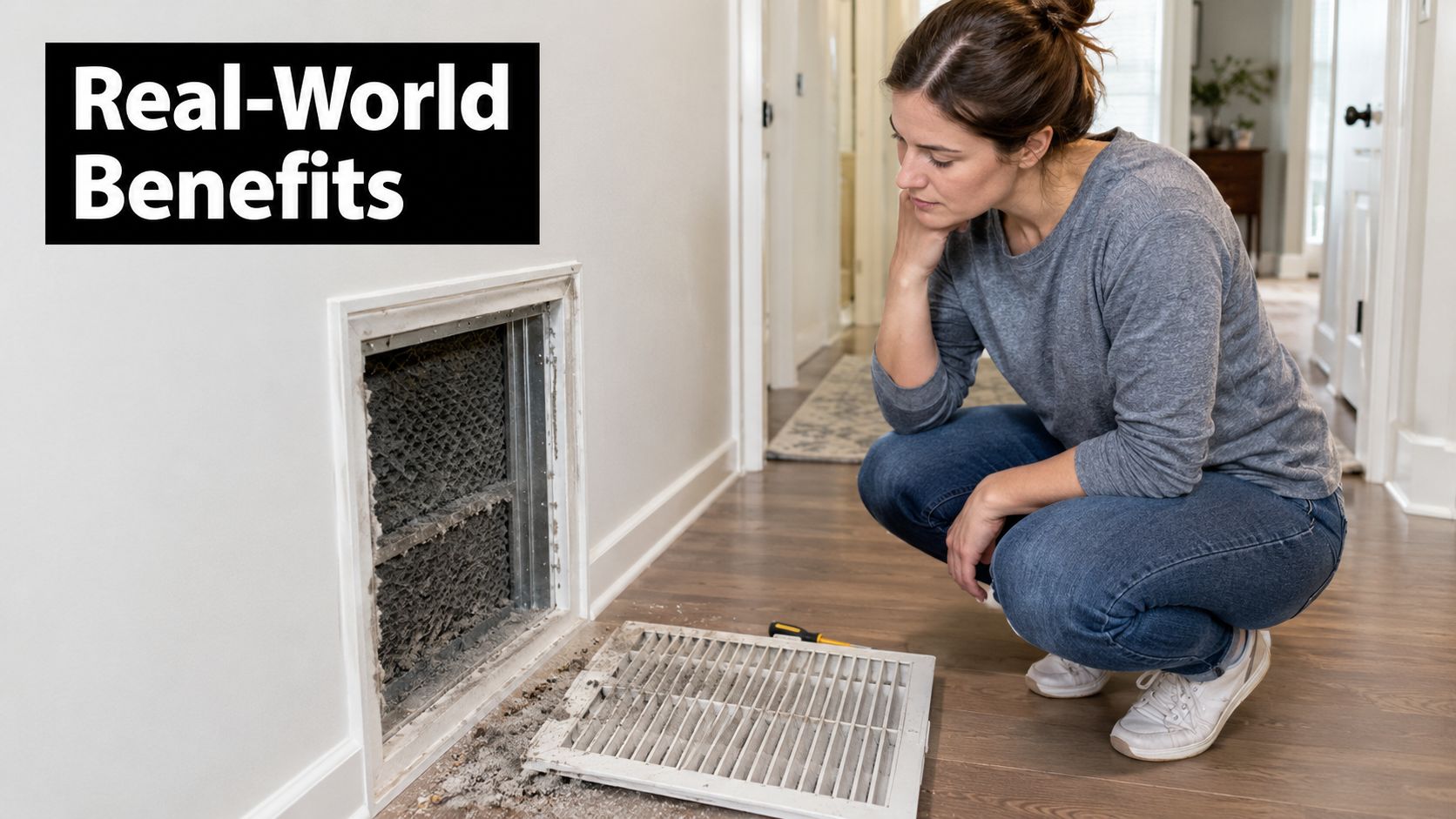
A dusty register can prompt an inspection, but the inspection should establish what's behind it.
Renovation Debris, Pets, and Workplace Complaints
After remodeling, a homeowner might find visible construction debris inside a return. That's a concrete reason to investigate the affected pathway, not schedule cleaning just because a renovation occurred. This guide to duct cleaning after renovation can help prepare that inspection.
A pet household presents a different problem: dander and hair may keep returning unless the owner also addresses collection at the source and filtration. An allergy sufferer noticing musty odors needs moisture and pollutant sources investigated, not an assurance that dust removal will resolve symptoms.
In a commercial space, weak delivery at a workstation calls for an airflow assessment. If the coil is dirty, that component needs its own evaluation rather than being treated as proof that every duct requires cleaning.
Useful decision cues are:
Visible renovation debris: Inspect the affected branches and document the extent.
Recurring pet-related material: Combine targeted cleaning, if justified, with ongoing source management.
Persistent symptoms or odors: Investigate the wider indoor environment.
Workplace comfort complaints: Measure delivery and assess nearby equipment.
Dryer Vents Have Different Evidence
NFPA estimated an annual average of 13,820 home clothes-dryer fires during 2014–2018, causing 7 civilian deaths, 344 civilian injuries, and $233 million in direct property damage; failure to clean contributed to 32%, and dust, fiber, or lint was first ignited in 27%, according to its home dryer and washing-machine fire report.
Lint-restricted exhaust can contribute to longer drying times and combustible buildup. That supports a dryer-vent safety inspection, not a health claim about HVAC ducts.
Keep these different service categories in mind when reviewing the accompanying video.
For Phoenix-area cooling complaints, ask the technician to inspect attic duct routes, insulation damage, and disconnected sections. Clean accessible contamination where warranted, but keep necessary repairs on a separate, clearly described scope.
How to Choose a Duct Cleaning Service
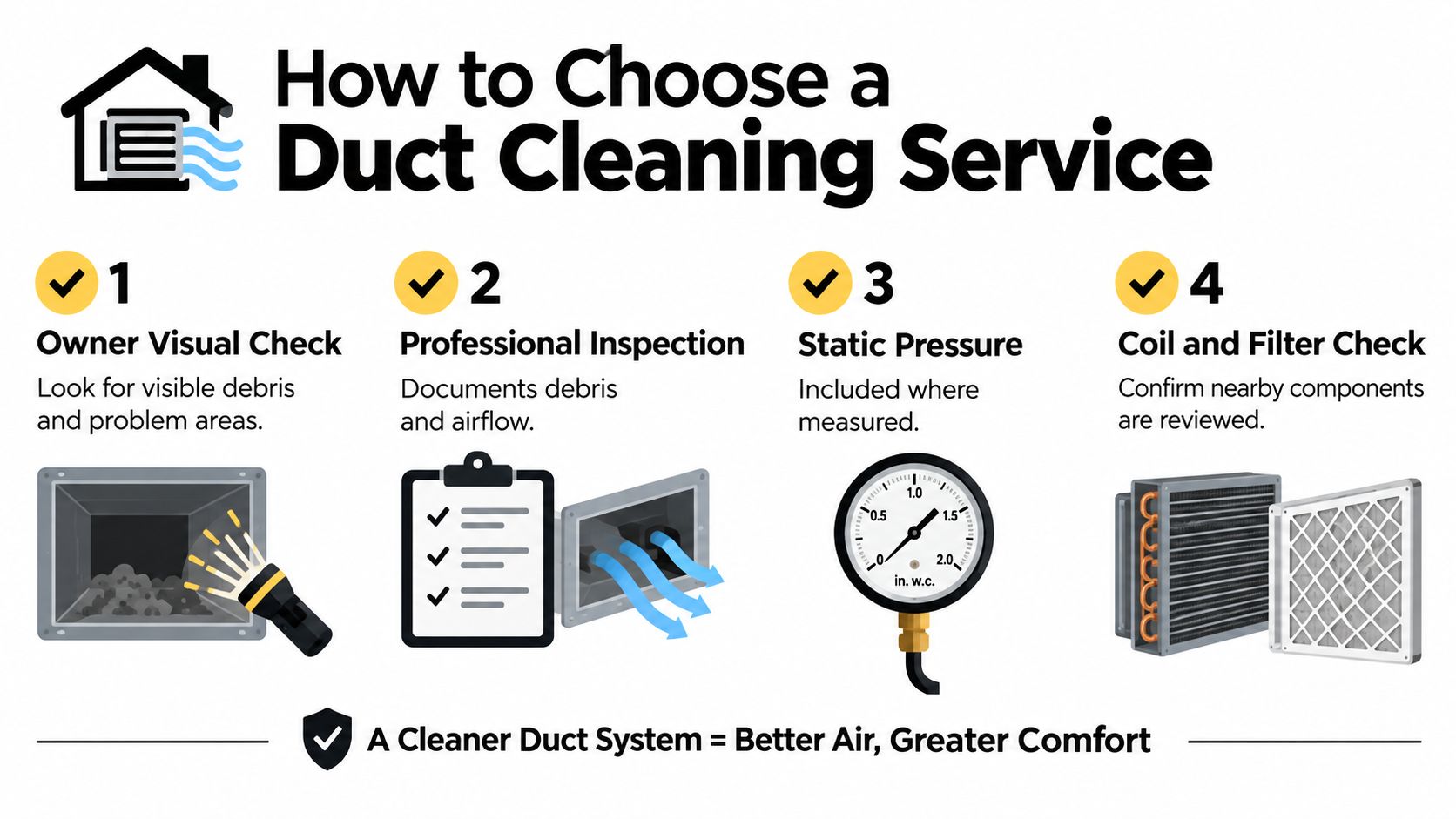
Start with what you can observe safely, then hire for what you can't establish yourself. An owner can photograph accessible registers and note problem rooms. A professional should document hidden conditions and explain whether they justify cleaning, repair, or further testing.
Don't reach into concealed ducts or disturb suspected mold or pest material to gather evidence. You need enough information to describe the concern, not perform the inspection yourself.
This checklist summarizes the distinction between an owner's observations and a professional assessment.
Compare the Scope, Not Just the Quote
A useful estimate identifies the components, access limitations, debris-containment method, and evidence you'll receive afterward. If measurements are proposed, ask which ones and why they're relevant.
Use these questions when comparing providers:
Access: Which supply branches, returns, registers, and equipment components are included?
Containment: How will loosened debris be collected and occupied areas protected?
Documentation: Will photographs identify the same locations before and after?
Testing: Will airflow, static pressure, coil condition, filter condition, or dryer restriction be assessed?
Chemical treatments: Why is an antimicrobial product being proposed, and what condition makes it necessary?
A review of NADCA duct-cleaning standards can help you ask more precise process questions. Ask providers to identify their technicians' actual credentials rather than treating a general reference to standards as proof of certification.
Evaluate Local Services and Add-Ons Separately
Purified Air Duct Cleaning is an Avondale, Arizona option serving residential and commercial clients across the Phoenix area, including Phoenix, Glendale, and Mesa. Its stated offerings include certified technicians, free quotes, flexible payment options, and separate duct, dryer-vent, and HVAC coil-cleaning services.
The company also offers in-duct and portable ActivePure systems, describing the technology as developed in partnership with NASA and claiming airborne and surface pathogen decontamination without harmful byproducts. Treat those as product claims requiring supporting documentation, not as evidence of what duct cleaning accomplishes.
For any purification add-on, request the applicable test report, operating conditions, installation requirements, and safety information. Ask how the tested conditions compare with your occupied building.
Duct cleaning, coil cleaning, dryer-vent cleaning, and air purification solve different problems. A sound proposal explains each recommendation independently instead of packaging them as a guaranteed health treatment.
Your Next Step for Cleaner Indoor Air
Prepare a short condition record before requesting an inspection. That gives the technician a useful starting point and helps you compare recommendations against what you observed.
Photograph accessible register faces, the area around the air handler, and the dryer's exterior vent from a safe location. Note which rooms run hot or cold and whether the problem changes when doors are open or closed.
Gather Observations Without Diagnosing Them
Record symptoms and conditions in plain language. “Musty odor near the hallway return when cooling starts” is more useful than deciding that the entire duct system contains mold.
Include the following in your notes:
Timing: When odors, discomfort, or allergy symptoms occur.
Location: The rooms and registers involved.
Visible concerns: Suspected mold, pest signs, loose material, or damaged components.
Dryer behavior: Longer drying cycles or an exterior outlet that appears obstructed.
Leave suspected contamination undisturbed. A photograph and a location description are enough to raise the issue for professional assessment.
Request a Decision You Can Verify
Ask for a written scope that separates ducts, coils, and dryer exhaust. Each proposed task should have a reason, an expected result, and a way to show completion.
Before accepting a promise about bills or symptoms, request the supporting findings. Photos may demonstrate removal of deposits; airflow measurements may demonstrate restored delivery. Neither automatically establishes a medical outcome.
The EPA's guidance on deciding whether to clean home air ducts supports this as-needed approach rather than automatic routine treatment.
Pair justified cleaning with a filter suited to the system, moisture corrections, and removal of obvious pollutant sources. Homeowners, facility managers, real estate agents, and families concerned about dryer lint can all use the same principle: inspect first, then authorize work that matches the findings.
In Avondale or the wider Phoenix metro, request a local inspection and written quote. The right next step may be targeted cleaning, a repair, or continued monitoring, but it should follow a documented look at the actual system.
Purified Air Duct Cleaning offers residential and commercial duct, dryer-vent, and HVAC coil cleaning across the Phoenix area. Visit Purified Air Duct Cleaning to request a free quote, discuss your photos and problem rooms, and ask for a scope tied to the conditions found.