

What Are Airborne Pathogens and How They Spread
Airborne pathogens are disease-causing microorganisms, such as viruses, bacteria and fungal spores, that travel in tiny airborne particles and stay infectious as they move through air.
You might be reading this in a shared office, a waiting room or a living room with the air conditioner running. The room feels comfortable, and the surfaces look clean, but neither observation tells you whether someone has released infectious particles or where the ventilation system will carry them.
What Airborne Pathogens Are in Plain Terms
Say two colleagues share a small office. One has a respiratory infection, and the other becomes ill after spending time breathing the same room air, without touching their colleague or sharing equipment. That's a possible airborne exposure, although illness alone wouldn't prove exactly where or how transmission happened.
The answer to what are airborne pathogens starts with a distinction: the pathogen is the organism that can cause disease; the airborne particle is its means of transport. Suspended particles containing biological material are called bioaerosols. Not every bioaerosol contains a pathogen, and not every pathogen remains infectious after entering the air.
A familiar workspace can therefore involve exposure that surface cleaning alone doesn't address.
Transmission routes compared
Route | Particle size | How far it travels | Example |
|---|---|---|---|
Airborne | Tiny respirable particles, including dried droplet residues | Across a room and potentially beyond, carried by air currents | Measles, tuberculosis |
Droplet | Larger respiratory droplets that settle more readily | Primarily close to the source, not a fixed boundary | Close face-to-face respiratory spread |
Contact | Fluid or particles transferred through hands and surfaces | Requires physical contact, followed by transfer to a susceptible site | Touching a contaminated surface, then touching the eyes or nose |
Airborne describes a transmission route, not a single disease category. Some infections can spread through more than one route, so these categories help explain exposure rather than create perfectly separate boxes.
The important distinction is whether infectious material stays suspended long enough for someone else to inhale it, including after the original respiratory fluid has evaporated. A surface can look spotless while the surrounding air still contains suspended particles.
The building matters too. Comparing indoor air quality with outdoor air quality helps explain why a comfortable enclosed room isn't necessarily a well-ventilated one.
Viruses, Bacteria and Fungal Spores Compared
Viruses, bacteria and fungal spores are microscopic, but organism size isn't the same as airborne carrier size. A virus can travel inside a respiratory particle containing water, salts, proteins and other material. That whole particle, not just the virus inside it, determines much of its behaviour in air.
This distinction prevents a common mistake: assuming the smallest organism must always float longest. A virus inside a relatively large respiratory droplet can settle sooner than a bacterial cell carried in a smaller particle.
Airborne organisms by size, example and health outcome
Organism | Typical size | Airborne examples | Health outcomes |
|---|---|---|---|
Viruses | Smaller than bacterial cells; carrier particles can be much larger than the virus | Measles, influenza, SARS-CoV-2, varicella-zoster | Respiratory infections, measles, chickenpox |
Bacteria | Cell dimensions differ by species; airborne behaviour follows the carrier particle | Mycobacterium tuberculosis, Legionella from water aerosols | Tuberculosis, Legionnaires' disease |
Fungal spores | Generally larger than individual viruses; dimensions differ by species | Aspergillus, Cladosporium, Penicillium | Allergic reactions, asthma flares, aspergillosis in susceptible people |
Different organisms enter indoor air in different ways
Respiratory viruses often enter shared air through an infected person. The Environmental Protection Agency's guidance on respiratory viruses indoors identifies influenza, respiratory syncytial virus and the virus that causes COVID-19 as spreading more easily indoors than outdoors.
Bacteria don't all follow that pattern. Mycobacterium tuberculosis can spread from an infectious person, while Legionella is associated mainly with inhaling contaminated water aerosols. A water-system investigation therefore asks different questions from an investigation of illness spreading among office occupants.
Fungal spores can enter from outdoors or arise from indoor fungal growth. Finding spores doesn't automatically establish a dangerous infection risk. The species, moisture conditions and occupants' health all matter.
Size rule: Judge suspension and deposition by the particle carrying the organism, not by the organism's name alone.
Smaller airborne particles generally settle more slowly and can reach deeper into the respiratory tract. Larger particles tend to deposit earlier, but air movement can alter their path. Neither observation tells you whether the organism is still viable or whether the inhaled amount will cause illness.
For practical decisions, identify the likely source first: an infectious occupant, aerosol-producing water equipment or a damp material. Buying the same device for all these situations can leave the actual source untouched.
How Airborne Transmission Happens Indoors
Cigarette smoke offers a useful analogy. You can notice it well away from the smoker because air movement distributes the emissions beyond their point of release. Infectious aerosols can also move through a room, although smell isn't a reliable detector of pathogens and smoke doesn't reproduce every aspect of infection.
The process below shows how a release becomes a possible inhalation exposure.
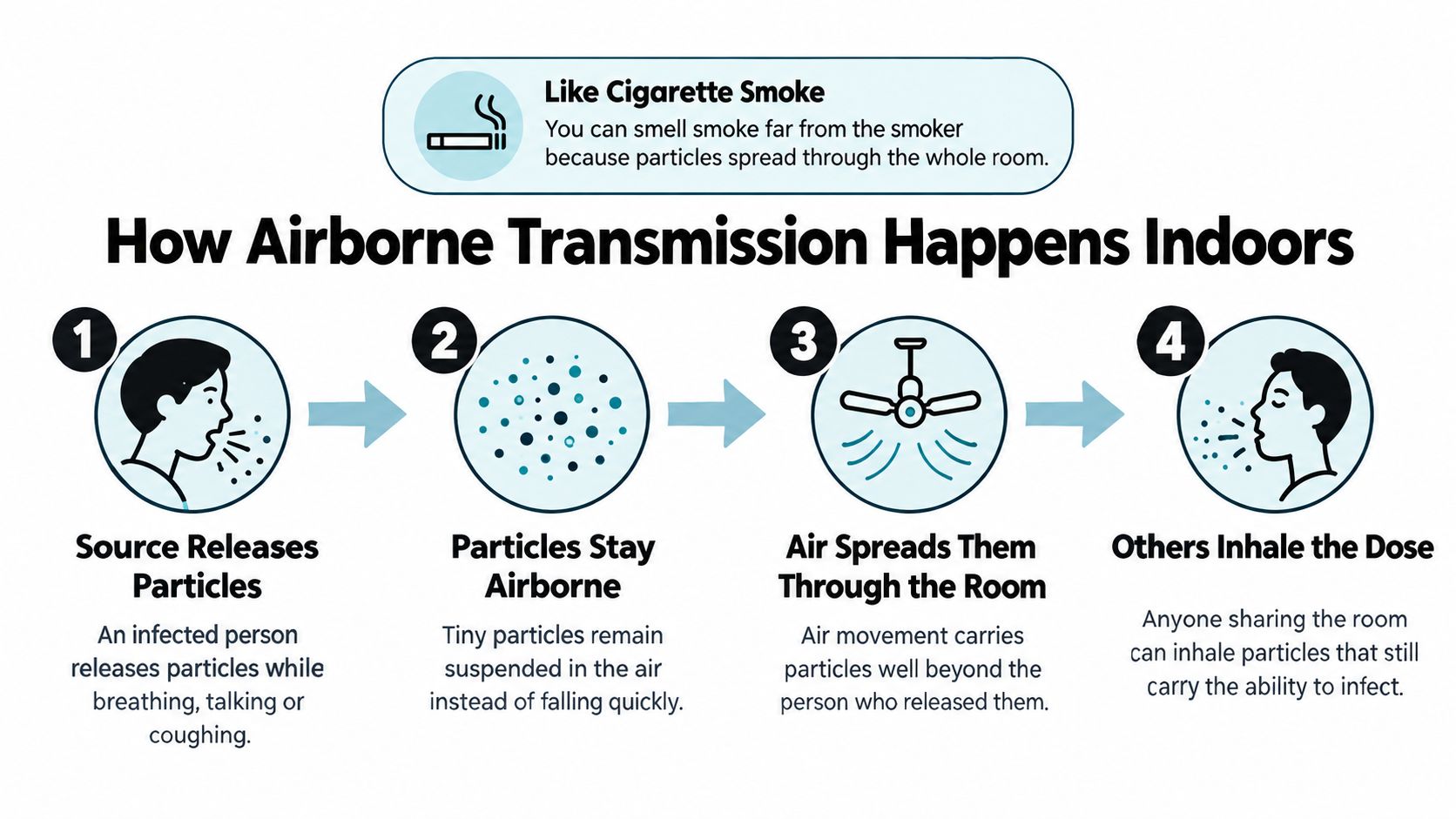
From release to inhalation
Release: An infected person breathes, talks, sings or coughs, releasing respiratory particles that may contain infectious organisms.
Evaporation and settling: Larger droplets settle more readily, while smaller droplets can lose water and leave suspended residues.
Suspension: Particle size, room air movement and settling speed influence how long material remains airborne.
Transport: Supply vents, exhaust fans, open doors and people moving through a room can change where particles travel.
Inhalation: Another occupant breathes in suspended particles, some of which may deposit in the respiratory tract.
The CDC's environmental infection-control guidance on air describes droplet nuclei as approximately 1 to 5 micrometres, gives approximate 50% aerodynamic cutoffs of 100 micrometres for the inhalable fraction, 10 micrometres for the thoracic fraction and 4 micrometres for the respirable fraction, and discusses indoor bioaerosols commonly ranging from about 100 nanometres to 10 micrometres.
These fractions describe particle behaviour and sampling conventions. They aren't sharp biological gates at which every particle suddenly changes destination. Aerodynamic diameter describes how a particle behaves in air, accounting for properties such as its shape and density rather than only its visible width.
Time matters alongside particle size
A brief walk through a room and an afternoon spent working there don't create the same opportunity for inhalation. Occupants keep drawing air into their lungs, so persistent contamination can create repeated exposure even when nobody is standing face-to-face.
For a plain-language companion explanation, VirusFAQ.com discusses reducing indoor exposure to airborne viruses. Building owners can also use this explanation of air exchange rates to distinguish air replacement from simple air movement.
This video provides another way to visualise airborne transmission.
A room that looks clean can still contain infectious particles. Visible dust isn't a measurement of airborne infection risk.
Cleaning accumulated dirt remains useful housekeeping. It answers a different question from whether occupants are breathing infectious aerosols.
Why Indoor Air Keeps Pathogens Close
The path from release to inhalation becomes harder to interrupt when occupants share enclosed air and the building carries contamination into other occupied spaces. More air movement isn't automatically better air removal.
The World Health Organization's ventilation guidance associates insufficient ventilation with increased infection rates or outbreaks, while recognising that higher ventilation can reduce risk without guaranteeing that transmission stops. The practical question isn't whether ventilation is useful. It's whether the actual airflow removes contamination, dilutes it safely or transports it towards someone else.
An open-plan office makes these shared-air relationships easy to overlook.
When a better room reading hides a worse pathway
A 2025 hospital outbreak investigation indexed in PubMed described aerosols moving from a patient room into a corridor and neighbouring rooms in a sealed, mechanically ventilated ward; opening a door increased the room's air-change rate from 3.29 to 4.01 air changes per hour, while also allowing potentially contaminated room air into the corridor.
That finding has a limited but important meaning. It doesn't show that opening doors is always dangerous or that ventilation generally increases infection. It shows that an improvement measured inside the source room can coincide with unwanted transport elsewhere.
Say a household uses a hallway fan to move air out of a sick person's bedroom. The bedroom may feel fresher, but if that air passes through an occupied living room before reaching an exit, the family hasn't necessarily created a safer overall route.
Separate the airflow functions
Outdoor-air ventilation: Introduces outside air to replace or dilute indoor air.
Recirculation: Moves indoor air through a system and returns it to occupied spaces.
Local exhaust: Removes air near a source and discharges it through an intended exhaust path.
Filtration: Captures particles in the air that reaches a filter.
Airflow balancing: Adjusts supply, return and exhaust relationships so air moves as intended.
A 2025 systematic review published by The Ecolibrium reported approximately 4.8 × 10^5 bacteria-like particles and 5.2 × 10^5 virus-like particles per cubic metre in indoor bioaerosol measurements. Those categories aren't equivalent to viable pathogens, infectious doses or a prediction for your building.
Where does the air go next? Ask that before opening an internal door, adding a fan or changing a ventilation setting. A useful assessment follows the whole pathway, including the spaces downstream.
Health Effects from Infection, Allergy and Asthma
A person can breathe in biological material without becoming ill. Infection depends on whether a pathogen remains capable of causing disease, reaches someone susceptible to it, and delivers a sufficient dose. Allergies and asthma involve different responses, so airborne material can cause symptoms without causing an infection.
Infection involves a viable pathogen
The CDC's scientific review of isolation precautions reports measles secondary infection rates above 90% among susceptible household contacts. People with measles can spread the virus for several days before the rash appears. The review also describes a different tuberculosis pattern: about 5% of infected people develop clinical disease, while approximately 20% of household contacts may develop a positive purified-protein-derivative skin test, particularly in close living quarters.
These figures describe different outcomes, not a single measure of risk. A positive tuberculosis skin test does not mean someone has active tuberculosis disease, and the household measles rate does not predict the outcome of every brief encounter.
The organism, the exposure setting and the person's susceptibility all shape the health risk. The word “airborne” describes a route of exposure, not a guarantee that infection will follow.
Allergy doesn't require infection
Fungal spores and dust-borne allergens can trigger sneezing, itchy eyes and nasal congestion in sensitised people. The body can react to these particles without them multiplying inside it.
Soft furnishings and settled dust can hold material that becomes airborne again when disturbed. Symptoms alone do not show that ductwork is the source, and dust visible in a vent does not identify what caused an allergy. Building observations can help frame questions about indoor air quality effects on health, but they do not establish a medical cause.
Asthma can worsen without a new infectious illness
Airborne spores and fine particles can provoke wheezing, chest tightness or an asthma flare in susceptible people. Repeated exposure to a trigger may make symptoms harder to control, though people do not all respond to the same material.
For recurring symptoms: Record when and where they occur, including whether they improve away from the building.
For dampness: Investigate leaks and moisture sources rather than relying only on an air-treatment device.
For breathing difficulty: Follow the person's asthma action plan and seek appropriate medical care rather than waiting for a building inspection.
Young children, older adults, people with asthma or allergies, and people with weakened immune systems may need more cautious exposure management. Their risks differ, so symptoms and circumstances matter when deciding what steps to take.
Which Controls Reduce Airborne Exposure Most
Use complementary controls rather than expecting one purchase to prevent infection. Source reduction, ventilation, filtration, validated disinfection and monitoring address different parts of exposure.
The Council on Strategic Risks' indoor-air biodefense review identifies ventilation, filtration, disinfection and monitoring as complementary measures and reports particle removal of up to 99.97% by high-efficiency filters and portable air cleaners for air passing through them. That qualification matters: device performance isn't an automatic whole-room reduction, and it isn't a measured reduction in infections.
Airborne exposure controls compared
Control | What it does | Main limit |
|---|---|---|
Outdoor-air ventilation | Dilutes indoor air by replacing it with outside air | Poor pressure relationships and exhaust paths can move contamination into other rooms |
Local exhaust at the source | Captures contaminants close to where they're produced | Requires a known source and a suitable exhaust arrangement |
High-efficiency or HEPA filtration | Removes particles from air passing through the filter | Filter fit, condition and system compatibility matter |
Portable air cleaners | Filter or otherwise treat room air locally | Placement, airflow rate, room size and treatment method determine usefulness |
Duct cleaning | Removes accessible dust and debris from ductwork; coils and vents may need separate cleaning | Doesn't by itself establish reduced infection risk |
In-duct systems such as ActivePure | Add an air-treatment process to the HVAC system | Performance and safety claims require independent evidence and maintenance |
CO2 monitoring | Helps assess ventilation relative to occupancy | Doesn't measure pathogens directly |
Put duct cleaning and treatment claims in context
The CDC's ventilation frequently asked questions report minimal definitive evidence that viable virus commonly travels through HVAC systems and causes disease in people in separate spaces. Investigations more often identify transmission among people sharing a room.
That doesn't make ductwork irrelevant. It means an assessment should examine airflow distribution, filtration and occupancy rather than assume contaminated ducts explain every illness. Cleaning substantial debris can address a maintenance problem, but it shouldn't be sold as proof that airborne transmission has been eliminated.
Purified Air Duct Cleaning in Avondale, AZ, offers ActivePure installations alongside duct and HVAC coil cleaning. The company describes pathogen reduction without harmful byproducts; treat that as a product claim requiring independent verification, not a guaranteed result in your home or workplace.
Before buying an in-duct or portable treatment system, ask for its test conditions, target organisms, treatment time, occupied-space safety information and maintenance requirements. A chamber result may not represent a furnished room with ongoing emissions and people moving through it.
Buying rule: Ask what the device treats, how much air reaches it and what evidence supports its use in your particular space.
For conventional particle capture, check indoor air quality filtration options against the HVAC system's capabilities. When outdoor air is unsuitable because of heat or pollution, properly selected local filtration can add protection without pretending to replace every other control.
Confirm Your Indoor Air Plan Before You Act
Use a normal occupied day to gather observations before changing equipment. This checklist helps turn a vague concern about germs into questions a building professional can investigate.
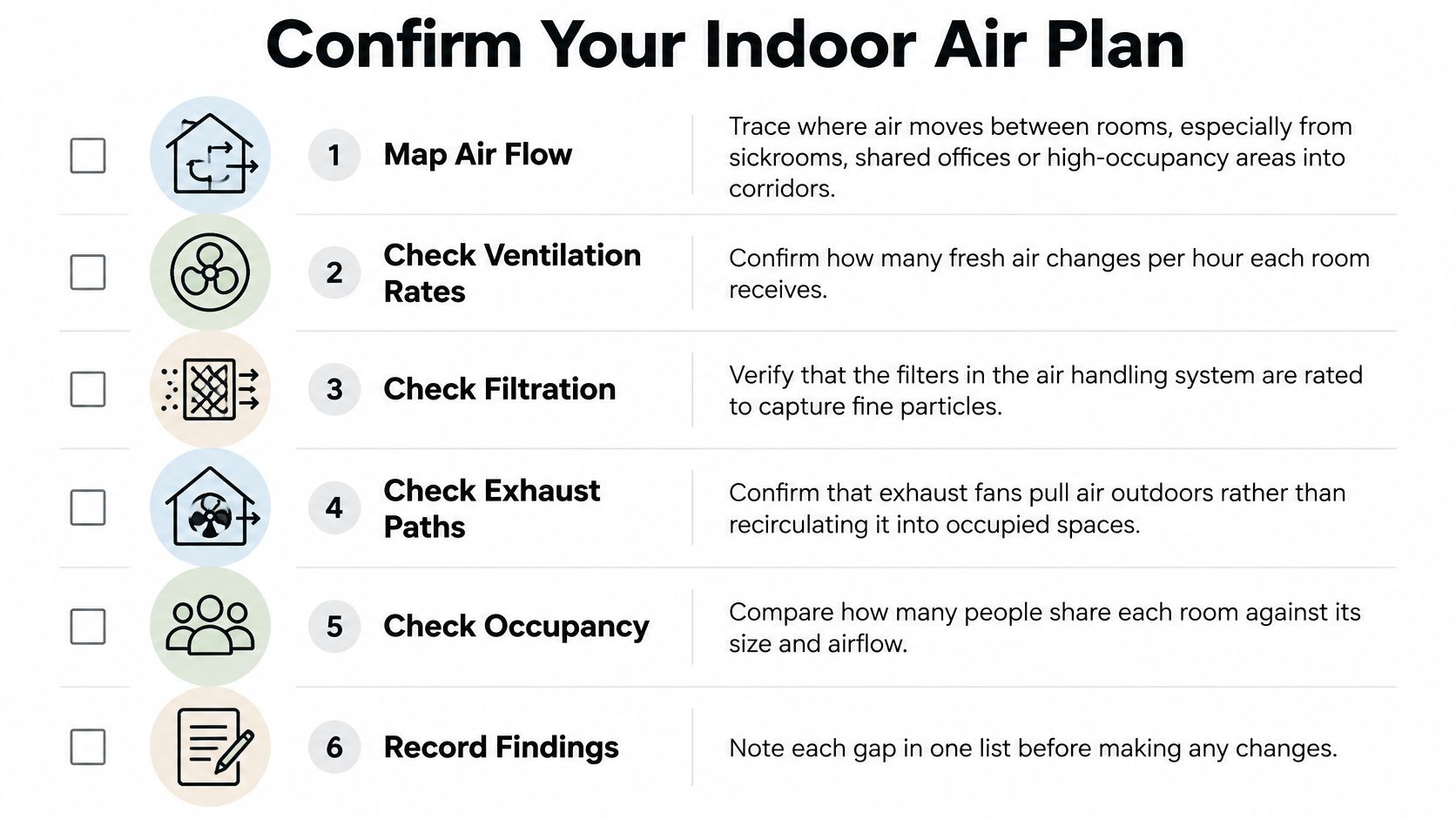
Map airflow: Note supply vents, returns, exhausts and doorways between sickrooms, shared workspaces and corridors.
Check filters: Record the filter rating, fit and replacement date, then confirm compatibility with the equipment.
Track CO2: Measure through normal occupancy and interpret trends alongside outdoor conditions and ventilation operation.
Inspect accessible components: Note dust, suspected mould, moisture or debris around vents and coils without disturbing suspect material.
Assess portable filtration: Match the cleaner's airflow and intended coverage to the room, and keep its intake and outlet unobstructed.
Request evidence: Obtain independent test reports and a maintenance schedule before purchasing an air-treatment product.
This guide to how to measure indoor air quality can help organise your observations. Take the resulting list to a qualified professional for an assessment of airflow, filtration and maintenance needs, with priority given to the rooms people occupy most.
Purified Air Duct Cleaning offers residential and commercial air duct cleaning, HVAC coil cleaning and ActivePure installation across the Phoenix metro area, including Avondale, Phoenix, Glendale and Mesa. Visit Purified Air Duct Cleaning to request a free quote, ask about flexible payment options and discuss how those services could fit into a layered indoor-air plan.