

Indoor Air Quality vs Outdoor: A Practical Comparison
A child starts sneezing every time they come home from school. The local outdoor AQI reads 35, so the obvious conclusion is that the air outside is fine and the problem must be somewhere else. That conclusion may be right, but an outdoor reading can't tell you what's happening in the living room, bedroom, basement, or inside the HVAC system.
Indoor air quality vs outdoor air isn't a contest between two separate environments. Outdoor pollutants enter through windows, doors, leaks, and ventilation equipment, while cooking, cleaning, moisture, furnishings, and combustion add pollutants indoors. The practical question is which sources are active, how quickly air is exchanged, and whether filtration removes what enters or gets generated.
The U.S. EPA reports that Americans spend approximately 90% of their time indoors, where concentrations of some pollutants are often 2 to 5 times higher than in typical outdoor air. EPA indoor-air-quality data also highlights how difficult indoor exposure has been to measure consistently at national scale. For homeowners assessing dust, allergies, odors, or dampness, Savera Wood Floor Refinishing on air quality offers useful context about how building materials and home maintenance can affect the air people breathe.
Why Indoor and Outdoor Air Quality Deserve Separate Conversations
Outdoor AQI is a useful starting point, not a diagnosis. Monitoring stations measure ambient conditions in a particular area, while your home has its own pressure differences, filtration, pollutant sources, and moisture history. A calm outdoor reading won't reveal a dirty return duct, a basement moisture problem, or particles produced by a frying pan.
The distinction matters because people spend most of the day inside. Outdoor air may look clean while indoor sources create a concentrated exposure, or outdoor smoke may enter rapidly during a wildfire event and make ventilation counterproductive.
Start with the source, not the label
During an assessment, I look at the air pathway in this order:
What is outside? Check particulate pollution, ozone, smoke, pollen, and traffic-related pollutants.
What enters the building? Inspect windows, doors, wall penetrations, outdoor-air intakes, and duct leakage.
What gets generated indoors? Look for cooking, combustion, cleaning chemicals, fragrances, furnishings, dust, and moisture.
What removes it? Verify exhaust fans, filters, air-cleaner operation, and actual airflow.
That approach explains why the same home can have different readings from one room to another. A bedroom may collect particles from a nearby return leak, while a kitchen may show a short-lived spike after cooking. A basement can have a completely different problem if moisture supports mould growth.
Practical rule: Don't ask whether indoor air or outdoor air is safer in the abstract. Ask which pollutant is present, where it originates, and whether the building is bringing it in or making it indoors.
The comparison below treats indoor and outdoor air as connected systems. It focuses on infiltration, source control, ventilation, and filtration, because those are the levers that change exposure.
What Counts as Indoor Air and What Counts as Outdoor Air
Outdoor air is the atmosphere surrounding a building. Public monitoring networks commonly track PM2.5, PM10, ozone, nitrogen dioxide, sulfur dioxide, carbon monoxide, and lead. The outdoor mix also includes pollen, road dust, regional haze, industrial emissions, and wildfire smoke. Weather, traffic, season, and nearby activity can change those conditions quickly.
Indoor air is the air within an enclosed space, including homes, offices, schools, vehicles, and mechanical rooms. Its quality reflects the building envelope, HVAC operation, occupancy, cleaning, cooking, combustion equipment, furnishings, and moisture. Outdoor air enters through designed ventilation and unintended leakage, then combines with pollutants generated indoors.
The numbers need careful interpretation
As noted above, EPA benchmarks show that indoor exposure cannot be judged from an outdoor monitor alone. A building can reduce outdoor particle levels through its envelope and filtration while indoor activities create their own short-lived peaks. Ventilation also has a trade-off: bringing in outdoor air helps dilute indoor contaminants when outside air is cleaner, but can increase exposure during smoke or other high-pollution events.
A residential PNAS study measured mean indoor PM2.5 at 3.31 ± 2.96 μg/m³, compared with 5.99 ± 2.10 μg/m³ outdoors. Indoor concentrations were lower outdoors in 92% of homes, with median indoor-to-outdoor ratios ranging from 0.50 to 0.61. Indoor sources still contributed a median 50% of indoor PM2.5. The PNAS residential study supports assessing infiltration and indoor generation together, rather than treating either one as the complete explanation.
A separate field study found median indoor-to-outdoor ratios of 0.14 for ozone, 1.01 for carbon monoxide, and 0.46 for PM2.5. The field comparison of indoor and outdoor pollutants shows why the pollutant and the building both matter. A low indoor particle reading does not automatically indicate clean air if another contaminant is entering or being produced indoors.
Indoor monitoring isn't an AQI clone
An outdoor AQI summarizes selected ambient pollutants. An indoor monitor may measure PM2.5, carbon dioxide, temperature, humidity, volatile organic compounds, or carbon monoxide, depending on the device. These readings answer different questions and should not be treated as interchangeable scores.
Pollutant Profiles Compared Side by Side
Indoor and outdoor air often have different dominant sources. A monitor may show that outdoor particles are entering the home, but the strongest indoor event may still come from cooking or a combustion appliance. The pollutant profile matters more than a general label such as “fresh” or “stale.”
Indoor vs Outdoor Pollutant Profiles
Pollutant | Dominant Source | Indoor vs Outdoor | Common Origins |
|---|---|---|---|
PM2.5 | Combustion and cooking | Often higher indoors during active sources, often lower indoors when outdoor infiltration dominates | Frying, gas cooking, candles, smoking, wildfire smoke |
Ozone | Atmospheric chemistry | Usually higher outdoors | Sunlight-driven outdoor reactions, urban air |
Carbon monoxide | Combustion | Can be similar indoors and outdoors, or higher indoors near a source | Vehicles, furnaces, stoves, attached garages |
VOCs and aldehydes | Materials and products | Often higher indoors | Paint, furniture, flooring, cleaners, personal-care products |
Carbon dioxide | Occupancy and combustion | Usually higher indoors | People, poorly ventilated rooms, combustion |
Mould and biological particles | Moisture and indoor reservoirs | Primarily an indoor building concern | Damp walls, crawlspaces, basements, dust |
Pollen and road dust | Regional and local outdoor activity | Usually higher outdoors, but readily transported indoors | Open windows, clothing, pets, traffic |
Ozone is a good example of why ventilation requires judgment. Outdoor ozone can be high during sunny conditions, while indoor surfaces and materials may remove some of it. That doesn't mean an indoor room is automatically safe, because other indoor pollutants may be increasing at the same time.
VOCs can reverse the comparison. A peer-reviewed indoor and outdoor study measured total aldehydes at an average of 442 μg/m³ indoors, compared with 21.5 μg/m³ outdoors, making indoor concentrations twenty times higher in that comparison. The aldehyde comparison study demonstrates how strongly indoor materials and products can influence the air.
Read the pollutant profile: A home can have lower indoor PM2.5 than outdoors and still have an indoor VOC or carbon monoxide problem.
The worst exposure usually depends on what's active at that moment. Cooking, smoking, candles, cleaning chemicals, damp materials, traffic, pollen, and wildfire smoke each require a different response. Filtration can help with particles, but it won't replace source control for gases, moisture, or combustion.
How Outdoor Air Sneaks Inside and Indoor Sources Add On Top
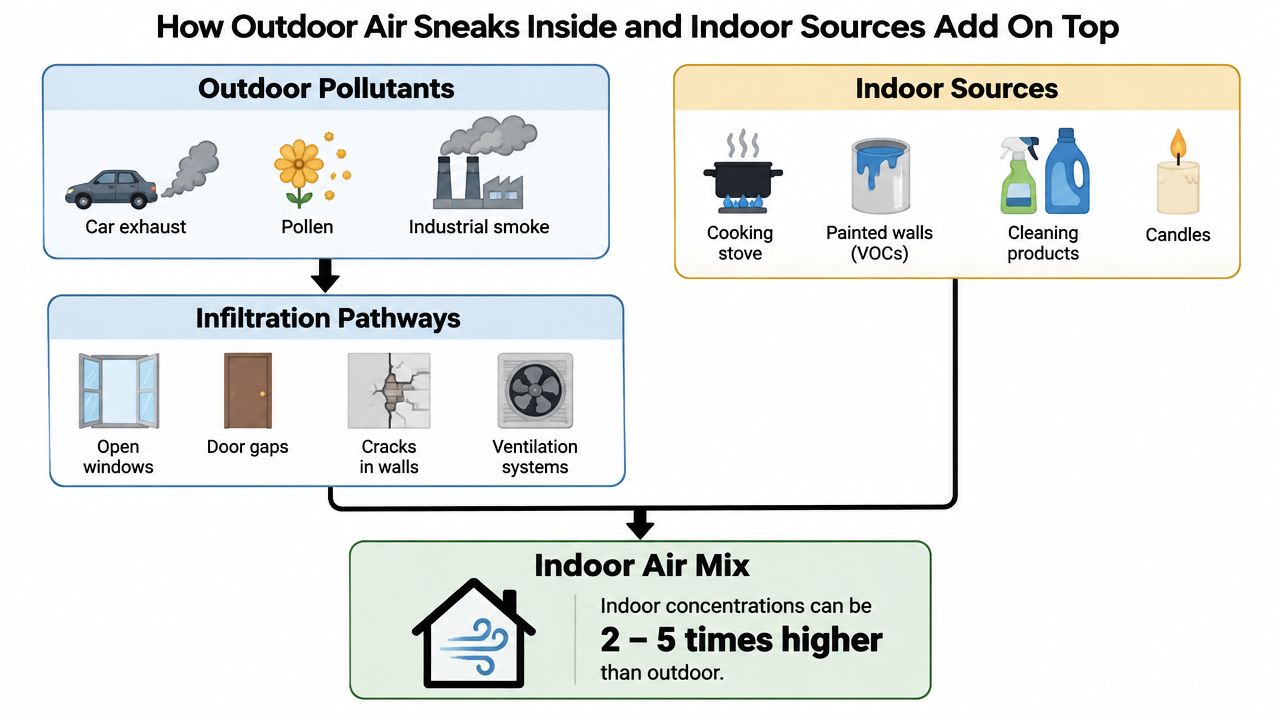
Two forces shape indoor air: infiltration brings outdoor pollutants inside, and indoor generation adds new pollutants within the building envelope. A sealed window may block one pathway, but a leaking return duct, attic hatch, or wall penetration can still move air between spaces.
Outdoor air enters through open windows and doors, gaps around frames, cracks in walls, recessed lighting, attic hatches, plumbing penetrations, and HVAC outdoor-air systems. Return-side duct leaks can also pull air from dusty or contaminated areas before the filter sees it. Building pressure, wind, temperature differences, and fan operation determine how much air moves through each route.
Indoor sources then add to the mix. Cooking produces particles, gas appliances can produce combustion pollutants, cleaners and fragrances release chemicals, and new furniture or paint can off-gas. Occupants add carbon dioxide and moisture through respiration, while damp materials can support mould and other microbial growth.
Why sealing alone isn't the fix
Air sealing reduces uncontrolled infiltration, but it also changes the ventilation balance. If a weatherized home lacks adequate mechanical ventilation, occupants may notice stuffiness, moisture, or rising carbon dioxide. If the HVAC system has a poorly located outdoor-air intake, tightening the envelope won't solve smoke or ozone entering through that intake.
Humidity affects both mechanisms. Moisture can support mould indoors, while temperature differences can increase pressure-driven airflow through leaks. A practical inspection therefore pairs envelope work with ventilation verification rather than treating draft reduction as a complete IAQ solution.
If you're prioritizing envelope work, guidance on when to replace drafty windows can help distinguish a window problem from broader building leakage. For the outdoor side of the equation, outdoor air pollution and duct systems is a useful companion reference when checking how outdoor contaminants reach the HVAC system.
The result isn't a binary indoor-versus-outdoor condition. Indoor air is an accumulated mixture of what enters, what gets produced, what reacts, and what the building removes.
When Outdoor Air Is the Bigger Problem Indoors
Fresh outdoor air helps when it dilutes indoor contaminants and outdoor air is reasonably clean. It can hurt during wildfire smoke, dust storms, severe traffic pollution, or high-ozone conditions. During those events, opening a window can replace a manageable indoor condition with a much dirtier outdoor supply.
The WHO states that in poorly ventilated dwellings, indoor smoke can reach fine-particle levels 100 times higher than acceptable. WHO guidance on household air pollution shows the opposite side of the comparison, indoor sources can overwhelm outdoor background concentrations. During wildfire smoke, however, the direction often reverses because outdoor PM2.5 enters through windows, doors, leaks, and ventilation intakes.
Use a smoke-event strategy
When outdoor air is smoky, the immediate priorities are:
Close windows and exterior doors as much as practical.
Set HVAC systems to recirculation where the equipment allows it.
Use properly fitted high-efficiency particle filtration.
Avoid adding indoor particles through frying, candles, fireplaces, or smoking.
Monitor indoor PM2.5 rather than relying on outdoor AQI alone.
A building under positive pressure can still pull polluted air through poorly filtered outdoor-air systems or leakage points. Turning on an outdoor-air damper without checking filtration may increase indoor exposure.
The requested strategy comparison needs to be based on actual measurements, not invented peak values. Because the verified data doesn't provide indoor PM2.5 readings for specific window or MERV strategies, the table below uses qualitative outcomes rather than fabricated concentrations.
Indoor PM2.5 Response During a Wildfire Smoke Event
Strategy | Indoor PM2.5 Peak | Reduction vs Outdoor Peak | Notes |
|---|---|---|---|
Unsealed window | Can rise toward outdoor conditions | No reliable reduction | Smoke enters directly and may continue entering through leakage |
Closed windows with recirculating HVAC | Usually lower than an open-window condition when leakage is limited | Depends on envelope and filter performance | Recirculation limits new outdoor smoke |
Properly fitted MERV 13 filtration | Can reduce particle transport through the HVAC system | Must be measured indoors | Filter fit, airflow, pressure drop, and system compatibility matter |
Portable HEPA cleaner | Can reduce particles in the room it serves | Depends on room size and operation | It doesn't remove pollutants from unserved rooms or eliminate the source |
The air-exchange-rate guidance is useful when deciding whether a building is replacing indoor air too quickly during a smoke episode. Ventilation isn't automatically beneficial. It has to be matched to outdoor conditions and backed by filtration.
A Practical Action Plan for Homeowners
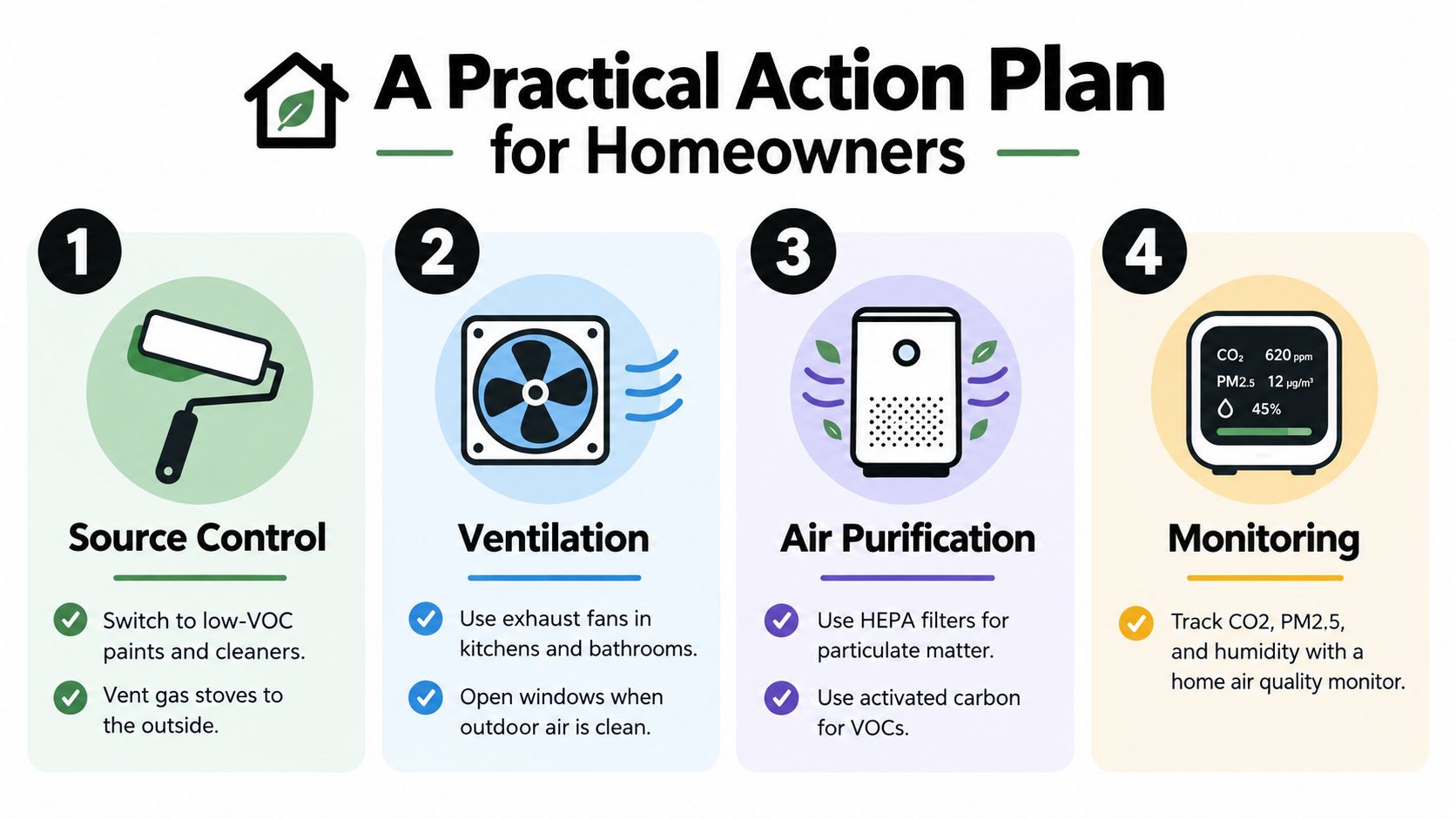
Homeowners get better results by matching each action to a source. Source control stops pollution before it enters the air, ventilation removes selected pollutants, filtration captures particles, and envelope or duct work controls unwanted movement.
Start at the source
Control emissions: Choose low-VOC paints and cleaners, vent kitchen ranges and dryers outdoors, remove scented candles and plug-in fresheners, and have combustion appliances checked for spillage. These steps address pollutants generated inside rather than trying to capture them after release.
Use exhaust deliberately: Run kitchen and bathroom exhaust fans during and after cooking, bathing, and other moisture-producing activities. Confirm that the fans discharge outdoors, not into an attic or wall cavity.
Choose ventilation by outdoor conditions: Open windows when outdoor air is clean, but keep them closed during smoke events or high outdoor pollution. Don't assume a pleasant temperature means acceptable outdoor air.
Filter the air that remains: Consider a properly fitted MERV 11 to MERV 13 return filter or a portable HEPA unit sized for the room. Check that the filter fits tightly and that the HVAC system can handle the added resistance.
Inspect the pathways
Seal visible duct leaks with mastic rather than relying on ordinary tape. Vacuum supply registers, inspect return grilles, and arrange duct cleaning when you can see growth or substantial debris. After major weatherization, verify that the blower-door result and mechanical ventilation still support acceptable indoor conditions.
Filter guidance such as Brisbane ducted AC filter tips is helpful for understanding routine filter care, but the correct filter still depends on equipment design and installation. A filter that is too restrictive or poorly seated can reduce airflow without solving the contamination source.
For room-level equipment, compare portable units using room coverage and clean-air delivery information, not marketing language. Residential air purifier selection guidance can help organize that decision.
The accompanying video provides another practical visual reference for homeowner air-quality measures:
What Facility Managers Should Adjust in Commercial Spaces
Commercial buildings add occupancy density, operating schedules, code requirements, and liability concerns to the indoor-outdoor calculation. A system that performs acceptably in a lightly occupied office may struggle in a crowded meeting room, school, healthcare space, kitchen, or retail area.
Facility managers should begin with the ventilation design and actual operation. ASHRAE 62.1 requirements, local exhaust for kitchens and restrooms, outdoor-air damper positions, filtration, and control sequences all influence exposure. Carbon dioxide is a useful occupancy and ventilation indicator, but it isn't a complete IAQ measurement because it doesn't directly measure particles, VOCs, mould, or combustion pollutants.
Treat outdoor AQI as an operating input
On ordinary days, outdoor air can dilute indoor sources. During smoke or high-pollution conditions, bringing in more outside air can raise indoor particle levels unless the system filters that air effectively. Building automation should allow the team to adjust outdoor-air intake, recirculation, filtration, and pressure strategy without abandoning required safety and ventilation functions.
Demand-controlled ventilation may need temporary modulation during high-AQI events, but staff shouldn't disable controls blindly. Any adjustment must account for occupancy, code requirements, exhaust makeup air, equipment limits, and the need to prevent carbon dioxide and moisture from accumulating.
MERV-13 or higher filtration can be useful for particle control where the air-handling unit can maintain design airflow and acceptable static pressure. A filter upgrade without an airflow check can create a different operational problem. Facilities teams should verify fit, pressure drop, fan capacity, and replacement schedules.
Document decisions before complaints escalate
Keep records of:
Outdoor-air damper positions during smoke or high-AQI periods.
Filter type, installation date, fit, and pressure-drop checks.
Indoor PM2.5, carbon dioxide, humidity, and temperature readings.
Tenant or employee complaints, locations, times, and corrective actions.
Exhaust fan operation and mechanical ventilation inspections.
This record helps distinguish a building-wide ventilation issue from a local source such as a renovation area, kitchen, loading dock, or water-damaged room. Guidance on indoor air quality in buildings can support a broader facilities review.
A facilities team that checks outdoor conditions each day and adjusts building operation accordingly is less likely to treat every IAQ complaint as a mystery. The goal isn't maximum outdoor air at all times. The goal is controlled, filtered, measured air appropriate to the conditions outside and the activities inside.
Common Questions About Indoor and Outdoor Air Quality
Does opening a window help or hurt?
The answer depends on both outdoor conditions and indoor sources. Opening a window can dilute cooking emissions, carbon dioxide, or chemical odors when outdoor air is cleaner than the room. It can worsen indoor conditions during wildfire smoke, dust, high ozone, or heavy traffic pollution. Check outdoor conditions first, then use an indoor PM2.5 monitor to confirm whether the change helped.
How often is indoor air worse than outdoor air?
There is no universal ratio for every pollutant or building. Indoor concentrations can be 2 to 5 times higher than typical outdoor levels for some pollutants. A residential PNAS study found indoor PM2.5 below outdoor PM2.5 in 92% of homes, while indoor sources still accounted for a median 50% contributor to indoor PM2.5.
These findings are compatible. Indoor conditions depend on the pollutant, source activity, infiltration, filtration, and the timing of measurements. The EPA's indoor exposure benchmarks and the earlier residential study provide useful context without reducing the comparison to one indoor-versus-outdoor number.
Can an air purifier close the gap?
A portable HEPA cleaner can reduce airborne particles in the room it serves when correctly sized and operated. It does not remove moisture, stop a gas leak, eliminate VOC emissions at their source, or repair contaminated ductwork. Filtration works best as one layer alongside source control and suitable ventilation.
Does weatherization create a ventilation problem?
Air sealing reduces uncontrolled outdoor infiltration, but a tighter envelope still requires adequate mechanical ventilation. Otherwise, carbon dioxide and moisture may accumulate. Verify airflow and ventilation after weatherization instead of assuming that either leakage or tightness is always beneficial.
Does an AQI reading tell me what my home air is like?
No. Outdoor AQI describes selected ambient pollutants at or near an outdoor monitoring location. An indoor monitor measures only the pollutants its sensors detect, which may include PM2.5, carbon dioxide, humidity, VOC indicators, or carbon monoxide. Compare both readings and note changes after cooking, ventilation, filtration, cleaning, or smoke events. Indoor air-quality sensor guidance can help match measurements to the problem under investigation.
Purified Air Duct Cleaning provides residential and commercial air duct cleaning, dryer vent cleaning, HVAC coil cleaning, and ActivePure air-purification system installation across the Phoenix metropolitan area. If indoor readings, dust, odors, or allergy symptoms suggest an HVAC or ductwork issue, visit Purified Air Duct Cleaning to request a quote and arrange an assessment.