

HEPA Air Filtration System Guide: What Works and Why
Only about 3 particles out of every 10,000 in the specified test aerosol may pass through a properly tested HEPA filter, under the U.S. Department of Energy's HEPA standard. That's impressive filtration, but it describes air passing through the filter, not how clean an entire room becomes. A HEPA air filtration system also needs enough airflow, sufficient operating time, and a sealed path that prevents dirty air from slipping around the filter.
The useful buying question isn't whether a device says HEPA. It's whether the complete system can deliver enough filtered air to the space where you spend time.
What HEPA Means and How Filters Trap Particles
HEPA stands for high-efficiency particulate air, a mechanical filter made from densely packed, pleated fibers that trap airborne particles rather than chemically neutralizing them. A fan pulls air through this fibrous material, leaving captured particles behind while filtered air returns to the room.
The U.S. benchmark is at least 99.97% capture at 0.3 micrometers. That test requirement applies to the filter under specified conditions, not automatically to every particle floating around your bedroom, office, or classroom.
Think of the distinction as the difference between a very effective fishing net and moving water through it. A net can catch almost everything it encounters while missing everything that flows around its edges. Likewise, an excellent filter can't clean air that never reaches its fibers.
Why the test particle is so small
The test size sits near the most penetrating particle size, where capture is especially difficult. It isn't a cutoff below which particles pass freely through the filter. Efficiency generally improves for particles both larger and smaller than this difficult-to-capture region.
That surprises people who picture a HEPA filter as a kitchen sieve. A sieve mainly sorts objects by whether they fit through its openings. A HEPA filter uses a deep network of fibers and several physical capture mechanisms, so particle movement matters as well as particle size.
These mechanisms overlap throughout the media. They aren't separate filter layers that every particle must encounter in a fixed sequence.
Interception: A particle follows the air around a fiber but passes close enough to touch it. Once captured, it stays on the fiber rather than continuing with the airflow.
Impaction: A heavier particle can't make the same sharp turn as the air. Its momentum carries it into a fiber, much as a moving cart can overshoot a tight corner.
Diffusion: Very small particles move irregularly as surrounding gas molecules buffet them. That wandering increases their chances of contacting a fiber instead of traveling straight through.
This explains why smaller doesn't always mean harder to capture. Very small particles don't behave like miniature arrows moving neatly through holes.
Practical rule: Don't interpret a HEPA test size as the smallest particle the filter can capture.
Why the folds and housing matter
Pleating adds filter-media area inside a compact cabinet. With more material available, the system can distribute airflow across a larger surface instead of forcing it through a small, flat sheet.
For the same total airflow, greater media area reduces the air speed through the material. It also provides more space for dust to accumulate before loading becomes a maintenance problem. Actual service life still depends on particle levels, operating conditions, and the complete filter design.
HEPA was developed during the 1940s Manhattan Project to control airborne radioactive contaminants, and its efficiency requirement was later tightened from 99.95% to 99.97%, according to the Department of Energy's historical handbook. Its origins help explain why meaningful evaluation involves measured performance, airflow resistance, and installation quality rather than branding alone.
For a homeowner, the practical lesson is straightforward: the filter, fan, and housing work as a system. The media determines what happens to air passing through it. The fan determines how much air gets there, while the housing determines whether that air follows the intended route.
HEPA and MERV Ratings Compared Side by Side
Rating or class | Efficiency reference | Typical use | Fit check |
|---|---|---|---|
MERV 8 | Basic filtration focused on larger particles | Basic residential furnace filter | Standard rack fit |
MERV 13 | At least 50% at 0.3 to 1.0 microns; 85% at 1 to 3 microns | Central HVAC upgrade when equipment allows | Confirm manufacturer rating and blower capacity |
MERV 16 | High-efficiency HVAC filtration across rated particle-size bands | Hospitals and demanding commercial systems | Usually needs professional airflow review |
HEPA (EN 1822 H13) | 99.95% reference; verify the tested most penetrating particle size rather than assuming a fixed 0.3-micron test | Portable room units and cleanrooms | Sealed housing and airflow check required |
HEPA (U.S. standard) | 99.97% at 0.3 microns | Portable units and protected healthcare rooms | Verify gasketed housing and no bypass |
The MERV performance figures in this comparison come from the CDC's ventilation guidance, which describes MERV 13 as at least 50% efficient for particles from 0.3 to 1.0 micrometers and 85% efficient for particles from 1 to 3 micrometers. The HEPA reference points shouldn't be treated as interchangeable certification claims: check the product's actual test documentation.
This visual summarizes the common labels shoppers encounter.
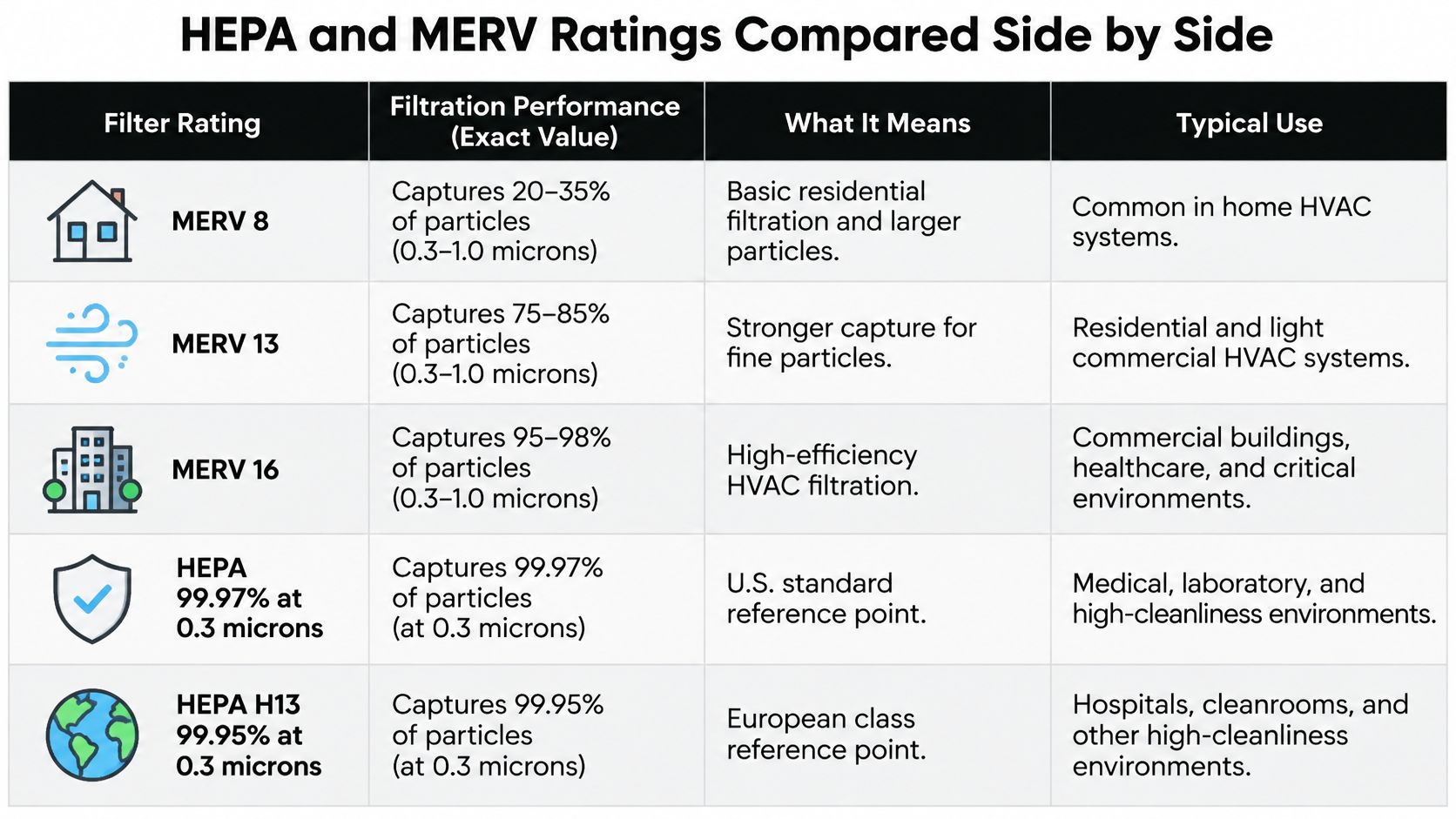
Read the rating before choosing the equipment
MERV 8 represents basic residential filtration, not a substitute for a dedicated fine-particle cleaner. MERV 13 is a practical central-system upgrade when the equipment supports it. MERV 16 belongs to a more demanding filtration category that warrants careful airflow review.
The H13 label identifies a European filter class, while the U.S. HEPA label refers to a different testing reference. An advertisement that treats every HEPA designation as identical leaves out important testing details.
MERV grades filter performance across particle-size bands. HEPA establishes a much higher particle-capture requirement under its applicable test method. Our guide to MERV ratings and choosing a home filter explains how that distinction affects ordinary furnace-filter purchases.
Check the system, not just the number
A denser filter can increase resistance, so a HEPA-grade filter isn't automatically a drop-in furnace replacement. ASHRAE's filtration guidance emphasizes that particle reduction also depends on airflow, particle size, filter location, and whether air bypasses the media.
Before upgrading, establish:
Equipment permission: Check the manufacturer's allowed filter specifications.
Rack sealing: Confirm that the installed filter can't leave an unfiltered route around its edges.
Blower capability: Have airflow resistance evaluated when moving beyond the system's established filter arrangement.
Use a compatible MERV-rated filter for the central system and reserve true HEPA for portable equipment or systems engineered for it. Buying the highest label without checking those conditions can produce a less useful installation.
How to Size a Portable HEPA Unit for a Room
Choose a portable cleaner with a Clean Air Delivery Rate, or CADR, that meets or exceeds the room's square footage, following the CDC's home ventilation guidance. CADR describes delivered clean air, making it more useful for room selection than filter efficiency alone.
For wildfire smoke, the EPA's smoke-and-heat preparation guidance recommends a tobacco-smoke CADR of at least two-thirds of the room's area in square feet. These are different selection rules, not evidence that smoke is easier to remove; the table keeps each rule clearly labeled.
Minimum CADR by room size
Room area (sq ft) | Wildfire smoke minimum CADR (two-thirds of area) | General cleaning minimum CADR (equal to area) |
|---|---|---|
300 | 200 | 300 |
450 | 300 | 450 |
800 | 534, rounded up | 800 |
The table applies the respective CDC and EPA rules above. CADR is commonly expressed in cubic feet per minute, so don't confuse a device's room-area claim with its actual clean-air delivery rating.
Follow the selection sequence
Measure the room. Use a tape measure to find its length and width, then multiply them for floor area. Include connected space if you expect the cleaner to serve it.
Choose the target. Compare the general-cleaning guideline with the smoke-specific guideline, using tobacco-smoke CADR for the latter.
Check the documentation. Find CADR on the unit label, shipping box, operator manual, or product specification sheet. Don't substitute an unexplained coverage claim.
Choose the strongest suitable option available. If an appropriately rated model isn't available, select the highest available CADR rather than assuming all portable filters provide equivalent cleaning.
Place it where people spend time. Keep the intake and outlet unobstructed, following the manufacturer's clearance instructions.
Say you're choosing between a bedroom unit and a larger device intended to sit down the hall. The bedroom unit has a direct path to the air you breathe while sleeping; the hallway device must rely on circulation through doorways. Location changes what the equipment can accomplish.
A correctly sized cleaner operating consistently in an occupied room can be more useful than a larger cleaner switched on sporadically elsewhere.
Account for the room you actually have
High ceilings, partitions, and connected rooms complicate a floor-area-only estimate. Commercial managers should also consider occupancy, operating hours, room volume, and whether multiple cleaners are needed.
Our explanation of air changes per hour helps connect airflow with room volume. For purchasing, also check whether the advertised CADR corresponds to a fan setting you'll tolerate during work or sleep.
Where HEPA Systems Fall Short
Air bypass is a common way an excellent filter becomes an ineffective installation. A loose cartridge, damaged gasket, or poorly seated cover can let air take an easier route around the media.
Start with the physical assembly rather than assuming the filter needs a higher rating. Switch the device off, disconnect power as the manual directs, and inspect the filter frame, gasket, and cover latches. Reseat the cartridge without crushing its seal, and replace damaged parts rather than improvising a repair that interferes with access or airflow.
Match each limitation to a fix
Failure mode | What goes wrong | Practical fix |
|---|---|---|
Bypass | Air avoids the filter material | Inspect the gasket, frame fit, and housing closure |
Low airflow | Too little room air reaches the filter | Match CADR to the intended space and clear obstructions |
Intermittent use | The cleaner sits idle while particles continue entering the air | Plan consistent operation during occupancy |
Gases and odors | Particle media doesn't address most gases or vapors | Consider suitable activated carbon and control the source |
HEPA captures particles, not most gases. Smoke, for example, contains both particulate and gaseous components. A particle filter can help with the particulate portion without making every smoke-related odor disappear.
Activated carbon can address some gases and odors, but performance depends on the material, its quantity, and the contaminant. A thin odor-control layer shouldn't be treated as universal protection, and no purifier makes a hazardous gas leak safe.
Avoid confusing treatment claims with protection
Choose equipment that produces little or no ozone. Ozone can cause coughing, breathing difficulty, and lung damage; a strong treatment smell isn't evidence of cleaner or safer air.
Different products also use the term air scrubber differently. Before buying, distinguish mechanical filtration from other treatment methods using our guide to air scrubbers for the home, then examine what the specific device does.
During smoke events, keep the intended cleaner-air room protected from unnecessary outdoor-air entry, while maintaining safe indoor temperatures. Filtration can't fully offset open windows, uncontrolled leakage, or ongoing indoor particle sources such as smoking.
Troubleshooting clue: Treat a lingering smell as a reason to investigate, not as proof that the HEPA media has failed.
Other warning signs include dust returning quickly to surfaces and a fan that rarely seems to operate. These aren't laboratory measurements of effectiveness, but they're useful prompts to check sources, settings, placement, and maintenance.
Choosing Between Portable, Central and In-Duct Options
Setup | Coverage | Filtration basis | Watch-out |
|---|---|---|---|
Portable HEPA unit | One room, moved as needed | HEPA particle-capture performance, paired with a CADR rating | Size by CADR and check ozone output |
Central filter at MERV 13 | Areas served by the air handler | MERV rating | Confirm the blower can handle the added resistance |
HEPA in a central system | Whole building if the system and ductwork support it | HEPA media in a sealed housing | Needs professional design and airflow testing |
In-duct air technology, for example ActivePure | Air moving through the ductwork | Technology-specific treatment, not automatically a HEPA rating | Request independent efficiency data before comparing with HEPA ratings |
The main coverage trade-offs are summarized below.
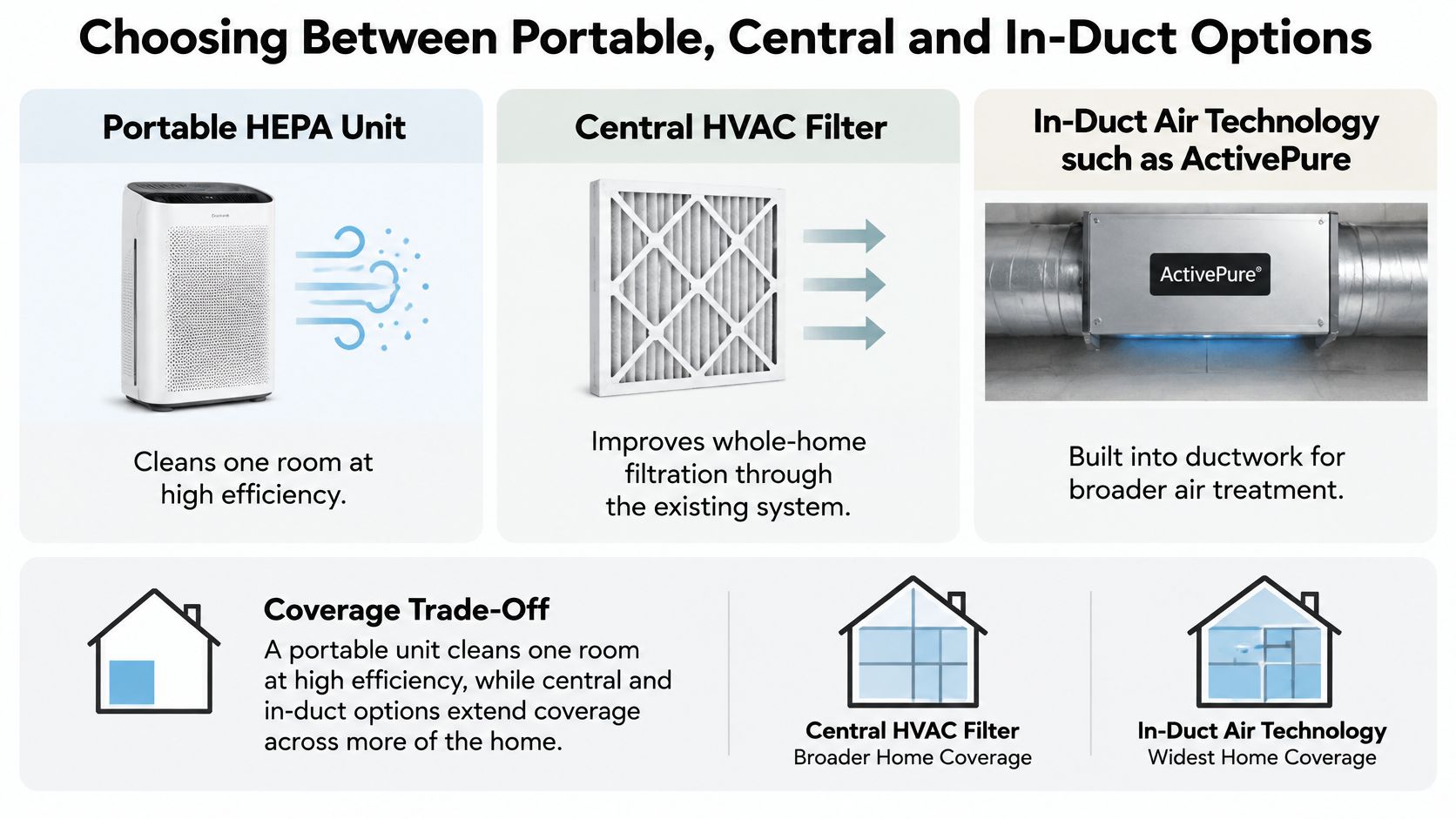
A portable unit concentrates cleaning in an occupied room. A central filter treats air that returns through the HVAC system, while in-duct technologies require evaluation according to their particular operating method. Broader placement doesn't automatically mean equivalent particle removal in every room.
Make compatibility a safety check
The EPA's cleaner-air-room guidance recommends MERV 13 or higher only when the HVAC equipment can accommodate it, with manufacturer or professional confirmation. It also advises snug filter fit, frequent inspection during smoke events, and replacement when filters are visibly dirty or smoke odors return.
Watch for reduced airflow at vents, weak delivery, or a blower that appears to work harder after a filter change. These symptoms warrant an equipment check, not an assumption that greater resistance proves better filtration.
Keep the filter dimensions and airflow-direction arrow in your maintenance record. Smoke loading can change replacement needs abruptly, so the calendar alone isn't a sufficient guide.
Compare evidence rather than coverage promises
Use these criteria when evaluating competing options:
Coverage: Identify which occupied rooms receive treatment during normal operation.
Filtration basis: Separate mechanical capture from other treatment methods.
Airflow impact: Check resistance and the system's ability to maintain delivery.
Ozone risk: Look for relevant emissions documentation.
Maintenance load: Confirm access, replacement requirements, and ongoing tasks.
Proof of efficiency: Seek independent testing that matches the advertised use.
Our discussion of whether in-duct air purifiers are worth it can help frame those questions. Technology-specific treatment results shouldn't be substituted for a HEPA filter test or a portable cleaner's CADR.
Use the video alongside the written specifications, not in place of performance documentation.
For many homes, a practical starting arrangement is a portable HEPA cleaner in the most-used room plus a compatible central filter. Central and portable filtration can complement each other, but neither removes the need to address pollutant sources.
Choose Your HEPA Setup and Maintenance Plan
Build your plan around selection, installation verification, and maintenance. A purchase is only the beginning; the useful outcome is a setup you can operate consistently and keep in good condition.
Turn the choice into an operating plan
Select for the actual space and equipment. Match the portable unit to the room's CADR target, or choose a central filter that the HVAC manufacturer permits. Include replacement-filter availability and tolerable operating noise in the decision.
Verify the installation. Confirm that the housing closes correctly, gaskets seat evenly, and no edge gaps remain. Record filter dimensions, installation direction, the installation date, and any airflow symptoms.
Schedule inspection and replacement. Put a monthly inspection reminder on your calendar as a practical starting routine. Inspect more often during smoke events, replace loaded filters according to condition and manufacturer instructions, and reassess after the event ends.
A monthly reminder is an inspection habit, not a universal replacement interval. Don't wash or vacuum HEPA media unless the manufacturer explicitly permits that method.
Our approach is to assess each customer's specific needs before recommending the most suitable system for the home. We also provide regular maintenance for the air purification systems we install, helping connect the equipment choice with an ongoing care plan.
Know when measurements are needed
Bring in an HVAC professional when manufacturer limits are unclear, when airflow changes after a filter upgrade, or when a central HEPA design needs measured airflow testing. A filter that fits the opening isn't necessarily compatible with the system.
Use a written preventive maintenance schedule to separate purifier care from other HVAC tasks. Duct cleaning is a different service: we generally recommend it every 3 to 5 years, depending on ductwork age and condition, heating and cooling equipment, and allergies or respiratory problems in the home.
Before buying, check:
Room area: Measure the space the cleaner will serve.
Primary need: Identify smoke, airborne allergens, or another concern.
HVAC allowance: Confirm the permitted central-filter specification.
Planned runtime: Choose settings you can maintain.
Ozone check: Review emissions information.
Write down your room area and current filter size, then compare them with the sizing table before you buy.
We assess your home's air purification needs, recommend a suitable system, and provide regular maintenance for the systems we install. Visit Purified Air Duct Cleaning to discuss your room measurements, current HVAC filter, and air-quality concerns so you can choose a setup that fits your home.