

HVAC Air Quality: How to Improve Indoor Air at Home
People spend most of their time indoors, and indoor pollutant levels can exceed those outdoors, according to the EPA's indoor air quality factsheet. Improving HVAC air quality starts with identifying the pollutant and choosing a fix that targets it. A stronger filter or an open window can make conditions worse if it restricts airflow or brings in polluted outdoor air.
How HVAC Systems Shape the Air You Breathe
Say dinner is cooking, the dog is sleeping on the rug, and someone is cleaning the bathroom. Those activities introduce different pollutants: cooking particles, pet allergens, moisture, and gases from cleaning products. A comfortable thermostat reading won't tell you whether any of them are accumulating.
Think of the HVAC system as part of the building's lungs. It moves air through rooms and filters returning air; where mechanical ventilation is installed, it also helps bring outdoor air in and discharge indoor air. Many residential central systems primarily recirculate air, so turning on the air conditioner doesn't automatically mean you're getting fresh air.
The controls that matter
Four practical levers determine how the system affects what you breathe:
Outdoor-air supply: Clean replacement air dilutes pollutants that accumulate indoors.
Particle capture: Filters intercept airborne material passing through their media.
Component condition: Dirty coils, obstructed returns, and contaminated ductwork need different corrective work.
Indoor sources: Cooking, smoking, cleaning products, pets, and moisture determine what the system must handle.
A clean living room is a good starting point, but appearance alone doesn't establish air quality.
Air also moves through cracks and joints, opened doors and windows, and exhaust fans. Those pathways can help dilute indoor contamination or introduce outdoor pollution. The air handler is only part of that exchange.
Start with a source inventory
Indoor pollution often goes unnoticed because occupants don't measure it. The EPA cautions that the United States lacks a nationwide network routinely measuring indoor air quality in a statistically valid sample of homes, schools, and offices.
Write down your home's likely sources before scheduling work. Match cooking to outdoor-vented exhaust, airborne pet allergens to capture and housekeeping, cleaning-product fumes to source reduction and appropriate ventilation, and dampness to moisture repair. That list gives a technician a useful starting point instead of a vague request to make the air cleaner.
Which Fix Removes Which Pollutant
Which HVAC fix targets which pollutant
Measure | What It Removes or Improves | What It Does Not Fix |
|---|---|---|
Compatible MERV 11 to 13 filter | Airborne dust, pollen, pet dander, and smoke particles passing through the filter | Gases, most odors, settled contamination |
Duct cleaning | Settled dust and debris inside ducts and vents | Airborne particles in rooms, duct leaks |
Coil cleaning | Dust and biofilm on evaporator and condenser coils | Airborne particles in rooms |
Fresh-air ventilation | Stale air, CO2 buildup, dilution of indoor gases | Outdoor smoke, ozone, and dust when outdoor air is poor |
In-duct air purifier | Targeted microbes and odors in air passing through the system, using an appropriate treatment technology | Dust already settled on surfaces |
Portable HEPA purifier | Fine particles in the room where it runs | Other rooms; gases unless fitted with suitable carbon media |
The important distinction is particle removal versus gas control. The EPA's guide to air cleaners in the home explains that filtration supplements source control and ventilation rather than replacing either. Typical particle filters don't eliminate gaseous pollutants.
A central filter is useful for suspended dust and allergens that reach the return. It won't collect pet dander still embedded in upholstery. For that part of the job, Canes Cleaners' guidance on deep cleaning to reduce household allergens provides a useful companion to HVAC work.
Cleaning equipment isn't the same as cleaning room air
Duct cleaning removes a reservoir of settled material. It doesn't seal a disconnected return, stop outdoor dust infiltration, or continuously capture particles created after the cleaning.
Coil cleaning addresses a different problem. Buildup can obstruct airflow and interfere with heat transfer; cleaning restores the coil's working surfaces. Cleaning an outdoor condenser coil helps equipment operation, but that outdoor coil doesn't filter the air in your living room.
Practical rule: Choose the intervention by the pollutant and its location, not by which service sounds most comprehensive.
Fresh-air ventilation is the better tool for diluting many indoor gases, provided the incoming air is clean. An in-duct purifier needs closer scrutiny: particle filtration, ultraviolet treatment, and gas-treatment media perform different jobs. Don't assume a device advertised as a purifier handles every contaminant.
Match the room to the equipment
A portable HEPA unit is useful when a particular bedroom or office needs additional particle removal. Place it where its intake and outlet aren't blocked, and size it for the room rather than expecting it to serve the entire building.
For smoke and other fine airborne particles, understanding indoor PM2.5 and air quality helps distinguish a particle problem from an odor complaint. Start with what you're trying to remove, then choose the treatment.
MERV Ratings and How to Upgrade Filters Safely
A higher MERV rating can capture more airborne particles, but it can also restrict airflow if the HVAC system is not designed for it. MERV, or Minimum Efficiency Reporting Value, rates particle-capture performance. ASHRAE's filtration guidance explains that ratings run from 1 through 16 and are tested under ASHRAE Standard 52.2.
The infographic summarizes the rating and the checks to make before changing filters.
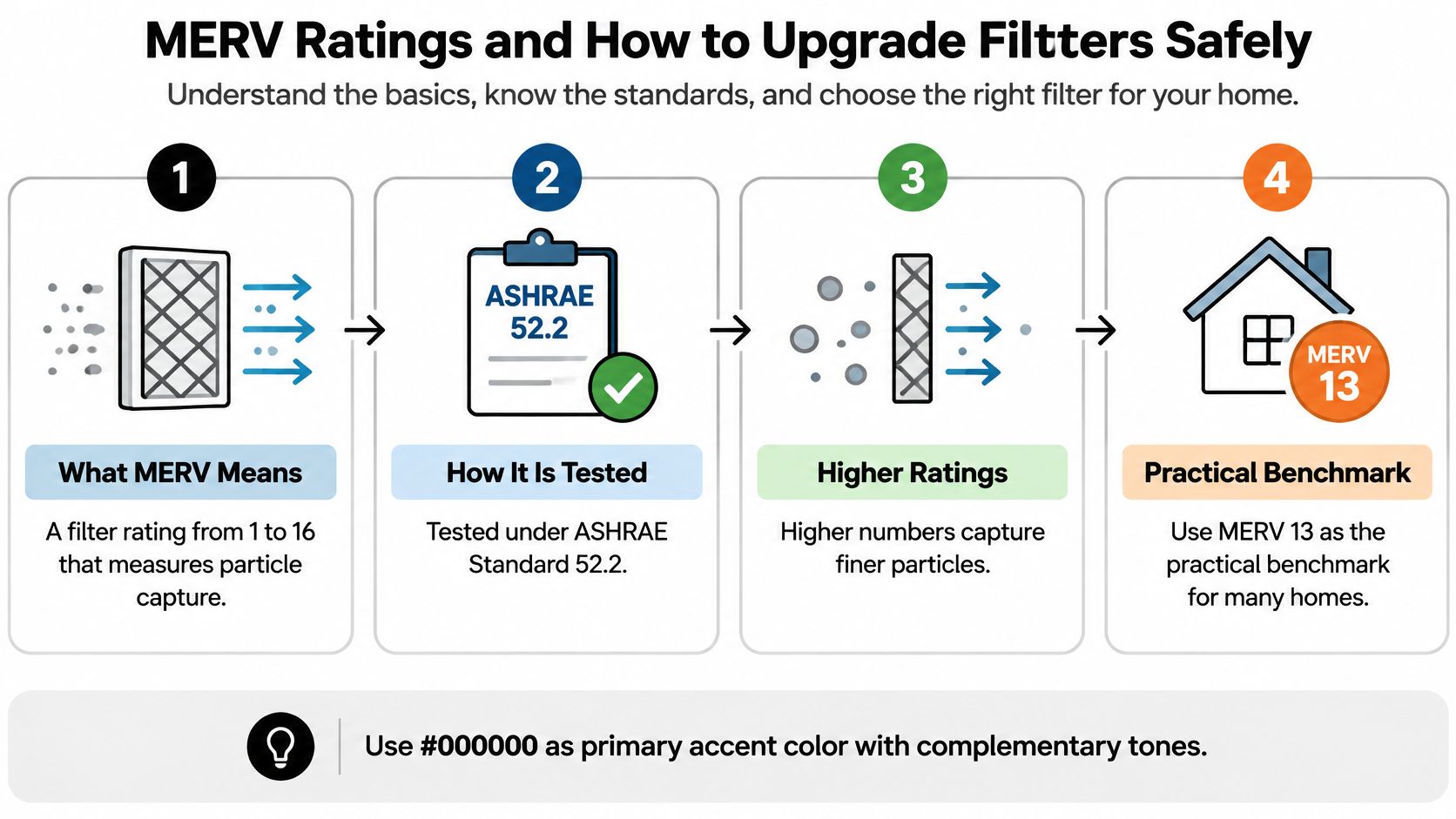
MERV 13 filters must meet the minimum particle-capture efficiency for each size range set by ASHRAE Standard 52.2. See the EPA's MERV performance table for the exact values. These are test results for particles, not a guarantee that the installed system removes every pollutant.
Upgrade without starving the blower
A more efficient filter can create greater resistance to airflow. The actual pressure drop depends on the filter's design, depth, face area, airflow, and how much dust it has collected. The MERV rating alone cannot confirm compatibility.
Too much resistance can reduce airflow and interfere with heating or cooling. A blower that compensates may use more energy.
Read the equipment documentation. Check the permitted filter configuration and available static-pressure limits. If the manual gives no maximum MERV rating, have a technician assess the system's airflow capacity.
Confirm dimensions and sealing. Check the filter's actual dimensions, airflow arrow, rack condition, and gaps around the frame. Air that bypasses the filter is not cleaned by its media.
Establish a pressure baseline. Ask a technician to measure system static pressure and pressure drop across the current filter with a manometer. Record the operating mode and fan setting for a useful comparison.
Choose the highest compatible efficiency. Select a filter the blower, rack, and duct system can handle. Use an intermediate rating if the preferred filter exceeds those limits. Don't force a restrictive filter into an undersized rack.
Check performance after installation. Recheck static pressure and delivered airflow, and compare supply temperatures with equipment requirements. The upgrade has gone too far if rooms no longer receive the heating or cooling they need.
Replace the filter based on its condition and limits. Use pressure readings, inspections, and manufacturer instructions together. Dust loading can increase resistance before a calendar-based replacement date.
Confirm the result in operation
The video explains filter selection and compatibility before an upgrade.
Bring the filter label and equipment model to the service appointment. This guide to choosing the right MERV-rated filter for your home can help you compare options, but measured airflow should determine whether the filter is suitable.
When Fresh Air Helps and When It Hurts
More outdoor air isn't always cleaner air. Opening windows during a smoke event can turn an indoor particle problem into an outdoor-pollution problem.
The EPA's indoor air quality factsheet identifies source control, improved ventilation, and air cleaning as the main improvement strategies. Ventilation dilutes indoor pollutants by bringing in clean outdoor air, while kitchen and bathroom fans help when they discharge outside.
Ventilation choice by outdoor condition
Outdoor Condition | Ventilation Choice | Reason |
|---|---|---|
Clean outdoor air, low PM2.5 | Ventilate; run bathroom and kitchen exhaust that vents outside | Dilutes indoor pollutants and exhausts old air |
Wildfire smoke or high outdoor PM2.5 | Close windows and doors; use the highest compatible efficient filter and recirculate | Outdoor air would import particles |
Outdoor ozone, dust, or extreme heat | Limit discretionary outdoor air; recirculate and filter particles while maintaining required ventilation | Incoming air can introduce pollution or excessive heat; particle filters don't remove ozone |
High-occupancy spaces at any time | Keep required ventilation on schedule and verify conditions with sensors | Occupancy increases CO2 and other indoor pollutant loads |
Use a deliberate smoke mode
The EPA's May 2025 wildfire guidance for schools and commercial buildings recommends evaluating whether systems can accommodate MERV 13 or higher, comparing indoor and outdoor conditions with sensors, closing windows and doors, and adjusting HVAC operation during smoke events.
For a home, that means checking whether an outdoor-air intake exists and how it's controlled. Don't assume the thermostat's fan switch changes the outdoor-air damper. In a commercial building, temporary smoke operation needs an operator who understands required ventilation, occupancy, exhaust, and building pressure.
Keep pollution out when possible, but don't treat recirculation as a permanent substitute for required ventilation.
Source control remains the first intervention: stop smoking indoors, reduce unnecessary aerosol use, and capture cooking emissions. Increasing fan runtime can improve particle capture, but the EPA's ventilation and filtration guidance also calls for considering system operation alongside ventilation and other controls.
Reopen based on outdoor recovery
Use local outdoor conditions and an outdoor sensor to decide when to resume normal ventilation, then confirm that indoor readings return toward their usual baseline. An indoor reading alone can't establish that outdoor smoke has cleared.
A planned indoor air quality ventilation strategy is more reliable than opening windows whenever a room feels stuffy.
Cleaner Air Without Higher Energy Bills
Cleaner air and energy efficiency don't always require opposing choices. A 2026 field study in two California classrooms found that a rule-based ventilation controller reduced carbon dioxide concentrations by 16% to 18% compared with fixed-rate ventilation, maintained or improved equivalent air changes for infectious-aerosol removal, provided comparable thermal comfort, and didn't increase energy use.
That finding supports better control, not a universal promise of free air cleaning. A home's climate, equipment, occupancy, and existing faults determine what's achievable.
What each indoor reading signals
Reading | Target or Sign | What It Signals | Corrective Action |
|---|---|---|---|
CO2 | Trend follows occupancy and clears when ventilation operates | Persistent buildup suggests ventilation may not match occupancy | Verify outdoor airflow, controls, and occupied schedules |
Indoor PM2.5 | Low baseline when outdoor air is clean | Elevated indoor particles suggest a source, infiltration, or capture gap | Control sources; inspect filtration; add targeted air cleaning |
Relative humidity | Roughly 30 to 50 percent as a working comfort range | Persistent dampness warrants moisture investigation | Check leaks, condensate drainage, and humidity control |
Temperature | Comfortable and consistent with room needs | Uneven conditions can indicate distribution or load problems | Inspect ducts and balance airflow |
Pressure drop | Within equipment and filter design limits | Excessive resistance may indicate loading or inadequate filter area | Replace the filter or evaluate rack size and blower capability |
Airflow by room | Matches each room's calculated requirement | Weak delivery may indicate a local restriction or imbalance | Test, adjust, and balance the system |
Fix control and distribution before adding capacity
Demand-controlled ventilation can respond to occupancy rather than treating an empty room like a crowded one. CO2 is useful for that purpose, but it doesn't measure smoke, cleaning chemicals, or every respiratory hazard.
Scheduled fan operation can improve particle capture during occupied periods without automatically committing to continuous operation. In cooling climates, evaluate humidity performance too, particularly where fan operation could re-evaporate moisture from a wet coil.
Testing, adjusting, and balancing separates inadequate total airflow from poor distribution. Don't reduce outdoor airflow below applicable requirements to chase an energy saving; verify what the building needs and what the system delivers.
Measure under comparable conditions
Log readings during occupied periods, after unusual cooking or cleaning, and when outdoor pollution changes. Compare similar operating conditions after each adjustment instead of drawing conclusions from unrelated snapshots.
For moisture-related inefficiency, Lighthouse Energy Services explains practical ways to reduce humidity and AC energy use. Pair that work with an HVAC system efficiency assessment focused on controls, airflow, and component condition.
Measure, change one variable, then measure again. That's how you separate a useful improvement from extra runtime.
HVAC Maintenance Schedule for Cleaner Air
Timing | Maintenance Task | What to Record |
|---|---|---|
Monthly homeowner review | Inspect accessible filters, returns, registers, and signs of moisture | Filter condition, unusual odors, blocked openings |
Quarterly operating review | Compare air-quality trends, fan schedules, and filter loading | Occupancy, readings, pressure changes |
Yearly professional review | Inspect coils, blower, drainage, airflow, and controls | Findings, measured performance, completed corrections |
Condition-based service | Replace loaded filters; clean fouled coils; investigate contamination | Reason for work and before-and-after findings |
Duct assessment cycle | Consider cleaning every 3 to 5 years, adjusted to the building | Duct condition, system type, occupant concerns |
These are planning checkpoints, not permission to leave a wet coil or overloaded filter until its scheduled date. Equipment instructions and observed conditions take priority.
Ducts are generally recommended to be cleaned every 3 to 5 years, depending on ductwork age and condition, the type of heating and cooling system, and any allergies or respiratory problems in the home. Treat that interval as a reason to assess condition, not proof that every duct system needs cleaning on the same date.
Know what can go wrong
The risks of air duct cleaning include dust and debris released into the air, allergic reactions, and mold growth. These risks are rare when a qualified company performs the work properly.
Our negative-pressure process uses a portable HEPA-filtered machine; a snake rotor brush extracts contamination from interior duct surfaces, and the ductwork is vacuumed end to end. Containment matters because loosening dust without collecting it can move contamination into occupied rooms.
Our air duct cleaning service takes an average of 2 to 3 hours from start to finish, depending on the size of the home. Access, preparation, and the scope of work still need to be established before scheduling.
Maintenance priority: Remove the contamination and correct the condition that allowed it to accumulate. Cleaning alone won't repair a leak or stop persistent condensation.
Coils and drain pans deserve particular attention when moisture is present. The resource air conditioner microbes explained by BacteriaFAQ provides context for microbial concerns, but visible moisture still calls for physical inspection and correction of its source.
Keep a usable service log
Facility managers should shorten inspection intervals during heavy smoke periods or high occupancy. Shorter inspections don't automatically mean more frequent duct cleaning; they help identify which component needs attention.
Use an HVAC system maintenance plan with clear responsibilities:
Monthly: Inspect the filter and accessible openings, look for water, and record unusual changes.
Quarterly: Review pressure and indoor-air trends, confirm schedules, and check that occupancy changes haven't outpaced ventilation.
Yearly: Arrange professional equipment and airflow checks, then document corrective work.
If money is tight, prioritize a properly fitted serviceable filter, correction of active moisture, and verified airflow. Those fundamentals should come before optional treatment devices.
Choose Your First Air Quality Upgrade
The best first purchase may be no purchase at all. A short measurement log and a condition check can prevent you from buying equipment that targets the wrong problem.
Measure before choosing equipment
Record a typical week. Note filter condition, visible duct debris, coil condition where safely accessible, and CO2 or PM2.5 trends. Add cooking, cleaning, occupancy, open-window periods, and HVAC operation so a technician can interpret the readings.
Correct the identified cause. A particle spike during cooking calls for capture at the stove; weak airflow calls for inspection before a filter upgrade. Clean fouled coils, assess visibly contaminated ducts, and adjust ventilation to actual occupancy rather than treating every complaint as a purifier problem.
Fill the remaining treatment gap. Consider additional air cleaning only after deciding which pollutant remains, where it occurs, and when exposure happens. Set a clear acceptance check, such as lower occupied-room particle readings without reduced supply airflow.
Allergy symptoms warrant attention, but symptoms alone don't prove that ducts are responsible. Bring the log to a qualified HVAC technician, and seek medical guidance for persistent breathing concerns rather than using an air-quality device as a diagnosis.
Select treatment by location and function
In-duct purifiers, including ActivePure units, provide system-integrated treatment, while portable HEPA units offer localized particle capture. ActivePure Technology is also available as a plug-and-play unit for a home or office, so installation format alone doesn't establish what a device treats.
We assess each customer's specific needs before recommending an air purification system for the home. Our team has over 20 years of experience in the Indoor Air Quality, HVAC, and Duct Cleaning industries.
Take your equipment model, filter information, maintenance history, and measurement log to the assessment. Agree on the problem and the verification method before purchasing equipment.
Purified Air Duct Cleaning offers residential and commercial duct cleaning, HVAC coil cleaning, and air purification services to address identified sources of indoor contamination. Visit Purified Air Duct Cleaning to request an assessment and bring your air-quality log so the recommended work matches your home's or building's needs.