

Best Portable Air Purifiers: Specs That Matter Most
The most common buying advice is also the least useful: choose a purifier by the room-size number printed on its box. That label can't tell you how much filtered air will reach your bed, whether the fan has to run loudly to deliver its rated performance, or how a doorway and open-plan layout affect coverage. For the best portable air purifiers, the more revealing question is whether the smoke CADR suits the space where you'll use the machine.
CADR, or clean air delivery rate, measures how quickly a purifier supplies filtered air, in cubic feet per minute. The right choice comes down to three questions: what pollutant do you need to remove, how large is the actual space, and can one unit cover it? The evidence offers useful guidance, but particle reductions in a study aren't promises about health outcomes in your home.
Why Room Size Labels Mislead Portable Air Purifier Buyers
A room-size label is not a guarantee that a purifier will clean every part of your room. It reflects a manufacturer's recommended coverage under stated conditions, and those conditions might not match your bedroom, living room or open-plan space. A closed door, a distant seating area, a crowded corner or a fan setting you find too loud can all limit how much clean air reaches where you spend time.
Look for CADR, which measures the volume of clean air a purifier delivers, in cubic feet per minute. Ratings are reported separately for tobacco smoke, dust and pollen. Smoke CADR is the most useful comparison for fine particles, including the small airborne particles associated with smoke. A high rating is more informative than a large coverage claim, but it still won't tell you whether air moves effectively from one room to another.
That matters because the most popular advice, match the box's square-foot number to your room, leaves out the factors that determine real coverage. If you want to understand how room ventilation relates to cleaning, see this guide to air changes per hour and why they matter for your home.
The market's popularity doesn't make the box label more dependable. Grand View Research's U.S. portable air purifier market figures put 2024 revenue at US$1,741.3 million, with HEPA technology representing 45.7% of the market. The more useful test for any product remains practical: does its specification predict performance in this room? The answers start with what you need to remove, the size of the space and whether one unit can cover it.
HEPA, Activated Carbon and CADR Explained Side by Side
True HEPA filters capture airborne particles. They're a sensible starting point for dust, pollen, pet dander and many smoke particles, but they don't remove gases or odors on their own. Before comparing purifier specifications, check the spec sheet for true HEPA. Labels such as HEPA-type and HEPA-like don't verify that a filter meets the true HEPA efficiency standard.
Activated carbon has a different job. It adsorbs gases, odors and many volatile organic compounds, so it can be useful for cooking smells or chemical odors. A thin carbon layer doesn't replace a particle filter: carbon and HEPA address different pollutants, and a purifier may need both when you're dealing with particles and odors.
CADR describes the purifier's clean-air output, not just its filter. Its standard ratings cover tobacco smoke, dust and pollen. Smoke CADR is especially useful when comparing fine-particle performance. A sealed housing matters because air that leaks around a filter bypasses filtration, reducing the clean air the unit delivers. A HEPA rating describes the filter; the housing and airflow determine whether air passes through it.
Before looking at the comparison table, screen out machines that pose an occupied-space ozone concern. The EPA guidance on ozone-generating air cleaners cautions against using them in occupied spaces. Ozone can irritate airways, and concentrations that remain within public-health standards don't effectively remove viruses, bacteria, mold or other biological pollutants. Ionizers and some bipolar units may produce ozone or other harmful by-products, so check the product's emissions information instead of assuming an electronic feature is harmless.
Filter loading can also change performance: dust on a filter can restrict airflow, so a published CADR may not reflect every point in the filter's service life. Compare the tested maximum or an AHAM-certified rating, and check which fan speed produced it. For more on how filters fit into broader indoor-air decisions, see this overview of indoor air quality filtration.
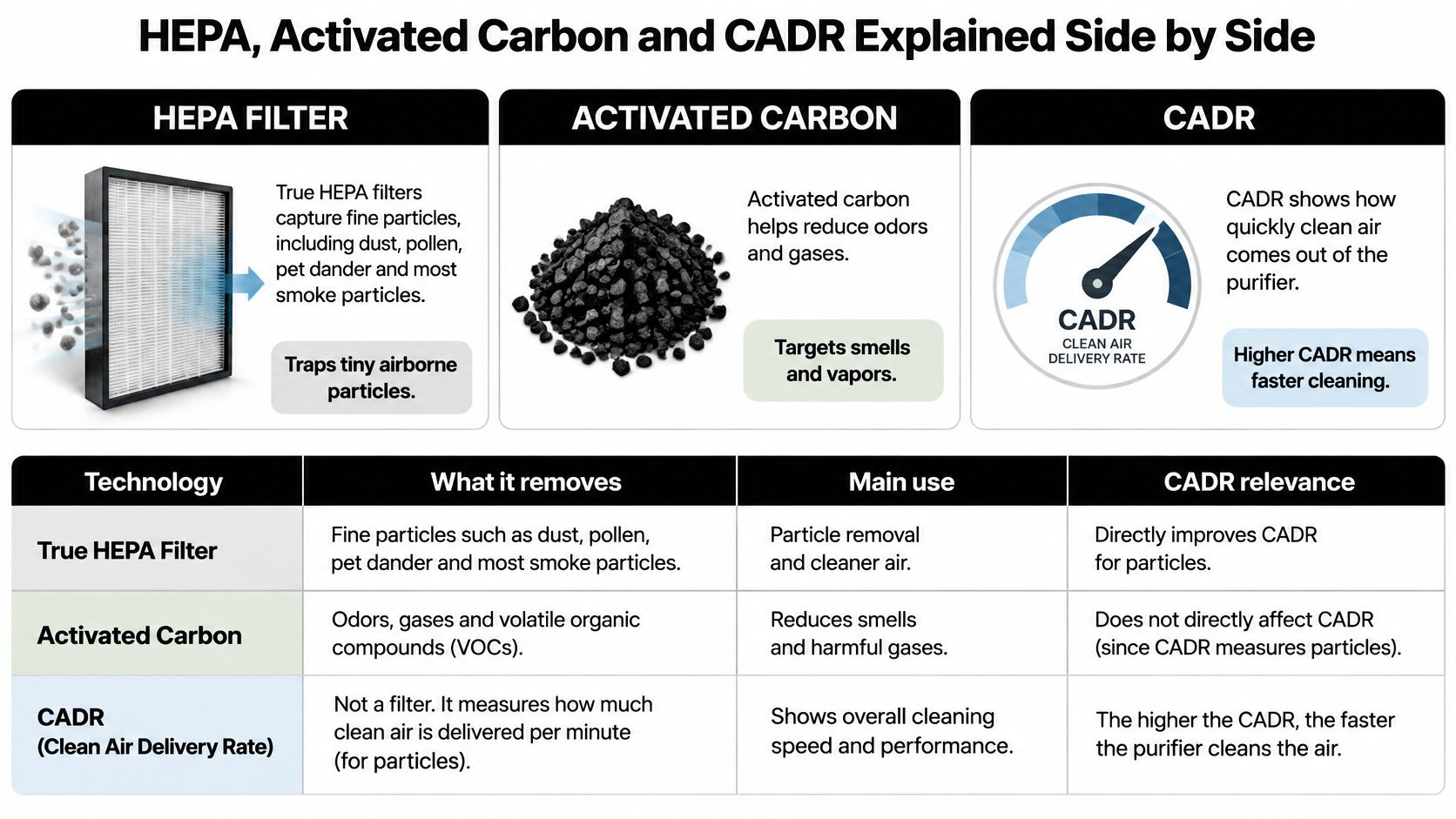
Technology | What it removes | Main limit | Best fit |
|---|---|---|---|
True HEPA filter | Fine particles, dust, pollen, pet dander, most smoke particles | Doesn't remove gases or odors alone | General use, allergies, smoke |
Activated carbon | Gases, odors, many volatile organic compounds | Doesn't capture fine particles alone | Cooking odors, chemical smells |
Ionizer or bipolar unit | Some particles through charging | Can generate ozone; the EPA cautions against occupied use | Avoid in occupied rooms unless ozone limits are verified |
In short, start with a sealed true HEPA unit for particles, add meaningful activated carbon if odors or gases matter, and don't treat an ionizer as a shortcut to cleaner air. Ozone safety is a screening criterion, not a feature to weigh against CADR.
Spec Priorities and Shared-Home Choices
Situation | Spec to prioritize | Placement | Watch for |
|---|---|---|---|
Bedroom or small office under 150 sq ft | High smoke CADR at sleeping fan speed, true HEPA | Near the bed, clear of walls | Noise at sleeping speed |
Living room near 300 sq ft | High smoke CADR, true HEPA plus activated carbon | Near the sofa or main activity area | Fan speed needed to reach rated CADR |
Open-plan space near 500 sq ft | Highest smoke CADR available, or two units | Spread units across zones | One unit often undersized |
Wildfire smoke days | High smoke CADR, sealed doors, continuous run | Near the most-used room | Filter loading lowers real CADR |
Pet dander or pollen allergies | True HEPA, continuous operation | Bedroom and living area | Replace filters on schedule |
Ozone-sensitive household | Any unit without ozone-generating technology | Occupied rooms | Ionizers and bipolar units without verified ozone limits |
Treat these as specification profiles, not model recommendations. A unit that meets a bedroom's needs can still fall short in an open-plan room. Check the rated smoke CADR for your actual space, then consider whether the relevant fan speed is quiet enough to use consistently.
Position the purifier near the bed, sofa or main pollutant source, with clear space around both intake and outlet. Don't tuck it behind furniture: obstructed airflow can make a strong rating less useful in practice. During wildfire smoke, prioritize the highest usable smoke CADR, keep doors closed where possible and run the unit continuously. Check the pre-filter often; dust and other accumulated particles can restrict airflow during a long smoky period.
Shared homes usually need room-by-room decisions. Say a two-bedroom Phoenix apartment is dealing with dust during dust season. A quieter bedroom unit can run at sleeping speed overnight, while a larger unit serves the living area during the day. That's more realistic than expecting a single purifier in the lounge to deliver the same air cleaning behind a closed bedroom door. If pet dander is a priority, this guide to choosing an air purifier for pet dander offers another way to frame the choice.
There's a practical trade-off: larger units often need higher fan output, and higher output can mean more noise and operating expense. A household may reasonably choose a quieter, smaller unit for the bedroom alone, then size a separate purifier for a larger shared area instead of buying one oversized machine for every room.
The room where someone spends the most hours is usually the room to size for first. One unit in that room is a starting point, not a guarantee that the rest of the home is covered.
Sizing, Noise, Filter Upkeep and Running Costs
A room-size label on a purifier box is only a starting point. Compare the unit's smoke CADR with the room's floor area, then account for whether its layout allows air to circulate between the purifier and the occupied area. The Association of Home Appliance Manufacturers recommends smoke CADR of at least two-thirds of the room's area in square feet. Its guidance puts a 120-square-foot room at a minimum of 80 cfm and a 150-square-foot room at approximately 100 cfm, as outlined in the AHAM air filtration standards.
Room area | Two-thirds rule smoke CADR |
|---|---|
120 sq ft | At least 80 cfm |
150 sq ft | At least 100 cfm |
300 sq ft | At least 200 cfm |
500 sq ft | At least 334 cfm |
Smoke CADR is useful for comparing performance on fine particles. Standard CADR ratings cover tobacco smoke, dust and pollen, with smoke representing the smallest particle category. The calculation gives a room-area target, not a guarantee of even cleaning throughout an open-plan space. Placement and airflow paths still matter.
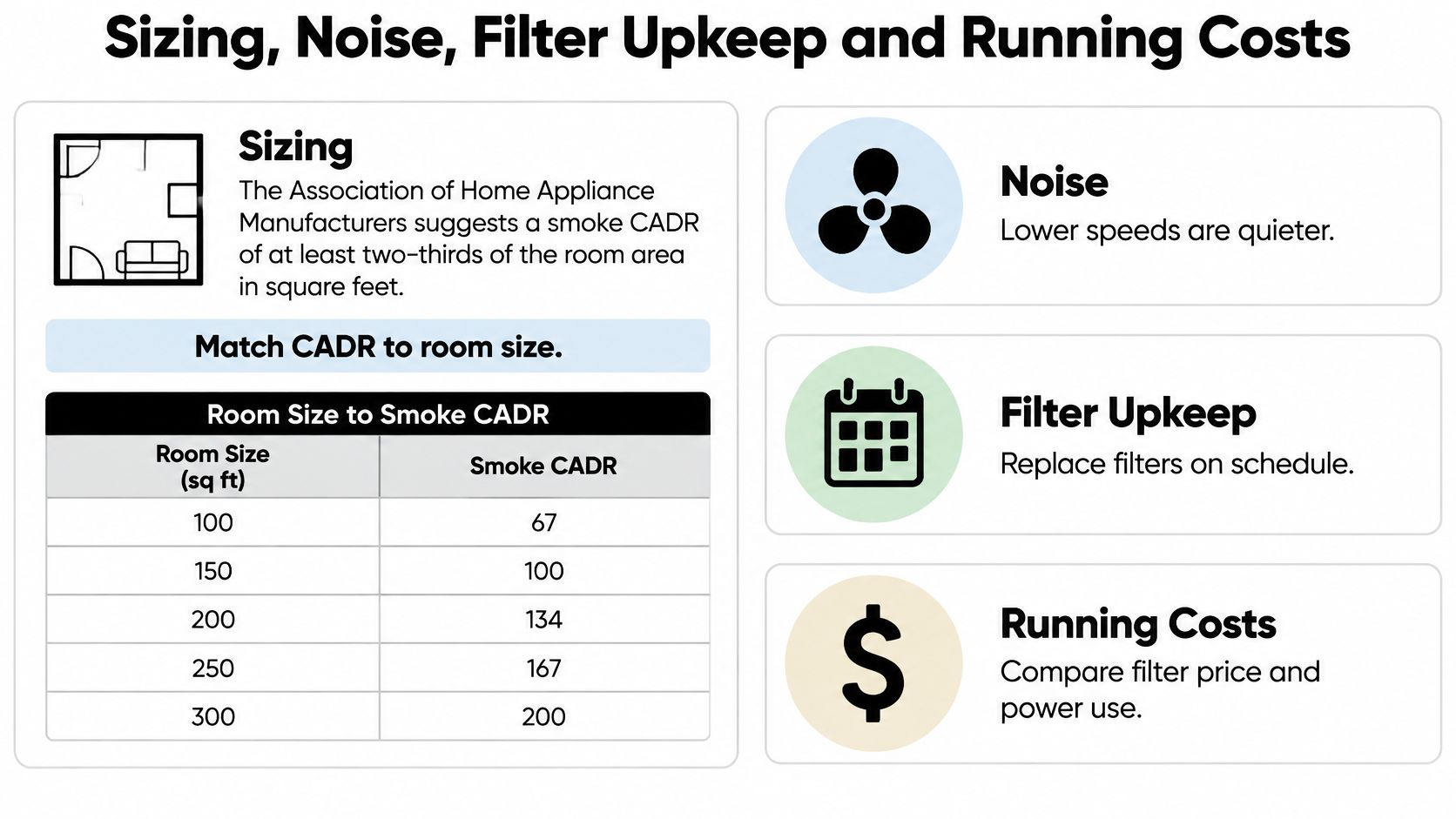
Noise affects whether a purifier can deliver its rated airflow in regular use. Compare decibel ratings at the fan speed you expect to use overnight, and check that products use the same measurement basis. A unit may meet its advertised CADR only at a setting that is too loud for the hours you want it running.
Filter upkeep affects performance as well as ownership cost. Check replacement schedules separately for HEPA and carbon layers, and clean a washable pre-filter regularly, especially in a dusty home. Carbon may need replacing sooner than the HEPA filter, so follow the manufacturer's instructions for each component rather than treating the filter assembly as one item.
Electricity use can be estimated from wattage and operating time. A hypothetical 60-watt purifier running 24 hours a day uses 1.44 kWh a day. At a hypothetical US$0.15 per kWh, that is about US$0.22 per day, before replacement filters. Consider both electricity and filter changes alongside the purchase price.
What the Clinical and Test Studies Show
The CDC tested portable HEPA cleaners against simulated exhaled SARS-CoV-2 aerosols in a conference-room setup. Two cleaners meeting the EPA's recommended clean-air-delivery rate reduced overall aerosol exposure by up to 65% without universal masking; used with universal masking, the reduction was up to 90%. The devices performed best when placed close to the aerosol source, so placement influenced the measured result. These were controlled tests of simulated aerosols, not a guarantee of what a particular purifier will achieve in a home. See the CDC study of portable HEPA cleaners and simulated aerosols.
A separate 2024 randomized, single-blinded crossover study examined 29 homes occupied by adults who had tested positive for COVID-19. Conducted from November 2020 through May 2021, it compared a portable unit with its HEPA filter installed against a sham condition with the filter removed. In primary rooms, average PM2.5 fell by 78.8% and PM10 by 63.9%; in secondary rooms, reductions were 57.9% for PM2.5 and 60.4% for PM10, according to the CDC home study of portable HEPA air cleaners.
The study also found that performance depended on airflow and room configuration. The findings measure particle and aerosol reductions under tested conditions, not health outcomes or guaranteed prevention of illness. For a plain-language look at what filtration can and can't establish about germs, see this guide on whether an air purifier kills germs. Building layout can further limit what one device delivers beyond the room where it operates.
When a Portable Unit Is Not Enough for the Whole Home
A portable purifier can sharply reduce particles near where it runs without providing equivalent cleaning everywhere in a house. In a 2025 test-house study, the National Institute of Standards and Technology found that a portable cleaner removed 90% of pulse-introduced particles within two hours when the house was sealed. During simulated wildfire-smoke infiltration, steady-state cleaning effectiveness reached 70%, 45% and 55% in different locations.
Those results point to a distinction box labels don't resolve: cleaning a room isn't the same as cleaning a home. Other rooms depend on air mixing, whether doors stay open, outdoor air getting in and whether central HVAC redistributes air. A purifier beside a bed may be a sound choice for the bedroom without being a whole-home solution.
Option | Coverage | Best fit | Trade-off |
|---|---|---|---|
One portable HEPA unit | Single room | One bedroom or office | Other zones receive less clean air |
Two or more portable units | Several rooms or open plan | Shared homes, larger open spaces | Higher running cost and filter count |
Central HVAC filter upgrade | Whole house through ducts | Homes with a working central system | Depends on system fan and filter rating |
In-duct air scrubber | Whole house through ductwork | Multi-zone homes, duct-related dust | Requires professional installation and service |
Plug-and-play ActivePure unit | Single room or office | Rooms needing a portable option with added technology | Not a whole-house fix on its own |
A second portable unit can serve another occupied room or zone. A central filter upgrade can be an option when the home has a suitable working HVAC system, while duct-based equipment may suit a multi-zone home or concerns involving ductwork. Read this practical overview of whether in-duct air purifiers are worth it before treating any in-duct option as interchangeable with a room purifier.
Purified Air Duct Cleaning offers both in-duct air scrubbers and portable air purifiers. ActivePure Technology is available as a unit installed in a residential or commercial air duct, or as a plug-and-play unit placed in a room at home or in an office. These are different installation formats, so the choice should follow the coverage problem, not just the technology name.
Consider a whole-home approach when several zones need attention, when duct-related dust is a concern or when allergy triggers persist across multiple rooms. A commercial space may also need a system sized and placed for its layout rather than a residential portable purifier. In-duct and other whole-home systems need scheduled service; portable machines still require their own filter maintenance.
Portable air cleaners can supplement source control and proper HVAC maintenance, but they don't replace either. Choose a room unit for room-specific needs, and look beyond one portable device when the problem spans the house.
Confirm Your Shortlist Before You Buy
A purifier's room-size label is only a starting point. Compare its smoke CADR with the actual room area and layout, then check whether the fan speed needed for coverage is quiet enough for the space.
Use this checklist to confirm the fit:
Match smoke CADR to the room. Use the sizing table and actual room area, not just the coverage label.
Verify the filter and housing. Look for a sealed true HEPA filter. Add a carbon layer if odors or gases are a concern.
Screen for ozone. Avoid ozone-generating technology in occupied rooms, and don't assume an ionizer is harmless.
Check bedroom noise. Read the decibel rating at the fan speed you would run overnight.
Price upkeep and power together. Record filter replacement intervals and costs, then estimate electricity use from wattage and daily operating hours.
Test the coverage plan. Decide whether one unit can serve the occupied space or whether separate units or a whole-home option better fit the layout.
Review the wider system. Dust in ductwork, concerns across several zones, or persistent allergy issues may call for a broader assessment.
Purified Air Duct Cleaning assesses each customer's needs and recommends a suitable air purification system for the home. Residential and commercial services come with free quotes, by phone or through a free walk-through at a commercial space.
Verdict: For one room, prioritize a portable unit with a sealed true HEPA filter and smoke CADR suited to the room. If the concern spans multiple rooms, consider separate units or a broader system rather than relying on one larger portable purifier.
Purified Air Duct Cleaning offers portable air purifiers, in-duct air scrubbers, and ActivePure units in duct-installed and plug-and-play formats. To discuss an assessment or request a free quote, visit Purified Air Duct Cleaning. For another perspective, explore Filtrete air purification.