

Indoor Air Quality Ventilation: A Practical Guide
You close the windows, turn on the air conditioner, and expect the house to feel fresh. Instead, cooking odors remain in the kitchen, the smell of cleaning products drifts through the hallway, and the same warm air keeps circulating from room to room. In a Phoenix-area home, that sealed-up feeling can become especially noticeable during long cooling periods, dusty weather, and monsoon humidity swings.
Indoor air quality ventilation is the relationship between what's in your indoor air and how deliberately that air moves. Ventilation can dilute indoor-generated contaminants, but it can't replace source control, filtration, moisture management, or sound ductwork. The practical question isn't whether your HVAC system runs. It's whether the right amount of outdoor air reaches the right rooms, through clean and properly connected pathways, while the system operates in a climate where opening a window may bring in dust, heat, or polluted outdoor air.
Why Indoor Air Quality and Ventilation Matter Together
Indoor air quality describes the condition of the air inside a home, including pollutants, moisture, odors, and particles. Ventilation is the controlled exchange of indoor air with outdoor air. The two belong together because activities inside the home continually add contaminants, while ventilation provides dilution and removal.
Cooking can release odors and particles. Cleaning products can add volatile organic compounds, often called VOCs. People, pets, furnishings, building materials, and combustion appliances also affect the indoor environment. If a home has little outdoor-air exchange, those pollutants may linger even while the central fan keeps circulating air.
Practical rule: A circulating HVAC fan moves air around the house, but it doesn't automatically bring fresh air indoors.
Phoenix homes create a difficult balance. Keeping windows closed helps limit outdoor heat and dust, but a tightly closed home can retain indoor emissions. Opening windows may provide natural air exchange when outdoor conditions are favorable, yet it can also introduce dust and uncomfortable heat. During monsoon weather, outdoor moisture can change quickly, so ventilation decisions need to account for humidity as well as temperature.
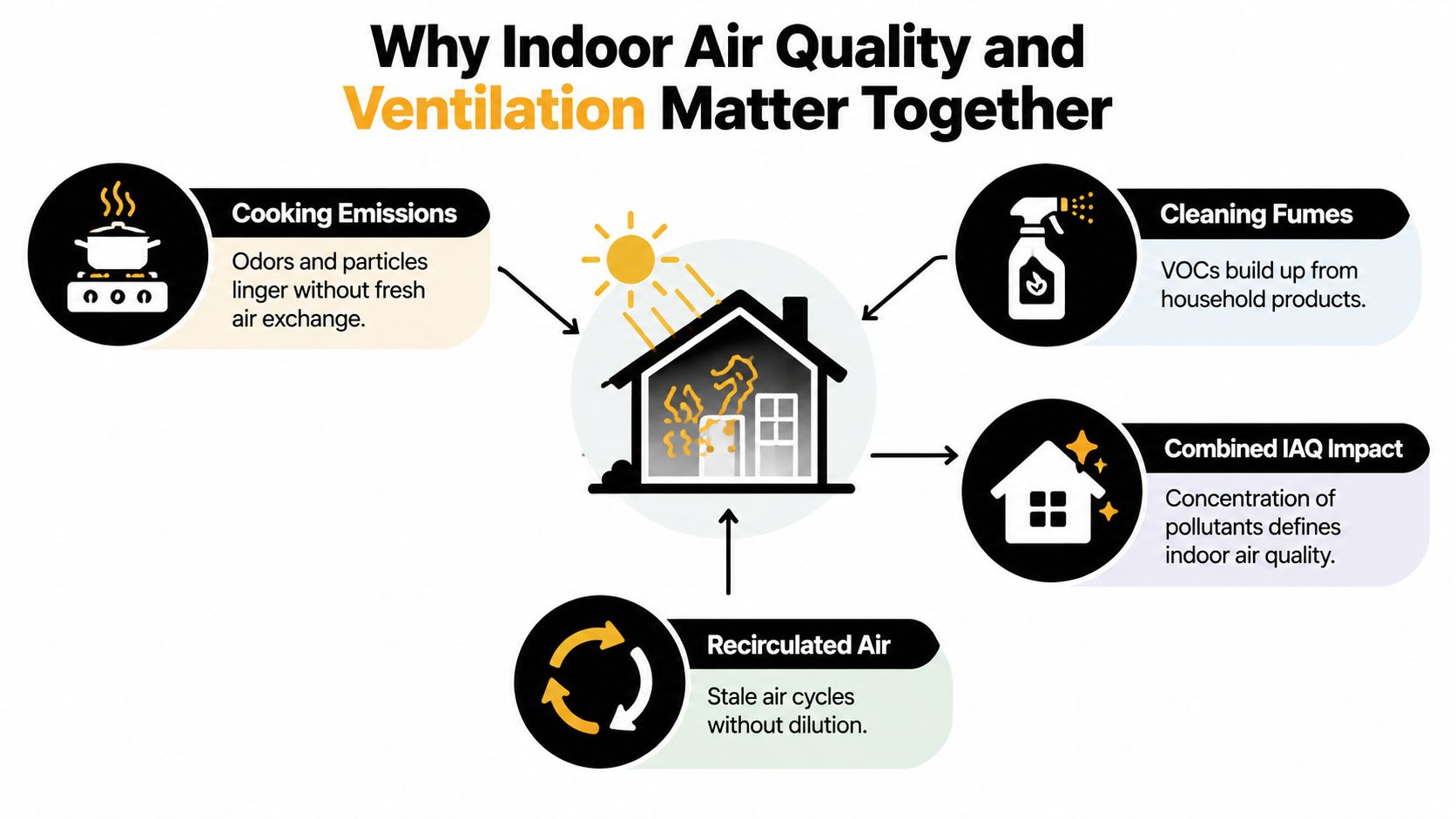
Ventilation is also a dilution strategy, not a magic eraser. A system may lower concentrations of CO2, moisture, and VOCs, but it won't remove a pollutant at its source. A range hood that exhausts outdoors, a properly vented bathroom fan, sealed combustion equipment, and particle filtration all address different parts of the problem. Guidance on indoor air quality versus outdoor air can help clarify why outdoor air quality matters before you choose a ventilation strategy.
Commercial buildings face the same basic principle, with larger occupancy loads and more complex systems. Facility managers may also need to consider moisture concealed inside walls or ceiling assemblies, making resources about commercial mold and air quality risks useful when visible mold isn't the only concern.
The starting point for a home assessment is simple: identify what adds pollutants, determine whether those pollutants have a source-control solution, and then evaluate whether the ventilation system supplies enough outdoor air to dilute what remains.
Natural, Mechanical, and Balanced Ventilation Explained
Think of ventilation as moving air through a house with a planned path. Opening a window is like opening a door between two rooms, while a mechanical system is closer to using a pump that controls where air enters and leaves.
Natural ventilation
Natural ventilation uses windows, doors, cracks, passive vents, wind pressure, and the stack effect. Warm air rises and escapes through higher openings while replacement air enters through lower openings. The approach can work when outdoor temperature, wind, dust, and air quality cooperate.
Phoenix weather often makes that cooperation unreliable. Opening windows during extreme heat can increase cooling demand and discomfort. Dusty conditions or outdoor pollution can also make unfiltered window air a poor choice. Natural ventilation is most useful when outdoor conditions are acceptable and the occupants can actively manage openings.
Mechanical ventilation
Mechanical ventilation uses fans and ductwork to move a measured amount of air. An exhaust-only system removes air from bathrooms or other areas, allowing replacement air to enter through planned openings or leakage. A supply-only system pushes outdoor air indoors, but the home still needs a reliable exhaust path. A whole-home system can distribute outdoor air more consistently than occasional window opening.
Mechanical ventilation works independently of weather, but installation quality matters. Blocked ducts, loose connections, poor return paths, and inadequate controls can undermine the intended airflow. Commercial applications require even more careful design, as this overview of commercial building ventilation illustrates.
Balanced ventilation
Balanced systems exhaust stale air while supplying outdoor air at a similar planned rate. Heat recovery ventilators, or HRVs, transfer heat between outgoing and incoming air. Energy recovery ventilators, or ERVs, can also transfer some moisture, which may help in climates where humidity control affects comfort.
Balanced ventilation generally offers the most predictable airflow, but it costs more to design and install than a simple window or exhaust fan. It also needs clean filters, accessible service points, and correctly sized ducts.
Approach | How It Works | Best Use Case | Limitations |
|---|---|---|---|
Natural | Uses windows, vents, wind, and temperature differences | Mild outdoor conditions and homes with occupants who can manage openings | Unpredictable, unfiltered, and difficult during Phoenix heat or dust |
Mechanical | Uses fans and ducts to supply or exhaust outdoor air | Airtight homes, renovated homes, and rooms needing consistent airflow | Requires proper sizing, duct integrity, controls, and maintenance |
Balanced | Supplies and exhausts air through coordinated fans, often with heat or energy recovery | Homes seeking steady whole-home ventilation with less energy waste | Higher installation complexity and ongoing filter maintenance |
Older homes may have enough leakage to exchange air, but leakage isn't the same as controlled ventilation. Newer or tightly sealed homes may need mechanical equipment because random openings don't guarantee that bedrooms, living areas, and wet rooms receive the airflow they need.
How Air Changes Per Hour and ASHRAE Standards Work
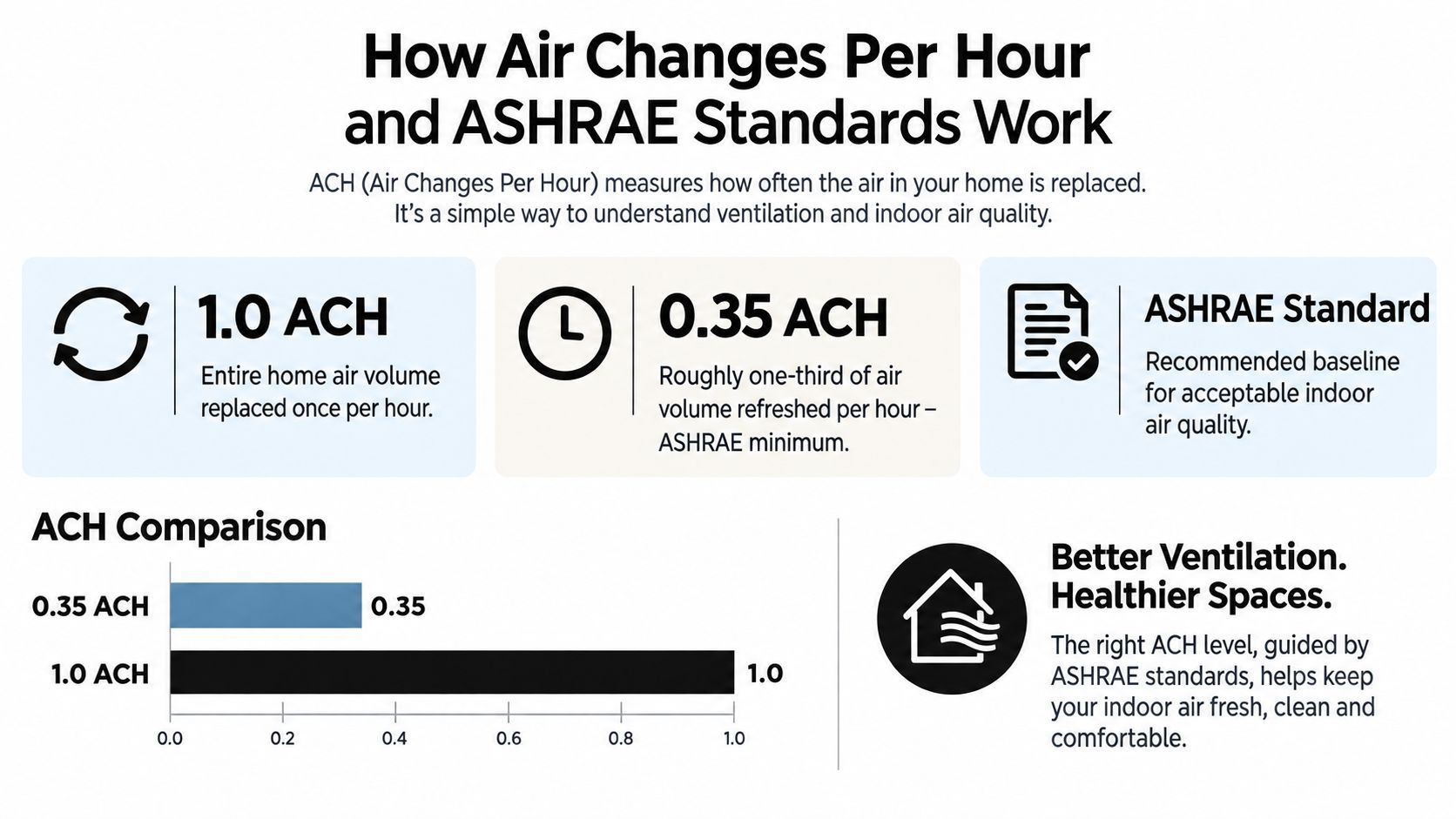
Air changes per hour, or ACH, compares the volume of air moved through a home with the home's total air volume. One ACH means an air volume equal to the entire home's airspace moves through the ventilation process in an hour. It doesn't mean every molecule leaves and gets replaced at once. Air mixes imperfectly, and some rooms may receive more effective ventilation than others.
For residential ventilation, ASHRAE 62.2 is the widely used benchmark. The EPA summarizes its minimum whole-home ventilation requirement as 0.35 ACH, but not less than 15 cubic feet per minute per person, as described in the ASHRAE Standard 62.1 and 62.2 resource. The standard's logic connects outdoor-air needs to both home size and occupancy.
A simple sizing example
Suppose a home has 2,000 square feet of floor area and an 8-foot ceiling. Its approximate air volume is:
2,000 × 8 = 16,000 cubic feet
At 0.35 ACH, the hourly outdoor-air volume would be:
16,000 × 0.35 = 5,600 cubic feet per hour
Divide that hourly volume by 60 minutes:
5,600 ÷ 60 = approximately 93 cfm
That 93 cfm is the whole-home volume implied by the ACH portion of the example. The occupancy rule still applies. If the number of occupants multiplied by 15 cfm exceeds the ACH result, the higher requirement becomes the relevant minimum. This calculation is a planning illustration, not a substitute for a complete design review.
What the standard doesn't tell you
A ventilation target doesn't guarantee equal air quality in every room. A bedroom with a closed door and no return path may remain poorly mixed even if the total system airflow looks adequate. A leaky or disconnected outdoor-air duct may also deliver less air than the equipment label suggests.
ASHRAE Standard 62.1 applies primarily to commercial and institutional spaces, while 62.2 addresses residential settings. The historical development of ventilation standards shows how public-health concerns became formal building practice, beginning with John Shaw Billings' 1893 proposal for 30 cfm per person, its 1895 adoption by the American Society of Heating and Ventilation Engineers, and the release of ASHRAE Standard 62 in 1973. That history is summarized in the American Journal of Public Health account of ventilation standards.
Use ACH as a sanity check, then verify actual airflow, room balance, filtration, outdoor conditions, and maintenance.
What Field Studies Show Ventilation Really Does
Field evidence shows that mechanical ventilation can lower pollutant exposure when the system is installed and operated correctly. In a Chicago residential retrofit study, the mean indoor-to-outdoor concentration ratios declined after mechanical ventilation was added. The reported reductions were approximately 12% for CO2, 10% for NO2, 42% for estimated PM1, 39% for PM2.5, and 33% for PM10, according to the published residential ventilation study.
Metric | Pre-Retrofit Average | Post-Retrofit Average | Percent Change |
|---|---|---|---|
CO2 | Study baseline | Lower after installation | About 12% lower |
NO2 | Study baseline | Lower after installation | About 10% lower |
Estimated PM1 | Study baseline | Lower after installation | About 42% lower |
PM2.5 | Study baseline | Lower after installation | About 39% lower |
PM10 | Study baseline | Lower after installation | About 33% lower |
These results don't mean every Phoenix home will achieve the same outcome. The Chicago project involved particular homes, equipment, outdoor conditions, occupant patterns, and retrofit details. A local home with leaky ducts, heavy air-conditioning runtime, dusty outdoor air, or a poorly located intake can perform differently.
Airflow alone isn't enough
Another study summarized in the same research source reported roughly 40% lower pollutant concentrations in summer with natural ventilation, but changing air-change rates from 0.3 to 0.8 per hour alone didn't meaningfully improve IAQ. That finding matters because outdoor air quality, seasonal conditions, and infiltration paths can outweigh a simple ACH target.
For Phoenix homeowners, the lesson is practical. A system that brings in outdoor air during a dust event may increase the amount of contaminated air entering the home unless the intake and filtration strategy are appropriate. During periods of extreme heat, occupants may also disable ventilation to reduce cooling load, changing real-world performance.
Ventilation works best as part of a system: control indoor sources, filter particles, manage moisture, and verify that outdoor air actually reaches occupied rooms.
A retrofit can also expose duct problems. Before treating dirty ductwork as the cause of every IAQ issue, inspect accessible sections, connections, insulation, and coil condition. A resource about whether air duct cleaning makes a difference can help separate duct cleanliness from the separate question of outdoor-air delivery.
The evidence supports measured improvement, not an automatic health guarantee. Health findings remain mixed, and ventilation studies don't establish a universal threshold that prevents asthma or guarantees symptom relief. Mechanical ventilation should therefore be evaluated by pollutant measurements, airflow verification, occupant experience, and the specific sources present in the home.
Common Ventilation Problems Most Homeowners Miss
Running the HVAC fan doesn't necessarily improve indoor air quality. In many homes, the fan only recirculates air through a filter. Cracking a window has the opposite problem: it introduces an unpredictable amount of outdoor air without ensuring that stale air leaves through a planned path.
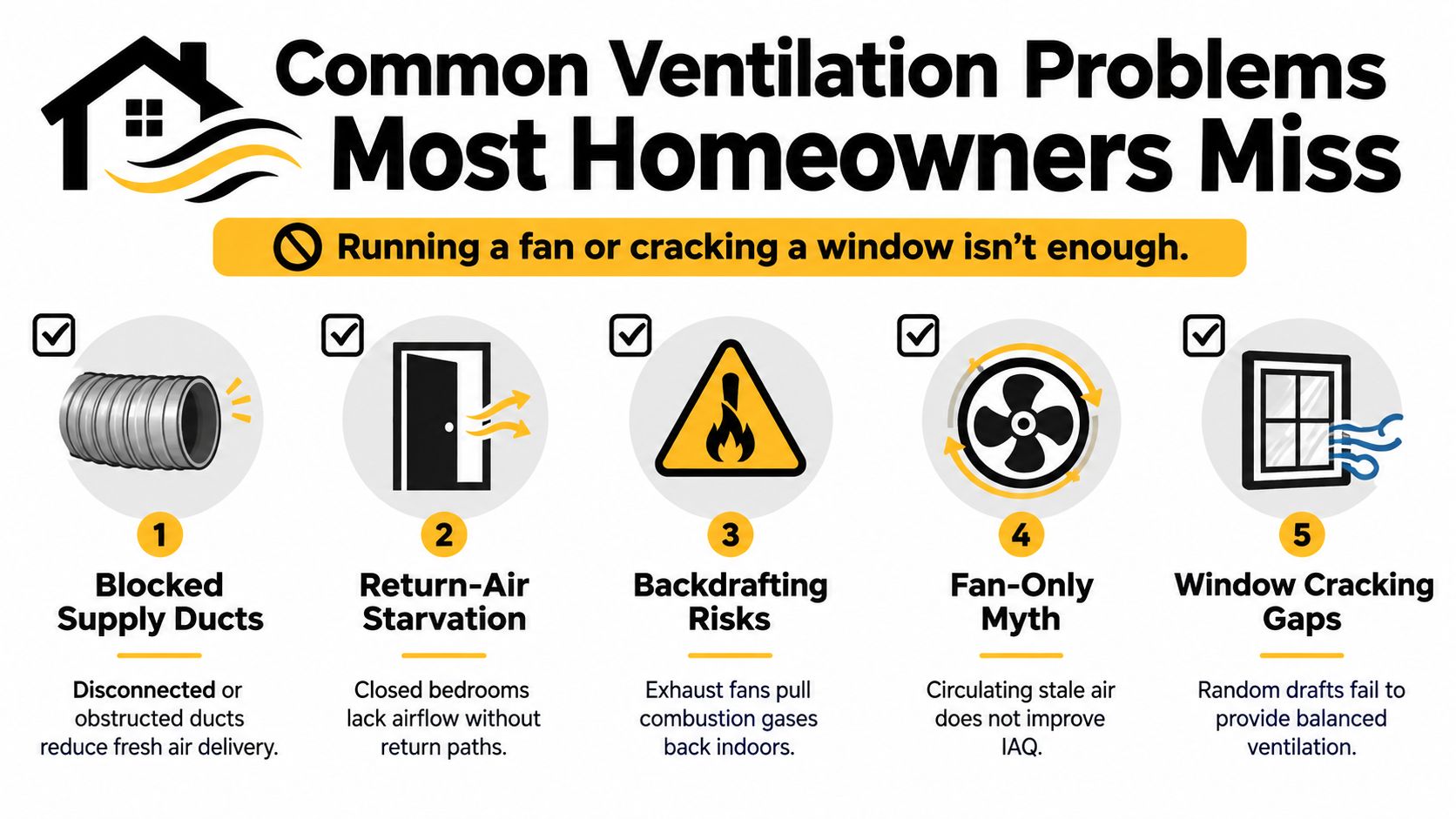
Five failure points to inspect
Blocked supply ducts: A crushed flex duct, closed damper, or disconnected run can reduce fresh-air delivery to the intended room. Look for weak airflow and unusual temperature differences between similar rooms.
Return-air starvation: A closed bedroom may have a supply register but no effective return path. With the door shut, pressure can build or fall, forcing air through gaps instead of allowing smooth circulation. Check for transfer grilles, undercut doors, or dedicated returns.
Backdrafting risks: Exhaust fans can depressurize a home and pull combustion gases from an improperly vented appliance. Have fuel-burning equipment and combustion safety evaluated by a qualified professional rather than relying on a window or bathroom fan as a correction.
The fan-only myth: A blower can distribute stale air, odors, and particles without adding outdoor air. Confirm whether the HVAC system has a dedicated outdoor-air intake or a ventilation unit.
Window-cracking gaps: Random drafts vary with wind, temperature, window position, and outdoor pollution. They rarely provide balanced ventilation to every occupied room.
Moisture and equipment behavior
An oversized air conditioner can satisfy the thermostat quickly and shut off before it removes enough moisture. That can leave humid pockets in bathrooms, closets, or poorly circulated rooms even when the rest of the house feels cool. Moisture management requires source exhaust, appropriate cooling operation, and inspection for leaks or condensation.
Phoenix conditions add another complication. Outdoor dust can load filters and equipment surfaces, while monsoon humidity can change how quickly moisture enters the home. Use a smoke pencil only as a basic airflow observation tool, keep it away from flames and combustion appliances, and arrange professional testing when pressure or combustion safety is uncertain.
A good diagnostic process asks three questions: where does outdoor air enter, where does stale air leave, and how does air travel through each occupied room? If you can't answer all three, the system needs more than a longer fan runtime.
Duct Cleaning, Filtration, and Air Purification Compared
These three interventions solve different problems. Duct cleaning addresses dust, debris, and contamination inside accessible duct sections and HVAC components. Filtration captures particles moving through the return-air path. Air purification adds treatment to the air stream or the occupied space, depending on the technology.
None of them automatically adds outdoor air. A clean duct system can still have inadequate ventilation. A higher-efficiency filter can capture more particles while leaving CO2, moisture, and VOCs unchanged. A purifier may reduce selected airborne contaminants or odors, but it shouldn't be used as a substitute for source control or outdoor-air exchange.
Intervention | What It Removes | Fresh Air Added | Typical Cost | Recommended Frequency |
|---|---|---|---|---|
Duct cleaning | Accumulated dust, debris, and contamination when present | None | Varies by system scope and access | Based on visible contamination, construction debris, moisture events, or system condition |
Filtration | Particles that pass through the installed filter | None | Varies by filter size and equipment | Inspect and replace according to loading and manufacturer guidance |
Air purification | Selected particles, odors, or biological contaminants, depending on technology | None | Varies by technology and installation | Follow the equipment manufacturer's service and replacement guidance |
NADCA-aligned work should begin with inspection, not an automatic promise that cleaning will solve every IAQ complaint. Technicians should identify accessible duct sections, registers, return pathways, blower compartments, coils, insulation condition, and signs of moisture or biological growth. Cleaning can't repair a disconnected duct or correct an undersized ventilation fan.
Choosing filtration carefully
A filter's efficiency matters, but so does airflow resistance. Increasing filter efficiency without checking system capability can raise static pressure and reduce delivered airflow. Before moving to a higher-MERV filter, have the blower, filter cabinet, and pressure drop evaluated.
Adding purification thoughtfully
HEPA, UV-C, activated carbon, and ActivePure systems don't perform the same function. HEPA targets particles, activated carbon is used for certain gases and odors, and UV-C or other treatment technologies depend on exposure conditions and installation. Review the product's testing, byproducts, maintenance needs, and placement before buying.
For homeowners comparing options, whole-home air purifier HVAC systems are best considered as one layer in a broader plan. The sequence should match the problem: control the source, repair airflow, select filtration, add purification where justified, and size mechanical ventilation for the home.
A Practical Home Ventilation Improvement Plan
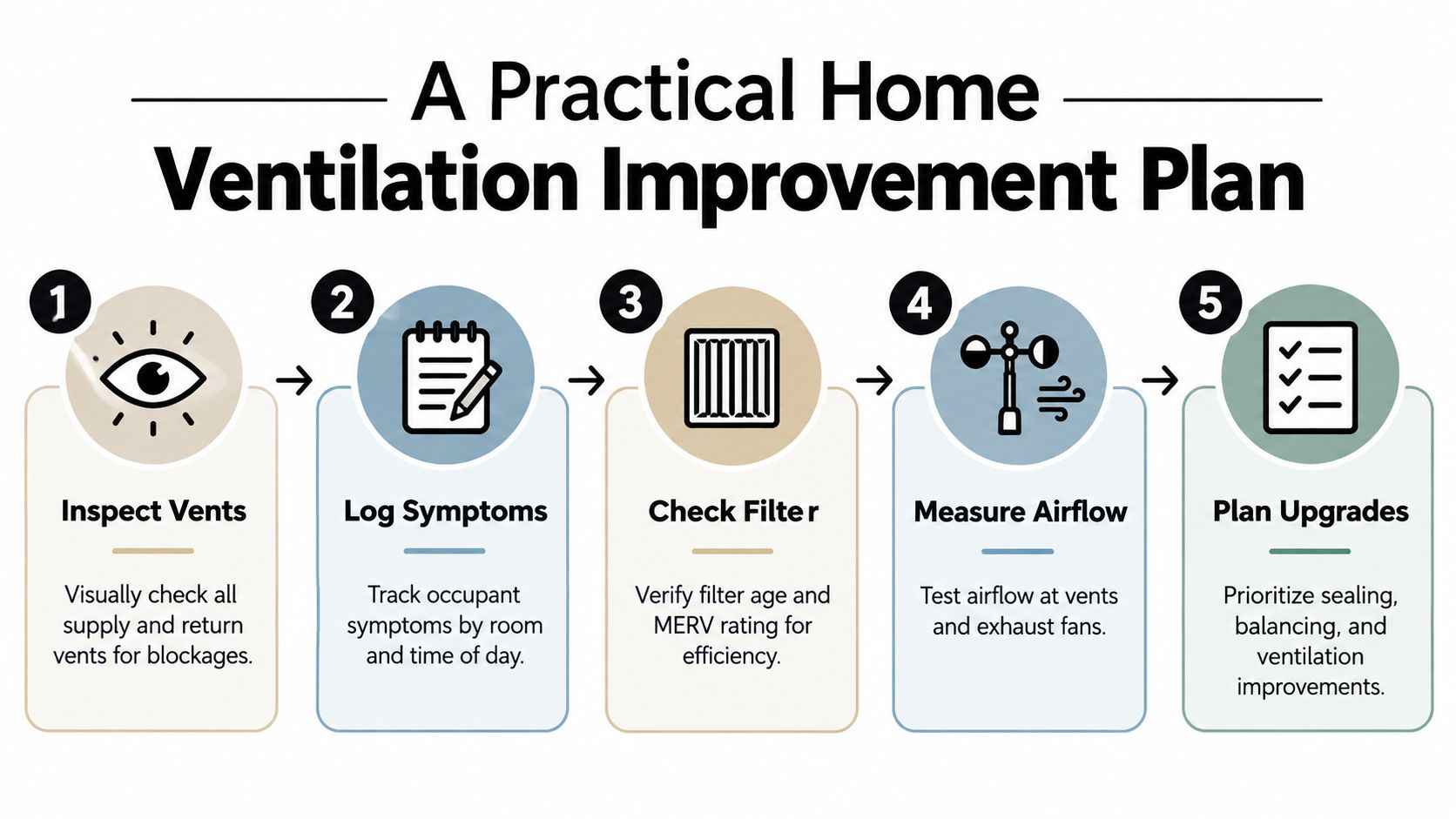
A stuffy bedroom, dusty return grille, or recurring cooking odor can have several causes. Use a five-step audit before buying equipment. The goal is to separate pollutant sources, poor airflow distribution, duct problems, filtration limits, and inadequate outdoor-air exchange.
1. Inspect supply and return vents
With the HVAC running, walk through every room. Confirm that supply registers and return grilles are open and clear of furniture, rugs, and other obstructions. Check bedrooms with closed doors closely. A supply register can deliver air, but without a return path, pressure builds and circulation suffers.
2. Log symptoms and conditions
For several days, record odors, irritation, headaches, visible dust, condensation, and comfort complaints by room and time. Note whether each problem follows cooking, cleaning, showering, sleeping with the door closed, or dusty outdoor conditions. These patterns often identify the source more clearly than saying that the air feels bad.
3. Check the filter
Write down the filter size, installation date, and MERV rating. Replace a visibly loaded filter, but confirm that the blower and cabinet can handle added resistance before choosing a more restrictive model. A filter that does not fit tightly can let air bypass the media, leaving part of the system unfiltered.
4. Measure airflow and outdoor air
A qualified professional can use a flow hood to measure supply and exhaust airflow. A CO2 spot check can reveal ventilation patterns, although it does not measure every pollutant. Ask whether the outdoor-air intake is open, connected, filtered, and delivering its intended flow during normal operation.
5. Inspect ducts and plan upgrades
In accessible duct areas, look for loose connections, damaged insulation, dust accumulation, moisture, or microbial growth. Qualified HVAC or IAQ support may include blower-door testing, duct-pressure testing, ERV or HRV sizing, combustion-safety checks, and verification after cleaning or repairs.
Phoenix homeowners should reassess filters and outdoor-air intakes during dusty periods, including monsoon weather. When outdoor temperatures exceed 105°F, open windows can add heat and increase cooling demand. An ERV, HRV, or properly controlled ventilation system may provide outdoor air with less disruption, provided the ducts, controls, and filters are commissioned and maintained.
Health claims also need restraint. Globally, poor indoor air is tied to 3.2 million premature deaths and IAQ burdens, so measured improvement matters more than promises. Berkeley Lab found mixed results, with just over half of reviewed home studies reporting at least one statistically significant health benefit from increased ventilation or lower CO2, as summarized in its ventilation rates and health research. NICE reports no difference in asthma control in one adult randomized controlled trial of mechanical heat recovery ventilation and no difference in respiratory health or wheezing in pediatric trials, as described in its guidance. Ventilation can support healthier indoor conditions, but it is not a guaranteed asthma treatment.
Purified Air Duct Cleaning can inspect and clean accessible residential or commercial ductwork, clean HVAC coils, service dryer vents, and install in-duct or portable ActivePure air purification systems. Phoenix-area homeowners can visit Purified Air Duct Cleaning to request a quote and discuss airflow, duct condition, filtration, and ventilation needs.