

Bipolar Ionization HVAC: A Practical Owner Guide
Bipolar ionization may help some particles clump so HVAC filters catch them, but only a model-specific UL 2998 file plus real-space measurements justify adding it, and it never replaces ventilation or mechanical filtration. The common advice to buy an ionizer because it promises an impressive laboratory reduction skips the questions that matter most: what happens in your building, and what else does the device put into its air?
A small air-handler attachment isn't automatically a small decision. Before approving one, separate particle removal, biological inactivation, and emissions safety. A test that answers one of those questions may say nothing about the others.
What Bipolar Ionization Means in an HVAC System
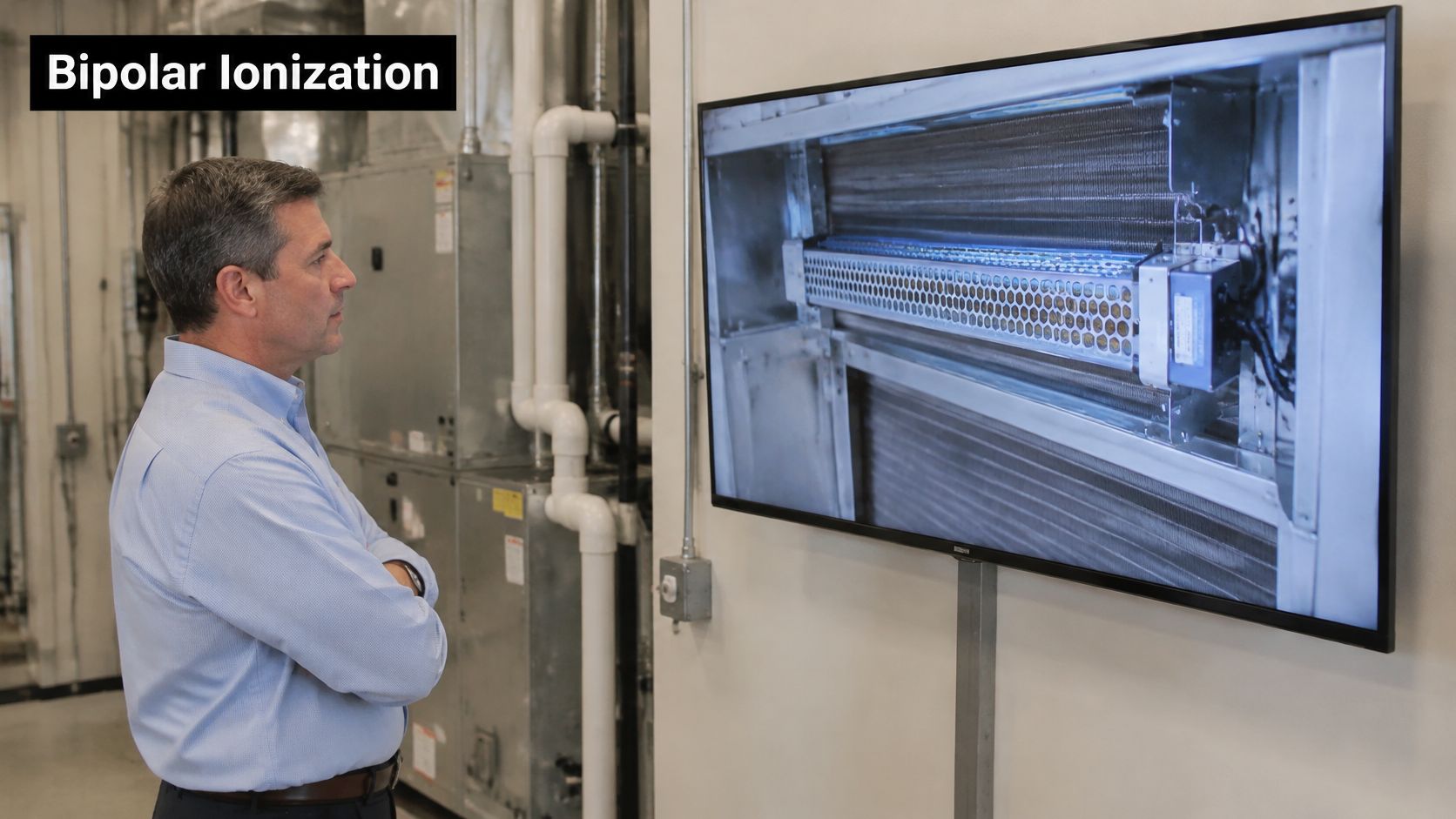
A property manager looks at a vendor slide showing a compact device mounted inside an air handler. The pitch promises cleaner air without rebuilding the ductwork or installing a larger filter. That's appealing when occupants complain about odors, allergies, or airborne illness.
Bipolar ionization is a high-voltage air-cleaning add-on that releases positively and negatively charged ions into an HVAC airstream. Depending on the approved installation, the device may sit in the supply airflow or another manufacturer-specified location. It isn't itself a mechanical filter.
Ions can help some particles clump so a downstream filter catches them, but published performance runs from weak to strong. The unit doesn't replace outdoor air, source control, or a correctly sized filter.
The installation can look straightforward, but the device's location and operating conditions matter.
Separate cleaning from safety
The cleaning question is whether a specific device meaningfully reduces the pollutant you're trying to control. Dust capture isn't the same outcome as odor reduction, and neither establishes protection against infection.
The safety question is whether the device produces unintended ozone or other reaction byproducts. Passing an emissions test doesn't prove useful cleaning, just as a favorable particle test doesn't establish emissions safety.
For a bipolar ionization HVAC proposal, useful evidence connects the mechanism to an actual installation: particle behavior, laboratory test conditions, zero-ozone documentation, and occupied-room measurements. Filtration, UVGI, and active purification products such as ActivePure also need different specifications. Those distinctions should be settled before anyone cuts into the ductwork.
What Decides Whether Ions Help the Filter
Think of a hallway carrying drifting dust toward a screened doorway. Ions act somewhat like static that encourages passing particles to hold together; the filter is the doorway that may stop the resulting clumps. Making a clump and catching it are separate events.
High-voltage electrodes generate positive and negative ions in the airstream. Those ions can charge suspended particles and encourage agglomeration, meaning particles combine into larger groups that may be easier to capture. Some systems also use reactive oxygen species to affect biological aerosols, but ASHRAE's air-cleaning handbook describes ionization as emerging technology, with results ranging from ineffective to very effective and limited convincing, rigorous peer-reviewed evidence.
There's another possible destination besides the filter. The University of Massachusetts Environmental Health and Safety guide explains that charged particles can stick to room surfaces and that bipolar ionization can emit ozone and other reactive species. A lower airborne particle count therefore doesn't necessarily mean contaminants have left the building.
The conditions that determine capture
An installer needs to evaluate the complete airflow path, not just whether the device fits inside the cabinet.
Ion concentration: The device must deliver its intended output under actual operating conditions, not merely near the electrode.
Air velocity and residence time: Faster airflow and short duct runs can limit the time available for particle interactions.
Filter efficiency: A weak, poorly fitted, or bypassed filter can miss particles even after they agglomerate.
Duct geometry and placement: Bends, branches, and installation location affect where treated air travels.
Humidity and contaminant type: Dust, biological aerosols, and gaseous pollutants don't behave identically.
Maintenance: Dirty electrodes, loaded filters, and neglected components change the conditions on which performance claims rely.
A fast-moving airstream through a coil section isn't equivalent to prolonged exposure in a test chamber. Nor does adding ions make an unsuitable filter suitable. Start by checking how indoor-air filtration works, including filter fit and blower compatibility.
Commission the system, not the brochure
Use a particle counter to establish baseline readings at named sampling locations. Record airflow, fan mode, filter condition, occupancy, and activities such as cooking or cleaning, then repeat measurements after installation under comparable conditions.
Where the equipment permits safe controlled testing, an on/off comparison can help distinguish the ionizer's contribution from normal filtration. Don't credit the add-on for an improvement caused by replacing a dirty filter at the same visit.
Design rule: Ionization supplements source control, outdoor-air ventilation, and mechanical filtration. It doesn't excuse weaknesses in any of them.
Measured Results Owners Can Actually Compare
Published bipolar ionization results and their limits
Source | Endpoint | Reported result | Limit on use |
|---|---|---|---|
ACEEE lab analysis | SARS-CoV-2 aerosol | 94.1% reduction after 60 minutes | One tested device versus a control, not every product or occupied room |
Intertek tests in that analysis | Ozone | Zero ozone under UL 867, CSA 22.2 No. 184, and UL 2998 | Applies to the tested device and procedure only |
2023 portable ionizer comparison | Particles | Up to 80% reduction | Ozone behavior varied by model; one device rose slightly |
2025 journal study | Bacillus subtilis and Staphylococcus aureus | 99.8% reduction after 3 hours | Needlepoint exposure in the study setup |
ASHRAE characterization | Overall category | Ineffective to very effective | Convincing peer-reviewed evidence still limited |
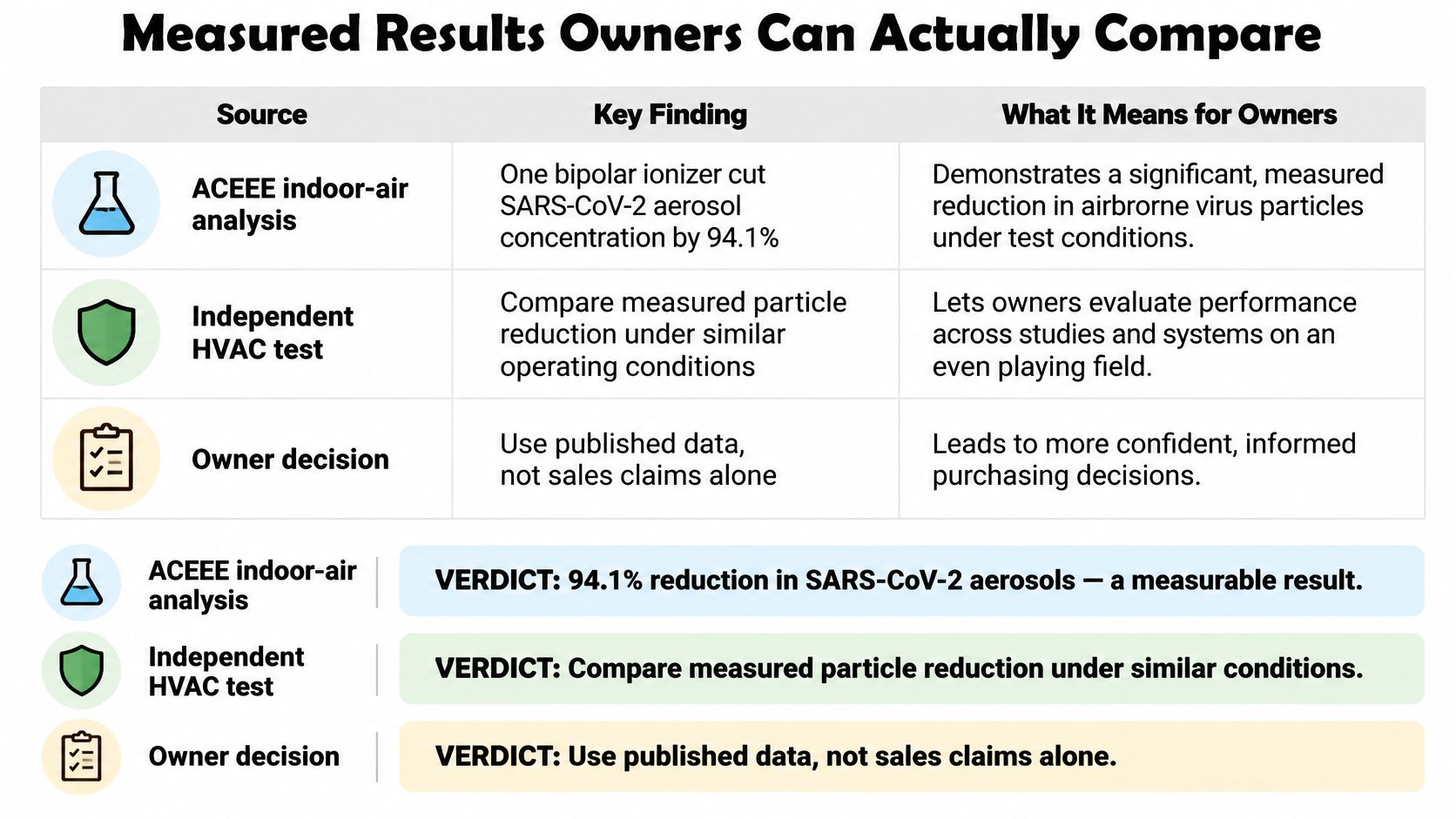
The table separates outcomes that sales presentations often combine. The visual below provides a shorter comparison for an owner reviewing a proposal.
Read each result within its boundaries
The ACEEE indoor-air-quality analysis reported that one bipolar ionizer reduced SARS-CoV-2 aerosol concentration by 94.1% after 60 minutes compared with a control. That's an aerosol result for the tested equipment and conditions, not a measured reduction in infections among building occupants.
The same analysis described 24-hour Intertek ozone testing under UL 867, CSA 22.2 No. 184, and UL 2998, reporting zero ozone for that device and consistency with the cited California Air Resources Board requirements. That row answers an emissions question, not how much dust or virus the device removes.
A 2023 portable-ionizer comparison described in the EPA cold-plasma bipolar-ionization material found particle reductions of up to 80% under its test conditions, while ozone behavior differed by model. The practical lesson is to request the exact model's report rather than treating portable ionizers as interchangeable.
The bacterial study row concerns specified organisms and prolonged needlepoint exposure. It shouldn't be converted into a general virus claim, an instant duct-pass result, or a promise about every occupied room. ASHRAE's category-wide assessment likewise calls for product-level evaluation rather than a blanket verdict.
Ask what the instruments measured
A credible report should disclose:
Test environment: Chamber volume, air-change rate, temperature, and relative humidity.
Exposure: Operating duration, airflow, and device settings.
Sampling position: Breathing-zone measurements versus readings close to the electrode.
Endpoint: Particle concentration, viable organisms, ozone, or another clearly named measure.
Control condition: What happened without the device under otherwise comparable conditions.
Use a consistent indoor-air-quality measurement approach to connect laboratory claims with the complaint in your building. A particle counter can't by itself establish pathogen inactivation or detect every gaseous byproduct.
For additional context while reviewing an installation proposal, the following video can accompany, but shouldn't replace, the model's written test reports.
How to Verify a Zero Ozone Claim
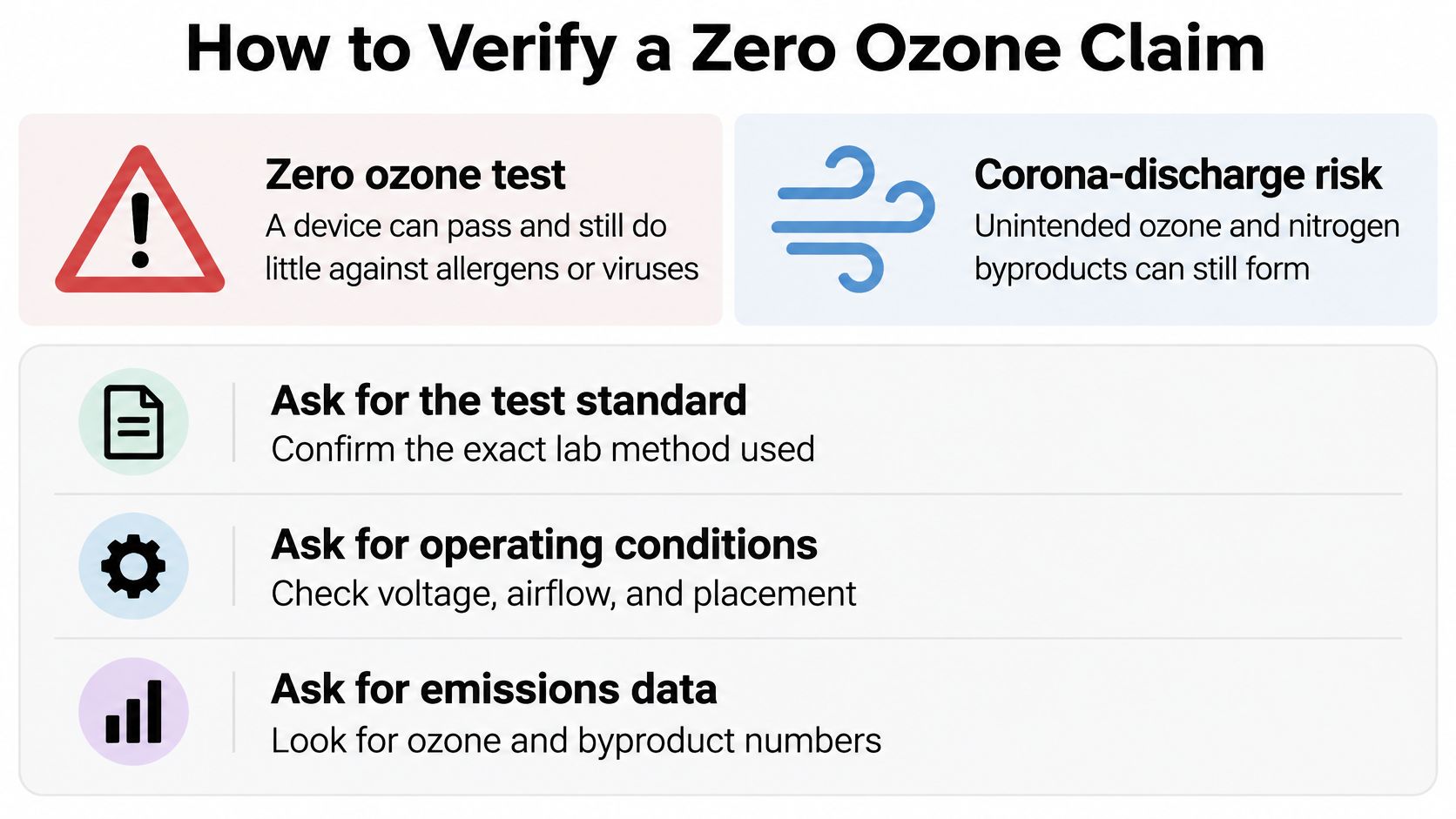
A device can pass a zero-ozone test and still do little against allergens or viruses. Emissions compliance and cleaning effectiveness are separate purchases, even when they're presented on the same marketing sheet.
Corona discharge uses electrical energy to ionize air, and unintended ozone and nitrogen oxides can form. Ozone can irritate airways and react with indoor chemicals to create secondary pollutants. The EPA's HVAC air-cleaner guidance recommends UL 2998-certified equipment and explains that ozone at concentrations within public-health standards is generally ineffective against viruses, bacteria, mold, and other biological contaminants.
Turn the claim into a specification
Specification | Evidence to obtain | What it doesn't establish |
|---|---|---|
Model-specific zero-ozone certification | Independent certification identifying the supplied model | Effective allergen or pathogen removal |
Approved operating configuration | Instructions covering power, placement, and airflow requirements | Performance in an untested layout |
Low indoor ozone | Commissioning measurements and a maintenance plan | Absence of every possible reaction byproduct |
Cleaning efficacy | Independent report with a defined endpoint and control | Equivalent performance in every building |
A zero-ozone claim should lead to documents and measurements, not just a logo. The checklist below keeps the emissions question separate from the cleaning claim.
Check the paperwork and the installed equipment
Match the model and power setting. Compare the equipment nameplate with the independent certificate. A document for a related product family isn't enough without confirmation that it covers the supplied configuration.
Read the installation layout. Check electrode placement, clearances, airflow direction, and electrical requirements. Reject a layout that bypasses required filtration or outdoor-air ventilation.
Obtain the service schedule. Keep the electrode cleaning or replacement instructions with the HVAC maintenance records. Don't assume that an illuminated indicator proves clean electrodes or correct output.
Separate independent testing from advertising. Read the actual report, including operating conditions and measurement methods. Treat certification logos and broad biological claims as different kinds of evidence.
Measure after commissioning and during maintenance. Use an ozone instrument appropriate to the concentrations being assessed, with a documented calibration status. Record sampling location and operating conditions so later readings are comparable.
For an existing ionizer, photograph its nameplate, match it to the certificate, and request its service record before changing anything. Note unusual sharp odors or visibly dirty electrodes, but don't use smell as an ozone meter.
Households managing asthma or allergies should be especially cautious about reactive byproducts, even when advertising describes a device as chemical-free. Also distinguish continuous occupied-space air cleaning from ozone shock treatment, which isn't a substitute for this verification process.
Why Chamber Tests Differ from Occupied Rooms
A closed bedroom with a long HVAC cycle may give recirculated air repeated contact with the system. An open office has people entering, talking, moving, and introducing pollutants throughout the day. A school or clinic adds changing occupancy, outdoor-air requirements, and people who may be particularly vulnerable to poor air quality.
Those spaces don't behave like the same sealed chamber. The EPA's guidance on emerging air-cleaning technologies describes limited research outside laboratory conditions and emphasizes that product design and maintenance affect emissions. A favorable chamber result therefore doesn't automatically describe breathing-zone exposure.
Exposure time changes the meaning
A 2025 study in Environmental Science and Pollution Research measured a 99.8% reduction of Bacillus subtilis and Staphylococcus aureus after 3 hours of needlepoint bipolar ionization exposure, according to the published journal study. That is a defined bacterial result over an extended exposure period, not a brief pass through a moving duct airstream.
Humidity, room mixing, ion concentration, and air changes affect whether ions encounter the target pollutant. A person close to an emission source may breathe affected air before it reaches the return grille. Conversely, outdoor-air ventilation may remove some pollutants before prolonged ion exposure occurs.
Airborne concentration, surface contamination, and infection risk are different endpoints. A reduced airborne reading doesn't identify where every particle went, and reduced microbial viability in a chamber doesn't directly establish fewer infections among occupants.
Specify the outcome you need to improve, then choose a test that can actually measure it.
Apply a field check to the room
Identify the equipment and laboratory. The independent report should name the tested model, not merely the technology.
Record the test environment. Note chamber size, air-change rate, humidity, mixing, and exposure duration.
Compare with the existing system. Document the MERV-rated filter, its fit, and the outdoor-air rate before crediting an add-on.
Check emissions after startup. Measure ozone and investigate other byproducts when the equipment or pollutant conditions warrant it.
For stale-air complaints, evaluate indoor-air ventilation rather than assuming more treatment of recirculated air solves insufficient outdoor air. In allergy households, reactive byproducts also deserve attention even if a brochure calls the technology gentle.
Phoenix-area cooling systems may operate for long stretches during hot weather. Treat electrode condition, filter condition, and documented service as part of the performance evaluation, not an administrative detail.
How Bipolar Ionization Compares with Other Air Cleaning
Bipolar ionization and the main HVAC alternatives
Option | Main action | Best fit | Limit to plan for |
|---|---|---|---|
MERV or HEPA filtration | Captures particles in the airstream | Dust, dander, and predictable particle removal | Pressure drop, leaks, and filter changes; no surface treatment |
UVGI | UV dose on a coil or in a designed airstream | Coil growth and some microbial control | Lamp life, shielding, and dose; not a particle filter |
Bipolar ionization | Charges particles and may use reactive species | A tested add-on after filtration and ventilation | Product-specific results and possible ozone or byproducts |
ActivePure | Active purification in-duct or portable | Air and exposed-surface goals without ozone byproducts, subject to model-specific verification | Still needs source control, outdoor air, and filtration |
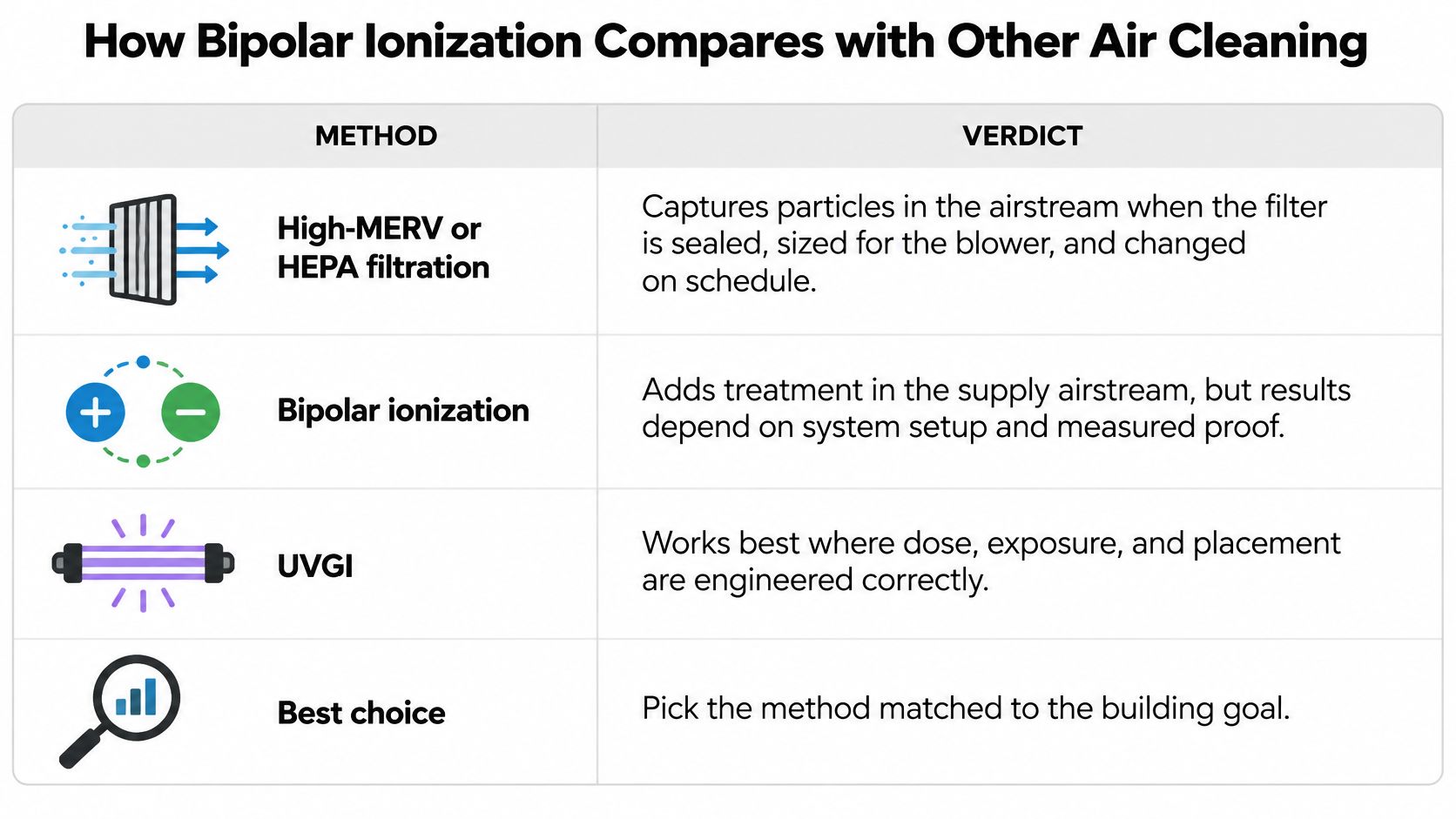
Filtration is the starting point for particle complaints. A high-MERV filter or properly selected HEPA system needs a sealed installation and a blower arrangement that can accommodate its resistance. It captures what reaches it, not settled dust on desks or floors.
UVGI fits a defined microbial-control location. Coil irradiation and airstream treatment require different placement and exposure considerations. An in-duct UV air purifier needs suitable shielding, lamp maintenance, and an engineered dose; it doesn't collect particles.
The comparison below highlights why these methods aren't interchangeable.
Match the technology to the complaint
Bipolar ionization is a conditional add-on, appropriate for consideration when a defined model has relevant efficacy evidence, emissions documentation, and a commissioning plan. It shouldn't become the default answer just because installation appears convenient.
ActivePure belongs in a separate product evaluation, not under an assumption that all active purification works like bipolar ionization. For air and exposed-surface goals, examine the exact model's independent tests, exposure conditions, and emissions evidence rather than relying on a slogan.
For emerging equipment, ASHRAE's filtration and disinfection guidance emphasizes ozone control and careful evaluation of manufacturer evidence; an Environmental Health Committee brief suggested indoor ozone below 10 parts per billion, with ozone introduction reduced as low as reasonably achievable. That's a suggested precautionary target, not a universal legal threshold or proof of efficacy.
Start with the source when possible
Dusty ductwork and allergy complaints call for inspection, appropriate cleaning, and filtration checks. Coil biofilm points toward coil cleaning and consideration of correctly designed UVGI. Combined air and exposed-surface goals may bring an active system into consideration after ventilation is confirmed.
Renovation dust illustrates why source control matters. Savera Wood Floor Refinishing's resource on cleaner hardwood refinishing on Long Island provides useful context for discussing dust capture during sanding rather than expecting HVAC equipment to collect everything afterward.
No emerging add-on removes the need to specify operating conditions, maintenance requirements, and measured emissions.
Decide Before You Add Anything to the Air Handler
Make approval conditional on a written scope, not a persuasive demonstration.
Name the complaint. Distinguish particles, odor, coil dirt, and stale air. They require different investigations.
Correct the basics. Address sources, filter fit, airflow, and ventilation first. For homeowners considering cleaning, J.G. Carpet Cleaning LLC's a Connecticut homeowner's duct cleaning guide offers context for evaluating that separate maintenance decision.
Require an equipment file. Obtain the exact model's zero-ozone certificate, installation layout, service interval, and independent efficacy report with airflow and humidity stated.
Define acceptance measurements. Specify before-and-after particle counts at stated airflow and sampling locations, plus an ozone reading. Don't accept a favorable reading taken only beside the device.
Keep a maintenance log. Record electrode service, filter changes, operating settings, and follow-up measurements. A bypassed filter or dirty electrode changes the installation you're evaluating.
Reject a proposal that promises universal near-total removal, omits the model number, or asks you to remove necessary filtration. Require the certificate, commissioning results, and service schedule in writing before authorizing installation.
At Purified Air Duct Cleaning, we assess each customer's specific needs before recommending a suitable home purification system. ActivePure is available in residential or commercial duct-mounted configurations and as a plug-and-play unit for a home or office.
We generally recommend duct cleaning every 3 to 5 years, adjusted for ductwork age and condition, HVAC type, and household allergies or respiratory problems. That maintenance decision should remain separate from whether an ionization add-on is justified.
Purified Air Duct Cleaning offers residential and commercial duct and HVAC cleaning, air purification assessment, and system installation across the Phoenix metropolitan area. Visit Purified Air Duct Cleaning to discuss your building's air-quality complaint and request a recommendation based on its needs, rather than choosing bipolar ionization by default.