

Photocatalytic Oxidation Air Purifier Guide
A photocatalytic oxidation air purifier is designed to break down gases and odors, not to replace a particle filter. In one in-duct study, single-pass removal of mixed indoor VOCs ranged from 19% to 85%, a spread that shows why a headline percentage alone can't tell you how a unit will perform at home.
The popular advice to choose the purifier with the highest removal number misses an essential point: oxidation can change a pollutant without fully destroying it. A useful PCO system needs to be judged by what comes out of the reactor, how the unit operates in the actual HVAC system, and whether another device handles particles.
What a Photocatalytic Oxidation Air Purifier Actually Treats
A photocatalytic oxidation (PCO) air purifier is a gas-treatment device. It's meant to react with certain gaseous contaminants and odors, not to catch dust, pollen, smoke, or pet dander as air passes through it. The U.S. Environmental Protection Agency says PCO cleaners are designed to destroy gaseous pollutants by converting them into other products, but aren't designed to remove particles from indoor air. The EPA also warns that some units may not destroy pollutants completely and can create new pollutants that irritate the eyes, throat, or nose, as described in its guide to home air cleaners.
Use the table as a matching tool. The question isn't whether a device has a PCO label, but whether its intended job matches the pollutant in your home and whether another control covers what PCO leaves behind.
What PCO treats and what it leaves behind | PCO role | What still matters |
|---|---|---|
Odors and many VOCs | Primary target; reaction aims toward carbon dioxide and water | Residence time, humidity, and catalyst condition |
Dust, pollen, pet dander, and smoke particles | Not designed to remove particles | HEPA or other particle filtration |
Bacteria, viruses, and molds | Activity has been reported, but fast airflow doesn't guarantee treatment | Contact, UV dose, and repeated passes |
Chlorinated solvents | Can react, but studies have found harsh by-products | Independent by-product testing |
Allergens carried on particles | Little direct effect | Filtration plus source control |
Match the device to the pollutant
Odors and many volatile organic compounds, or VOCs, are the main reason to consider PCO. Particles require a filter that physically captures them; an oxidation surface doesn't do that job. For a clearer picture of what may be affecting your home, start with the basics of indoor air quality and identify the likely source before choosing equipment.
Microbe claims need context, too. A result from a controlled chamber doesn't guarantee the same effect in a moving duct, where air may pass the treated surface quickly. Chlorinated chemicals call for extra care because reactions can form undesirable secondary products.
Two questions to ask first: What pollutant is actually present? And will anyone measure what leaves the unit, not just what enters it?
That distinction keeps a PCO purifier in its proper role: a possible gas-treatment add-on, not an all-purpose replacement for filtration, ventilation, or fixing the pollutant source.
How Ultraviolet Light and Titanium Dioxide React
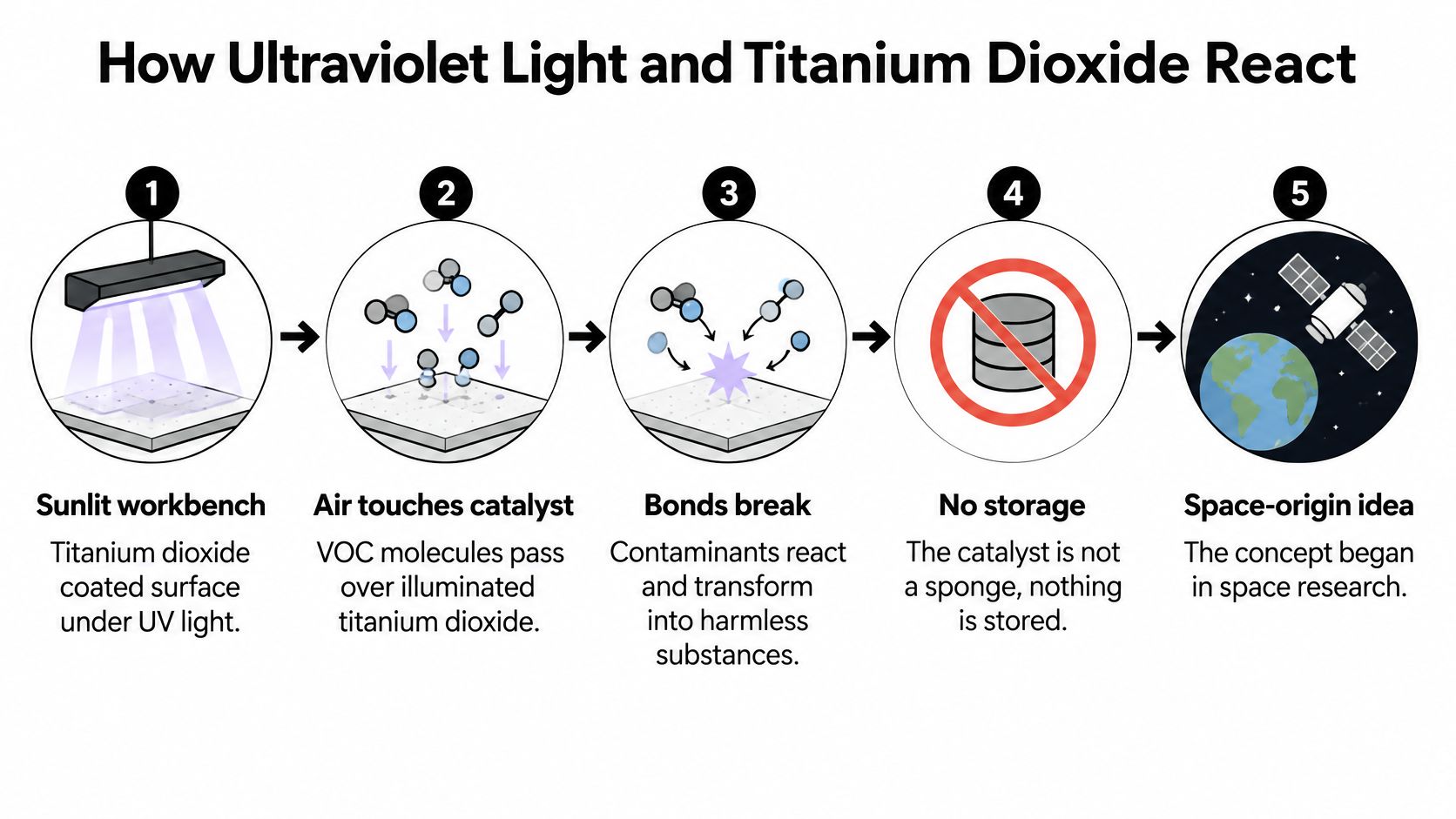
Think of titanium dioxide as a sunlit workbench, not a sponge. A sponge stores what it catches. A photocatalytic surface doesn't work that way: air has to contact the illuminated catalyst, and the reaction needs enough time and energy to proceed.
The technology's early purpose wasn't to clean living rooms. Work at the University of Wisconsin–Madison's Wisconsin Center for Space Automation and Robotics, funded by NASA's Marshall Space Flight Center, developed PCO to remove ethylene from plant-growth chambers used in space-related research. NASA later reported activity against VOCs, bacteria, viruses, and molds, broadening the possible applications beyond ethylene control, as described in NASA's account of air-treatment systems.
Follow the reaction from lamp to outlet
The process is easier to understand in order:
The lamp illuminates the catalyst. Ultraviolet light activates a surface commonly made with titanium dioxide.
Air supplies the ingredients. Oxygen and water vapor help form reactive oxygen-based species at the surface.
The reactive species attack contaminants. Organic molecules contact the illuminated catalyst, and chemical bonds begin to break.
The reaction needs time to finish. With sufficient UV intensity and contact time, the intended end products are principally carbon dioxide and water.
The catalyst isn't a container that fills up with contaminants. Instead, it provides a surface for a reaction. Pollutant molecules that never reach that surface, or move past it too quickly, may not react fully.
That last point matters in a real duct. A compact test chamber and a fast-moving HVAC airstream don't give air the same contact conditions. Ask where the lamp and catalyst sit in the system, and how the design expects room air to pass them repeatedly.
Single Pass VOC and Pathogen Results
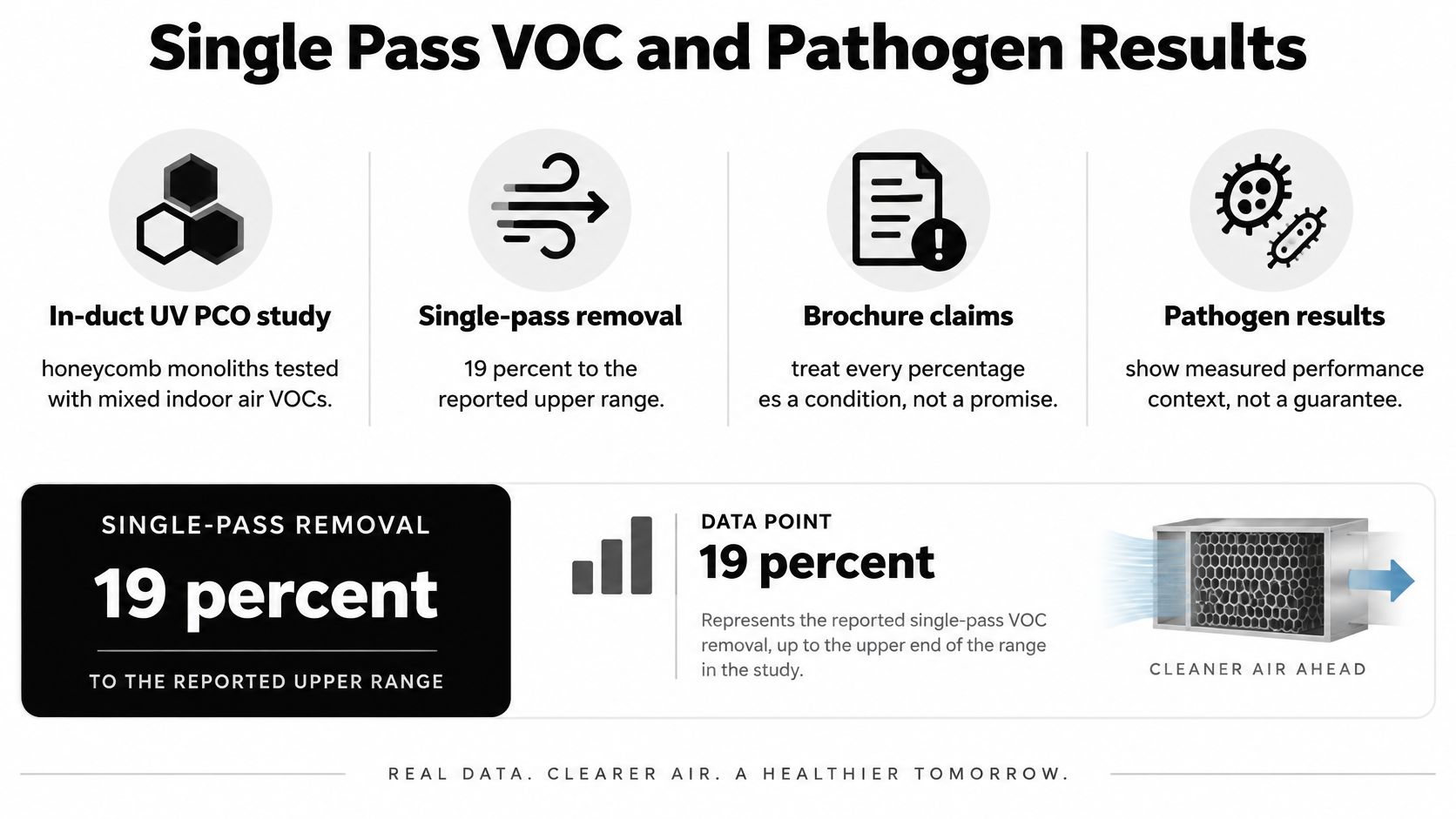
In an in-duct UV-PCO study using honeycomb monoliths and mixed indoor-air VOCs, single-pass removal ranged from 19% to 85%. That range is a description of results under the study's test conditions, not a promise that a unit will remove a matching share of every chemical in a home. ASHRAE reports the range and the differences by chemical class in its handbook discussion of air-cleaning technologies.
Chemical type changes the result
The tested compounds didn't react at one uniform speed. ASHRAE gives this order, from faster to slower:
Chemical class | Relative speed |
|---|---|
Alcohols and glycol ethers | Fastest |
Aldehydes, ketones, and terpene hydrocarbons | Second |
Aromatic and alkane hydrocarbons | Third |
Halogenated aliphatic hydrocarbons | Slowest |
A unit might make a noticeable difference to one compound while doing much less to another present in the same space. Airflow, humidity, UV intensity, and catalyst design also affect how closely a test result maps to a particular installation.
Pathogen claims need the same careful reading. Activity reported against bacteria, viruses, or molds doesn't automatically mean that a fast-moving stream of air receives a sufficient treatment dose. The organism has to encounter the active surface or its reactive products for long enough. ASHRAE identifies the HVAC return or mixed-air section as a preferred installation location because air can pass through the PCO equipment repeatedly.
For example, a unit in a return-air path may treat the same room air during multiple HVAC cycles. That's different from claiming every pass produces complete treatment. If you're assessing infection-control concerns, it helps to understand what airborne pathogens are and ask for the test conditions behind any performance claim.
Before trusting a percentage, get four details: which chemical or organism was tested, the single-pass result, the airflow, and the humidity. If those conditions don't resemble the home system, the quoted number may not predict its performance.
Byproducts and Real HVAC Verification
A falling VOC reading doesn't prove that the original contaminant became only carbon dioxide and water. PCO can shift the mixture of indoor chemicals if oxidation stops at an intermediate stage. That's why the useful question is not just “What was removed?” but also “What was produced?”
Reported by-products by pollutant | Reported by-products | Note |
|---|---|---|
Ethanol oxidation | Acetaldehyde as the dominant intermediate | Formaldehyde wasn't the main product |
Pilot reactor, all challenge compounds | Formaldehyde and acetaldehyde | Propionaldehyde and crotonaldehyde formed under some conditions |
Aircraft-cabin experiments | Formaldehyde and acetaldehyde | Detected as intermediates during PCO treatment |
Trichloroethylene | Carbon monoxide, phosgene, carbon dioxide, hydrogen chloride, and chlorine | Listed in an EPA technical summary |
Four chlorinated VOCs | Phosgene and chlorides | Detected in studies summarized by the EPA |
The technical discussion of PCO by-products and reactor performance describes both the risk of incomplete oxidation and the possibility of effective treatment under specific test conditions. In aircraft-cabin experiments, researchers detected formaldehyde and acetaldehyde during treatment; one cited study found that at least 50% of tested VOCs were fully converted to carbon dioxide and water under its experimental conditions. A VUV-PCO purifier with a nanoporous titanium-dioxide film removed ozone by-products at reported rates of 36.19% to 62.49%, using 0.01 kWh per cubic meter in the reported test. Those results apply to the tested systems and conditions, not automatically to every product or building.
Commission the whole system
Laboratory findings don't settle how a device performs in an occupied home. A review of PCO and related air-cleaning technologies describes gaseous-pollutant results as fragmented and real-world clinical validation as limited. It also reports ozone concentrations of 340–1,282 ppb in cited VUV-PCO experiments, while UVC-PCO reactors showed different ozone behavior. The configurations aren't interchangeable.
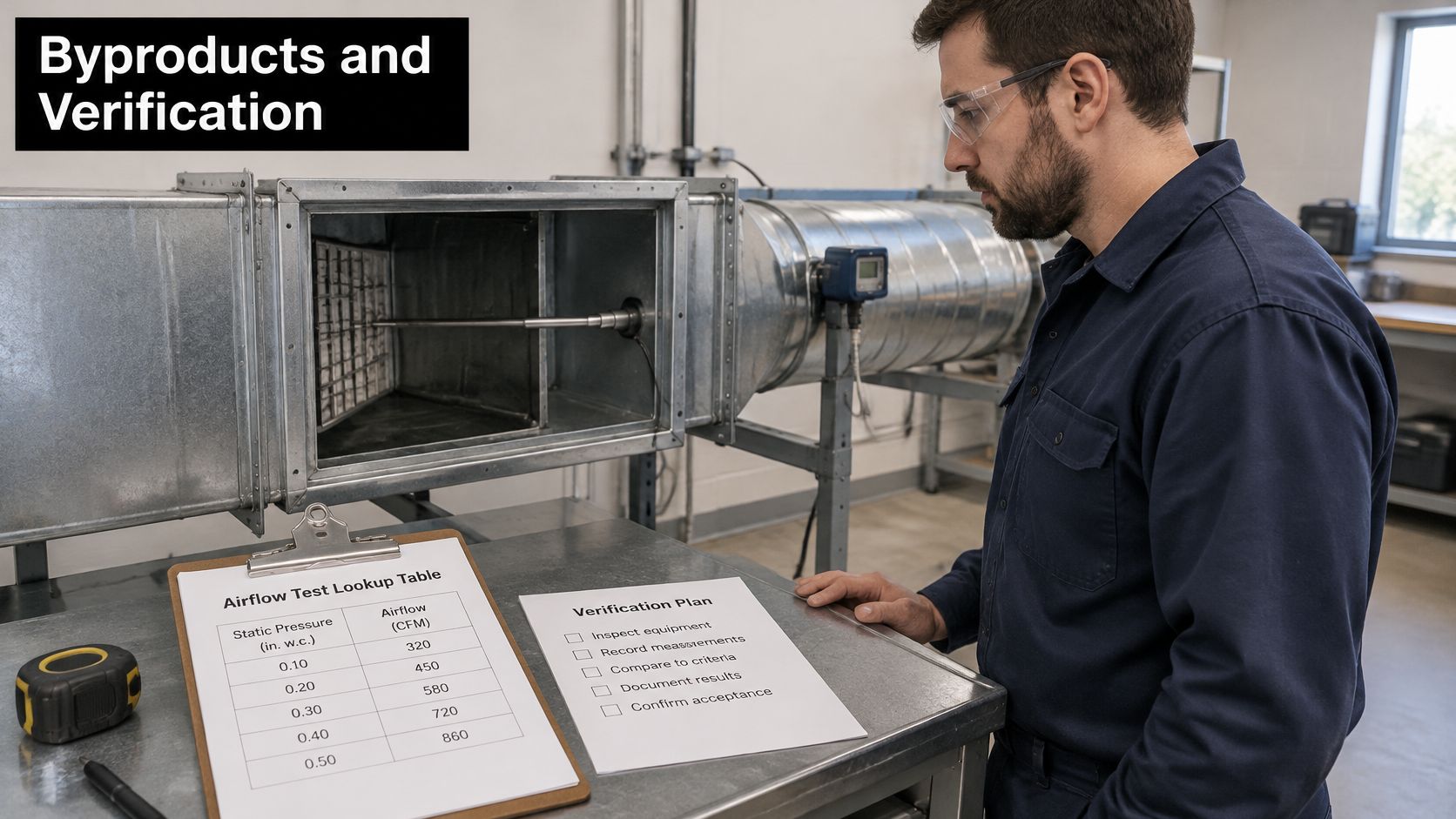
In the Phoenix area, cooling-season HVAC use, dust loading, and changing indoor humidity can make actual operating conditions different from controlled tests. Treat commissioning as a check of the reactor and the building together:
Measure the outlet air. After startup, test formaldehyde, acetaldehyde, ozone, and total VOCs under representative humidity and airflow.
Inspect the catalyst. Look for dust fouling that can block the active surface.
Check UV output. Confirm that the lamp still delivers its intended output as it ages.
Test at operating airflow. Judge single-pass performance with the HVAC system moving air as it normally does.
A higher oxidation rating isn't automatically safer. If airflow, catalyst loading, or residence time is poorly matched, a device may change the pollutant mixture without fully mineralizing it. For a practical approach to measurements, see how to measure indoor air quality.
Maintenance for Lamps Catalysts and Filters
Plan maintenance before you buy. A PCO unit's performance depends on components that wear, gather dust, or lose effectiveness, and a system that starts clean may not stay that way without routine checks.
Track lamp hours. Compare the operating hours with the manufacturer's lamp rating and replace the UV lamp on schedule. Output declines with age, and weaker illumination can reduce the energy available for the reaction.
Inspect the catalyst. Check the titanium dioxide surface for dust buildup. Clean or replace the catalyst cell only as the manufacturer directs, since rough handling or unsuitable cleaning can damage the coated surface.
Protect the catalyst with filtration. Keep a particle filter ahead of the PCO cell and change it when loaded. Capturing dust upstream helps prevent the catalyst from becoming fouled.
Retest after service. Check ozone and aldehydes after changing a lamp or catalyst, not just when first installing the unit.
Keep a maintenance log with service dates, lamp hours, and test results. A gradual change in those records can flag a problem before an odor returns. Ask about the replacement interval, component life, and whether testing for by-products is part of service. In the Phoenix area, frequent HVAC operation during the cooling season makes regular inspection especially useful. For broader upkeep, follow a consistent HVAC system maintenance routine.
PCO Compared with HEPA UV and ActivePure
Each technology has a different job. Choosing among them isn't about crowning one universal winner; it's about matching the treatment to the pollutant and checking the limits of the device.
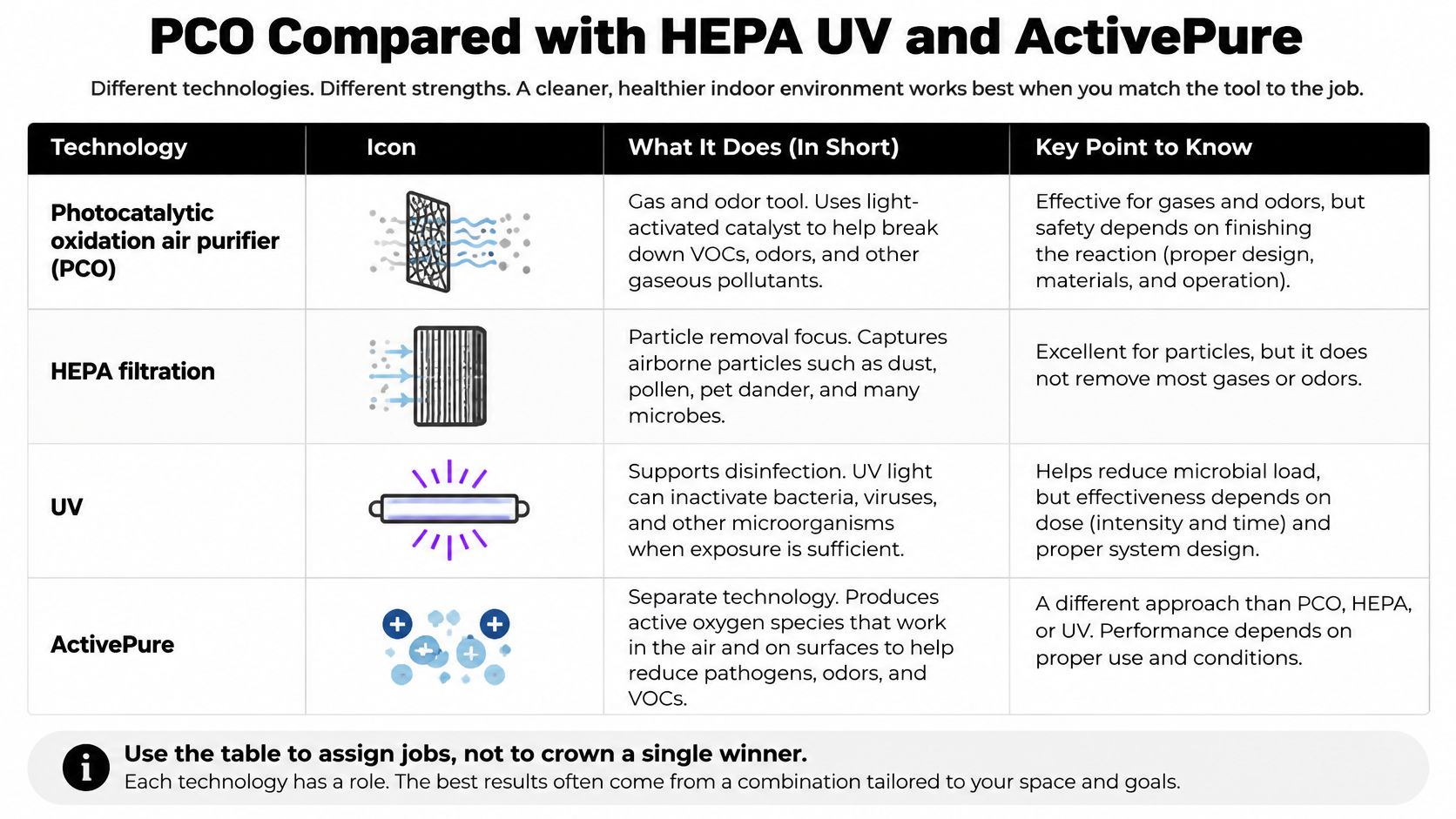
PCO, HEPA, UV-C, and ActivePure by job | Main target | Particles | Gases and odors | By-product concern | Best role |
|---|---|---|---|---|---|
PCO with UV and titanium dioxide | Gaseous organics and odors | No; needs a separate filter | Yes, if residence time is long enough | Aldehydes; ozone or phosgene may occur with some designs and chlorinated VOCs | Add-on for VOCs when outputs are measured |
HEPA filtration | Airborne particles | Yes, including dust, pollen, dander, and many aerosols | No; gases pass through | No chemical by-products; performance falls as the filter loads | First defense for allergens and dust |
UV-C germicidal | Microbes on coils or in the airstream | No | Limited; doesn't mineralize most VOCs | Lamp output declines; some lamp designs can make ozone | Coil and airstream germ control |
ActivePure | Marketed for pathogens in air and on exposed surfaces | Not a HEPA substitute | Odors, smoke, and toxins are part of the marketed claim | Marketed as producing no harmful by-products; ask for independent tests | Whole-space treatment alongside filtration |
Pair the approach with the complaint
For dust, pollen, and pet dander, start with particle filtration and source control. PCO won't capture those particles, and UV-C isn't a particle filter either.
For persistent chemical odors or VOC concerns, PCO may be an add-on, but only if you can measure what comes out of the system. A purifier that reduces an odor without checking by-products leaves an important question unanswered.
For microbial concerns on coils or in moving air, UV-C may have a role in germicidal treatment. ActivePure is a separate active technology, not another name for PCO, and it shouldn't replace particle filtration where dust or allergens are the concern. If you're comparing an in-duct UV option, learn how a UV air purifier for HVAC systems fits with filtration and the rest of the system.
Stacking devices without a pollutant target can add cost and maintenance without solving the original problem. Decide what needs to be controlled first, then select equipment that covers that job.
Decide Whether PCO Fits Your Home
Yes, consider PCO when the main concern is a gaseous pollutant, such as a persistent chemical odor or high VOCs, a particle filter is already part of the plan, and you can measure formaldehyde, acetaldehyde, ozone, and total VOCs after installation. The decision should rest on outlet-air results and actual HVAC conditions, not the product label alone.
No, don't make PCO the main fix when the complaint is dust, pollen, or pet dander. Those problems call for filtration and source control. If a seller won't discuss possible by-products, lamp life, or how performance is tested, you don't have enough information to judge the system.
Not yet makes sense when the pollutant hasn't been identified or the ducts and HVAC components haven't been assessed. Purified Air Duct Cleaning in Avondale evaluates customers' specific needs and recommends an appropriate purification system for the home, with regular maintenance for the systems it installs.
A useful next step is a walkthrough that identifies the likely pollutant, checks the ducts and coils, and then compares PCO, filtration, UV, or another suitable option.
Purified Air Duct Cleaning offers air-purification system assessments, installation, and regular maintenance, helping homeowners match equipment to the pollutant and HVAC layout. If you're weighing PCO against filtration or another approach, Purified Air Duct Cleaning can help you plan a system around your home's needs.