

What Is Indoor Air Quality and Why It Matters
You walk into your home after work and notice that the air feels heavy. A stale corner near the hallway holds yesterday's cooking odor, the windows have stayed shut through winter, and someone starts sneezing before taking off their coat. Nothing looks obviously wrong, yet the room doesn't feel fresh.
That experience is one practical entry point into what is indoor air quality. IAQ describes how the air inside and around a building affects the health and comfort of the people using it. The U.S. Environmental Protection Agency's overview of indoor air quality notes that Americans spend about 90% of their time indoors, while concentrations of some pollutants inside buildings are often 2 to 5 times higher than outdoors and can occasionally exceed outdoor levels by more than 100 times.
The important question isn't whether your air looks clean. It's whether ventilation, moisture, temperature, and invisible pollutants are working together in a way that supports the people in the space. You can learn to recognize the likely sources, choose useful measurements, and prioritize the improvements that matter more than just buying a purifier.
The Air You Cannot See at Home
A homeowner may notice poor indoor air quality through small, familiar clues. The bedroom feels stuffy in the morning. A cooking smell lingers long after dinner. Eyes sting after cleaning, or a child's nose becomes congested in one particular room. These signs don't identify a single pollutant, but they tell you the building deserves a closer look.
Air behaves a little like water in a house. It moves through rooms, gathers in low-flow areas, carries material from one space to another, and changes when doors, windows, fans, and heating systems alter the pressure. A closed home can trap moisture from showers, particles from cooking, odors from furnishings, and gases from combustion appliances. A room can feel warm and tidy while still holding contaminants you can't see or smell.
Practical rule: A lack of odor isn't proof of safe air, and an unpleasant odor isn't a complete diagnosis.
The EPA's figures provide useful context. Indoor pollutant concentrations are often 2 to 5 times higher than outdoor levels, and some can occasionally be more than 100 times higher indoors. That doesn't mean every home has dangerous air at all times. It means enclosed spaces can concentrate pollutants when sources continue producing them and ventilation doesn't dilute or remove them effectively. You can read a focused comparison in indoor air quality versus outdoor air.
The issue also extends far beyond modern homes. The World Health Organization reports that around 2.1 billion people still cook with open fires or inefficient stoves using polluting fuels. Household air pollution caused an estimated 2.9 million premature deaths in 2021, including more than 309,000 deaths among children under age five, according to the WHO fact sheet on household air pollution and health.
For a homeowner or facility manager, the useful starting point is not panic. It's curiosity. Where does the air enter, where does it leave, what is being released, and which occupants react first? Those questions turn a vague feeling of stale air into an investigation you can act on.
What Indoor Air Quality Really Means
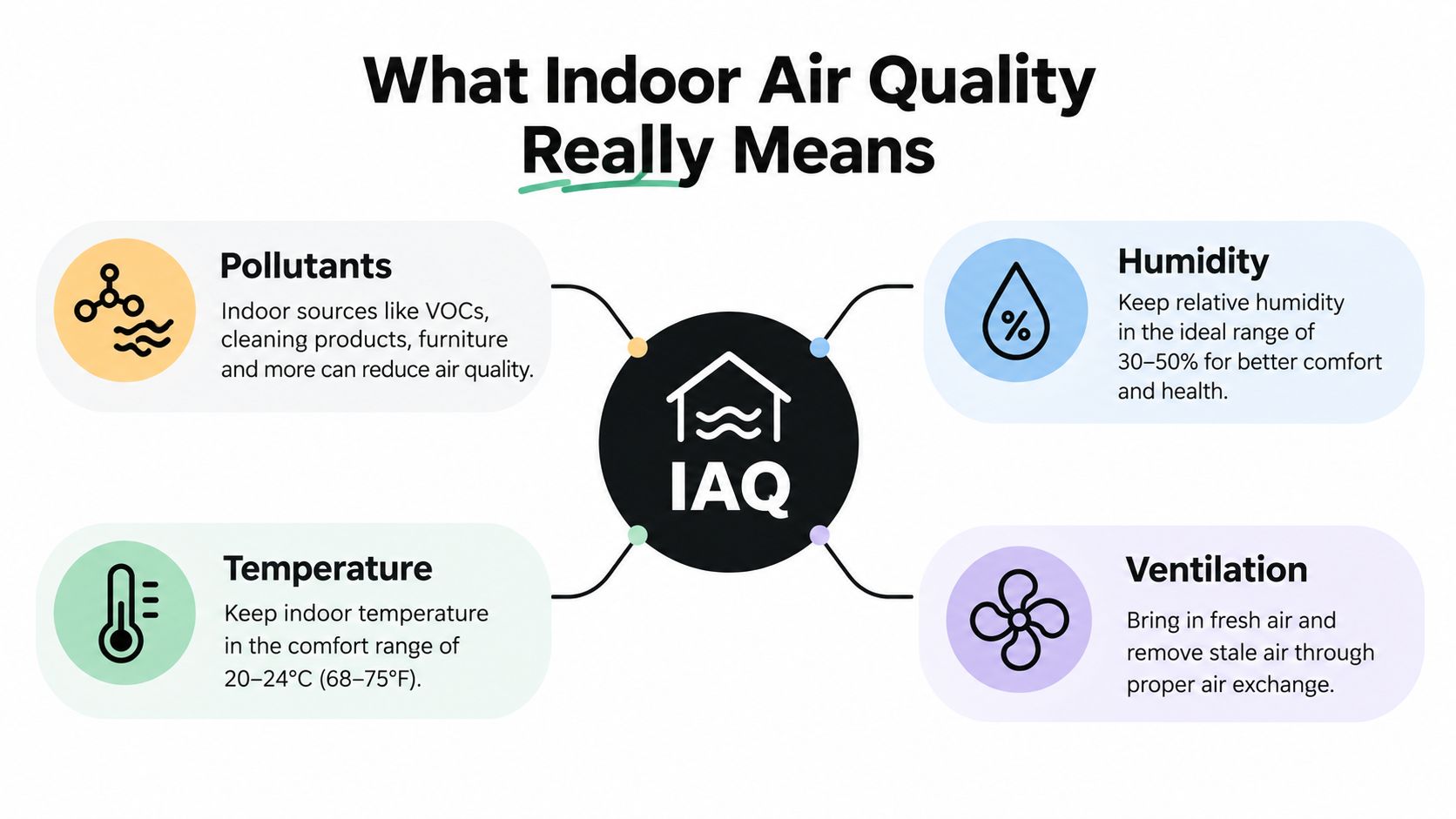
A family can feel comfortable in a living room while the air still contains pollutants no one can see. Indoor air quality is the condition of air inside and around buildings as it affects occupant health and comfort. It is not a cleanliness rating or a single universal number. It is a changing balance between what enters the space, what is released inside, how air moves, and how the room feels.
Ventilation changes the whole balance
Ventilation replaces or dilutes indoor air with outdoor air. Exhaust fans remove air from kitchens and bathrooms, open windows create natural movement, and mechanical systems bring in or distribute air through a building. If a source releases pollutants faster than the space can remove or dilute them, concentrations rise.
Ventilation does not guarantee healthy air. Outdoor air may carry smoke, traffic-related pollution, or pollen, while an incorrectly balanced HVAC system may spread contaminants without removing them. A useful assessment asks whether the system fits the building, its occupants, its pollutant sources, and the quality of incoming air.
Pollutants are the ingredients you need to identify
Pollutants include particles, gases, biological material, and combustion byproducts. Cooking and cleaning release some during ordinary activities. Others enter through leaks, arrive on clothing, grow where moisture persists, or come from building materials and appliances.
The EPA explains that no nationwide monitoring network provides a statistically valid sample of homes, schools, and offices, and only two national IAQ indicators are available in its factsheet on what indoor air quality means. A homeowner therefore needs to examine the specific room, activity, and building conditions rather than rely on a national average.
Moisture and temperature shape comfort
Humidity affects how air feels and how buildings behave. Excess moisture can support mold and other biological problems, while overly dry conditions can irritate the skin, eyes, nose, and throat. Temperature and drafts also change comfort even when pollutant levels stay the same.
In practice, improving ventilation without addressing a gas stove leak is like opening windows while the burner is still on. Dilution cannot compensate for an active source. The same principle applies to moisture: cleaner incoming air will not solve a persistent leak or damp area.
The broader health context explains why IAQ deserves attention. WHO identifies PM2.5, carbon monoxide, ozone, nitrogen dioxide, sulfur dioxide, and particulate matter as pollutants of strong public health concern in its overview of air-pollution pollutant types. Healthy indoor air depends on finding and controlling sources, managing moisture, and choosing effective ventilation, not just buying an air purifier.
The Pollutants Hiding in Everyday Spaces
A kitchen can look clean while cooking has filled its air with particles. A newly furnished bedroom may smell fresh while materials release gases. Indoor air usually contains a mixture of pollutants, so grouping them by source helps you connect what you notice with what may be happening.
Particles, gases, and biological material
Particulate matter comes from cooking, smoking, candles, fireplaces, and outdoor air entering through windows, doors, and building gaps. Fine particles can be too small to see and may travel from the kitchen into bedrooms or living areas. WHO describes PM2.5 and PM10 by aerodynamic diameter and provides guideline values for exposure. These values are useful reference points, but a homeowner still needs to consider when and where particles are produced.
Gases and volatile organic compounds, commonly called VOCs, can come from paint, cleaning products, adhesives, furnishings, flooring, and new furniture. A strong “new” smell can indicate off-gassing, although many VOCs have no reliable warning odor. Renovated rooms and poorly ventilated spaces often deserve closer attention. Carpeting is one example, and this explanation of carpet off-gassing examines that source more closely.
Biological contaminants include mold, dust mites, pet dander, and pollen. They may enter on clothing, through open doors, or with outdoor air. Damp bathrooms, basements, laundry areas, carpets, bedding, and upholstered furniture can hold or support them. Their effects may follow seasons, specific rooms, cleaning habits, or moisture problems.
Combustion deserves separate attention
Fuel-burning equipment needs its own check because it can add pollutants while the room appears normal. Gas stoves, heaters, fireplaces, and attached garages can introduce combustion byproducts. Carbon monoxide has no dependable smell or visible sign. Nitrogen dioxide can also come from fuel-burning appliances, and vehicle exhaust may enter from a connected garage.
Household air pollution from inefficient stoves or open fires can include particulate matter, black carbon, methane, carbon monoxide, polycyclic aromatic hydrocarbons, and volatile organic compounds. Fine particulate matter and carbon monoxide receive particular attention because they can indicate damaging exposure in this setting. Use a carbon monoxide alarm for that specific safety risk, rather than relying on odor or a general air-quality reading.
Pollutant Category | Common Sources | Where It Concentrates | Noticeable? |
|---|---|---|---|
Particles | Cooking, smoking, candles, fireplaces, outdoor air | Kitchens, living areas, rooms with poor circulation | Sometimes visible or irritating, often not |
VOCs and gases | Paint, cleaners, adhesives, furnishings, flooring | Renovated rooms, bedrooms, enclosed spaces | Some odors, many have no reliable odor |
Biological contaminants | Mold, dust mites, pet dander, pollen | Damp rooms, carpets, bedding, upholstery | May cause symptoms without being visible |
Combustion byproducts | Gas appliances, heaters, fireplaces, garages | Kitchens, utility areas, attached garages | Carbon monoxide has no dependable warning smell |
The right first check depends on the suspected source. If cooking is the concern, place a PM2.5 monitor in the kitchen during cooking and watch how levels change. If renovation triggered the concern, prioritize a TVOC or formaldehyde check in that room. A humidity meter can support a moisture investigation, but it cannot identify formaldehyde, and a particle monitor cannot rule out combustion gases. A pleasant-smelling room may still need source control or better ventilation.
How Indoor Air Quality Is Measured
A widely shared question is straightforward: Is my indoor air bad? A single IAQ score usually can't answer it because indoor air quality is a collection of conditions, sources, and exposure patterns rather than one substance.
Match the metric to the suspected source
A PM2.5 or PM10 monitor helps identify particle patterns from cooking, smoke, fireplaces, or outdoor pollution. Carbon dioxide can act as a ventilation indicator, especially when people report stuffiness in occupied rooms. It doesn't represent every pollutant, and a comfortable CO2 reading doesn't rule out mold, VOCs, or combustion gases.
TVOCs can suggest that a group of volatile compounds is present, but the reading doesn't identify each chemical or prove a health threshold has been crossed. Carbon monoxide requires a dedicated safety alarm. Radon and formaldehyde also need methods designed for those pollutants, rather than assumptions based on a general-purpose monitor.
Relative humidity is more direct. It helps explain moisture-related conditions, comfort, and the likelihood that a building problem is developing. Biological contaminants such as bacteria and mold spores may require inspection, targeted sampling, and interpretation rather than a quick consumer reading.
Metric | What It Indicates | Common Indoor Source |
|---|---|---|
PM2.5 and PM10 | Fine and larger airborne particles | Cooking, smoke, fireplaces, outdoor air |
Carbon dioxide | Ventilation and occupancy-related stuffiness | People in rooms with limited outdoor-air exchange |
TVOCs | Presence of multiple volatile compounds | Paint, cleaners, adhesives, furnishings |
Carbon monoxide | Combustion safety concern | Fuel-burning appliances, fireplaces, garages |
Radon | A specific soil-gas exposure | Entry from the ground through building pathways |
Formaldehyde | A specific volatile chemical | Some furnishings, composite materials, finishes |
Relative humidity | Moisture and comfort conditions | Showers, cooking, leaks, poor moisture control |
Mold spores and bacteria | Biological contamination patterns | Damp materials, HVAC contamination, water damage |
WHO's PM2.5 guideline values illustrate why time matters. The annual mean of 5 micrograms per cubic meter addresses longer exposure, while the 24-hour mean of 15 micrograms per cubic meter addresses a shorter window. Those reference points aren't a universal indoor pass-or-fail score. They help show why sampling the right pollutant, in the right room, over an appropriate period is more useful than reacting to one quick spike. A homeowner considering equipment can review the practical capabilities of an indoor air quality meter.
A useful measurement answers a decision. If you don't know what action a reading would change, start by identifying the likely source.
Health and Comfort Effects of Poor IAQ
Poor IAQ can show up as irritation, fatigue, or discomfort long before a homeowner can name the cause. People may experience irritated eyes or throat, coughing, sinus congestion, headaches, or trouble concentrating. A recent renovation, for example, may create an acute reaction to airborne chemicals, while a damp area may keep triggering symptoms over a longer period.
The same room can affect two people differently. Someone with allergies or asthma may react to dust, mold, pet dander, or pollen that another occupant barely notices. Children, older adults, pregnant people, and people with respiratory conditions can be more vulnerable to an indoor environment that feels tolerable to everyone else.
Health effects and comfort effects overlap
Health and comfort aren't identical. A room may feel unpleasant because of stale air, odors, drafts, temperature, or excessive dryness without causing an immediately recognizable illness. Conversely, carbon monoxide and some other pollutants may create serious risk without a smell that warns occupants to leave.
Longer exposure can matter even when symptoms seem mild. Indoor air problems may aggravate respiratory disease, contribute to cardiovascular strain, disturb sleep, or make daily concentration more difficult. WHO's household-air-pollution assessment estimates that exposure caused 2.9 million premature deaths in 2021 and resulted in about 95 million disability-adjusted life years lost that year. The burden is especially severe where combustion occurs indoors and ventilation is limited.
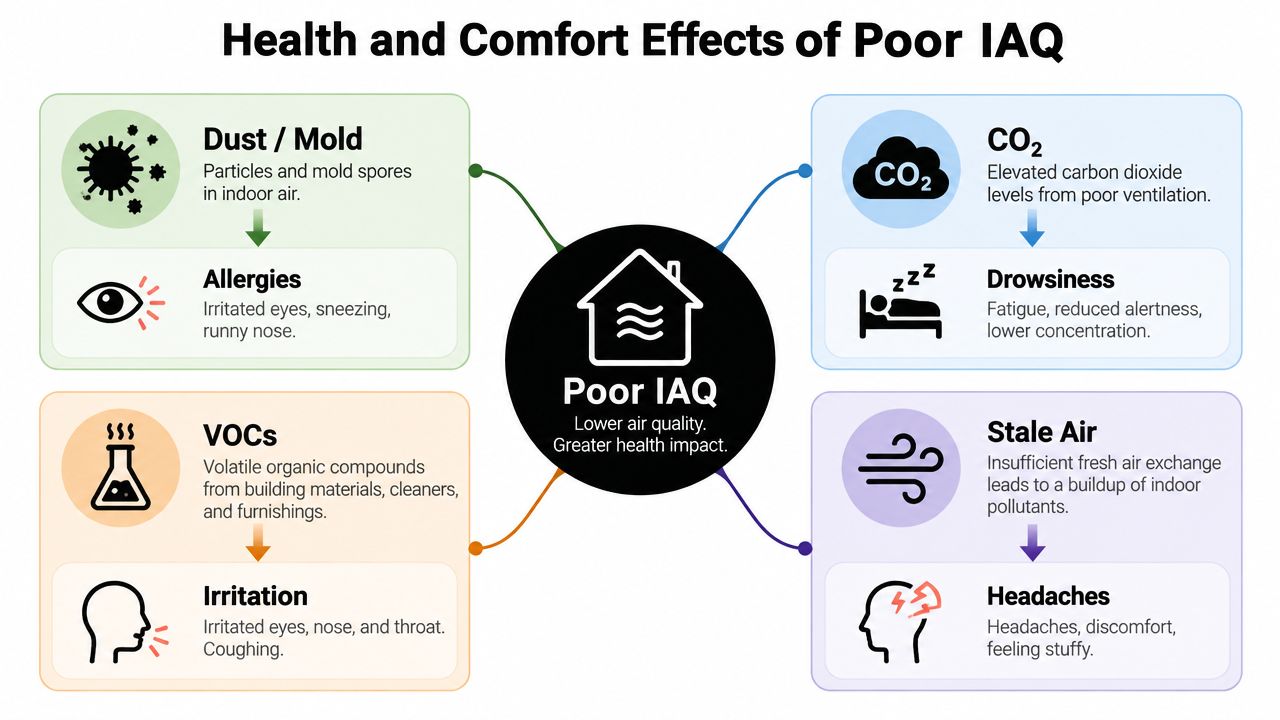
Moisture adds another layer. Water damage can support mold growth, while an HVAC system with persistent dampness may spread biological material through occupied areas. Facility managers investigating microbial concerns may also find it useful to review specialized background on Pseudomonas in HVAC systems, particularly when water, cooling equipment, and recurring occupant complaints overlap.
The practical lesson is to connect symptoms with patterns. Note where people feel unwell, when symptoms begin, which activities occurred beforehand, and whether symptoms improve after leaving. A symptom log doesn't diagnose the problem, but it can guide better measurement and inspection. A broader discussion of indoor air quality effects on health can help households organize those observations.
The Main Ways to Improve Indoor Air
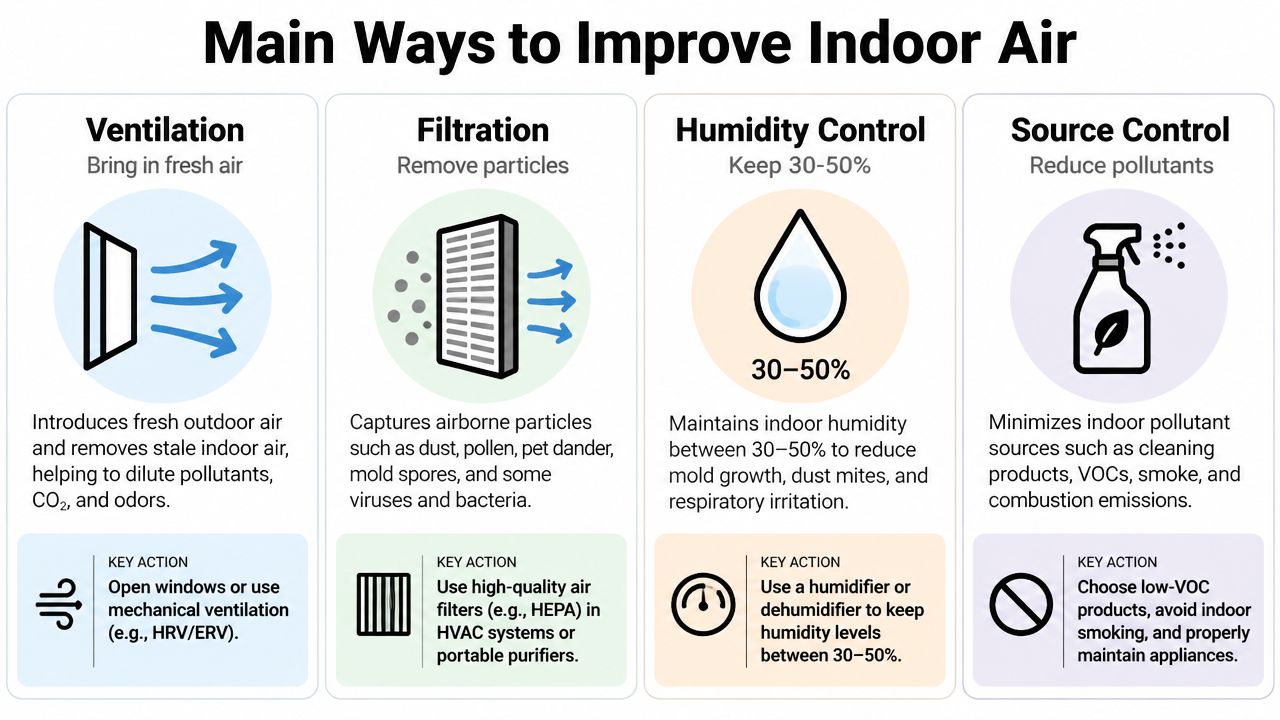
Buying an air purifier is only one possible move, and it may not be the first one that matters. Indoor air improves when four levers work together: ventilation, source control, filtration, and moisture management.
Ventilation removes what filtration may miss
Bring outdoor air in and exhaust stale air out when outdoor conditions allow. Open windows can help dilute indoor pollutants, while kitchen and bathroom fans should exhaust to the outside when possible. Mechanical ventilation systems, including heat-recovery or energy-recovery systems, provide a more controlled approach in tightly enclosed buildings.
For homes, the EPA summarizes ASHRAE guidance as 0.35 air changes per hour, but not less than 15 cubic feet of air per minute per person, as minimum ventilation intended to help provide acceptable IAQ and reduce adverse health effects. The EPA guidance on home ventilation also notes that kitchens and bathrooms may need intermittent exhaust to control pollutants and moisture.
Control the source before you clean the air
Source control often produces the most direct improvement because it stops pollutants before they spread. Choose low-VOC paints and cleaners, store chemicals in sealed containers, maintain combustion appliances, and avoid indoor smoking. Repair leaks quickly, dry water-damaged materials appropriately, and treat persistent moisture as a building problem rather than an odor problem.
Filtration complements those actions. Mechanical filters with HEPA or MERV ratings can remove particles, but the filter must match the HVAC equipment's airflow capacity. Activated carbon can help with some odors and gases, while electronic air cleaners use a different removal method. A small plug-in purifier may help in a bedroom or office, but it can't automatically clean a large, leaky, or poorly ventilated building.
Use professional services strategically
Duct cleaning, HVAC coil and blower cleaning, mold inspection, and whole-home IAQ assessments can address conditions that routine filter changes don't reach. These services shouldn't replace ventilation or source control. They should support a plan that identifies where contaminants originate and how the building moves air.
Plants can add visual appeal and may contribute to a pleasant interior, but they shouldn't substitute for ventilation, moisture control, or source reduction. For a careful discussion of natural air purification plants, keep the distinction clear between decorative greenery and an engineered air-cleaning system.
The four levers are easiest to remember this way: remove the source, dilute the remainder, capture particles, and control moisture.
When Professional Help Makes the Difference
Homeowners can take useful first steps without specialized equipment. You can open windows, run exhaust fans, replace HVAC filters, observe moisture patterns, and move obvious pollutant sources. But persistent symptoms, recurring odors, water damage, or suspected combustion problems require more than a quick visual check.
A professional assessment becomes especially valuable when basic changes haven't helped, when a renovation or leak altered the building, or when someone in the home has asthma or another respiratory condition. Calibrated instruments can examine particulate matter, carbon dioxide, VOC patterns, and humidity across rooms and over a meaningful time window. That profile is more informative than placing one consumer monitor in a hallway and treating its reading as the building's verdict.
Look for the source, not just the symptom
A trained inspector can examine ductwork, coils, blowers, filters, and return-air pathways. They can investigate whether staining reflects active moisture, evaluate possible combustion-appliance backdrafting, and help sequence repairs by likely impact. The result should be a prioritized plan, not a shopping list of devices.
Commercial buildings, schools, clinics, and other occupied facilities have additional responsibilities. Occupancy, ventilation performance, complaint patterns, and code-related requirements make room-by-room reasoning more important than a single portable purifier.
Decision point: If you can't explain what a device will remove, where the pollutant originates, and how you'll verify improvement, assess the building before buying more equipment.
A home inspection can also help readers understand how professionals approach building conditions, observations, and follow-up questions. This guide to what to expect during a home inspection provides useful general context, although an IAQ investigation may require additional measurements and specialist expertise. For a targeted evaluation, an indoor air quality expert can help connect symptoms, sources, airflow, and equipment.
The cost of expert help is real, but targeted investigation can prevent spending money on a filter that doesn't address the problem. It can also shorten the path from “the air feels wrong” to a documented repair plan.
Your First Steps Toward Cleaner Indoor Air
Start with actions that reduce pollutants before they spread.
Ventilate during pollutant-producing activities. Run the range hood and bathroom exhaust fan while cooking or bathing, and make sure they discharge outdoors. Open windows briefly when outdoor conditions are suitable, including during colder weather if practical, to dilute accumulated indoor pollutants.
Control moisture. Keep household humidity around 30% to 50%, a range supported in practical indoor-air guidance from the Asthma and Allergy Foundation of America. Repair leaks, dry wet materials, and pay attention to bathrooms, kitchens, basements, and HVAC components.
Filter deliberately. Fit the central HVAC system with a MERV-rated filter that the equipment can handle, and keep supply and return vents clear. A portable purifier with a true HEPA filter can be useful in a bedroom or home office where people spend extended periods.
Reduce indoor sources. Store chemicals tightly, limit scented products and smoke, and choose lower-emission materials during renovations. Source control prevents the HVAC system from circulating contaminants throughout the home.
Maintain the gains. Set reminders to inspect filters, clean accessible supply lines, check for moisture, and replace purifier pre-filters according to the equipment instructions. A neglected system can undo otherwise sensible improvements.
If dust, debris, allergens, or HVAC buildup may be affecting your home or facility, Purified Air Duct Cleaning offers air duct cleaning, dryer vent cleaning, HVAC coil cleaning, and indoor air quality solutions in the Phoenix metropolitan area. Request a quote and discuss the building conditions, symptoms, and equipment concerns that should guide the service.