

MERV Rating Air Flow: How Filters Affect Your HVAC
If you've stood in the filter aisle long enough, you've heard the shortcut: buy the highest MERV rating the slot will hold. The reasoning sounds airtight. More capture, cleaner air, healthier house. What the shortcut omits is the one thing your blower cares about, which is whether it can still push the same volume of air through denser media.
A filter isn't a window you look through. It's a restriction sitting in the middle of an air path, and every step up the rating scale makes that restriction stronger. Air that never reaches a room doesn't get cleaned for that room.
So the useful question isn't "what's the highest rating?" It's "what's the highest rating my system can run while still moving the air I paid for?" Answering that takes three numbers: the resistance of a clean filter, the resistance of a loaded one, and the pressure your blower has left to spare. Getting the MERV rating air flow relationship right for one specific house is a measurement question, not a label question.
MERV Ratings and Airflow Numbers at a Glance
A filter sold as MERV 13 has to clear three capture bars, and each bar is a percentage of particles caught within a set size band. Under EPA's MERV rating guidance, that means at least 50% average capture for particles from 0.30 to 1.0 micrometers, at least 85% for 1.0 to 3.0 micrometers, and at least 90% for 3.0 to 10 micrometers. Those percentages describe what happens to particles that reach the media. They say nothing about how much air gets there.
The airflow side is measured in pascals, the pressure unit a barometer uses, and the number that matters is resistance: how hard the blower has to work to pull air through the media. ASHRAE's handbook chapter on air cleaners puts common panel filters rated MERV 1 to 6 at roughly 13 to 63 Pa of resistance when clean, rising to about 125 to 250 Pa once loaded, and published replacement thresholds sit near 125 Pa for low-resistance filter units and 500 Pa for high-resistance ones. Clean resistance is the starting bid. Final resistance is the ceiling where the filter is due for replacement, and the distance between those two numbers is the budget your blower spends over the filter's working life.
MERV 13 capture thresholds and airflow resistance reference values
Reference point | Value | Source |
|---|---|---|
MERV 13 capture, 0.30 to 1.0 micrometers | at least 50% average | EPA guidance |
MERV 13 capture, 1.0 to 3.0 micrometers | at least 85% | EPA guidance |
MERV 13 capture, 3.0 to 10 micrometers | at least 90% | EPA guidance |
Panel filters MERV 1 to 6, initial resistance | about 13 to 63 Pa | ASHRAE handbook |
Panel filters MERV 1 to 6, final resistance | about 125 to 250 Pa | ASHRAE handbook |
Replacement threshold, low-resistance units | about 125 Pa | ASHRAE handbook |
Replacement threshold, high-resistance units | about 500 Pa | ASHRAE handbook |
Read the table in two halves. The first three rows describe capture, which is the filter's job at the media. The last four describe resistance, which is the blower's job at the fan. One set of numbers tells you what the filter traps. The other tells you what it costs to move air through it.
Treat every figure here as a reference point rather than a promise. Each one comes from a filter tested under set conditions, and your ductwork, blower wheel, coil and return grille all add their own resistance on top. A MERV 13 filter in a system with generous ductwork and a strong blower behaves differently than the same filter in a system already near its limit.
For a starting point, EPA's guidance on choosing a filter identifies MERV 8 as a common default in homes and says MERV 13, or the highest rating the equipment can accommodate, improves removal of smaller particles including viruses from recirculated air. The phrasing matters: the recommendation is the highest rating the equipment can accommodate, not the highest rating on the shelf, because a filter that starves the system of air can impair heating and cooling performance in ways the rating never mentions.
What a MERV Rating Measures and What It Leaves Out
Pour coffee through a paper filter and the paper traps the grounds while the liquid runs through. Switch to a finer mesh and it catches more of the silt, and the coffee drips more slowly. The mesh didn't change how much coffee is in the mug. It changed how fast the mug fills.

That's the whole MERV conversation in one kitchen picture. MERV stands for Minimum Efficiency Reporting Value, an ASHRAE-developed method for comparing HVAC air-filter performance on a scale that generally runs from MERV 1 through MERV 20, with higher ratings indicating greater particle-removal efficiency under standardized test conditions (EPA's filter performance reference).
What the number actually reports
The rating measures the fraction of particles removed from the air stream that passes through the filter. It does not measure the total amount of air the HVAC system can move. Those are different quantities with different units, and the second one is what your rooms feel.
A MERV 13 filter catching 90% of the particles in a size band is doing exactly what it claims, even if your registers are whistling. The label told the truth about capture. It never claimed anything about delivery.
The three things the rating leaves out
Fan capacity: a blower has a fixed amount of pressure it can generate, and the filter spends some of it. A motor that's already maxed out has nothing left to give a denser pleat pack.
Duct design: undersized returns, long flex runs, and sharp turns all consume pressure before the air ever reaches the filter slot. Two houses with identical equipment can have very different headroom.
Dust load: the rating describes a clean filter on a test bench. Three weeks of pet hair, construction grit, or wildfire smoke changes the number that matters in service.
A test-condition check before you compare
Two filters with the same rating but tested at different airflows aren't directly comparable, because results depend on test airflow, particle concentrations, and other conditions. Ratings are most useful when the filters were tested the same way.
That's why a MERV from one brand lines up with a MERV from another, while the proprietary numbers printed on some retail boxes don't line up with anything outside that brand's own packaging.
The two-question rule: the MERV number answers "how much particle capture?" A second question, "can my system move air through this thing?", answers "does it belong in my house?"
For a wider look at how filtration fits with duct condition and source control, this guide to indoor air quality and filtration covers the parts of the system the filter box doesn't.
Why Higher-Efficiency Filters Restrict Airflow
A hundred people can file out of a stadium through a wide fire exit in the time it takes thirty to squeeze through a narrow doorway, even though everyone walks at the same pace. The people didn't change. The opening did.
A filter is the opening. High-efficiency media packs finer fibers closer together, so the gaps shrink and the same fan pressure pushes fewer cubic feet of air through per minute. Technicians call that cost pressure drop, the static pressure difference across the filter at a given face velocity. That reading is only one segment of the pressure picture, and this guide to static pressure in ductwork shows how the segments add up across a whole system.
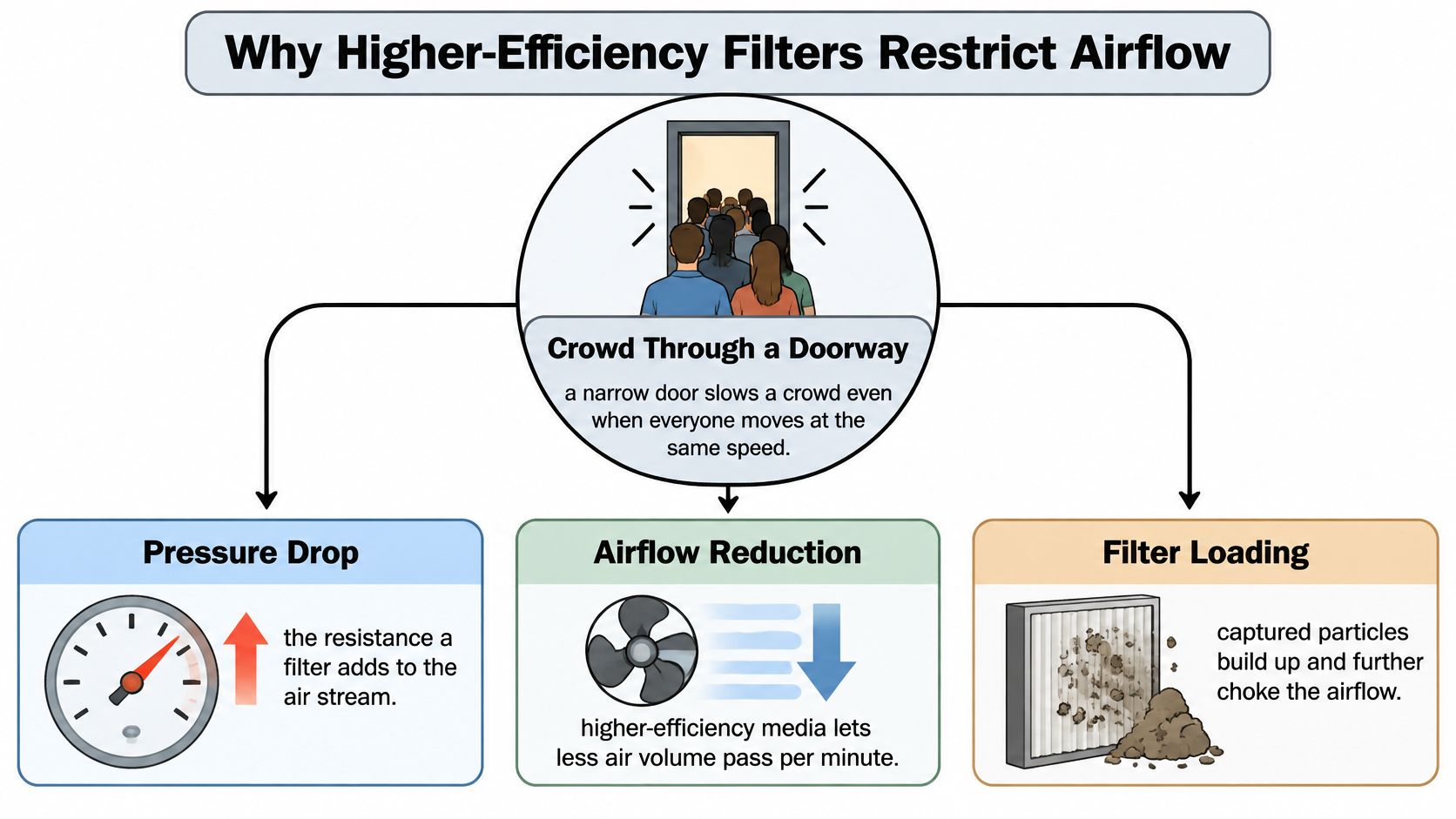
Two numbers decide whether the drop matters: how much pressure the filter takes away, and how much the blower has in reserve.
Why a deep pleat beats a dense flat one
Face velocity is airflow divided by filter face area. Send 1,200 CFM through a 20x25 slot and the air crosses the media at one speed. Give that same 1,200 CFM a five-inch pleat pack with several times the surface area and it crosses far more slowly, so each fiber sees less traffic and the filter resists less.
A thin one-inch filter forced into a shallow slot is the worst version of this. All the airflow has to cross a small area at high speed, and a high-MERV version of that design stacks dense media on top of the problem.
ASHRAE's filtration and disinfection FAQ is blunt about the consequence: added resistance can reduce airflow, increase fan energy use, or produce both. The same guidance cites EPA's finding that MERV 14 to 16 filters typically have greater airflow resistance than medium-efficiency filters of the same thickness, while deeper pleats and larger surface area can bring resistance back down.
Here is the same problem the way a technician sees it, with gauges hooked up rather than a label consulted.
What a field test of 15 rooftop units found
A field test of 15 rooftop units, recorded in the EPA HERO reference database, swapped MERV 8 filters for MERV 13 or 14. Cooling energy use rose 2% to 4%, while estimated PM2.5 clean-air delivery rose 2.9 to 3.8 times. On those terms the trade was favorable: much more particle capture for a small energy penalty.
The fan controller decided the rest of the energy story. In fan-only operation, units without fan-speed control drew less power because they moved less air, while units with fan-speed control ramped up to hold airflow and drew more. Same filters, different brains responding to the added resistance.
Match the rating to the fan's capacity and the depth of the slot, not to the highest number on the box.
How Dust Loading Changes Airflow Over Time
A clean filter is the easiest test your system will ever pass. Every week after that, dust, lint, and smoke particles pack into the pleats, and resistance climbs. The rating printed on the frame stays fixed while the actual pressure drop grows, so a system that breathes easily in March can be airflow-limited by May.
Loading works like a damper closing a little more each day. Each layer of trapped dust narrows the open paths through the media, and a heavily clogged filter can substantially reduce the airflow your system delivers. In balanced ventilation equipment it can also shift the exhaust-air balance, so less stale air leaves the house than the duct layout assumes.
The part that trips people up: electrical consumption can fall while airflow drops. A fan that cannot pull air through the media does less work, so a lower bill can be the signature of a choked system, not a healthy one.
Charged media and the MERV-A number
Some charged-media filters lose efficiency during their first stretch of use, which is why ASHRAE's filtration guidance treats a manufacturer-listed MERV-A value as a better representation of minimum efficiency than the standard MERV figure (ASHRAE filtration and disinfection resources). If you're choosing a filter for allergy relief rather than equipment protection, that second number is worth hunting for on the spec sheet.
Filters that load faster than the calendar
Calendar replacement is a guess wearing a schedule. These conditions turn a 90-day filter into a 30-day filter:
Pets in the house: shed dander and hair bind with dust and mat the media surface quickly.
Construction nearby: drywall dust and sawdust load a filter in days, not months.
Wildfire smoke: fine ash plugs pleats fast and often arrives with the windows closed.
High occupancy: more people means more skin flakes, more lint, and more cooking aerosol in the return.
Two habits catch all of it. Write down how the filter's resistance and delivered airflow change between replacements, so the next interval is set by measured loading instead of the calendar. And remember that a lower-rated filter changed on time can move more usable air than a higher-rated filter left to clog.
Watch for weak flow at the registers, a cooling coil that ices over or a furnace that trips on high limit, and fan noise that creeps upward over a few weeks. Any of those means the filter, not the thermostat, is the first thing to check. A duct and coil that have never been cleaned add their own resistance on top of the filter, which is why routine HVAC system maintenance matters as much as the rating on the frame.
How to Measure Airflow Before Upgrading a Filter
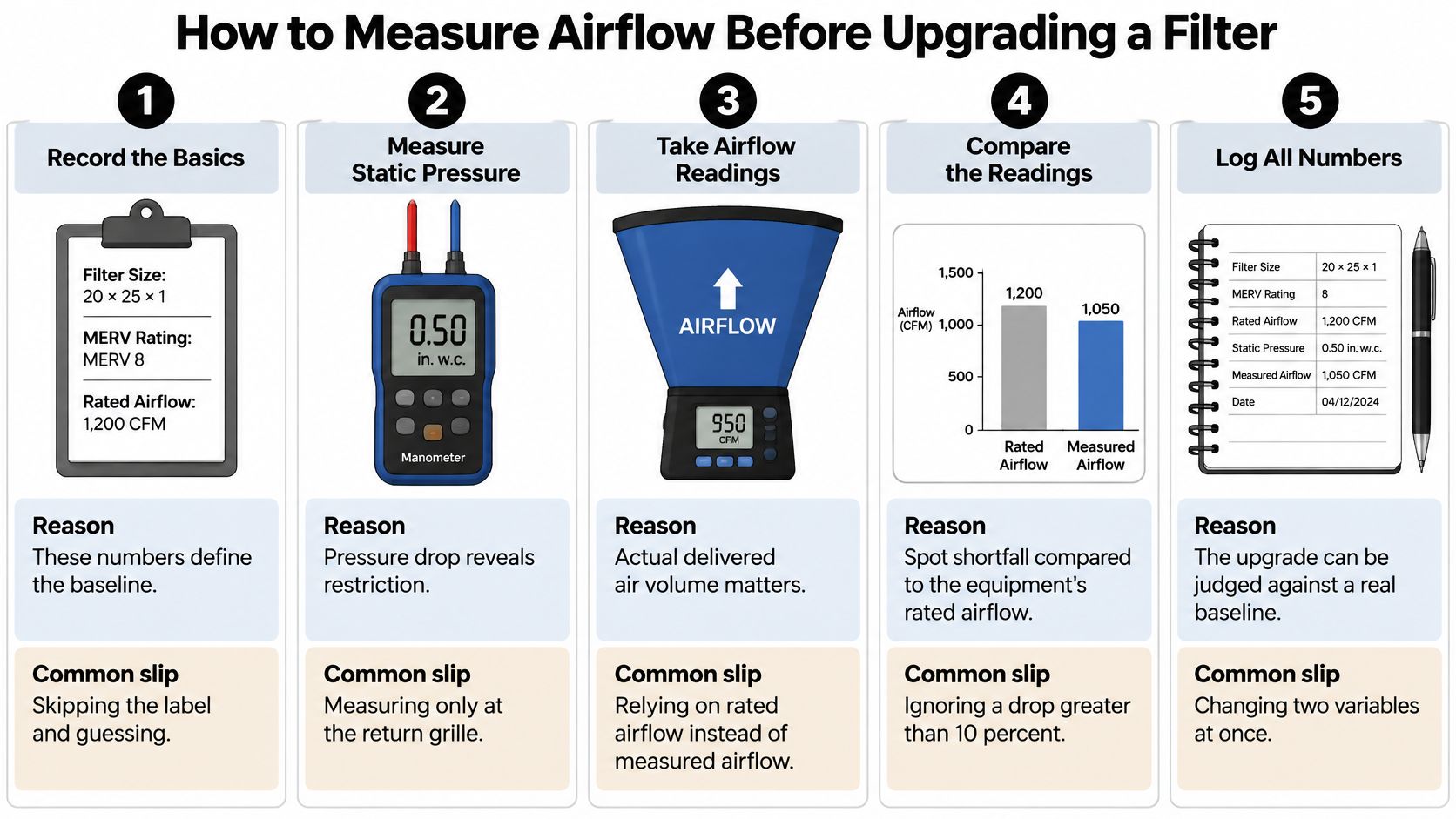
This is the part most filter advice skips, and it's the part that settles the question. The sequence below takes about an hour with a manometer and a flow hood, and it turns a guess into a before-and-after record.
The reason it's worth the effort is that MERV selection directly affects airflow, since higher-efficiency filters generally create greater resistance to moving air (ASHRAE handbook chapter on air cleaners). The same chapter notes that filters are tested at manufacturer-selected airflow rates across roughly 472 to 2,990 CFM, which is a wide range. Your equipment label tells you where your system sits inside it.
The seven steps, in order
Record the baseline from the equipment. Write down the filter size, the current MERV rating, and the rated airflow from the label or manual. The blower's published limits set the ceiling for everything that follows. The common slip is skipping the label and guessing from the size of the house.
Measure the pressure drop across the filter you have now. Use a manometer with the fan running and the test ports on either side of the media. This tells you what the clean starting point looks like in your ductwork. The common slip is measuring a filter that's been in place for months and calling that the baseline.
Measure supply airflow at the registers. A balancing hood at each supply gives you delivered cubic feet per minute, and the total external static pressure at the air handler gives you the other half of the picture. Record both. The common slip here is trusting rated airflow instead of measured airflow, and those two numbers often disagree.
Install the candidate filter in a sealed rack. Every edge should sit tight against the frame, with no gap for air to slip past. The common slip is a filter that's a quarter inch undersized, which lets unfiltered air around the media and voids the rating you paid for.
Repeat steps 2 and 3. Run the same measurements with the new filter in place and compare them to the manufacturer's stated operating limits. The slip is comparing only pressure and ignoring airflow, when both matter.
Step down a level if you're near the edge. If static pressure sits close to the limit or airflow drops noticeably, drop one MERV level or switch to a deeper filter with more media area. The slip is pushing a one-inch slot to MERV 13 and hoping the blower covers for it.
Write the numbers down. Keep a card taped inside the air handler door with the filter size, MERV, pressure drop and airflow. The slip is changing two variables at once and then having no idea which change caused the difference.
A filter change is a system change. Measure before and after, or you're just guessing with extra steps.
What success looks like
Good numbers look unremarkable: filter pressure drop within the range the equipment expects, supply airflow close to the baseline you recorded, and total external static pressure inside the manufacturer's limit with margin left for a loaded filter. If a higher rating meets those three tests, run it with confidence. If it doesn't, you've learned something more useful than any chart. For a refresher on how delivered air volume is measured and why it drives comfort, this explanation of CFM in HVAC covers the units before you start.
Choosing a MERV Rating Your System Can Support
Filter efficiency only applies to air that passes through the filter. ASHRAE's filtration and disinfection guidance makes two points that settle most upgrade debates: filters have to be sealed so air cannot slip around them through gaps, and the fan has to be running for any filtration to happen at all. The same guidance warns that raising efficiency generally raises pressure drop, so check pressure differentials and airflow rates before you change ratings.
The test numbers behind any rating you read
Every MERV printed on a label comes from a bench test run under controlled conditions: a set face velocity, a defined resistance at the end of the test, and a standardized dust fed to the media at a steady rate. Those conditions exist so filters can be ranked fairly against each other, not so they can predict what happens in your return duct. Your blower may move air faster or slower than the test rig, and your filter will face a different mix of particles. Treat a MERV as a ranking, then let your own pressure and airflow measurements decide whether the ranking fits your system.
Matching the rating to the system you have
System situation | Filter approach | What to verify |
|---|---|---|
Slot and blower can accept MERV 13 | Use MERV 13 as the target | Static pressure and airflow before and after install |
Blower already near its limit | Choose the highest rating that stays within limits | Supply airflow against manufacturer limits |
Fixed-speed fan with no controls | Test before upgrading and expect added fan energy | Fan energy use and delivered airflow |
Variable-speed or controlled fan | Higher rating may be workable | Controller response to the pressure reading |
Shallow filter slot | Deeper pleated filter with more area | Resistance rating and face area against slot size |
Homes with pets, construction dust or wildfire smoke | Shorter interval set by pressure drop | Pressure drop at each change, not calendar alone |
Hot climate with weak cooling | Verify cooling and comfort before any upgrade | Delivered cooling capacity and room temperatures |
If allergies are the reason you're shopping for a higher rating in the first place, this guide to the best HVAC filter for allergies narrows the choice to the ratings that help a sensitive household.
In the Phoenix metro, that last row earns its place. Restricted airflow costs cooling capacity exactly when a house needs it most, so an upgrade that looks fine on a mild spring day can turn into a system that runs all afternoon in July without reaching setpoint. Measuring first is cheaper than discovering it in August.
Filters, coils, and blowers work as one reliability picture, and Forge Reliability on HVAC systems covers the equipment side in plain terms if you want that context before spending money.
A qualified technician can measure static pressure and airflow in a single visit and tell you where your headroom sits. Our team assesses each customer's specific needs and recommends the most suitable system for the home, including air purification options when a filter alone won't get you where you want to be.
The one rule for your next filter purchase: choose the highest rating your system can run with measured airflow still inside the manufacturer's limits, then confirm it at the first filter change with a pressure reading rather than a feeling.
That's the whole decision. The right rating is whichever one your blower can carry with air still arriving at the far bedrooms, whether that turns out to be MERV 8 or MERV 13.
If you'd like the numbers measured instead of guessed, Purified Air Duct Cleaning serves Avondale and the wider Phoenix metro with air duct cleaning, dryer vent cleaning, HVAC coil cleaning, and air purification systems matched to each home's actual equipment rather than to a label on a box. We can check your filter setup, static pressure, and delivered airflow, then tell you which rating your blower will carry without complaint. Visit Purified Air Duct Cleaning to schedule a walkthrough of your system.