

Best MERV Rating for HVAC: What Phoenix Homes Should Use
For most central HVAC systems, MERV 13 is the default target, the rating that captures at least 85% of particles in the 1.0 to 3.0 micrometer band. The best MERV rating for HVAC is still the highest one your blower can push air through without strain, not the biggest number on the shelf.
The popular line is simple. Buy the highest rating you can find, and the house gets cleaner air. That advice skips the machine doing the work. A denser filter catches more dust, and it also asks more of the fan. In Phoenix, summer heat stretches run times, and desert dust loads the media faster than a mild climate would. I would treat MERV 13 as the starting point, then let the blower, the slot, and the season decide whether you stay there or step up.
Recommended MERV Ratings at a Glance
MERV 13 fits most central systems when the fan can carry it. The best choice is the highest rating that the same blower can move air through without strain. Match your house to a row, then confirm the condition before you buy.
Situation | Recommended MERV | Condition to Check |
|---|---|---|
Standard home with a 1-inch filter slot | MERV 13 | Blower handles the filter without strain |
Allergies or asthma in the household | MERV 13 | Filter fits the slot with no gaps |
Allergies, system approved for higher rating | MERV 14 | Manufacturer specifications allow it |
Older PSC-motor system | MERV 8 | Airflow test passes before any increase |
Commercial office or light commercial | MERV 13 or higher | Equipment designed for the rating |
MERV 15 to 16 | Only where the system is built for it | Not for standard residential units |
Standard home with a 1-inch slot: MERV 13 is the usual step up, and only if the blower still delivers design airflow.
Allergies or asthma: MERV 13 is the baseline, and the filter has to seal the slot so air cannot sneak around the media.
Allergies with an approved system: MERV 14 is the step when the equipment maker allows that rating.
Older PSC-motor systems: Stay at MERV 8 until a technician confirms the fan can take more resistance. These motors do not compensate the way many variable-speed blowers do.
Commercial offices and light commercial spaces: Target MERV 13 or higher only on equipment built for that load.
MERV 15 to 16: These belong on systems designed for them, not on a standard residential furnace.
Find the row that matches your home. Confirm that choice with the compatibility check later in this article before you buy a higher-rated filter.
How the MERV Scale Measures Filter Performance
The number printed on the filter frame answers one question. Under a lab test, how well does this media catch particles of known sizes? It does not promise how clean the rooms will feel.
MERV, or Minimum Efficiency Reporting Value, comes from an ASHRAE test method so filters can be compared on the same terms. The EPA explanation of MERV ratings covers particles from about 0.3 to 10 micrometers, split into three bands: 0.3 to 1.0, 1.0 to 3.0, and 3.0 to 10 micrometers. General HVAC filters run from MERV 1 through MERV 16. A higher number means stronger capture of the sizes that rating is scored on. A box that only says "high efficiency" tells you nothing you can measure.
What each band actually holds
Smoke and many aerosols sit in the smallest bands. Larger dust, lint, and pet dander fall into the coarser band. That split is why two filters can both look fine on a shelf and perform very differently once the fan runs.
EPA figures show the gap in plain numbers. MERV 8 captures at least 20% of particles measuring 1.0 to 3.0 micrometers and at least 70% of particles measuring 3.0 to 10 micrometers. MERV 13 captures at least 85% of 1.0 to 3.0 micrometer particles, at least 90% of 3.0 to 10 micrometer particles, and at least 50% of 0.3 to 1.0 micrometer particles. No comparable minimum is listed for MERV 8 in that smallest range. Those capture rates are why MERV 13 is the practical target for residential and commercial systems that can take it, without jumping to HEPA equipment. A true HEPA air filtration system is a different setup, not a thicker 1-inch pad.
The rating is a lab result. Whole-building results still depend on filter fit, operating hours, duct leakage, fan performance, and how often you replace the filter.
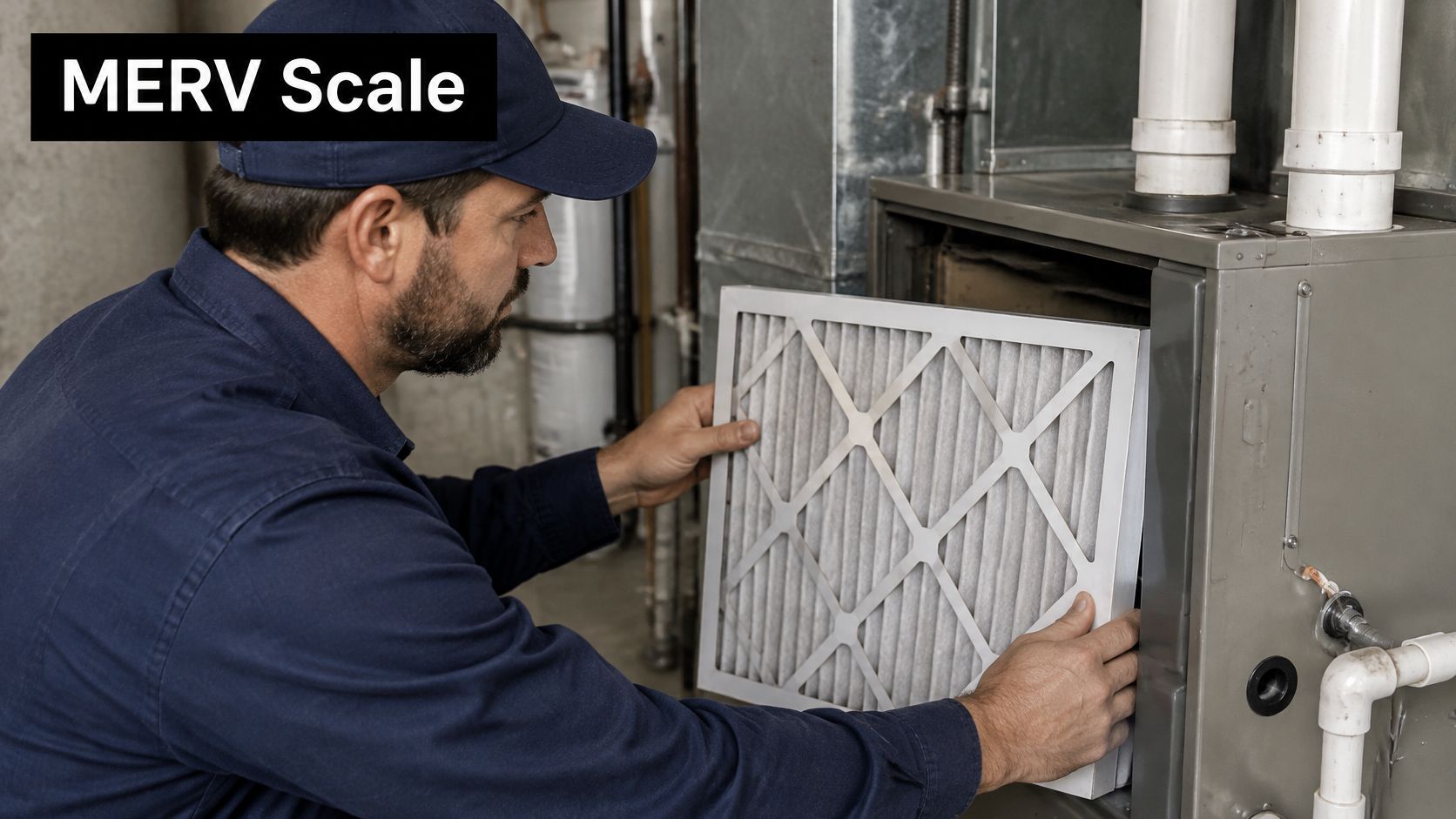
Read the rating on the frame, then decide which band matters in your house. Fine smoke points at the small bands. Hair and lint point at the coarse one.
MERV 8, 13 and 14 Compared Side by Side
The highest useful rating is the one the blower can still move air through. A higher number that starves the fan is not an upgrade. In Phoenix, heavy dust and long runs of extreme heat load the media faster, so that limit needs a recheck more often than a single spring swap.
ASHRAE's filtration guidance sets the floors in the table: MERV 13 is at least 50% on 0.3 to 1.0 micrometer particles, at least 85% on 1.0 to 3.0 micrometers, and at least 90% on 3.0 to 10 micrometers. MERV 14 is at least 75%, at least 90%, and at least 90% in those same bands.
Rating | 0.3-1.0 micrometers | 1.0-3.0 micrometers | 3.0-10 micrometers |
|---|---|---|---|
MERV 8 | No listed minimum | at least 20% | at least 70% |
MERV 13 | at least 50% | at least 85% | at least 90% |
MERV 14 | at least 75% | at least 90% | at least 90% |
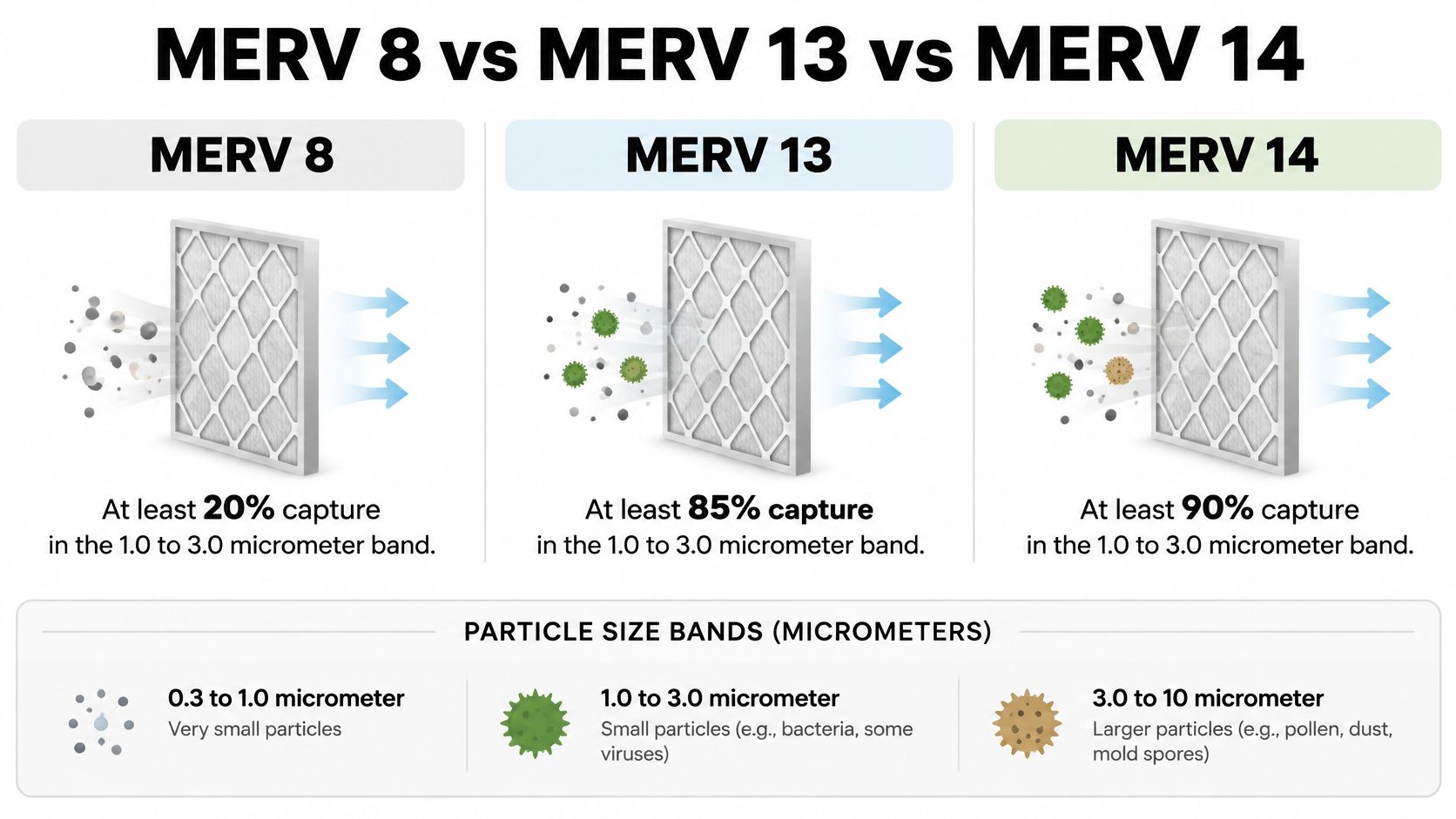
Where each step actually gains
The 1.0 to 3.0 micrometer band is the wide residential gap. MERV 8's floor is 20%. MERV 13 moves it to 85%. MERV 14 adds five points, to 90%. Ordinary fine dust is mostly settled by that first jump.
On 3.0 to 10 micrometers, MERV 8 already reaches 70%. MERV 13 and MERV 14 share the same floor, at least 90%. Hair, lint, and larger dander are a weak reason to pay for MERV 14.
The 0.3 to 1.0 micrometer band is the key split. MERV 13's floor is 50%. MERV 14's is 75%. MERV 8 has no comparable minimum listed. Smoke and the smallest allergen fragments sit here. That extra capture usually costs more pressure drop, so I recommend MERV 14 only when those fine particles are the complaint and the blower still delivers its airflow.
MERV 8 remains a sound default on an older blower or a tight return, because it still takes a large share of coarse debris. MERV 13 closes most of the fine-dust gap on a normal house that can carry the media. MERV 14 is a narrow choice.
The step from MERV 8 to MERV 13 delivers the largest practical gain. The step from MERV 13 to MERV 14 is incremental, and it is worth it only for a specific fine-particle concern.
After a dust storm or a string of 110-degree afternoons, look at the filter and the supply air again. Captured dust raises resistance even when the printed rating has not changed. The right rating is still the highest one that fan can move, and Phoenix dust and heat decide how soon you confirm it.
Airflow Strain and When a Higher Rating Backfires
The common mistake is treating a higher rating as an automatic upgrade. Many homes already run MERV 8 as the default. Moving to MERV 13 can improve removal of fine particles, including viruses, and that move still has to clear the fan's airflow capacity. The EPA indoor air guidance recommends MERV 13, or the highest rating the system can accommodate, not whatever is highest on the shelf.
A higher MERV rating generally captures more, and it also creates more airflow resistance. When that resistance is too high, the blower moves less air. Rooms heat and cool unevenly. The system runs longer. Coils and motors work harder. Older PSC-motor blowers feel this sooner than many newer variable-speed units, which can ramp to hold airflow until they hit their own limit.
Signs the filter is winning and the house is losing
Weak registers: Supply air feels thin even with the fan on.
Longer cycles: The thermostat takes longer to satisfy, especially on a 110-degree afternoon.
Uneven rooms: One wing stays warm while the unit near the return seems fine.
A clean-looking filter that still struggles: Restriction can show up before the media looks black.
A filter that does not seal the slot wastes the rating. Air takes the gap. You paid for media the airstream never touched.
Say a Phoenix homeowner swaps MERV 8 for MERV 13 on a system nobody tested. Cooling slows in July. An airflow check shows the static rise. They step back one rating, and the rooms even out. The denser filter was not "bad." The blower could not pay for it.
The best rating is the highest one the system can move air through without strain.
Phoenix heat and dust stack on that limit. Long summer run times mean a restricted filter costs more energy in the months you already run hardest. Desert dust, plus construction dust in growing neighborhoods, loads a filter faster and raises pressure drop between changes. Check the filter more often in dusty months, and recheck airflow after a season change. If you want the measurement behind that check, start with what static pressure in ductwork means. Move to the next rating only after the system passes the steps below.
Recommended Ratings for Homes, Allergies and Commercial Buildings
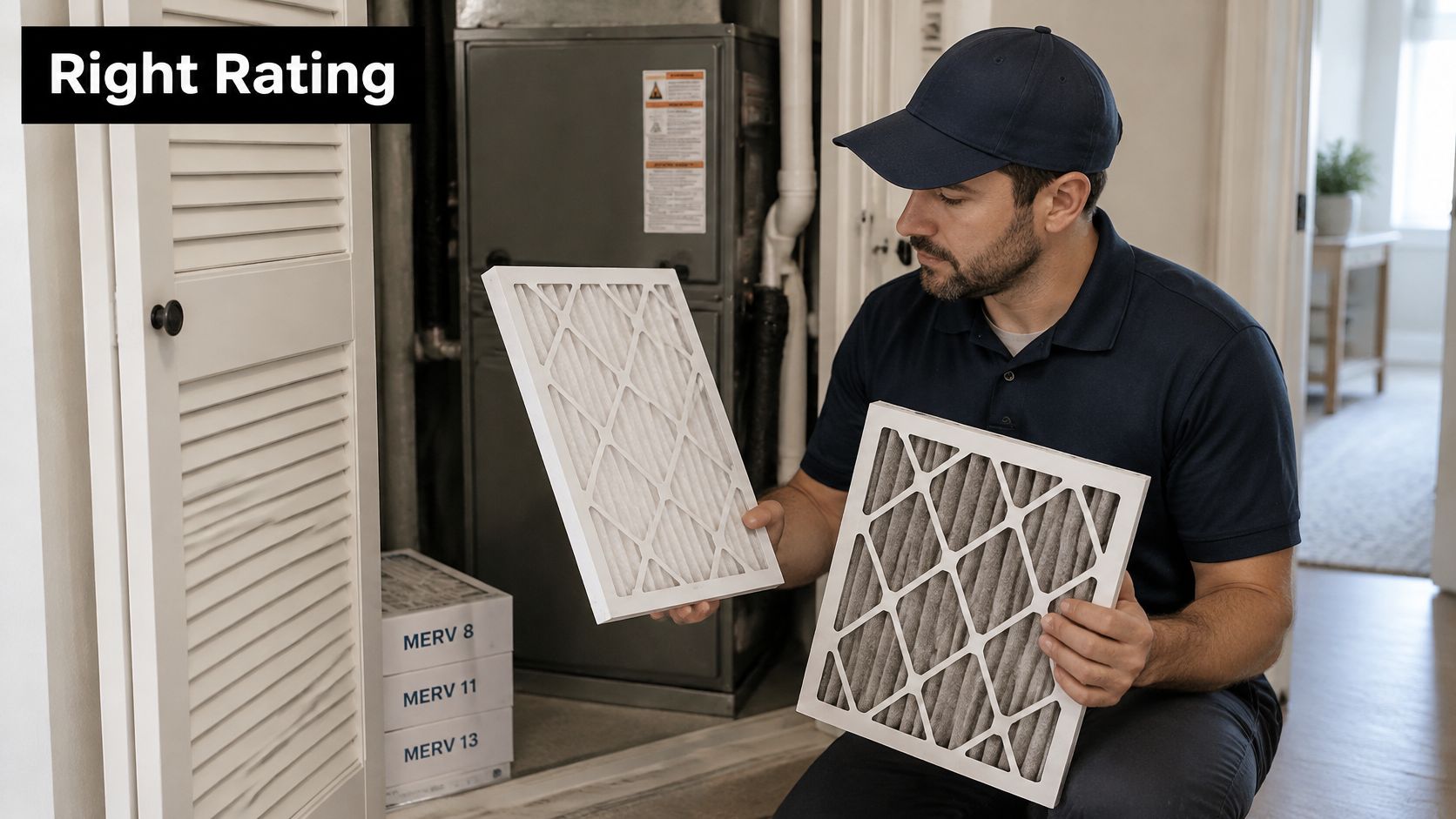
Use the glance table as the lookup. The reasoning behind each case is different, and the condition you verify is different too.
A typical 1-inch residential slot
In 2026, ASHRAE's residential FAQ stated that a typical 1-inch residential filter can generally be upgraded to MERV 13, while filters above MERV 13 may create enough airflow resistance to affect HVAC performance. That makes MERV 13 the realistic ceiling for most of these cabinets, not a stepping stone to 16. The condition to verify is slot fit. The frame has to match the opening, and the door has to close without crushing the pleats.
Allergies, asthma, and pets
Households with allergies or asthma gain the most from fine-particle capture, so MERV 13 is the baseline. MERV 14 suits only a system that passes an airflow check. Pets add hair and dander. Coarser ratings already catch much of that hair, and the fine-particle step still helps when allergens break into dust that rides the return. A useful next read if symptoms drive the choice is our guide to the best HVAC filter for allergies. If you suspect the building itself is feeding symptoms, a lab look such as Sunridge Medical's mold building profile can separate a filter problem from a moisture problem. The condition here is the airflow test, not a guess from the box.
Offices and light commercial equipment
Commercial offices should target MERV 13 or higher on equipment designed for it. Facility managers should confirm the rating with the equipment maker before the change. We clean ducts and HVAC systems for both residential and commercial customers, and the same rule holds in both. The machine sets the ceiling. The condition to verify is the manufacturer limit, written on the unit or in the submittal, not a house rule copied from a home.
How to Check Your System Before Upgrading
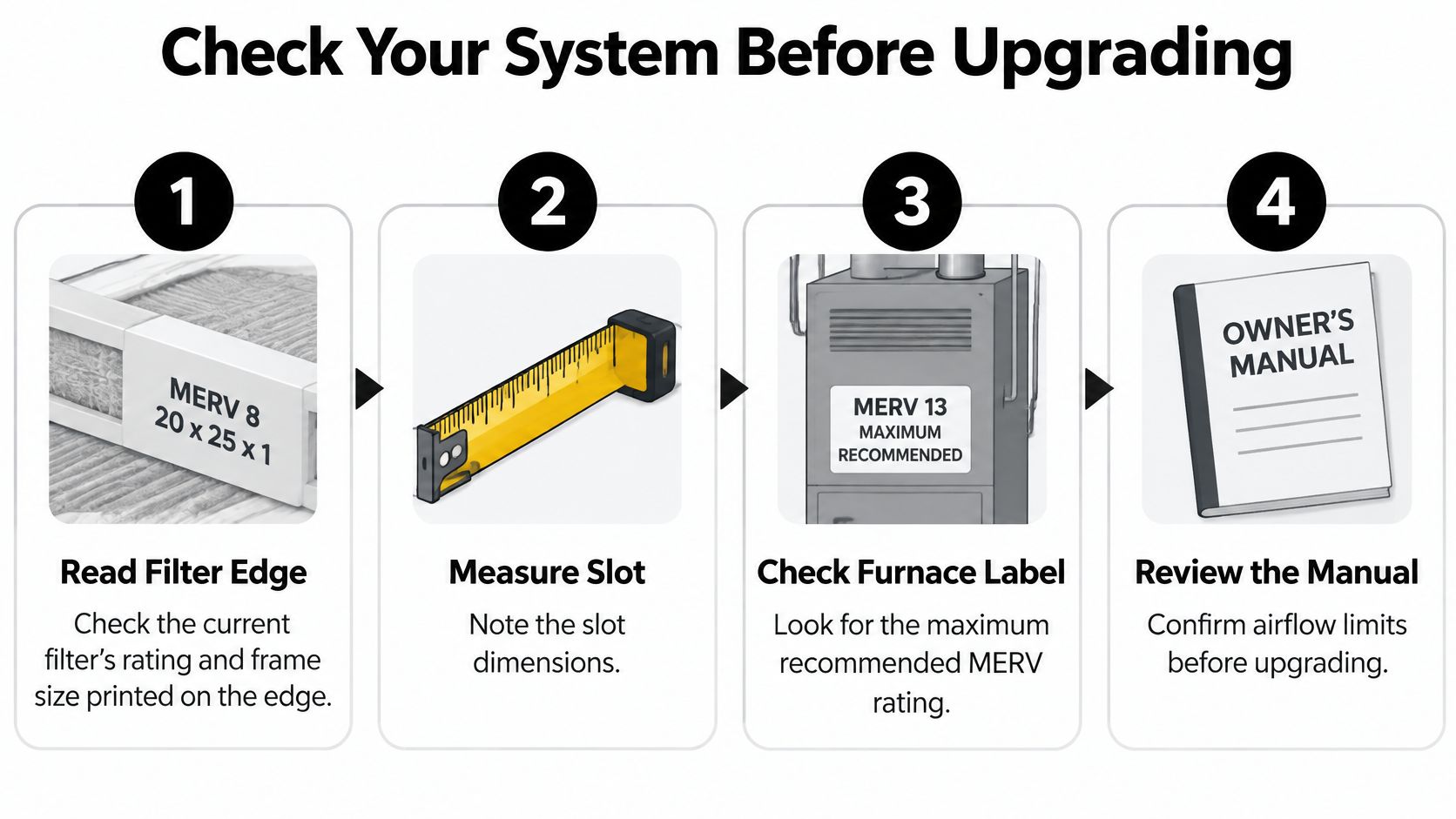
Do this before you spend money on a denser filter. Each step exists because a skipped one produces a false pass.
Read the edge. Note the current MERV rating and the frame size printed on the filter. Write the slot dimensions next to it. A 16x25x1 is not a 16x25x4, and depth changes how much media you get for the same face velocity.
Read the equipment. Check the furnace or air handler label and the manual for the maximum recommended MERV rating and the listed filter size. If the label stops at a lower number, that number wins.
Seal the slot. The filter has to fill the rack with no gaps. Gaps let unfiltered air bypass the media, so the rating on the frame never reaches the coil.
Measure the load. Measure pressure drop across the filter, or have a technician measure static pressure before and after the change, and compare it with the manufacturer's limit. CFM in HVAC is the airflow number that drop is stealing from.
Step once. Move to MERV 13 only if the measurement passes and the rating sits inside the equipment limit. Do not jump two ratings in one visit.
Watch two weeks. Weak airflow at the registers, longer run times, or uneven rooms mean you step back to the prior rating.
Before that test, have the ducts inspected. Dirty ducts add resistance that can make a clean filter look like the problem. Ducts are generally recommended to be cleaned every 3 to 5 years, depending on ductwork age and condition, the type of heating and cooling system, and any allergies or respiratory problems in the home. If smoke is the reason you want a finer filter, odor in fabrics and drywall will not leave with the media alone. First steps for tackling smoke odor cover the surfaces a filter never touches.
A passing result looks ordinary. Airflow at the registers stays steady, run times stay in their normal range, and the new filter still sits flat in the slot with the door closed.
Choose Your MERV Rating and Confirm the Fit
Start from the rating your row called for, then verify it before you buy a carton. Confirm the maximum rating on the equipment label. Check that the filter seals the slot with no gaps. Measure airflow before and after the change using the steps above.
For Phoenix homes dealing with desert dust, construction dust, or a smoke episode, pair that rating with a look at the ductwork and the coils. Dust load changes how fast a filter plugs and how soon pressure drop climbs. A rating that was fine in March can strain the blower by July if the coil is already coated.
Practical rule: Write the maximum rating from the equipment label on a piece of tape inside the filter door, so the next change does not drift upward by habit.
If the airflow result is unclear, or the system fails the check, do not guess with a thicker filter. We have over 20 years of experience in the indoor air quality, HVAC, and duct cleaning industries, and both residential and commercial services come with free quotes, given over the phone or through a free walk-through at a commercial space. That assessment should happen before a higher-rated filter is purchased. Offices that need more than a 1-inch pad should look at a commercial air filtration system sized for the air handler, not a residential shortcut.
Write down the maximum rating from the equipment label, run the airflow check, and request a quote if the result is unclear.
Purified Air Duct Cleaning helps Phoenix-area homes and commercial buildings match filter ratings to real blower capacity, and we clean the ducts and coils that change how that filter performs. If you are unsure whether MERV 13 or a higher rating will strain your system, start with a free quote before you buy the next filter. Visit Purified Air Duct Cleaning to schedule a phone quote or a commercial walk-through.