

Electronic Air Cleaner Guide: How It Works and What to Buy
If an air cleaner claims to destroy pathogens but doesn't tell you how much cleaned air it delivers or how much ozone it produces, what have you learned about the air you'll breathe?
An electronic air cleaner can be useful, but its technology label isn't a buying recommendation. The meaningful questions are narrower: What does this exact model remove, how quickly does it treat your space, and what does it release while operating? Answering those questions separates a suitable installation from an impressive laboratory claim.
Types of Electronic Air Cleaners Compared
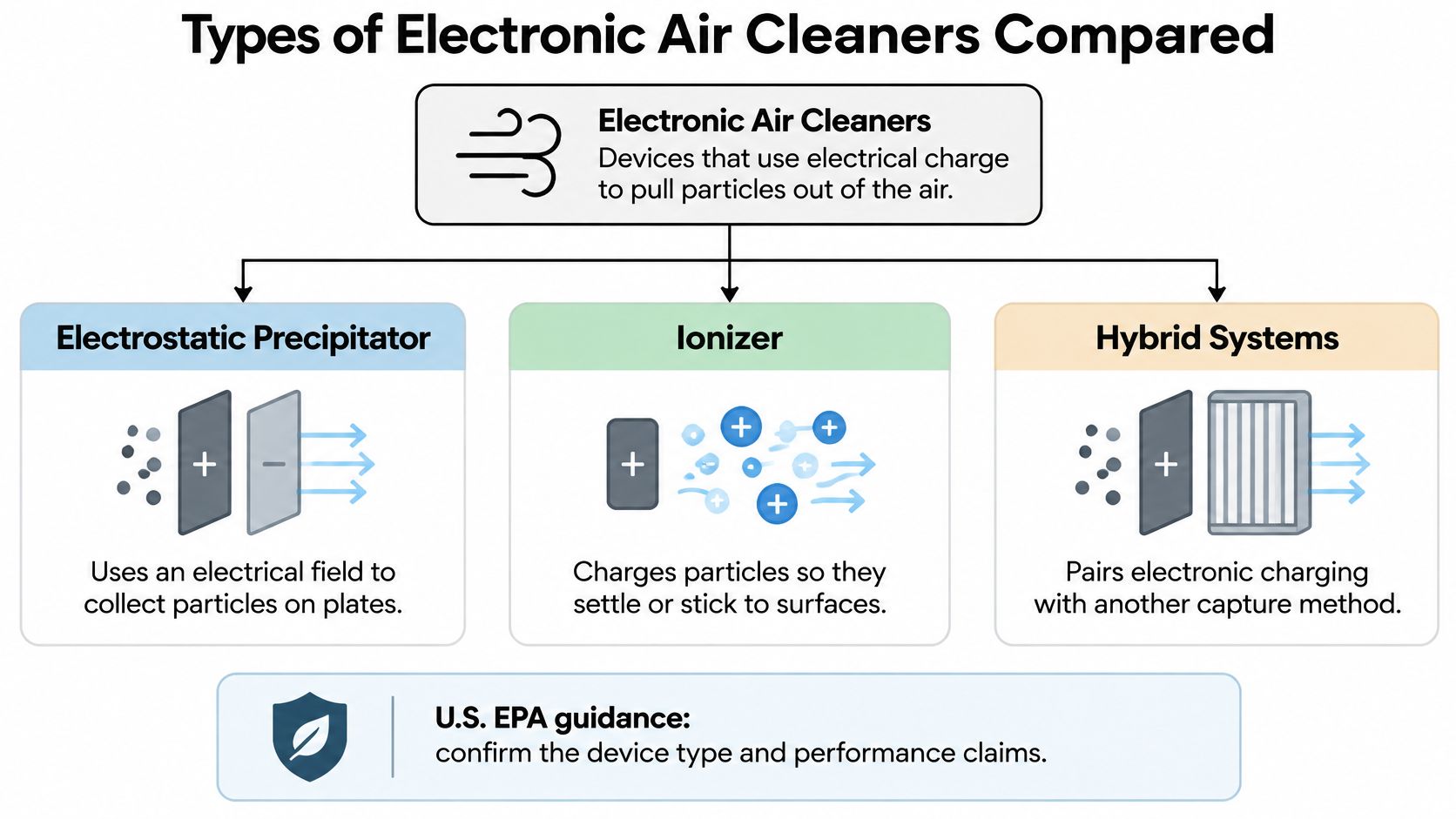
An electronic air cleaner is a family of devices that uses electrical charge to help remove particles, rather than relying only on a dense mechanical filter. The important distinction is where those particles go: into a collector, onto a separate filter, or onto surfaces around the room.
Electronic air cleaner types at a glance
Type | How It Works | Ozone Concern | Typical Placement |
|---|---|---|---|
Electrostatic precipitator | Charges particles, then collects them on oppositely charged plates | Can emit ozone; check model-specific testing | HVAC ducts and whole-home systems |
Ionizer | Charges particles so they deposit on nearby surfaces | Can produce ozone; check the design's emissions | Portable and in-duct units |
Intentional ozone generator | Produces ozone on purpose | High; EPA advises against use in occupied spaces | Not recommended for occupied rooms |
Bipolar ionization design | Releases ions to charge particles and surfaces | Can produce ozone and other by-products | In-duct HVAC installations and some portable units |
The EPA's guidance on air cleaners and HVAC filters identifies ozone as a lung irritant, advises against intentional ozone generation in occupied spaces, and cautions that some bipolar-ionization designs may produce other by-products. A technology name therefore can't establish safety by itself.
Collection matters more than the label
An electrostatic precipitator gives charged particles a collection surface inside the equipment. An ionizer without an internal collector may instead move contamination from the air to furniture, floors, and walls. Those outcomes aren't interchangeable, especially if you want pollutants contained for removal during maintenance.
A hybrid system combines electronic charging with another capture method. That can be a useful arrangement, but hybrid describes the configuration, not a guaranteed level of performance. Ask which component captures particles and whether the published results apply with every component operating.
For a closer look at an HVAC-specific arrangement, this explanation of bipolar ionization in HVAC systems provides context for understanding where an ion-producing stage fits. Facility operators comparing broader equipment categories can also use the air purification guidance from Facility Management Insights to organize questions about system selection.
Starting point: Match the equipment format to the room or duct system, then judge the exact model's independently verified emissions and delivery performance.
A portable device should serve the occupied room where you need it. An in-duct device must work with the HVAC airflow available to it. Neither placement rescues a model with missing performance documentation.
How Electronic Air Cleaners Trap Particles
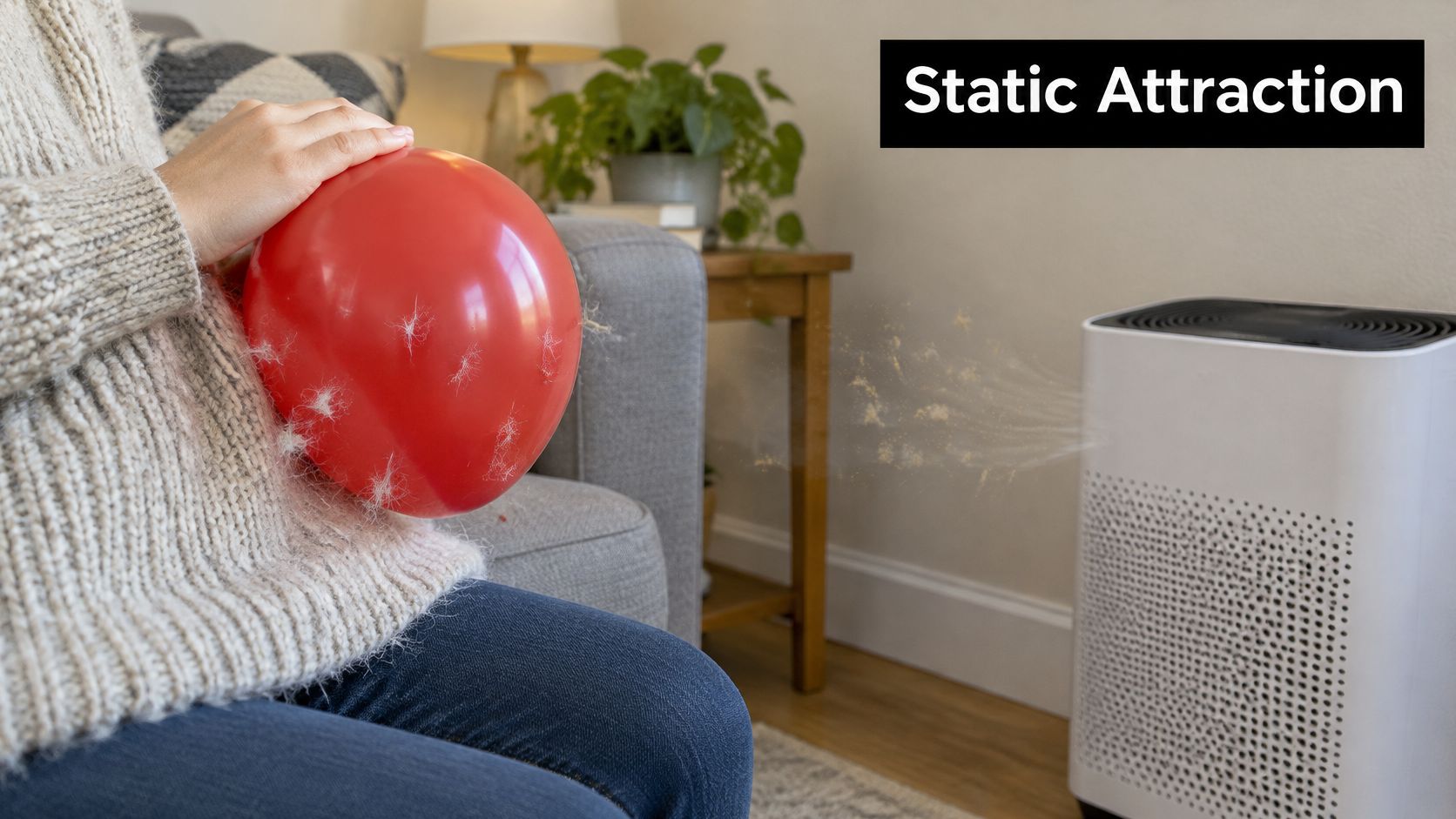
Rub a balloon against wool and it can stick to a wall because of electrostatic attraction. An electronic particle collector applies a related principle to airborne material, using controlled electrical fields rather than a rubbed balloon.
The analogy helps explain attraction, but don't confuse it with magnetism. Dust doesn't need to contain metal for an electric field to influence its movement.
Follow a particle through the equipment
Air enters. A portable unit's fan, or the HVAC blower serving an in-duct unit, moves room air through the cleaner. Air that never reaches the device can't be treated by its collector.
The charging stage acts. An energized electrode gives passing particles an electrical charge. Not every particle necessarily receives the same charge or follows the same path.
The collector attracts particles. In a precipitator, oppositely charged plates pull charged particles out of the moving airstream. In a collector-free ionizer, nearby room surfaces can become the destination instead.
Treated air leaves. Captured material remains on the collection plates until it's removed during cleaning. The outgoing air isn't necessarily free of gases, odors, or every particle size.
Say a dusty airstream passes quickly between collection plates. Some particles reach a plate, while others leave before the electrical field pulls them far enough across the channel. Change the airflow, plate geometry, or electrical settings, and the result can change even though the technology name stays the same.
What a laboratory percentage really measures
Laboratory example: A 2013 peer-reviewed positive-polarity precipitator study used 16 carbon-fiber ionizers per channel with parallel metallic collection plates and measured 50% to 95% single-pass collection efficiency at airflow rates of 10 to 20 cubic meters per minute; efficiency improved when ionizer voltage increased from 6 to 8 kilovolts and collection-plate voltage moved from negative 5 to negative 7 kilovolts.
Those results demonstrate that electronic collection can work well under defined conditions. They also show why a single advertised percentage doesn't describe the whole technology category. The electrical settings and airflow are part of the result, not fine print unrelated to it.
Residence time is the time a particle spends inside the treatment region. Faster airflow can shorten that time, while particle size affects charging and movement toward a plate. A test conducted with a clean collector also doesn't tell you exactly how a neglected collector will perform.
Whole-room conditions introduce another problem: mixing. A cleaner can repeatedly treat air near its inlet while pollution elsewhere reaches it more slowly. Open doors, ongoing indoor sources, and the fan setting affect what occupants ultimately breathe.
A high efficiency number measures the device under test conditions, not the room.
Ozone Limits and Safety Standards to Know
Ozone documentation deserves its own review, separate from particle-removal claims. Start by identifying what each standard measures, because an outdoor-air benchmark and an equipment-emissions test aren't interchangeable.
Ozone limits and tests for electronic air cleaners
Standard or Test | Ozone Limit | What It Covers |
|---|---|---|
CARB indoor air cleaner rule | 0.050 ppm (50 ppb) | Covered electronic portable and in-duct cleaners sold in California, as described by CARB's consumer guidance, which traces the regulation to 2008 |
Outdoor eight-hour ozone standard | 0.070 ppm (70 ppb) | Outdoor ambient air; ASHRAE's air-cleaning guidance also explains the incoming-air ozone-removal requirement under Standard 62.1 |
UL 867 chamber test | Below 0.05 ppm | Ozone emissions in a specified test chamber |
UL 2998 zero-ozone route | 5 ppb | More stringent emissions validation for electronic air-cleaning technologies |
EPA guidance on ozone generators | Not approved for occupied spaces | Devices that intentionally produce ozone |
The UL test limits distinguish a conventional chamber-emissions test from the more stringent zero-ozone route. Neither test name, by itself, establishes how much particulate pollution the device removes.
Read the certification, not just the badge
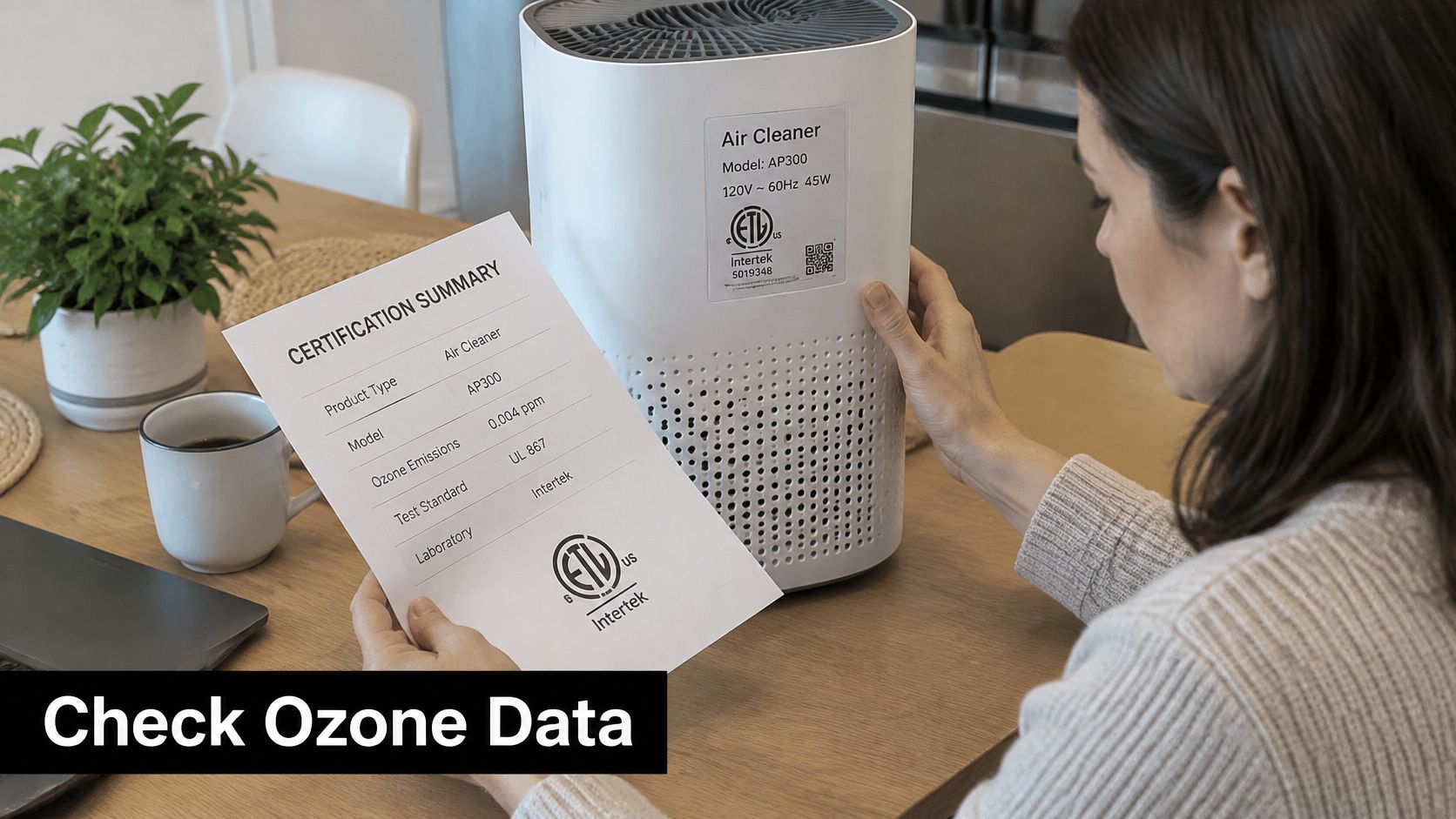
Start with the label's named test and the complete model designation. A certification for a product family, component, or related device isn't sufficient unless the documentation explicitly covers the unit you're buying.
Then check the tested configuration. Determine whether the electronic stage was enabled, what operating mode was used, and whether an additional component was required. A marketing statement such as low ozone is less useful than a test report identifying the equipment and conditions.
Confirm coverage. Match the model number on the quote, equipment label, and certification documentation.
Separate the purposes. Treat ozone testing as emissions evidence, not proof of particle capture or disinfection.
Check the application. Confirm that the installation and operating instructions match residential or commercial use as intended.
ASHRAE recommends testing and labeling electrically powered air-cleaning devices for ozone under the stricter UL route or an equivalent international test. For facility managers, incoming outdoor ozone also matters: adding an electronic stage doesn't remove the obligation to evaluate outdoor-air treatment requirements.
Low emissions are achievable, but model-specific
The positive-polarity experiment described earlier recorded a maximum ozone concentration of 5.4 ppb over 12 hours. That's evidence of low-ozone operation for that tested configuration, not certification of unrelated products.
If you're considering another active treatment method, this explanation of photocatalytic oxidation air purifiers can help distinguish the processes. A label without a named test is a reason to request documentation before proceeding.
Electronic Cleaners Compared With HEPA and ActivePure Systems
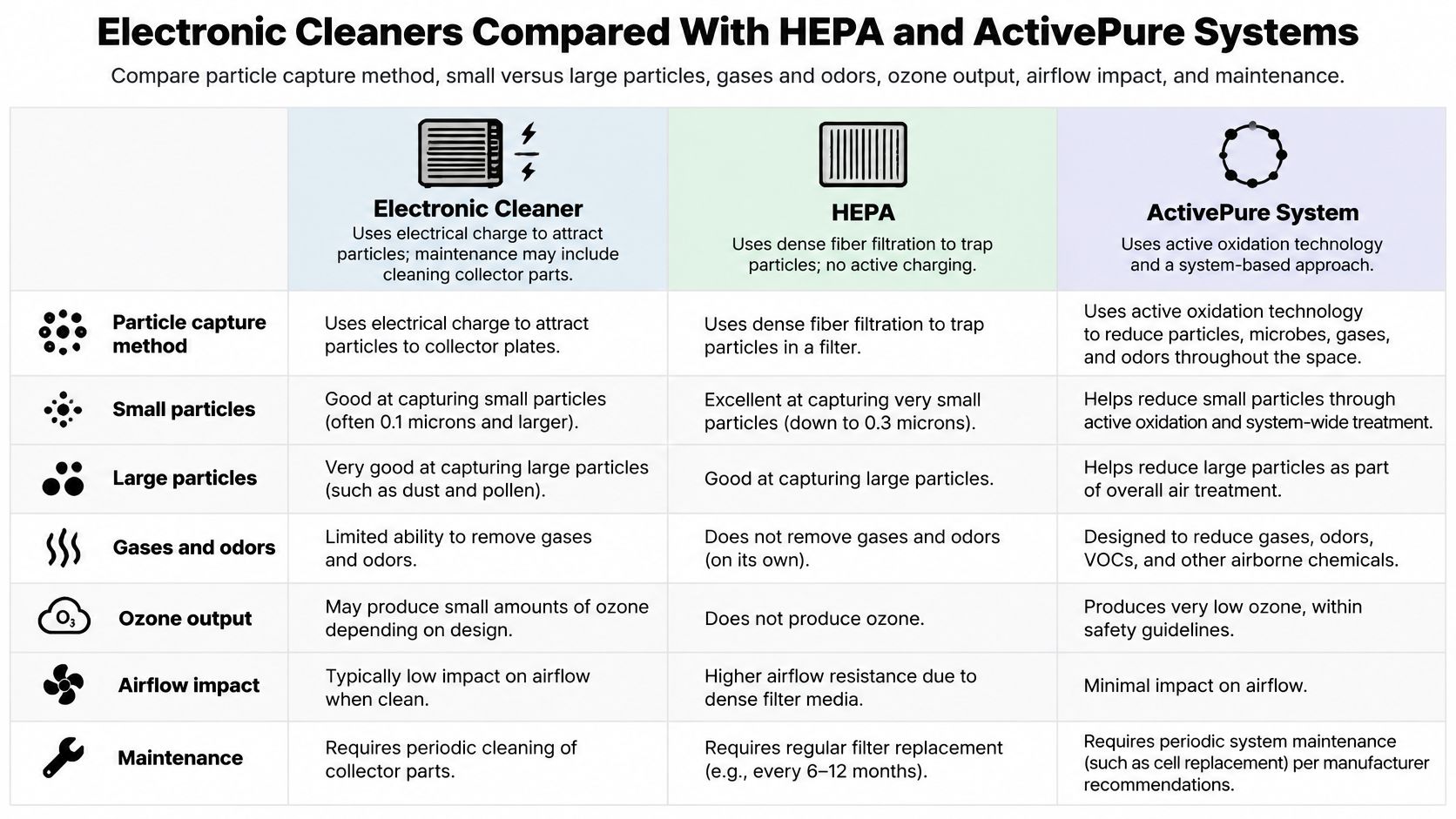
Compare equipment by particle capture, particle size, gases and odors, ozone output, airflow impact, and maintenance. These criteria are more useful than deciding that active treatment must be better than a conventional filter.
Electronic cleaner, HEPA and ActivePure compared
Criterion | Electronic Air Cleaner | HEPA Filter | ActivePure System |
|---|---|---|---|
Particle capture method | Electrical charge and collection plates or surfaces | Mechanical fiber mesh | Manufacturer-described active oxidation; identify any accompanying particle filter |
Ultrafine particles, 8 to 14 nm | Under 10% removed in tested residential in-duct ESPs | Require model-specific size-resolved testing | Require independent model-specific testing |
Rated efficiency | Check model, airflow, and target particle | 99.97% at 0.3 microns under test conditions | Check the exact claimed outcome and test conditions |
Ozone output | Can be significant; verify exact model | None from the filter itself | Verify independent emissions certification |
Gases and odors | Limited without suitable additional treatment | Limited without a carbon stage | Verify contaminant-specific results and by-product testing |
Airflow impact | Often lower pressure drop than dense filtration | Can impose higher pressure drop | Evaluate the complete installed configuration |
Maintenance | Clean collector cells on a set schedule | Replace filter on a set schedule | Follow the model's component service schedule |
The HEPA benchmark is a filter test specification, not a promise that a room becomes equally clean. The ultrafine-particle finding applies specifically to the tested residential precipitators, not every electronic cleaner.
Independent results can contradict broad claims
In EPA-indexed testing of residential in-duct precipitators, two brands removed less than 10% of tested 8 to 14 nm particles, continuous operation raised indoor ozone to 77 ppbv for one model and 20 ppbv for another, and activated-carbon filters reduced steady-state ozone by only 6% to 39%.
These findings expose distinct problems. A unit can use a credible collection principle yet perform poorly against a particular particle-size range. A carbon stage can reduce ozone without eliminating the exposure concern.
Don't generalize those results into a verdict against every precipitator. Use them to reject category-wide assurances that electrical charging automatically captures ultrafine particles or that adding carbon automatically resolves ozone.
Capture and active treatment answer different questions
HEPA filtration physically retains particles in fibrous media. A properly selected system can provide a straightforward particle-control baseline, but the HVAC blower must accommodate its resistance. Don't insert a dense filter into an unsuitable cabinet and assume the improvement is automatic.
An electronic collector may impose less resistance than a dense filter. That can help preserve airflow, but the advantage isn't enough if the model's target-particle capture is weak or its emissions are unacceptable.
ActivePure is a manufacturer-described active oxidation technology available in in-duct and portable arrangements. Evaluate its claims against independent testing for the exact system, including particle delivery, gas treatment, emissions, and operating conditions. A surface-treatment or pathogen-inactivation result doesn't automatically establish a room's particle-removal rate.
For Phoenix-area households weighing dust, pet-related particles, and odors, this overview of indoor air quality and filtration helps separate filtration needs from other treatment goals.
Keep a properly sized mechanical filter as the baseline. Add an electronic stage only when independent model data demonstrate a useful benefit for the pollutants you actually need to control.
Installation and Maintenance That Keep Performance Up
A strong equipment specification doesn't guarantee strong installed performance. The EPA's home air-cleaner guide emphasizes the importance of airflow and maintenance, with electronic collection also affected by particle size, residence time, and electrode cleanliness.
Installation should make maintenance possible, not merely make the cabinet fit. A collector that can't be withdrawn without dismantling nearby equipment is likely to become a neglected collector.
Set up the unit for serviceable operation
Choose the appropriate form. Match an in-duct unit to the HVAC system's airflow and available service clearance. Place a portable unit where curtains, furniture, and walls won't block its inlet or discharge. For an integrated installation, review the practical considerations in whole-house air purifier installation.
Clean the collector cells on the manufacturer's schedule. Shut down and isolate power before opening the equipment, and observe the specified discharge procedure. Use the approved cleaning method, inspect for damaged electrodes, and let washed components dry completely before reinstalling them.
Measure airflow and pressure drop after installation. A technician should check the complete assembly, including any prefilter and carbon stage. Inspect cabinet seals so air doesn't bypass the treatment path.
Service carbon separately. Use the replacement interval specified for the installed application, and replace it sooner when assessment shows that it's no longer doing its job. Don't use the absence of an odor as proof that an ozone-control stage remains effective.
Include duct condition in the inspection. Ducts are generally recommended to be cleaned every 3 to 5 years, depending on ductwork age and condition, heating and cooling system type, and allergies or respiratory problems in the home. This is a general service recommendation, not a substitute for inspecting the actual ducts.
Keep a useful maintenance record
Say a household has pets and a ten-year-old HVAC system. Schedule an earlier inspection of collector loading, prefilters, and duct condition rather than assuming the original maintenance interval still fits. Inspection findings should determine whether cleaning is needed.
Record the service date, collector condition, cleaning method, replacement components, airflow readings, and any unusual arcing or indicator faults. Keep the model manual and installation measurements with that log so future technicians can distinguish a new problem from the original operating condition.
Smoke events require a separate operating decision, not just a shorter cleaning interval.
Choosing a Model and Confirming Its Ozone Data
Treat equipment selection as a documentation check before it becomes a purchase. Set aside any model with an unresolved gap rather than filling that gap with a salesperson's description of the underlying technology.
Follow a model-specific buying sequence
Confirm the exact model's ozone certification. Read the named test on the label and match the complete model designation to the certification record. UL validation and CARB certification serve different purposes, so retain the actual documents rather than a photograph of an unexplained badge.
Find its Clean Air Delivery Rate. CADR combines airflow with contaminant-removal efficiency. In a worked example using ASHRAE's CADR relationship, a unit moving 500 cubic feet per minute while removing 80% of a target contaminant delivers approximately 400 cubic feet per minute of equivalent cleaned air. Match the published delivery rate to the intended space and the fan speed you'll be willing to tolerate, not just the maximum setting.
Check HVAC compatibility. Compare required airflow, cabinet dimensions, service clearance, and total pressure drop with the existing system. For an in-duct unit without a portable-style CADR rating, require equivalent performance information at the proposed operating airflow. A generic whole-home coverage claim isn't enough.
Request realistic emissions information. Obtain the ozone test conditions, operating mode, airflow, and configuration. Distinguish the certification chamber result from a prediction of occupied-room exposure. A qualified installer should evaluate installed airflow and ozone with appropriate instruments, including background conditions, rather than checking only that the power indicator illuminates.
Decide whether gas treatment is necessary. Name the problem first: cooking odors, a specific gas, or particle pollution. If carbon is proposed, document the media type, intended contaminant, replacement requirements, and evidence supporting its use. Don't treat an unspecified carbon sheet as universal gas control.
Assign maintenance responsibility. Write down who cleans cells, replaces components, records readings, and responds to faults. If the service requirements aren't practical for your household or facility, choose equipment you can maintain consistently.
For comparisons that remain focused on actual equipment, use home air cleaner reviews as a starting point for a model shortlist, then obtain the supporting documents before choosing.
Make a separate plan for smoke and extreme heat
The EPA's indoor air-filtration guidance for wildfire smoke doesn't recommend electronic cleaners for smoke removal when their effectiveness is uncertain and warns that they may produce ozone. During a smoke event, prioritize verified mechanical particle filtration rather than assuming an electronic stage can replace it.
Close windows and doors against smoke, reduce infiltration where practical, and use HVAC recirculation where the system permits. Keep the highest-efficiency mechanical filter compatible with the equipment, and monitor airflow rather than forcing an unsuitable filter into place.
During extreme heat, maintaining safe indoor temperatures remains essential. If a building becomes dangerously hot, seek a safer cooled location instead of relying on sealing alone. Verify emissions before running an electronic stage continuously.
Get the documents before authorizing installation
The decisive checks are a named ozone test, delivery performance matched to the space, and independent particle and gas results. Pathogen-destruction language can't replace any of them.
Purified Air Duct Cleaning is one option among several. We assess each customer's specific needs, recommend a suitable system for the home, and provide regular maintenance for the air purification systems we install.
Whichever installer you select, request the exact model's certification, CADR or equivalent delivery information, and ozone-emissions documentation in writing before purchase or installation.
Purified Air Duct Cleaning offers air purification system assessment, installation, and regular maintenance for the systems we install. Visit Purified Air Duct Cleaning to discuss your home's airflow, pollutant concerns, and service needs, and bring your model shortlist so certification and delivery documentation can be part of the decision.