

Dust Mite Allergy: Symptoms, Causes and What Helps
Approximately 84% of U.S. households contain house dust mites, according to the NCBI Bookshelf clinical overview. Their presence doesn't mean a home is dirty, or that everyone living there has an allergy. The practical question is whether you're reacting to the proteins they leave behind, and whether your efforts are reaching the places those proteins collect.
What Dust Mite Allergy Is and Who Gets It
Dust mite allergy affects approximately 4% to 6% of the world's population, up to about 500 million people, according to an academic review of house-dust-mite allergy. The same review describes reported rates of 60% to 80% in some warm, humid populations, not across all people living in those climates. That distinction matters because geography, housing and the definition of allergy all affect estimates.
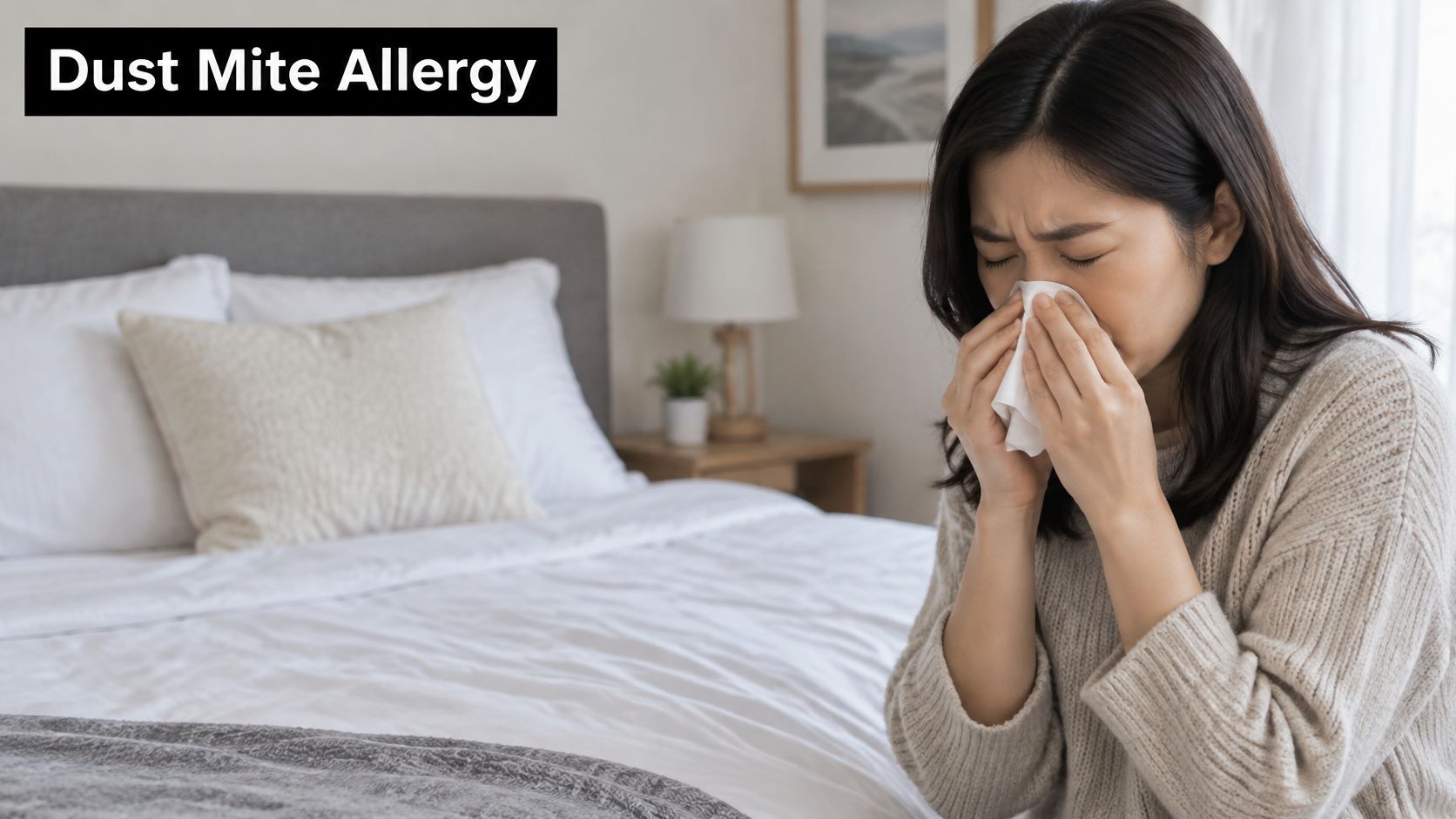
Say you wake with a blocked nose even though your bedroom looks spotless. Your sheets are clean, the floor is clear, and there's no obvious dust cloud. Yet your mattress and pillows can still hold material you can't see.
The organism and the material it leaves behind
Dust mites are microscopic organisms that live in household fabrics and settled dust. Two globally important species are Dermatophagoides pteronyssinus and D. farinae.
The allergen isn't a live mite. It's mainly proteins in mite bodies and feces, which mix into household dust and can become airborne when disturbed. Think of the mite as a tiny bystander and the allergen as the crumbs it leaves behind.
A bedroom is a useful place to recognize the difference between visible cleanliness and exposure.
Exposure isn't the same as allergy
Your immune system must recognize a substance as a threat before an allergic response develops. Sensitization means testing detects that immune recognition. Clinical allergy means exposure also fits your symptoms.
Exposure: Mite material is present in your surroundings.
Sensitization: Your immune system recognizes mite proteins.
Symptomatic allergy: Contact contributes to symptoms such as nasal congestion or wheezing.
Someone can encounter mites without becoming ill. Another person can react in a room that appears immaculate. Neither situation tells you how carefully the household cleans.
The useful starting point isn't whether your house contains mites. It's whether your symptom pattern makes them a plausible trigger, especially if you already have allergic rhinitis or asthma.
Symptoms That Point to Dust Mites
Dust mite symptoms compared with other common indoor triggers
Trigger | Typical symptoms | When it flares | Clue that points to it |
|---|---|---|---|
Dust mites | Sneezing, congestion, itchy eyes, night cough | Year-round, worst in bedrooms and on waking | Eases on trips away from home |
Pollen | Sneezing, itchy eyes, runny nose | Seasonal, often spring to late summer | Worse outdoors and on windy days |
Pet dander | Sneezing, wheezing, itchy skin | Whenever near the animal | Eases for days after leaving the pet's rooms |
Mold | Stuffy nose, cough, headache | Damp areas such as bathrooms and basements | Worse in humid rooms and after rain or leaks |
Dust mite allergy commonly produces nasal and eye symptoms that persist beyond a pollen season. Waking congested, sneezing while making the bed, or coughing after disturbing bedroom fabrics are useful clues. They aren't a diagnosis.
Pollen is more suspicious when symptoms track outdoor exposure and local flowering seasons. Pollen carried indoors can still cause trouble in a bedroom, so location alone doesn't identify the trigger.
Pet-related symptoms may follow time spent around an animal or its favorite furniture. Leaving the room doesn't necessarily end exposure immediately because allergen can remain on clothing and furnishings.
Mold becomes more plausible when symptoms accompany dampness, leaks or musty rooms. Headache alone isn't a reliable allergy clue, and several triggers can coexist in the same home.
Pay attention to breathing and sleep
Dust-mite sensitization is associated with allergic rhinitis, wheezing, eczema and asthma. People with allergic asthma deserve particular attention because ongoing cough or wheeze may indicate more than an uncomfortable nose.
Notice what happens after vacuuming, handling bedding or spending time in humid rooms. Improvement during travel can support suspicion of a home trigger, but a trip also changes other exposures. For practical bedroom adjustments, use this guide to sleeping better with allergies.
A short self-check
Timing: Do symptoms repeat throughout the year?
Location: Are they most troublesome in the bedroom or on waking?
Time away: Do they ease after you've been away from home for a few days?
There's no validated score for this informal check. A consistent pattern across the questions is a reason to discuss testing, not permission to diagnose yourself. Even without that pattern, persistent symptoms that affect sleep or daily life justify a medical appointment.
Don't wait for every clue to line up if you're wheezing or becoming breathless. Severe breathing difficulty needs urgent medical care.
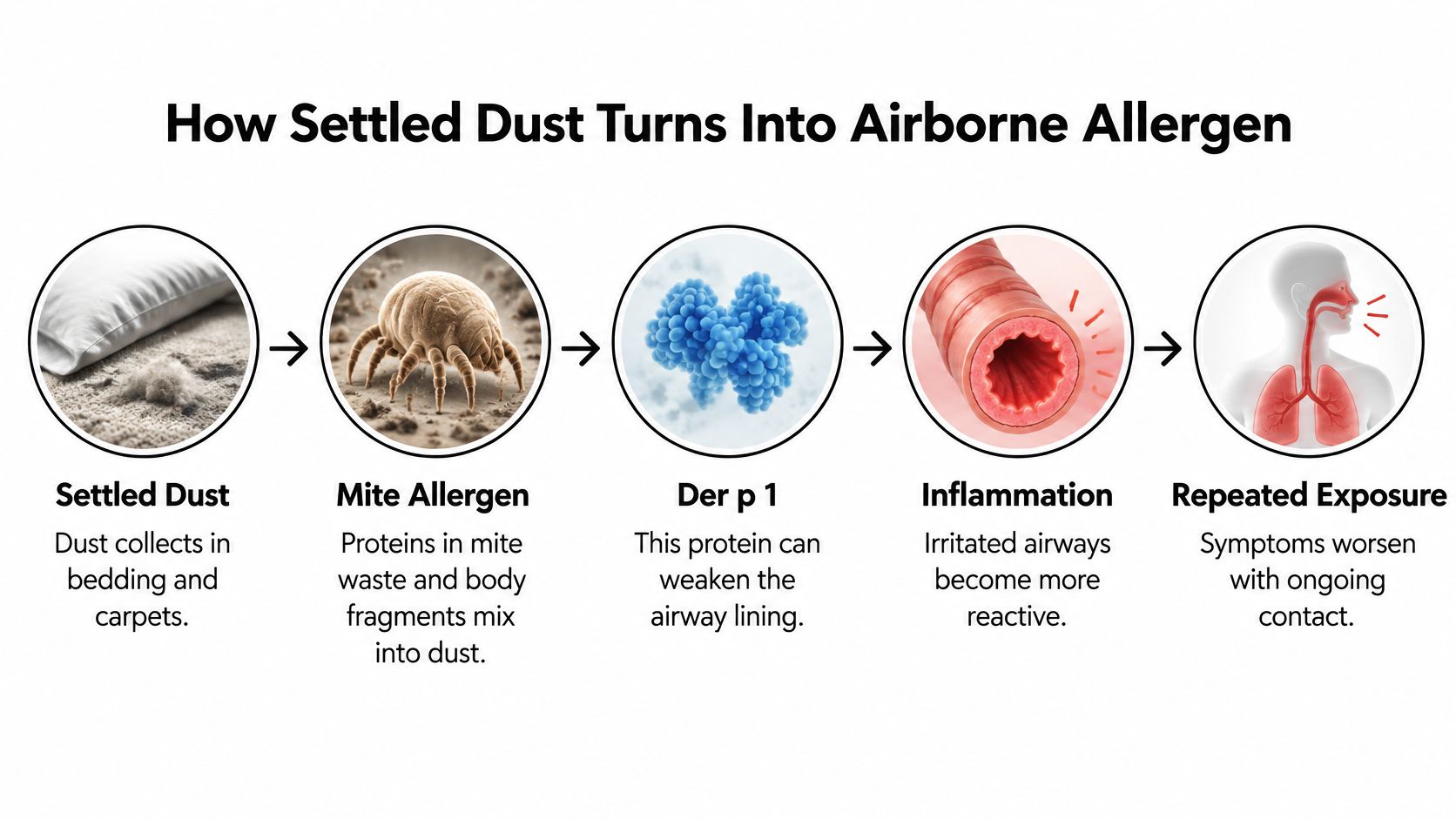
How Settled Dust Turns Into Airborne Allergen
Dust is like a sponge holding allergen. Fabrics and floor coverings store the material, and movement can release some of it into the air, much as squeezing a wet sponge releases water.
The pathway below connects household reservoirs with airway exposure.
Follow the particles through the room
Allergen settles into soft furnishings. Mattresses, carpets and upholstery hold particles between fibers, so wiping a nearby shelf doesn't address the whole reservoir.
Everyday movement lifts dust. Making the bed, walking across carpet or vacuuming with poor particle containment can disturb material close to your face.
Some particles remain airborne temporarily. Particle size, air movement and ventilation influence how long they stay suspended; much mite-associated material also settles back onto surfaces.
Air enters the HVAC return. Entrained particles can reach filters and ductwork, where accumulated dust may provide another reservoir that airflow can disturb.
You inhale particles into your nose and airways. Exposure near a pillow or during cleaning can matter even when the rest of the room looks clear.
This isn't a claim that every particle follows the entire route. Bedroom fabrics can expose you directly without the HVAC system being involved.
Why the airway response can persist
Der p 1, a mite-allergen protein, is an enzyme that can weaken protective connections between airway-lining cells and promote inflammatory signaling, as described in experimental work published in International Immunology. That helps explain why repeated exposure can contribute to ongoing inflammation rather than only a passing tickle.
Practical rule: Find the places that store dust before buying equipment intended to clean the air.
A low-efficiency HVAC filter may capture coarse debris while allowing smaller particles through. A better filter can improve particle capture, but it still won't wash a pillow or remove dust embedded in a rug. Filtration and reservoir cleaning perform different jobs.
This video offers another way to visualize the exposure pathway.
Map your own reservoirs by room: bedding first, then carpets, upholstered seating and any visibly dusty returns or ducts. That map is more useful than judging exposure by the appearance of hard surfaces alone.
Testing Methods and Dust Allergen Levels
Der p 1 levels in settled dust and what they indicate
The American Journal of Respiratory and Critical Care Medicine review describes the proposed concentrations below, approximately 2 micrograms per gram associated with sensitization and 10 micrograms per gram associated with symptom provocation.
Der p 1 in settled dust | Associated effect | How to read it |
|---|---|---|
About 2 micrograms per gram | Sensitization | Flags a home worth testing further |
About 10 micrograms per gram | Symptom provocation | Likely to trigger symptoms in sensitized people |
These are proposed exposure associations, not universal clinical cutoffs. No home test replaces a clinician because diagnosing an allergy requires evaluating the person, not only the house.
Test the person first
An allergist may use a skin-prick test or a blood test for allergen-specific IgE to assess sensitization to dust mite species. The clinician compares the result with your symptoms, history and other possible triggers.
A positive result doesn't automatically establish that mites explain your blocked nose. Someone can be sensitized while another allergen, an infection or a nonallergic nasal condition accounts for the current symptoms.
Testing is most helpful when it answers a practical question. For example, would confirming mites change your bedroom priorities or support a discussion about immunotherapy?
Understand what a dust sample measures
Environmental sampling usually involves collecting settled dust from a defined location, such as a mattress or carpet, and sending it to a laboratory. The report may measure Der p 1 concentration, rather than counting live mites.
A sample describes the material collected from that location. It doesn't measure every room, reconstruct your entire day of exposure or predict exactly how your body will react.
A dust report describes a reservoir. An allergy assessment helps determine whether that reservoir matters to you.
Allergen-containing particles can remain after the organisms die. A report therefore can't establish that a treatment succeeded merely because it killed mites.
If you're considering environmental services, distinguish allergen sampling from general particle monitoring when comparing indoor air quality testing companies. Ask which substance the test measures and how the result would change your next action.
Prepare for the appointment
Symptom diary: Record symptoms over a couple of weeks, including the room and activity.
Seasonal pattern: Note which months bring trouble and whether travel helps.
Sleep disruption: Include night cough, waking and morning congestion.
Previous attempts: List medicines, cleaning changes, covers and moisture-control measures.
Bring the pattern, not just a photograph of a dusty vent. Request testing that can resolve the likely cause instead of repeating increasingly intensive cleaning without a clear target.
Controlling Humidity and Bedding Reservoirs
Humidity and temperature targets for dust mite control
The National Institute of Environmental Health Sciences dust-mite guidance recommends keeping indoor relative humidity at or below 50%; the favorable conditions summarized below are approximately 55% to 75% relative humidity and 68°F to 77°F.
Measure | Value | Action |
|---|---|---|
Relative humidity where mites thrive | 55% to 75% | Avoid this range in bedrooms |
Recommended indoor relative humidity | 50% or below | Run air conditioning or a dehumidifier and check with a hygrometer |
Temperature where mites thrive | 68°F to 77°F | Improve airflow and avoid overheating bedrooms |
Prioritize moisture and bedding before repeated whole-home cleaning. That doesn't mean changing the thermostat alone will solve the problem. Moisture control makes the environment less favorable for mites, while bedding measures address the material closest to your breathing zone.
Make moisture visible
Place a digital hygrometer in the bedroom. Keep it away from a supply vent, window or direct sunlight so you're checking representative room conditions.
Check morning and evening. Record readings alongside symptoms to identify recurring moisture problems rather than relying on how the room feels.
Use air conditioning or a dehumidifier. Choose the approach that maintains the target consistently, and keep the equipment clean and draining correctly.
Run bathroom and kitchen exhaust fans. Remove moisture where showers and cooking produce it instead of allowing it to spread.
Avoid drying laundry indoors. Wet fabric adds moisture to the same air you're trying to dry.
Repair leaks and dry damp materials. A persistent plumbing or roof problem needs a repair, not a stronger dehumidifier.
In a property with several occupied rooms, check more than the hallway. A comfortable central thermostat reading doesn't tell you whether a closed bedroom or carpeted lower level stays damp.
For troubleshooting equipment and recurring moisture, use this practical guide to indoor humidity control.
Put a barrier around the bed
Choose zippered, allergen-proof mattress and pillow encasements that enclose the entire item. A loose mattress pad isn't the same product. Check the seams, zipper closure and washing instructions before buying.
Keep ordinary washable sheets and pillowcases over the encasements. This preserves a straightforward laundering routine without repeatedly removing the full mattress cover.
Carpet and upholstered furniture deserve closer attention in rooms with persistent moisture. Don't assume that drying the room also removes previously accumulated allergen from those materials.
Set a measurable humidity target and choose suitable encasements this week. Those are focused changes with a clearer purpose than another untargeted deep clean.
Cleaning, HVAC and Air Purification Options That Work
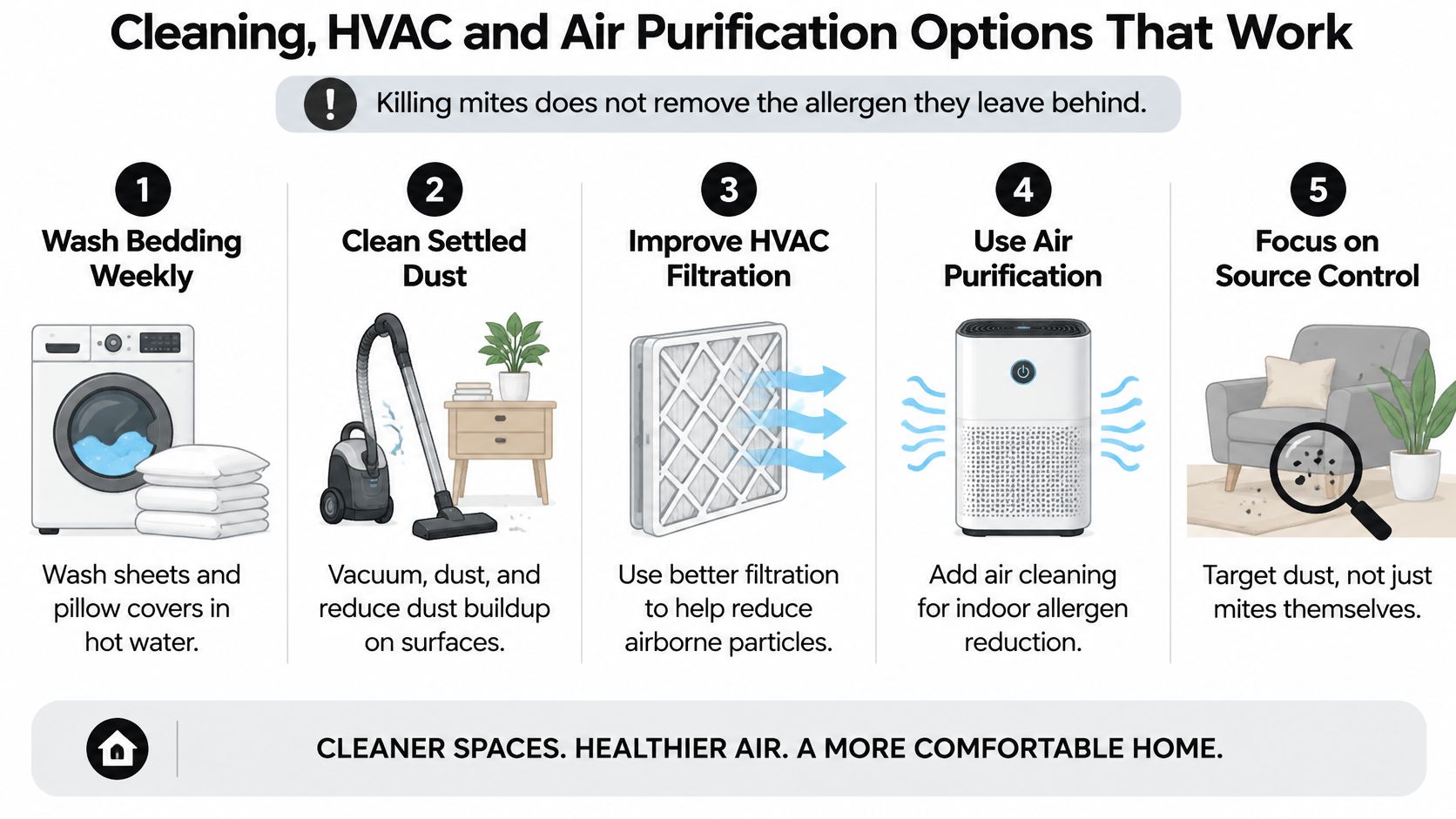
Killing mites doesn't remove the allergen they leave behind. Cleaning should remove or contain settled material, not merely treat the organisms.
The household plan below keeps source control ahead of optional equipment.
Work through the highest-value tasks
Wash bedding weekly in hot water. Laundering carries accumulated material out of sheets and pillowcases rather than leaving it in the sleeping area.
Use appropriate dryer heat for items that can't be washed hot. Mayo Clinic guidance specifies at least 15 minutes above 130°F, or 54.4°C, to kill mites, while warning that killing them doesn't remove allergens; check fabric-care instructions and include suitable cleaning afterward.
Vacuum carpets and upholstery with a HEPA-filtered machine. Good filtration and a well-sealed dust path help contain collected particles.
Dust with a damp cloth. The cloth picks up settled material instead of sweeping it into the air.
Reduce dust-catching clutter. Clear bedside surfaces and washable storage make thorough cleaning easier to maintain.
Maintain HVAC filters. Replace them on the manufacturer's schedule and use the highest efficiency your system can accommodate without restricting airflow.
Have duct leaks assessed and sealed. Repairing unintended air pathways can limit the movement of dust from surrounding spaces into the system.
For removable floor coverings, Rubber Ducky Rug Cleaning Birmingham's resource on dust mite treatment for area rugs can help frame questions about rug-specific cleaning. Match the method to the fibers and construction rather than applying bedding heat instructions to a rug.
Keep ducts and purifiers in a supporting role
Duct cleaning is supplementary reservoir reduction, not an allergy treatment. Consider inspection when ducts are visibly dirty or the home has a substantial dust burden. Ducts are generally recommended to be cleaned every 3 to 5 years, depending on ductwork age and condition, heating and cooling equipment, and household allergies or respiratory problems, rather than as a guaranteed symptom-control schedule.
Risks include dust and debris released into the air, allergic reactions and mold growth. These risks are rare when a qualified company performs the work properly; our process uses HEPA-filtered negative-pressure equipment and contains collected debris.
Portable and in-duct air cleaners address airborne material, not dust embedded in fabric. Compare a HEPA air filtration system with other technologies based on particle capture, room needs and upkeep. We assess individual needs and recommend suitable options, including ActivePure systems, and provide regular maintenance for the air purification systems we install.
Keep a written maintenance schedule for the selected equipment. Start this month with a manageable combination of bedding laundering, HEPA vacuuming and filter maintenance rather than purchasing several devices at once.
Decide When to Book an Allergist Visit
Book an allergist when symptoms persist despite several weeks of environmental control, when sleep is regularly interrupted, or when asthma or eczema worsens. Wheezing and breathlessness warrant prompt assessment, not another round of cleaning. Severe or rapidly worsening breathing difficulty requires urgent care.
A clinician can discuss symptom medicines, including antihistamines and nasal sprays, and decide whether immunotherapy fits your diagnosis. Understanding the relationship between allergies and asthma is particularly useful when cough accompanies nasal symptoms.
Compare treatment routes without assuming a winner
An evidence synthesis covering trials published through 2025 included 7,329 participants and found that both injection and tablet immunotherapy improved house-dust-mite allergic-rhinitis symptoms versus placebo, with modeled standardized mean differences of −0.40 for SCIT targeting multiple components and −0.30 for major-component SLIT tablets.
SCIT and SLIT compared for house dust mite allergic rhinitis
Feature | SCIT | SLIT |
|---|---|---|
Route | Injections under the skin | Tablets under the tongue |
Modeled symptom effect (standardized mean difference) | −0.40 | −0.30 |
Precision of estimate | Less precise | More precise, supported by more large contemporary trials |
Expected duration | Several years | Several years |
These effect measures aren't percentages of symptom relief. SCIT had the strongest modeled symptom signal, while SLIT's estimate was more precise because more large contemporary trials supported it.
A small prospective comparison also found similar symptom improvement despite stronger IgG4 antibody responses with SCIT. A larger immune-marker change doesn't automatically mean better everyday relief, so the best choice isn't settled by a laboratory result.
Choose a plan you can sustain
Both routes require adherence over an extended period. Your allergist should review asthma control, potential reactions, monitoring, appointment demands and whether the specific product is appropriate for you.
Access and insurance coverage differ by country and plan. Ask about the full commitment before starting, including follow-up and what happens if doses are missed.
Environmental control supports treatment. It isn't proof that you should be able to manage a true allergy through housekeeping alone.
Record symptoms for two weeks, bring your humidity readings and a list of the changes you've tried, and book the appointment with that diary in hand. The goal is a confirmed explanation and a workable treatment plan, not a cleaner-looking room at any cost.
Purified Air Duct Cleaning offers residential and commercial duct cleaning, HVAC coil cleaning and air purification installation across the Phoenix metropolitan area. Visit Purified Air Duct Cleaning to request a quote and discuss whether duct inspection or air-cleaning support belongs alongside your bedding, moisture-control and medical plan.