

Energy Recovery Ventilator Cost: 2026 Price Guide
A standalone residential energy recovery ventilator usually costs about $1,800 to $2,600 installed in a retrofit, while published total system budgets run from $1,000 to $6,000 depending on scope. The important distinction is whether that price buys a working ventilation system or just the box that moves the air.
Don't choose an ERV by its equipment price. Duct routing, access, electrical connections, and controls can determine whether an apparently affordable unit becomes an expensive project. For Phoenix homeowners, there's another question worth answering before signing: will recovering energy from outdoor ventilation save enough to justify the added cost?
Typical ERV Installed Costs at a Glance
An energy recovery ventilator, or ERV, transfers heat and moisture between outgoing stale air and incoming outdoor air, adding energy-recovery equipment that a plain exhaust fan doesn't have. Your useful budget is the installed system price, not the online equipment listing.
A Florida Solar Energy Center review summarized compact equipment at $600 to $1,100, installation at $1,200 to $1,500, and an approximate combined benchmark of $1,800 to $2,600; it also reported a residential database average of about $1,300 and an ERV equipment premium of $150 to $200 over comparable HRVs. These are historical reference points, not current Phoenix contractor quotes.
Installed ERV cost by project scope
Project scope | Installed cost | Basis |
|---|---|---|
Standalone residential ERV, retrofit with equipment and labor | $1,800 to $2,600 | Florida Solar Energy Center equipment-and-labor benchmark |
National database average, residential ERV | About $1,300 | NREL Residential Efficiency Measures Database, summarized by FSEC |
Ceiling-mounted residential unit, equipment plus installation | $2,100 to $3,800 | Calculated from Dataintelo's published ranges: $1,200 to $2,400 equipment plus $900 to $1,400 installation |
Whole-home ERV/HRV, 2,400-square-foot, four-bedroom home | $2,193 | January 2025 Georgia state cost-study model, described by Resource Hub, including controls, labor, ducts, and electrical connections |
Single-story home, fully ducted unit installed separately from existing ductwork | $1,000 to $1,500 | California Energy Commission building-research benchmark |
Premium residential retrofit | $5,000 to $8,500 | MarketIntelo's residential ventilation estimate for premium retrofits |
Broad total system range, all scopes | $1,000 to $6,000 | Indicative system budget from Weber State University |
The table isn't a price ladder. A separately ducted installation from one building study isn't automatically cheaper than a compact retrofit in your house, because the assumptions, labor conditions, and included work differ.
Match the scope before comparing the number
Start with the row that describes your project, then ask what's included. A whole-home installation should identify where outdoor air enters, where exhaust leaves, and how air reaches occupied rooms.
If you're considering passive ventilation instead, Trickle Vent Installation Costa Blanca's guide to the cost of adding trickle vents is useful for understanding that alternative's pricing structure. It isn't a Phoenix cost benchmark, and trickle vents don't provide the same balanced mechanical ventilation or energy recovery.
Budget rule: A published equipment price is a shopping reference. An installed price needs a defined airflow, duct layout, electrical scope, and startup procedure.
Keep the historical averages in perspective. None should be presented as a guaranteed local price or relabeled as a newly surveyed contractor rate.
What Moves an ERV Quote Up or Down
Scope and ductwork usually matter more than the unit's list price. When comparing energy recovery ventilator cost, rank the installation requirements before comparing brands.
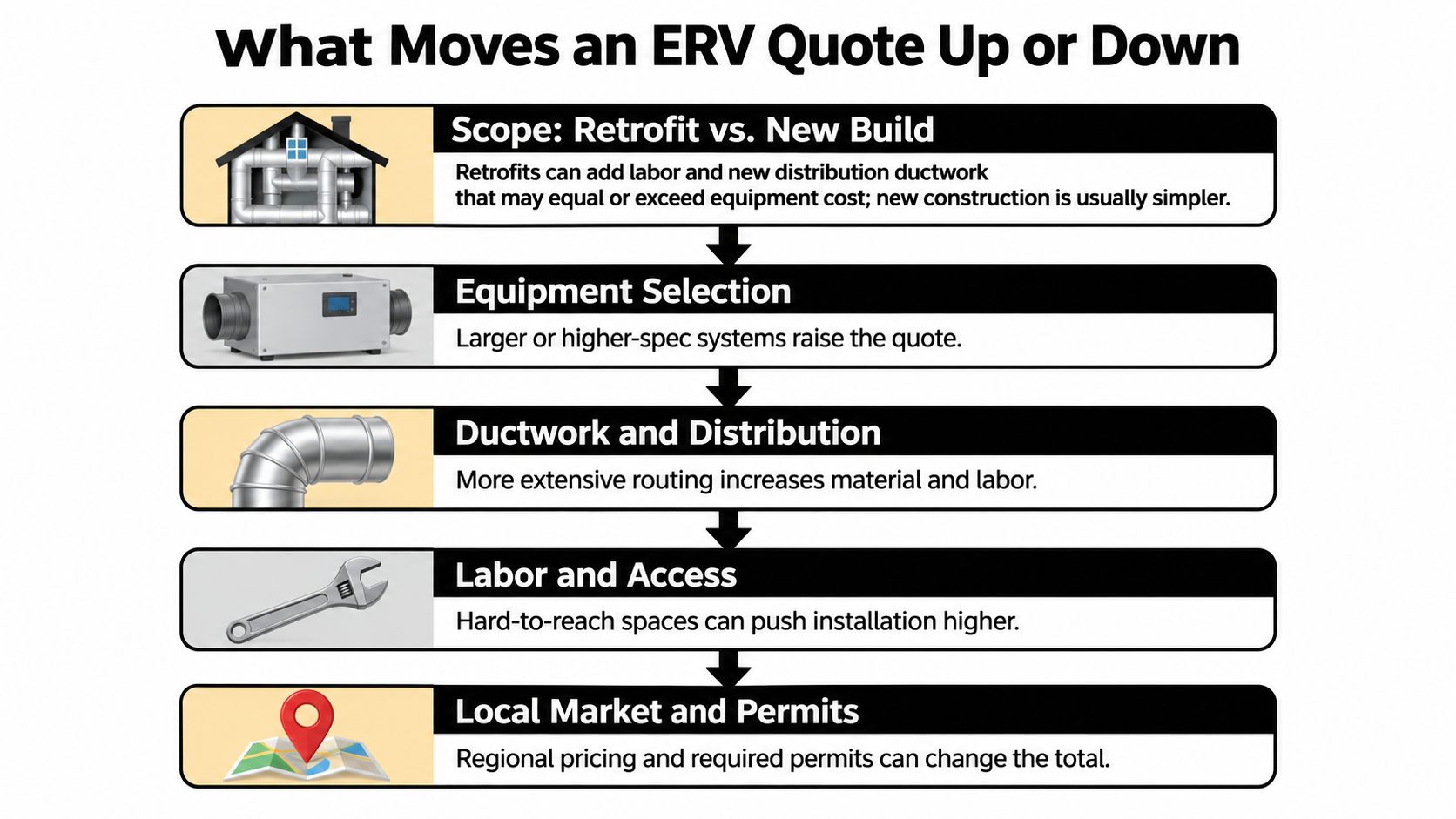
The biggest installation drivers
Retrofit versus new construction comes first. In an existing house, installers may need to open finished surfaces, work around framing, and add distribution ducts. During construction, they can coordinate those routes before ceilings and walls close.
The California Energy Commission building report includes a $1,000 to $1,500 separately ducted single-story ERV/HRV benchmark and mechanical-ventilation retrofit costs of $3,296 to $9,999 per apartment, alongside roughly 8 to 18 labor hours, depending on ducting and electrical requirements. Those aren't interchangeable project types, but they demonstrate why a generic equipment allowance can miss the actual job.
Airflow and equipment selection come next. Ask the estimator to show the required supply and exhaust airflow, then identify a unit that delivers it against the proposed duct resistance. Don't pay for excess capacity just because a larger model is available.
Efficiency needs a precise definition. ASHRAE's air-to-air energy recovery guidance reports manufacturer-listed sensible effectiveness commonly at 80% to 90% and states that, as of 2019, Standard 90.1 requires covered recovery systems to achieve an enthalpy recovery ratio of at least 50%. Temperature effectiveness and total energy recovery aren't the same measure, so a high percentage alone doesn't justify a premium.
Site work and integration
Look for these separate quote lines:
Ductwork and access: Identify dedicated ducts, ceiling openings, attic platforms, hangers, and the route needed to remove the unit for service.
Penetrations and drainage: Specify exterior intake and exhaust terminations, weather sealing, and condensate management where the selected equipment requires it.
Electrical work: State whether existing power is usable or a new circuit and disconnect are included.
Controls and HVAC integration: Name the controller and explain when the ERV and central air handler operate together.
Permits and inspections: Identify the responsible contractor and whether fees are included.
Don't accept “HVAC integration” as an unexplained allowance. Our guide to indoor air quality and ventilation helps distinguish outdoor-air delivery from cleaning or treating recirculated air.
Commercial spaces need equally clear boundaries. Material Handling USA's overview of climate control for modular warehouse offices is useful when an enclosed office has different conditioning needs from the surrounding warehouse.
Question vague allowances, not necessary installation work. Accessible filters, properly supported ducts, and balanced airflow are worth buying; unnecessary capacity and controls nobody will use usually aren't.
Commercial ERV Costs by Airflow and Lifecycle Value
Commercial installed ERV cost by airflow
Airflow or case | Installed cost | Basis |
|---|---|---|
500 cfm | About $1,800 | 500 × $3.60 per installed cfm |
1,000 cfm | About $3,600 | 1,000 × $3.60 per installed cfm |
2,000 cfm | About $7,200 | 2,000 × $3.60 per installed cfm |
ERV-521S, 75% energy-transfer efficiency | $10,800 installed | ASHRAE application example, not equipment-only pricing |
ERV-521S with downsized air conditioning | $800 net first cost | ASHRAE example after avoided HVAC costs |
The airflow calculations use an ASHRAE application benchmark of $3.60 per installed cfm; its ERV-521S example had 75% energy-transfer efficiency, cost $10,800 installed, and reached $800 net first cost after avoided air-conditioning costs were credited at $1,000 per ton. These are illustrative engineering economics, not current bids for arbitrary buildings.
Static pressure, building layout, structural requirements, and control integration can change a commercial proposal substantially. Use the table to understand the calculation, not to approve a purchase order.
Credit avoided equipment only when it's real
The ASHRAE example matters because an ERV can change the rest of the HVAC design. A contractor who prices it solely as an accessory may overlook an opportunity to reduce conditioning capacity.
But don't count a capacity credit when you're keeping the existing cooling equipment. The credit belongs in the financial model only when the project avoids a purchase or reduces a planned equipment expense.
Larger installations can spread fixed installation work across more airflow. That doesn't mean a straight per-cfm multiplication predicts every project, especially when duct routes or electrical work change.
Fan energy can erase an apparent bargain
At approximately 1,000 cfm, ASHRAE's operating-energy example found recovered sensible energy of about 7.3 to 8.8 times the recovery unit's electricity consumption, with a practical energy-cost benefit approximately three times its operating cost. Thermal recovery and electrical consumption have different economic values, so don't treat those energy quantities as equal-dollar savings.
A cheap unit with restrictive airflow paths can demand more fan power. Request the selected operating point, fan input power, pressure drop, and expected schedule.
Our commercial building ventilation guide provides context for defining that ventilation scope. The purchasing decision should compare lifecycle cost, including maintenance and utilities, rather than awarding the job to the lowest equipment bidder.
When an ERV Pays Back and When It Does Not
An ERV's payback depends on the building's conditioning loads, operating hours, and utility rates. A system can make sense when mechanical ventilation is needed and runs for long periods. With low ventilation demand, a simpler option may cost less overall.
ERV payback outlook by building scenario
Building scenario | Payback outlook | Variables to model |
|---|---|---|
Tightly sealed home that needs mechanical ventilation anyway | Stronger case, because the ERV limits the conditioning penalty of necessary ventilation | Fan watts, avoided cooling load, runtime, utility rates |
Older leaky home with a simpler ventilation option available | Often weaker; basic exhaust or fresh-air ventilation may be more economical | Infiltration reduction, simpler-system cost, filter upkeep |
Continuously occupied commercial building | Often strongest, with sustained ventilation demand | Airflow, operating hours, pressure drop, energy prices, avoided HVAC capacity |
Building with low ventilation hours in a mild climate | Often weakest, because recovery opportunities are limited | Runtime, climate, replacement timing, first cost |
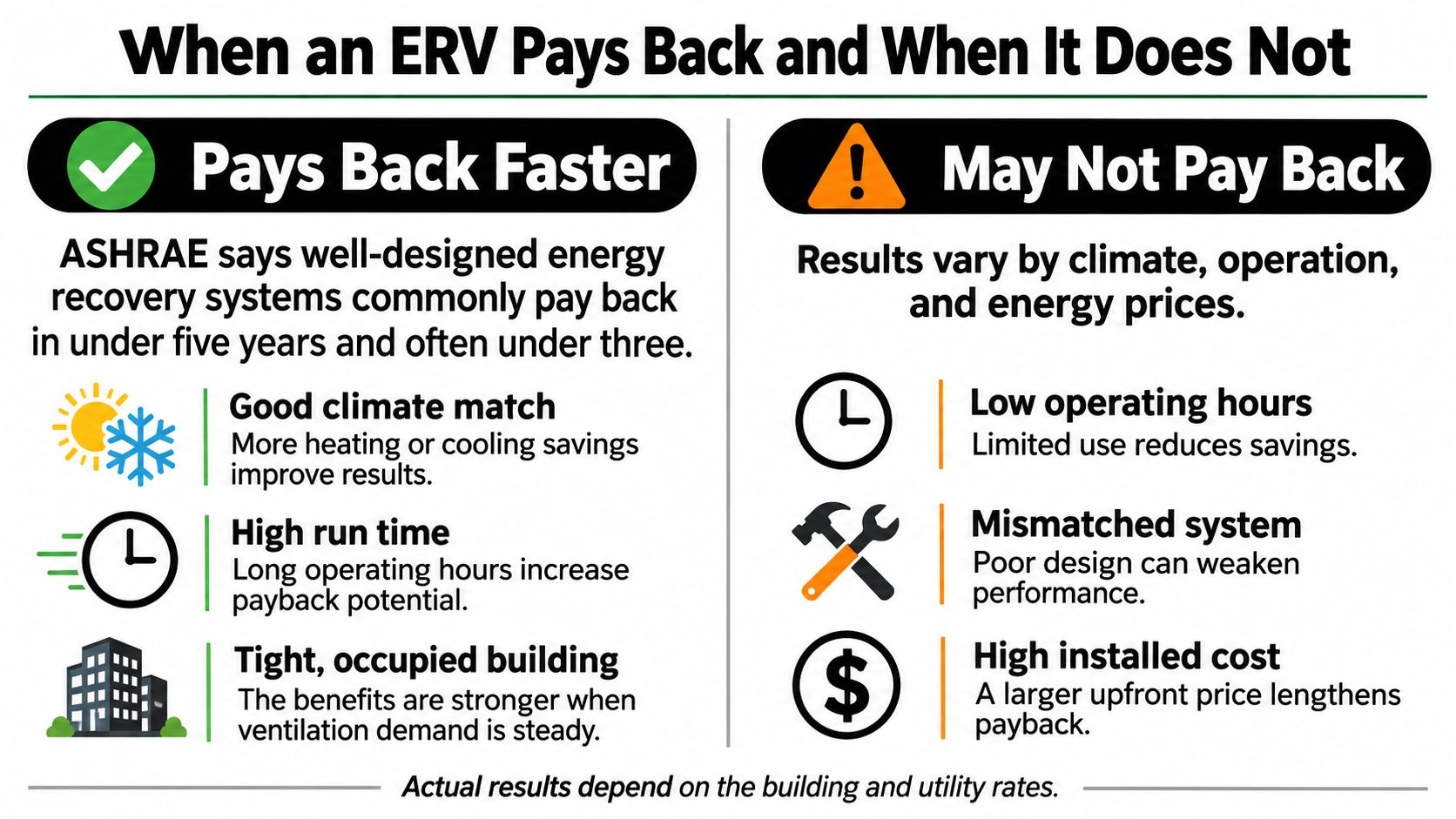
Calculate the incremental return
Use these relationships:
Annual net savings: Avoided heating and cooling energy expense minus added fan electricity, filter costs, and core maintenance.
Simple payback: Net installed cost divided by annual net savings.
Fair comparison: If ventilation is needed anyway, compare the ERV's additional cost with a compliant simpler alternative, not with doing nothing.
For a hypothetical example, $2,000 in net installed cost divided by $300 in annual net savings gives about 6.7 years. If annual net savings are zero or negative, there is no energy-only simple payback.
The guide to calculating energy savings can help organize the inputs. Exclude speculative repair savings and equipment credits unless the project will realize them.
A ventilation upgrade may be necessary even when it is not a fast-payback energy investment. Keep those decisions separate.
In Phoenix, test the project's actual temperature and moisture conditions rather than assuming that every hot climate produces the same result. Compare the ERV with the ventilation alternatives that fit the building, then weigh its modeled savings against the project-specific installed cost.
If roof replacement is already planned, metal roof estimates from Superior Home Improvement provide a separate scope reference, not an ERV savings input.
Maintenance and Financing Costs Over Time
An installation proposal isn't a complete ownership budget. Get the recurring costs in writing while the equipment model is still negotiable.
Recurring costs to price
Filters. Follow the manufacturer's inspection and replacement schedule, adjusting inspections for dusty conditions. Price the actual filter part numbers and several years of replacements rather than accepting a generic filter allowance.
Core inspection and cleaning. Confirm how the heat-exchange core slides out and which cleaning method its material permits. Don't assume every core can be rinsed with water, and don't approve an installation that blocks removal.
Fan electricity. Use the fan input power at the proposed airflow and static pressure, then apply the actual operating schedule and utility rate. A low-speed brochure rating won't represent a system running against restrictive ducts.
Annual checkup. Have the service scope address intake screens, dampers, controls, airflow, and any condensate drain the unit uses. Ask whether balancing verification is included or billed separately.
Replacement planning. Request warranty terms and current availability of replacement fans, controls, and cores. Compare the anticipated repair or replacement horizon with the payback calculation before paying extra for projected long-term savings.
Our overview of commercial HVAC maintenance services can help facility managers place ventilation upkeep within the broader mechanical-service plan. Keep ERV servicing distinct from duct cleaning so neither gets assumed into the other's price.
Financing without hiding the cost
Check payment-plan terms. Ask the installing contractor whether financing is available, and request the total repayment amount, interest terms, and fees. A payment method isn't the same as a financing agreement.
Compare borrowing options. Review home-equity and personal-loan terms against expected savings and your financial circumstances. Don't use an optimistic energy estimate to justify a payment you can't comfortably carry.
Confirm incentives before signing. Check applicable utility or state programs, eligible models, documentation, and installation requirements. Treat an incentive as unconfirmed until eligibility is established in writing.
For our services, we accept cash, check, credit card, debit card, Venmo, PayPal, Cash App, and Zelle. Those payment options don't imply that we offer ERV financing.
Compare installed cost plus several years of filters, core service, and fan power. Otherwise, the apparently cheaper bid may omit costs you'll pay later.
How to Get an Accurate ERV Quote
Send every bidder the same scope. An inexpensive proposal with missing ducts or startup work isn't competitive, it's incomplete.
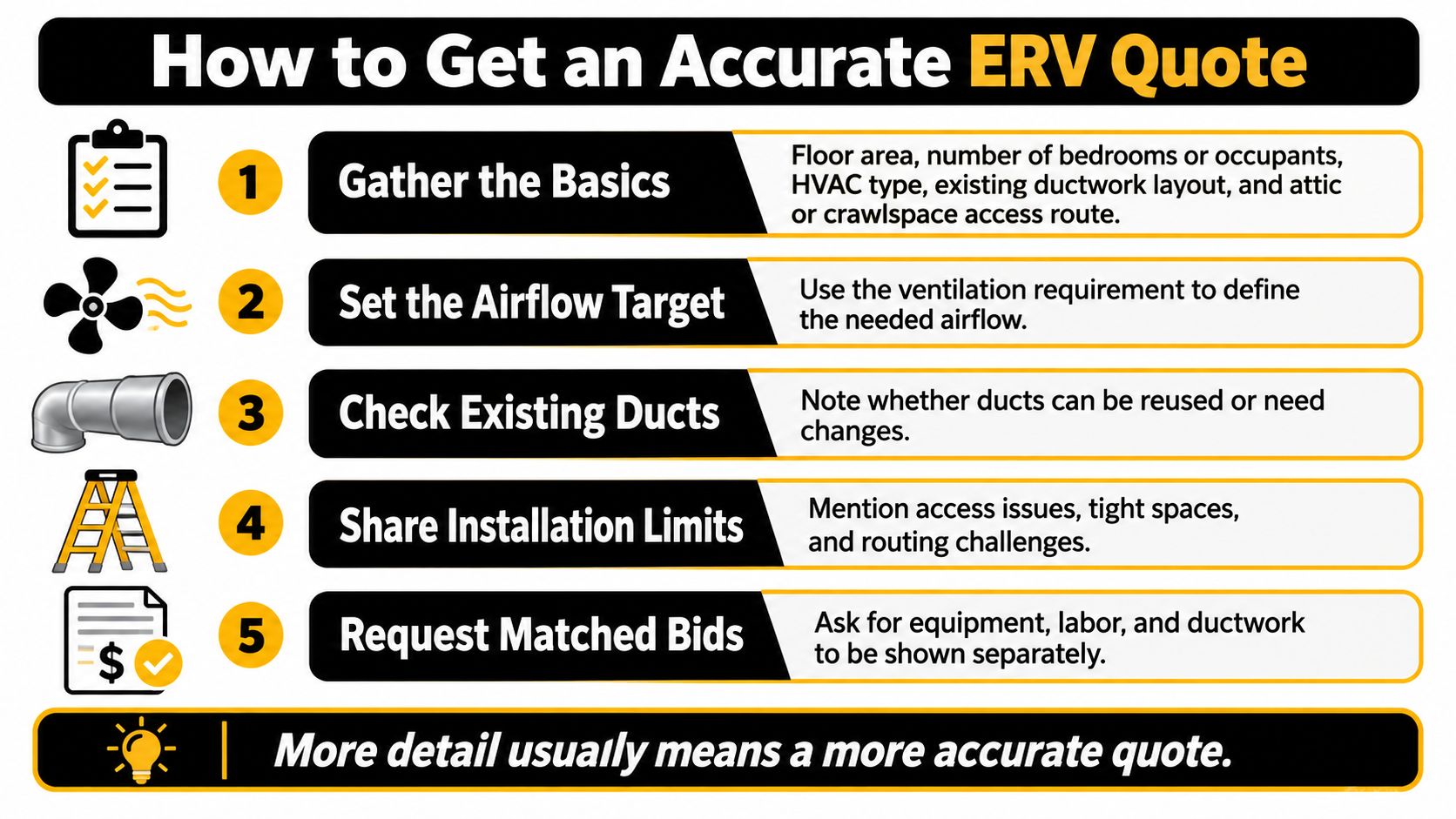
Build a comparable bid package
Gather the building basics. Record floor area, bedrooms or occupants, HVAC type, and the existing duct layout. Include photographs of the proposed equipment location and attic or crawlspace access so the labor allowance reflects the actual route.
Set the airflow target. Have the ventilation designer establish the required outdoor-air delivery for the home or occupancy. Each quote should state supply and exhaust airflow rather than naming only a cabinet size.
Require a site check before a final commitment. Have the installer verify duct routes, available electrical service, exterior termination locations, and service clearance. A phone estimate can establish a budget, but concealed conditions need explicit exclusions or inspection.
Request separate cost lines. List the unit, controls, labor, ductwork, electrical connections, permits, commissioning, and warranty. Require any drywall repairs, painting, or roof work to be included or clearly excluded.
Confirm performance in writing. Request sensible effectiveness, enthalpy recovery performance, and fan power at the selected operating condition. Reject a proposal that substitutes a single marketing efficiency percentage for an equipment schedule.
Assign permit responsibility. State who obtains permits, pays fees, schedules inspections, and resolves corrections. Our building code compliance guide explains why compliance belongs in the project scope rather than an afterthought.
Get the operating and maintenance details. Ask for filter part numbers, core-cleaning instructions, service access requirements, and the control sequence. The handover should also identify who verifies and records final supply and exhaust airflow.
Reject an unexplained lump sum. A final quote without airflow, equipment identification, and installation boundaries isn't ready for approval. Request clarification before discussing discounts.
Compare the exclusions as carefully as the total
Get three itemized bids for the same scope. Put them side by side and mark missing work before deciding which number is lowest.
Quote check: Ask each bidder to state what would trigger a change order. Access problems and electrical upgrades shouldn't remain invisible until installation day.
We provide free quotes for residential and commercial services, over the phone or through a free walk-through at a commercial space. For an ERV installation proposal, use a qualified ventilation installer's equipment selection and site assessment rather than treating a cleaning or air-purification quote as an installation design.
Decide Whether an ERV Fits Your Budget
Buy an ERV when you need dependable mechanical ventilation and the complete ownership cost fits your budget. A tight home, steady occupancy, and a meaningful outdoor-air conditioning load support the case. None replaces a proper airflow design.
Choose a simpler compliant ventilation option when usage is limited and the ERV's additional recovery benefit doesn't justify its installed and operating costs. Don't buy premium equipment merely because it carries a better headline efficiency rating.
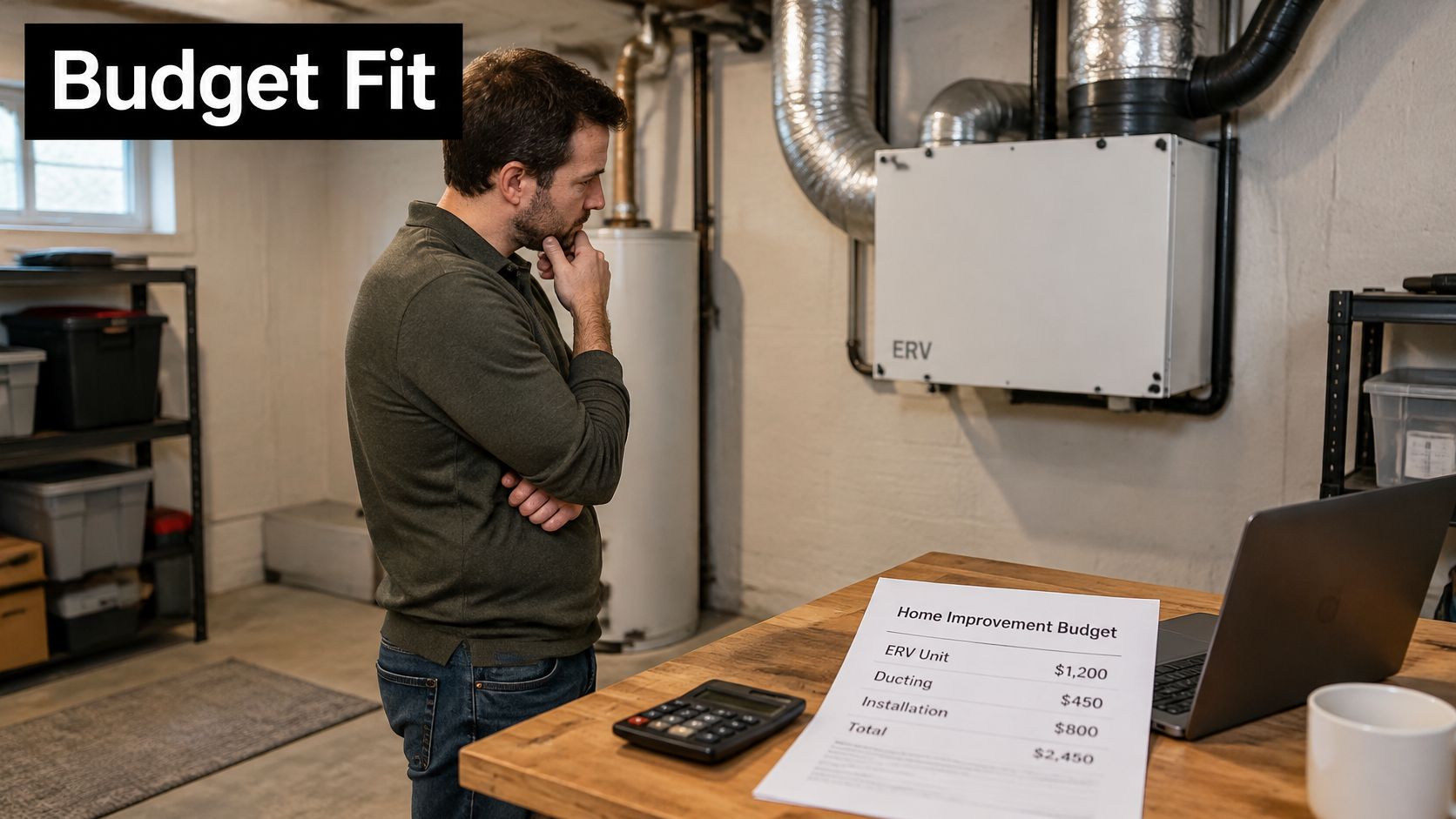
Make the decision around your project
For a new build or major renovation, make the ventilation decision before the mechanical layout is finalized. For an occupied home, prioritize a practical duct route and accessible equipment over squeezing a preferred model into an unsuitable location.
Set your working budget near the upper end of the project category that matches your scope. Keep unresolved access, electrical, and permit items visible rather than assuming the lowest published total includes them.
Use these decision criteria:
Proceed with the ERV: The design meets the ventilation need, the proposal includes startup and balancing, and the ownership budget remains comfortable.
Request an alternative: The return depends on unrealistic operating hours, unearned cooling-equipment credits, or ignored maintenance.
Pause the purchase: The contractor can't explain airflow, duct routing, service access, or what the quoted price excludes.
This week, select the two closest project scopes from the cost table, write down your required airflow and installation boundaries, and send the same package to three installers. Compare complete lifecycle costs, then choose the contractor who documents the work clearly, not the one who advertises the cheapest box.
For help with the duct cleanliness and indoor-air-quality side of your plan, call 602-694-2964 to request a free quote. Keep that service scope separate from the ERV installation bid so you know exactly what you're buying.
We offer residential and commercial air duct cleaning, HVAC coil cleaning, and air-purification solutions that can complement a properly designed ventilation plan. Visit Purified Air Duct Cleaning to request a free quote and discuss which indoor-air-quality services belong in your project budget.