

Dust Mites in Air Ducts: Real Risk and Fixes
The most popular advice treats dust on a supply register as proof that mites have infested the ducts, and that a cleaning will end the allergies. That reading is too simple. A light film of dust on metal duct walls is normal, and much of it sticks to the surface instead of entering the room.
The allergic material is mite bodies and feces mixed into household dust. Bedding, carpets, upholstery, and floors hold most of it. Filters decide how much of that dust the blower picks up, and humidity decides whether mites can keep producing allergen at all. Cleaning is a later step, and only after those two are under control.
Where Dust Mites Hide and How Much Ducts Matter
Finding allergen inside a duct and finding a colony living there are two different measurements, and the first does not imply the second. Dust mites in air ducts usually show up as debris in settled dust that the system moved, while the colony itself lives elsewhere. The EPA Inside Story guide calls house dust mites a source of one of the most powerful biological allergens found indoors, and describes them as organisms that grow in damp, warm places. The trigger is allergenic material from bodies and feces mixed into household dust. That material settles on returns, filters, registers and nearby insulation, and the blower can lift it at startup. Visible dust is evidence of transport.
Most of the allergen load sits outside the duct system, in bedding, carpet and upholstery where skin cells accumulate and conditions stay favorable. Households replacing flooring can treat carpet buying advice for Cumming homeowners as a practical screen for fibers that hold less settled dust, a choice that shrinks the reservoir feeding the return side of the system.
What the sample counts actually show
A 2022 study in Anhui, China, collected 189 dust samples from households, schools, and hotels, and the Springer Environmental Science and Pollution Research paper reports mites in 34.67% of air-conditioner filter samples against 20.18% of floor samples. Positive filter samples averaged 2.04 mites per gram, with a maximum of 10 mites per gram. A filter only reports what the air carried through it, so a positive filter shows the system intercepted mites and says nothing by itself about whether the duct wall hosted them.
Exposure is common even where ducts look ordinary. In the 1988 Baltimore study of 106 homes of allergy-clinic patients, dust-mite antigen appeared in 99% of homes, with a median of 1,123 nanograms per gram, as reported in the American Review of Respiratory Disease abstract. Reviews of ventilation-duct cleaning in that literature found little mite-allergen accumulation on interior duct surfaces, while filters can sharply cut the allergen that reaches supply air. The EPA duct-cleaning guidance adds that duct cleaning has not been shown to prevent health problems, and that wet fiberglass duct insulation generally cannot be cleaned effectively and should be replaced.
Reservoir | What the evidence shows | Duct relevance |
|---|---|---|
Bedding and mattresses | Primary reservoir in most homes, where mite allergen settles | Low, washing and encasements matter more |
Carpets and upholstery | Settled dust holds mite allergen, found in 99% of homes in the Baltimore study | Low to moderate |
Floor dust | Breeding mites found in 20.18% of floor samples in the Anhui study | Moderate, dust drifts from floors toward returns |
HVAC filters | Breeding mites found in 34.67% of filter samples in the Anhui study | High, filters collect dust that enters the system |
Duct interior surfaces | Reviews report little mite-allergen accumulation | Low when dry, higher when moisture is present |
Wet fiberglass duct liner | EPA: generally cannot be cleaned effectively and should be replaced | High whenever moisture is present |
The order of operations follows the evidence: dominant reservoir first, then the pathway moving it. Bedding and floors, then filters, and wet liner handled as a replacement job. A dust mite allergy plan that skips those reservoirs keeps treating the wrong surface.
Humidity Targets That Keep Dust Mites Alive
A comfortable daily average can hide the hours that matter. Mites don't need a damp house all day. They need repeated spikes, and a thermostat display never shows them.
A CDC-hosted clinical guidance document states that indoor relative humidity needs to exceed 50% for only about one hour per day for mites to survive, while about two to three hours per day above 50% is needed for reproduction. The same guidance recommends household humidity of 35% to 50% to reduce mite growth, and cautions that humidity below 25% may irritate the respiratory tract. Condensation on a cooling cycle, or a humidifier left running, can produce those hours even when the afternoon reading looks fine.
Thresholds you can check on a hygrometer
EPA health guidance for clinicians recommends keeping indoor relative humidity below 50%, and below 45% for people allergic to mites. Field research points in the same direction: very high humidity at floor level, where mites live, is associated with higher mite allergen, while drier floor zones show little or none. Floor readings run well above what the hallway hygrometer reports. The lower allergy goal, not the floor reading, is the number to manage.
Threshold | Source | What it means |
|---|---|---|
Between 30% and 50% relative humidity | EPA general guidance | Recommended range for homes |
Below 45% relative humidity | EPA guidance for dust-mite allergy | Better target for allergy sufferers |
35% to 50% relative humidity | CDC-hosted clinical guidance | Range recommended to reduce mite growth |
Above 50% for about 1 hour per day | CDC-hosted clinical guidance | Enough for mites to survive |
Above 50% for 2 to 3 hours per day | CDC-hosted clinical guidance | Time needed for mites to reproduce |
Below 25% relative humidity | CDC-hosted clinical guidance | Can irritate the respiratory tract |
Very high floor-level humidity | 2025 New Zealand field study | Associated with higher mite allergen |
Where the duct adds water the room average misses
Coils sweat during air-conditioning cycles. Clogged drain pans, leaky returns, overcooling, and wet fiberglass duct board hold that moisture after the room has dried. Contamination can return quickly unless the underlying humidity is reduced, and wet fiberglass duct board can support dust mites, mold, and microbial growth.
Dry outdoor air does not guarantee dry ducts. In hot climates, evaporative cooling, condensate that never leaves the pan, and supply air that overcools a closed room can keep a local pocket above 50% for the one to three hours mites use. Log those spots, not just the hallway thermostat. A practical sequence for indoor humidity control is hygrometer first, coil and drain-pan check second, and cleaning only after the moisture source is named.
This is the distinction most advice misses. A hygrometer controls whether mites keep breeding. Cleaning only shifts dust that has already settled.
Practical rule: Treat humidity control as the first fix and duct cleaning as the second step. Drying the air is what stops new allergen from being produced. Vacuuming only removes what is already loose.
Clean Ducts Step by Step and Avoid Common Failures
Cleaning helps when debris is heavy and moisture is already fixed. It does not, by itself, make a home mite-free. The EPA introduction for health professionals recommends home relative humidity between 30% and 50%, and below 45% for people with dust-mite allergies, because warm, damp air encourages mite populations and drier air makes mites desiccate. Measure with a hygrometer. A room that feels fine can still be wet next to a coil, a humidifier, or lined duct.
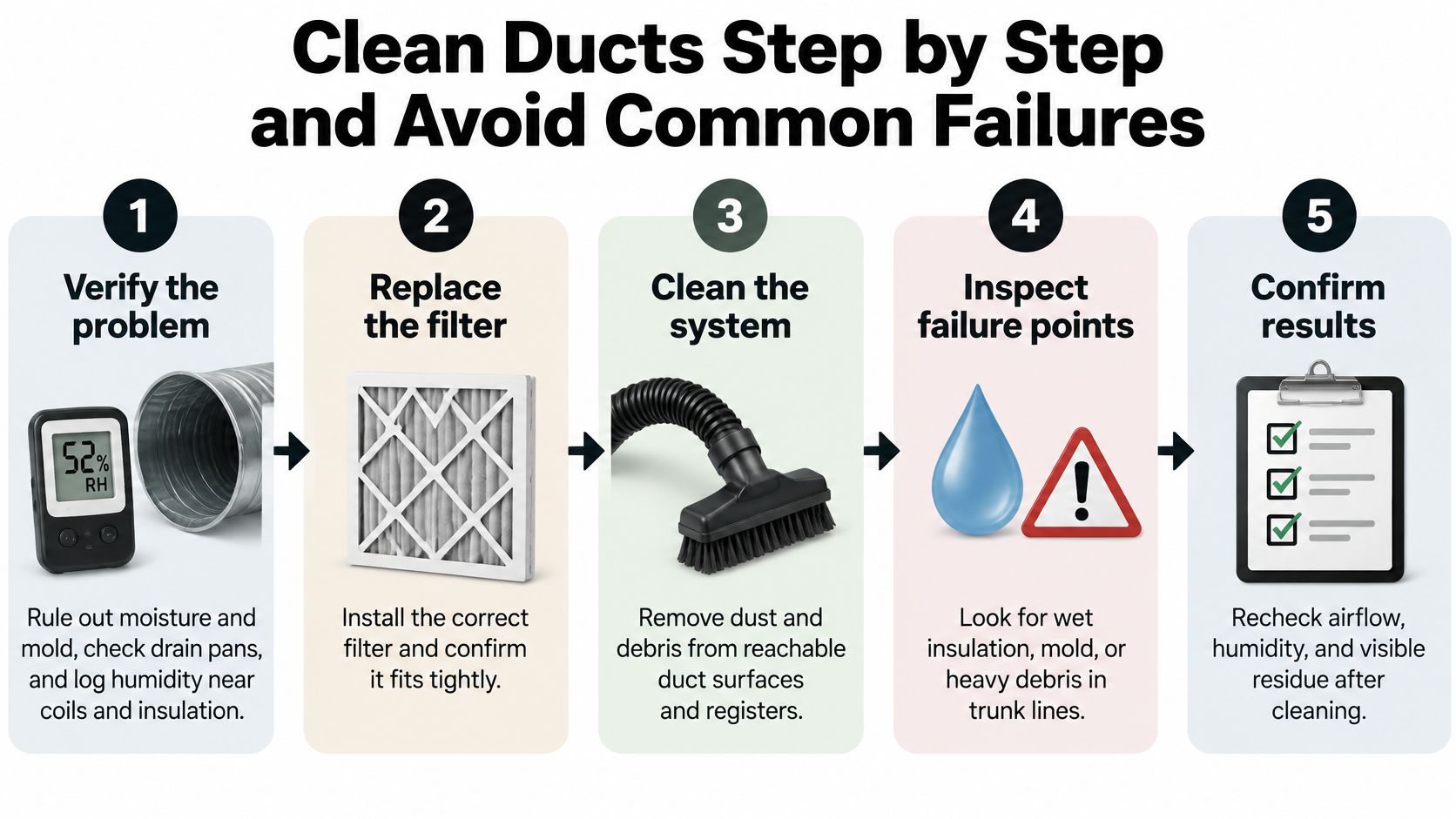
A sequence that captures dust instead of spreading it
Verify the problem. Rule out standing water and visible mold before any brush goes in. Check the drain pan, the coil face, and insulation. Log humidity beside the coil and at the liner, because those readings often differ from the living room. Skipping this step is why cleaned systems smell musty a week later.
Replace the loaded filter and protect the rooms. Put the new filter in before agitation starts, and confirm it seats tight. Cover nearby furnishings with plastic sheeting. A clogged filter during cleaning just becomes another dust source.
Pull debris out under negative pressure. A portable HEPA-filtered collection machine should hold the duct under suction so loosened dust goes into the bag. We remove grills and dirty filters and run that machine through the system, with a plastic tarp at the work area so anything that drops is vacuumed into a HEPA bag. Household vacuums don't hold that seal.
Agitate only what the duct can tolerate. The EPA appendix on duct cleaning notes that high-velocity cleaning above 6,000 cfm should include gentle, controlled brushing or another method to dislodge particles. Metal you can reach is fair game. Fiberglass-lined ducts should not be scrubbed. A snake rotor brush on bare metal, followed by vacuuming from end to end, is the usual combination on sound duct.
Inspect coils, plenums, registers, and insulation. Replace wet fiberglass liner. Cleaning it leaves the moisture and the food source in place. Coil cleaning belongs in the same visit when the coil face is matted, because a dirty coil is where condensate lingers.
Close the moisture paths. Seal obvious leaks, clear the drain, and set the humidity target before you call the job finished. Bedding is still a principal reservoir, so wash sheets weekly in hot water and use mattress encasements. Duct work that ignores the bed puts the allergen back into the return within days.
Failures that make the air worse
Cleaning only the visible registers leaves trunk and return lines full. Skipping the filter change, or skipping the humidity fix, guarantees a fast reload. Biocides and ozone irritate airways and do nothing about water. The Florida International University evaluation in that EPA appendix measured about an 85% drop in bioaerosols two days after air-sweep and mechanical brushing, then levels moved back near the starting point within one to three months. An NIH summary in the same appendix reports that indoor-air effects after cleaning are highly variable, and that post-cleaning contaminant levels sometimes exceed the levels measured before.
A finished job has a short checklist: debris removed from the surfaces in scope, a new filter installed and dated, humidity logged at the coil and in the bedroom, a monthly filter check on the calendar, a quarterly humidity log, and no new cleaning booked until someone re-inspects. Our residential air duct cleaning write-up walks through that order for a typical house. Most homes take about 2 to 3 hours, depending on size.
Filters, Cleaning and Air Purifiers Compared
No single option removes dust mite allergen from a home. The useful question is which layer solves which problem: particles in the airstream, debris on a surface, or the moisture that keeps mites alive.

A loaded filter is the first place return air dumps what it picked up from floors and bedding. Replacing it catches larger airborne particles, including some mite allergen, on the next cycle. It cannot lift allergen that has already settled on a mattress or a carpet. Negative-pressure cleaning is for loose debris and visible buildup, and the benefit can fade if humidity stays high. Brushing belongs on accessible, sound metal. It can tear fiberglass liner, so lined duct is a replacement decision, not a scrub.
Option | What it removes | Limit | Best use |
|---|---|---|---|
Filter replacement | Larger airborne particles, including some mite allergen | Cannot remove settled allergen from indoor surfaces | Routine, whenever a filter is loaded |
Negative-pressure duct cleaning | Loosened debris captured in a HEPA-filtered collection bag | Does not guarantee mite-free ducts; benefit may fade | Heavy debris or visible buildup |
Mechanical brushing | Particles dislodged from accessible metal duct surfaces | Can damage fiberglass-lined ducts | Accessible, sound metal ducts |
In-duct air scrubber | Particles and allergens passing through the unit | Does not treat moisture or settled dust | Continuous treatment after cleaning |
Portable HEPA purifier | Airborne particles in one room | Does not treat duct surfaces | Bedroom for an allergy sufferer |
Dehumidifier | Moisture that keeps mites alive | No effect on dust already present | Humidity that stays above 50% |
Where each option stops
An in-duct air scrubber, including an ActivePure unit mounted in the duct or a plug-and-play unit in a room, treats air moving through that device. Ask for tested performance on the model you are buying, and don't treat it as a humidity fix. A portable HEPA purifier helps the bedroom, where allergy sufferers spend the most hours, and it does nothing to duct surfaces. A dehumidifier addresses moisture and leaves existing dust where it is.
For a typical allergic household, rank the work this way: filter replacement and humidity control first, cleaning if inspection shows heavy buildup, and purification as an added layer rather than a substitute. Choosing the best HVAC filter for allergies is the step you can finish this week without opening a single trunk line.
The short video below shows how return air, the filter, and supply registers sit in one loop, which is why a bedroom purifier and a duct filter are not interchangeable.
Decide Whether a Professional Duct Service Is Worth It
Run the cheap checks first: a fresh filter, seven days of hygrometer readings at the return and in the bedroom, and a look at accessible registers. Book a qualified company when inspection shows wet insulation, mold, or heavy debris in trunk lines, or when someone with asthma still reacts after humidity and filtration are already controlled. Visible dust at a register is weak evidence by itself; settled allergen can ride household dust without a live mite population inside the duct.
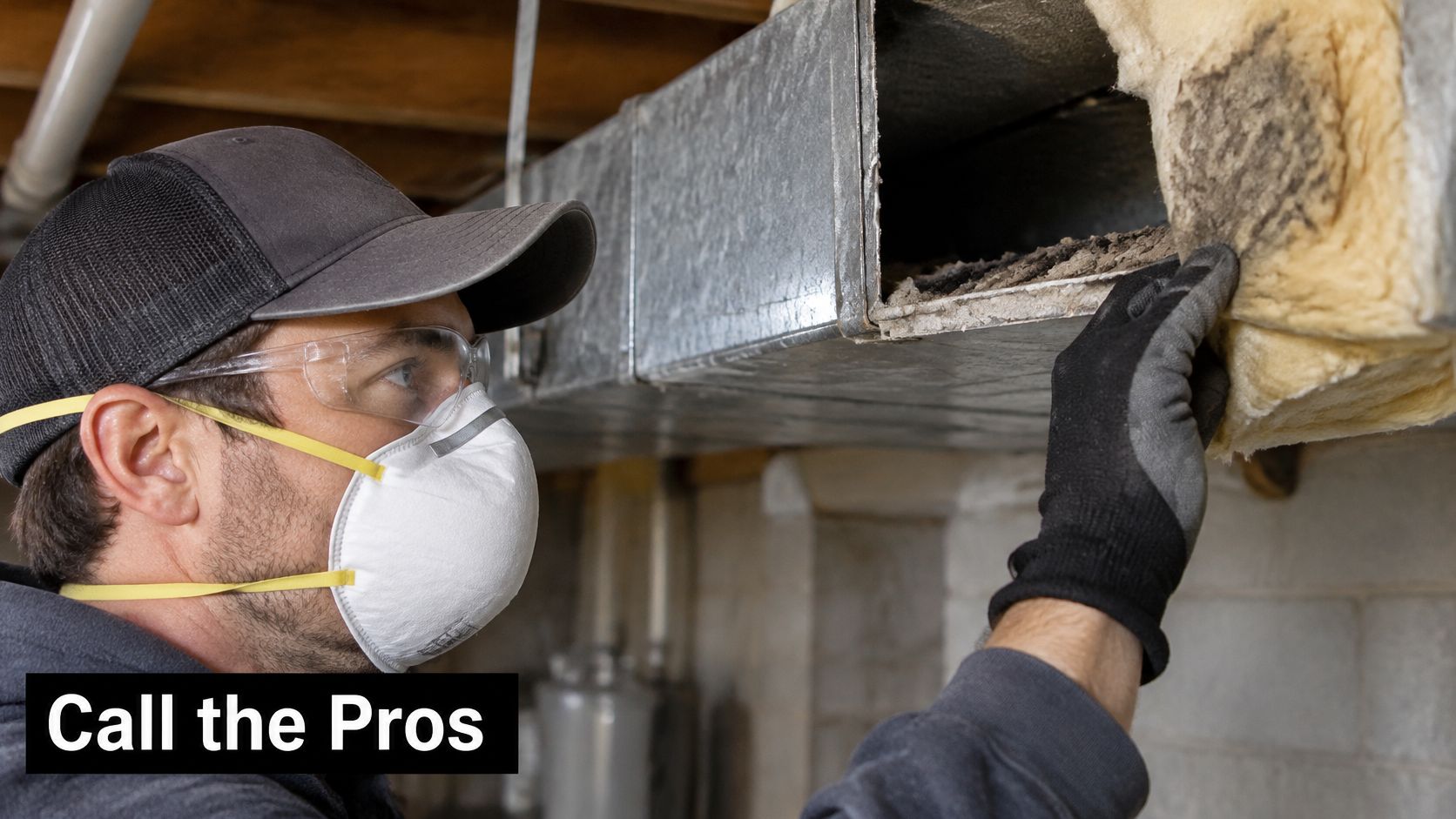
Ducts are generally cleaned every 3 to 5 years, depending on duct age and condition, the type of heating and cooling system, and any allergies or respiratory problems in the home. A sudden dust discharge can justify an earlier visit. Dust release, allergic reactions, and mold growth are uncommon when the work is done properly; a provider who skips moisture checks is a warning sign. Compare quotes against scope: inspection before cleaning, filter and humidity causes addressed, fiberglass liner replaced rather than scrubbed, and no biocide or ozone promises. Use these NADCA duct cleaning standards as a yardstick for access, source removal, and protection of occupied rooms.
On site, expect containment before agitation: a plastic tarp around the service area, dropped debris vacuumed into a HEPA bag, a snake rotor brush on interior duct surfaces, and an end-to-end vacuum of the ductwork. A typical visit runs about 2 to 3 hours depending on home size.
Purified Air Duct Cleaning removes dust, allergens, and debris from residential and commercial ductwork, coils, and dryer vents for homes across the Phoenix area, including Avondale, Glendale, and Mesa. If your humidity log and filter check point to heavy buildup or wet liner rather than a simple filter change, that is the job we scope before any brush goes in. Visit Purified Air Duct Cleaning to request a quote and a clear plan for your system.