

What Is an Energy Recovery Ventilator and How It Works
An energy recovery ventilator is a balanced ventilation unit that exchanges stale indoor air for outdoor air while transferring heat and moisture between the two airstreams. A good unit recovers more than 80% of the temperature difference in cold weather, with the best systems above 90%, and clears better than 50% total recovery, heat plus moisture, during cooling conditions.
You shut the windows weeks ago because the air outside is miserable and the air conditioner or furnace is already working hard. Then the back bedroom starts smelling stale by morning, someone wakes up congested, and you start weighing fresh air against the utility bill.
That trade-off is exactly what an ERV was built to soften. It doesn't make outdoor air free. It makes outdoor air cheaper to bring inside, and it does that with a surprisingly simple piece of hardware.
What an Energy Recovery Ventilator Is
An energy recovery ventilator, or ERV, is a balanced mechanical ventilation unit. It pushes stale indoor air outside and pulls fresh outdoor air in at the same time, and it routes both airstreams through a core that hands heat and moisture from the outgoing stream to the incoming one. The two airstreams pass within inches of each other and never mix.
This is what the hardware looks like when you open the cabinet.
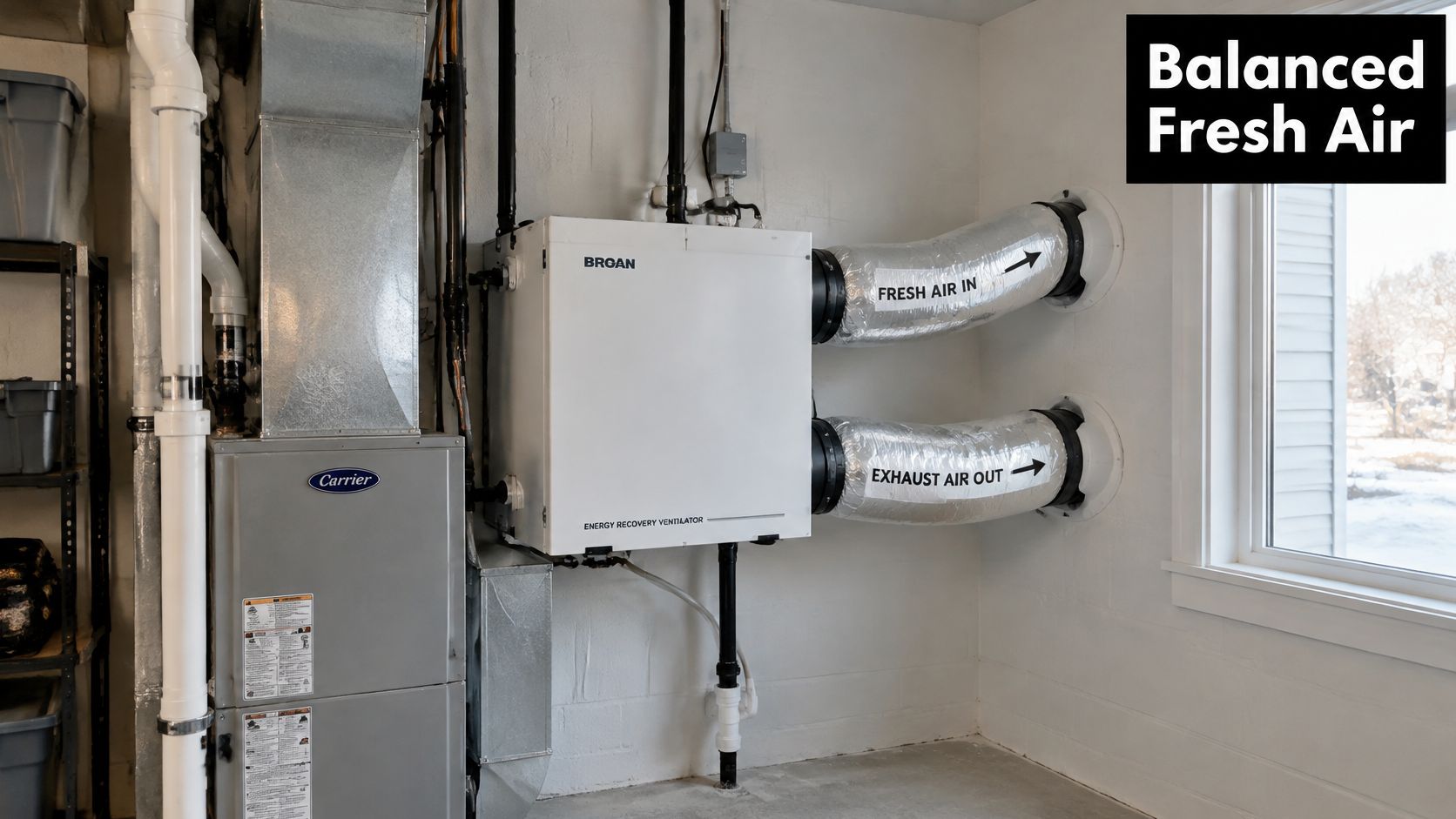
Think of two lanes of traffic running side by side through one shared tunnel. The outgoing lane is carrying warmed, moisturized air you already paid for. The incoming lane is carrying raw outdoor air. Through the wall between them, the leaving lane hands over its warmth and its humidity without a single passenger changing lanes.
Now the problem it solves. A sealed house still has to replace stale air, and every cubic foot of replacement air arrives at whatever temperature and humidity the weather decided on. Your furnace or air conditioner then has to correct all of it. The U.S. Department of Energy describes ERVs as a way to avoid wasting conditioned air that would otherwise be exhausted straight outdoors, forcing the HVAC equipment to reheat or recool the replacement. In winter, heat moves from the warmer exhaust into the colder incoming air. In summer, the cooler exhaust pulls temperature out of the incoming stream before that air ever reaches the occupied space.
On a 95°F afternoon with the house sitting at 75°F, the exhaust air is the cooler of the two streams, so the incoming air leaves the core already below outdoor temperature. The cooling coil handles the gap that's left, not the whole gap.
Inside the cabinet you'll find two fans, the core, and a filter on each side. That's the entire machine. Restate the definition in your own words and you'll land on something like this: it's an air-to-air exchanger that moves fresh air in, stale air out, and keeps most of the energy on site. It is not a purifier. It moves air and it conditions air, and the filters on the unit protect the core rather than cleaning the room.
How an ERV Moves Heat and Moisture Across Seasons
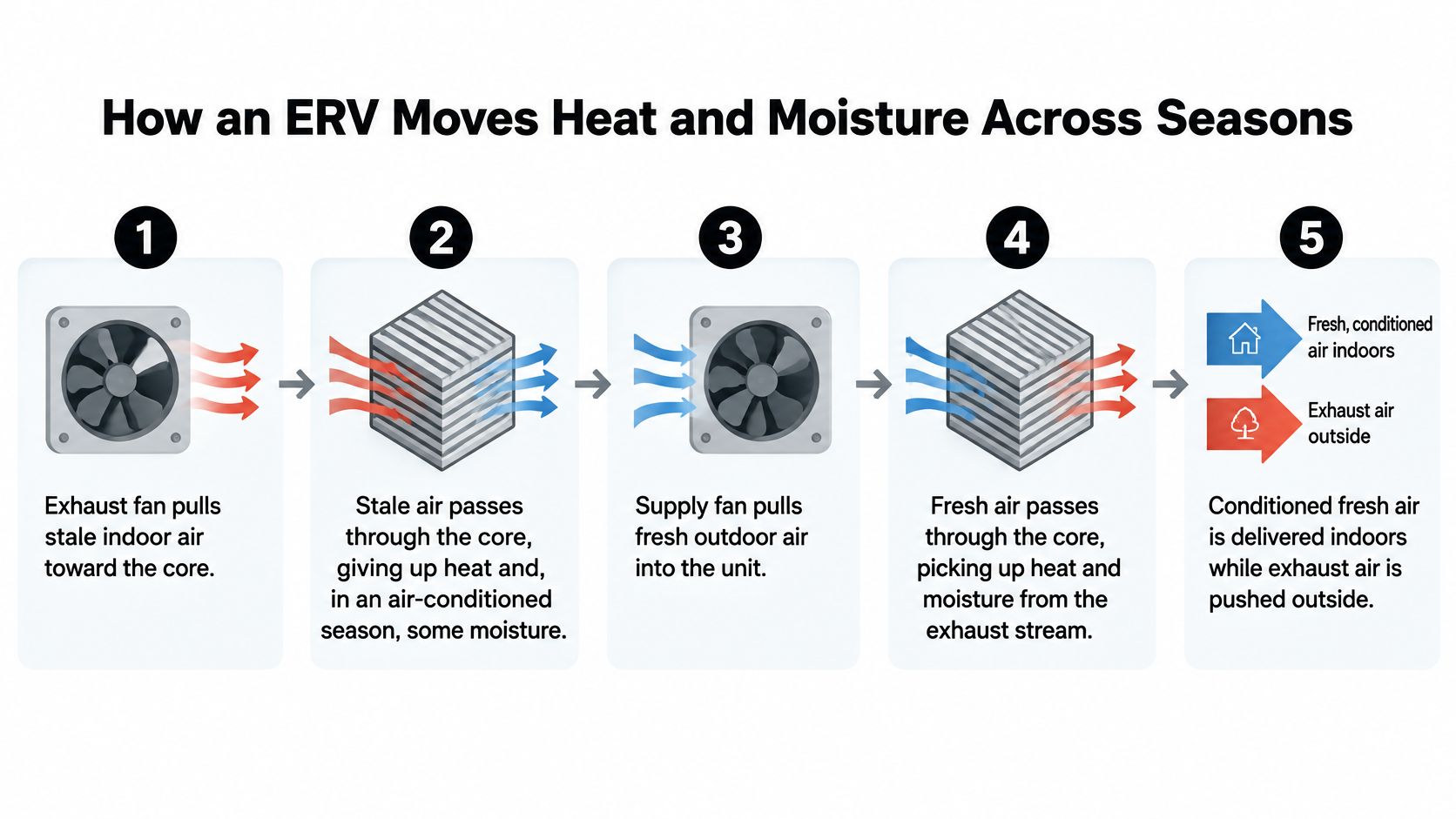
Trace the airflow through a running unit and the whole design clicks into place.
The exhaust fan pulls stale indoor air toward the core. This is air from bathrooms, kitchens, bedrooms, wherever the return grilles sit.
That stale air passes through one side of the core and gives up heat and, in an ERV, part of its moisture to the other stream.
The supply fan draws fresh outdoor air through the opposite side of the same core. The two paths stay physically separate the whole time.
The incoming air leaves the core already warmed or cooled, so it reaches the supply grille closer to room conditions than the weather outside.
The heating or cooling equipment handles only the remaining gap. That's where the energy savings come from.
Two terms explain the transfer. Sensible heat is the energy that changes a temperature reading. Latent heat is the energy tied up in moisture, the difference between dry air and humid air at the same temperature.
Season | Incoming outdoor air | What the exhaust air does | Effect on HVAC load |
|---|---|---|---|
Winter heating season | Cold and dry | Warms incoming air and returns some indoor moisture | Less heating needed for ventilation air |
Summer cooling season | Hot and humid | Cools and partly dehumidifies incoming air | Less cooling needed for ventilation air |
Mild shoulder seasons | Moderate temperature | Small temperature difference, so little recovery | Small savings; fans still ventilate |
Practical check: hold your hand at a supply grille on a cold morning. The air should feel noticeably closer to room temperature than the outdoor air does. If it feels like the outdoors, the core is bypassing, the balance is off, or the unit isn't running.
Moisture handling is where homeowners get surprised. In a humid summer, the ERV is drying the incoming air with the help of your drier indoor air, and that's a real benefit in monsoon season. If your house already runs humid from cooking, showers and laundry, indoor humidity control covers the daily habits and equipment that keep the number in range.
ERV, HRV and Exhaust Fans Compared
One difference separates the two recovery devices, and it decides which one belongs in your house. An ERV recovers sensible heat and latent moisture. An HRV, a heat recovery ventilator, recovers sensible heat only. The U.S. Department of Energy ventilation selection guide states that split plainly and adds the benchmarks worth remembering: apparent sensible effectiveness above 80% for cold-weather recovery, with the most efficient systems exceeding 90%, and total recovery efficiency above 50% as a target for ERVs during cooling conditions.
Ventilation type | Heat transfer | Moisture transfer | Best fit |
|---|---|---|---|
Energy recovery ventilator (ERV) | Sensible and latent | Yes, through a vapor-permeable membrane | Humid or mixed climates and tight homes that need humidity moderated year round |
Heat recovery ventilator (HRV) | Sensible only | No | Cold climates where winter dryness is the main concern |
Exhaust fan only | None | None | Simple spot ventilation with no recovery and higher conditioning cost |
Read the rows as verdicts. Exhaust fan only is the baseline: a bathroom fan removes air without recovering a thing, so every cubic foot it dumps outside gets replaced by air your equipment must condition from scratch. HRV makes sense where winters are long and dry and the indoor air is already too dry, because it brings heat back without dragging moisture with it. ERV earns its price in humid or mixed climates and in tight homes where the indoor humidity swings too high in summer and too low in January.
Beyond the label, weigh these: local climate, how much outdoor air the space requires, the pressure drop through the core, the controls, and how easily you can reach the filters. Choosing by product name alone is the most common mistake in this category, because two units with similar ratings can behave very differently at your airflow.
In labs and other high-exhaust buildings the same logic runs at a much larger scale, where makeup air and exhaust have to be balanced precisely. See Labs USA's lab ventilation systems for how that balance is engineered. For a house, the sequence is simpler, and the indoor air quality ventilation basics still apply.
Why Homes and Buildings Install an ERV
Every building faces the same trade. Outdoor air dilutes the pollutants that build up indoors, and every cubic foot of it has to be heated or cooled to room temperature first. An ERV exists to make that trade cheaper.
The unit works like a runner passing a baton. Before the stale indoor air leaves the building, it hands most of its heat, and part of its moisture, to the fresh air coming in. The exchange runs continuously, so outdoor air arrives without carrying the full conditioning bill.
Airtight construction is what pushed this machine into homes. Older houses leaked enough that the envelope did some ventilating on its own, badly and unpredictably. Newer houses do not leak, so the fresh air has to be delivered on purpose, by a machine. A household that runs the bath fan after every shower and cracks windows in January to clear cooking smells is paying full price for ventilation either way. The ERV does the same job while keeping most of that heat inside.
The case for installing one usually rests on four points:
Lower ventilation load: the exhaust stream does part of the conditioning, so the furnace or air conditioner starts closer to the setpoint.
Steady fresh air: no open windows, no weather dependence, no forgetting.
Moderated humidity: indoor moisture is conserved through winter and partly stripped from incoming air in summer.
Predictable rates: airflow stays constant across seasons, which makes design and commissioning possible.
The U.S. Environmental Protection Agency lists energy-efficient heat-recovery ventilators, also called air-to-air heat exchangers, among the approaches for bringing outdoor air indoors while limiting the heating and cooling penalty.
An ERV changes what ventilation costs. It does not change what ventilation is for.
Three cautions keep the promise honest. An ERV moves and conditions air; it does not purify it. A headline efficiency figure is a lab number, and what a household saves depends on the local climate, the airflow balance between the two fans and the electricity those fans draw. And it cannot fix moisture problems at the source. If mould is already present, the remedy is moisture control and removal of affected material, the same basic sequence a mould-prevention guide lays out, such as this one on preventing mould in Dublin bathrooms.
Because an ERV touches the air in every room, ventilation sits within a bigger picture. Understanding what indoor air quality actually includes helps place an ERV alongside filtration, source control and maintenance rather than ahead of them.
Where an ERV Fits and Where It Falls Short
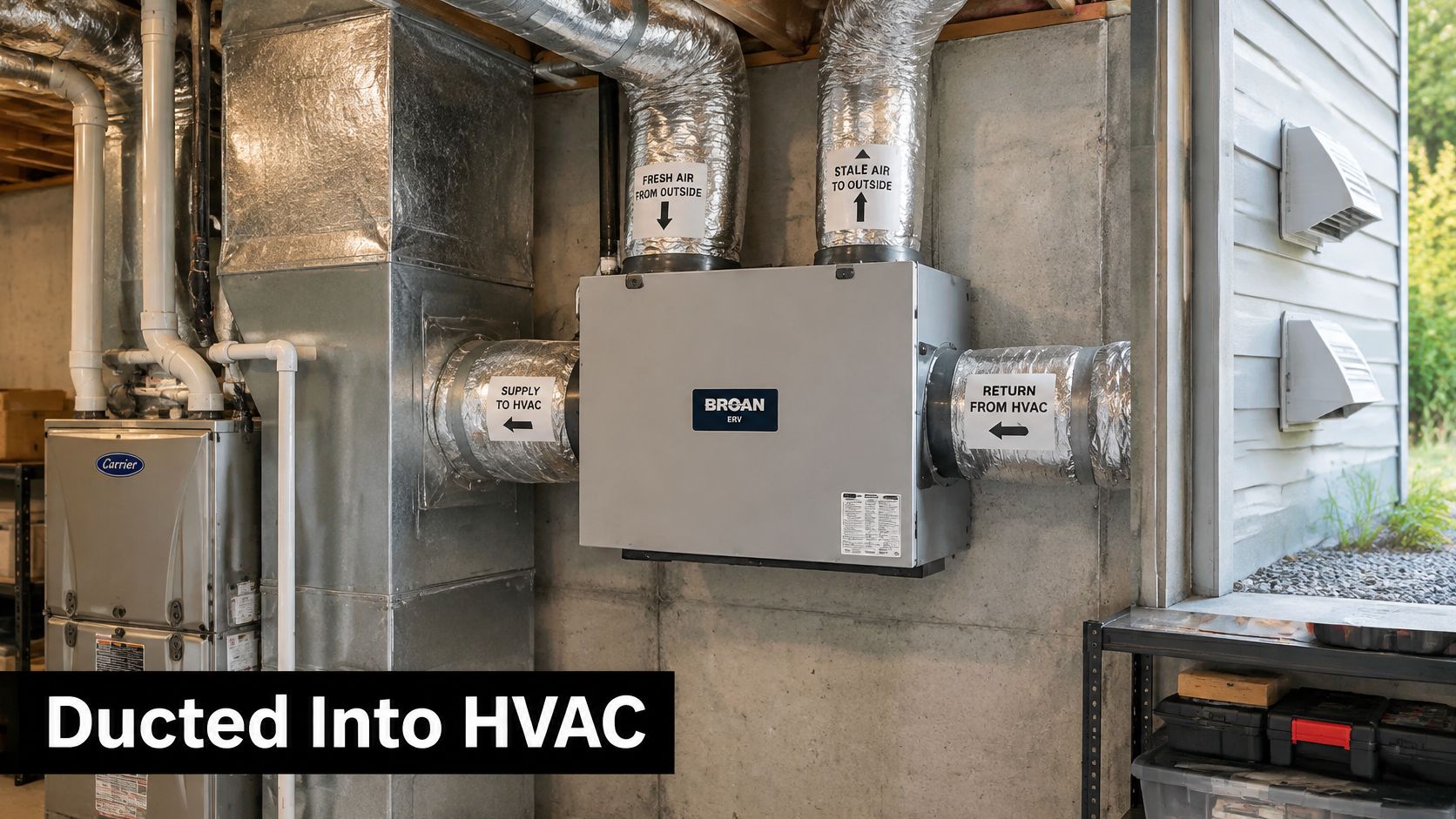
An ERV is ducted into the home's HVAC system. Outdoor air comes in through an exterior hood, stale air leaves through a second hood, and the unit itself usually sits near the air handler or in a utility space, attic or basement.
A family in a newly built, tightly sealed house is the textbook good fit. The windows stay closed for months, the bedrooms feel flat by evening, and the ventilation rate is a design number rather than a hope. An ERV supplies steady fresh air with a much smaller heating and cooling penalty than open windows or a bare exhaust fan.
A dry-climate home focused on cooling cost is a murkier case. ENERGY STAR's ventilation program requirements adjust recovery efficiency for fan power, leakage, exhaust-air transfer and airflow imbalance, which tells you a tested core number isn't the same as delivered savings.
Dry climates show why. In a place like metropolitan Phoenix, an ERV can hand indoor moisture back to the incoming air during cooling season instead of helping the dehumidification load, so sensible recovery matters more than latent recovery and the fan's own electricity eats into whatever the core saves. The balancing logic scales up in larger buildings too, where commercial building ventilation lives or dies on matching supply and exhaust across every zone.
How much can a rating overstate the bill impact? A Department of Energy analysis of smart ventilation controls, run on a highly insulated European residential prototype using an efficient enthalpy recovery ventilator as the baseline, found heating savings of about 2% to 3% once recovery efficiency was accounted for, against cooling savings of 12% to 36%. Read a spec sheet the way you'd read a fuel-economy sticker: the number was earned under one set of conditions, and your house sets its own.
The limits worth knowing before you buy:
It moves and conditions air, but it doesn't purify it. Cooking smoke, pet dander and volatile gases pass through unless you add filtration built for that job, and the core filter isn't it.
A high rating isn't a bill reduction. Efficiency is measured at one set of conditions. Your savings depend on climate, runtime, airflow balance and how tight the house is.
A leaky old home may gain little. If the envelope already trades air freely, mechanical recovery reclaims energy the house was losing anyway.
Unbalanced airflow cancels the benefit. Supply and exhaust need to match, or the unit pressurizes or depressurizes the house and recovery drops.
The question to answer before shopping: does this home need mechanical ventilation at all? Everything else follows from that.
Reading ERV Ratings and Checking Fit Before You Buy
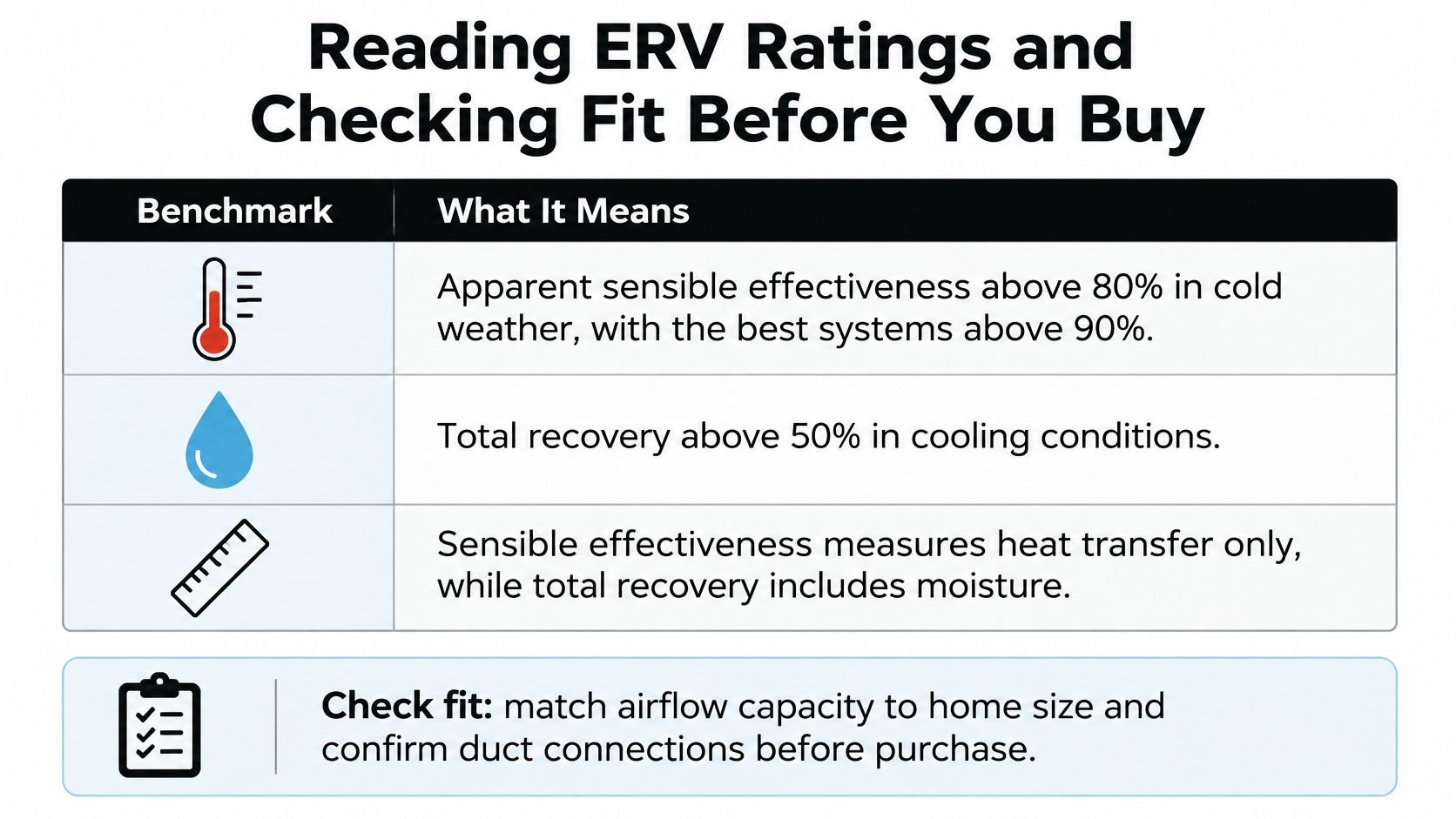
A rating is a measurement taken at one point, not a promise about your house. Two numbers do the work. Sensible recovery measures temperature transfer alone. Total recovery adds latent moisture transfer to the sensible figure.
Metric | Reference value | What it tells you |
|---|---|---|
Apparent sensible effectiveness (cold weather) | Above 80%; best systems above 90% | How much heat the unit recovers in winter |
Total recovery efficiency (cooling conditions) | Above 50% as a target | Heat and moisture recovered in summer |
Field-tested residential ERV (DOE study) | 57% sensible at 32°F supply; 38% total at 95°F supply | Ratings shift with test temperature and mode |
Why the same unit can post two very different numbers
A U.S. Department of Energy field validation study measured a residential ERV running at approximately 106 cubic feet per minute. It reported 57% sensible recovery efficiency and 38% total recovery efficiency, and it was careful about when each applied: the sensible figure came from heating-season conditions with a 32°F supply temperature, the total figure from cooling-season conditions with a 95°F supply temperature.
Both numbers are honest. They describe different seasons, different operating modes and different outdoor temperatures. That's why a spec sheet percentage on its own tells you almost nothing until you know the airflow and the test conditions behind it.
Rule of thumb: compare two ERVs only at similar airflow rates and similar pressure drops, then ask what each figure was measured at.
Six checks to run before you sign a quote
Confirm the ventilation need with numbers. A blower door test or a measured air exchange rate shows how much fresh air the house already gets. Tight house, real need. Drafty house, probably not.
Name the climate. Humid, mixed and dry climates weigh moisture recovery differently. Phoenix is a dry climate with a monsoon season, so ask how the unit behaves in both.
Request sensible and total recovery figures tested at the same airflow. If one number comes from a heating test and the other from a cooling test, say so and compare like with like.
Ask for fan power and measured supply and exhaust airflow. Fan energy offsets recovered heat, and a beautifully efficient core behind an inefficient blower saves less than the brochure implies.
Confirm frost control, summer bypass and condensate management. Cold-climate units need a frost strategy, and cooling-season bypass matters if you want free cooling on mild days.
Check the physical fit. Duct connections to the existing system, service clearance, and filter access you can reach on a step stool.
Gather those measured values before you request a quote, and the conversation changes from brand names to numbers. When we specify air purification systems, we assess each customer's specific needs and recommend the most suitable system for the home, then provide regular maintenance on what we install. An air purification system is a separate product from an ERV, so ask which unit meets your ventilation and humidity goals rather than assuming one box does both.
Purified Air Duct Cleaning handles the parts of a ventilation system that undo a good ERV, from clogged returns and dirty coils to ductwork that never delivered the airflow the unit was rated for. If your fresh-air strategy is sound but the house still smells stale, start with an assessment of the ducts, vents and coils feeding it. Visit Purified Air Duct Cleaning for a free quote across Avondale and the Phoenix metro.