

UV Air Purifier for HVAC: How It Works and What to Expect
A homeowner usually starts looking for a UV air purifier for HVAC after a familiar cycle: the filters are changed, the rooms are cleaned, and yet allergies, stale air, or a musty smell keep returning. A portable purifier may improve one bedroom or living area, but it doesn't treat air as it moves through the central heating and cooling system.
That doesn't mean UV is a magic solution. A properly selected system can add biological control and help protect components inside the air handler, but it doesn't replace mechanical filtration. The best results come from matching the technology to the problem, installing it in the right location, and maintaining it instead of treating it as a set-and-forget appliance.
Understanding the Problem Modern Homeowners Face
Consider a home where a family changes the HVAC filter regularly, vacuums often, and still notices irritation whenever the system starts. In another house, a musty odor appears near the supply registers after the air conditioner has been running. A portable purifier may make the bedroom more comfortable, but the odor and airborne contaminants can continue circulating through the central system.
That's why whole-home treatment attracts attention. An in-duct device works inside the air handler or duct path, allowing the HVAC system to move treated air through multiple rooms. It also reaches equipment that portable units don't touch, including the evaporator coil, drain pan, and nearby surfaces where moisture and organic debris can accumulate.
Why central treatment appeals to homeowners
Portable filtration and in-duct UV solve different problems. A portable unit can create strong air cleaning in a limited zone, while an HVAC-mounted device treats air only when the blower operates and depends heavily on lamp placement, exposure, and system design. Neither approach automatically removes every type of pollutant.
Before choosing a UV product, I look at the source of the complaint:
Dust, pollen, and pet dander: These require a properly sized mechanical filter.
Persistent moisture or biological buildup: The coil, drain pan, insulation, and ductwork need inspection.
Musty odors: The odor source needs to be identified rather than covered with fragrance or an air-cleaning claim.
Whole-home circulation: The HVAC system may provide broader distribution than a single portable unit, but only when the ductwork and air handler are functioning correctly.
Homeowners in humid regions may also benefit from professional inspection and duct cleaning for Florida homes when visible debris, construction residue, or suspected contamination exists inside the system. Cleaning doesn't make UV unnecessary, and UV doesn't make cleaning unnecessary. They address different conditions.
A useful overview of the broader factors behind comfort, ventilation, filtration, moisture, and contaminants is available in this guide to what indoor air quality means. Once the underlying issue is clear, UV becomes easier to evaluate as one layer in a complete plan rather than an answer chosen from a product label.
How Ultraviolet Germicidal Irradiation Works in HVAC Systems
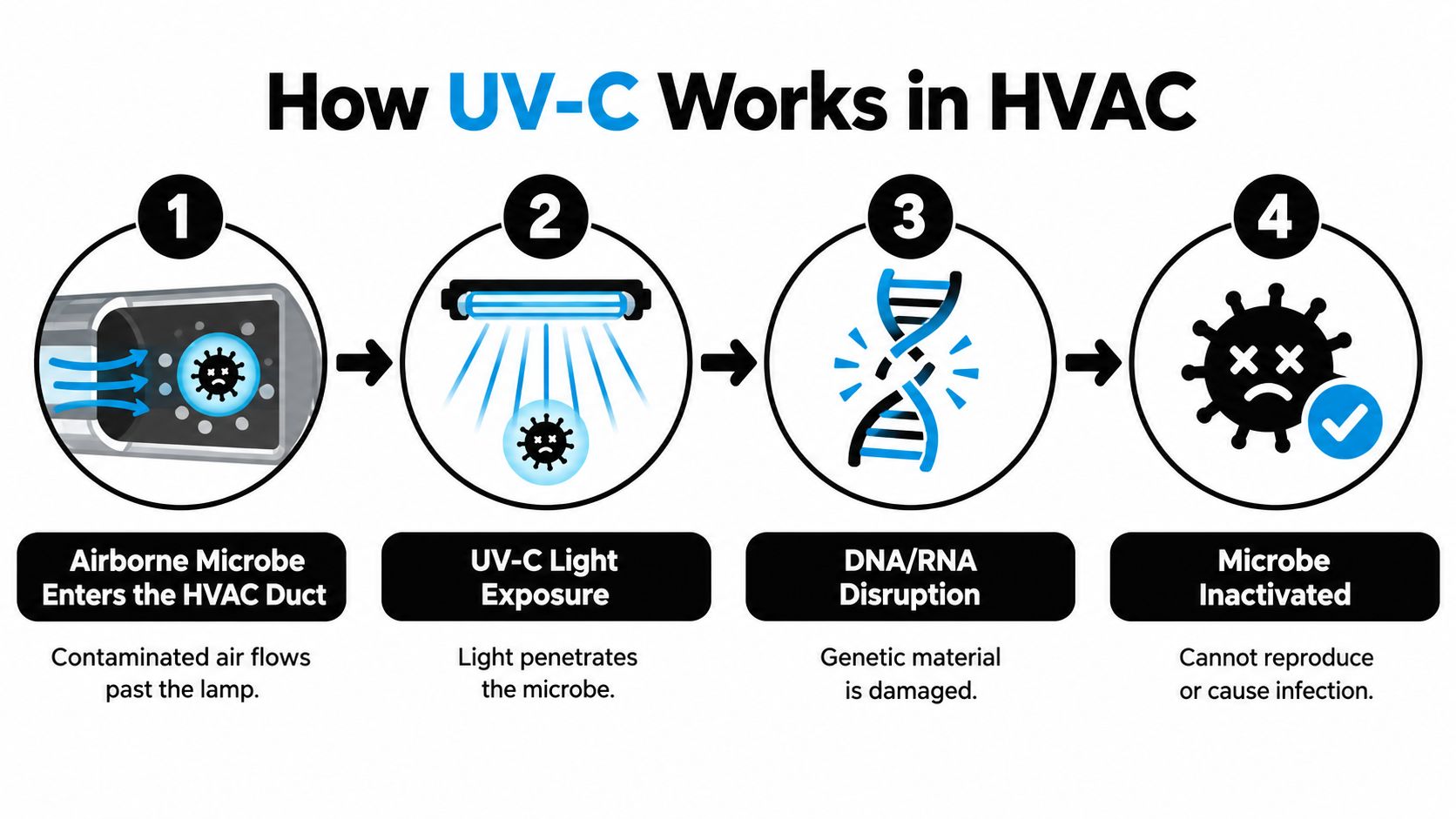
A ultraviolet germicidal irradiation system uses germicidal UV-C energy to damage the genetic material of microorganisms. The light disrupts DNA or RNA, preventing affected organisms from reproducing normally or remaining infectious.
In a residential HVAC system, technicians typically position lamps near the cooling coil, evaporator section, or another air-handler component. As air passes the lamp, microorganisms receive an exposure dose. Performance depends on air speed, distance, airflow pattern, humidity, surface condition, and exposure time. A lamp that is powered on but poorly positioned may deliver little useful treatment.
Where the lamp belongs
HVAC UVGI generally uses two arrangements:
In-duct or air-handler treatment: The lamp is installed inside the equipment or duct path, treating passing air and nearby surfaces.
Upper-room UVGI: Fixtures sit near the ceiling, with the design directing germicidal energy above the usual breathing zone.
Residential installations usually use the first arrangement. A coil-mounted lamp often targets damp surfaces where biological buildup can restrict heat transfer and contribute to maintenance problems. An air-path design places more emphasis on exposing microorganisms as air circulates.
UV should supplement filtration, not replace it. A mechanical filter captures particles, while UV affects microorganisms that pass through its exposure zone or remain on illuminated surfaces. The two devices address different parts of the indoor-air problem.
The familiar 254-nanometer UV-C specification describes conventional germicidal lamp design. It does not, by itself, establish that the system will perform well in a specific home. Poor placement, limited coverage, excessive airflow, or an obstructed surface can reduce exposure.
Practical rule: Judge the installation, not just the bulb. The contractor should identify the treatment area, exposure path, electrical connection, service access, and safety interlock or shielding method.
A systematic review of HVAC-related UV research identified 32 relevant studies published between 1936 and 2020 from 12,177 unique citations. The review reported that UV radiation inactivates viruses and bacteriophages, while dose, airflow pattern, air changes per hour, and device location affect results, as summarized in ASHRAE's UVGI training resource.
For a homeowner-focused explanation of whether an air purifier kills germs, the practical takeaway is simple: UV is an established treatment method, but its value depends on correct design and installation.
Efficacy Against Pathogens and Particulate Matter
A UV lamp and an air filter do different jobs. UV inactivates microorganisms, while a filter captures particles. Light can affect biological contaminants in moving air or on an illuminated surface, but it does not collect dust, smoke, pollen, or pet dander.
That distinction matters in homes with allergies. Fine dust and severe pet dander still require an appropriately sized mechanical filter, and the HVAC system must be able to handle the filter's resistance. Adding UV beside an undersized, overloaded, or poorly fitted filter leaves the particle problem largely unchanged.
What the evidence supports
HVAC UV has two practical targets. It can help control microorganisms in moving air and on accessible surfaces. It can also help preserve the evaporator coil by limiting biological fouling that restricts airflow across the coil and reduces heat-transfer performance. The second benefit receives less attention in consumer buying guides, but it can affect how the equipment operates between cleanings.
One office-system study reported by the National Air Duct Cleaners Association found that UVGI applied to HVAC drip pans and cooling coils reduced airborne bacteria by 25% to 30%, as summarized in ASHRAE's Ultraviolet Air and Surface Treatment committee information. The finding applies to that system and application. It should not be treated as a guaranteed result for every residence.
The coil effect can be easier to identify during service. Field measurements at a fouled air handler found approximately a 21.65% to 21.7% reduction in mean coil airside pressure drop and a 14.5% to 14.8% increase in mean overall heat-transfer coefficient, or UA, after UVGI treatment, according to Penn State's HVAC coil research. In practical terms, a cleaner coil can reduce resistance for the fan and transfer heat more effectively.
What UV can't capture
UV does not replace:
Mechanical filtration: Filters capture particles that remain suspended in the airstream.
Source control: A water leak, wet insulation, or damaged drain pan still requires repair.
Duct and coil cleaning: Deposits and established contamination may require physical cleaning.
Ventilation: A lamp does not provide outdoor air or correct inadequate air exchange.
Humidity management: Excess moisture can continue supporting unwanted growth while the lamp operates.
The CDC describes germicidal ultraviolet treatment as a supplemental method for inactivating airborne viruses. Homeowners can also review this analysis of whether an air purifier helps against viruses. The CDC guidance on air cleanliness presents UVGI as an added layer alongside ventilation and filtration, not as a replacement for either.
The buying decision follows that division of labor: use filtration for particles, repairs and cleaning for contamination sources, ventilation for fresh-air exchange, and UV when microbial control or coil preservation justifies the installation.
Comparing UV Systems to HEPA and ActivePure Technology
A homeowner dealing with dusty rooms, recurring coil buildup, or concerns about airborne microbes may hear the same three terms: UV, HEPA, and ActivePure. They are not interchangeable. Each addresses a different part of indoor-air quality, so the right choice depends on whether the priority is particle capture, microbial control, surface treatment, or a layered approach.
UV and HEPA solve different problems
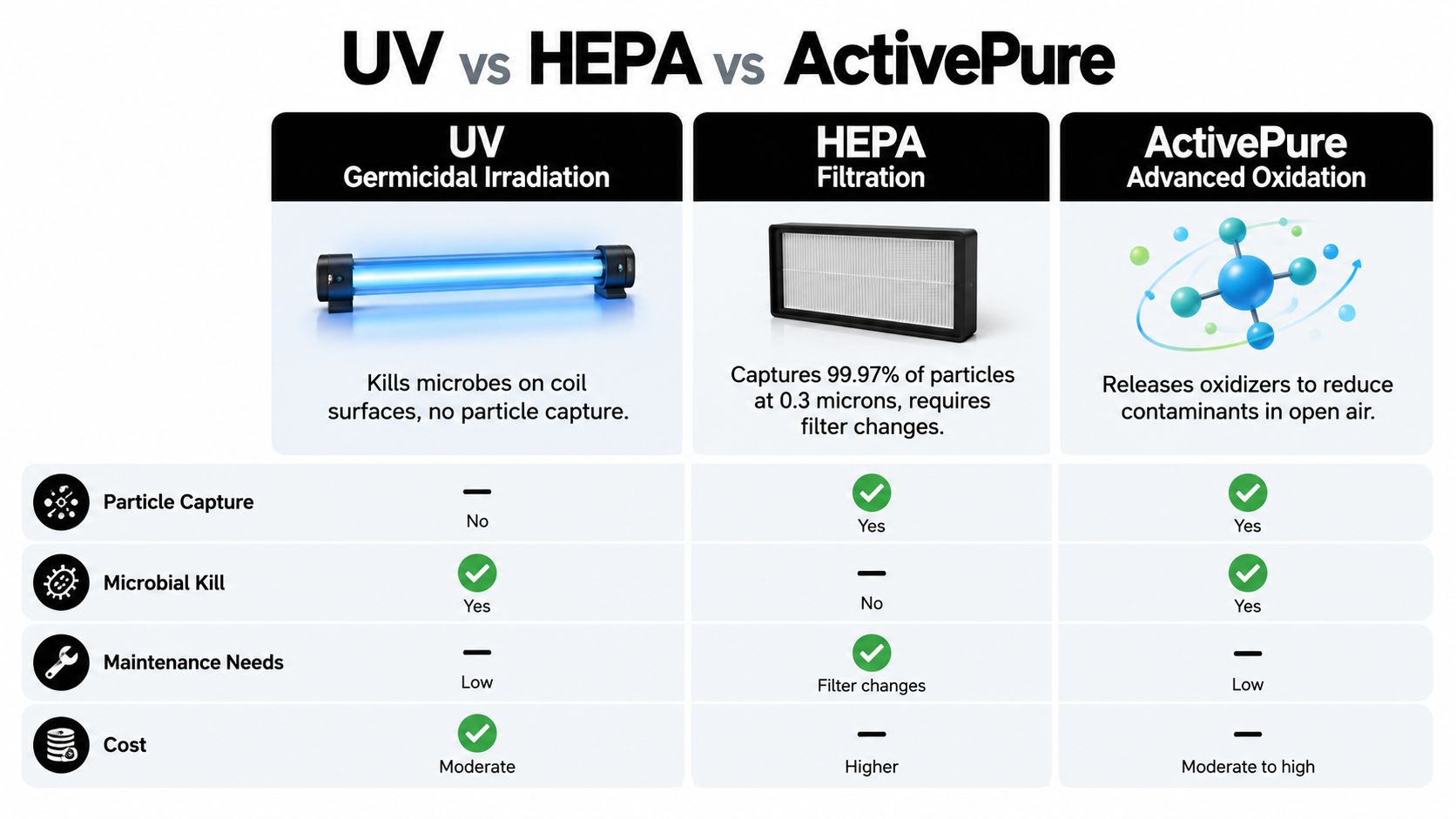
A UV system exposes air or HVAC surfaces to germicidal energy. It does not collect dust, so it cannot replace a properly selected filter. Its main benefits are biological inactivation and coil-surface treatment, provided the lamp has suitable placement, exposure, and maintenance.
HEPA filtration works by trapping particles. It can help with smoke, fine dust, pollen, and pet-related debris, but the dense filter media also creates airflow resistance and requires replacement. The central HVAC system must have enough blower capacity and filter access to handle that resistance without causing comfort or performance problems.
UV is therefore a supplement to filtration, not a substitute for it. In many homes, the strongest arrangement combines particle removal through filtration with UV treatment aimed at microbes and damp coil surfaces.
ActivePure uses a different air-treatment process. Products in this category are designed around reactive agents rather than relying only on a filter surface or direct UV exposure. Ask what the specific unit produces, how its performance was evaluated, and what service or operating requirements apply. A technology label alone does not establish suitability for a particular system.
Match the tool to the complaint
Primary concern | More relevant first step | Where UV may fit |
|---|---|---|
Dust, pollen, smoke, or pet dander | Mechanical filtration and source control | As a separate supplemental layer |
Damp coil or recurring biological buildup | Coil, drain, and humidity inspection | Directly on or near the coil |
Concern about airborne microbial transmission | Ventilation and filtration review | Supplemental in-duct or upper-room treatment |
Odor with an unknown source | Locate and correct the source | Only after the cause is understood |
Whole-home air treatment | Evaluate the central HVAC system | In-duct installation when compatible |
ASHRAE's evaluation framework includes effectiveness, safety, maintenance, and economics. Those factors matter more than a broad technology comparison. A UV lamp may preserve a coil and support microbial control, but its value depends on the equipment layout, operating conditions, service access, and the home's existing filtration.
For homeowners comparing complete systems, this overview of residential air purification systems helps distinguish in-duct treatment, filtration, and other options. The practical decision is often layered: use filtration for particles, UV for supplemental biological control and coil preservation, and professional service to address the conditions that allow contamination to persist.
Installation Compatibility and System Requirements
A UV lamp is only useful if the HVAC system can provide a sensible exposure path and a safe service arrangement. Before approving an installation, a technician should inspect the air handler, coil orientation, return and supply configuration, available electrical access, and the space around the equipment.
The ideal location varies. A lamp mounted near a cooling coil may illuminate a damp surface continuously, while a lamp positioned in the air path may treat passing air. Some installations need more than one lamp or a different mounting arrangement, but the decision should follow the equipment layout rather than a generic package recommendation.
Questions to ask before purchase
Ask the installer to answer these questions in plain language:
What is the primary target? Is the proposal aimed at coil preservation, airborne microbial control, or both?
Where will the lamp sit? Request a clear explanation of the illuminated area and airflow direction.
How will exposure be maintained? Fast airflow, distance, and obstructions can reduce the useful dose.
How will the technician service it? The lamp and sleeve need safe access without dismantling half the air handler.
What does the filter already do? A UV proposal shouldn't replace a discussion about particle filtration.
What protects occupants and workers? UV-C must remain contained inside the equipment or be used in a properly designed upper-room installation.
The EPA says HVAC UVGI systems are commonly installed either inside the HVAC system or near a room ceiling as upper-room UVGI. It also says a professionally designed, properly installed, and maintained system can help kill the virus that causes COVID-19 indoors, while warning that UV equipment not designed specifically for indoor-air disinfection can expose eyes and skin to hazardous radiation. The agency also states that UVGI isn't enough by itself and should be combined with other measures, as described in the EPA guidance on HVAC UVGI.
Sizing also deserves attention. A system that treats a small air path may not address the needs of a large, multi-zone home, while an oversized solution can add expense without solving the actual complaint. This guide to air purifier capacity offers useful context for thinking about coverage before comparing equipment.
Retrofitting is often possible, but the work should include electrical routing, mounting, access, shielding, and verification that the lamp won't damage nearby materials. A homeowner considering a broader whole-house air purifier installation should expect the contractor to assess the complete HVAC setup, not just install a lamp through the nearest panel.
Long-Term Maintenance and Ownership Considerations
The ownership experience is straightforward, but it isn't maintenance-free. UV lamps gradually lose useful output, and many manufacturers recommend annual replacement. The exact interval depends on the equipment and the manufacturer's instructions, so the service record should identify the lamp model, installation date, and replacement recommendation.
Dust and film can also collect on the lamp or its quartz sleeve. A dirty sleeve blocks part of the available energy, which means a lamp can remain visibly lit while delivering less useful treatment. During service, the technician should follow the manufacturer's cleaning procedure, inspect the mounting hardware, and verify that the lamp operates safely.
The maintenance people overlook
UV-C safety matters during every service visit. ASHRAE guidance highlights the need for special training and personal protective equipment when workers service UV-C systems and contaminated filters. The power should be shut off before access, and technicians need to prevent direct exposure to skin and eyes.
A sensible maintenance plan includes:
Lamp inspection: Confirm operation, age, and physical condition.
Sleeve cleaning: Remove dust and residue according to the equipment instructions.
Coil and drain review: Check whether moisture or buildup is creating the original problem.
Filter replacement: Keep mechanical filtration on its own schedule.
Safety verification: Confirm that access panels, shielding, and electrical connections are secure.
The energy demand of a lamp may be modest, but total ownership also includes replacement parts, labor, access difficulty, and occasional cleaning. A low-maintenance product can still become a poor investment if the lamp is installed where nobody can reach it safely.
Neutral public-health guidance makes the central limitation clear: UVGI can inactivate germs, but it doesn't remove dust, smoke, or other particles. It works best as a supplement to mechanical filtration in mechanically ventilated spaces or inside the air handler, not as a universal fix for every indoor-air concern, as outlined by King County's UVGI guidance.
For long-term reliability, schedule service before the lamp is forgotten, using a documented preventive maintenance schedule. UV is most appropriate for homeowners who want an additional microbial-control layer or coil-preservation strategy and who are willing to keep filtration, moisture control, cleaning, and ventilation in place.
Purified Air Duct Cleaning provides HVAC duct and coil cleaning along with in-duct air purification installations, including UV-C and ActivePure options, for homes and commercial properties in the Phoenix metropolitan area. Visit Purified Air Duct Cleaning to request an assessment and discuss which combination of filtration, cleaning, and HVAC-based air treatment fits your system.