

Does Air Duct Cleaning Make a Mess: What to Expect
Professional air duct cleaning doesn't have to make a mess when certified technicians use negative-pressure containment and HEPA filtration with 99.97 percent collection efficiency for 0.3-micron particles. Improper methods, however, can temporarily worsen indoor air quality during the job and leave dust where it doesn't belong.
You're probably asking because you've seen dust collect around a vent, noticed a stale odor when the HVAC starts, or have a cleaning appointment scheduled and don't want your living room covered in debris. The honest answer to “does air duct cleaning make a mess” depends less on the existence of dust inside the system and more on how the contractor contains it.
Light dust, microbial contamination, and damaged or leaking ductwork create very different situations. A careful technician treats each one differently, explains the limitations of the work, and controls the airflow before loosening anything inside the ducts.
The Homeowner Fear About Messy Duct Cleaning
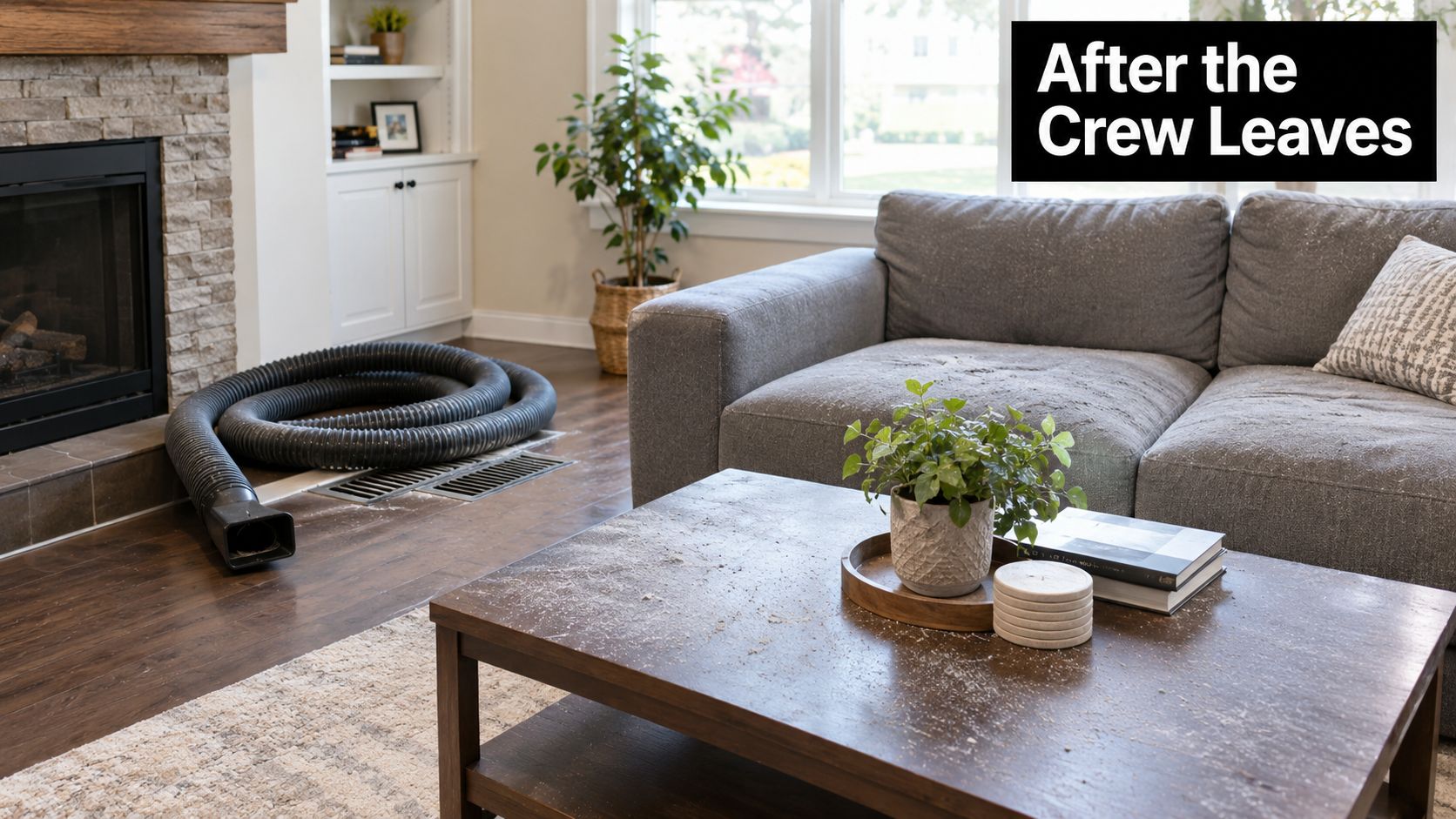
The moment usually comes after the equipment leaves. You walk past the sofa and notice a fine gray film on the armrest. There's grit near a floor register, dust on the return grille, or a dark streak beside an access panel. You start wondering whether the cleaning removed dirt from the ductwork or only redistributed it throughout the house.
That concern is reasonable. Ducts can contain dust, pet hair, construction debris, and other material that becomes airborne when a technician agitates the interior. If the crew opens registers without isolating the system, runs an undersized vacuum, or fails to protect nearby surfaces, the job can create a temporary indoor mess.
Why the answer isn't simply yes or no
The work itself disturbs material. That doesn't mean a professional service should blow dust into occupied rooms. The important question is whether the technician creates a controlled path from the duct to the collection equipment, then verifies that the system and work area are clean when the process ends.
The air duct cleaning process shown in this professional walkthrough gives homeowners a useful point of comparison: serious work involves inspection, access planning, protection, mechanical cleaning, and a final review. A quick pass over visible vent covers isn't equivalent to controlling the entire HVAC system.
The expected outcome also depends on what the ducts contain. With light dust, the main concern is visible debris escaping during agitation. With microbial contamination, the technician must consider safe handling, moisture, and whether cleaning alone addresses the underlying source. With damaged or leaking ducts, cleaning may disturb debris without fixing the pathway that allows particles into the home.
The cleanest job starts before the first brush enters the duct. If the system isn't isolated and held under controlled suction, the contractor is relying on luck.
Government guidance doesn't establish that dirty ducts automatically raise household dust levels, and the EPA says research hasn't conclusively shown that dirty ducts increase dust in homes. That uncertainty matters. Cleaning can remove contaminants from duct interiors, but the effect on indoor pollutant levels varies, so a contractor shouldn't promise instant whole-home air-quality improvement as a guaranteed result. EPA's guidance on whether homeowners should clean air ducts supports a more careful decision.
How Certified Standards Prevent Mess During Cleaning
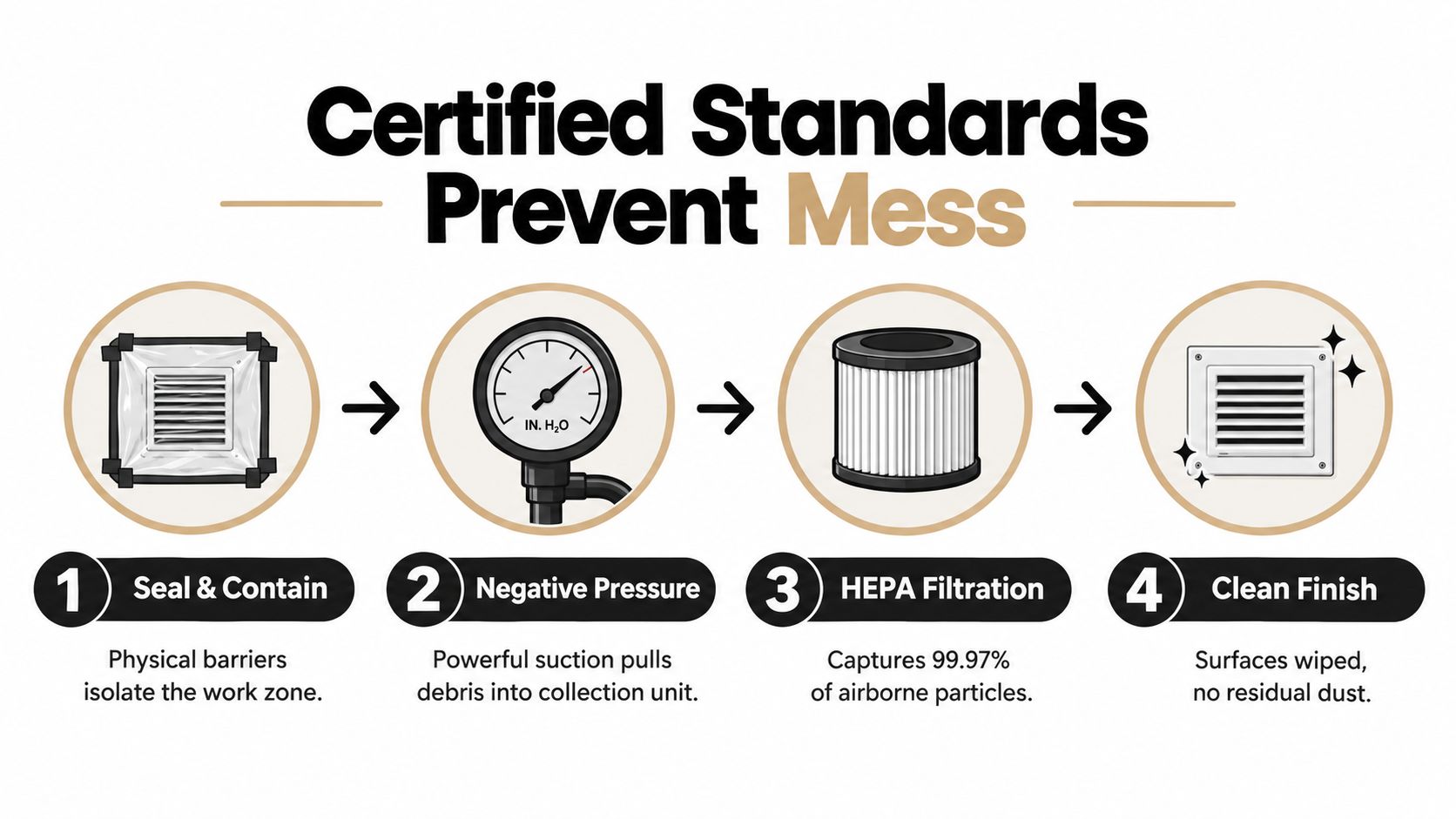
A sealed hose and a strong exhaust fan create one-way airflow. Air moves toward the collection unit, so loosened material has a controlled path out of the duct instead of an open route into the room. The result depends less on the fact that cleaning is taking place and more on how well the technician contains the work.
Light dust usually creates a manageable debris problem when the system is isolated and covered. Microbial contamination requires tighter handling, attention to moisture, and proper containment of removed material. Damaged or leaking ductwork presents a different risk. Cleaning can disturb debris, while leaks or broken insulation may still allow particles to enter the home.
Negative pressure comes first
NADCA's 2021 General Specification requires the HVAC component or work area to remain under negative pressure during cleaning. It also recommends containment barriers, protective coverings, and sealed 6-mil polyethylene floors and walls to limit particulate migration. Removed debris must be contained, and wastewater from wet cleaning must be captured and disposed of under applicable regulations. The specification calls for cleanliness verification after the work. For the full standard behind these controls, see NADCA's 2021 duct-cleaning specification and our summary of NADCA duct cleaning standards.
Those requirements turn source removal into a controlled process. A technician should not push a brush through a grille and rely on a portable vacuum to catch whatever escapes. The collection point, hose connection, access opening, sealed registers, and protected floor must function as one containment system.
Filtration determines where the debris ends up
Negative pressure controls airflow direction. Filtration determines whether captured dust stays in the collection equipment or returns through the exhaust. A collector must be sized and configured to retain the material removed from the system.
The EPA warns that an inadequate vacuum collection system can release more dust and contaminants than leaving the ducts alone. That trade-off matters. Proper equipment can control a dirty system, while weak collection can temporarily worsen indoor conditions. EPA's technical guidance on residential air duct cleaning explains why collection quality matters more than a contractor's promise that cleaning will be mess-free.
A professional setup typically includes:
Sealed access points: The technician closes openings that are not being serviced so the system maintains pressure control.
Physical protection: Drop cloths, floor coverings, barriers, and careful hose routing protect flooring, walls, and furniture from equipment and residue.
Directed agitation: Brushes, air whips, and similar tools loosen material while the collector draws it toward the source-removal hose.
Final verification: The crew checks accessible surfaces and duct components instead of treating equipment removal as the end of the job.
No method prevents every disturbance, especially in heavily contaminated or damaged systems. Proper containment gives the debris a controlled destination and makes cleanup predictable.
What Homeowners Should Do Before the Crew Arrives
Preparation reduces two risks at once: accidental damage from moving equipment and dust settling on items that should have been moved before work began. Clear a path to every supply register, return grille, furnace, air handler, and known access panel.
Move fragile décor, electronics, and small furniture away from the work areas. If a return grille sits behind a bookcase, don't wait for the technician to discover that access is blocked. A crew that has to improvise around obstacles may spend more time opening and closing doors, repositioning hoses, or working in cramped spaces.
Make the house easier to protect
Secure pets in a quiet room or arrange for them to be elsewhere during the appointment. Technicians may need to move between rooms, open doors, and carry hoses through the home. A curious dog or cat can disturb floor protection, track debris, or get too close to active equipment.
Tell the crew about recent remodeling, visible mold-like growth, vermin, unusual odors, water damage, or a register that blows visible debris. Those details help determine whether the job involves ordinary dust, a moisture-related issue, or duct damage that needs attention beyond cleaning.
You can also decide whether your family wants to stay. Negative-air machines and collection equipment can be loud, and the HVAC system may remain off while the crew works. If someone stays home, keep one adult available to answer questions and approve access decisions.
What a proper setup should look like
Before cleaning begins, expect a walkthrough and a clear explanation of the access points. Protective coverings should appear before hoses and tools begin moving through the home. The crew may install covers over registers, place barriers around the work zone, and position collection equipment so exhaust and traffic don't create new problems.
This guide to house AC vent cleaning can help you recognize the difference between cleaning an accessible grille and addressing the connected HVAC system.
The sound of suction is normal. A visible dust cloud escaping from an uncovered vent is not. If you're unsure about a setup, ask the technician to explain where the air is moving and where the collected debris will go.
Signs of a Sloppy Job vs Professional Containment
You can learn a lot before the first duct is cleaned. A professional crew spends time preparing the system and protecting the home. A careless crew starts brushing immediately, treats visible vent covers as the entire job, and leaves you to notice problems after the equipment is gone.
The strongest warning sign is uncontrolled airflow. If several registers are open while the technician agitates one branch, loosened material may travel through the system or escape into the room. Another concern is a vacuum hose connected to a convenient opening without an explanation of how the main trunk, supply runs, and return paths are being isolated.
Use the setup as your evidence
The comparison below gives you concrete details to watch for:
Indicator | Professional Setup | Sloppy Setup |
|---|---|---|
Work-zone protection | Floors, walls, furniture, and nearby surfaces receive appropriate coverings or barriers. | Equipment rests directly on finished surfaces, with little protection around access points. |
Register control | Supply and return grilles are covered or isolated as the work requires. | Multiple openings remain exposed while dust is being agitated. |
Air movement | Negative-air equipment pulls debris toward a sealed collection point. | A small shop vacuum or weak collection method allows visible dust to escape. |
Filtration | The contractor can explain the filter and where filtered air exhausts. | The technician can't identify the filtration method or exhausts dusty air indoors. |
Main connection | The hose is connected to an appropriate access point and the crew explains the containment plan. | The hose is attached to a convenient grille with no clear system-wide strategy. |
Work pace | The crew spends time inspecting, sealing, cleaning, and checking the result. | The crew rushes through openings and leaves little time for setup or verification. |
Debris handling | Removed material is contained and taken away without scattering it through the home. | Loose bags, open bins, or debris remain near living areas. |
Independent government guidance from the Department of Defense requires debris to be collected so it isn't dispersed outside the HVAC system. When equipment exhausts inside a building, that specification calls for HEPA filtration with 99.97 percent collection efficiency for 0.3-micron particles. NIH guidance also describes filter covers over supply and return grilles, work during unoccupied periods, containment barriers, and negative-air machines with high-efficiency filters. The HVAC cleaning specification published through the Whole Building Design Guide provides a useful benchmark for the level of control expected in a careful operation.
If you can see dust leaving the work zone, stop the process and ask how the contractor plans to regain containment.
A contractor may need to adjust the setup when the duct material is fragile, the access is limited, or the system has leaks. That's different from ignoring the problem. A professional explains the limitation, protects the home, and avoids promising a result the equipment cannot safely deliver. For more detail on the role of controlled suction, review this explanation of negative-air duct cleaning.
Questions to Ask Your Air Duct Cleaning Provider
Before booking, ask how the crew will control dust in your specific system. Light dust, microbial contamination, and damaged or leaking ductwork present different risks. A provider who gives the same answer for every home may be selling a package rather than planning the work.
Ask who will perform the cleaning, what training or certification the technicians hold, and which recognized duct-cleaning standards guide the job. Then require clear answers to these questions:
How will you create negative pressure? The provider should identify the collection-unit connection, explain how the system will be isolated, and describe how air will move during cleaning.
What filtration does the collector use? Ask where filtered air exhausts and how the crew prevents captured debris from returning to occupied rooms.
How will you protect the home? Expect details about floor coverings, barriers, register covers, hose routing, and shoe or surface protection.
How will you handle removed debris? Sealed collection and responsible disposal should be part of the plan. Open bags or loose piles near living areas indicate weak control.
How will you verify the result? Ask which accessible components the crew will inspect and how it will document cleanliness after the work.
What happens if the ducts are damaged or contaminated? A trustworthy provider should separate cleaning from repairs, moisture correction, and specialized microbial remediation.
Use the EPA's earlier caution about broad health claims as a sales test. If a company promises instant whole-home air-quality improvement, ask which of these questions it can answer with specific equipment, procedures, and limitations. The condition of the system and the containment plan matter more than a guaranteed outcome.
Facility managers can apply the same questions when comparing facility HVAC supplies from Material Handling USA. Supplies support the work, but they do not replace judgment about pressure control, filtration, duct construction, or waste handling.
A responsible contractor should also say when cleaning is not the first step. Light dust may not justify service. Microbial contamination calls for source investigation, while leaking or damaged ductwork may need repair before cleaning can produce a meaningful result. DIY equipment often lacks the isolation, filtration, and disposal controls needed to keep removed material out of the building.
Post-Service Cleanup and Verification Steps
The final inspection should feel deliberate, not rushed. The technician should remove barriers and coverings carefully, close access panels, reinstall registers, and collect every piece of debris and equipment before leaving each work area.
Walk through the home with the crew. Check the floors around access points, the surfaces near returns, and the areas where hoses crossed rooms. You shouldn't find loose insulation, filter material, fasteners, plastic scraps, or visible dust deposits left behind by the service.
Confirm the HVAC is ready to run
Ask the technician to verify that registers are secure and that the system operates normally. Confirm that temporary covers have been removed where appropriate, filters are installed correctly, and no access opening remains unsealed.
Look inside accessible grilles for obvious residual debris, but don't mistake a clean visible cover for proof that every internal surface is spotless. Professional standards call for cleanliness verification, and the contractor should explain what was inspected and what areas were inaccessible.
If you're tracking indoor conditions, an indoor air-quality sensor guide can help you understand what sensors can and can't tell you. A reading isn't a substitute for inspecting the work, and it shouldn't be used to support an unsupported promise about health outcomes.
After the crew leaves, run the HVAC system and listen for unusual rattling, whistling, or airflow changes. If you notice fresh dust around registers or a new odor, contact the provider promptly and document the affected area. A reputable contractor should be willing to review the concern rather than dismiss it.
Purified Air Duct Cleaning uses negative-pressure containment, sealed HEPA collection, floor protection, and cleanup procedures for residential and commercial duct-cleaning work in the Phoenix metropolitan area. If you want a provider to assess whether your issue involves light dust, contamination, or damaged ductwork, visit Purified Air Duct Cleaning to request a quote and discuss the containment plan before work begins.