

Residential Indoor Air Quality Services: A Complete Guide
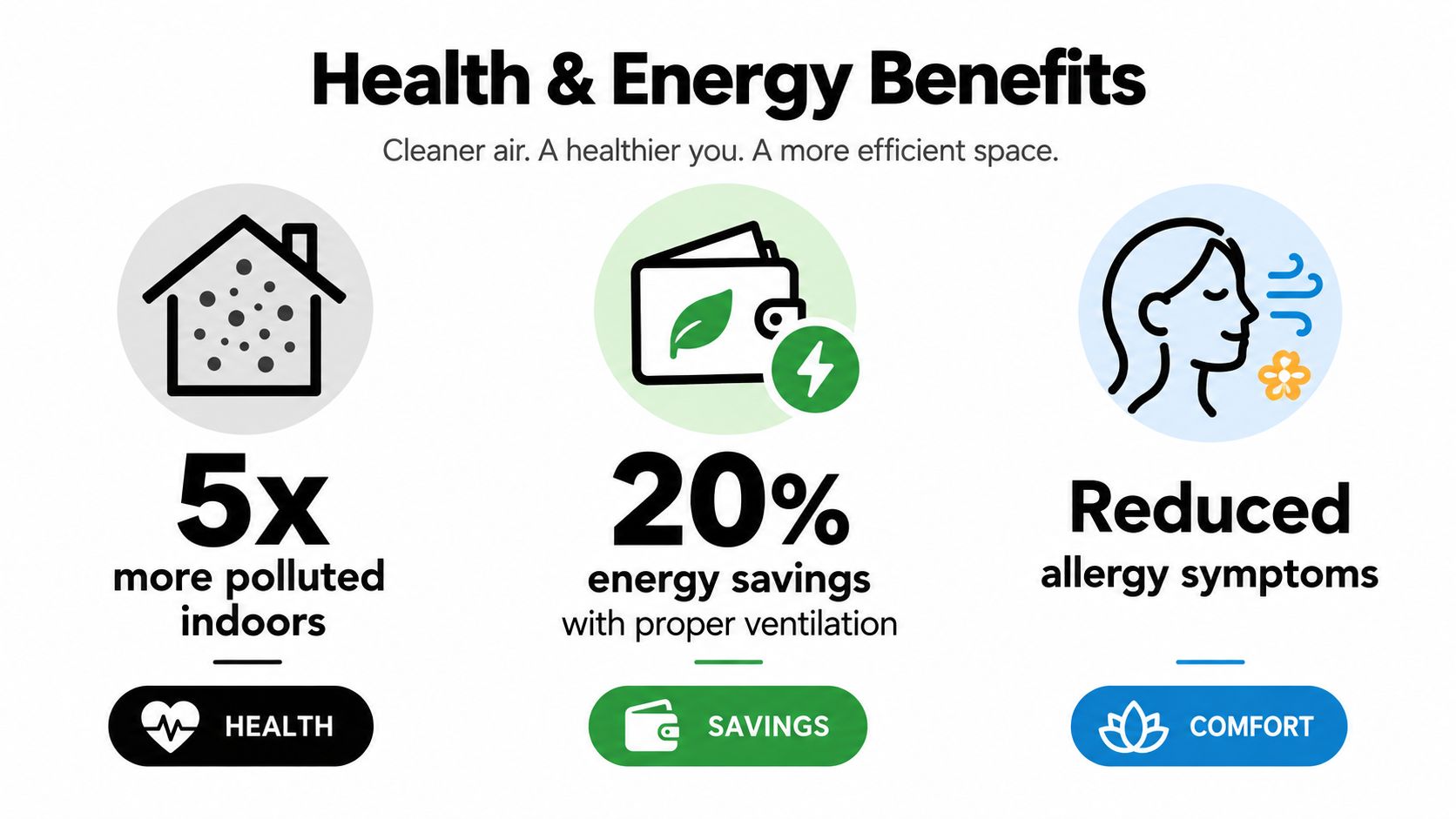
Indoor air can be 2–5 times more polluted than outdoor air, while Americans spend about 90% of their time indoors. That makes residential indoor air quality services useful not only when you see mold or dust, but whenever your home feels stuffy, causes persistent irritation, or seems unable to manage moisture and particles.
A family in Phoenix might notice the pattern gradually. Dust returns soon after cleaning, someone wakes with congestion, and the air conditioner runs longer than expected. None of those signs proves that the ductwork is the cause, but together they justify a careful assessment rather than a quick promise of a healthier home.
The right approach starts by identifying the pollutant or system defect, then choosing the narrowest service that addresses it. Ventilation, filtration, source control, duct inspection, coil maintenance, and air cleaning can all play different roles. The objective isn't to buy every available treatment. It's to improve the air path without creating airflow, moisture, or maintenance problems.
Why Indoor Air Quality Matters for Your Home
Indoor air problems often begin with ordinary household conditions. A tightly closed house may hold cooking odors and humidity, while an aging filter allows dust to move through the return air system. In a dry climate such as Phoenix, outdoor dust can also enter through doors, windows, and small building leaks, then settle on furniture and inside HVAC components.
The concern is exposure over time. Independent guidance notes that people spend about 90% of their time indoors and that indoor pollutant concentrations can reach 2–5 times outdoor levels, creating an ongoing need for testing, ventilation, filtration, and condition-based duct services. See the residential indoor air quality guidance from Trane for that broader context.

Symptoms aren't a diagnosis
Dust, odors, allergy flare-ups, and uneven comfort can point to several different causes. A dirty filter, disconnected duct, wet insulation, outdoor air leakage, a combustion source, or inadequate ventilation may produce similar complaints. Cleaning one component without finding the source can leave the underlying problem untouched.
That's why a professional assessment should document what technicians can directly observe. Useful evidence may include visible contamination, moisture damage, airflow restrictions, filter pressure drop, or air leakage in accessible HVAC sections. Homeowners looking into the health implications can also review this resource on indoor air quality effects on health.
Residential indoor air quality services cover a broad set of tasks, but they shouldn't be sold as a universal cure. A home with visible debris being released from vents needs a different response from a home that mainly lacks outdoor-air exchange. Treating those situations separately protects your budget and makes the result easier to verify.
Understanding Core IAQ Concepts and Standards
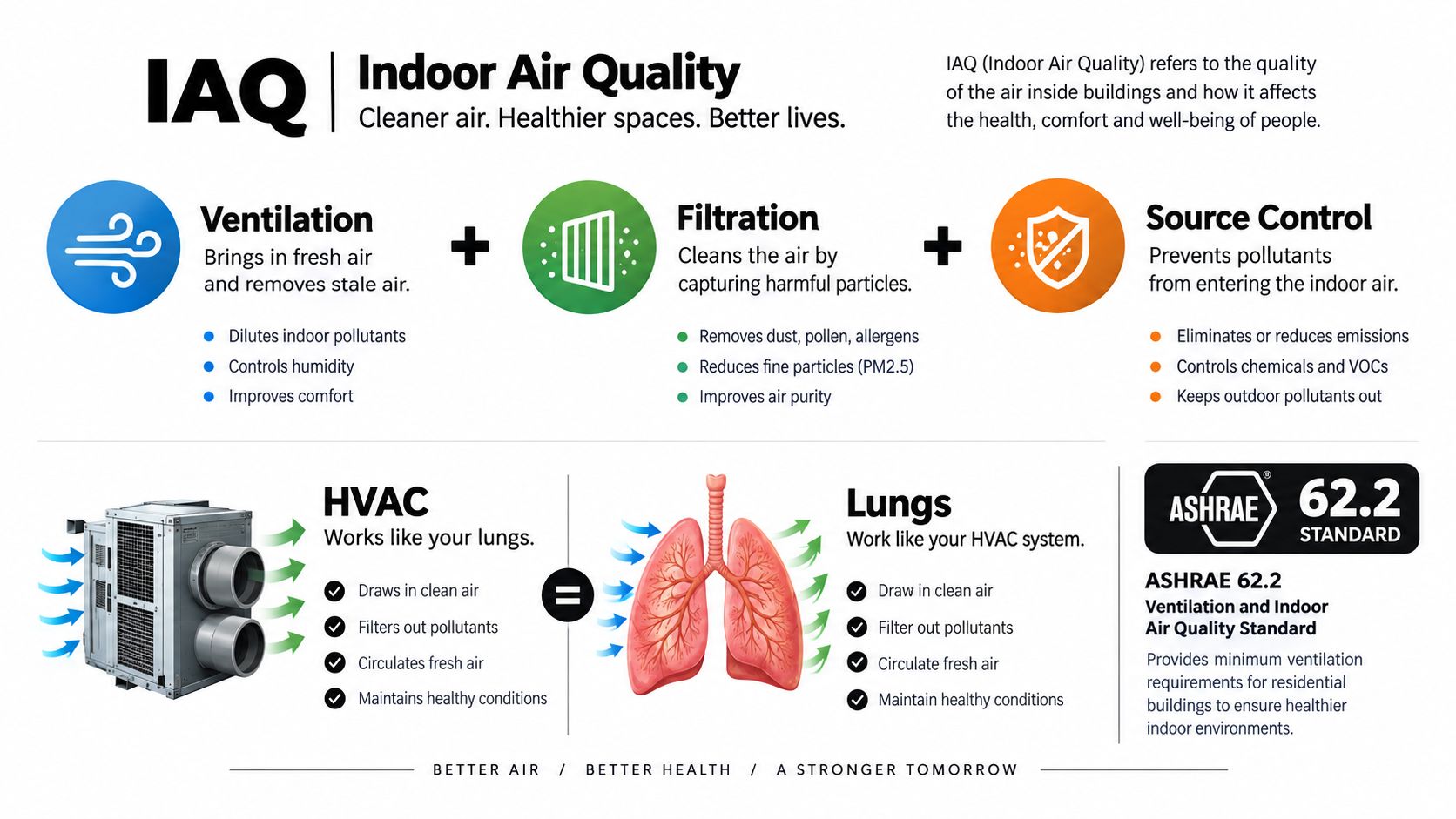
Think of your HVAC system as the home's respiratory system. Ventilation brings in outdoor air and removes stale indoor air. Filtration catches particles as air passes through a filter. Source control stops pollutants at their origin, such as repairing a moisture leak or controlling dust during renovation.
These functions work together, but they aren't interchangeable. Opening a window may dilute indoor pollutants, yet it won't remove particles already circulating. A stronger filter may capture more particles, but it can also restrict airflow if the equipment isn't designed for it. Removing a contaminated material is often more effective than trying to filter everything it releases.
The standards behind residential practice
Residential ventilation guidance developed over time. By the 1880s, the U.S. consensus for proper ventilation was about 30 cubic feet per minute per person, and 22 states had that value prescribed by law by 1925, according to this historical review from ACEEE. ASHRAE created a separate residential ventilation committee in 1996, followed by approval of ASHRAE Standard 62.2 in 2003, which established minimum ventilation and IAQ requirements specifically for homes.
For homeowners, those dates matter because they show the shift from broad public-health ventilation rules to a home-specific technical discipline. A professional isn't just trying to make air “feel fresh.” They're evaluating airflow, equipment, contaminants, and the way the building is occupied.
Three questions clarify most problems
What is the source? Look for moisture, combustion, construction dust, pests, tracked-in debris, or household activities that release pollutants.
How does air move? Check whether the home receives enough outdoor air and whether the HVAC system distributes air evenly.
What captures or removes the pollutant? Select filtration, cleaning, source removal, or ventilation based on the contaminant and the equipment's limits.
Homeowners who want a structured starting point can test your home's air before choosing a service. For ductwork practices, this overview of NADCA duct cleaning standards can help you ask more precise questions about inspection, containment, and accessible components.
Common Residential IAQ Services Compared
Different services solve different problems. Air duct cleaning addresses contamination inside accessible HVAC air paths when there's a clear condition-based reason. Dryer vent cleaning focuses on lint and airflow in the clothes-dryer exhaust, a separate system that shouldn't be confused with central HVAC ductwork. HVAC coil cleaning removes buildup from accessible heat-transfer surfaces, while air purification devices supplement source control, ventilation, and filtration.
The EPA says routine duct cleaning hasn't been shown to prevent health problems. It recommends cleaning when there's visible mold growth, pest infestation, or excessive dust and debris actively released into the home, as explained in its guidance on when to have air ducts cleaned.
Service | Primary Benefit | Recommended When | Typical Cost Range |
|---|---|---|---|
Air duct cleaning | Removes condition-based dust, debris, or contamination from accessible HVAC air paths | Visible release of debris, confirmed contamination, pest intrusion, or appropriate remediation | Varies by system size, access, and documented condition |
Dryer vent cleaning | Restores exhaust airflow and removes lint accumulation | Drying performance has declined, airflow is restricted, or maintenance is due | Varies by vent length, access, and obstruction |
HVAC coil cleaning | Removes buildup from accessible coils and related components | Dust or debris coats components, airflow is impaired, or maintenance findings justify cleaning | Varies by equipment type and accessibility |
In-duct or portable air purification | Supplements particle or contaminant management | A defined air-cleaning need remains after source control and ventilation review | Varies by device, installation, and replacement needs |
A reputable provider should explain what was found before recommending cleaning. Wet or moldy insulation that can't be effectively cleaned may need removal and replacement, while a sealed, clean air path may not need routine treatment.
Practical rule: Choose the service that matches the documented defect, not the service with the broadest health promise.
For everyday dust reduction, housekeeping still matters. This clean home advice from Professional Window Cleaning can complement HVAC maintenance, especially when dust enters from outdoor surfaces and household activity. If purification remains appropriate, learn how residential air purification systems fit alongside, rather than replace, ventilation and filtration.
Health and Energy Benefits Explained
IAQ improvements can make a home feel more comfortable, but the benefit depends on what changed. Source control can stop a pollutant from entering the air. Ventilation can dilute indoor contaminants. Filtration can capture particles that pass through the system. These are practical mechanisms, not guarantees of symptom relief.
A HEPA filter has a clearly defined particle-capture benchmark. The EPA says it can theoretically remove at least 99.97% of dust, pollen, mold, bacteria, and other airborne particles that are 0.3 microns in size, as described in its HEPA filter guidance. That performance applies to qualifying particles and doesn't mean a HEPA device removes every pollutant in a home.
Separate comfort from health claims
Better airflow can reduce stuffiness and help rooms feel more balanced. Removing excessive debris from accessible HVAC components may also protect system operation when that buildup is interfering with airflow or heat transfer. Those are reasonable service outcomes.
Routine duct cleaning alone isn't proven to prevent health problems, and studies haven't conclusively shown that dirty ducts increase particle levels throughout homes. A provider who promises universal allergy relief from cleaning is overstating what the evidence supports.
Filtration also requires system judgment. A higher-efficiency filter can increase resistance, so technicians should verify compatibility and measure pressure drop before recommending an upgrade. A filter that captures particles well but causes inadequate airflow can undermine comfort and equipment performance.
The same logic applies to energy. Cleaning a restricted coil or repairing leakage may help the system operate as intended, but no responsible provider should promise a fixed energy reduction without inspecting the equipment and building. Energy performance depends on duct sealing, thermostat settings, insulation, equipment condition, airflow, and outdoor weather.
Watch the following explanation with a critical question in mind: what pollutant or mechanical defect does the proposed treatment address?
The strongest plan usually follows this order: control the source, provide appropriate outdoor-air ventilation, then use filtration or air cleaning as a supplement.
How to Choose and Maintain IAQ Services
Start with the complaint, not the equipment catalog. Persistent odors, visible debris from vents, moisture damage, unusual dust, or a stuffy bedroom each point toward different questions. Ask the provider to inspect before quoting a broad package.
For homes, ASHRAE recommends a minimum continuous ventilation rate of 0.35 air changes per hour, but not less than 15 cubic feet per minute per person, as summarized by the EPA's residential ventilation guidance. A technician should consider the home's layout, occupancy, equipment, and climate rather than treating that benchmark as a one-size-fits-all promise.
Questions to ask before booking
Request findings: Ask for photographs, measured observations, and a written explanation of the suspected source.
Confirm the method: Find out whether the team uses containment, appropriate vacuum equipment, component access, and protection for occupied rooms.
Check credentials: Look for relevant training, documented experience, and familiarity with recognized residential HVAC and IAQ practices.
Clarify the scope: Make sure the quote states which ducts, registers, coils, filters, and other accessible components are included.
Ask about follow-up: A good provider explains filter care, moisture correction, ventilation settings, and what should be monitored afterward.
Phoenix and Avondale homeowners may need to pay particular attention to dust entering from outside, pollen, filter loading, and cooling-system performance during extended hot weather. That doesn't automatically justify frequent duct cleaning. It does make regular filter inspection, coil condition checks, and attention to unusual airflow especially important.
Maintenance should be condition-based. Replace or clean filters according to the filter and equipment requirements, keep supply and return grilles unobstructed, address leaks quickly, and investigate musty odors instead of masking them. If a provider recommends a purification device, ask what it removes, how airflow is affected, what maintenance it needs, and whether independent evidence supports the claimed use.
For a second opinion on an inspection or treatment plan, consult an indoor air quality expert who can connect the complaint to a specific corrective action.
Your Action Plan for Cleaner Indoor Air
Treat IAQ as an ongoing management task rather than a one-time cleaning purchase.
Record the complaint: Note odors, dust release, humidity concerns, uneven temperatures, or symptoms that change between home and elsewhere.
Inspect the basics: Check filters, visible vents, moisture areas, condensate components, and any recent renovation debris.
Identify the source: Ask whether the issue comes from outdoor infiltration, household activity, moisture, pests, combustion, or the HVAC air path.
Choose the narrowest remedy: Use source removal first, ventilation where needed, and filtration or air cleaning as a supplement.
Verify the result: Request before-and-after documentation, confirm airflow remains acceptable, and schedule maintenance based on observed conditions.
A monitor can help track changes over time, but readings only become useful when you understand what they measure and what action follows. This guide to indoor air quality monitoring services can help you frame that conversation with a qualified provider.
Purified Air Duct Cleaning offers residential air duct cleaning, dryer vent cleaning, HVAC coil cleaning, and in-duct or portable ActivePure air purification installations across Avondale and the Phoenix metropolitan area. Request a documented assessment and a free quote from Purified Air Duct Cleaning to match the service to your home's actual IAQ needs.