

Indoor Air Quality Certification: Types, Issuers and Proof
What exactly did the certificate certify?
A facility manager has a framed certificate in the lobby and a monitor in a conference room that reads 1,400 ppm of carbon dioxide at 2pm on a Tuesday, in a room booked for eight people and holding fourteen. Nothing on the certificate is false. It just doesn't answer the question being asked.
Conventional thinking treats indoor air quality certification as a verdict on the air in a building right now, the way a hygiene grade on a restaurant window reads. That framing is wrong, and it costs owners money, because a certificate is a document with a date, a method and a pass rule. Learning to identify which document you're looking at, and what it had to prove on the day it was issued, is the whole skill.
Once you can name the document type, most of the confusion falls away. A home label, a whole-building rating, a ventilation calculation and a technician's badge aren't competing answers to one question. They answer four different questions, and only one of them usually concerns the air in the room today.
Indoor Air Quality Certifications at a Glance
There's no single global credential for indoor air quality, and that's the first thing to unlearn. No world body issues one certificate that means the same thing in Phoenix, Hong Kong and Frankfurt. What exists is a group of programs that each answer a narrower question, in a market big enough to keep adding new ones: the global indoor-air-quality testing market was valued at USD 4.8 billion in 2024, according to Growth Market Reports.
Indoor air quality certification programs compared
Program | Issuer | Applies to | What it checks | Evidence required |
|---|---|---|---|---|
ASHRAE 62.1 and 62.2 | ASHRAE | Commercial buildings (62.1) and low-rise homes (62.2) | Minimum ventilation and acceptable indoor air quality | Engineering design and ventilation calculations |
LEED | U.S. Green Building Council | New and existing buildings | Building design, operation, materials and ventilation | Documented design and operation records |
WELL Building Standard | International WELL Building Institute | Buildings and interiors | Occupant health across air, water, light and comfort | Performance and management documentation |
RESET Air | RESET Standard | Offices, schools and other occupied spaces | PM2.5, TVOC, carbon dioxide and humidity against set thresholds | Continuous monitoring data retained for review |
Indoor airPLUS | U.S. Environmental Protection Agency | New homes and apartments | Source control, ventilation and filtration during construction | Third-party verification and inspection records |
Hong Kong IAQ Certification Scheme | Hong Kong government | Commercial and public buildings | Excellent or Good levels against IAQ objectives | Records of ongoing management practice |
Read the first row carefully, because it isn't a certificate at all. ASHRAE 62.1 and 62.2 are engineering standards that set minimum ventilation and define acceptable indoor air quality. The label programs below them borrow from those standards rather than replace them.
The second and third rows rate whole buildings. LEED judges design, operation and materials. WELL leans on occupant health and spans air, water, light and comfort, and in 2025 it covered more than 6 billion square feet of real estate and nearly 100,000 locations, according to the International WELL Building Institute as reported by Facilities Dive. RESET Air is built the other way around, starting from what a monitor records.
Practical rule: match the program to the property type first, then to the evidence you can actually produce. A home label says nothing useful about a commercial kitchen.
Two rows in that table are often confused for one another. Indoor airPLUS is a new-construction label with a verifier in the loop. Hong Kong's scheme assesses standing premises against government objectives and looks for management practice behind them. Neither one is a statement about this afternoon's particle count, and neither is a substitute for a measurement you take yourself.
Standards Labels Credentials and Equipment Claims
What does a clean-air label verify? Start by sorting the name into one of four documents: an engineering standard, a building label, a personal credential, or an equipment claim. Each checks something different, so the evidence file matters more than a broad promise of clean air.
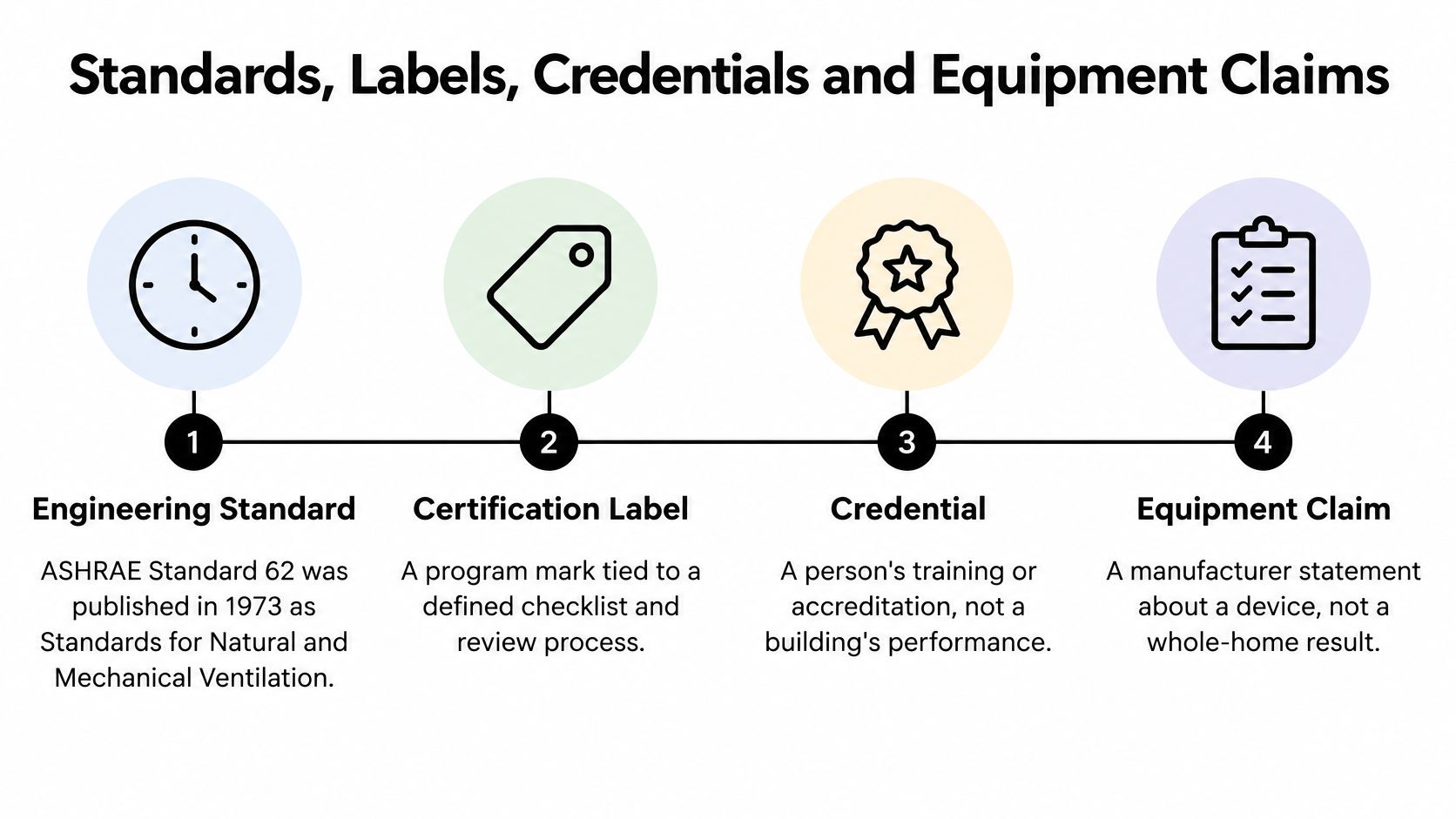
The standard underneath the label
The foundation is older than the labels. ASHRAE Standard 62 was first published in 1973 as Standards for Natural and Mechanical Ventilation, replacing earlier recommendations with a consensus engineering document, as a peer-reviewed review of indoor air quality standards recounts. The 1981 edition added the IAQ Procedure, allowing designers to model indoor contaminant concentrations when calculating outdoor-air needs, rather than relying only on fixed ventilation rates. The standard later split into 62.1 for commercial, institutional and high-rise residential buildings, and 62.2 for low-rise homes. A calculation that follows 62.1 is evidence of a design approach, not a building certificate.
Building labels use standards as part of a broader assessment. LEED and WELL brought indoor air into building-performance and occupant-health evaluations. LEED began in August 1998 and had more than 69,000 registered or certified projects across over 150 countries by the time the same green-building certification review was written. LEED addresses applicable ASHRAE 62.1 ventilation rates, tobacco-smoke control and cleaning practices that limit biological and chemical exposure. WELL was released in 2014 after a seven-year development period. In LEED v4.1 Building Design and Construction, credits address occupant comfort and indoor air quality, but a credit count alone does not tell you what was checked at a specific property.
Materials also affect indoor air. Low-emitting paints and furnishings can contribute to a building's score, and the same principle applies when renovating a single room. For example, choosing green cabinets for kitchens can help limit sources of emissions from new materials. The label's evidence file should show which materials or practices were assessed.
A credential belongs to a person, not a building. Hong Kong's scheme explains its assessment process and evidence of ongoing management in an official FAQ that explains how buildings are assessed and how ongoing management is evidenced. In the U.S., Indoor airPLUS verifiers and reviewers must hold competencies aligned with ANSI/BPI-1200 or an EPA-approved equivalent. Check who performed the assessment and what their credential covers.
An equipment claim is different again. A filter, purifier or duct-cleaning service does not become a building label because it may affect air quality. The program's rules must accept the documented result. For a practical distinction between a service and a certification, see this guide to air duct cleaning certification. A certificate describes a defined review; it does not guarantee today's air conditions.
Pollutant Benchmarks Behind the Labels
Now the numbers, because readers can get hurt here. Certification benchmarks differ by pollutant and by averaging method, so a single spot reading tells you very little about whether a building passes.
Pollutant and carbon dioxide benchmarks by program
Metric | RESET High Performance | RESET Acceptable | Other programs |
|---|---|---|---|
PM2.5 | Daily average, tier-specific threshold | Daily average, tier-specific threshold | Around 12 µg/m³ in several demanding programs |
TVOC, daily limit | 400 µg/m³ | 500 µg/m³ | Limits set separately by each program |
Carbon dioxide, daily | 600 ppm | About 1,000 ppm | About 1,000 ppm |
Averaging basis | Daily | Daily | Set by each program |
Those figures come from comparative certification data summarized by RESET Standard's benchmark announcement. PM2.5 targets sit around 12 µg/m³ in several demanding programs, while RESET High Performance sets a daily TVOC limit of 400 µg/m³ and RESET Acceptable allows 500 µg/m³. The two TVOC values aren't interchangeable with a short-term reading, because the averaging periods differ.
Carbon dioxide deserves its own paragraph, because it's the most misread number in the room. RESET High Performance targets 600 ppm daily, where RESET Acceptable and several other programs land at approximately 1,000 ppm daily. CO2 is a ventilation-performance indicator, not a complete health assessment. A room can sit at 700 ppm with a serious formaldehyde problem, and it can sit at 1,100 ppm with nothing else wrong except too many people and too little outdoor air.
A cleaning invoice and a CO2 trend chart answer different questions. One shows what was removed; the other shows whether enough fresh air is arriving.
Here's the cause-and-effect logic that matters for anyone commissioning work. Removing settled dust from ducts may reduce resuspension, which is a real benefit. Persistently high CO2 points to weak outdoor-air delivery, occupancy overload or a control problem, and cleaning alone can't correct any of those three. Equally, an air-purification device shouldn't be credited with ventilation compliance unless the certification protocol accepts its documented effect and the building still meets the required outdoor-air and monitoring criteria.
That's why the commissioning plan should name six things before work starts: the pollutant, the threshold, the averaging period, the occupancy schedule, the instrument grade and the corrective-action triggers. Write them into the scope, and a vendor can't hand you a one-off reading and call it proof. The wider set of indoor air quality standards behind these thresholds is worth reading before you specify anything.
What a Certificate Proves and What It Cannot
A certificate is an inspection file with a date, a method and a pass rule. The most useful thing you can do with one is read the pass rule, because it tells you how hard the building had to work to earn the mark.
RESET Air makes that rule visible. Projects must continuously monitor PM2.5, total volatile organic compounds, carbon dioxide, temperature and, depending on the project, relative humidity. Coverage has to represent at least 80% of occupants, with open-area coverage generally limited to 500 m² per monitor. Then the hard part: thresholds must be achieved for three consecutive months, and the data must be transmitted, visualized and retained for review, per RESET Standard's monitor requirements.
An afternoon with a handheld meter doesn't satisfy that. Neither does a sensor on a shelf.
The same standard of proof, applied to construction
EPA's Indoor airPLUS program treats evidence the same way. The agency describes the label as covering source control, ventilation and filtration, rather than one broad indoor air quality score, and the certification system requires repeatable standards for deciding whether discrepancies found in quality-control file reviews and field evaluations stay within allowable thresholds, according to EPA's Indoor airPLUS certification system document.
Three things follow from that structure:
There's a checklist. An Indoor airPLUS Quality Control checklist supports those assessments, so the review leaves a paper trail rather than a verbal opinion.
There's a threshold. Findings below it are acceptable. Findings above it are not.
There's a root-cause step. When deficiencies exceed the allowable threshold, the responsible process must address them and identify why they happened, so they don't recur.
That last point separates a real certification from a badge. A corrective-action mechanism means the file records what went wrong and what changed, which is exactly what a property owner needs when a tenant asks whether the building is fine.
Certified and Gold are different files. Gold requires the applicable Indoor airPLUS Gold measures in addition to ENERGY STAR certification, while ordinary certification requires the applicable Certified Verification Requirements. A filter, purifier or duct cleaning installed afterward sets neither tier.
Sensors show you that something changed. A validated laboratory method tells you which contaminant changed and by how much. Don't let the first one stand in for the second.
If you want to run your own checks rather than rely on a dashboard, this guide to how to measure indoor air quality covers the practical side of taking readings that mean something.
How Indoor airPLUS Certification Works
Walk the pathway once and the whole category gets clearer. Take a builder putting up a small development of single-family homes and wanting the EPA label on each one. Here's the order of operations, and where a label can be lost.
1. Design to two sets of requirements at once. The dwelling unit, and applicable multifamily common spaces, must be designed and constructed to meet or exceed every applicable item in the Indoor airPLUS Verification Requirements, on top of the applicable ENERGY STAR Residential New Construction requirements. That's not a marketing pairing. It's a precondition, as the EPA's national program requirements set out.
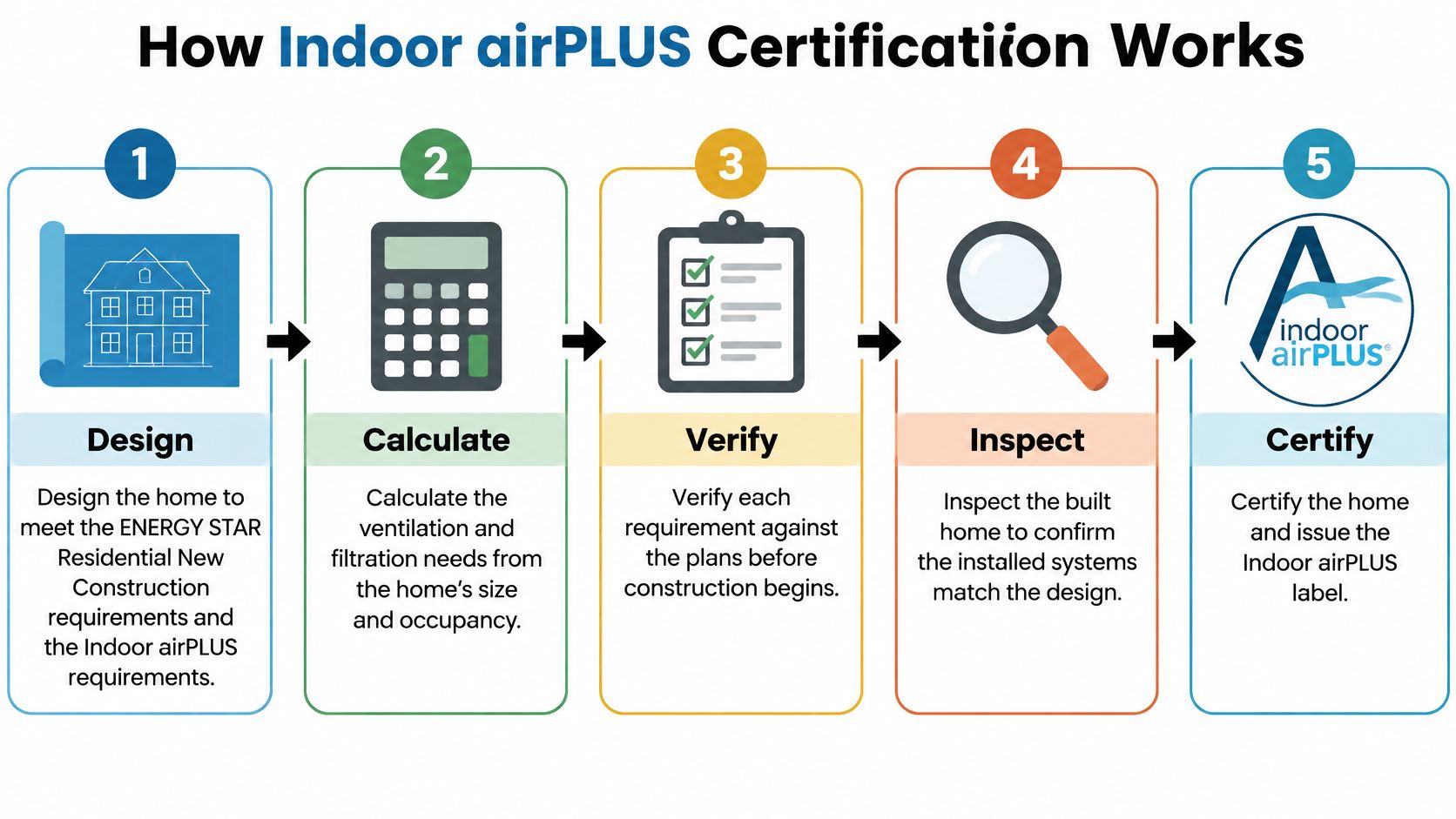
2. Calculate the loads, not the square footage. Heating and cooling design loads must be calculated for newly installed HVAC systems in dwelling units and common spaces, regardless of system type, according to EPA's guidance on building, verifying and reporting labeled homes. You can't justify equipment choice by floor area or by replacing what was there before. The load calculation becomes part of the technical record.
3. Build to the verification requirements. Source control, ventilation and filtration, item by item, in the sequence the checklist follows.
4. Get a qualified third party on site. Certification doesn't rest on a contractor's statement or a single air-quality measurement. A verifier must operate under Home Certification Organization oversight before the first inspection. In the earlier version of the program, that inspection could happen during the ENERGY STAR inspection, performed by a certified Home Energy Rater, Rating Field Inspector or an equivalent designation approved by a verification oversight organization such as RESNET.
5. Clear the quality control checklist. Any discrepancy above the allowable threshold gets corrected, and its root cause gets recorded.
6. Confirm code compliance. The home must satisfy applicable state and local building codes before the label issues.
Then there's the tier question. Gold homes must meet the Indoor airPLUS Gold requirements and the requirements for ENERGY STAR certification under either the Single-Family New Homes or the Multifamily New Construction program. Ordinary certification requires only the applicable Certified Verification Requirements. Same builder, same address, two different files.
A label earned at certificate of occupancy describes how a home was designed, built, inspected and verified. It is not a general claim that the air inside is clean.
That's the sentence to keep. If you own an existing home and someone offers you an "Indoor airPLUS equivalent" assessment, ask which verification requirements were met, who oversaw the verifier and when the inspection happened. An assessment can be really useful. It just isn't the label, and it shouldn't be sold as one.
Keeping Certified Air Healthy Between Reviews
What does a certificate tell you about the air today? It records that a building met defined requirements when it was assessed. Since buildings and their use change, ongoing checks and maintenance help keep conditions aligned with those requirements.
Indoor airPLUS Version 2 materials cover practical design and operation measures, including humidity monitoring, keeping air handlers and ducts within the thermal and pressure boundary, balanced ventilation, and a 300-cfm intermittent kitchen exhaust requirement for certain homes. The details appear in the EPA's Indoor airPLUS Version 2 webinar slides. Those measures explain what a building is expected to provide, but a label does not show whether filters are loaded or ventilation is working well today.
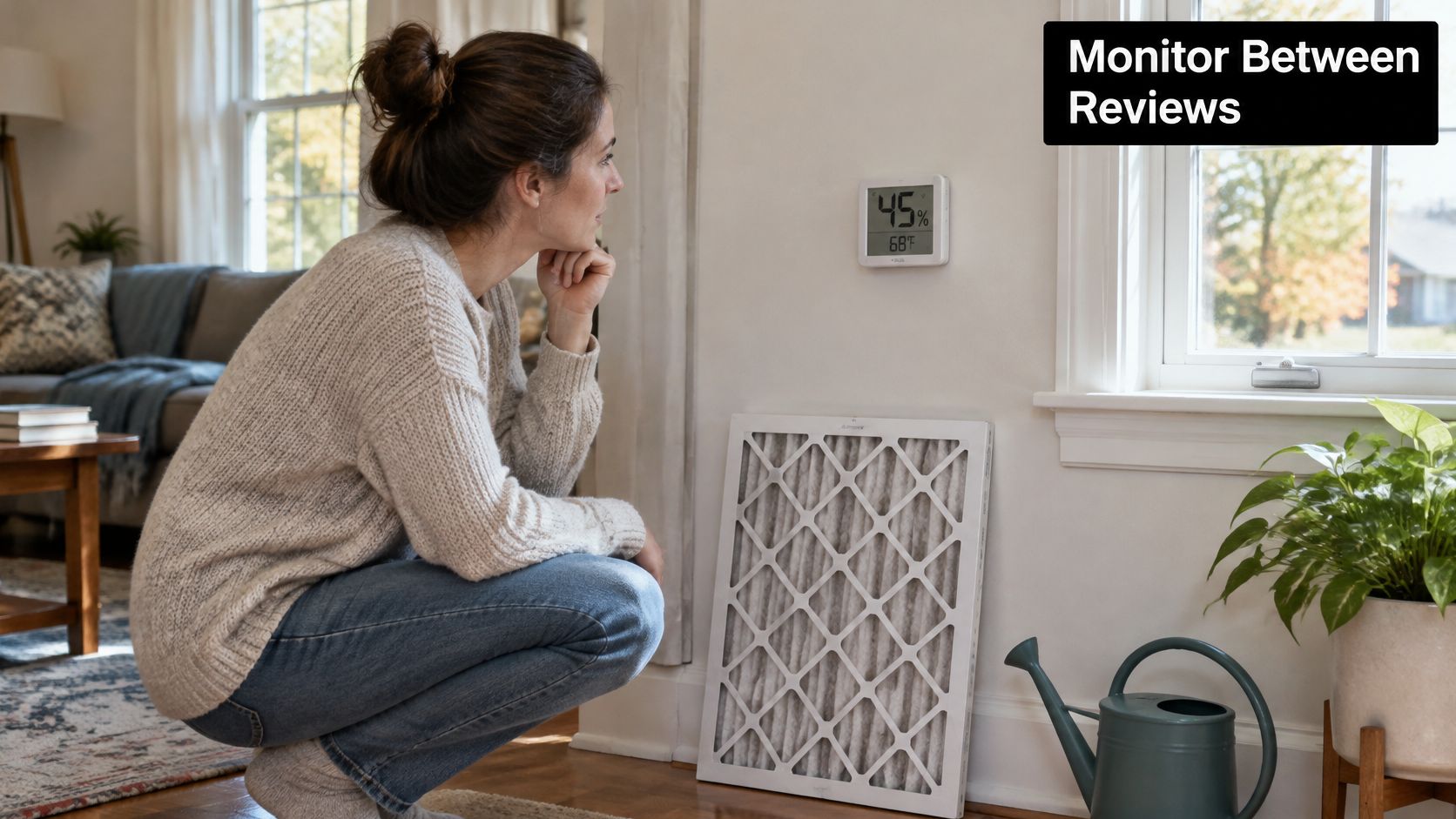
An indoor-air-quality management plan turns the label's requirements into a routine: identify what to monitor, who responds to a change, and what records to keep. A guide to an indoor air quality management plan can help clarify how monitoring, maintenance and corrective action fit together.
The triggers and the responses
Seasonal humidity shifts. Check sensor readings and review dehumidification settings. High summer humidity can raise mold risk even when particle readings look acceptable.
Wildfire smoke episodes. Review conditions promptly. Check filter loading, recirculation settings and whether outdoor-air intake was reduced during the event.
Renovation or new furnishings. Consider retesting with a validated method after work finishes. Coatings, adhesives and casework can contribute to a rise in volatile organic compounds.
Water intrusion. Inspect the affected assembly promptly. Moisture inside a building can create conditions for mold growth.
Occupancy change. Revisit ventilation calculations if a room's planned occupancy changes. Fourteen people in a room designed for eight create a ventilation concern, not just a cleaning task.
Filter or ventilation failure. Check the system promptly and update the maintenance record.
Sensor calibration drift. Compare the sensor with a reference and follow the manufacturer's replacement interval.
Screening and confirmation serve different purposes. Low-cost sensors can flag changes early, but they do not replace validated testing for every contaminant. For source control, practical steps to reduce household air pollutants naturally can complement monitoring without requiring a purchase.
Climate also affects conditions after certification. In a hot, dry market like metropolitan Phoenix, cooling operation, infiltration, dust and episodic outdoor pollution can shift indoor air quality. Review cooling-season readings separately from readings taken during a mild month.
Write the escalation path before a problem occurs. Record each reading, compare it with the applicable program threshold, notify the person responsible for the system, and arrange retesting if the average remains above the threshold for the required averaging period. Keep sensor logs, calibration dates, maintenance records and notes on corrective actions. Together, these records show whether the building continues to meet its operating expectations, rather than relying on a certificate as a promise about today's air.
Confirm the Evidence Before You Hire a Provider
What should you check before accepting an indoor air quality label or signing a service agreement? Start with the records behind the claim. A certificate is a document with a defined scope, not a promise that every room has clean air today.
Name the program and its scope. Does it cover a whole building, a home, an interior fit-out, a person, or a product? These are different kinds of documents. An engineering standard, a building label, a personal credential, and an equipment claim each require different evidence.
Match the property. In 2024, office, retail and leisure buildings accounted for 84% of indoor-air-quality certifications globally, based on Savills Research's analysis of WELL, RESET and Fitwel project directories. Those directories rarely describe a house. For housing, the relevant home track is Indoor airPLUS. In 2024, the EPA recognized 82 affordable housing units verified as earning that certification by Integral Building + Design, according to the agency's announcement.
Ask for four details in writing: the pollutant measured, its threshold, the averaging period, and the instrument grade. These identify what the result represents. If the provider cannot name them, the claim is difficult to verify.
Ask for the timeline, not only the result. Request the baseline period, later trend data, calibration dates, and any corrective-action record. Three consecutive months of retained data show a pattern; a single visit shows conditions at one point in time.
Check the verifier, not only the logo. Ask which oversight body the verifier works under and what credential they hold. A recognizable label is not a substitute for knowing who reviewed the evidence.
Ask how the work gets chosen. A needs assessment should come before a proposal. Purified Air Duct Cleaning has over 20 years of experience in indoor air quality, HVAC, and duct cleaning. For air purification systems, it assesses each customer's needs, recommends a suitable system for the home, and provides regular maintenance for systems it installs. That sequence is a useful test: a provider should ask about the building before recommending equipment.
Separate maintenance from certification. Ducts are generally recommended to be cleaned every 3 to 5 years, depending on ductwork age and condition, the heating and cooling system, and allergies or respiratory problems in the home. This is a maintenance guideline, not a way to renew a label or replace the program's retest requirements. Readers comparing local services can compare Birmingham cleaning companies, but evaluate any indoor air quality provider by the work and evidence it offers.
Write the terms down before signing: the program, its scope, the evidence you will receive, and the retest date. If a provider makes a claim, ask which document or measurement supports it. A qualified indoor air quality expert should be able to explain the credential and oversight behind a claim, not rely on a brochure alone.
Purified Air Duct Cleaning serves residential and commercial customers across Avondale and the Phoenix metropolitan area, with air duct cleaning, HVAC coil cleaning, dryer vent cleaning, and NASA-certified ActivePure air purification systems. It assesses each customer's needs before recommending a system, then installs and maintains the selected equipment. Contact the business for a free quote and ask what evidence is appropriate for your property.